Login

These Snakes Escape Danger by Spinning Like Wheels
 Some snakes cartwheel away from danger at remarkable speeds.
 Some snakes cartwheel away from danger at remarkable speeds.

The written word is one of humanity's most important information technologies. Without it, mathematical and scientific discoveries would be lost to history. But it can also lock ideas in place long after they've stopped making sense.
So does writing speed up cultural change or slow it down?
Russell Gray, a professor in the Department of Linguistic and Cultural Evolution at the Max Planck Institute for Evolutionary Anthropology in Germany, heads a research project investigating how writing affects the way languages change. His team uses methods borrowed from evolutionary biology to trace languages through family trees — similar to the way biologists trace species.
Language is one element of culture that researchers can measure to determine whether writing speeds up or slows down cultural change.
"The obvious answer," Gray said, is that writing slows culture down because writing "is all codified and specified and people get trained in it." Gray doesn’t think the obvious answer is necessarily the right one. But other researchers agree that writing can lock in ways of thinking.
"Writing can lead to what learning psychologists sometimes call 'canalization,'" Charles Perreault, an associate professor in the School of Human Evolution and Social Change at Arizona State University, told Live Science in an email. "It can narrow the range of ways people think about a problem. When a rule, method, or story is written down, people may come to see it as the correct version … and may not even consider that a better or different way could exist."
Religious texts and legal codes are good examples. In both cases, the interpretation of rules written hundreds — or even thousands — of years ago shapes the way things are done, long after the circumstances that produced them have changed.
This idea shows up in artistic expression, too: A 2017 analysis by ethnomusicologist Patrick Savage looked at more than 4,000 British-American ballads from the 16th through 20th centuries and found that written melodies changed less than those shared through oral tradition.
But there are also ways that writing may speed up cultural change.
"Before writing, much cultural knowledge had to be stored in people's brains," Perreault said. "That has obvious limits."
People forget things they don't study routinely, and when people die, their knowledge often dies with them. Because writing moves information storage beyond the human brain, it can reduce those losses, Perreault said.
"If writing prevents knowledge from being lost, and if it also helps information spread through a society, as with the printing press, then it could accelerate the ratchet effect of cumulative cultural evolution," Perreault said. "But this remains, to some extent, a hypothesis."
One reason the question of whether written language speeds or slows cultural evolution is that writing is hard to separate from everything that comes with it.
Writing has been separately invented only around four times in human history — although "some people argue there's a fifth in India," Gray said — which means nearly every writing system on Earth descends from that handful. Those systems spread through contact; trade, war, religion and the other ways humans intermingle had their own effects on cultural change that are hard to untangle from the effects of writing.
Also, "mass literacy is quite recent," Gray said. "If you've got these written varieties that are just used by, often, religious elites, that's potentially going to have much less impact."
So which force wins? Both experts think writing speeds up cultural change, though neither can prove it yet.
"I would say that writing probably speeds up cultural change overall," Perreault said. Gray agreed, though he acknowledged that most people would guess the opposite.
Still, Perreault cautioned, "these are empirical questions that have yet to be answered empirically."

 New experiments reveal a sophisticated posture-control system hidden inside living wood.
Chimpanzees are known to use rudimentary tools when foraging for food. According to a new paper in the journal Frontiers in Psychology, this learned behavior is passed down from adults to offspring through social learning. Specifically, adult chimps deliberately model the behavior, then turn their tools over to the youngsters so they can mimic the same motions.
"Receiving food and tools from experienced individuals, which we call food or tool transfer, may help chimpanzees learn to use technology to extract foods that are difficult to access,” said co-author Andreu Sánchez-Megías, a graduate student at the University of Barcelona and the Jane Goodall Institute Spain in Senegal. “Tool transfers thus appear to be a form of teaching, together with observation and supervised practice. It appears that mothers are the main models and teachers for young chimpanzees in this manner.”
As we have previously reported, tool use was once thought to be one of the defining features of humans, although Charles Darwin observed chimpanzees using stones to crack nuts in 1871. In 1960, the late primatologist Jane Goodall observed a chimp named David Greybeard bend a twig, strip off the leaves, and use it to spoon termites out of a nest and into his mouth. When he learned of the behavior, Goodall's mentor, Louis Leakey, famously observed, “Now we must redefine ‘tool,’ redefine ‘man,’ or accept chimpanzees as humans.” Since then, chimps have been observed making sponges out of leaves to soak up liquids, shaping sticks to collect algae, and sharpening rudimentary spears for hunting.
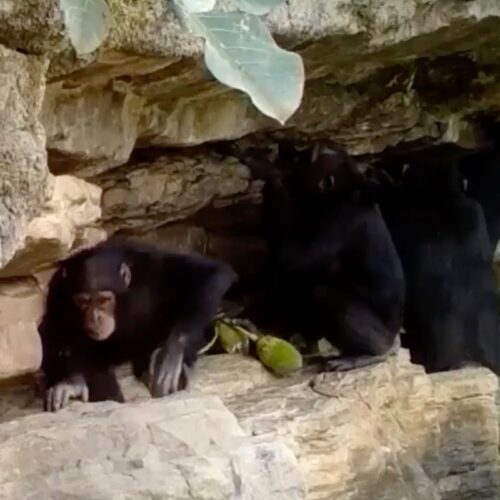
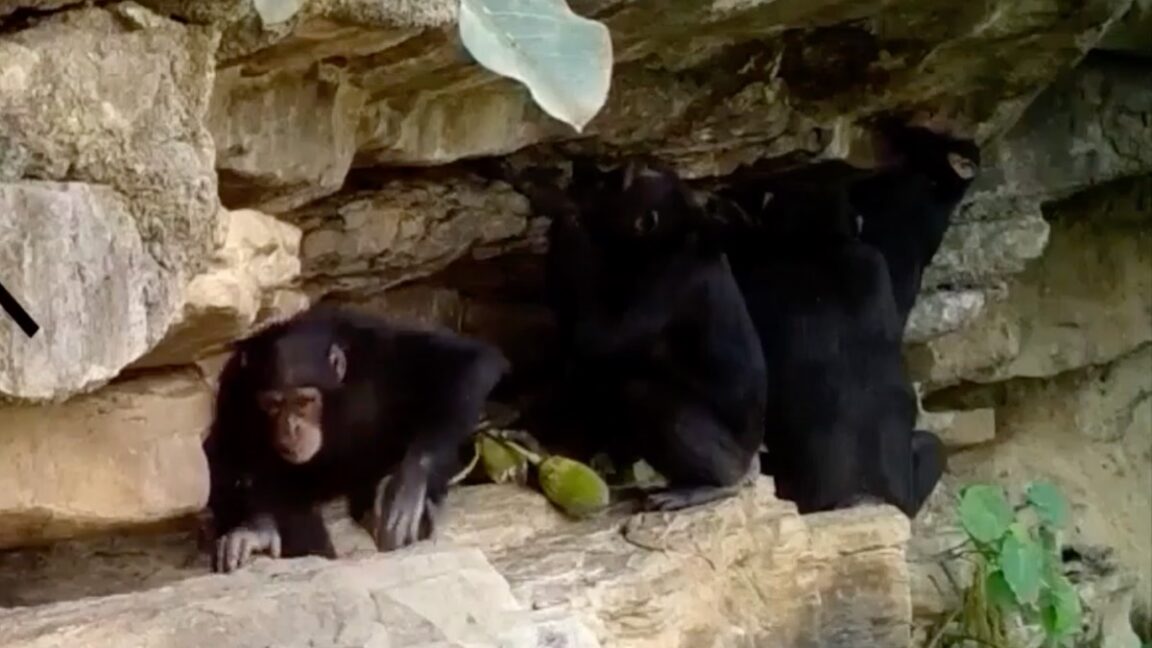
© Jane Goodall Institute Spain in Senegal
Chimpanzees are known to use rudimentary tools when foraging for food. According to a new paper in the journal Frontiers in Psychology, this learned behavior is passed down from adults to offspring through social learning. Specifically, adult chimps deliberately model the behavior, then turn their tools over to the youngsters so they can mimic the same motions.
"Receiving food and tools from experienced individuals, which we call food or tool transfer, may help chimpanzees learn to use technology to extract foods that are difficult to access,” said co-author Andreu Sánchez-Megías, a graduate student at the University of Barcelona and the Jane Goodall Institute Spain in Senegal. “Tool transfers thus appear to be a form of teaching, together with observation and supervised practice. It appears that mothers are the main models and teachers for young chimpanzees in this manner.”
As we have previously reported, tool use was once thought to be one of the defining features of humans, although Charles Darwin observed chimpanzees using stones to crack nuts in 1871. In 1960, the late primatologist Jane Goodall observed a chimp named David Greybeard bend a twig, strip off the leaves, and use it to spoon termites out of a nest and into his mouth. When he learned of the behavior, Goodall's mentor, Louis Leakey, famously observed, “Now we must redefine ‘tool,’ redefine ‘man,’ or accept chimpanzees as humans.” Since then, chimps have been observed making sponges out of leaves to soak up liquids, shaping sticks to collect algae, and sharpening rudimentary spears for hunting.
© Jane Goodall Institute Spain in Senegal

© Chona Kasinger for The New York Times

 Lipid droplets in the kidneys may help cats maintain a consistent chemical “scent identity.” Scent marks can linger long after an animal has moved on, allowing urine and other chemical signals to carry information across both distance and time. Yet the molecules responsible for odor do not remain unchanged. They evaporate, break down, and shift [...]

 GPS collars reveal hyenas retreating while male lions repeatedly close the distance.
In one of the most comprehensive investigations of its kind, researchers have taken a major step toward untangling the biology underlying suicide risk, moving the field beyond long-standing debates about whether suicidal behavior is simply a consequence of psychiatric illness. By integrating large-scale genetic data with cutting-edge approaches that map how genes act in specific brain cells and circuits, an international team has identified shared genetic liability that cuts across psychiatric diagnoses while also pinpointing druggable biological pathways that could one day inform prevention strategies. The study, published in Translational Psychiatry, offers a sweeping synthesis of how inherited risk factors may translate into molecular vulnerabilities, and it does so with a level of resolution that previous candidate-gene approaches could never achieve.
Suicide remains one of the leading causes of death worldwide, claiming more than 700,000 lives each year according to global health estimates. Despite decades of research, clinical prediction remains stubbornly imprecise, and biological models of suicidal behavior have historically been hampered by small sample sizes, inconsistent findings, and a tendency to conflate suicide risk with the psychiatric disorders with which it so often co-occurs. Major depression, bipolar disorder, schizophrenia, and substance use disorders all carry elevated suicide risk, yet most people with these conditions never attempt suicide, while some individuals who die by suicide have no diagnosed psychiatric illness at all. This paradox has long suggested to researchers that suicidal behavior may possess partially distinct biological underpinnings, and the new study set out to test that hypothesis with unprecedented statistical power.
At the heart of the work lies genome-wide association study methodology, or GWAS, which scans hundreds of thousands to millions of genetic variants spread across the entire genome in very large groups of people, comparing individuals who have experienced suicidal thoughts or behaviors with those who have not. Each variant is tested for statistical association with the outcome, and the results can be combined into polygenic risk scores, numerical summaries of a person’s inherited liability based on the cumulative small effects of thousands of variants. Because no single common variant exerts a large effect, the field depends on aggregating data across massive biobanks and cohorts, a strategy that has only become feasible in the past decade as datasets containing hundreds of thousands of individuals became available.
The research team took particular care to address a central confound: psychiatric disorders themselves are highly heritable, and any genetic signal linked to suicide could simply reflect inherited liability to depression or schizophrenia rather than to suicide specifically. To disentangle this, the investigators applied sophisticated statistical techniques, including genetic correlation analysis and conditional modeling, which allow researchers to ask how much genetic overlap remains between suicidal behavior and psychiatric conditions after accounting for their shared heritability. Their findings revealed a complex architecture. Substantial genetic correlations confirmed that suicide risk shares a meaningful fraction of its inherited basis with major psychiatric disorders, supporting the idea of a common pool of genetic liability. Yet the analyses also uncovered signals that persisted beyond what could be explained by those disorders, pointing to biological mechanisms that may be more specific to the emergence of suicidal thoughts and actions.
A key conceptual innovation of the study is its framing of “shared genetic liability” as a bridge between diagnoses. Rather than treating suicide as an epiphenomenon of any single disorder, the researchers modeled it as a transdiagnostic phenomenon, one whose risk emerges partly from inherited vulnerabilities that cut across diagnostic categories. This perspective aligns with a growing movement in biological psychiatry that emphasizes symptom dimensions and mechanisms over traditional diagnostic boundaries. From this vantage point, the genetic variants that raise risk for depression, PTSD, and schizophrenia may do so partly because they converge on shared molecular pathways, and those same pathways may govern an individual’s threshold for suicidal crises regardless of which diagnosis they carry.
Identifying genetic variants, however, is only the first step. A GWAS signal typically points to a genomic region rather than a specific causal gene or mechanism, since many associated variants fall in non-coding stretches of DNA that regulate gene activity from a distance. To translate statistical associations into biological insight, the team deployed a battery of functional genomics approaches. Transcriptome-wide association studies, known as TWAS, integrate gene expression data to identify genes whose genetically predicted expression levels are linked to suicide risk. Tissue and cell-type enrichment analyses then ask whether the implicated genes are unusually active in particular organs or cell populations. The results converged strikingly on brain tissue, and more specifically on neuronal populations, providing support for the idea that inherited suicide risk is mediated largely through gene regulation within the central nervous system.
The study’s most clinically provocative findings concern druggable biology. Using databases that catalog the protein targets of approved and investigational medications, the researchers examined whether genes implicated in suicide risk were over-represented among known drug targets. The analysis identified several classes of candidate targets, including components of neurotransmitter signaling systems, ion channels, and intracellular signaling cascades that are already the focus of pharmacological development for other conditions. This “druggable genome” approach, which has gained traction in genetics research across many diseases, offers a pragmatic shortcut for translational science: rather than waiting decades for entirely new therapeutic classes to be invented, researchers can prioritize existing or in-development compounds whose molecular targets intersect with genetically implicated pathways.
Among the pathways receiving attention in the analysis were those involving glutamatergic and GABAergic neurotransmission, the primary excitatory and inhibitory systems of the brain, which have repeatedly surfaced in studies of mood disorders and stress response. The endocannabinoid system and inflammatory signaling pathways also appeared in the convergent analyses, consistent with a broader literature linking immune dysregulation and allostatic load to suicidal ideation. Importantly, the authors emphasize that these findings identify hypotheses rather than ready-made treatments. Genetic association with a drug target does not guarantee that modulating that target will reduce suicide risk, and any therapeutic application would require extensive preclinical validation and carefully designed clinical trials. Nevertheless, the work provides a principled, data-driven map for where to look, replacing decades of largely failed candidate-gene speculation with a genome-wide evidence base.
The methodological rigor underpinning the study deserves emphasis, because the genetics of suicidal behavior has a troubled history. Early candidate-gene studies, which typically examined a handful of variants in genes related to serotonin signaling, produced findings that largely failed to replicate and in some cases were later shown to reflect statistical artifacts, small samples, and publication bias. The field has since undergone a reckoning, and modern efforts adhere to far stricter standards: preregistered analyses, very large and ancestrally diverse cohorts, replication in independent samples, and conservative multiple-testing corrections that demand genome-wide significance thresholds on the order of five times ten to the negative eighth power. The new study reflects these lessons, applying sensitivity analyses to guard against confounding from psychiatric comorbidity and examining whether findings generalize across ancestral groups, an issue of considerable importance given that most genetic discovery to date has been conducted in populations of European ancestry.
The implications for clinical practice, while still distant, are worth considering. Polygenic risk scores for suicide-related outcomes currently explain only a small fraction of individual differences in risk, far too little to be used as stand-alone screening tools, and their predictive performance is degraded in populations not represented in the discovery data. Researchers in the field are careful to stress that genetic risk is not destiny: suicidal behavior arises from an intricate interplay of inherited vulnerability, mental illness, trauma, substance use, social isolation, access to lethal means, and the availability of support. What genetics offers is not a crystal ball but a window into mechanism, and mechanistic knowledge is the raw material from which better biomarkers, risk stratification tools, and ultimately targeted interventions are built. In the near term, the druggable pathway findings are most valuable as a guide for laboratory science, directing neurobiologists toward molecular systems whose manipulation might alter suicide-relevant phenotypes in animal models and cellular assays.
Looking forward, the study signals where the field must go next. Sample sizes for suicide-specific genetic analyses remain smaller than those for major psychiatric disorders, and expanding representation across ancestries is essential if the benefits of this research are to be shared equitably. Integrating genetic data with longitudinal measures of life stress, neural imaging, and digital phenotyping may eventually allow researchers to model how inherited liability interacts with environmental triggers across the lifespan. Functional experiments in induced pluripotent stem cell-derived neurons and brain organoids could test whether the implicated genes genuinely alter stress-response circuitry or resilience. And randomized trials in patients carrying high genetic liability, though ethically and logistically complex, represent the logical endpoint of the druggable-target approach.
What the study ultimately delivers is a reframe. Suicide risk, in this analysis, is not an amorphous clinical outcome but a measurable, partly heritable trait whose genetic architecture is now being resolved with the same tools that have transformed our understanding of heart disease, diabetes, and schizophrenia. By demonstrating that shared genetic liability links suicide risk across diagnostic boundaries and by mapping that liability onto specific, pharmacologically tractable biology, the researchers have converted a long-standing clinical puzzle into a concrete research agenda. The path from genetic correlation to effective prevention is long, and no genetic finding will soon replace the human work of crisis intervention, connection, and care. But for a problem that has defied biological explanation for generations, the identification of shared, druggable mechanisms represents a genuine and hard-won advance, one that may shape suicide research for years to come.
Article Title: From shared genetic liability to druggable biology in suicide risk
Article References: Yao, K., Zhuo, C., Chen, X., Li, C., Song, H., Zou, J., & Tian, H. (2026). From shared genetic liability to druggable biology in suicide risk. Translational Psychiatry. https://doi.org/10.1038/s41398-026-04428-1
Image Credits: AI Generated
DOI: 10.1038/s41398-026-04428-1
Keywords: suicide risk, genetic liability, genome-wide association study, polygenic risk score, druggable genome, transdiagnostic psychiatry, TWAS, brain gene expression, glutamatergic signaling, psychiatric genetics, Translational Psychiatry
 From fireflies to mammals, evolution may have tuned communication to the rhythm of neurons.
In Boé National Park, researchers have repeatedly encountered a small number of trees marked by gouged bark and piles of stones at their bases. These signs suggest that wild chimpanzees have returned to the same trees for years to throw rocks. According to a recent field account by University of Victoria researchers Robyn Nakano and Ammie Kalan, some of these sites have remained in use for over a decade.
This behavior, called accumulative stone throwing, has been observed in only four chimpanzee populations in West Africa. While rocks and trees are widespread in chimpanzee habitats, piling stones at specific trees is rare. Nakano, Kalan, and other researchers suggest this may be a cultural practice within certain groups rather than arising from environmental factors alone.
Video recordings collected through the Pan African Programme and analyzed in a 2016 Scientific Reports study led by Hjalmar Kühl show that mostly adult male chimpanzees throw rocks at particular trees and repeatedly return to the same trunks. During these events, the chimpanzees pant-hoot, a loud call used for long-distance communication, and sometimes perform buttress drumming by repeatedly striking the tree’s buttressed base with their hands and feet.
Pant-hooting and buttress drumming are typical features of displays put on by male chimpanzees. The fact that these behaviors occur alongside stone throwing suggests that accumulative stone throwing may have developed as a variation of these existing social displays.
Researchers suspect this behavior may be cultural rather than simply a response to environmental conditions because it occurs only in certain areas, even though appropriate rocks and trees are common throughout chimpanzees’ habitats. Within one population, only particular trees are used as throwing sites. Earlier studies have suggested that the behavior might function as a form of communication or could indicate places of symbolic significance within a community’s territory.
The behavior could also offer archaeologists a rare example of how repeated stone use and accumulation can create material traces that persist after the animals that made them have moved on.
Some primates use stones as tools, including populations that use rocks to open nuts for food. Accumulative stone throwing differs because the behavior occurs in a social context rather than during extractive foraging. The purpose of this behavior for the chimpanzees remains unclear.
Nakano and Kalan conducted their fieldwork from Béli, a village where the Dutch nonprofit Chimbo operates a solar-powered research compound with local partners. The team traveled 22 kilometers by bicycle and on foot into the savanna-woodland to establish a camp, working with field assistants Djei Baldé, Balu Séra, and master’s student Taylor Tippett from the Great Ape Behaviour Lab.
The Boé chimpanzees are not used to humans and tend to avoid them, making direct observation impossible. The team instead set up two video cameras at each known stone-throwing site and placed audio recorders nearby to monitor the area.
Each day began at 6:30 a.m. with visits to two to five sites to replace SD cards and batteries, check equipment, measure trees, and create 3D scans of rocks thrown at the trees for later analysis. The team also recorded chimpanzee nests, feeding traces, and vocalizations along the trails. Their camp was located beside the Fefine River, which continues flowing through the dry season and provides an important water source for wildlife.
The team found that most sites first identified by the Pan African Programme and revisited in 2017 remained active when Nakano and Kalan’s team returned in 2026. Chimpanzees have returned to these same trees to throw rocks for more than ten years.
The video and audio collected during this trip will allow the team to identify the age and sex of individual stone-throwers and observe how nearby chimpanzees respond to these events. This data could help the researchers determine the purpose of this behavior.
Chimpanzees’ habitat in Guinea-Bissau is becoming increasingly threatened by industrial mining. During fieldwork, the researchers discovered boreholes dug to explore bauxite, the ore used to produce aluminum. Although bauxite mining might help promote economic development, comparable operations in neighboring Guinea have caused habitat loss and pollution, with negative effects on both wildlife and local communities. The country’s political instability also presents challenges for environmental oversight.
Nakano and Kalan emphasize that losing these stone-throwing sites would be both a cultural and ecological loss, erasing a documented example of primate material culture.
Nakano and Kalan are still analyzing the footage from this field season, but the main question of why chimpanzees throw stones at these specific trees remains unanswered. Still, the evidence collected by the cameras and recorders could help determine whether the behavior functions as territorial signaling, long-distance communication, or something else entirely.
Austin Burgess is a writer and researcher with a background in sales, marketing, and data analytics. He holds an MBA, a Bachelor of Science in Business Administration, and a data analytics certification. His work focuses on breaking scientific developments, with an emphasis on emerging biology, cognitive neuroscience, and archaeological discoveries.