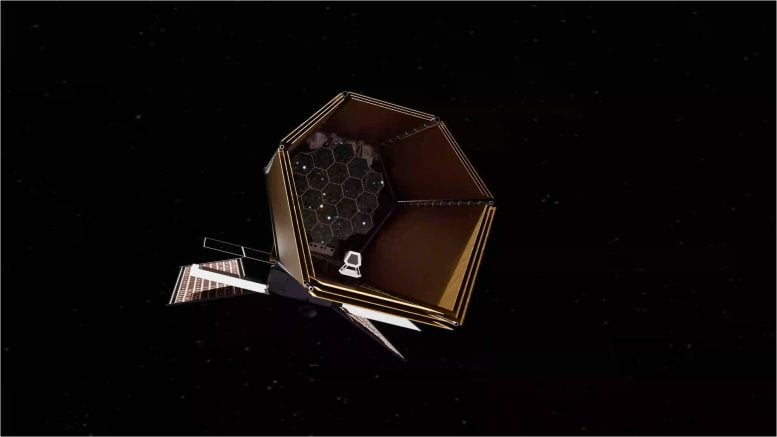
The NASA Exoplanet Exploration Program (ExEP) has a curated list of 164 nearest Sun-like stars that are easily visible from Earth. This list represents the first targets for a proposed large space telescope specially designed to find life in the universe, currently known as the Habitable Worlds Observatory (HWO).
After the HWO is completed, likely sometime in the 2040s, scientists will use the specialized telescope to directly image planets in those star systems. The telescope will search around Sun-like stars for planets in a region known as the habitable zone, where temperatures allow liquid water to exist. Scientists hope to find Earth-like planets with liquid water in the habitable zones of other stars.
While the 164 stars on ExEP’s list have qualities that make them good candidates for study, it remains unknown how many actually have terrestrial planets within their habitable zones. A team of scientists at Arizona State University used simulated data for ExEP’s 164 stars and their hypothetical planetary systems to assess which are most likely to have habitable worlds. Their results would help the HWO prioritize which star systems to observe.
The team started with a subset of 134 stars on ExEP’s list with no known exoplanets, giving researchers the freedom to simulate potential worlds around them. They used a software model called the DYNAmical Multi-planet Injection TEster (DYNAMITE) to predict the possibility that an unseen planet exists around each star by generating 100,000 simulated planetary systems around it. The simulations use mathematical formulas based on observations of real exoplanets to determine the sizes and orbital characteristics of hypothetical gas giants and rocky exoplanets. DYNAMITE then determines whether these planetary systems would be stable and include a terrestrial exoplanet in the star’s habitable zone.
The other 30 stars in the ExEP’s list have known exoplanets, but none of them are rocky planets in habitable zones. To predict whether these stars have unseen terrestrial planets in their habitable zones, the team used the same DYNAMITE process as before with the additional requirement that each star must have an exoplanet matching the one already found.
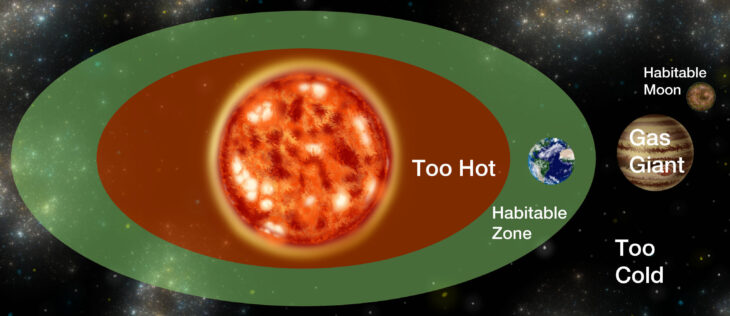
The space around a Sun-like star can be divided into three regions. The region closest to the star is too hot for liquid water to persist on an exoplanet’s surface, while the region farthest from the star is so cold that any water on an exoplanet would be frozen solid. Between these lies the habitable zone, where temperatures would allow liquid water to exist. However, it’s also possible that a combination of light and gravity could create habitable temperatures on large enough moons orbiting gas giants even beyond a star’s main habitable zone. Illustration by Andrew Bizal.
To increase the chances of finding a terrestrial planet in a habitable zone, the team also investigated potentially habitable moons orbiting gas giants in these systems. For each simulation that included a gas giant, the team inserted between 2 and 23 moons, with masses between 10% of Earth’s Moon and 50% of Earth. Then they simulated the surface temperatures of these moons based on how much starlight they receive and how strongly their host planet pulls on them. They deemed the moons potentially habitable if they were large enough to retain an atmosphere and had a temperature ideal for liquid water, even if they were not technically in their stars’ habitable zones.
For each star, the team calculated a metric based on the probabilities that the star had a terrestrial planet in its habitable zone, that the planet would remain in a stable habitable zone for at least 2 billion years, and that the star had a potentially habitable moon. They called this probability statistic a rankingmetric and used it to compare star systems.
Based on the ranking metric, the team found that the dimmer and cooler stars on their list generally had better chances of hosting a habitable-zone terrestrial planet than the brighter, hotter stars. They also found that stars without known exoplanets ranked more favorably. Around 70% of the stars with known exoplanets had less than a 1% probability of hosting a terrestrial planet in their respective habitable zones. Additionally, fewer than 0.1% of their simulated moons were habitable.
Overall, the researchers concluded that the HWO should prioritize observing cooler, Sun-like stars with no known exoplanets. They claimed that the exoplanets with known characteristics in their sample set were of sizes and in positions that made it unlikely for other exoplanets to be in their systems’ habitable zones. Even with expanded habitability criteria for moons, it would be very unlikely for HWO to find another Earth orbiting a gas-giant exoplanet. They ranked 47 stars in the highest-priority category (A Tier), 51 stars in the middle category (B Tier), and 66 stars in the lowest category (C Tier) to observe with HWO.
At the end of their study, the team remarked that the proposed HWO represents a potential next step in the search for other Earths, but scientists still need to identify the best targets for this future telescope. The HWO telescope should be able to image rocky exoplanets directly, so thorough research to prepare a list of high-priority targets will help avoid overlooking other Earths.
Since the 1976 Viking missions, when NASA first successfully placed uncrewed landers on Mars, scientists who study life in the universe, known as astrobiologists, have been gathering evidence to determine whether microorganisms ever lived on the red planet. It has been a challenging determination to make. Until a Mars sample return mission occurs, all necessary analyses must take place on Mars, using instruments designed as much to withstand the stresses of space travel as to collect data, which limits how thoroughly scientists can study Martian rocks. As a result, the search for evidence of microbial life on Mars is inherently incremental.
Recently, scientists added another piece of exciting, yet inconclusive, evidence to their search. In the summer of 2024, the Mars 2020 Perseverance Rover science team was searching for signs of ancient microbial life in a 3,700-million-year-old lake bed on Mars, known as Jezero Crater. In the process, they detected complex, carbon-containing organic molecules in mudstones within a river channel that once brought water to the now-dry lake bed.
Widely dispersed organic molecules associated with minerals that can support microbial life are exactly what astrobiologists would expect to see if microorganisms once lived in Jezero Crater. However, organic molecules can also form through geological processes, like when gases and minerals react at high temperatures and pressures at deep-sea vents on Earth. Therefore, astrobiologists must carefully assess organic molecules to determine their origin.
In July of 2026, more than 60 Perseverance science team members took a first step towards determining whether ancient microorganisms could have made the organic molecules found in Jezero Crater. They compared the organic molecule detections in Martian mudstones to similar detections of organic molecules in samples of known origin, including fossilized Earth life, meteorites, and minerals.
NASA scientists detected the organic molecules in Jezero Crater with a rover instrument called Scanning Habitable Environments with Raman and Luminescence for Organics and Chemicals (SHERLOC). SHERLOC uses a 248.6 nanometer (nm) wavelength laser to excite molecules in unknown materials. When molecules are excited, they absorb and scatter the laser light, causing characteristic shifts in the wavelength of the scattered light.
Instruments like this, known as Raman spectrometers, detect the shifted light and display the detections as lines called spectra, which scientists use to identify the unknown molecules. The Raman spectra from the 4 mudstones in Jezero crater showed shifts of about 1600 nm, which is characteristic of complex carbon molecules. These shifts appear as bands in the spectra that are often called G-bands.
Raman spectrometers are common laboratory instruments, but most use lasers with wavelengths of 485 nm or higher, so the spectra they produce can be slightly different from SHERLOC spectra even when the laser excites the same kind of molecule. To get around this issue, the scientists compared the Mars spectra with spectra of complex carbon molecules from fossilized Earth microorganisms, coal, graphite, meteorites, and synthetic samples collected by Raman instruments using the same wavelength laser that SHERLOC uses. They found that the spectra collected on Mars overlap with at least one example from every sample type except graphite.
These results don’t rule out the possibility that organic molecules in Jezero Crater were produced by ancient microbial life, but they can’t tell us exactly how they formed either. That determination will have to wait until the samples are brought to Earth so they can be studied with laboratory instruments.
The Perseverance team has made a small but critical contribution towards determining whether microbial life ever inhabited our closest planetary neighbor, Mars. Their efforts exemplify how the science of astrobiology and the search for possible extraterrestrial life slowly and carefully move forward. If we keep at it, humans may one day have a definitive answer to one of our most consequential questions: Are we alone?
Astronomers and astrobiologists use a wide range of tools in their search for extraterrestrial life. Probes, satellites, and rovers take photographs and collect data on the geology and chemistry of planets and moons in the solar system. Radio telescopes sweep the sky, looking for signals from intelligent civilizations. And telescopes like the JWST can observe the atmospheres of distant exoplanets, potentially finding ones similar to Earth’s.
A limitation of these methods is that they assume life on other worlds is fundamentally similar to life on Earth, requiring the same balance of molecules in the atmosphere, producing the same chemicals for their metabolic processes, or developing technologies analogous to those humans make. While researchers use these assumptions as baseline markers to look for, assuming such similarities might lead them astray. Scientists looking for life using too narrow a set of parameters might miss life unlike Earthlings. Or they might mistake coincidentally similar geological, chemical, or astronomical processes for having been made by living things.
So, to complement techniques that assume alien life resembles life on Earth, scientists also consider approaches that detect signs of life while making as few assumptions as possible about what it could look like, known as agnostic biosignatures. One of these life signs with few assumptions is complexity. Though it can be difficult to quantify precisely, living things tend to create more complex systems than nonliving things. A team of researchers recently tested whether living and nonliving worlds could be distinguished solely by examining the complexity of the light-reflection patterns from their surfaces.
For this, the team treated Earth and Mars, similar planets but one with life and one without, as stand-ins for exoplanets around other stars. They collected data on the light reflected off both planets’ surfaces from a space station monitoring Earth, known as the Deep Space Climate Observatory or DSCOVR, and an orbiter around Mars observing its atmosphere, known as the Hope Probe.
The team identified 3 nearly identical wavelengths of light that these machines observe from their respective planets. From the machine databases, they collected measurements of how much light each planet reflected, called its reflectance, at these 3 wavelengths over 486 local days. By using only individual wavelengths of light rather than full photographs, the team claimed that, if their test worked, researchers could apply it to distant exoplanets that cannot be photographed in detail.
Without looking for any particular chemical or signal, the team compared these measured reflectances using a series of statistical tests to determine the variation and randomness in their reflected light, which they considered representative of the complexity of the planets’ surfaces. The researchers found that of the 27 complexity metrics they tested, Earth scored higher than Mars on 25, Mars scored higher than Earth on 1, and the planets scored the same on 1. So, even though both planets have rocky surfaces with atmospheres, weather, and cyclical changes, the one with life is measurably more intricate and dynamic, and the researchers found this difference detectable even with a small stream of light at great distances.
The researchers claimed their test demonstrated that complexity could be a valid agnostic biosignature, with caveats. One is that Earth is quite distinct from Mars, in that it has oceans and a relatively thick atmosphere. This means that processes like making and dispersing clouds and the sharp contrast between land and water could add complexity to Earth’s measurements without direct ties to living things.
They suggested 2 possible explanations for how these complicating factors relate to life on Earth. Either life allows Earth to have these factors, or Earth is inherently complex regardless of life, and therefore it can’t be used to assess how life leads to measurable complexity. To say which is the case, one would have to replicate this test with a lifeless copy of Earth. However, the team argued that Earth’s biosphere is unlikely to be wholly unrelated to its water cycle.
To bolster the validity of their methods, the team plans to expand their sample of planets to include Venus, Saturn’s moon Titan, and simulated exoplanets with modeled biochemistry and atmospheres. If the model holds up, their methodology could represent a new category of mission to find alien life, with long searches for variations in reflected light uncovering properties of distant worlds that would otherwise go unnoticed.
Dr. Delia Santiago-Materese wants things to get complex
From terrestrial animals to experiments in microgravity and Martian clouds, this NASA program scientist’s career path links diverse challenges. Today, she supports a mission to Saturn’s moon Titan, a world teeming with organic molecules that could hold valuable clues about the origin of life.
When novelty is your hobby, you already have a large part of the recipe for a career full of challenges. That is why Dr. Delia Santiago-Materese describes her path within NASA as “meandering.” Her diverse roles have taken her to low Earth orbit, to the clouds of Mars, and to the surroundings of Jupiter. Now, they are also bringing her closer to the surface of Titan, an intriguing moon of Saturn. Woven together by her exploring spirit and a perennial curiosity, all these experiences have one point in common: life.
Today, Santiago-Materese is part of the Planetary Science Division at NASA Headquarters in Washington. The main decoration in her office is a model of Jupiter, larger than a basketball, resting next to a scale model of the spacecraft exploring it, Juno. Small black and red pins with the inscription “Dragonfly” rest in the center of a round table. Several framed diplomas cover a wall. From here, Santiago-Materese does “a little bit of everything” on any given workday as a program scientist for the Juno and Dragonfly missions, and for the Discovery program, which features a portfolio of several missions in our cosmic neighborhood.
This medley of roles is no coincidence. Santiago-Materese describes herself as someone who does not pursue a single goal, but rather diverse interests that she discovers along the way. “I am always looking for something new to add to my experiences,” she says, “because I think I also get bored easily.”
Santiago-Materese holds her model of Jupiter, just outside her office. As a program scientist for Juno—a mission studying this planet—for Dragonfly, and for the Discovery program, she guides these projects by promoting leadership based on kindness and respect: “Every person brings something unique.”
NASA/Noelia González
The daughter of a military family, Santiago-Materese was born in Spain by coincidence. Her roots are actually on another continent: her mother is Mexican-American and her father is Puerto Rican. From her time in Spain, she only keeps some baby photos; she lived part of her life in Texas and then in California, which she considers her home—despite having spent her childhood summers in San Sebastián, Puerto Rico. It was in the Golden State where she first imagined herself as a veterinarian and decided to study Biological Sciences. And it was during her studies at Stanford University, “just around the corner” from NASA’s Ames Research Center in California’s Silicon Valley, that Santiago-Materese discovered astrobiology.
This elective course brought her closer to a discipline that, to some extent, was in its infancy. Today, NASA’s Astrobiology Program investigates life in the universe on many levels: how it began, how it evolved here on Earth, and where it might exist elsewhere. And that was how Santiago-Materese realized that biology and space were not two isolated things, she recounts.
Rodents, Insects, and Martian Clouds
After finishing her studies, Santiago-Materese completed a one-year internship at the San Francisco Zoo. But the unknown that astrobiology presents continued to intrigue her, so she went back to one of her professors to inquire more about it. She asked around and found someone at Lockheed Martin, a company that often contracts with NASA on space projects. They were looking for people for a new project studying the nutrition of the food bars for rodents traveling to space aboard the space shuttle.
Santiago-Materese has applied that formula ever since: identifying what truly interests her and finding the right person to ask questions. If people “don’t know what you’re interested in, they can’t help you,” she explains. After experience with the Space Shuttle Program, including managing databases for science payloads aboard the space shuttle, she went on to work with the International Space Station, which was then beginning its legacy of over 25 years in Earth orbit. She supported the development of biological experiments in microgravity, this time with fruit flies. But Santiago-Materese wanted to keep moving farther from Earth and investigate future space destinations.
This curiosity led her to the Martian sky. As part of her graduate studies at the University of California, Santa Cruz, Santiago-Materese investigated the Martian atmosphere, focusing on ice in the clouds and the development of climate models for the Red Planet. She earned her master’s degree and would later return to complete her doctorate under the NASA Pathways program, which is one of the agency’s primary early-career hiring pathways. She would defend her thesis six months after giving birth to her first daughter (one of the achievements she is most proud of, she says). That is why, although she loves the “weird” planets of the outer solar system, she is “more of a Mars person,” by training.
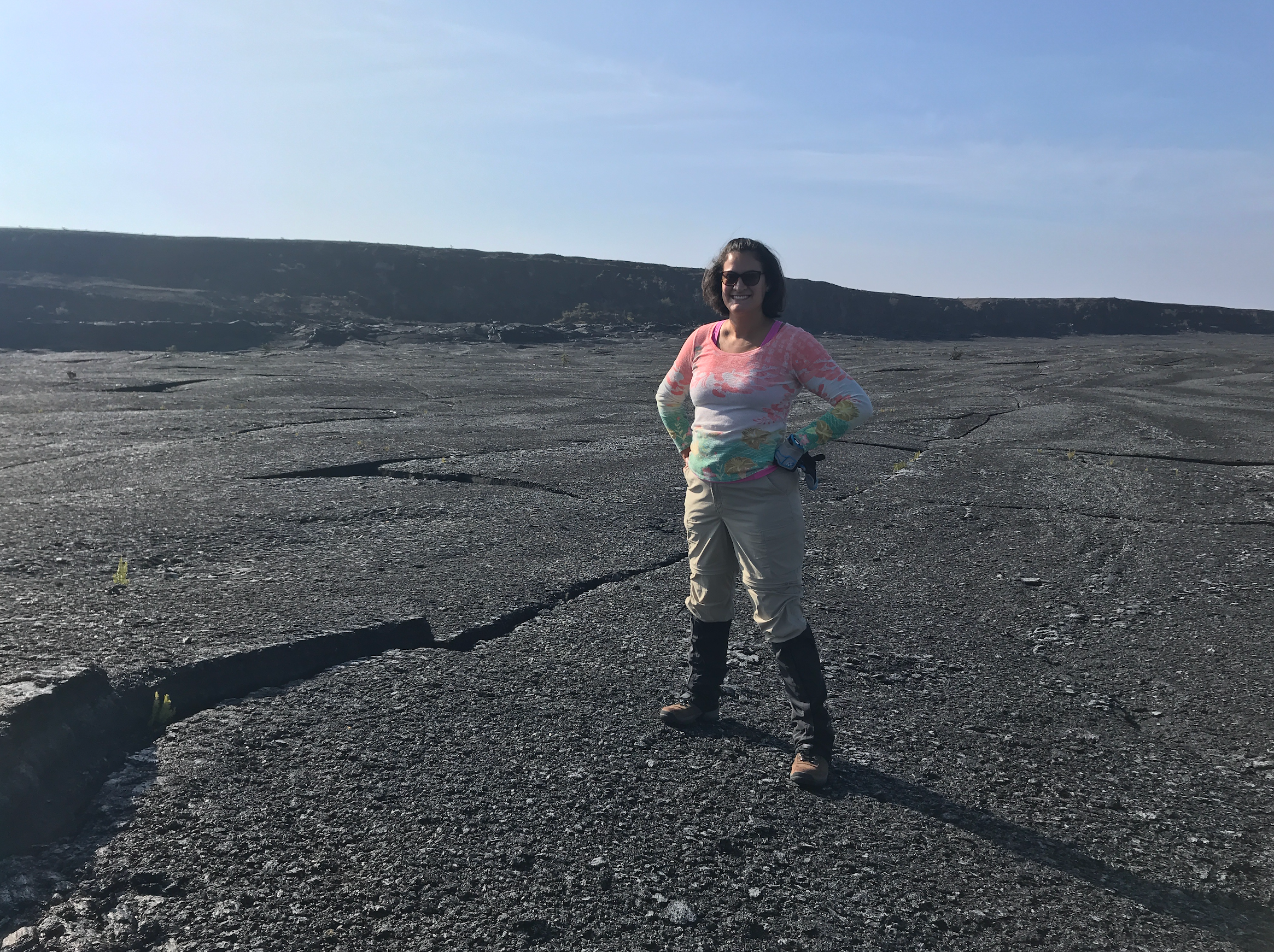
During her NASA career, Santiago-Materese traveled to Hawaii to investigate a planetary analog, a type of terrestrial environment that has very similar characteristics to those we might find on other worlds.
Image credit: Delia Santiago-Materese
At NASA Ames, Santiago-Materese held various roles, ranging from social media and open science to lunar sciences. She then became a program officer for the Solar System Workings program in the Planetary Science Division at NASA Headquarters as part of a detail, or temporary assignment. And then, she took off for Maryland along with her family.
Enabling Science
Santiago-Materese sums up her current role as a program scientist as the “science liaison” between NASA Headquarters and a mission. “When you do program scientist work, you might not be specialized or an expert in the exact science, but you need to be able to understand it and talk about it, to understand its importance,” she explains. “In general, we are supporting other people so they can do science.” In this endeavor, being someone who “gets more energy from working with people” is useful… and necessary: “You are having conversations all day long” with colleagues from different disciplines— from science and engineering to finance.
The Juno mission, in orbit around Jupiter since 2016, and Dragonfly, which is scheduled to launch no earlier than July 2028, are part of NASA’s New Frontiers program. Santiago-Materese also oversees the array of missions in the Discovery program, which includes ongoing science missions like Psyche and Lucy—heading to different asteroids—and future missions to Venus.
For Santiago-Materese, sharing her unconventional path can be valuable for students and youth in general, especially those who are unsure of what they want to do. “Your dream job,” she says, “you might not know it exists, or maybe it doesn’t exist today.” Beyond that, this zigzagging path has led her to accumulate experiences and relationships with different people, which she treasures even as she sets off for her next destination.
An Alien World
About two years out from Dragonfly’s launch, it is no surprise that this robotic mission takes up much of Santiago-Materese’s time. “Dragonfly feels like a combination of all my different experiences over time,” she reflects. And it signifies, to some extent, a return to her roots: it is an astrobiology mission. Although not designed to detect life, Dragonfly will investigate prebiotic chemistry: the chemical processes that could have led to the emergence of life on Earth.
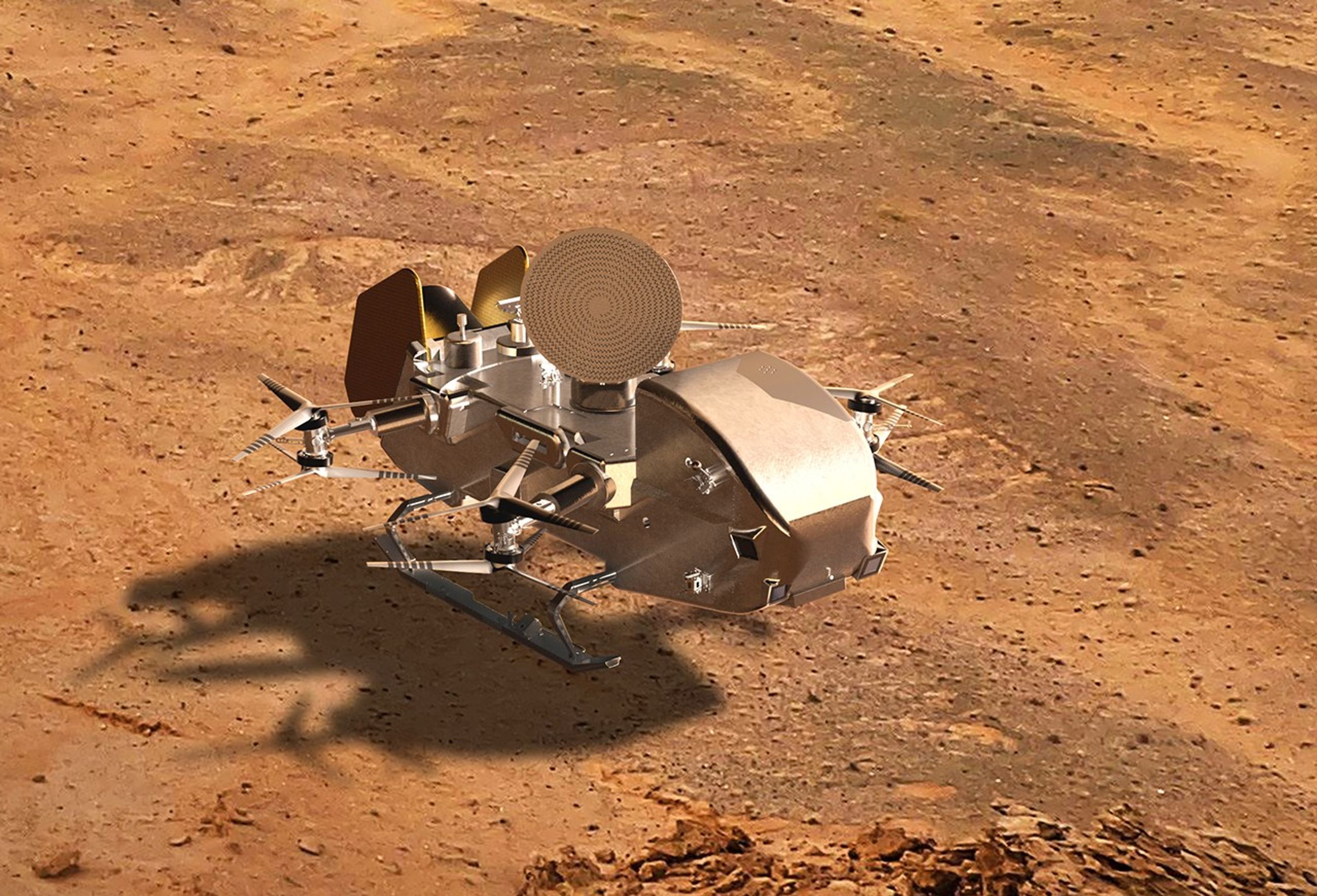
Digital concept of NASA’s Dragonfly lander on the surface of Saturn’s moon Titan.
NASA/Johns Hopkins APL/Steve Gribben
Dragonfly will embark on a journey of about six years to the surface of Titan. The spacecraft will carry an array of science instruments and will be the first NASA science mission to explore another world by flying from location to location. This car-sized rotorcraft will touch down at various geological sites of interest to analyze the moon’s composition and its habitability potential.
When it arrives at Titan, it will encounter a landscape that is strange and familiar at the same time: it could be a window into Earth’s remote past. This frozen world has a thick atmosphere and clouds drifting across the sky; dunes, lakes, rivers, canyons and mountains. Titan even has a process equivalent to our water cycle. However, on Titan, it is not water that flows but hydrocarbons, primarily methane and ethane. “It’s a more methane-based chemistry, so it is very alien, and that is what I really love about Titan,” says Santiago-Materese. And on this moon, organic molecules abound.
These molecules contain carbon and are used by all known forms of life. They are fundamental to understanding the origin of life, as they can be produced by both biological and non-biological processes. On Titan, these organic molecules fall to the surface and form dense deposits over its bedrock of water ice. Scientists believe that the complex chemistry precursor to life could be triggered there if provided with a little liquid water, such as that generated by an asteroid impact.
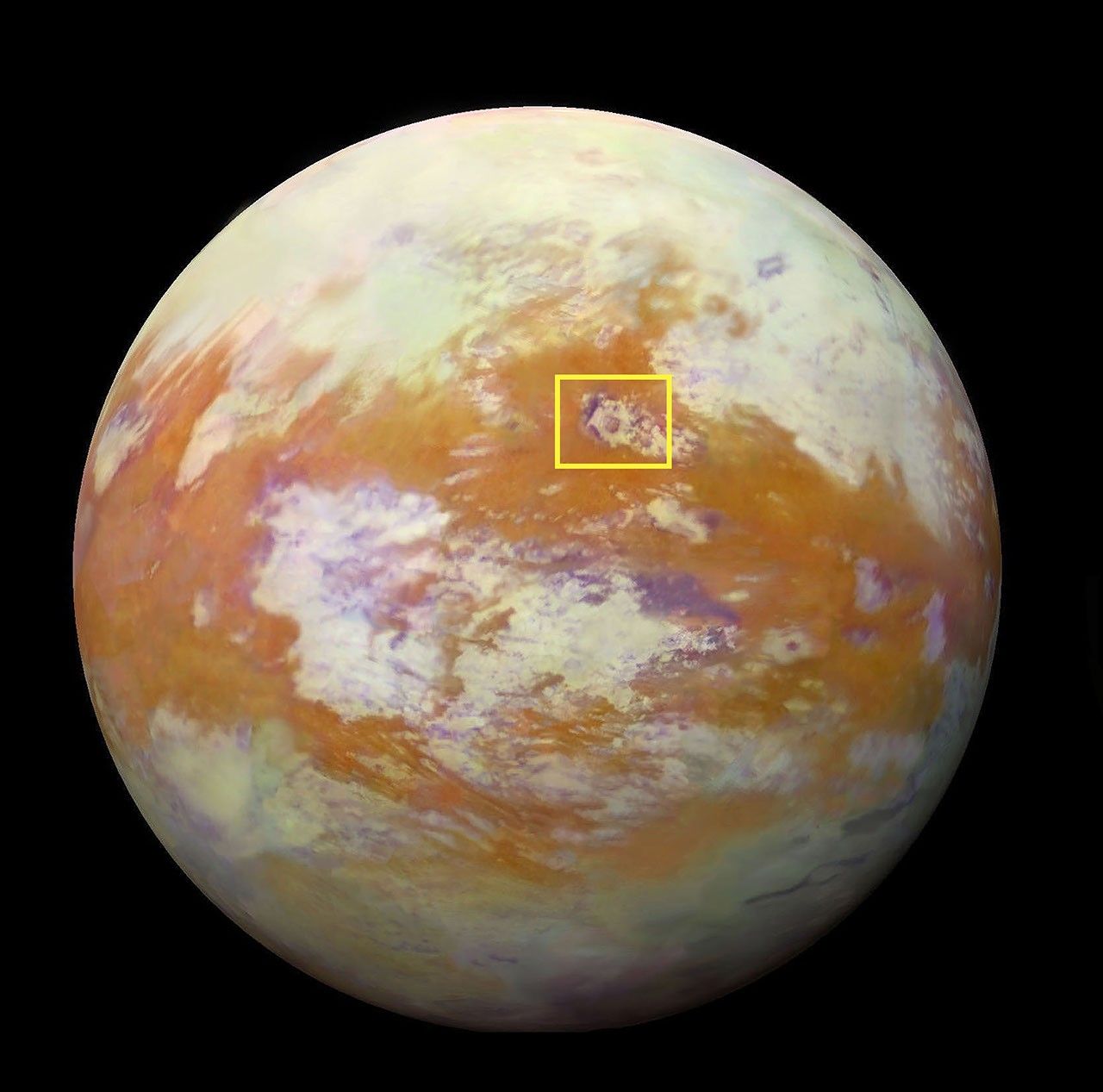
Selk Crater, an 80-kilometer (50-mile) diameter impact site highlighted in this infrared image of Titan, is a key destination for Dragonfly. The rotorcraft will touch down near Selk and explore various sites, analyzing the surface chemistry to investigate the frozen remains of what could have been prebiotic chemistry in development.
NASA/JPL-Caltech/University of Nantes/University of Arizona
Santiago-Materese is especially excited about what the Dragonfly Mass Spectrometer (DraMS) instrument will help discover. DraMS, designed and built at NASA’s Goddard Space Flight Center in Greenbelt, Maryland, will analyze samples from Titan’s surface. “The more complex things get, the more interesting things happen,” she says. “So I’m curious: just how complex do the molecules get? Will we find any interesting patterns?”
But in science, every time you ask a question, a new one arises. Dragonfly will try to answer several of them. “When you have a planet with complex chemistry but not life, what happens? What is there before life?” the program scientist wonders.
Titan, a valuable natural laboratory, “is going to completely change our understanding of what another world can be like,” she anticipates. In addition to what the scientific community expects to discover thanks to Dragonfly, Santiago-Materese is interested in the potential unexpected findings. “There are very defined science goals, but a lot of it is exploratory work,” she explains. “It is kind of nice to know that there is a big range [of possibilities], that we could be very surprised.”
By Noelia González, NASA’s Goddard Space Flight Center, Greenbelt, Maryland
A cubic meter of lunar soil might be one of our best bets for finding physical proof that another advanced civilization once existed somewhere in the Milky Way, according to a new paper to be published in the International Journal of Astrobiology.
A provocative new paper suggests consciousness may not be unique to Earth and could arise in alien life forms far stranger than we can imagine. A new philosophical paper argues that consciousness may not be exclusive to life as we know it. According to Eric Schwitzgebel, a distinguished professor of philosophy at the University of [...]
Researchers want to explore the idea that microscopic particles shed by alien civilizations have accumulated on the lunar surface, making it an archive of extraterrestrial technology.
One of the biggest challenges in the search for alien life is that Earth remains the only example of life we know. As a result, nearly every attempt to identify biology elsewhere starts, at least partly, by looking for chemistry that resembles life here.
Researchers at the University of Glasgow are exploring a different strategy. Rather than asking whether an alien molecule looks biological by Earth standards, they propose asking a more fundamental question: How difficult was that molecule to make?
In a new study published in the Proceedings of the National Academy of Sciences, researchers demonstrate a method that combines mass spectrometry with machine learning to estimate what researchers call “molecular assembly,” or MA.
The concept comes from Assembly Theory, which attempts to quantify molecular complexity by identifying the minimum number of construction steps needed to build a molecule. Researchers argue that when highly complex molecules appear repeatedly and in abundance, their existence may point to a process that is consistently steering chemistry down particular pathways.
That could make molecular assembly useful as an “agnostic” biosignature—one that does not depend on alien life sharing Earth’s chemistry.
“There is a growing interest in ‘agnostic’ life detection strategies: methods that can identify molecular signs of life without needing an exact understanding of what that life might look like, or how it might interact with a complex, poorly characterized environment,” the researchers write. “The measured assembly index, defined as the number of steps along the shortest construction pathway, is fixed for each molecule and does not depend on external conditions, such as the environment in which the molecule might be detected or the specific ‘alien’ biochemistry from which it might arise.”
The researchers’ proposed “agnostic” approach could become increasingly important as scientists encounter tantalizing, but often ambiguous, chemical signals in the search for alien life.
Methane on Mars, phosphine reported in Venus’s atmosphere, and dimethyl sulfide proposed as a possible biosignature within exoplanet atmospheres have all attracted attention because living organisms can produce those compounds.
However, biology is not the only way to make them. Methane, for example, can emerge from geologic processes. Dimethyl sulfide is strongly associated with life on Earth, yet it has also been detected in cometary material and produced in laboratory experiments simulating primordial chemistry.
The presence of a particular molecule, in other words, does not necessarily tell scientists what produced it. Molecular assembly approaches the problem from a different angle. Under Assembly Theory, researchers calculate the shortest possible pathway for constructing a molecule from simpler building blocks. A molecule with an MA of 40, for example, has a shortest construction pathway twice as long as one with an MA of 20.
The reasoning is rooted in probability. Undirected chemistry has an enormous range of possible molecular structures. As molecules become more complex, the odds of repeatedly producing the same highly elaborate structure shrink unless something constrains the process.
Biological systems store and use information to direct chemical reactions toward particular outcomes, permitting organisms to manufacture the same complicated molecules again and again instead of wandering randomly through the immense space of possible chemistry.
Previous experiments cited in the study found an approximate dividing line between abiotic and biological samples at an assembly index of around 15.
Perhaps more importantly, in the search for alien life, scientists would not necessarily need to know what a molecule is before recognizing that it is unusually complex.
That could be especially useful on worlds such as Mars, Europa, Enceladus, or Titan, where spacecraft may encounter compounds unlike anything commonly found on Earth.
Several proposed planetary missions use, or could use, mass spectrometers. These instruments analyze molecules by measuring ions’ mass-to-charge ratios.
More sophisticated multistage mass spectrometerscan repeatedly break molecules apart, giving indications of their structure and assembly history. But spacecraft operate under severe limits on power, mass, computing capacity, and instrument complexity. Many planetary missions, therefore, rely on simpler, single-stage mass spectrometry.
To close that gap, the researchers trained an XGBoost model on standardized mass spectra from the National Institute of Standards and Technology Chemistry WebBook. The model learned to estimate molecular assembly directly from single-stage spectra.
According to the study, it reduced relative mean squared error threefold compared with the best-performing baseline model, cutting the figure from 0.12 to 0.04.
The model also tended to underestimate molecules with especially high MA values. For a life-detection system, that bias could be preferable. It means the model was more likely to be conservative than to classify a molecule as an unusually strong biosignature mistakenly.
Researchers envision future spacecraft using this kind of analysis autonomously. A rover or lander that detects molecules with unusually high assembly scores might flag the surrounding area for closer inspection, prioritize certain samples, or identify material worth returning to Earth.
The study explicitly evaluated conditions designed to resemble instruments proposed for missions to Titan and Europa.
The same framework also raised another, more speculative possibility: when the researchers compared very large molecular databases, they identified several medical compounds with unusually high MA values. Their complexity was not the product of biology alone, but of deliberate human synthesis.
That led the team to suggest that particularly complex artificial molecules might serve as “molecular technosignatures”—chemical evidence oftechnology, rather than life itself.
For now, however, the method remains far from being a ready-to-fly alien-life detector. Instrument settings strongly affected performance. In simulated experiments, changing impact energies could nearly double prediction error, while one comparison increased it by more than 2.3 times. Molecules that break apart unusually easily can also cause the model to overestimate assembly, while molecules that resist fragmentation may be underestimated.
The researchers therefore describe the study as a proof of concept. Turning the approach into an effective tool for planetary investigation would require standardized databases, careful instrument calibration, and chromatographic separation to isolate individual molecules before analysis.
Future versions could also combine mass spectrometry with other techniques, including nuclear magnetic resonance or infrared spectroscopy. Infrared measurements, the researchers suggest, extend aspects of the approach to the remote study of exoplanet atmospheres.
Yet the wider goal is significant. Instead of deciding beforehand what alien biology should produce, scientists could search for evidence that a process has persistently directed chemistry toward highly specific, complex outcomes.
“In this work, we presented a proof-of-concept demonstrating the potential use of ML to predict the MA molecular complexity as a biosignature from in situ mass spectrometers during future space missions,” the researchers write. “Although the application of ML in life detection remains a nascent endeavor, it holds significant promise.”
Tim McMillan is a retired law enforcement executive, investigative reporter and co-founder of The Debrief. His writing typically focuses on defense, national security, the Intelligence Community and topics related to psychology. You can follow Tim on Twitter:@LtTimMcMillan. Tim can be reached by email: tim@thedebrief.org or through encrypted email:LtTimMcMillan@protonmail.com
For decades, astronomers have assumed that the Martian surface froze solid around 3 billion years ago and has stayed that way ever since. If this were really the case, any liquid water would have long since either been locked away underground or lost to space.
The economist John Maynard Keynes once remarked, “In the long run we are all dead.” From an astronomical standpoint, this is true for the Earth itself. In roughly 5 billion years, the Sun will exhaust the hydrogen at its core and enter the next phase of its life as a Red Giant, where it will swell up large enough to engulf and destroy the Earth.
Currently, the Sun is still in its main-sequence phase, where it fuses hydrogen into helium in its core. Although it remains relatively stable during this phase, it will gradually grow brighter with time. As the Sun shines brighter, the increased heat and radiation will raise Earth’s surface temperature, potentially pushing it past the threshold for life to survive.
One of Earth’s geological processes that helps regulate its surface temperature is the carbon cycle. Over millions of years, carbon moves from the Earth’s interior into the atmosphere as carbon dioxide or CO2, where it functions as a greenhouse gas that traps heat. Plants take in this CO2 through photosynthesis and move carbon through the biosphere.
Meanwhile, rain and rock weathering draw carbon into the oceans and rocks. By pulling CO2 out of the atmosphere, the carbon cycle could mitigate Earth’s warming as the Sun brightens over time. Today, human activities are increasing atmospheric CO2 and warming the planet. However, over billions of years, the carbon cycle could gradually remove enough CO2 from the atmosphere that eventually too little would remain to support photosynthesis.
With these challenges to life on Earth in mind, the researchers Jacob Haqq‐Misra and Eric Wolf investigated how long Earth’s biosphere could last in the distant future. The team used computer models to calculate the balance of energy that Earth would receive and emit over time, accounting for the effects of increasing sunlight and changing atmospheric CO2 concentrations. They followed this up with calculations using the ExoCAM model to determine the temperature and atmospheric conditions of future Earth across different latitudes. They related these conditions to a habitability metric to determine their impact on the biosphere.
To estimate the biosphere’s maximum possible lifespan, the team conducted 29 simulations representing the planet’s conditions over the next 2 billion years. In one set of simulations, the Earth’s carbon cycle contributed little to regulating surface temperature, with the atmosphere’s CO2 concentration fixed at approximately modern levels of 400 parts per million (ppm) and surface temperatures continuing to increase. In another, the carbon cycle worked to keep Earth’s average surface temperature fixed at the modern average of approximately 59℉ (15℃), no matter how much it had to reduce CO2 in the atmosphere.
In the scenario with a fixed CO2 concentration, the team found that in 1.7 billion years, Earth’s surface reached an average of 122°F (50°C), which is too hot for most land plants. After 1.9 billion years, it reached 149°F (65°), becoming too hot for all land plants to survive as temperatures continued to rise.
They also found that in the fixed average surface temperature scenario, atmospheric CO2 dropped below the 150 ppm level that most plants require for photosynthesis within 500 million years. After 1.4 billion years, CO2 levels fell below 10 ppm, leaving only a few land photosynthesizers and aquatic plants alive. After about 1.8 billion years, atmospheric CO2 dropped to 1 ppm, leaving only microbes capable of photosynthesis.
The researchers’ findings generally extend the estimated lifetime of Earth’s future biosphere compared with earlier, simpler models that suggested maximum lifespans of 100 million to 1.5 billion years. However, they clarified that other scientists should verify their results by running tests with other models, especially under extreme conditions of high incoming solar radiation and low atmospheric CO2.
Lastly, Haqq‐Misra and Wolf noted that their model did not account for major evolutionary changes that could help life adapt to future conditions. Over time, plants could evolve to tolerate higher temperatures or lower atmospheric CO2 levels. Future humans or another intelligent species might also engage in large-scale geoengineering projects to prevent the end of life on Earth. If life on Earth proves adaptable enough, the biosphere may endure until a Red Giant fills the daytime sky.
A £3 million investment could help secure a leading UK role in NASA’s future search for life on nearby planets. An Earth-like planet orbiting a nearby star would appear as little more than a dim point beside a light source 10 billion times brighter. British astronomers are preparing technology that could help NASA separate that [...]
We know Mars has water ice in its polar regions, but astronauts (and their solar-powered equipment!) would much rather experience life closer to Mars' equator. As NASA looks toward landing humans on the red planet, the Planetary Science Institute (PSI) is mapping where water should and shouldn't be found and using statistics to quantify its certainty. Two new papers, led by PSI's Hanna Sizemore and Samuel Courville, highlight new global maps of subsurface water ice and identify the missions and tools needed to increase the certainty of the maps.
Europa, one of Jupiter's icy moons, has long fascinated scientists because of what may lie beneath its frozen shell: a global ocean of liquid water. That hidden ocean has made Europa one of the most compelling places in the solar system to study the conditions that might support life. But new research led by Rutgers scientist Lujendra Ojha suggests one of the most promising shortcuts to Europa's ocean may be far more complicated than previously thought.
Researchers have detected a sugar in the interstellar medium for the first time. Sugars are central to life. They help form the structural backbone of DNA and RNA and participate in essential metabolic reactions. They are also thought to have been necessary for the formation of the earliest nucleic acids. Yet researchers studying life’s origins [...]
Scientists have painted the most detailed portrait yet of the planetary system orbiting Barnard's Star—the sun's closest neighbor after Alpha Centauri, just under six light-years from Earth.
The discovery of all five nucleobases on Ryugu strengthens the idea that life’s molecular ingredients formed in space before reaching Earth. A new study reports that samples from the asteroid Ryugu contain all five fundamental nucleobases, the molecular “letters” of life. Tiny asteroid grains can preserve chemical clues about the ingredients that may have helped [...]
University of California, Riverside’s Professor Eric Schwitzgebel and University of Lisbon postdoctoral researcher Jeremy Pober argue that consciousness is substrate flexible, meaning it can arise not just in the biological tissue we find on Earth, but potentially in radically different physical materials found elsewhere in the cosmos.
It’s a bit worrying when a scientific paper begins, “How long will life on Earth survive?” But in this case—a study by Jacob Haqq‐Misra of Blue Marble Space and Eric Wolf at the University of Colorado Boulder—the billion-plus-year timeline under consideration shouldn’t cause you too much existential panic.
The context for this question is that we understand the Sun will brighten as it eventually matures into a red giant that swallows the Earth in a solar furnace. So, where along that 5 billion-year path will life on Earth, in fact, be cooked?
Weathering and the weather
This isn’t just a question of incoming radiation. Among the thermostat-like stabilizing feedback loops in Earth’s climate, the cycling of CO2 through the solid Earth is a major factor over timescales this long. The weathering of silicate rocks at the surface converts atmospheric CO2 into carbonate that ends up on the seafloor, where it can be subducted into the mantle with tectonic plates. (And eventually, it can cycle back out to the atmosphere through volcanoes.)

 Login