
❌

Reading view

Non-reciprocal interactions keep particles in collective motion

Illustration of non-reciprocal interactions
Breaking action–reaction symmetry Non-reciprocal interactions occur when one particle influences another more strongly than it is influenced in return. This figure shows how unequal electrohydrodynamic attraction between differently sized particles generates non-reciprocal interactions and self-propelled particle pairs. (Courtesy: Yutaka Sumino, Tokyo University of Science, Japan)

Attractive interactions between particles do not necessarily lead to these particles aggregating. This is the new finding from researchers at the Tokyo University of Science in Japan who say this behaviour comes from non-reciprocal interactions amongst particles of different sizes that exert unequal forces on each other. These interactions could serve as a general design principle for creating active matter with a structure that continuously reorganizes rather than simply relaxing towards a static state.

Nature abounds with examples of active matter, with some well-known examples being flocks of birds, fish and insects, sheets of biological cells and swarms of bacteria. Researchers have been trying to copy this collective behaviour and make synthetic active materials – such as self-propelled colloids and dense phases of mechanically driven biopolymers – in the laboratory. Before such applications see the light of day, however, they need to first understand the fundamental physics of these systems.

In their new study, a team led by Yutaka Sumino and Kiwamu Yoshii of Tokyo University of Science’s department of applied physics, came across a system in which colloidal particles interact through electrohydrodynamic flow. “We found that mixing particles of two different sizes in such a system completely changed the collective behaviour of these particles,” explains Sumino. “Instead of forming increasingly large crystal-like aggregates, as is the case for particles with the same size, the system remained highly dynamic.”

The physicists’ experiment involved suspending polystyrene colloidal particles with radii of 1 and 1.5 µm in water and confining them between transparent indium tin oxide-coated electrodes. This set up allowed them track more than 10,000 particles and quantitatively analyse their dynamics for more than an hour, as opposed to just a few minutes in previous such studies.

Newton’s third law holds

When the researchers applied an alternating electric field to the system, they observed electrohydrodynamic flows around the particles, the strength of which increased strongly as the size of the particles became bigger. The electrohydrodynamic-mediated attractive interactions therefore became asymmetric, they explain, something that causes larger particles to attract smaller ones more strongly. This imbalance leads to non-reciprocal interactions, meaning that a larger particle pushes a smaller one, but a smaller one doesn’t push back.

While the effective interaction between the particles appears to break Newton’s third law, it doesn’t because there is no violation of momentum conservation, explains Sumino: momentum is transferred to the surrounding fluid through the induced flows and is ultimately dissipated through friction with the substrate.

The researchers also observed that particles of different sizes spontaneously pair together to form asymmetric structures with a distinct front and tail. These pairs behave as self-propelled units and move through the suspension – even though individual particles cannot propel themselves. As more self-propelled pairs form, they assemble into larger clusters, but these clusters do not continue growing into large aggregates and instead repeatedly fragment, rearrange themselves and reform. Importantly, they note: “the larger particle tends to be at the front of these moving pairs. This head-heavy size asymmetry, together with excluded-volume interactions, promotes the fragmentation of larger clusters and thereby prevents continuous coarsening”.

Sumino and Yoshii combined their experiments with numerical simulations, thereby identifying non-reciprocal pair motion as the microscopic origin of this behaviour.

The results, they say, suggest that non-reciprocal interactions can serve as a general design principle for creating active materials with structures that continuously reorganize rather than simply relaxing toward a static state. “An interesting aspect,” explains Sumino, “is that self-propulsion does not need to be built into each individual particle: it can emerge collectively from non-reciprocal interactions between particles that do not self-propel on their own.”

If such interactions can be controlled externally, they could provide a way to design microscopic systems that collectively gather, transport, fragment or mix materials, he tells Physics World. “Possible directions include programmable active materials and microrobotic systems, although these applications are still some way off.”

Reporting their findings in Physical Review Letters, the researchers say they would now like to understand how general this non-reciprocal mechanism is and whether the same principle – collective activity emerging from non-reciprocal interactions – can be transferred to other experimental systems. In the system studied in this work, the strength of the non-reciprocity depends on parameters such as particle size, composition and the applied electric field. By systematically tuning these parameters, they aim to explore what other types of collective states can be generated and whether transitions between them can be controlled.

“A more detailed hydrodynamic analysis of the system is also needed to develop a quantitative understanding of the interactions and ultimately predict the collective motion of the colloids,” says Sumino.

The post Non-reciprocal interactions keep particles in collective motion appeared first on Physics World.
  •  

Doubts cast on ‘superradiant neutrino laser’ proposal

Could radioactive atoms in a Bose–Einstein condensate (BEC) form a “superradiant neutrino laser”? According to a paper published last year by Benjamin Jones of the University of Manchester and  Joseph Formaggio of the Massachusetts Institute of Technology the answer is “yes”. We were intrigued by this proposal and commissioned the freelance physics writer Tim Wogan to write an article for us.

As part of his reporting, Wogan sought the opinion of a BEC expert – James Thompson of NIST, JILA and the University of Colorado in Boulder. Thompson told us that he was sceptical of the viability of such a device – in particular, he pointed out that the de Broglie wavelength of the emitted neutrinos is much too short for superradiance to occur.

Now, another physicist (Wolfgang Ketterle, who shared a Nobel prize for his pioneering work on BECs) has published two papers that cast doubt on Jones and Formaggio’s proposal. All three papers are published in a very prestigious journal, so this is a scientific debate of note.

So what is superradiance, and how could it be used to create a source of coherent neutrinos?

Coherent burst

Superradiance was originally envisioned in an ensemble of excited atoms, each of which can decay by emitting a photon. Normally, the rate at which photons are emitted from such an ensemble is simply proportional to the number of atoms present. Double the number of atoms, and the rate of emission will double. However, if the ensemble is dense enough that the wavelength of the emitted photons is much longer than the separation between neighbouring atoms, the emission of a single photon will involve all of the atoms. What is more, the superradiant emission rate is proportional to square of the number of atoms. The result is short, intense burst of coherent radiation. It is this coherence that has caused some to refer to superradiant lasers – although the physics of lasers is different.

Jones and Formaggio’s proposal involves radioactive atoms that decay with the emission of a neutrino, rather than a photon. Their idea is to cool an ensemble of these atoms to near absolute zero so that it forms a BEC. This is a unique form of matter that can be described as a macroscopic quantum state. Under this condition, the duo argued that neutrinos would be emitted rapidly from a superradiant state.

Now, Ketterle, Yu-Kun Lu and Hanzhen Lin at the Massachusetts Institute of Technology argue in two papers that such a superradiant neutrino laser is an impossibility. As well as backing up Thompson’s concerns about the short wavelength of the neutrinos, they point out that the atoms produced by the neutrino decays are fermions, and this precludes superradiance. They also showed that the recoil of atoms after neutrino emission would not allow the coherent emission of neutrinos to occur.

I think this is a fascinating subject and I hope that Jones and Formaggio can revive their proposal, because a BEC-based neutrino laser would be very cool!

You can read more about the debate in an article in Physics by Thompson and colleagues.


The post Doubts cast on ‘superradiant neutrino laser’ proposal appeared first on Physics World.

  •  

Porous material offers the benefits of graphene in 3D

My guest in this episode of the Physics World Weekly podcast is Marco Caffio, who is co-founder of iGii. The UK-based company has developed a porous 3D carbon nanomaterial called Gii, which it manufactures for a range of customers and applications.

Caffio describes Gii as a 3D version of graphene that delivers many of the useful electronic, structural and chemical properties of that 2D wonder material. Unlike graphene, which can be difficult to manufacture and integrate into devices, Caffio explains that Gii can be customized for use in practical technologies such as chemical sensors, batteries and heaters.

We also chat about the genesis of the company and Caffio offers career advice to physicists who are keen on working in the materials-technology sector.

The post Porous material offers the benefits of graphene in 3D appeared first on Physics World.

  •  

How far ahead can we predict the weather?

What will the weather be like tomorrow, or next week or, indeed, in a month’s time? Today’s numerical weather predictions can easily answer the first two parts of this question, but they fall short beyond about 14 days. New work on predictability limits by scientists at the University of Miami and the NOAA Cooperative Institute for Marine and Atmospheric Studies (CIMAS) say that this maximum could be extended to around 129 days – but probably no further. Whether this limit can be reached in practice, however, will depend on future improvements in forecasting technologies, they say.

Numerical weather prediction was developed in the late 1940s. Indeed, it was one of the first major applications of electronic computers. As these have advanced, so have the predictions. Indeed, thanks to ever more sophisticated mathematical models capable of analysing increasing amounts of observational data, we can now predict, for example, when hurricanes will occur as far as eight days in advance – something that was deemed impossible even a few decades ago. But how far ahead can such predictions be made?

Previous attempts to determine this predictability limit have largely relied on analysing the behaviour of very small perturbations in the atmosphere. These tiny errors, however, are inaccessible either observationally or via numerical modelling, explains Zoltan Toth of the NOAA who led this new study together with his colleague Wei Zhang. “These past studies therefore had to make some assumptions about the behaviour of the small errors, and these assumptions are necessarily somewhat arbitrary.”

Analysing the energetic balance of the atmosphere

The method developed by Toth, Zhang and their colleagues makes no reference to this error behaviour and instead goes back to analysing the energetic balance of the atmosphere, which continually absorbs solar radiation on the molecular level. In their approach, the researchers began by considering how our planet’s atmosphere would behave as a closed system, the deterministic dynamics of which preserves information about its initial state, assumed to be perfectly known. In theory, such a hypothesis would allow forecasts of the atmosphere’s behaviour right out to infinity. This is not possible in reality, they explain, because the atmosphere is obviously not a closed system: it receives and emits radiation. In the real atmosphere, the phases of photons in sunlight are completely random and cannot be determined, injecting quantum-scale uncertainty into the atmosphere.

These unknown quantum characteristics act as noise and destroy any retained information, beginning first of all on the smallest scales, explain the researchers. As these scales become bigger, noise eventually affects all parts of the system. When the total energy in the atmosphere is entirely replaced, the ability to make any prediction is completely lost.

“Using the relatively well-measured quantities of total energy in the atmosphere and the incoming and outgoing solar radiation fluxes at its upper boundary, we estimate that the range of skilful forecasts could potentially be extended from 14 days as at present to 129 (±7) days at the most,” explains Toth.

Very different from the mainstream discourse

“This result is very different from the mainstream discourse about atmospheric predictability, which to this day is strongly influenced by early publications in the field,” adds Toth. “More recently even, the authors of a 2018 article in the Bulletin of the American Meteorological Society speculated on whether current forecast systems are reaching their limits for when it comes to predicting tropical cyclones. In 2020, we argued that this limit is at least decades, if not much farther away.”

The theoretical foundation for the new methodology to determine the time limit of predictability is rather simple, he says. “At its core is a conceptual realization, which came to us intuitively. This is that the energy turnover time (that is, the time it takes for all energy in the atmosphere to be replaced by incoming solar radiation) is equivalent to the upper limit of predictability.”

While there is no complex mathematics involved, Toth notes that he and his colleagues had to find a way to describe the technique in a readily understandable way – something that was not easy, he admits, given the complexity of the subject.

Looking ahead, the researchers, who detail their present work in Advances in Atmospheric Sciences, are now looking into several other independent ways to estimate the limit of predictability. “There is no doubt, this limit has a theoretical feel to it,” Toth tells Physics World. “Yet there are a number of very practical implications for both traditional equation- and AI-based modelling of the atmosphere following on from the theory of predictability that we are also exploring in a series of ongoing studies.”

The post How far ahead can we predict the weather? appeared first on Physics World.

  •  

Skyrmion topology makes long-distance optical communications more robust

Researchers at the University of the Witwatersrand (Wits) in Johannesburg, South Africa, have succeeded in harnessing a relatively unexplored property of light – its topology – to robustly transfer information through the atmosphere. The work could advance the development of more reliable long-distance optical communications, including space-based ones, and connect remote and underserved communities worldwide.

Their work is detailed in two separate studies, one based on classical and the other on quantum optics. These studies show that the topological information can remain remarkably robust – even when the states of light carrying this information are subject to the severe distortions caused by atmospheric turbulence. Instead of relying entirely on increasingly sophisticated hardware or computational algorithms to correct atmospheric distortions before or after light transmission, the new concept provides a fundamentally different way of thinking about robust optical communication in complex environments, such as air or water, they say.

Both studies are based on the same fundamental idea: creating an optical topological structure known as a skyrmion in a light field and testing whether it remains robust when it passes through a distorting environment, explains Andrew Forbes, who is head of the Structured Light Lab at the Wits School of Physics. Skyrmions are quasiparticles with a two-dimensional, knot-like structure and were first observed in magnetic materials. They have, however, recently been seen in electromagnetic fields and the electric field of light waves. Here, the swirling structures are created by twisting the polarization or spin vectors of light in space so that every polarization is found exactly once, twice, three times and so on – the count being the skyrmion number. Skyrmions are topologically stable, which means that external perturbations do not affect them in any way.

Real-world test

In the first study, Forbes and colleagues used laser light with a wavelength of 532 nm shaped into various vectorial beams using a spatial light modulator and a modified Mach–Zehnder interferometer to generate optical skyrmions with skyrmion numbers of 1, 2 and 3. These numbers, which are always whole integers, describe how twisted the vortex-like structure of the skyrmion is. They then sent the laser light through a 270-m-long real-world free-space optical link located on Wits’ Braamfontein campus in the centre of Johannesburg.

The researchers measured the topology of the skyrmions with a Stokes polarimetry setup and found that the skyrmion number remains robust in a wide variety of atmospheric conditions, ranging from “calm, cool morning air to the highly erratic and intense distortions at midday” when it is hotter. “This result holds true even when the vectorial polarization of the underlying laser beam has been highly scrambled by atmospheric turbulence effects – and was therefore unrecognizable,” says Forbes.

In-built correlations

In the second work, the team created the topology through the in-built correlations between two photons entangled in their optical angular momentum (OAM). The OAM quantum states are not themselves stable in distorting environments and the information they encode is easily lost. The researchers investigated the robustness of a skyrmion with a skyrmion number of 1 in a controlled laboratory environment by studying photons in media with varying levels of turbulence.

The result? Despite local distortions, the skyrmions maintained topological numbers close to 1. This, they say, suggests the topological number is fundamentally decoupled from modal crosstalk induced by the turbulence and the spreading of an individual photon’s OAM.

Despite the very different physical systems, both experiments reveal a similar result, says Forbes: the conventional properties of optical fields can be strongly degraded by distortions, while the topological information encoded in those states remains remarkably robust. Together, the two works demonstrate that topology can be harnessed in both classical and quantum optical systems as a robust carrier of information in very different communication and information-processing scenarios.

Robust protection

Topology is a concept that appears throughout physics, from fundamental particle physics to magnetism and condensed matter systems. In many of these systems, explains Forbes, topology comes with a physical protection mechanism – such as an energy barrier – that explains why a topological structure is resistant to external disturbances. In optics, however, the situation is rather different. Optical topologies can be created and manipulated with relative ease, but their robustness is not necessarily guaranteed by any particular underlying physical protection mechanism. “We therefore wanted to address a fundamental question: how robust is optical topology when light encounters a real-world, highly distorting environment?

“The atmosphere provides a particularly interesting testbed because it is highly relevant to optical sensing and communications and represents an extreme case where the distortions vary rapidly both in space and time,” he tells Physics World. “Demonstrating robustness in this setting was therefore both a fundamental test of the dynamics and resilience of optical topologies and an indication of its potential practical value.”

Hurdles and challenges

One of the major challenges was simply doing precision optical experiments outdoors, he adds. “We had to contend with the unpredictability of nature: changes in sunlight and temperature, wind, rain and even the thermal expansion of buildings, which can affect optical alignment, making it difficult to maintain stable measurements over long periods.”

Another hurdle to overcome was to find a way of measuring the optical topology itself. Existing methods to do this can be quite sensitive to experimental noise and imperfections, so the researchers say they had to carefully distinguish genuine changes in the optical channel from apparent changes introduced by the measurement process. Ultimately, this meant developing new ways to both obtain and process the experimental data so that they could reliably track the topological properties of the light despite the noise that was present.

Applications include free-space optical, satellite and space communications, and linking remote or underserved communities, where atmospheric turbulence and the lack of physical infrastructure can present significant challenges, says Forbes. “More broadly, topology could be useful beyond communication,” he adds. “Indeed, its underlying robustness could potentially be exploited for optical sensing, information processing and other applications where light has to propagate through complex or noisy environments.”

The quantum experiment adds another possibility, he notes. “We know that entanglement decays in real-world conditions that are not pristine.  Our work shows that despite this, the quantum information stored in the topology remains intact.  This may allow us to distribute information across a quantum network in a more reliable and robust manner.”

Looking ahead, the Wits researchers say they will now assess whether the robustness they have observed extends to other kinds of challenging environments, such as underwater and biological tissue, where scattering, birefringence and other phenomena can be much more prevalent than in the atmosphere.

“We also want to develop detectors and techniques for measuring optical topology,” says Forbes. “Improving how we characterize these structures will be important for moving from proof-of-principle experiments towards practical applications.

“Finally, we would like to actually exploit the robustness of the topology we have identified in high-speed communication experiments. This means implementing realistic communication protocols and investigating how much information can be reliably transmitted using a ‘topological alphabet’.”

The post Skyrmion topology makes long-distance optical communications more robust appeared first on Physics World.

  •  

Bilayer approach ramps performance of all-perovskite triple-junction solar cells

Researchers at the Helmholtz-Zentrum Berlin (HZB) in Germany have overcome a long-standing barrier in next-generation photovoltaics by developing a new type of all-perovskite triple-junction solar cell. Perovskites are a class of synthetic materials with a unique crystal structure that excel at absorbing light, while a triple-junction design stacks three distinct perovskite sub-cells together, each tuned to capture a different part of the solar spectrum to maximize energy harvesting. With this combination, the device achieved a power conversion efficiency of 27.3%.

Stacking three such individual sub-cells allows multi-junction devices to bypass the theoretical efficiency ceiling of traditional single-junction solar cells. However, their real-world implementation has been severely constrained by optical and electrical losses at the buried interfaces of their narrow-band-gap sub-cells. By introducing a novel graphene oxide and self-assembled monolayer (SAM) bilayer strategy, the HZB team has effectively suppressed these losses, unlocking both high efficiency and unprecedented operational stability.

The challenge of buried interfaces

The main bottleneck in multi-junction all-perovskite architectures centres on the narrow-band-gap tin-lead bottom sub-cell, which captures near-infrared light. For years, the field has relied on an organic polymer called PEDOT:PSS as the hole-transport layer to extract positive charges from this sub-cell. However, PEDOT:PSS suffers from a high degree of parasitic light absorption, robbing the underlying bottom cell of valuable incoming photons. Furthermore, its highly acidic and hygroscopic nature chemically degrades the sensitive perovskite material, creating a critical compromise between efficiency and device lifespan.

This results in a severe material trade-off, whereby a layer intended to extract electric charge ends up blocking the very light needed to generate that charge, all while slowly destroying the underlying solar cell structure.

To move away from PEDOT:PSS, researchers have frequently looked to SAMs, molecularly engineered alternatives that perform exceptionally well in pure lead-based perovskites. Yet, when deposited directly onto tin-lead perovskite layers, SAMs present an unexpected physical anomaly, triggering severe internal electrical field screening and inducing uneven grain growth at the buried interface. Using fast-hysteresis measurements and bias-assisted charge extraction measurements, the HZB team discovered that standard carbazole-based SAMs lead to massive ion accumulation, which severely hinders the cell’s ability to separate and extract photogenerated charge carriers.

Unlocking charge flow with a molecular bilayer

Led by Steve Albrecht, the HZB team designed a synergistic bilayer to circumvent this destructive ion accumulation and field-screening mechanism. They deposited an ultrathin, uniform layer of hydrophilic graphene oxide directly onto the transparent indium tin oxide conductive base, before introducing a specialized SAM molecule, MeO-2PACz. The phosphonic acid head groups of the SAM anchor strongly onto the oxygen-containing functional groups of the graphene oxide via hydrogen and covalent bonding.

This chemical arrangement prompts a favourable molecular reorientation that deepens the layer’s electronic work function, markedly enhancing its electrical conductivity. Additionally, the graphene oxide provides a smooth, hydrophilic foundation that accelerates crystal nucleation, generating a uniform, high-quality perovskite film completely free of the microscopic empty spaces (nanovoids) that plague SAM-only devices in this study.

When integrated into single-junction tin-lead solar cells, the new bilayer achieved a standalone power conversion efficiency of 22.1%, heavily outpacing the 12.0% efficiency of SAM-only equivalents. Using optoelectronic characterization, the team confirmed that this massive improvement was driven almost entirely by the mitigation of internal electronic and ionic extraction losses.

Record stability and the path to 30%

The researchers demonstrated the true potential of this technique when they integrated the bilayer into a monolithic triple-junction stack featuring sub-cells with band gaps of 2.00, 1.60 and 1.25 eV. By replacing the conventional gold and PEDOT:PSS interconnecting layers with an optimized indium tin oxide and graphene oxide/SAM bilayer configuration, they minimized parasitic light absorption in the near-infrared spectrum. This structural optimization raised the short-circuit current density of the narrow-band-gap bottom cell to 10.3 mA/cm2, driving the overall triple-junction efficiency to 27.3%.

Beyond the efficiency milestone, the chemically benign and robust nature of the graphene oxide/SAM interface yielded exceptional longevity. While traditional PEDOT:PSS-based cells degrade rapidly due to chemical interactions, the encapsulated bilayer devices successfully retained 90% of their initial performance after 770 h of continuous operational tracking under 1-sun illumination at room temperature. This sets a new stability record for triple-junction all-perovskite configurations.

The team notes that the current triple-junction performance is still bound by slight current mismatches and series-resistance transport losses across the interconnecting sub-cell junctions. By further optimizing the quality of the wider-band-gap perovskite layers and fine-tuning the band alignments of the intermediate contacts, the researchers project that the efficiency of this multi-junction solar architecture can comfortably clear the 30% barrier in the near future.

The solar cell design is detailed in Joule.

The post Bilayer approach ramps performance of all-perovskite triple-junction solar cells appeared first on Physics World.

  •  

Universities should judge quantum-computing investments by what students learn

The best moment in my quantum-computing class often comes when something fails. A student writes a short quantum circuit – a program that tells qubits what operations to perform – then runs it on an ideal simulator and gets the clean answer theory predicts. Yet when the same circuit runs on real quantum hardware, unexpected results appear.

What once looked certain now becomes messy. The student may think the machine has failed but this is, in fact, when the real lesson begins. A run on a quantum processor is a physical experiment that produces a computational result.

Quantum education is expanding rapidly. A recent analysis of course catalogues from 1456 US institutions identified more than 8000 courses the titles or descriptions of w hich mentioned “quantum”. That growth is welcome, but it also carries a risk. Many students on such courses first meet quantum computing as a perfect cartoon: ideal qubits, flawless gates and clean probabilities.

Such idealization can be useful with computer simulators – ordinary software that imitates a quantum computer without real qubits. Simulators make excellent first classroom tools because they let students grasp three basic quantum ideas: superposition, where several outcomes remain possible before measurement; interference, where those possibilities strengthen or cancel one another; and entanglement, where two qubits become linked so measuring one helps predict the other.

Students should feel the shock of an imperfect result

Simulators also let students debug code and see the mathematics clearly. That matters in my classroom, because many students arrive with more confidence in Python than in quantum mechanics.

Useful as those abstractions are, they are not enough: students should learn not only the algorithm but also the machine that runs it. Real hardware exposes the gap between an ideal circuit and a physical device. A qubit is not a tiny coin showing heads and tails at once. It is a fragile physical system that gives different answers with varying probabilities when measured. Qubits lose information, gates make small mistakes, measurements misread states and nearby qubits can disturb one another.

The educational goal is to connect a quantum circuit to a real device – one in the lab, or one reached through the cloud. Yet that same circuit can behave differently after a recalibration, or after the device has “drifted”.

Students should see this as soon as possible. Teaching noise early shows students that quantum computing is an experimental science. If universities buy or rent quantum computers merely so that students can press “run”, they miss the best part of the lesson.

Intel inside

At Florida International University, this view shapes how I teach quantum computing. My students use Python, Qiskit, Jupyter notebooks, simulations and cloud quantum systems. My students have cloud access to an IonQ quantum computer that uses trapped-ion qubits, charged atoms confined by electromagnetic fields and manipulated with lasers. For now, our teaching uses cloud access to a quantum processing unit (QPU), raising a useful question: what does that access teach well, and what does it hide?

What cloud access teaches best is comparison. Students can run the same circuit on a simulator and a real QPU, then ask why the histograms – bar charts of measured output strings – differ. On platforms that expose device details, students can compare connectivity maps and calibration data such as coherence times, readout error rates and gate error rates.

Cloud systems, however, can still hide too much. A polished interface can make a QPU look like a web service rather than a delicate machine. Students may not see the lasers that control ions or atoms, the cryostat that cools a superconducting chip, the microwave electronics that drive gates, or the human work behind calibration, where engineers tune the machine to keep it reliable. Cloud access teaches students to submit and analyse circuits. Access to hardware, control settings and error data helps them understand how the processor operates.

On-campus systems matter when students can inspect what sits behind the screen. In 2024 Rensselaer Polytechnic Institute in New York became the first university campus to host an IBM Quantum System One, initially powered by a 127-qubit Eagle processor. It is a striking example of a university putting a major machine within students’ reach.

Yet the educational value of any system depends less on qubit count than on what students can inspect, control and measure. A modest, accessible teaching platform – such as a photonic testbed that uses light to process information, a cryogenic set-up for testing devices at extremely low temperatures or a control-electronics lab that shows how signals drive qubits – can often teach more than a larger system that students cannot inspect.

Universities then should judge quantum-computing investments by learning outcomes, not headlines. Can students compare simulation and hardware? Can they test how a quantum computer changes over time by running the same circuit in the morning, afternoon and again the next day? Can they keep a notebook of circuits that worked in simulation but failed on hardware? Can they explain why one qubit pair works better than another? Can they connect algorithms to measurement, control, optics, microwaves, cryogenics and error reduction?

The experience has an emotional dimension too: a beautiful circuit on the whiteboard can become a difficult experiment on the chip. Students need to ask, “What algorithm did I write, and what physical experiment did the machine actually run?”

Students should feel the shock of an imperfect result, the frustration of a circuit that should have worked and the satisfaction of tracking down the physical cause. That experience turns quantum computing from a diagram into a craft.

A university quantum computer should be a teaching instrument that reveals the machine behind the calculation. Its purpose is to train people who can question claims, understand the hardware, and build the technology with sound judgement. The field needs graduates who understand the algorithm, the machine and the gap between them.

The post Universities should judge quantum-computing investments by what students learn appeared first on Physics World.

  •  

Using AI to plan for climate variability in renewable energy systems

Using solar and wind power for clean energy generation relies on the weather, which can be unpredictable. In addition to seasonal changes and daily variability, energy planners must also account for rare and extreme weather events. Traditional planning methods often fail to capture these events accurately, resulting in systems that are either overly expensive or insufficiently reliable.

In this work, the researchers aimed to develop a more effective way of planning energy systems that can cope with real climate variability. They built an artificial intelligence model trained on 30 years of wind and solar data from Pingtan in China. The model generated thousands of realistic weather scenarios, including both typical conditions and extreme events.

The researchers then used these scenarios to determine the most cost-effective and reliable combination of energy technologies. Their Integrated Energy System included solar panels, wind turbines, batteries, hydrogen production and storage, and a connection to the national electricity grid. The optimal system configuration was identified by testing its performance across all of the AI-generated scenarios.

The optimisation showed that the most effective renewable energy system combines several technologies working together. Wind and solar provide the main source of electricity, batteries manage short-term fluctuations in supply and demand, hydrogen storage provides backup during extended periods of low renewable generation, and the grid acts as an additional safety net.

The key finding is that batteries and hydrogen have complementary roles: batteries are best for balancing daily variations, while hydrogen is better suited to storing energy over weeks or months. Together, they help create a renewable energy system that is both reliable and cost-effective.

Do you want to learn more about this topic?

Energy policy and public opinion: patterns, trends and future directions by Parrish Bergquist, David M Konisky and John Kotcher (2020)

The post Using AI to plan for climate variability in renewable energy systems appeared first on Physics World.

  •  

Real-number quantum theory can be more wrong than you thought

Imaginary numbers first appeared in the 16th century as a mathematical invention, introduced to solve equations that real numbers could not. As the name implies, many treated them as kind of trick to get results, rather than an underlying truth about the nature of reality. Although highly controversial at the time, these numbers are now ubiquitous in many fields of physics and mathematics.

One such field is quantum mechanics. Researchers routinely use complex numbers, which include both imaginary and real parts. For many simple quantum systems, you could think this is a mathematical convenience rather than a physical necessity. Predictions made with complex numbers can often be reproduced using only real numbers, albeit in a larger mathematical space.

The key question is: are complex numbers merely just a convenience, a trick, or are they necessary to understand complicated quantum systems? And if they are necessary, to what extent?

A team of researchers from France, Poland and Spain have been working on this problem and they’ve now come up with an answer. Their work relies on the composition postulate – a standard starting point for formulations of quantum mechanics which describes how quantum systems are combined mathematically.

They set out by studying a star-shaped quantum network. In this network, a number of outer parties (N) each receive one part of a quantum system, while a central party (Eve) receives the other parts from independent sources.

Each outer party chooses between several simple two-outcome measurements, while the central party performs one measurement with many possible outcomes.

Their strategy was to build a specially designed, conditional Bell test. The most well-known Bell test compares classical physics with quantum mechanics, with experiments demonstrating the latter is a better description of reality.  However, Bell tests can compare the correlations predicted by many other different theories.

The two theories studied here were standard quantum theory using complex numbers and a different formulation of the theory only using real numbers. While it was already shown that complex numbers are necessary, just how much the predictions of complex and real quantum theories differ is still an open question.

They found that the ratio between the predictions of the two theories increased proportional to N-1. So as the network gets larger, real-number quantum theory becomes increasingly bad at reproducing the results of standard complex-number quantum theory.

The work therefore gives a clear answer to the original question. Namely, in sufficiently large quantum networks, complex numbers provide an advantage that can become arbitrarily large. If the composition postulate is respected, they are physically required.

Read the full article

Gap between quantum theory based on real and complex numbers is arbitrarily large – IOPscience

S. Sarkar et al 2026 Rep. Prog. Phys. 89 070503

The post Real-number quantum theory can be more wrong than you thought appeared first on Physics World.

  •  

Optical vortices provide a natural way to create topologies

Structured light is light with a designed spatial pattern. It can be shaped into standard topological structures, such as a twist in its phase or a changing polarisation across the beam. These patterns are useful because they can encode information, probe small distances and create topological field structures.

However, the issue is that is that these carefully engineered patterns often spread or degrade as the beam travels. This is a problem for real-world applications, such as precision metrology and super-resolution sensing.

In a new work, a team of researchers from Singapore and Spain went down a different route. They identified a spin structure which is both a topological texture and topological defect that is not laboriously engineered but appears automatically at the dark core of an optical vortex because Maxwell’s equations require it.

An optical vortex is a dark core in a light beam where the electric field vanishes. Because the field is zero there, the phase cannot be defined. The researchers found that the light around this core has a tiny, ordered spin pattern.

The called this a meronic spin defect. A meron is a texture that covers half of a sphere of possible spin directions, while a defect is a point where the direction becomes undefined. Here, both features occur together: the spin vanishes at the centre but forms a half-sphere-like pattern around it.

Crucially, these defects do not spread out during propagation. The beam might diffract as usual, but the normalised spin and polarisation patterns remain confined on subwavelength scales. They are also more stable against turbulence than standard engineered structures, because they arise intrinsically from Maxwell’s equations rather than from carefully balanced beam components.

Although still a fundamental result, the finding suggests that vortex cores could provide unusually stable and compact building blocks for future structured-light technologies.

Read the full article

Non-spreading meronic spin defects around optical vortices – IOPscience

N. Mata-Cervera et al 2026 Rep. Prog. Phys. 89 077901

The post Optical vortices provide a natural way to create topologies appeared first on Physics World.

  •  

Cling film helps stamp two-dimensional materials onto patterned surfaces

Since the discovery of graphene over two decades ago now, two-dimensional (2D) materials have revolutionized almost all areas of science and technology thanks to their unique properties compared with bulk materials. These include high electronic conductivity, high mechanical strength, transparency and flexibility, to name just a few. The problem since the beginning, however, has been to produce sheets of these materials large enough for real-world applications and, importantly, to be able to transfer them onto other substrates without cracking the sheets. A team of researchers in Amsterdam, the Netherlands, has now succeeded in doing just this, with the help of an unexpected material – kitchen cling film. Their work could help in the continuing development of next-generation electronic and optoelectronic devices.

“The method we developed allows us to, for the first time, pick up, transfer and place large (roughly 1-mm-sized) 2D layers on almost arbitrarily patterned surfaces,” explains Jorik van de Groep of the 2D Nanophotonics group at the UvA-Institute of Physics, who led this research study. “Being able to do this is crucial since it enables the integration of 2D materials with structures like larger electronic devices and photonic coatings. Most importantly, the transfer is no longer probabilistic (as were most other methods) but has a near-unity yield.”

In the early days of 2D materials, researchers obtained micron-sized mono- or multi-layers of these structures by mechanically shaving off, or exfoliating, flakes from the bulk material using sticky tape. This was first famously done for graphene, a sheet of carbon just one atom thick. More recently, a technique known as gold-assisted exfoliation has allowed them to produce high-quality centimetre-sized layers of technologically important materials like transition-metal dichalcogenides (TMDCs) and transfer these onto flat glass surfaces.

For the field of nanophotonics in particular, explains van de Groep, we need to be able to transfer large-area 2D materials onto both flat and patterned substrates – such as those with electrical contacts and optical coatings on them, for example – if we are to fabricate functional devices. The problem is that existing transfer techniques are limited in this respect.

Kitchen cling film to the rescue

The Amsterdam team – which also includes researchers from UvA’s Van ‘t Hoff Institute for Molecular Sciences, ARCNL and AMOLF – has now developed a simple method that allows them to reliably transfer both large-area monolayers of TMDCs and hexagonal boron nitride/monolayer heterostructures onto patterned or non-patterned substrates, ranging from flat surfaces to high-aspect ratio and low adhesion patterned interfaces. In their process, which is detailed in ACS Nano, they used low-density polyethylene (LDPE), or kitchen cling film, an inexpensive and widely available polymer that has a low melting temperature.

In their work, the researchers transferred a gold-assisted-exfoliated large-area monolayer of the TMDC tungsten disulphide (WS2) from a silica (SiO2) substrate to another target SiO2 substrate. They began by fabricating a stamp made of a heat-resistant half-sphere covered by LDPE cling film. They then mounted the stamp on an xyz-micron precision stage and moved it slowly towards the WS2 monolayer, which was heated to 70 °C, at a speed of 0.5 µm/s until it contacted with the LPDE.

“We used force sensors in the stage to measure the forces involved during the stamping procedure, both in the plane of the 2D material (Fx and Fy) and perpendicular to it (Fz),” explains van de Groep. “This not only offers better control and repeatability of the transfer, it also provides crucial information on the contact and friction dynamics throughout the process.”

During initial contact with the substrate, the normal force (Fz) increases to 120 mN, at which point the researchers stop moving the stamp. Once it has contacted the monolayer, they heat the system to 140 °C. This induces a phase transition at which the LDPE melts, so allowing it to strongly adhere to the monolayer. They then cool the ensemble back down to 70 °C to solidify the LDPE. Finally, they pull off the monolayer from the LPDE with the stage moving at 0.5 µm/s and clean it to remove any polymer residue.

Material retains its good photoluminescence properties

To assess how the transfer process affects the monolayer, the researchers imaged it before and after the procedure. Before transfer, cracks covered 8% of the material. This figure increased to 14% after, with the cracks mainly generated at the edge of the stamp contact area. “As such, the procedure only modestly increases the cracked area fraction and largely preserves the monolayer topography,” says van de Groep. “More importantly, the material retains its good photoluminescence properties.”

The new work could help 2D materials scientists working in a variety of different fields to build larger and more complex devices. “Already, we are using it to develop atomically thin optical elements, optical modulators, single-photon emitters and other optoelectronic devices,” van de Groep tells Physics World. “Also, and more fundamentally, the method we have developed could allow for the fabrication of complex heterostructures of interest for quantum materials.”

The Amsterdam team is now busy optimizing its method further by, for example, building a humidity-controlled environmental enclosure around the stamping setup. “2D materials and the (van-der-Waals) adhesion between them strongly depends on the surface chemistry and, as such, on the relative humidity during the stamping procedure,” explains van de Groep. “We’re also working on additional methods to characterize the thickness of the materials in situ, that is, during the stamping process.”

The post Cling film helps stamp two-dimensional materials onto patterned surfaces appeared first on Physics World.

  •  

Missing decay at BESIII points to long-sought glueball

Physicists at China’s BESIII experiment in Beijing have found the strongest evidence yet for the existence of glueballs – subatomic particles made of gluons alone. The glueball-like particle is called X(2370) and it was first spotted at BESIII 15 years ago.

Gluons carry the strong nuclear force that binds quarks into protons and neutrons. Gluons also pull on each other as hard as they pull on quarks, which means they ought to be able to clump into particles called glueballs.

“So far, all ordinary matter that we know of is composed of quarks and leptons,” says Colin Morningstar of Carnegie Mellon University, whose 1990s supercomputer simulations helped predict what glueballs should look like. “A glueball is a totally new form of matter made up entirely of gluons – no quarks, no leptons,” explains US-based Morningstar, who is not a member of the BESIII team.

For four decades, detecting glueballs have been an important goal of BESIII and its predecessor – according to Shan Jin of China’s Nanjing University. BESIII is on the BEPCII accelerator, where electrons collide with positrons to create large numbers of J/ψ particles. A J/ψ can sometimes decay by shedding a flash of light and dumping the rest of its energy into gluons. The gluons could then bunch together to create a glueball.

Lightest glueball

In 2011, Yanping Huang was Jin’s PhD student and observed the production of the short-lived X(2370) particle at BESIII. “The most important next step was to determine its spin-parity quantum numbers, and it turned out to be one of the most difficult steps for us due to large background processes,” says Huang, now at China’s Institute of High Energy Physics in Beijing. Those numbers describe how a particle behaves when turned around and seen in a mirror – a kind of fingerprint. Only in 2024, with an exceptionally clean chain of decays and all 10 billion J/ψ particles, could the team read it, and it matched the prediction for the lightest glueball.

Now, Huang, Jin and the rest of the BESIII team have gone further and searched in vain for a specific X(2370) decay channel. They argue its absence suggests that X(2370) contains no quarks and the lightest glueball is its dominant constituent.

Quarks come in several types, or flavours, and a glueball contains none, so it cannot favour one flavour over another. That even-handedness forbids the X(2370) from breaking up into a particular pair of kaons, which are lightweight particles carrying a strange quark. BESIII looked for that break-up and found that the decay occurs at a rate that is at most 8% of the rate of a much more common X(2370) decay channel.

Huang explains that an ordinary quark-based particle should undergo the kaon-pair decay far more often. “The lightest glueball is essential for a natural and complete explanation of all these properties, while all other interpretations can hardly explain them simultaneously”.

Like a duck

Francesco Giacosa at Jan Kochanowski University in Poland is enthusiastic about the BESIII research, which he was not involved with. “We have an object, X(2370), that walks like a duck, quacks like a duck and, in addition, does not do something that the duck we are searching for should not do.”

Jin says that the BESIII result has important implications. “This is the direct proof of self-coupling among gluons predicted by QCD about 50 years ago,” where QCD is quantum chromodynamics, the theory of the strong force. It also illuminates the origin of mass, “since the gluon mass is zero and the glueball mass is totally from the strong interaction”. Glueballs, he says, are “a unique kind of matter made of pure force”.

Morningstar observes, “The results are the strongest evidence yet that particles dominated by a glueball component can exist in nature. This work is certainly an experimental triumph.”

Not everyone is ready to call the 50-year search over. “In my opinion, an independent experimental confirmation would be extremely important,” says Giacosa. A glueball can also blend with ordinary quark particles, he notes, so “even if X(2370) is predominantly a glueball, we do not know precisely how large its non-glueball component is”.

Upgrade needed

Gentler collisions elsewhere could shed further light on this, says Jin, “but it seems difficult for them to collect 10 billion J/ψ events to perform systematic studies as BESIII in a short time, unless we upgrade BEPCII itself again”.

That upgrade is on the collaboration’s wish list. Huang plans further measurements of the particle’s properties, which “will also certainly help us to identify more glueballs”. Reaching them may take ten times more data.

Morningstar also looks forward to further discoveries, “Our theoretical computations have suggested other glueballs that might exist, so with this successful study, I believe the search for other glueballs will intensify”.

Giacosa thinks the prize is worth it. “Glueballs are, in my view, among the most fascinating composite objects predicted within the Standard Model,” he says, meaning physicists’ theory of the fundamental particles and forces. “Establishing one experimentally would be much more than adding one more particle to the list – it would confirm one of the most remarkable predictions of the theory of the strong interaction.”

The results were presented in August at the International Conference on High Energy Physics and are described in a preprint on arXiv.

The post Missing decay at BESIII points to long-sought glueball appeared first on Physics World.

  •  

Researchers shrink double-slit experiment to atomic scale

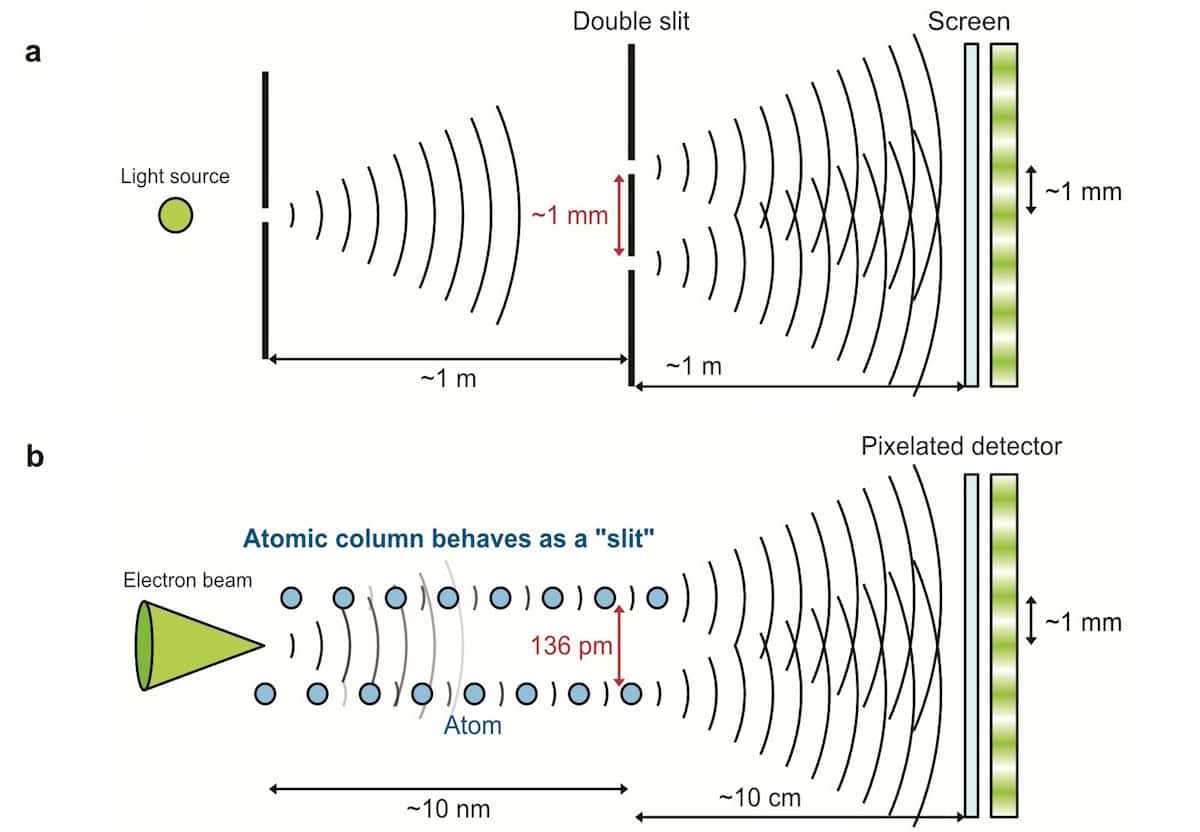
Shrinking Young’s double-slit experiment
Shrinking Young’s experiment (a) The classical double-slit experiment using light (slit spacing ~1 mm, propagation distance ~1 m). (b) Schematic of atomic-scale interference in which a pair of neighbouring silicon atomic columns act as a “double slit” for a focused electron probe (spacing 136 pm; crystal thickness ~10 nm; distance to detector ~10 cm). (Courtesy: Koudai Tabata/University of Tokyo)

For the first time, physicists in Japan have carried out an atomic-scale version of the double-slit experiment. Using an ultraprecise electron beam channelled along two adjacent columns of atoms in a crystal of silicon, Naoya Shibata and colleagues at the University of Tokyo observed clear interference fringes in electrons scattered by the atoms: fringes that persisted even at high temperature, thanks to correlations in the atoms’ thermal vibrations.

The double-slit experiment is perhaps the most iconic demonstration in quantum mechanics: showing how a single particle’s wavefunction interferes with itself as it passes through two slits at once, with a tangible impact on where the particle is ultimately observed.

In practical research, this effect is now routinely harnessed in electron, neutron and atom interferometers. By observing the interference fringes that it creates, researchers can extract valuable information about both the quantum matter wave and whatever object is doing the diffracting.

Recently, physicists have attempted to push double-slit interferometry all the way down to the atomic scale, replacing conventional slits with crystal lattices. When a moving electron encounters an atom in a crystal, it scatters across a range of angles – producing an outgoing spherical wave that’s mathematically identical to the diffraction pattern from a classical slit.

Since atoms in a crystal sit at such well-defined separations, any neighbouring pair of them could, in principle, act as a double-slit interferometer. In reality, however, the many repeated unit cells in a crystal mean the resulting interference fringes are washed out, making it difficult to isolate the signal from a single atomic pair.

To address this challenge, Shibata’s team used the ultraprecise probe of a 4D scanning transmission electron microscope: an instrument designed to capture electron diffraction patterns with a pixellated detector. Fired into a pure silicon crystal at just the right orientation, the microscope’s precision let the researchers target two adjacent columns of aligned silicon atoms, separated by just 136 pm. As a result, the electron wave overlapped both columns, and no others.

“Our key idea was to use these two atomic columns as the two slits,” describes team member Takehito Seki. “By channelling the probe along both columns at once, we turned them into two coherent scattering sources – effectively making the crystal itself into an atomic-scale double-slit interferometer.”

At this scale, Shibata and Seki’s team created electron interference fringes some seven orders of magnitude smaller than in Thomas Young’s original double-slit experiment with light, first carried out in 1801.

Just as in a larger-scale experiment, these patterns encoded information about the crystal and the electron beam. But at this scale, the researchers could also detect the signature of individual phonon modes in the columns. Rather than destroying coherence as uncorrelated atomic motion would in a classical picture, these correlated vibrations between the two atomic columns kept them moving in sync, preserving the interference.

“In a which-path picture, relative motion of the two atomic columns makes the two electron pathways more distinguishable and reduces the interference, whereas correlated in-phase motion preserves coherence,” Shibata explains. As a result, distinct interference fringes remained visible across temperatures ranging from 300 to 900 K.

The team’s results already point to how an atomic-scale double-slit experiment could offer new ways to measure phonon correlations directly between single pairs of atoms. But as Shibata explains, the possible applications could stretch much further.

“It also opens a route to probing local lattice dynamics at the scale of individual atomic bonds, including at interfaces and defects, where local lattice dynamics can strongly influence thermal transport,” he says. “In the long run, such atomic-scale insight could help inform better thermal management strategies for future chip technologies.”

The study is published in Nature.

The post Researchers shrink double-slit experiment to atomic scale appeared first on Physics World.

  •  

Noise that entangles may accelerate the dawn of quantum technologies

Qubits are delicate and often misbehave. A qubit’s advantage over an ordinary bit is that in addition to “0” or “1”, it can hold values of 0 and 1 at once, in a specific combination; that combination is what quantum algorithms actually run on. But any stray interaction with the surrounding world (a vibration, a stray field, a single errant photon) leaks out a bit of information about which state the qubit is in – and that’s enough to collapse the combination back into an ordinary, classical either/or state. Coupling to the environment leads to high decoherence, meaning high error rates, and is normally how we lose good quality qubits. As such, most of the engineering effort in quantum computing goes into avoiding this coupling.

Yet recently, a team at the Institute of Science and Technology Austria (ISTA), working with collaborators in Munich and Madrid, has defied this norm.

Writing in Physical Review X, Alejandro Andrés-Juanes, Johannes Fink and colleagues show that two superconducting transmon qubits, separated by a metre of coaxial cable, can settle into an entangled state by being exposed to the same quantum-correlated microwave field. Avoiding synchronized pulses, heralding, post-selection and feedback (techniques usually used to actively generate and verify entanglement, rather than to fix decoherence), the entanglement can be generated and maintained for as long as the field is on. In other words, the researchers have managed to exploit noise to generate entanglement, rather than losing their qubits to it.

This idea of entangling by using fields belongs to a family of techniques known as dissipation engineering. “The common understanding is that the environment is bad, and it will decohere your qubits,” Andrés-Juanes tells Physics World. “The main idea [here] is that one can engineer a specific interaction with the environment that is not detrimental but – like in this case – prepares your qubits in an interesting state without you having to actively apply any action on the system.”

This proposal dates back more than 20 years, to work performed by Barbara Kraus and Ignacio Cirac, but this is its first experimental realization.

The correlated environment comes from a superconducting device (a Josephson parametric converter) that splits each pump photon into a pair of photons at gigahertz frequencies. The two photons of this pair are entangled with one another and each is sent down its own coaxial cable to one of the qubits, half a metre away in either direction.

Quantum research at ISTA
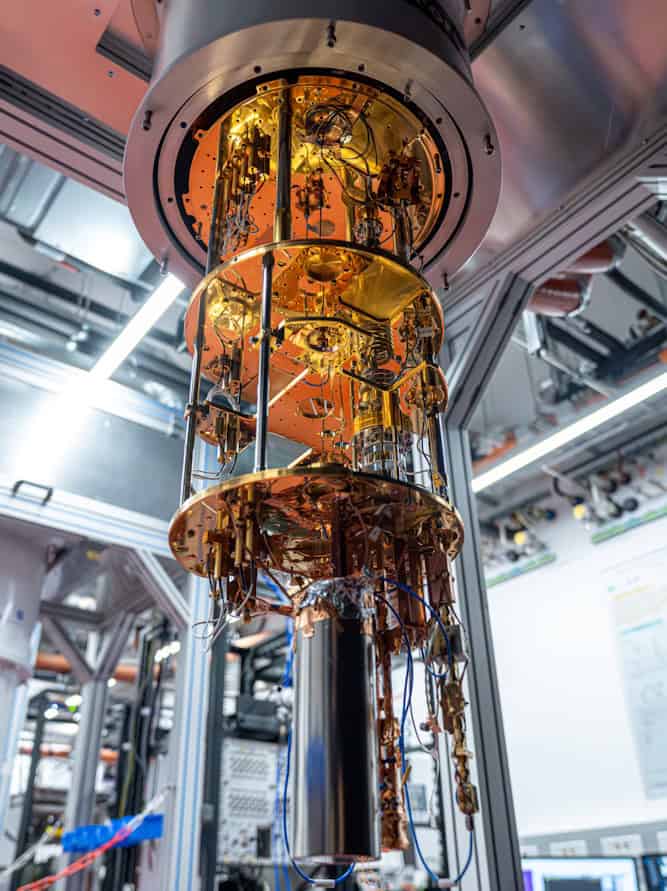
Quantum research The lab at the Institute of Science and Technology Austria. (Courtesy: © ISTA)

Because the noise reaching the two qubits is correlated, relaxing into it does not scramble them (specifically, it does not wash out the fixed phase relationship between them, as independent noise on each qubit would). They settle instead into a superposition, for which absorbing a photon from the field and emitting one into it interfere destructively: “the destructive interference between a photon emission event in the first waveguide and a photon absorption process at the location of the second qubit,” as the authors explain.

Once there, the qubits stop evolving and the field passes through unchanged: the entangled state is dark, invisible to the very field that created it. What the experiment does, in effect, is convert the continuous-variable (CV) entanglement carried by the two microwave beams into ordinary entanglement between two conventional transmon qubits – “we obtain qubit entanglement from CV entanglement,” Andrés-Juanes confirms – with roughly a tenth of it inherited.

Most entanglement-distribution schemes deliver entanglement as events: a pulse sequence runs, a detector clicks, a pair is announced, and the state then decays until the sequence runs again. The author’s autonomous version could enable the elimination of this machinery.

“It removes a lot of overhead on the pulse sequences you need to run to get the entanglement,” says Andrés-Juanes, an advantage that’s expected to matter most at scale, since one correlated photon source can drive many pairs at once. “Another differential feature of this protocol is that the entanglement is ‘always on’ for when you need to use it. In active protocols, you would have to reinitialize the entangled state because it would decohere after a while.”

The practical limit of this setup is temperature: “We use microwave frequencies, which are only quantum at very low temperatures,” Andrés-Juanes explains. “The real limit in the separation is how big your dilution refrigerator is”, with the longest such link so far being 30 m, at ETH Zurich. He positions the work as an intermediate-distance technology rather than a long-distance one. At optical frequencies, the constraint would lift, though achieving the same strong qubit–waveguide coupling in an atomic system would be its own problem.

For now, the numbers are modest: two qubits, entangled with a concurrence of just 0.10 (on a scale where 1 is a perfect pair), inheriting only about a tenth of the entanglement carried by the microwave beams. The group is working on a module with more than one qubit per node.

But critically, the idea is no longer theoretical. The team has now realised an entangled link that is always “there”, bringing us one step closer to distributed quantum computing (linking separate processors into one machine via entanglement), networked sensing (detectors sharing entanglement to jointly see what none could alone) and quantum repeaters (relay stations for long-distance quantum links, needed because a quantum state can’t be copied and amplified like a classical signal).

The post Noise that entangles may accelerate the dawn of quantum technologies appeared first on Physics World.

  •  

Magnetism likely played a key role in early solar system formation

The oldest known solids in the solar system contain evidence that the protoplanetary disc that went on to form the planets around our Sun experienced a magnetic field stronger than the field on Earth today, new research suggests. Study of inclusions in a primordial meteorite called a carbonaceous chondrite indicates that magnetism needs to be considered in simulations of planet formation, and may even be the dominant factor.

When planetary systems condense, they initially form high-temperature molecular nebulae. These later cool and accrete into planets surrounding central stars – which, at some point, begin to undergo nuclear fusion. Even before this happens, however, the gas is highly ionized. “A good portion of the ionization is coming from the molecular cloud itself,” explains planetary scientist Cauê Borlina of Purdue University. “It’s a combination of radiation from space and high temperature.”

In any ionized system there is the potential for magnetic fields, but simulations of disc formation often take no account of them, partly as they remain poorly constrained: “It’s a lot easier to just crank up the gravity and use that as a way to match the accretion rate,” says Borlina.

The new study from Borlina and colleagues in the US, China and the UK provides an unprecedented peek at fields in the terrestrial planet-forming region in the first 500,000 years of the Solar System’s existence – before the Earth had formed – using calcium-aluminium-rich inclusions. These are the oldest known solar system solids, comprising minerals with extremely high melting points that are inclined to condense early. “It is very unlikely to get them at later stages,” says Borlina. Previous researchers have confirmed their ages using isotopic dating.

Millions of years after these inclusions formed, they agglomerated with other protoplanetary material into planetesimals, some of which went on to form planets. Planetary scientists think the remaining material accreted to form the chondrites – which astronomers distinguish into several different types depending on their chemical composition. When they fall to Earth as chondrite meteorites, therefore, they provide a valuable glimpse into the solar system’s raw material.

Carbonaceous chondrites hold particular interest as they are thought to have the most primitive chemical compositions of all meteorites. The researchers studied calcium-aluminium inclusions in the 667 g Dominion Range 08006 carbonaceous chondrite discovered in Antarctica in 2008. Such inclusions had, until around 2010, been thought to contain no magnetic minerals. Borlina and colleagues, however, found that some – although not all – of the inclusions contained nanometre-scale amounts of ferromagnetic iron-nickel.

The researchers measured the thermoremanent magnetization of these iron-nickel grains (the field strength they experienced at the time when they cooled down through their “Curie temperature”, thereby fixing their own magnetism). In theory, this could be achieved by heating the sample above the Curie temperature, which for iron-nickel is about 1050 K, and measuring the field required to demagnetize it. Unfortunately, says Borlina, heating meteorites up in the laboratory tends to oxidize the materials extremely quickly, making reliably calibrated experiments very difficult.

Instead, the researchers used an established method called anhysteric remanent magnetization, concluding that the inclusions were exposed to fields of 150–600 µT when they cooled through the Curie temperature (the field on Earth today is around 30–60 µT). “This is good evidence that…you can’t just ignore magnetic fields,” says Borlina. “They need to be present in your simulations.”

The researchers are now studying other carbonaceous chondrites and other types of chondrite meteorites – some of which are thought to have formed in different regions of the protoplanetary disc – hoping to gain a fuller picture of how magnetism shapes disc evolution. “The idea was to put it out there that there’s this new inclusion that might hold magnetic carriers, and there’s a lot of work to be done,” says Borlina.

Meenakshi Wadhwa of University of California, San Diego – who formerly directed the Center for Meteorite Studies at Arizona State University – describes the work as “genuinely significant”. First, she says, it provides the first definitive paleomagnetic signal from a carbonaceous chondrite. Second, the estimated field is multiple times previous estimates.

“Yes, the sample size is small (five inclusions from a single chondrite), but I think the authors make a reasonably solid argument for their conclusions,” she says. The next step, she concludes, “is to measure inclusions from other chondrite groups to see if the signal is reproducible, and to test whether it’s a real nebular record versus something very localized, specific to DOM 08006 or the carbonaceous chondrite reservoir. Beyond that…pinning down when and where inclusions acquired their magnetization will also be important.”

The research is published in Proceedings of the National Academy of Sciences.

The post Magnetism likely played a key role in early solar system formation appeared first on Physics World.

  •  

Astronomers discover unusual 10-sided atmospheric wave on Saturn

While Earth’s atmosphere is constantly changing, many spectacular storms and atmospheric waves on Saturn remain stable for decades or even centuries.

Images from NASA’s Voyager craft as it flew-by the planet in the early 1980s revealed a large and long-lived hexagonal atmospheric wave around Saturn’s north pole.

Yet despite decades of observations from other craft such as the Cassini mission, no similar wave has been reported in the southern hemisphere or elsewhere.

Now, Agustín Sánchez-Lavega from the University of the Basque Country in Bilbao and colleagues have spotted a growing decagon-shaped wave around the planet’s south pole.

The researchers discover the phenomenon thanks to images from NASA’s Hubble Space Telescope as well as ground-based telescopes as the planet’s south pole came back into view from Earth due to Saturn’s axial tilt.

It seems that the 10-sided wave developed between 2023 and 2025 and may still be evolving, in contrast to the 40-plus years of steadiness shown by the hexagon.

The longitudes of the decagon’s vertices oscillate over a period of 32 days, and its movements suggest it may be trapped by the curvature of an atmospheric jet.

The researchers suggest the wave could have been created by a spatially periodic disturbance in the jet peak or driven by an “anticyclonic vortex” to its north.

However, further study is required to better understand how it formed and how it compares to the hexagon structure in the north.

“The most intriguing part to me is that this seems to have just formed recently,” notes study co-author Amy Simon from NASA’s Goddard Space Flight Center in Maryland. “The question is, why did it suddenly form now when we haven’t seen one before?”

The post Astronomers discover unusual 10-sided atmospheric wave on Saturn appeared first on Physics World.

  •  

‘Lid’ of asteroid dust smothered and burned the dinosaurs, say scientists

As wildfires and extreme heat events rage across the world, “apocalyptic” has become an increasingly common descriptor. These climate disasters are not unprecedented, however. New research suggests they may have been the main mechanisms behind the mass extinction event that killed the dinosaurs – and much other life on Earth – 66 million years ago.

Our modern understanding of this extinction dates back to 1980, when the father-and-son, physicist-and-geologist team of Luis and Walter Alvarez presented evidence that it was triggered by an asteroid strike. Subsequent work identified the Chicxulub crater in Mexico’s Yucatán Peninsula as the likely impact site, but debate has persisted – including over how a single asteroid could cause worldwide destruction.

In the latest work, Brandon and Alexandria Johnson, a husband-and-wife duo at Purdue University in the US, fit another piece into this puzzle. By combining Brandon’s research on impact cratering with Alexandria’s expertise on the behaviour of atmospheric particulates, they found that the asteroid impact sent up a near-impermeable layer of dust that smothered the entire planet. Their research, published in Journal of Geophysical Research: Biogeosciences, breathes new life into a theory that had fallen out of favour: that extreme heat and wildfires were the main killers on the day the asteroid hit. 

The key to ignition

At some level, this dust layer likely produced a cooling effect, much as large volcanic eruptions do today. Indeed, a previous study showed that condensed droplets of rock known as spherules would have blocked the Sun’s radiation from entering the atmosphere.

At the Earth’s surface, however, the Johnsons think the dinosaurs had the opposite problem. The impact also sent a massive plume containing over 1000 km3 of vaporized material high into the atmosphere. When this material rained down as spherules, the dust cloud’s potential cooling effect was reversed.

“[The spherules] are essentially adding energy back to the atmosphere by travelling through it to the surface. That energy has to go somewhere,” Alexandria Johnson explains. “What we found is that this dust layer over the planet is essentially acting like a lid, and it’s keeping almost all the radiation that should try to find its way back out to space and reradiating it back down to the surface. So it’s enough to not only kill the dinosaurs but actually start widespread wildfires.”

Both researchers were surprised at just how opaque this dust layer was. By their reckoning, it trapped almost all radiation within the atmosphere, allowing a staggeringly tiny upwards transmittance of just 10-286. 

“I asked [Brandon] to redo my calculation, I was like ‘make sure these numbers are right’, because this is absolutely nothing,” says Alexandria. “I expected more than what we got to be reradiated out, but the fact that it doesn’t just enhances the whole idea of the heat pulse killing things off in a very quick manner.” 

Based on the Johnsons’ estimated heat fluxes, any creatures that couldn’t shelter or burrow – dinosaurs included – would have suffered temperature-induced deaths within an hour or two of the impact. The radiation was also more than enough to ignite lichens, grasses and pine needles, destroying vast amounts of plant life through wildfires. 

Never-ending night

Anything that survived the heat then had to face the darkness. “You would have had darkness lasting for a long time which then can cause collapse of the food chain in the oceans and cause oceanic extinctions,” says Brandon Johnson. The dust particles were about as small as those in wildfire smoke, and they may have blocked out the Sun for as long as decades before settling into what we now see as the K-Pg boundary: a rock layer a few millimetres thick that contains high levels of iridium, identified by the Alvarezes as coming from an asteroid.

Although some previous works suggested that the impact couldn’t have ejected enough material to trigger such large-scale effects, Brandon says his analysis of rock vaporization thresholds indicates that the plume’s mass was big enough to facilitate the transport of material across the planet’s atmosphere. Without this transport, he adds, the wreckage would have been more localized to the Chicxulub impact site. 

Given the interdisciplinary nature of the field, Brandon thinks there are many ways this line of research could continue. Possibilities include investigating the geological record in more detail and combustion experiments to better understand the wildfires’ impacts. He himself is hoping to carry out 3D impact simulations which can more accurately incorporate the vaporization of rock. “Essentially, [we want] to see what happens to that vapour and see if it is going to expand and be deposited globally as we expect,” he says.

The post ‘Lid’ of asteroid dust smothered and burned the dinosaurs, say scientists appeared first on Physics World.

  •  

Finding careers in STEM and the weirdness of AI

This episode of the Physics World Weekly podcast features two conversations. The first is with career consultant Alaina G Levine who gives advice on how to build a “unicorn career” in science, technology, engineering, and mathematics. Our second guest is the optics and artificial-intelligence researcher Janelle Shane who writes extensively about the absurd, and often hilarious, side of AI.

Levine’s latest book is called Create Your Unicorn Career and Shane writes about artificial intelligence on her blog  AI Weirdness.

This podcast is supported by American Elements, the world’s leading manufacturer of engineered and advanced materials. The company’s ability to scale laboratory breakthroughs to industrial production has contributed to many of the most significant technological advancements since 1990 – including LED lighting, smartphones, and electric vehicles.


The post Finding careers in STEM and the weirdness of AI appeared first on Physics World.

  •  
❌