❌

Reading view

AAS 248: Day 1

Virgo Cluster

Editor’s Note: This week we’re at the 248th AAS meeting in Pasadena, CA. Along with a team of authors from Astrobites, we will be writing updates on selected events at the meeting and posting each day. Follow along here or at astrobites.com for daily summaries, or follow @astrobites.bsky.social on Bluesky for more coverage. The usual posting schedule for AAS Nova will resume on 22 June.

Table of Contents:


Fred Kavli Plenary Lecture: Richard Teague, Revealing the Dynamics of Planet Formation (by Lexi Gault)

Richard Teague (Massachusetts Institute of Technology) gave the Fred Kavli Plenary Lecture on his groundbreaking work in the dynamics of planet formation. The study of planet formation, as Teague introduced, has advanced significantly in the last two decades with the discovery of thousands of exoplanets and the launch of cutting-edge instruments. While planets are found everywhere orbiting a wide variety of stars, not all planetary systems look the same. Our solar system looks very different from other exoplanetary systems, challenging our understanding of planet formation and requiring us to build a picture that works across the board.

Where do we look to build a better understanding of planet formation? Planets are inherently the byproduct of star formation, forming in protoplanetary disks around new stars. These disks are filled with gas and dust, concentrating mass into rings that then eventually form planets. Exactly how this process proceeds is variable, and the resulting planetary system depends on how the material in the protoplanetary disk mixes and combines into planets. Teague compared planets to bread: we know the simple list of ingredients that it takes to make them, but what you end up with depends on how you bring those same ingredients together. We need to study what is happening in the planetary mixing bowls to understand how planets form.
exoALMA disks

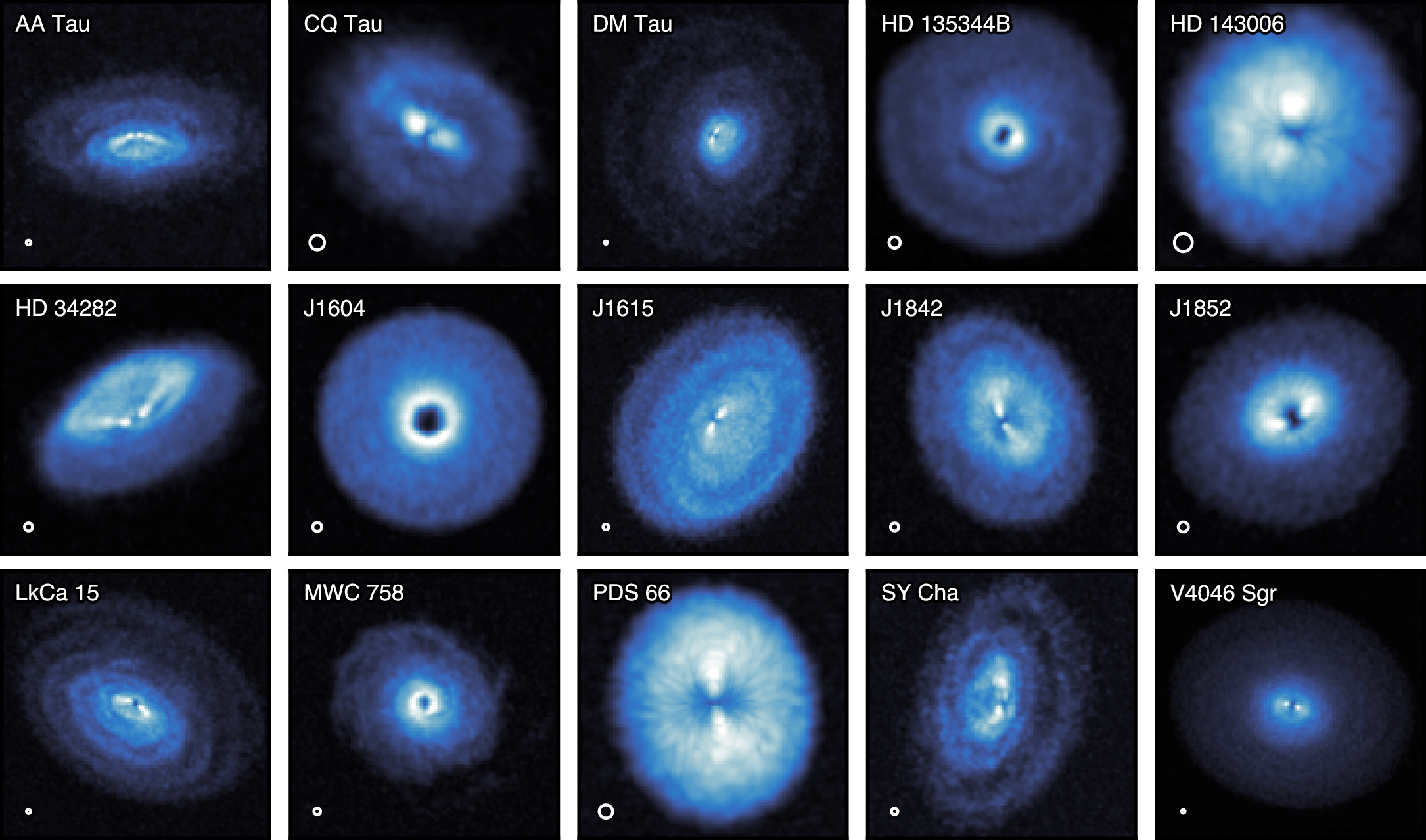
The full exoALMA sample. All 15 disks show evidence of substructure in their gas emission. [Teague et al. 2025]

Leveraging the high spatial and spectral resolution of the Atacama Large Millimeter/submillimeter Array (ALMA), Teague and collaborators have developed exoALMA, a planet-hunting campaign focusing on the still-forming planets of protoplanetary disks. This project has focused on 15 sources, obtaining and analyzing high-resolution observations to explore the kinematics, 3D velocity structures, and mass distributions within these protoplanetary disks.

The first science results from exoALMA have started to reveal that the planet formation process is highly dynamical — precise kinematic measurements uncover dynamical perturbations within protoplanetary disks across their sample. These perturbations point to the impacts protoplanets have on disk kinematics and mass distributions as they continue to form, and the high resolution of ALMA observations unlocks the inner workings of protoplanetary disks.

Looking forward, Teague emphasized that the future is broad for planet formation science. The upcoming Wideband Sensitivity Upgrade on ALMA will enable even more detailed maps of protoplanetary disks, unlocking the mysteries of planet formation while it happens.

Return to Table of Contents.


Press Conference: The Science of Stellar Remnants (Briefing video) (by Lucas Brown)

In AAS 248’s very first press conference session, we heard from a variety of scientists and research teams on all sorts of stellar remnants: white dwarfs, supernovae, pulsars, and beyond. Basically, if it came from a dying star, it was fair game for this session.

Boron and Beryllium as Unlikely Probes of Extrasolar Planets

First up was Ben Zuckerman (University of California, Los Angeles), who updated us on ongoing research into the presence of boron and beryllium in certain white dwarf systems. For some context, there exist many white dwarf systems in which a companion object — sometimes a planet — can have its material accreted onto the surface of the white dwarf due to tidal disruption during close approaches in its orbit. This deposition of material can then be detected via spectral signatures in observations of the white dwarf.

In 2021, evidence was first presented for two white dwarfs being “polluted” with trace amounts of beryllium, which is a particularly rare element, cosmically speaking. This raises the question of how so much beryllium ended up in these systems. In the hunt for answers, however, another mystery has emerged: missing boron. As Zuckerman went on to describe, boron was also recently discovered in some of these white dwarf systems, but at an abundance roughly equal to that of the beryllium. This is despite boron being about a hundred times more common in the universe, further muddying the waters of what exactly is causing such a strange pattern of heavy metals in these systems. Work remains ongoing to find a physical model that can reconcile these observations.

White Dwarf Kicks via Episodic Mass Ejection from Red Giant Stars
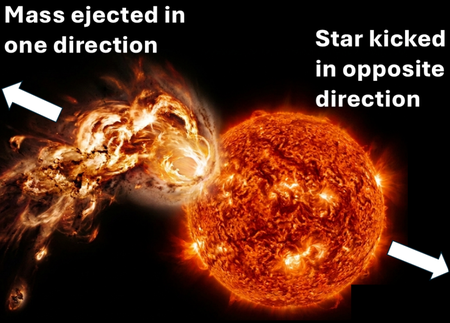
Image showing a star undergoing a massive coronal ejection event. Text superimposed on the image indicates that the mass being ejected in one direction pushes the star in the opposite direction.

In the model explored by Jim Fuller and collaborators, repeated mass-ejection events can cause red giant stars to be “kicked” up to a relatively high velocity before they collapse to form white dwarfs, explaining the high velocities many white dwarfs are observed to have. [Jim Fuller]

Next we heard from Jim Fuller (Caltech). Fuller filled us in on some recent studies aiming to explain why white dwarfs often obtain such high velocities when formed. Just like our own Sun occasionally ejects plumes of plasma from its surface, the red giant stars that eventually form white dwarfs are expected to periodically undergo mass-ejection events. But unlike with our own Sun, these ejections can shear off a significant amount of the star’s total mass — up to ~0.01% per ejection. Each time such an ejection occurs, Newton’s 3rd law ensures that the star itself will also receive a random velocity boost in the opposite direction. Over many thousands of ejections, assuming they occur randomly in all directions, this can significantly “kick” a meandering red giant up to speeds exceeding half a kilometer per second. Once such a star collapses to form a remnant white dwarf, the white dwarf will have this excess velocity too.

Additionally, this random ejection process predicts that red giants in binary systems will experience a sort of “random walk” in their orbital parameters, not just their overall velocity. This can lead to the complete dissociation of binaries, or to the direct collision of a red giant with its companion — leading to predictions about how many widely spaced white dwarf binary systems should exist. | Press release

Probing Intrabinary Material in a New Spider Millisecond Pulsar

Rebecca Kyer (Michigan State University) gave an update on research into so-called “spider” millisecond pulsars. These rapidly rotating neutron stars are a sub-class of pulsar characterized by their very high spin rate and the presence of a companion from which the pulsar is accreting material. Such systems are further sub-classified as either “Black Widows,” which have very low-mass companions (~3% solar mass), “Redbacks,” which have larger companions at ~10-80% solar mass, and “Huntsmans,” which have more massive red-giant companions. These Huntsman pulsars are the newest category, with only two known cases — until now!

Kyer presented evidence collected by their team that may indicate the discovery of a third Huntsman pulsar. The evidence involves radial velocity measurements of the companion star, which shows an orbital period of 3.64 days and variable H-alpha emission. In these systems, the radio emission typically associated with the pulsar can be blocked from our view for unpredictable amounts of time due to clouds of hot gas and dust that emerges from the complex interaction between the pulsar and red giant winds. Despite this, Kyer hopes that with enough targeted observations with the Green Bank Telescope, a radio signal will eventually be detected, confirming the pulsar’s presence.
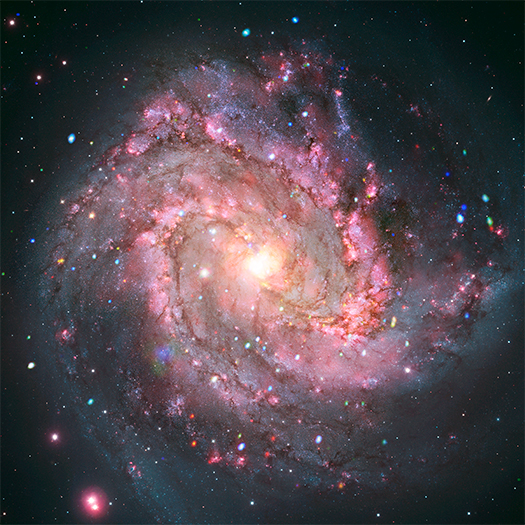
Image of galaxy M83 in X-ray and optical light.

Image of Messier 83 in both X-ray and optical light. Prominent X-ray sources can be seen as small colorful blobs strewn throughout the galaxy. Some of these X-ray sources are supernova remnants, a subset of which have recently been found to show variability in their brightness. [X-ray: NASA/CXC/SAO; Optical: NASA/ESA/AURA/STScI, Hubble Heritage Team, W. Blair (STScI/Johns Hopkins University) and R. O’Connell (University of Virginia); Image Processing: NASA/CXC/SAO/A. Jubett, L. Frattare and P. Edmonds]

NASA’s Chandra Finds Unexpected Fireworks in Aftermath of Stellar Explosions

Finally, we heard from a team of three researchers — Andrea Prestwich (Catholic University of America / NASA Goddard SFC), Roy Kilgard (Wesleyan University), and Zoe Hoiland (Vassar College) — on an unexpected supernova discovery. Traditionally, supernovae are modeled as having a relatively constant or slightly decreasing luminosity, at least after their initial explosion. As the stellar material is blasted away from the progenitor’s core, it interacts with the surrounding interstellar medium and a blob of hot, shocked gas is left over. This blob will eventually cool and dim, but often over a long time period, leading to the aforementioned prediction of constant or slightly decreasing brightness.

However, in 14-year Chandra observations of a supernova remnant in Messier 83, Prestwich and her collaborators actually found significant X-ray variability, with the remnant occasionally even increasing in brightness. In a follow-up study, it was found that supernova remnants in Messier 51 likewise show this up-and-down variability. In contrast, an analysis of remnants in Messier 101 showed zero variable remnants. Notably, the former two galaxies are very actively star-forming, while the latter is not. Some possible theoretical models to explain this variability include the possibility of stellar material falling back on the compact object leftover by the supernova, creating an accretion disk that can generate variable emission. Alternatively, it has been proposed that there could be a neighboring star to the remnant object, forming an accreting X-ray binary system that could also induce variability. | Press release

Return to Table of Contents.


Plenary Lecture: Sanmi (Oluwasanmi) Koyejo, The Measurement Gap: What AI Can Get Wrong and Why Astronomers Are the Fix (by Lexi Gault)

Sanmi (Oluwasanmi) Koyejo, a professor of computer science at Stanford University, focused this plenary talk on the limitations of AI as it becomes more integrated with science and how astronomers can help solve these problems. Koyejo began by addressing the question of why an AI researcher is talking to astronomers. His research explores how to set AI standards and how to best assess the performance of an AI model, which becomes particularly important when these models are used to do science.

Evaluating the performance of an AI model relies on benchmarks, a fixed set of questions with known answers that are used to score the AI. These benchmarks are simple, reproducible, and comparable, but passing a benchmark does not equate to getting a meaningful scientific result. Benchmarks assume cheap checks, fast feedback, and fixed questions, but science is none of those things; answering astronomy questions relies on telescope time, and ground truth cannot be found quickly.

Much like telescopes, AI benchmarks are measuring instruments with noise that can compound. If you run an AI model many times, the goal is often convergence on an agreed-upon answer, but getting to an agreed-upon answer does not mean that the answer is correct. Koyejo’s recent research found that AI models more often agreed with each other than they did with the actual truth. This is made worse when AI is used to evaluate itself. For example, Koyejo notes the rising number of academic paper submissions due to AI-written papers greatly exceeds the capacity of human reviewers. If AI tools are used to evaluate AI-generated paper submissions, the AI will tend to favor AI-written materials, ignoring the actual scientific merit. Making evaluation of AI an AI problem compounds its failures, straying further from a correct answer.

This is where astronomers come in. Having the expert knowledge of what “correct” looks like, being able to judge which errors matter, access to expensive ground truth (telescope time), and a culture of blind analysis (not knowing exactly what the answer should be), astronomers are well equipped to build standards for AI evaluation. We can define what good AI is for astronomy and use our expertise to help build the standards. Koyejo left the audience with the charge to engage with AI (engagement does not mean endorsement), so that astronomers can help set the standards for appropriate AI use in science.

Read Astrobites’s interview with Sanmi Koyejo.

Return to Table of Contents.


Press Conference: Variable, Windy, and Disruptive: The Behavior of Supermassive Black Holes (Briefing video) (by Niloofar Sharei)

This press conference focused on what supermassive black holes do to the world around them, from relativistic jets of the most famous black hole, to the multi-phase winds launched from active galactic nuclei, to temperature-shifting coronae, and even the radio burps that are produced years after a black hole tears apart stars.

Chandra Tracks the Evolving Jet from Messier 87’s Black Hole: 

Camille Poitras (Laval University) presented the largest Chandra X-ray movie of jet evolution in the famous supermassive black hole Messier 87 (M87). M87 has been studied across the electromagnetic spectrum, but X-ray observations of its jet have always suffered from blur because high-energy photons are hard to focus. Using improved Chandra calibrations and deconvolution techniques, the team produced a 13-year X-ray movie of M87’s jet from 2012 to 2025. Tracking a bright knot within the jet, Poitras’s team saw it split into two components in 2023, with one component moving at an apparent five times the speed of light (which is a known illusion called superluminal motion). That allowed the team to look into where and how the particles are being accelerated to extreme energies along the jet. | Press release

Watching a Black Hole Wind Grow: Chandra and Hubble Reveal the Early Stages of Galaxy
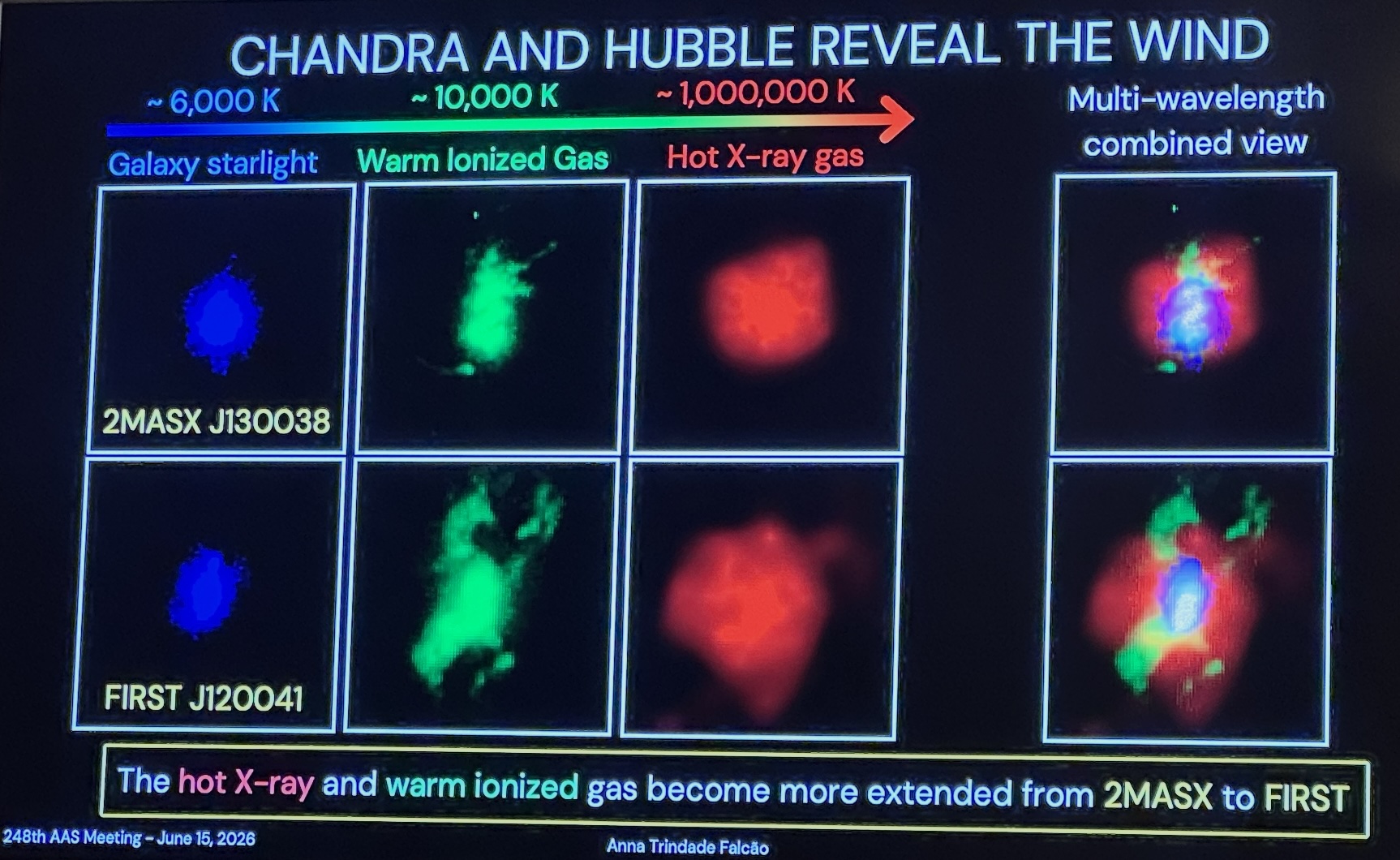
Multi-wavelength images of two quasars

Multiwavelength images of two nearby quasars show that the hot X-ray (red) and warm ionized (green) gas are far more extended in the bottom system. Click to enlarge. [Anna Trindade Falcao]
Anna Trindade Falcao (NASA Goddard SFC) presented combined Chandra and Hubble observations that may capture a supermassive black hole wind in its earliest stages of growth. Active galactic nucleus (AGN) feedback is thought to happen, but how it begins remains poorly understood. Studying two nearby quasars in which Chandra (tracing hot X-ray wind) and Hubble (tracing warm ionized gas) data are aligned, the team found that the hot and warm phases extend together and not independently. This would suggest a single multi-phase outflow. Their team proposed a four-stage sequence for AGN feedback and also argued that their two systems capture the earliest stages of that process.
three black hole wind types at increasing distances

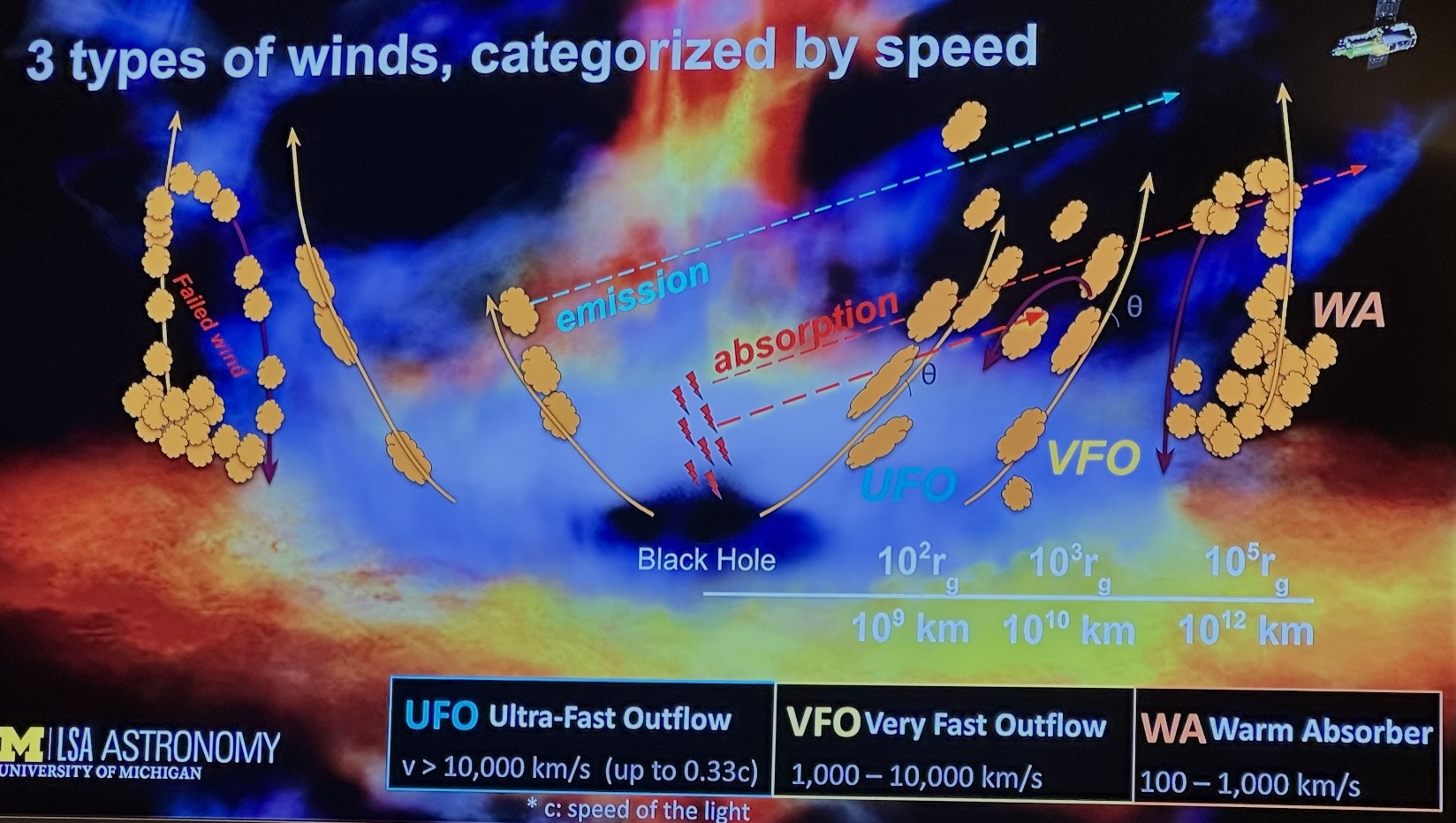
The three types of wind launched from an accreting supermassive black hole. Click to enlarge. [Xin Xiang]

XRISM Reveals Changing Accretion-Driven Winds in a Nearby Active Galaxy:

Xin Xiang (University of Michigan) presented the most detailed X-ray portrait of the winds flowing out of NGC 4151, an active galaxy roughly 16 million light-years away with a 30-million-solar-mass black hole. Every major X-ray observatory has observed this galaxy before, but earlier instruments could not separate its multiple wind components. With the high-resolution X-Ray Imaging and Spectroscopy Mission (XRISM) spectrometer, Xiang resolved three wind populations by velocity: warm absorbers (100–1,000 km/s), very fast outflows (1,000–10,000 km/s), and ultra-fast outflows (over 10,000 km/s). Across 14 XRISM observations over a year, they found that the fast winds turn on three hours after each bright X-ray flare, matching the predicted timescale for magnetically driven wind. | Press release

NuSTAR Reveals a Significantly Variable Active Galactic Nucleus Corona

Xiurui Zhao (Caltech) presented the first observational evidence of significant temperature variation in the corona of an AGN. The corona produces about 90% of all X-ray photons from an AGN, but its temperature can only be measured with X-ray missions sensitive to high-energy spectral curvature like NASA’s NuSTAR. They compared NuSTAR’s observations across multiple years and found that despite having the same luminosity in 2015 and 2024, the 2024 corona was significantly cooler than the 2015 corona. In follow-up observations in 2025, it was back at its earlier temperature. This is the first clear observation of coronal temperature variability in an AGN. | Press release

New Surprises from Radio Observations of Tidal Disruption Event Outflows

Kate Alexander (University of Arizona) presented new radio observations of tidal disruption events (TDEs). TDEs occur roughly once every 100,000 years in a given galaxy. It happens when a star drifts too close to the black hole, is stretched and squeezed into a long stream of debris (a process astronomers call spaghettification) and some of that debris falls onto the black hole while the rest is thrown outward and lights up in radio. Alexander and her team used six years of Very Large Array monitoring of several dozen nearby TDEs. They found that many TDEs unexpectedly turn on in the radio years after the original event, even long after their optical light has faded. Their team combined radio data with X-ray and optical accretion-rate measurements and found that these late-time radio flares appear when the black hole is eating either very quickly or very slowly, but not at moderate rates! This pattern matched what is seen in stellar-mass black holes and this suggests that accretion physics may operate similarly across many orders of magnitude in black hole mass. | Press release

Return to Table of Contents.


Plenary Lecture: Mario Jurić, Early Results from the Rubin Observatory: Mapping the Solar System and Beyond (by Kerry Hensley)

Mario Jurić (University of Washington; PI of the University of Washington Rubin operations element) began by remarking on how our collective concept of what an astronomer is has been transformed over the past 25 years. While a Google image search for “astronomer” yields an array of people pointing small telescopes at the night sky, today’s version of professional astronomy looks quite different: huge telescopes with enormous cameras covering vast swaths of the sky, with analysis aided by software and data deposited in massive databases.

This rapid transition was first spurred by enterprises like the Sloan Digital Sky Survey, which collected 20 terabytes of raw data from 1.2 billion observations. Now, digital sky surveys are common, and they’re becoming ever larger. The next massive digital sky survey will be the Legacy Survey of Space and Time from the NSF–DOE Vera C. Rubin Observatory — an observatory that can “download the universe” and is poised to transform our understanding of everything from asteroids to dark energy.

Rubin released its first images on 23 June 2025, and among these stunning images is a broad view that contains thousands of galaxies in the Virgo cluster, a golden tangle of four colliding galaxies, a nearby galaxy cluster, a distant galaxy cluster, and a handful of nearby spiral galaxies bursting with star formation. As fantastic as this image is, Jurić emphasized that it’s just one still image in a movie: as Rubin returns to the same fields of view time and time again, it’ll spot things that change brightness (like variable stars and transients) and things that move (like asteroids).

Jurić highlighted four areas in which Rubin has already contributed greatly, focusing on discoveries within our solar system:

    1. Asteroid variability: Rubin has already collected hundreds of thousands of observations of asteroids, resulting in the discovery of extremely fast rotators like 2025 MN45, which must have an extremely high tensile strength not to fly apart.
    2. Observations of interstellar object 3I/ATLAS: During the observatory’s commissioning survey, the Rubin team realized that they had observed 3I/ATLAS before it was discovered — but in observations that were technically under embargo. Recognizing the high impact of the data, the team found a way to share their findings, leading the 150-person collaboration to write a paper on their findings in a mere three days.
    3. High-precision asteroid photometry: While analyzing the commissioning data, the Rubin team discovered systematic offsets in the positions of asteroids — but no other types of objects. They found that this effect varied across the sky and was worse in the south. They eventually discovered that because most asteroids are observed from the north, that catalogs of asteroid orbits are systematically biased at a level of 20-40 milliarcseconds. Luckily, Rubin will provide the much-needed southerly data necessary to clean up these catalogs within about a year.
    4. Outer solar system studies: Researchers discovered 380 new trans-Neptunian objects in Rubin’s commissioning data. (Compare that to just 5,000 known trans-Neptunian objects in total!) In the time since the commissioning data were collected, hundreds more candidate objects were discovered.

With such enormous data yields from Rubin, how do we efficiently turn data into science? Jurić outlined strategies for handling massive datasets using well-crafted data formats, computing tools, and AI. In particular, Jurić highlighted the Astronomical Catalog Inference Driver, or ACID, which he built in four weeks on his phone using Claude. The tool is comparable to “a product developed in >3 years by extremely capable human professionals” and can rapidly handle immense data tables, showing how AI can accelerate the development of tools to handle tomorrow’s datasets.

Read Astrobites’s interview with Mario Jurić.

Return to Table of Contents.


Plenary Lecture: Esra Bulbul, Cosmology and Baryons Across Scales: Probing Halo Mass Function to Cosmic Filaments with eROSITA (by Lexi Gault)

Esra Bulbul (Max Planck Institute for Extraterrestrial Physics) began her plenary talk at the beginning of time — the Big Bang marked the start of the universe, and from there we attempt to constrain cosmological parameters in order to understand how the universe was born and how it has evolved. Bulbul notes that a lot of work has been done to constrain cosmology from the cosmic microwave background (CMB), and we must compare those early time measurements to those from later times to build a full picture. In cosmology, tensions have arisen between early-time and late-time probes. CMB measurements of the Hubble constant and S8, the “clumpiness” parameter of the universe, do not agree with late time probes that find that the universe is accelerating faster with smaller fluctuations than the CMB predictions. How do we work toward resolving this tension?

The extended ROentgen Survey with an Imaging Telescope Array (eROSITA) is a space telescope that has performed the first imaging all-sky survey in the medium X-ray range, seeking to map the large-scale structures of the universe to better constrain cosmological constants. eROSITA focuses on finding galaxy groups and clusters via the hot X-ray gas within and between them across the last 5-7 billion years of the universe. Since its launch in 2019, eROSITA has completed more than four full-sky surveys. Of the million X-ray sources detected by eROSITA, only 12,247 (1%) are galaxy clusters and groups.

From the observed X-ray emission from the galaxy clusters and groups, the eROSITA team has been able to measure the temperature of the intercluster medium within the sample. Working with weak gravitational lensing surveys, they have been able to measure the masses of the newly discovered clusters and groups. These measurements show that eROSITA has detected sources across three orders of magnitude in mass, reaching from the galaxy level to large-scale clusters.

The galaxy cluster and group observations allow them to constrain a few cosmological parameters including S8 (density fluctuations), Ωm (matter density), and w0 (dark energy). From the impressive eROSITA data, Bulbul showed that they could constrain S8 and Ωm to five times better precision than ever before! These late-time results are fully consistent with what has been measured from the early-time CMB measurements. Additionally, the dark energy measurements agree with what has been measured thus far from the Dark Energy Spectroscopic Instrument survey.

Bulbul then switched us from the exciting cosmological results to those regarding baryon detection. A striking result from eROSITA was the detection of hot gas well beyond what is typically considered the gravitational extent of a galaxy cluster — reaching out to 16 million light-years, often larger than the galaxy cluster itself. This underscores the importance of X-ray surveys in detecting the very extended gas encapsulating the largest-scale structures of the universe.

Looking forward, Bulbul discussed the future work planned for eROSITA. Transitioning now to working with the deepest data of the survey, the team expects to find about 40,000 galaxy clusters with about half of those being used for cosmology. They anticipate obtaining even higher precision on cosmological parameter measurements, comparable to that obtained from CMB observations. The work of eROSITA is revolutionizing cosmology at later times in the universe, and the future is exciting.

Read Astrobites’s interview with Esra Bulbul.

Return to Table of Contents.

The post AAS 248: Day 1 appeared first on AAS Nova.

  •  

ALMA Band 9 CO(6–5) Reveals a Warm Ring Structure Associated with the Embedded Protostar in the Cold Dense Core MC 27/L1521F

Kazuki Tokuda et al 2026 ApJL 1001 L1
A newly discovered distribution of dense, warm gas around a protostar, roughly in the shape of the number “9,” is unlikely to be solely due to outflows and instead may be caused by magnetic flux redistribution.

The post ALMA Band 9 CO(6–5) Reveals a Warm Ring Structure Associated with the Embedded Protostar in the Cold Dense Core MC 27/L1521F appeared first on AAS Nova.
  •  

NASA’s Pandora SmallSat Mission: Simulated Modeling and Retrieval of Near-Infrared Exoplanet Transmission Spectra

Kazuki Tokuda et al 2026 ApJL 1001 L1
During its year-long prime mission in 2026-2027, Pandora will likely constrain the abundance of water and methane to ~1.0 dex for the atmospheres of sub-Neptune and hot-Jupiter exoplanets.

The post NASA’s Pandora SmallSat Mission: Simulated Modeling and Retrieval of Near-Infrared Exoplanet Transmission Spectra appeared first on AAS Nova.

  •  

AAS 248: Welcome!

banner for AAS 248

This week, AAS Nova and Astrobites are attending the American Astronomical Society (AAS) summer meeting in Pasadena, CA.

AAS Nova Editors Kerry Hensley and Susanna Kohler and AAS Media Fellow Lexi Gault will join Astrobites Media Intern Niloofar Sharei and Astrobiter Lucas Brown to live-blog the meeting for all those who aren’t attending or can’t make it to all the sessions they’d like. We plan to cover all of the plenaries and press conferences, so follow along here on aasnova.org or on astrobites.org! You can also follow Astrobites on Bluesky at astrobites.bsky.social for more meeting content.

Where can you find us during the meeting? We’ll be at the Astrobites booth in the Exhibit Hall all week — stop by and say hello! You can also find Susanna, Kerry, and Lexi at the press conferences in Ballroom H Monday and Tuesday at 10:15 am and 2:15 pm PDT and Wednesday at 10:15 am PDT. AAS press conferences are open to all attendees, and they can also be found on the AAS Press Office YouTube channel for anyone not attending the meeting.

In addition to the usual press conferences, the AAS Press team has collaborated with Los Angeles’s own Griffith Observatory to arrange a special live recording of the Observatory’s acclaimed astronomy program, All Space Considered. This event is open to all AAS 248 attendees and will take place Wednesday, 17 June, at 2:15 pm PDT in Ballroom H. We hope to see you there!

Finally, you can read the currently published AAS 248 keynote speaker interviews, which were conducted by Astrobiters Niloofar Sharei, Amaya Sinha, Sowkhya Shanbhog, Katya Gozman, and Natalie Price. Be sure to check back all week as the remainder are released!


Education, Outreach, and More at AAS 248

AAS 248 features a broad range of sessions related to education and outreach. For a comprehensive and curated list of sessions, check out this post from AAS Director of Education Programs Tom Rice. Here are a few highlights (all times PDT; must be logged in to aas.org for links to work correctly); note that times and locations are subject to change:

On Monday, kick off the meeting with the Astronomy Education, Outreach, and Night-Sky Stewardship iPoster session, 9:00–10:00 am in Exhibit Hall A. Wrap up your day by attending the Reception for Astronomy Educators from 6:30 to 8:00 pm in Room 107.

Tuesday morning, hear about pressing issues relating to climate change at the Special Session What Astronomers Can Do About Climate Change: Infrastructure, Education, and Communication, from 10:00 to 11:30 am in Ballroom G. That afternoon from 2:00 to 3:30 pm, tune in to the Pathways into Modern Space Science oral session in Ballroom C.

On Wednesday, learn how to Make Your Voice Heard as an Advocate for Science in a Special Session co-sponsored by the AAS and the American Institute of Physics from 10:00 to 11:30 am in Ballroom G. Throughout the week, check in with the League of Women Voters in the Exhibit Hall — they’ll be conducting a voter registration drive during the meeting.

Thursday, the final day of the meeting, closes with a look at a local institution in the 40 Years of Community Engagement at IPAC: Lessons Learned Special Session from 2:00 to 3:30 pm in Ballroom F.

If you’re sticking around Pasadena after the meeting, consider heading to Griffith Observatory for their open house on Saturday, 20 June, 2:00–10:00 pm, which will showcase accessible observing techniques like tactile images, 3D models, live camera feeds, and sonification.

And remember, you can find a longer curated list of education-related sessions here!

The post AAS 248: Welcome! appeared first on AAS Nova.
  •  

AAS Publishing at AAS 248 in Pasadena

banner for AAS 248

The 248th meeting of the American Astronomical Society, to be held in Pasadena, CA, 14–18 June, is nearly here. The AAS Publishing team looks forward to connecting with meeting attendees, and you can find representatives from the publishing and journals’ editorial staff at the AAS booth in the Exhibit Hall in the Pasadena Convention Center. AAS Director of Scholarly Publishing Kerry Kroffe will be available at the AAS Publishing booth, so be sure to stop by to say hello, chat about the journals, and pick up some swag!

AAS Nova Editors Kerry Hensley and Susanna Kohler, AAS Media Fellow Lexi Gault, Astrobites Media Intern Niloofar Sharei, and the rest of the Astrobites team will also be available periodically at the Astrobites booth in the Exhibit Hall. We look forward to seeing you there!


AAS Peer Review Workshop

This workshop led by the scientific editors of the AAS journals will teach participants about the peer review process, give them the opportunity to see both poor and exemplary referee reports, and provide them with hands-on experience in writing a peer review report. Participants will receive a graduation certificate. While signups for the AAS 248 peer review workshop are closed, more workshops are planned for future AAS meetings, so keep an eye out for more information about upcoming opportunities!


Open Science, Data, and AI in Astronomy: Sessions to Look for at AAS 248

Note: The links in this section take you to the corresponding entries in the AAS 248 block schedule. You must be logged in for the links to work correctly; otherwise, they will take you to the main block schedule page. Note that times and locations are subject to change.

The upcoming AAS meeting has a number of sessions, workshops, and lectures for those interested in open-source tools, data management strategies, and AI’s role in astronomy. Sunday, 14 June, will feature a trio of data-related workshops. (Note that these workshops require an additional fee and can be added to your registration.) The “Euclid Data in the Cloud: Access, Analysis, and Science Opportunities” workshop (10:00 am – 11:30 pm PDT in Room 101) will introduce participants to accessing and analyzing data from Euclid, a European Space Agency mission with NASA participation. The overlapping workshop “High Energy Science Analysis with HEASARC Services” (10:00 am – 12:00 pm PDT in Room 102), organized by the High Energy Astrophysics Science Archive Research Center (HEASARC), is targeted toward early-career scientists and anyone curious about HEASARC services. The workshop will begin with an overview of available services before transitioning into hands-on experimentation with these tools. Finally, “An Introduction to Fornax: Scalable Data and Compute for Scientific Analysis” (2:00–4:00 pm PDT in Room 101) will introduce attendees to NASA’s new Astrophysics Science Platform through live demonstrations and guided exercises.

Of particular interest regarding AI in astronomy is Monday morning’s plenary lecture from Sanmi (Oluwasanmi) Koyejo titled “The Measurement Gap: What AI Can Get Wrong and Why Astronomers Are the Fix.” This session will take place from 11:40 am to 12:30 pm PDT in Ballroom DE.

The “AI-Driven Science in the Survey Era” Special Session will take place on Tuesday, 16 June, from 2:00 pm to 3:30 pm in Ballroom F. This session will highlight recent breakthroughs in a broad range of astronomical sub-fields that have greatly benefited from the use of AI and machine-learning techniques. Also on Tuesday, check out recent work on imaging and data-handling methods at the “Observational Imaging Methods and Data Pipelines” iPoster session from 5:00 pm to 6:00 pm in the Exhibit Hall.

The post AAS Publishing at AAS 248 in Pasadena appeared first on AAS Nova.
  •  

The Spatially Resolved Hot Gas Properties of NGC 1266’s Active Galactic Nucleus–Driven Outflow

Sebastian Lopez et al 2026 ApJ 1001 69
Archival data from the Chandra X-ray Observatory and the Very Large Telescope reveal the temperature, density, and thermal energy of the wind from a low-luminosity active galactic nucleus.

The post The Spatially Resolved Hot Gas Properties of NGC 1266’s Active Galactic Nucleus–Driven Outflow appeared first on AAS Nova.

  •  

The Impact of Strong Lensing on Hubble Constant Measurements with Gravitational-Wave Dark Sirens

Eungwang Seo et al 2026 ApJS 284 20
Combining strongly lensed gravitational wave signals with luminosity distances from their host galaxies, the Hubble constant could be measured in a way that is complementary to electromagnetic methods.

The post The Impact of Strong Lensing on Hubble Constant Measurements with Gravitational-Wave Dark Sirens appeared first on AAS Nova.
  •  

Shot from the Heart of the Milky Way: Discovery of an Old Hypervelocity Star

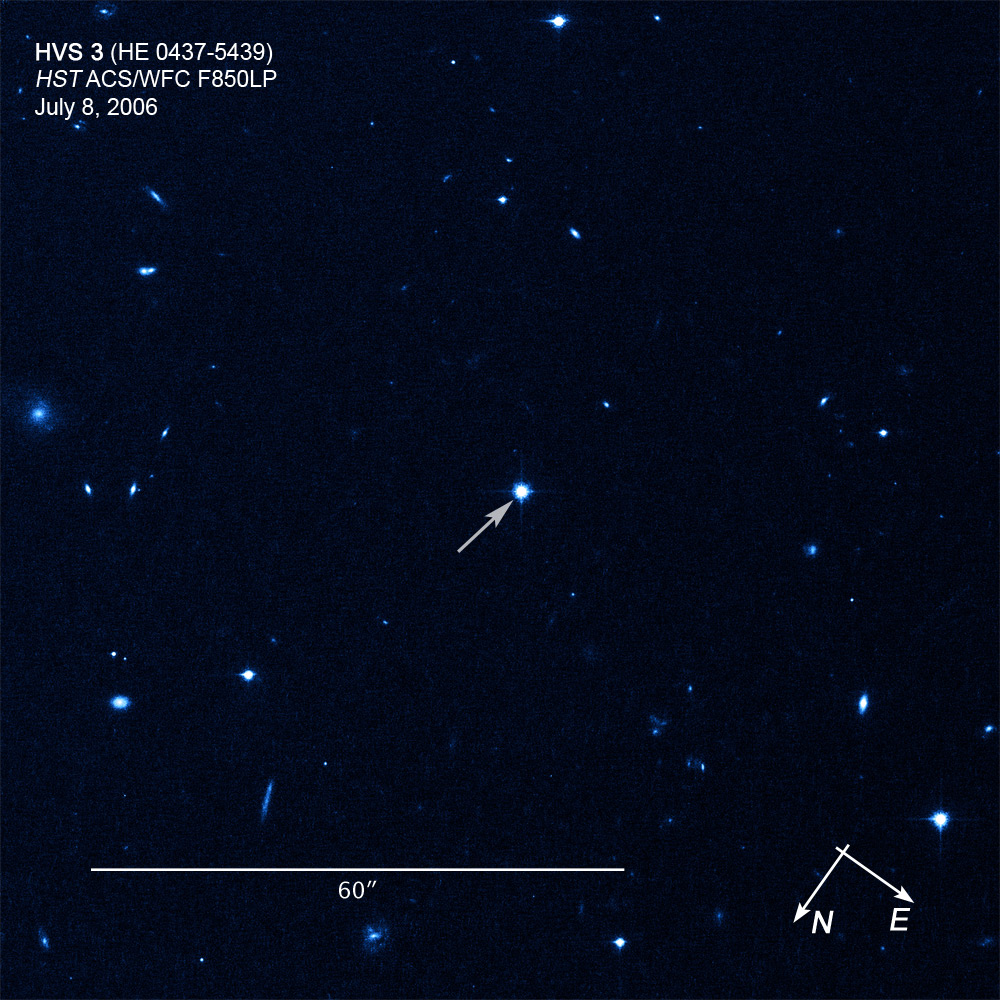
Hypervelocity stars in galaxy

Zooming through the galaxy faster than they should, hypervelocity stars are a curious population of stars whose origins are often difficult to determine. A recent study presents the first evidence of an old, low-mass hypervelocity star launched from the Milky Way’s center, providing clues into this elusive set of fast-moving stars.

Flinging Fast Stars

Astronomers have caught a number of hypervelocity stars zipping through the Milky Way since their first discovery in 2005. With speeds fast enough to escape the galaxy, hypervelocity stars were launched off course by some strong dynamical interaction. One such method, known as the Hills mechanism, predicts that when a binary star system approaches the Milky Way’s central supermassive black hole, one binary member is captured by the black hole and the other is flung away with high velocity.

However, constraining a hypervelocity star’s origin to the galactic center is limited by uncertainties in distances and proper motions, muddling how well researchers have been able to trace their orbits backward. Among a number of candidate galactic center–origin hypervelocity stars, only one has been confidently identified as having been kicked from the galaxy’s center. Intriguingly, this hypervelocity star and most galactic center–origin candidates are young, massive stars — old, low-mass hypervelocity stars from the galactic center have yet to be identified.

What does this dearth of old, low-mass zooming stars mean? Either stars in the galactic center are preferentially young and massive, with fewer than expected old and small stars, or low-mass hypervelocity stars are missed by selection effects, challenging to detect in current surveys. Searching for hypervelocity stars with higher precision and sensitivity may allow astronomers to tease out this missing population and trace back more zooming stars to a Hills mechanism origin.

Discovering An Old Hypervelocity Star

Leveraging high-quality spectra from the Dark Energy Spectroscopic Instrument (DESI) survey and precise astrometry from Gaia, Shunhong Deng (University of Chinese Academy of Sciences; China West Normal University) and collaborators reported the discovery of the hypervelocity star DESI-HVS1. From the spectroscopic and astrometric analyses, the authors determined that DESI-HSV1 is a ~14-billion-year-old low-metallicity star with a mass about 80% that of the Sun’s, moving through the galaxy at 523 km/s.

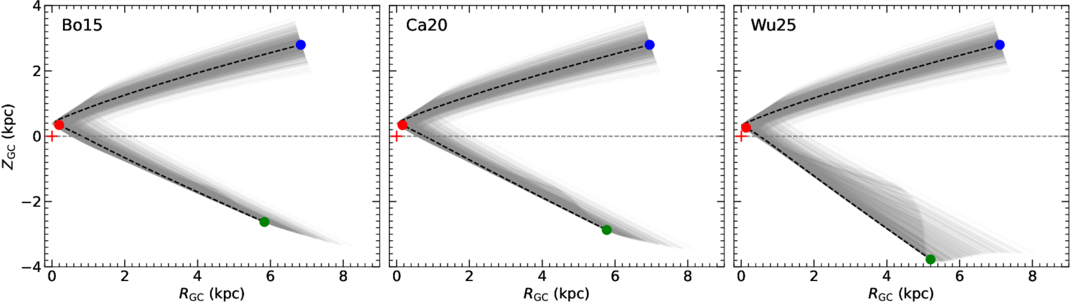
Backward orbit integration

Backward-integrated orbits of DESI-HVS1 for three different galactic potential models. The blue, red, and green points show the star’s current position, closest approach to the galactic center, and position 50 million years ago, respectively. Click to enlarge. [Deng et al 2026]

Exploring the possible origins of this hypervelocity star, the authors integrated the star’s orbit backward in time for one billion years. The backward orbit integrations show the star approaching the galactic center where it then turns around, traveling away faster than the local escape velocity of the galaxy. Even when varying the galactic potential and constants, all orbit integrations suggest DESI-HVS1’s motion through the galaxy is most naturally explained by the Hills mechanism.

While more refined galaxy models and comparison to other candidate galactic center–origin hypervelocity stars are necessary to fully confirm its origins, DESI-HVS1 provides the first compelling evidence for an old, low-mass hypervelocity star candidate consistent with a galactic center launch. This suggests that the observed lack of such stars is likely not a reflection of the Milky Way’s central stellar population, but rather a consequence of observational constraints making such small hypervelocity stars particularly difficult to detect. As large spectroscopic and astrometric surveys continue to advance, the sample of galactic-center hypervelocity star candidates will grow, enabling further exploration of the stellar environment and dynamical processes at the Milky Way’s core.

Citation

“An Old, Low-mass, Metal-poor Hypervelocity Star Candidate Consistent with Galactic Center Origin,” Shunhong Deng et al 2026 ApJL 1003 L9. doi:10.3847/2041-8213/ae6505

The post Shot from the Heart of the Milky Way: Discovery of an Old Hypervelocity Star appeared first on AAS Nova.
  •  

Carbon Cycle Imbalances on Arid Terrestrial Planets with Implications for Venus

Haskelle T. White-Gianella and Joshua Krissansen-Totton 2026 Planet. Sci. J. 7 79
Modeling suggests that even planets within their stars’ habitable zones may become uninhabitable if they do not have a sufficient water inventory to balance their carbon cycle.

The post Carbon Cycle Imbalances on Arid Terrestrial Planets with Implications for Venus appeared first on AAS Nova.

  •  

Could a White Dwarf–Black Hole Pair Explain the Longest Gamma-Ray Burst Ever Seen?

illustration of GRB 250702B

What’s the story behind the longest gamma-ray burst ever observed? Researchers explore how repeated interactions between a white dwarf and an intermediate-mass black hole could explain GRB 250702B’s unusual properties.

An Exceptional Gamma-Ray Burst

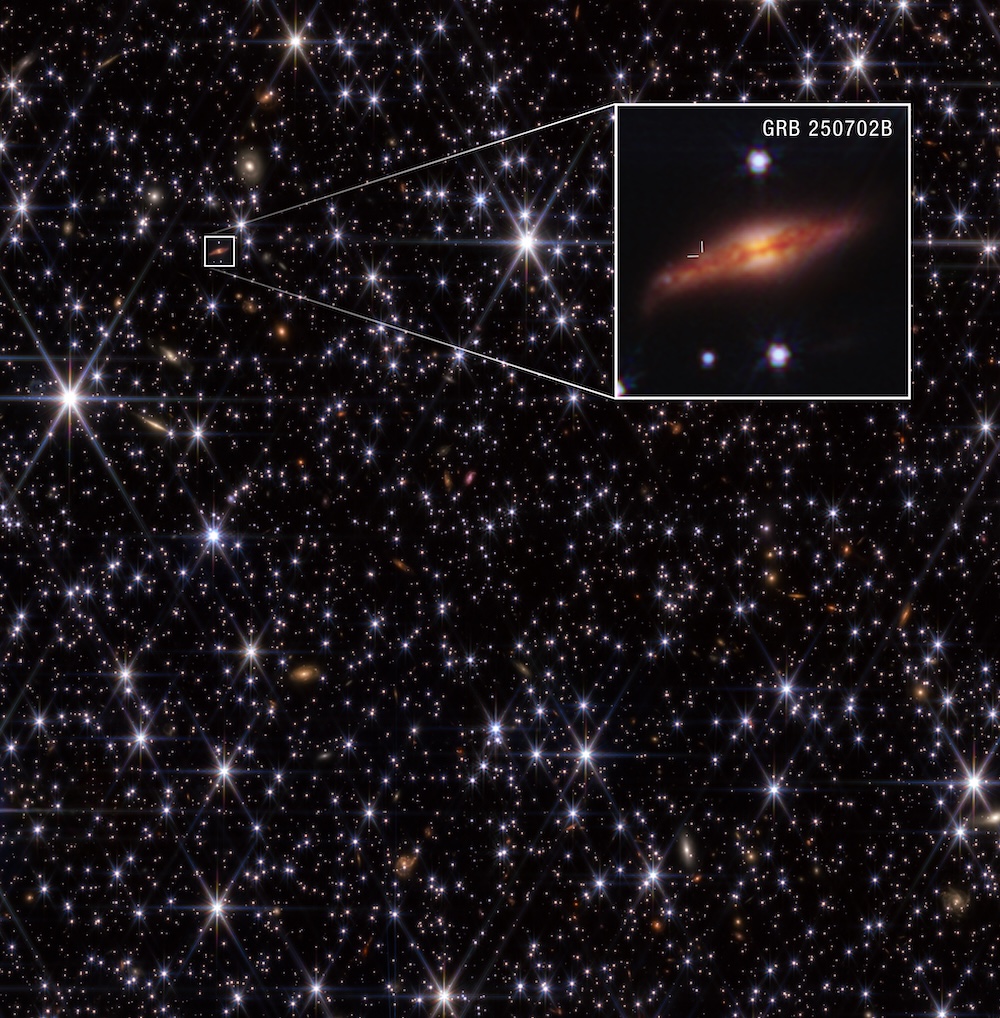
GRB 250702 host galaxy

An image of GRB 250702B’s location within its host galaxy. [NASA, ESA, CSA, H. Sears (Rutgers). Image Processing: A. Pagan (STScI)]

In 2025, the Fermi Gamma-ray Space Telescope spotted an intense flash of gamma rays from a distant, dusty galaxy, and a fleet of spacefaring and earthbound telescopes soon revealed the remarkable characteristics of the event. GRB 250702B featured multiple bursts spanning several hours, individual flares lasting roughly 100 seconds, and X-ray emission in the 24 hours leading up to the gamma-ray activity — something never seen before in a gamma-ray burst.

These characteristics have been challenging to explain with typical models of long gamma-ray burst formation, such as collapsing massive stars, but researchers have developed numerous promising alternatives. In a new research article, astronomers have shown how GRB 250702B’s behavior might be explained by repeated close encounters between a white dwarf and an intermediate-mass black hole.

Eccentric Close Encounters

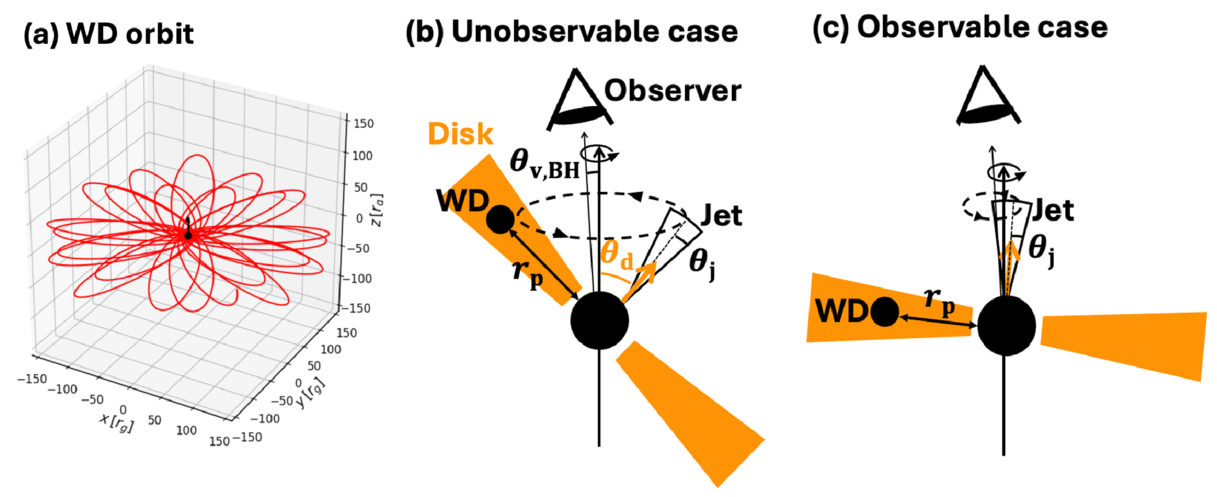
Yuri Sato (Tohoku University) and collaborators modeled the source of GRB 250702B as a white dwarf that has been captured into orbit around an intermediate-mass black hole. In their model, the white dwarf travels on an extremely eccentric orbit, drawing close to the black hole roughly once an hour. Each time the white dwarf ventures close, the black hole’s tidal forces strip away part of the star until, after about 40 such encounters, the white dwarf is completely destroyed.

geometry of the GRB 250702B system

Schematics showing the orbit of the white dwarf (WD; left) and the geometries that produce observable and unobservable jets. Click to enlarge. [Sato et al. 2026]

When the black hole peels material away from the white dwarf, some material swirls into an accretion disk, and some is cast off into space. Accretion from the disk powers a narrow relativistic jet: the source of the event’s powerful gamma-ray flares. This should mean that there is one jet produced each time the white dwarf is partially disrupted — 40 times — yet astronomers detected only a handful of flares from GRB 250702B.

Jet Precession and Model Predictions

The discrepancy can be resolved if the angle between the jet and the black hole’s spin axis precesses over time so that only some of the jets are pointed toward us. This can occur if the accretion disk is misaligned relative to the black hole’s spin. As an alternative, disk instabilities or other processes could keep all but a few of the expected jets from being launched.

radio afterglow predictions for GRB 250702B

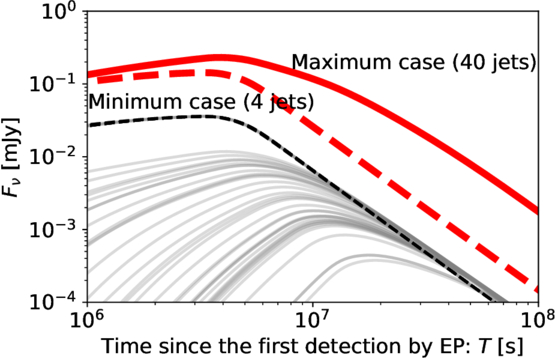
Predicted strength of the radio afterglow for the jet precession case (maximum case) and the case in which only four jets were launched due to disk instabilities or jet choking (minimum case). The x-axis shows the time since the burst was detected in X-rays by the Einstein Probe (EP). [Sato et al. 2026]

Sato and coauthors found that these two scenarios have different long-term outcomes, providing a potential way to ascertain what’s going on at the source; in the jet precession scenario, the jets that are launched away from our line of sight produce an order of magnitude more radio emission at late times.

This work by Sato and collaborators demonstrates how the repeated partial tidal disruption of a white dwarf by an intermediate-mass black hole can match the properties of one of the most remarkable recent transient sources — one that has pushed astronomers to consider new ways of producing gamma-ray bursts.

Citation

“Successive Partial Disruptions with Orbital Precession in a White Dwarf–Black Hole System for Repeating GRB 250702B,” Yuri Sato et al 2026 ApJL 1003 L44. doi:10.3847/2041-8213/ae6a8f

The post Could a White Dwarf–Black Hole Pair Explain the Longest Gamma-Ray Burst Ever Seen? appeared first on AAS Nova.
  •  

Evidence for a Delayed Ultraviolet Counterpart to X-Ray Quasiperiodic Eruptions in Ansky

Hengxiao Guo et al 2026 ApJL 1000 L57
ZTF19acnskyy may be the first X-ray quasiperiodic eruption source to display correlated ultraviolet emission — another strange behavior that researchers must explain for this already unique source.

The post Evidence for a Delayed Ultraviolet Counterpart to X-Ray Quasiperiodic Eruptions in Ansky appeared first on AAS Nova.
  •  

Shining a Light on the Shadowy Movements in Saturn’s Rings

Editor’s Note: Astrobites is a graduate-student-run organization that digests astrophysical literature for undergraduate students. As part of the partnership between the AAS and astrobites, we occasionally repost astrobites content here at AAS Nova. We hope you enjoy this post from astrobites; the original can be viewed at astrobites.org.

Title: Dynamics of Planetary Rings Under Thermal Forces
Authors: Wen-Han Zhou et al.
First Author’s Institution: The University of Tokyo
Status: Published in ApJL

If you ask anyone what their favourite planet is, the answer you’ll most likely hear is Saturn. Why? Why else than the beautiful and intricate ring system surrounding the gas giant. The other gas and ice giants in our solar system — Jupiter, Uranus, and Neptune — have ring systems themselves but none quite as striking as Saturn’s. Would it surprise you to learn that astronomers’ best models have not yet totally explained why Saturn’s rings look the way they do?

In contrast, it may not surprise you to hear that people have been trying to explain the rings for as long as we have seen them with telescopes. We now know that planetary rings are collections of relatively small particles (think micrometre up to metre sized), most likely having once been the material of a larger body that was disrupted either by collisions or tidal forces. This material, due to the gravity of its local planet, is sculpted into a flat disc where more subtle interactions then lead to substructure forming within the disc such as gaps and ringlets. Many of these substructures are explained by well-understood physics — for example gaps being carved by embedded moonlets or resonances sculpting ring edges — though there remain some outstanding problems in our understanding.

The authors of today’s article set their sights on the problematic inner edge of Saturn’s A ring (Figure 1). They describe some mechanisms — namely the collisions of micrometeoroids within the rings — by which a sharp ring edge can be maintained, but there exists a gap in the understanding of how such an edge can form in the first place. All hope is not lost, though, as today’s authors reintroduce a physical process they call the “eclipse–Yarkovsky” effect, which seems to explain these phenomena.

horizontally sliced Saturn's rings

Figure 1: A horizontally sliced image of Saturn’s rings shows the rich substructure and gaps within the various rings. Saturn, which is not shown here, would be to the left of the image. The authors of today’s article are particularly concerned with the bright and sharp inner (left side) edges of the A and B rings. Click to enlarge. [NASA/JPL/Space Science Institute]

Billions of Rocket-Powered Bumper Cars

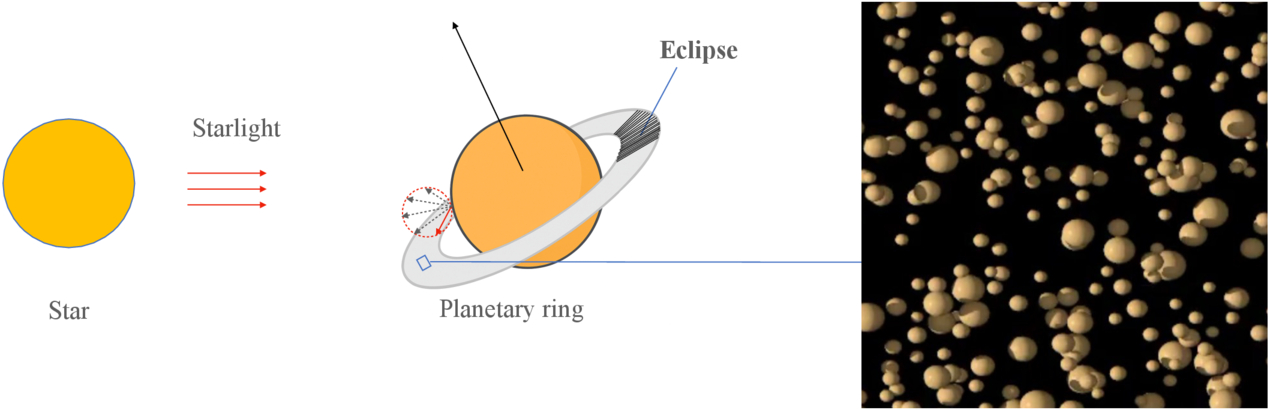
The idea behind this process revolves entirely around light. When sunlight hits a particle within a planetary ring, non-absorbed sunlight imparts a little “bump” onto a particle, ever so slightly altering its trajectory. At the same time, some of the sunlight is absorbed into the particle, which heats it up; light is soon re-emitted via thermal radiation, which, again, can slightly change the trajectory of these tiny particles. From a point on the surface of each ring particle (see rightmost side of Figure 2), the photons from this thermal radiation are all emitted in random directions; however, across the whole surface of the particle there is a net force! These tiny particles are spinning, and so the side just near “sunset” is hottest and emitting the most thermal photons. In this way, the pressure from the sunlight plus the thermal radiation of each particle imparts a net torque on the ring itself which changes the angular momentum of the ring.

diagram showing sunlight falling on Saturn and the planet casting a shadow on its rings

Figure 2: Starlight is the main source of light onto the particles that make up a planetary ring (right panel) though reflected light from the planet’s surface hits it too. This light “heats up” the ring and forms an asymmetry as the ring is eclipsed by the planet, which produces a net force. [Zhou et al. 2026]

What we described just then is essentially solar radiation pressure plus the Yarkovsky effect. It turns out that the net force from this process typically averages out to zero as the ring particles orbit around the planet. This assumes, though, that the sunlight is constantly shining on the ring. Stunning imagery of Saturn tells us that this isn’t the case, so what happens when we take into account the shadow cast on the ring from the planet? Today’s authors find that the net effect induces a positive change in angular momentum of the ring particles, which they call the eclipse–Yarkovsky effect.

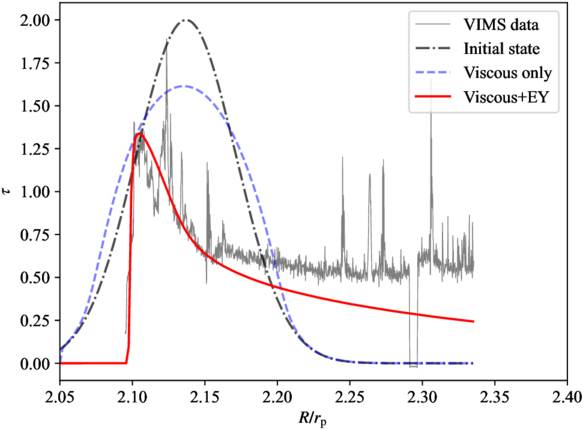
After today’s authors detailed all of the math involved in this process (and there is a lot), they put it into practice to try to help explain Saturn’s curious rings. Including the eclipse–Yarkovsky effect together with other known effects that drive ring evolution allowed them to reproduce the optical depth profile (how thick the ring looks) of Saturn’s A ring better than ever before (notably the sharp inner edge in Figure 3). On top of this, the effect provides another avenue for moonlet formation in the outer edges of ring systems as the positive torque from the effect drives material out toward and away from the Roche limit.

plot of optical thickness versus radius

Figure 3: The authors try to explain the current structure of Saturn’s A ring by initialising it with a Gaussian profile of optical thickness versus radius (black dot-dashed line) and evolving it for 81 million years under different effects. When viscous effects are included (blue dashed line), the ring spreads out, but it’s only when the eclipse–Yarkovsky (EY) effect is included (red line) that the model closely matches the observed data (grey line). [Zhou et al. 2026]

Undeniably useful for Saturn, the eclipse–Yarkovsky effect may also explain some other conundra in the solar system. Mars may have once had rings, which are thought to have eventually clumped together to form the inner moon Phobos. This idea is problematic, though, in that current models suggest there should still be some residual ring system around Mars even after Phobos formed. Enter the eclipse–Yarkovsky effect: being 100 times stronger for Mars than Saturn (due to its more intense incident sunlight), the effect may have driven out and dispersed that residual ring altogether. While the authors are currently looking into this possibility, the reintroduction of the eclipse–Yarkovsky effect has already shown great promise for our most beautiful ringed planetary neighbour.

Original astrobite edited by Wasi Naqvi.

About the author, Ryan White:

I am a first-year PhD student at Macquarie University in Australia, working mainly on binary/multiple systems with massive stars (Wolf–Rayets in particular!). Outside of study, I’m probably drinking coffee, baking, reading, or going for a run. You can also find me procrastinating on Bluesky @astroryan.bsky.social.

The post Shining a Light on the Shadowy Movements in Saturn’s Rings appeared first on AAS Nova.

  •  

The Response of Planetary Atmospheres to the Impact of Icy Comets. III. Impact Driven Atmospheric Escape

F. Sainsbury-Martinez et al 2026 ApJ 1001 57
Simulations suggest that tidally locked planets have similar atmospheric escape rates to Earth analogs despite having cooler and drier atmospheres near their surfaces.

The post The Response of Planetary Atmospheres to the Impact of Icy Comets. III. Impact Driven Atmospheric Escape appeared first on AAS Nova.

  •  

Courtside Seats on Mars

A photograph of an entire visible hemisphere of Mars.

When the third known object from the galactic space beyond our Sun barreled through the solar system last year, Earth was in a terrible spot to view its flyby. Thankfully, however, a spacecraft that was previously busy mapping Mars took advantage of much better positioning for a closer look.

Cheap Seats

Astronomers have now observed three interstellar objects as they’ve flown through the solar system: 1I/ʻOumuamua, which shocked astronomers in 2017; 2I/Borisov, which followed in 2019 and behaved almost identically to a solar system comet; and now 3I/ATLAS, which was found buzzing toward the Sun in July 2025. As soon as 3I/ATLAS was spotted, pretty much every telescope on the planet took a look. The data swiftly revealed much that intrigued astronomers: while 3I/ATLAS was behaving essentially like a standard comet, its chemistry was nothing like its solar system counterparts, and its coma and dust outflow were strangely shaped. Among other oddities, it seemed to counterintuitively have a dust tail that pointed toward the Sun.

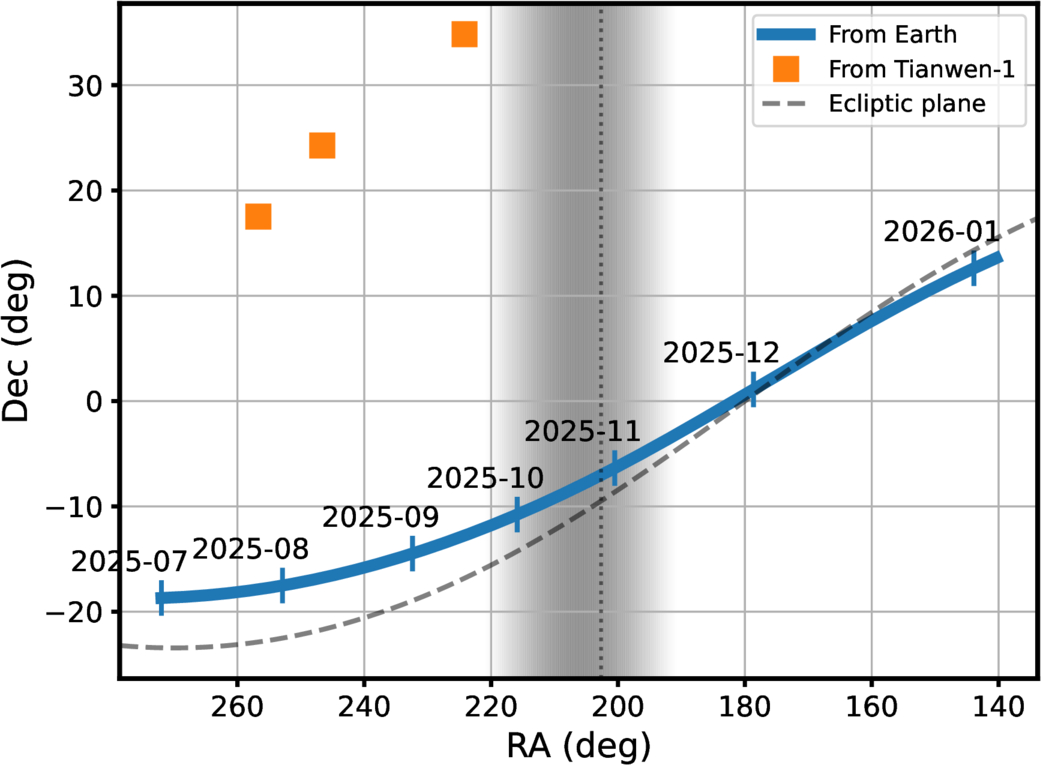
A plot showing that Earth-based observations could only get as best a 20-degree out-of-plane view, while Mars-based observations could get up to nearly 40.

3I/ATLAS’s path across the sky as seen from Earth versus the clearer line of sight from Mars. The shaded region represents the times where the comet was too close to the Sun for viewing. [Xin Ren et al. 2026]

Unfortunately for astronomers, 3I/ATLAS didn’t make it easy for them to study the shape of its coma. Thanks to a cosmic coincidence, the interstellar visitor was traveling almost perfectly within the plane of our solar system, and Earthbound observers were often limited to an edge-on view of its tail. Even worse, 3I/ATLAS looped around the back of the Sun from our perspective, meaning no one on the planet could observe the comet for a few weeks in the fall. This led a group of astronomers to consider their assets that are farther from home.

Better View from Mars

The Tianwen-1 spacecraft, which entered Martian orbit in early 2021 and has been diligently mapping the Red Planet ever since, has a high-resolution camera that’s normally pointed at the planet’s surface. By spinning the spacecraft around, a team of researchers led by Xin Ren (National Astronomical Observatories, Chinese Academy of Sciences) repurposed the camera to act as a small telescope when 3I/ATLAS flew by. In another cosmic coincidence, 3I/ATLAS happened to pass very near Mars last fall, and this close approach gave Tianwen-1 a great out-of-plane view of the coma. The orbiter managed to capture 57 images of 3I/ATLAS over three days last fall, representing China’s first-ever observations of an object from an asset in deep space.

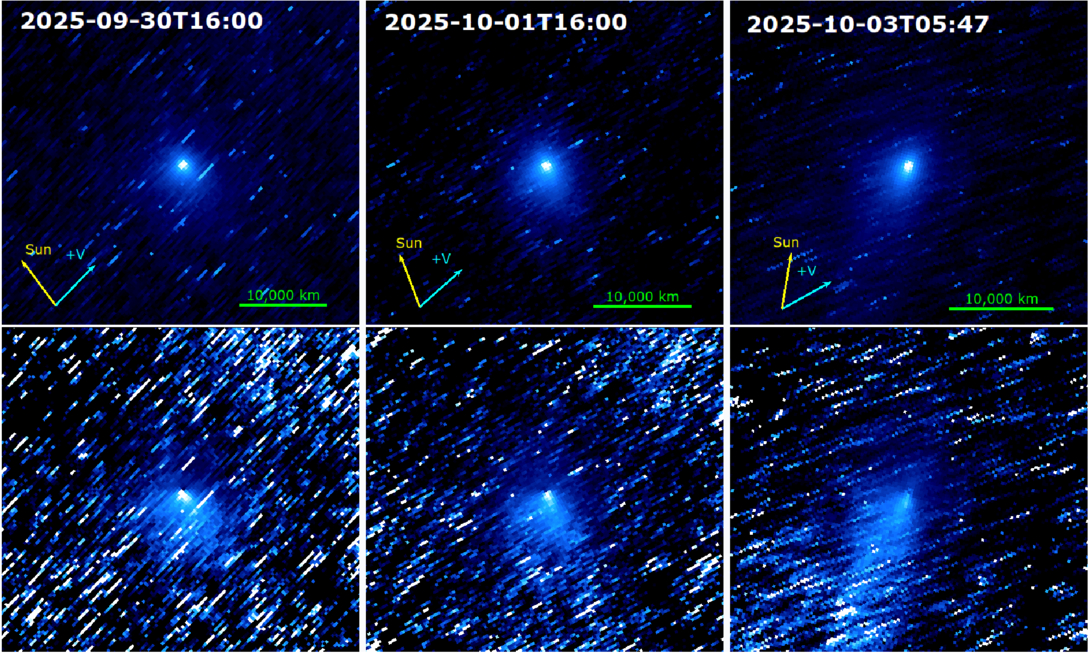
Multi-panel photographs of a comet against a background of streaked stars.

Stacked images of 3I/ATLAS from the Tianwen-1 orbiter across three epochs; the tail’s apparent shape shifts as the viewing geometry changes. Click to enlarge. [Xin Ren et al. 2026]

The team took full advantage of the great view and leveraged the spacecraft’s unique perspective to extract some intriguing results. By tracking how the gentle pressure of sunlight nudged the escaping grains, the researchers found that the coma is dominated by surprisingly large dust. With an average size of hundreds of microns across, the dust is more like coarse sand than smoke, and they found that it ambles away from the comet at just 3–10 meters per second. All told, 3I/ATLAS was shedding dust at roughly 1,000 kilograms every second. The big grains may be a fingerprint of a cold, distant birthplace: models suggest such grains collect in the frigid outer reaches of planet-forming disks, hinting that 3I/ATLAS was forged far from its parent star before being flung into the dark.

As new surveys begin to turn up interstellar interlopers more often, this improvised observation makes a tidy point: the spacecraft already scattered across the solar system can double as a fleet of opportunistic comet-watchers, each offering a view we simply can’t get from home.

Citation

“Interstellar Object 3I/ATLAS Observed from Mars by China’s Tianwen-1 Spacecraft,” Xin Ren et al 2026 ApJL 1003 L10. doi:10.3847/2041-8213/ae61b3

The post Courtside Seats on Mars appeared first on AAS Nova.

  •  

The First Dedicated Survey of Atmospheric Escape from Planets Orbiting F Stars

Morgan Saidel et al 2026 AJ 171 257
A survey of six gas giants orbiting F-type stars suggests that atmospheric escape of these planets is determined by the X-ray and extreme-ultraviolet output of their host stars as well as the Roche filling factor.

The post The First Dedicated Survey of Atmospheric Escape from Planets Orbiting F Stars appeared first on AAS Nova.

  •  

Now That’s Metal: How to Spot Stars That Have Swallowed Their Planets

An illustration of an exoplanet about to be engulfed by its host star

Planets that get too close to their host stars are liable to be engulfed and consumed. New research explores how to identify stars that have had a planetary snack.

It’s Snack Time

Being a planet that closely orbits its star is dangerous, and various dynamical processes can draw a planet inward past the point of no return. When a planet vanishes beneath the surface of its host, it eventually disintegrates within the star, its atoms mixing into the blazing stellar soup.

This outcome is likely extremely common across the universe, and researchers have begun to see evidence for it: stars that appear to have absorbed angular momentum from their planets, white dwarfs with uncanny metals in their spectra, and stars with chemical abundances that don’t match those of their siblings. Now, in a recent publication led by Kaitlyn Lane (Vanderbilt University), researchers seek to find observational signatures of planetary engulfment of rocky exoplanets by main-sequence stars.

Modeling Engulfment

Lane’s team focused on main-sequence stars in the range of 0.5 to 1.4 solar masses, using one-dimensional analytical models to determine which of these stars will most readily display signs of having engulfed a planet. They simulated the stars as they consumed either an Earth-like planet or a super-Earth with the same composition as Earth but 15 times its mass.

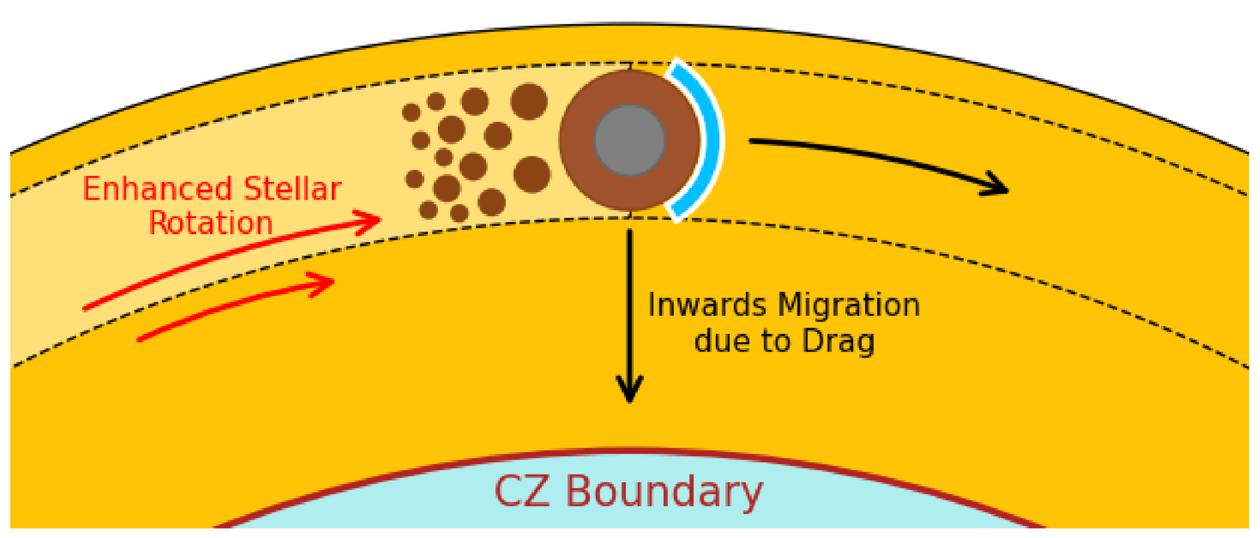
illustration of a planet being engulfed by its star

Diagram showing a planet being engulfed by its star and beginning to disintegrate before migrating inward. The boundary between the star’s outer convective zone (CZ) and inner radiative zone is shown. Click to enlarge. [Lane et al. 2026]

At the onset of the model, the engulfment is set to begin, the planet placed tangent to the star’s surface. The planets sink down and orbit just barely within their stars for 1–10 years, their solid surfaces slowly beginning to evaporate.

After that relatively lengthy phase, the process proceeds rapidly: as the planet inches deeper into its star, the drag forces grow stronger and the planet’s demise accelerates, with the planet disintegrating over the course of hours. In the last phase, the planet makes its final plunge and is destroyed in a half hour.

Signs of Planets Past

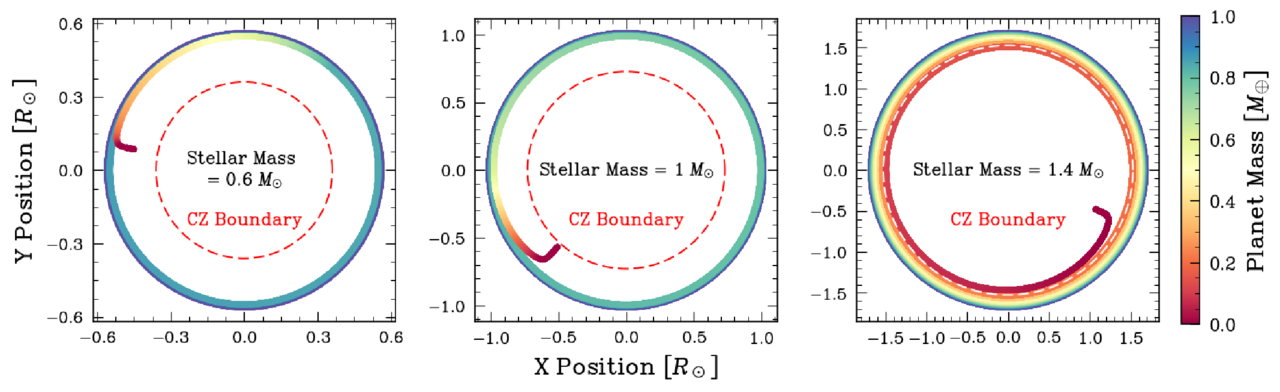
Lane’s team found that the planets tended to be destroyed fully within the outer convective layer of their stars, except in the case of the most massive stars studied here. For more massive stars, the outer convective zone is shallower than it is for the less massive stars, allowing a chunk of each planet to survive the passage through the convective zone to reach the radiative zone below.

simulation results showing planets disintegrating within their host stars

The trajectories of three example cases, showing how the planet loses mass as it spirals inward. In the 1.4-solar-mass case, part of the planet survives to reach the radiative zone, but the shallowness of the star’s convective zone means that the disintegrated planetary material is easier to observe. Click to enlarge. [Lane et al. 2026]

What this translates to, for the purposes of identifying planet-eating stars from afar, is that stars near the top of the mass range studied — from 1.0 to 1.4 solar masses — make the best targets. This is because the tell-tale planetary metals are not overly diluted within the stars’ relatively small convective zones, making these elements easier to detect. In terms of specific metals, the authors found that aluminum, calcium, and vanadium are the best signposts of planetary engulfment, with lithium also making the list.

While the authors acknowledge that there’s more work to be done — they plan to investigate the impacts of planetary engulfment on stellar structure more closely, for example — this work represents an important foray into identifying targets for future studies of stars that have eaten their planets.

Citation

“Observable Metal Pollution in Main-Sequence Stars: Simulations of Rocky Planets Engulfed by Stars in the 0.5 to 1.4 M⊙ Range,” Kaitlyn T. Lane et al 2026 ApJ 1003 67. doi:10.3847/1538-4357/ae5b9a

The post Now That’s Metal: How to Spot Stars That Have Swallowed Their Planets appeared first on AAS Nova.

  •  

Measuring the Distances to Asteroids from One Observatory in One Night with Upcoming All-Sky Telescopes

Maryann Benny Fernandes et al 2026 Planet. Sci. J. 7 76
Using simulations of 20 asteroids from 0.05 to 2.4 au away, researchers demonstrate how the technique of topocentric parallax could be used to determine the distance to an asteroid in a single night.

The post Measuring the Distances to Asteroids from One Observatory in One Night with Upcoming All-Sky Telescopes appeared first on AAS Nova.

  •  

The First Starspot Spectrum Revealed by JWST

M-dwarf star with starspots

Editor’s Note: Astrobites is a graduate-student-run organization that digests astrophysical literature for undergraduate students. As part of the partnership between the AAS and astrobites, we occasionally repost astrobites content here at AAS Nova. We hope you enjoy this post from astrobites; the original can be viewed at astrobites.org.

Title: A Panchromatic JWST Spectrum of a Giant Starspot on the Fully Convective M Dwarf TOI-3884
Authors: C. A. Murray et al.
First Author’s Institution: University of Colorado Boulder
Status: Published in ApJ

We often picture stars as smooth, glowing spheres, as if they’ve been run through an Instagram filter. But real stars have spots: cooler, darker regions on a star’s surface caused by strong magnetic fields.

Annoyingly, these spots can seriously interfere with how we study exoplanet atmospheres.

How to Probe a Planetary Atmosphere

Planetary atmospheres are often probed through transmission spectroscopy. When a planet transits its star, some starlight passes through the planet’s atmosphere before reaching us. We can distinguish the light that has passed through the planet’s atmosphere by comparing the star’s light in transit versus out of transit. In doing so, we can isolate the atmospheric spectrum and look for absorption features of species like water or oxygen.

Easy, right?

How Starspots Get in the Way

Things get more complicated once we stop thinking of the star as if it’s been smoothed out by an Instagram filter. Starspots are cooler than the surrounding stellar surface, which means they emit a different spectrum. They are also constantly changing: new spots can form, old ones can disappear, and the star’s rotation carries them in and out of view. This changes things.

First of all, your star’s spectrum changes over time, which could mean that the star’s spectrum out of transit is not the same as the star’s spectrum during transit. On the other hand, the planet may transit across a starspot instead of a “normal” stellar region. In this case, the light we measure during the transit is affected by the spot, and it is no longer accurate to directly compare it with the overall stellar light outside the transit.

Ultimately, absorption features that we thought were from the planetary atmosphere could actually be coming from starspot contamination instead.

Starspot Models: Our Solution?

To deal with this, astronomers build starspot models, where they vary the spots in terms of the following:

  • The surface covering fraction: this parameter tells us how much of the stellar surface is covered in spots
  • The temperature contrast: this parameter tells us how much cooler (in ratio) the spot is compared to the rest of the stellar surface, and by proxy how much dimmer

These models are promising, but how do we know that we have chosen the right parameters?

A Unique Laboratory: TOI-3884

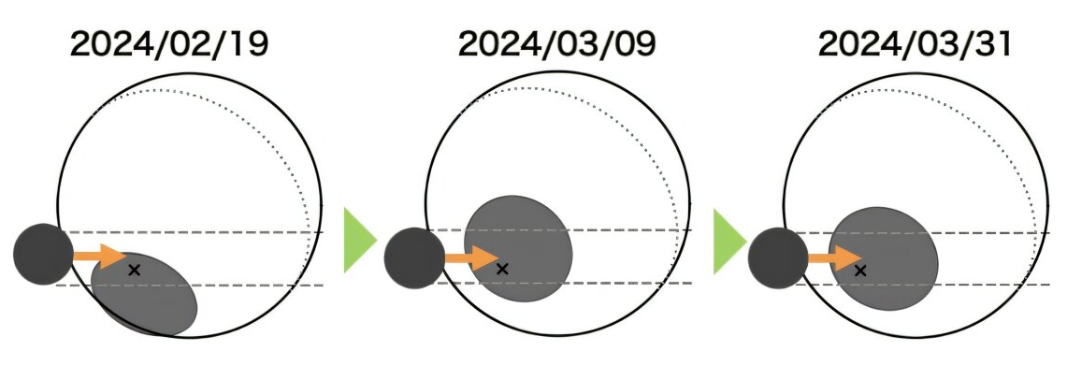
The TOI-3884 system is a unique laboratory for testing our starspot models. As seen in Figure 1, it has very convenient starspot geometry, with a large starspot located close to its pole. On top of that, we observe this star almost completely pole-on, which means that we always see this starspot, no matter how much the star rotates. To top this all off, the star hosts a close-in planet, which orbits the star from pole to pole.

Illustration of the TOI-3884 system

Figure 1: Illustration of the TOI-3884 system. The pole (and rotation axis) of the star is indicated with a black “x,” indicating that we see the star almost pole-on. The polar starspot is indicated in grey, and the transiting planet TOI-3884b is indicated in black. Different dates are shown, illustrating how the system evolves over the span of a few weeks. [Adapted from Mori et al. 2025]

The planet transits the star, and as it does so, it always passes over the polar starspot. This gives us a rare opportunity to probe the spectrum of a starspot. Similar to how we can use normal in/out of transit observations to probe a planetary atmosphere, we can now compare the observations during/after a “starspot transit” to probe the starspot region. Today’s authors do exactly this using six different transit observations from JWST.

So… How Good Are Our Models?

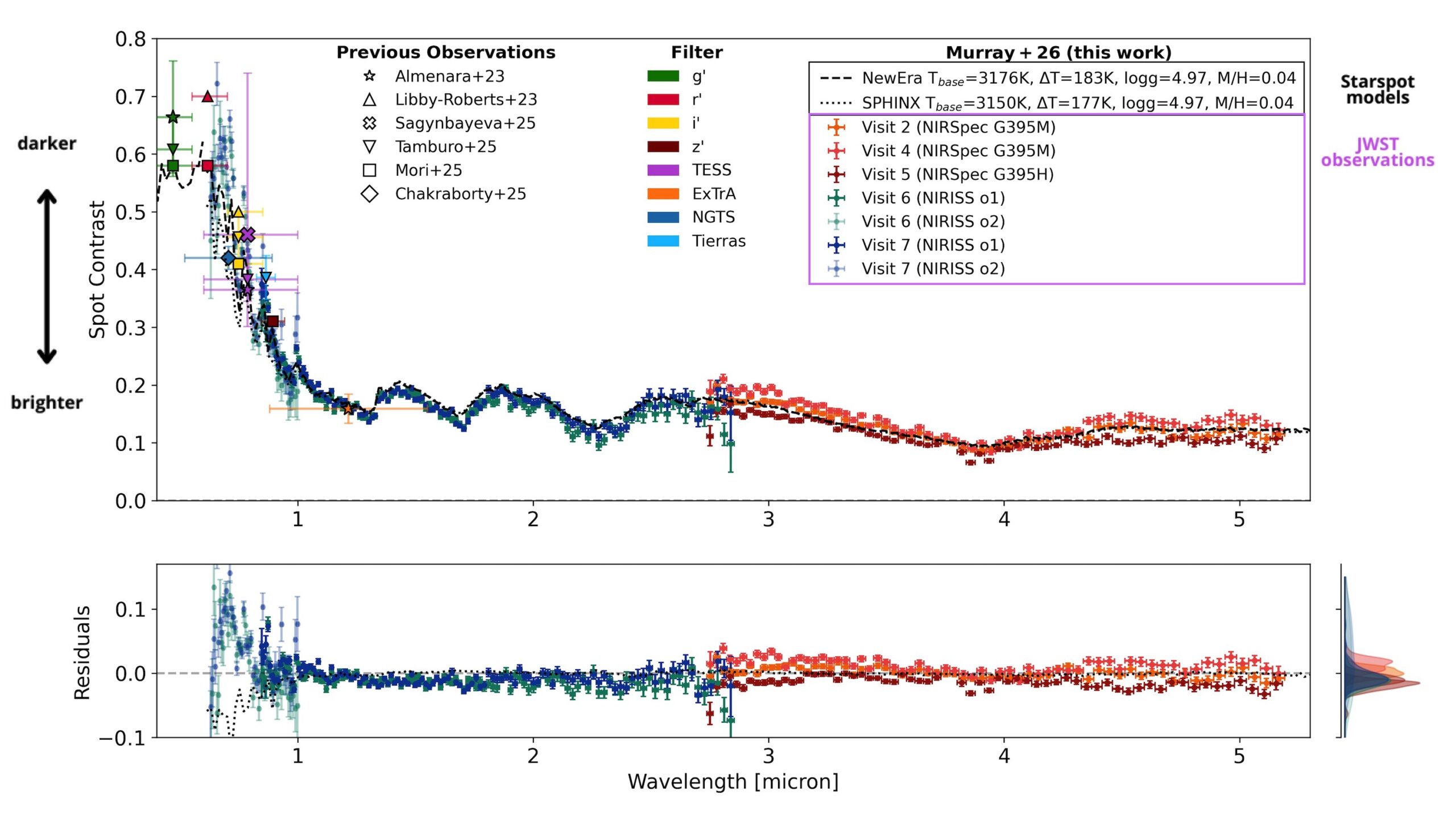
From the JWST observations, the authors extract a starspot spectrum for the first time. Figure 2 shows this as the spot contrast (how much dimmer the spot is than the surrounding stellar surface) plotted across different wavelengths. To see how well our models are doing, they compare this observed spectrum to two commonly used starspot models. The difference between the data and the models (the residual) is plotted in the lower panel.

spectrum of TOI-3884’s starspot.

Figure 2: The spectrum of TOI-3884’s starspot. The y-axis in the upper panel, the spot contrast, indicates how much dimmer the starspot is compared to the “normal” stellar surface. Different observations taken with JWST are indicated in different colored crosses, and other previous observations are overplotted in various other shapes. Model starspot spectra are shown in dashed or dotted black lines. The residuals between the model spectra and the JWST observations are shown in the bottom panel. [Adapted from Murray et al. 2026]

At wavelengths longer than about 1 micron, in the near-infrared regime, things look good! The residuals stay small, meaning the models do a solid job reproducing the observations. But move left into shorter wavelengths, in the optical regime, and the agreement quickly falls apart. The residuals grow, and it becomes clear that the models are missing something.

There’s still work to be done before we can confidently probe planetary atmospheres at optical wavelengths without worrying about stellar contamination, and this observed starspot spectrum provides a unique benchmark to test future starspot models. For now, the near-infrared remains a safer and more reliable window for planet atmosphere studies.

Original astrobite edited by Natalie Price.

About the author, Elise Koo:

I’m a PhD student at the University of Amsterdam, working to detect magnetic interactions between stars and their planets using radio and spectroscopic observations. Outside of research, I like to try out a variety of sports.

The post The First Starspot Spectrum Revealed by JWST appeared first on AAS Nova.

  •  
❌