❌

Reading view

AGN SIG Spotlight Series, 21 July 2026

AGN SIG Spotlight Series

Active Galactic Nuclei Science Interest Group

AGN SIG about AGN SIG Spotlight Series

Location

Virtual

Dates

21 July 2026
1:00pm ET / 10:00am PT

Community

AGN SIG

Type

Seminar

Spin Signatures in Horizon-Resolved Images of LLAGN

Speaker

Dr. Daniel Palumbo, Harvard University

Abstract

With the advent of the Event Horizon Telescope (EHT), near-horizon black hole imaging with sub-mm very-long-baseline interferometry (VLBI) is now routine for the two sources for which terrestrial VLBI is sufficient to resolve the black hole shadow: Messier 87* and Sagittarius A*. Since the first images of M87*, the theoretical analysis of these images has advanced a broad class of black hole spin tracers in horizon-resolving observations, all of which have complex interplay with the astrophysical conditions near the horizon. Meanwhile, space VLBI mission concepts such as the Black Hole Explorer aim to drastically improve the angular resolution available via sub-mm VLBI, resolving out the primary accretion disk image to isolate the strongly lensed “photon ring,” which more robustly exposes black hole mass, spin, and viewing inclination to distant observers. In this talk, I will detail the spin signatures in both of these angular resolution regimes, and how they work together to build a “robustness ladder” for spin measurement with which the spins of many more low-luminosity AGN will soon become accessible as sub-mm VLBI sensitivity, frequency coverage, angular resolution improves. The resulting local “spin census” will help fill in missing pieces of the history of accretion and merging in the broader AGN population.

Coupling Driven H2 Excitation in Seyferts: GATOS JWST/MRS

Speaker

Daniel Delaney, University of Alaska

Abstract 

We utilize James Webb Space Telescope/Mid Infrared Instrument (JWST/MIRI) Integral Field Unit observations from the Galaxy Activity, Torus and Outflow Survey to investigate the diverse range of ionized outflow rates of obscured active galactic nuclei (AGN) with similar bolometric luminosity and explore potential associations with AGN feedback. We explore spatial correlations between ionized emission potentially associated with fast shocks ([Fe II]5.34μm) and the excitation of H2. We further constrain our investigation to the inner 400 pc (the nuclear and circumnuclear regions r < 200 pc), and estimate the excitation temperature and column density of H2 assuming local thermodynamic equilibrium and using the S(1)–S(8) rotational H2 emission lines visible to JWST/MIRI spectroscopy. We report the molecular gas temperature of the deprojected 400 pc nuclear region to correlate with the ionized mass outflow rate. We also observe a stronger degree of spatial correlation between [Fe II]5.34μm emission and H2 gas temperature. We observe regions of enhanced [Fe II]5.34μm/[Ar II]6.99μm spatially coincident with the ionization cones of objects with higher ionized outflow rates and [Fe II]5.34μm/[Ar II]6.99μm in the deprojected 400 pc nuclear region to scale positively with both the ionized outflow rate and the estimated molecular gas temperature. We do not observe the estimated jet cavity power within the central 400 pc as strongly correlated with the ionized mass outflow rate or molecular gas temperature of the nuclear region. We take the preceding observations to suggest a higher degree of interaction between AGN outflows and the circumnuclear disk.

Seminar Connection

Zoom Registration (note this is a new registration link), you will receive connection details by email after registration: 

https://alaska.zoom.us/meeting/register/V1okit8uSk2ql97gegbdzg

News Straight to Your Inbox

Subscribe to your community email news list

We will never share your email address.
Privacy Policy

Sign Up
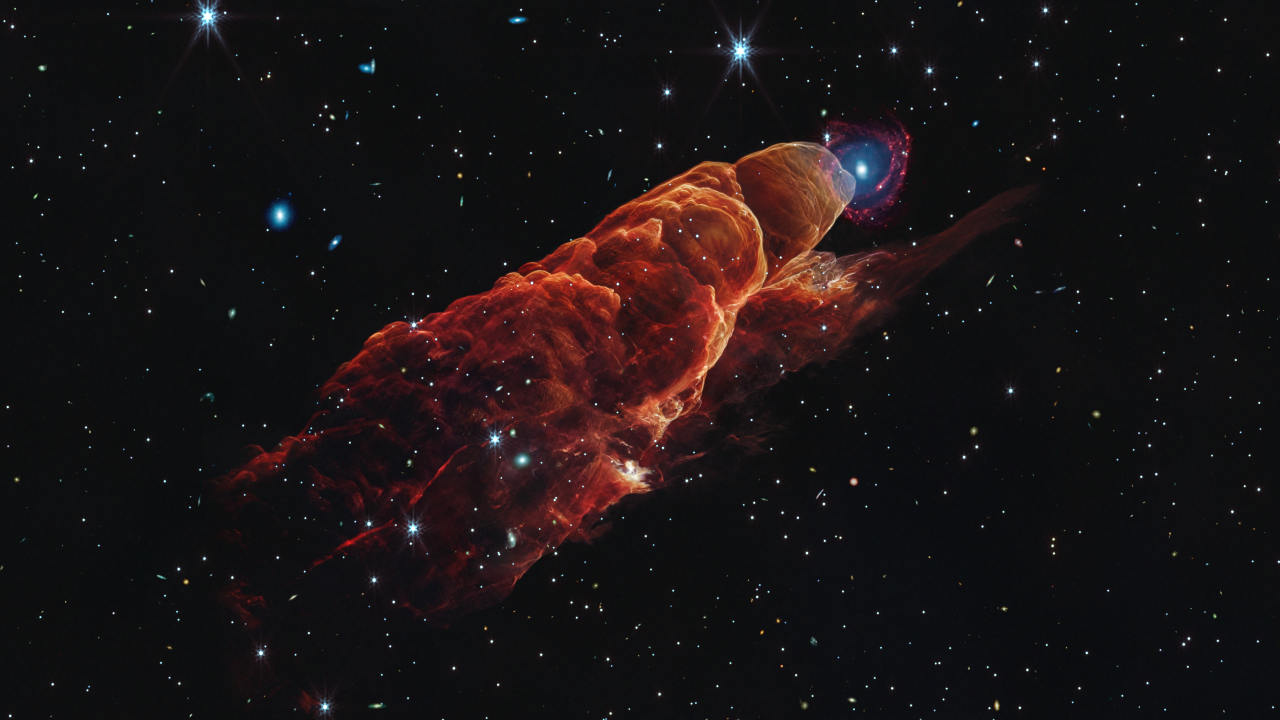
Angled from the upper left corner to the lower right corner is a cone-shaped orange-red cloud known as Herbig-Haro 49/50. This feature takes up about three-fourths of the length of this angle. The upper left end of this feature has a translucent, rounded end. The conical feature widens slightly from the rounded end at the upper right down to the lower right. Along the cone there are additional rounded edges, like edges of a wave, and intricate foamy-like details, as well as a clearer view of the black background of space. In the upper left, overlapping with the rounded end of Herbig-Haro 49/50, is a background spiral galaxy with a concentrated blue center that fades outward to blend with red spiral arms. The background of space is speckled with some white stars and smaller, more numerous, fainter white galaxies throughout.

The post AGN SIG Spotlight Series, 21 July 2026 appeared first on NASA Science.

  •  

DGCE SIG Seminar, 23 July 2026

DGCE SIG Seminar

Diffuse Gas in Cosmic Ecosystems Science Interest Group

DGCE SIG about DGCE SIG Seminar

Location

Virtual

Dates

23 July 2026
4:00pm ET / 1:00pm PT

Community

DGCE SIG

Type

Seminar

From Micro to Macro: Connecting the Physics of Galaxy Formation Across Scales

Speaker

Drummond Fielding, New York University

Abstract

Galaxy formation is controlled by the cycling of diffuse gas through the ISM, CGM, and larger-scale environment, but predictive models remain limited by unresolved microphysics. I will discuss how sub-pc processes—including cosmic-ray transport, magnetic reconnection, and turbulent mixing—regulate multiphase structure, energy and momentum transport, and the launching of galactic winds. I will then describe how simulations, analytic models, and new multi-scale numerical methods can connect these processes to kpc-scale feedback and Mpc-scale galaxy evolution. The aim is to build physically grounded models of gas cycling that can sharpen our interpretation of observations and move galaxy formation theory beyond phenomenological feedback prescriptions.

Seminar Connection

Join the Seminar

News Straight to Your Inbox

Subscribe to your community email news list

We will never share your email address.

Privacy Policy

Sign Up
Angled from the upper left corner to the lower right corner is a cone-shaped orange-red cloud known as Herbig-Haro 49/50. This feature takes up about three-fourths of the length of this angle. The upper left end of this feature has a translucent, rounded end. The conical feature widens slightly from the rounded end at the upper right down to the lower right. Along the cone there are additional rounded edges, like edges of a wave, and intricate foamy-like details, as well as a clearer view of the black background of space. In the upper left, overlapping with the rounded end of Herbig-Haro 49/50, is a background spiral galaxy with a concentrated blue center that fades outward to blend with red spiral arms. The background of space is speckled with some white stars and smaller, more numerous, fainter white galaxies throughout.

The post DGCE SIG Seminar, 23 July 2026 appeared first on NASA Science.
  •  

HWO SIG Seminar, 12 August 2026

HWO SIG Seminar

Habitable Worlds Observatory Science Interest Group

HWO SIG about HWO SIG Seminar

Location

Virtual

Dates

12 August 2026

Community

HWO SIG

Type

Seminar

Title TBA

Speaker

TBA

Seminar Connection

Join the Seminar

News Straight to Your Inbox

Subscribe to your community email news list

We will never share your email address.

Privacy Policy

Sign Up
Angled from the upper left corner to the lower right corner is a cone-shaped orange-red cloud known as Herbig-Haro 49/50. This feature takes up about three-fourths of the length of this angle. The upper left end of this feature has a translucent, rounded end. The conical feature widens slightly from the rounded end at the upper right down to the lower right. Along the cone there are additional rounded edges, like edges of a wave, and intricate foamy-like details, as well as a clearer view of the black background of space. In the upper left, overlapping with the rounded end of Herbig-Haro 49/50, is a background spiral galaxy with a concentrated blue center that fades outward to blend with red spiral arms. The background of space is speckled with some white stars and smaller, more numerous, fainter white galaxies throughout.

The post HWO SIG Seminar, 12 August 2026 appeared first on NASA Science.
  •  

GW SIG Seminar, 23 July 2026

GW SIG Seminar

Gravitational Wave Science Interest Group

GW SIG about GW SIG Seminar

Location

Virtual

Dates

23 July 2026
10:00am – 11:15am ET

Community

GW SIG

Type

Seminar

LISA Preparatory Science and LISA Science Gaps

Details TBA

Seminar Connection

Join the Seminar

News Straight to Your Inbox

Subscribe to your community email news list

We will never share your email address.

Privacy Policy

Sign Up
This cropped horizontal image has layers of semi-opaque rusty red colored gas and dust that starts at the bottom right and goes toward the top left. There are three prominent pillars rising toward the top left. The left pillar is the largest and widest. The peaks of the second and third pillars are set off in darker shades of brown and have red outlines.

The post GW SIG Seminar, 23 July 2026 appeared first on NASA Science.
  •  

Habitable Worlds Observatory SIG Seminar, 12 Aug 2026

Habitable Worlds Observatory SIG Seminar

Habitable Worlds Observatory Science Interest Group

HWO SIG about Habitable Worlds Observatory SIG Seminar

Location

Virtual

Dates

12 August 2026

Community

HWO SIG

Type

Seminar

Title TBA

Speaker

TBA

Seminar Connection

Join the Seminar

News Straight to Your Inbox

Subscribe to your community email news list

We will never share your email address.

Privacy Policy

Sign Up
This cropped horizontal image has layers of semi-opaque rusty red colored gas and dust that starts at the bottom right and goes toward the top left. There are three prominent pillars rising toward the top left. The left pillar is the largest and widest. The peaks of the second and third pillars are set off in darker shades of brown and have red outlines.

The post Habitable Worlds Observatory SIG Seminar, 12 Aug 2026 appeared first on NASA Science.
  •  

Ontario Wildfire Smoke Moves East

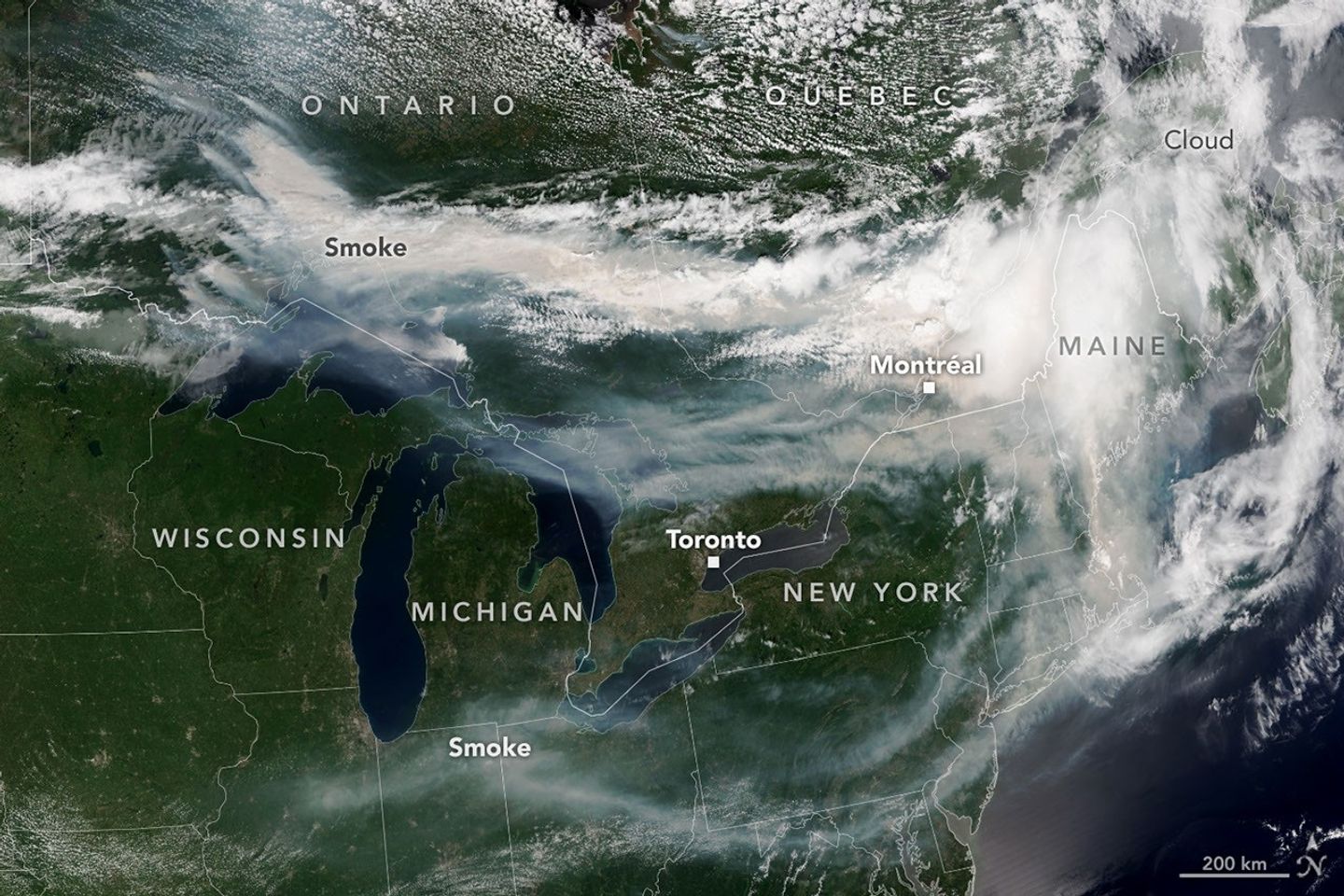
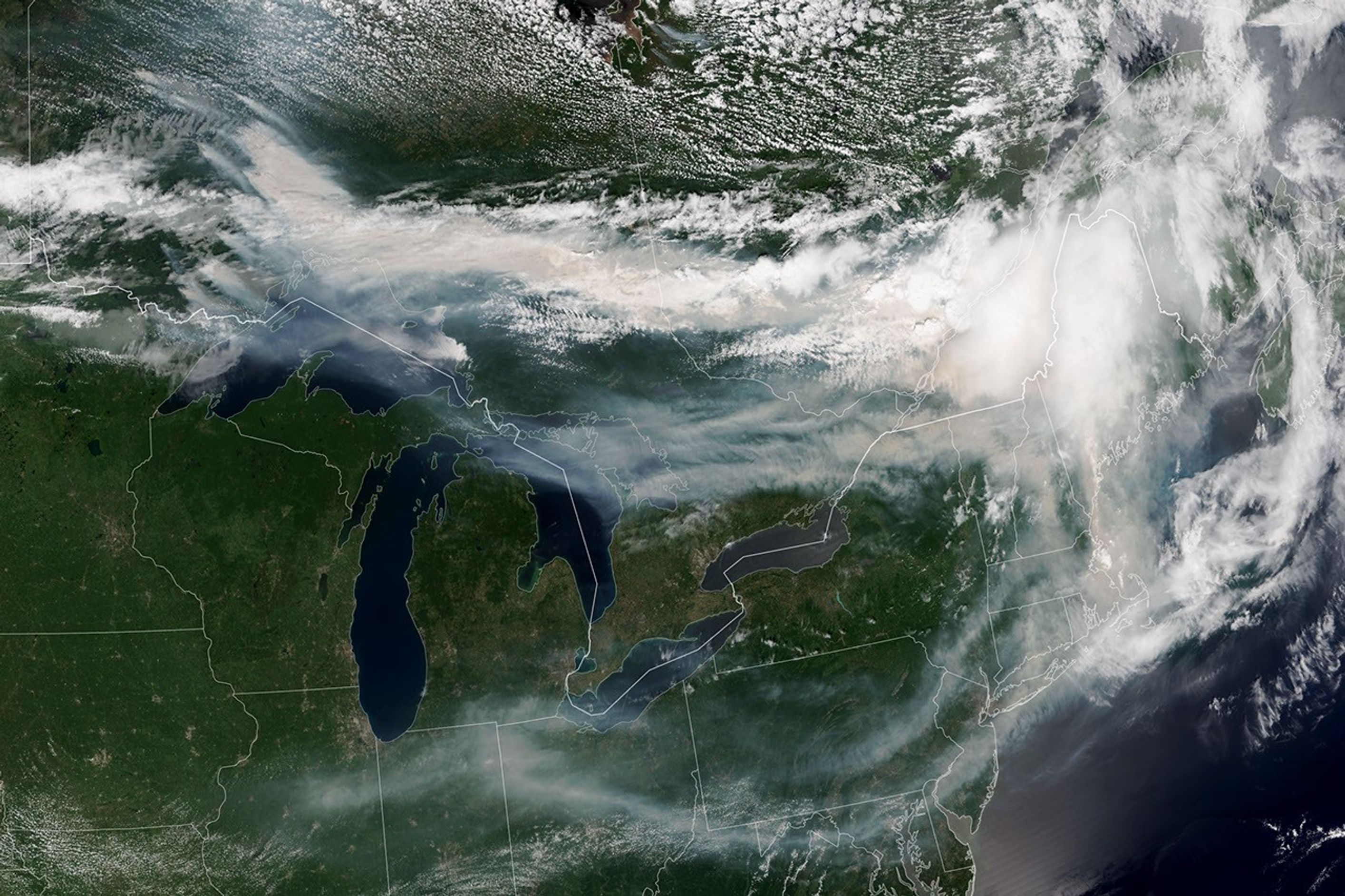
A satellite image shows brown smoke from wildfires in Ontario, Canada, streaming east across parts of Canada and the U.S. Areas of white clouds are mixed in with the smoke.
Smoke from wildland fires pours eastward over Canada and the U.S. in an image captured on the afternoon of July 14, 2026, by the VIIRS (Visible Infrared Imaging Radiometer Suite) on the NOAA-21 satellite.
NASA Earth Observatory/Lauren Dauphin

After a slow start to Canada’s 2026 fire season, activity picked up by the end of June amid dry, warm conditions and returned closer to the 25-year average. By mid-July, almost 850 fires were actively burning across the country, according to the Canadian Interagency Forest Fire Centre. More than 180 of those were burning in Ontario.

This NOAA-21 image, acquired on the afternoon of July 14, 2026, shows smoke billowing from the Ontario fires. Winds carried the smoke primarily southeast over much of the southern part of the province, as well as parts of Quebec and the U.S. Midwest and Northeast, tinting the sky shades of gray and yellow and the Sun orange in many areas.

The smoke’s impact on air quality varied, depending largely on altitude. In areas where smoke was high in the atmosphere, air quality impacts were negligible; where it drifted closer to the ground, conditions worsened. Air quality in Toronto, for instance, reached unhealthy levels, according to AirNow. People in the southern parts of the province were also grappling with a heat wave, compounding the health risks.

Much of the smoke came from fires in Northwestern Ontario, where eight blazes saw significant growth on July 13 and 14. The fires prompted officials to issue evacuation orders for several communities in this part of the province, according to news reports.

As of July 14, fires across Canada have burned 1.9 million hectares (4.7 million acres) since the start of the year—still well below the season totals from the extreme fire years of 2023 and 2025. How the rest of the season plays out remains to be seen. A seasonal fire outlook—compiled by wildland fire experts from the U.S., Canada, and Mexico—shows where fire conditions are more or less likely through July, August, and September.

NASA Earth Observatory image by Lauren Dauphin, using VIIRS data from NASA EOSDIS LANCE , GIBS/Worldview , and the Joint Polar Satellite System (JPSS). Story by Kathryn Hansen.

Downloads

A satellite image shows brown smoke from wildfires in Ontario, Canada, streaming east across parts of Canada and the U.S. Areas of white clouds are mixed in with the smoke.

July 14, 2026

JPEG (3.96 MB)

References & Resources

You may also be interested in:

Stay up-to-date with the latest content from NASA as we explore the universe and discover more about our home planet.

Fighting Fire With Fire
3 min read

In fire-prone ecosystems in Australia’s Northern Territory, prescribed burns are lit to minimize the severity of fires later in the…

Article
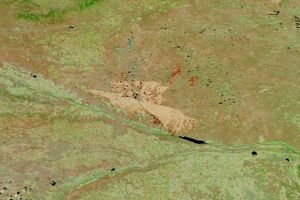
Fires Tear Through Nebraska Grasslands
3 min read

Dry, warm, and windy conditions across the U.S. Great Plains led to extreme fire activity in March 2026.

Article
Cottonwood Fire Chars Utah
5 min read

The blaze burned more than 150 square miles and swept through parts of a ski resort.

Article

The post Ontario Wildfire Smoke Moves East appeared first on NASA Science.
  •  

NASA Uses Subscale Aircraft to Accelerate Flight Innovation

4 Min Read

NASA Uses Subscale Aircraft to Accelerate Flight Innovation

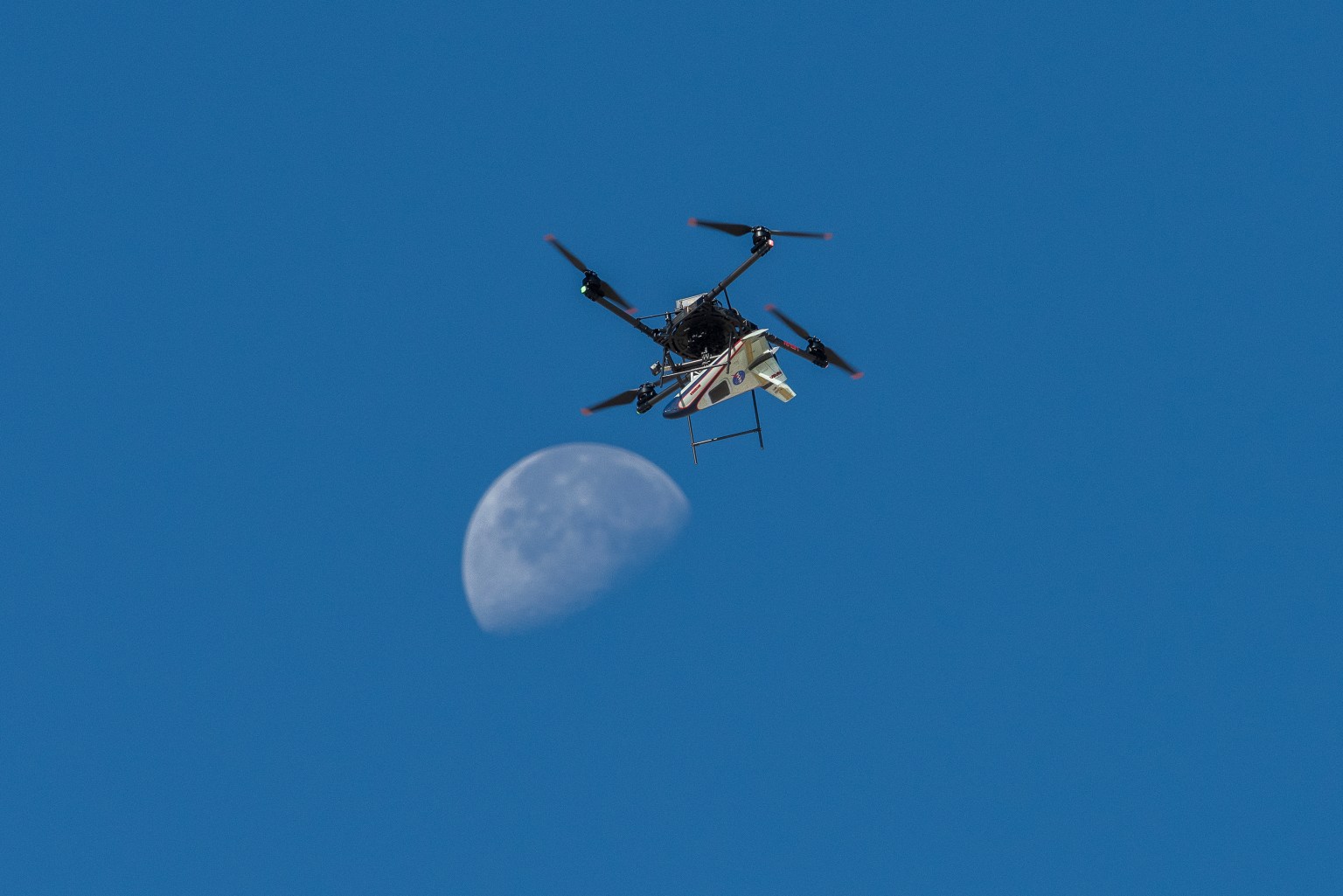
A white, blue, and red probe attached to a rotor with four blades flies in the blue sky, just above the Moon.
An atmospheric probe model attached upside down to a quad rotor remotely piloted aircraft ascends with the Moon visible on Oct. 22, 2024. The quad rotor aircraft released the probe above Rogers Dry Lake, a flight area adjacent NASA’s Armstrong Flight Research Center in Edwards, California. The probe was designed and built at the center.
Credits: NASA/Steve Freeman

Testing new aerospace concepts in flight remains one of NASA’s most effective ways to advance knowledge and reduce risk.

The Dale Reed Subscale Flight Research Laboratory at NASA’s Armstrong Flight Research Center in Edwards, California, supports this mission by using small, remotely piloted and autonomous aircraft as cost‑effective platforms to mature innovative ideas, accelerate learning, and enable smoother transitions to full‑scale flight.

When experiments require a flight platform, several NASA remotely piloted aircraft are available: the Alta‑X quadrotor; the Dryden Remotely Operated Integrated Drone (DROID) with its 10‑foot wingspan; and the Multi‑Use Cub, a 14‑foot‑span fixed‑wing aircraft with an expandable payload capacity for flight experiments. For electric vertical takeoff and landing testing, the HQ‑90 quadrotor provides an additional option.

Once aircraft and experiments are cleared for operations, laboratory pilots support the mission, including ground operations and flight activities.

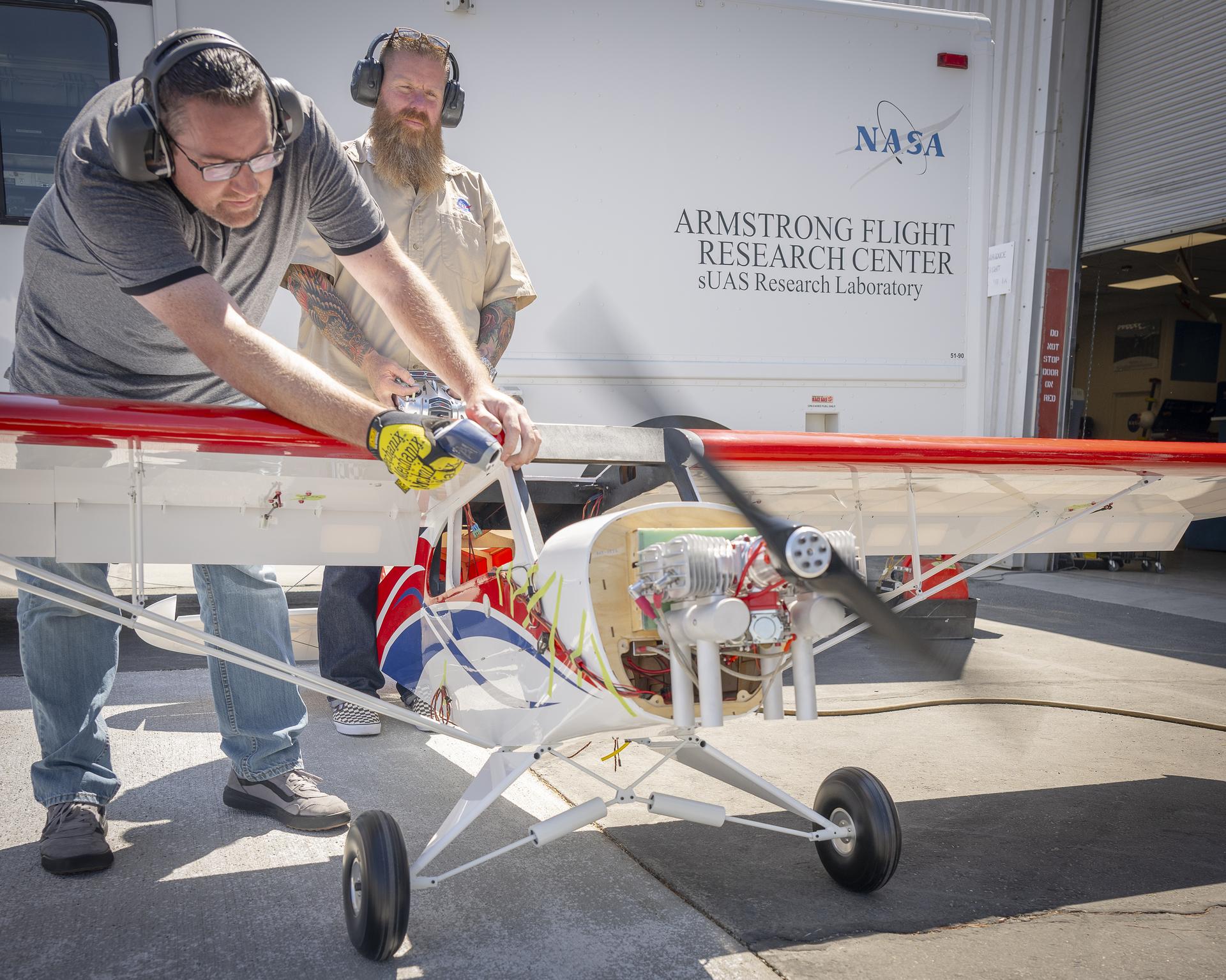
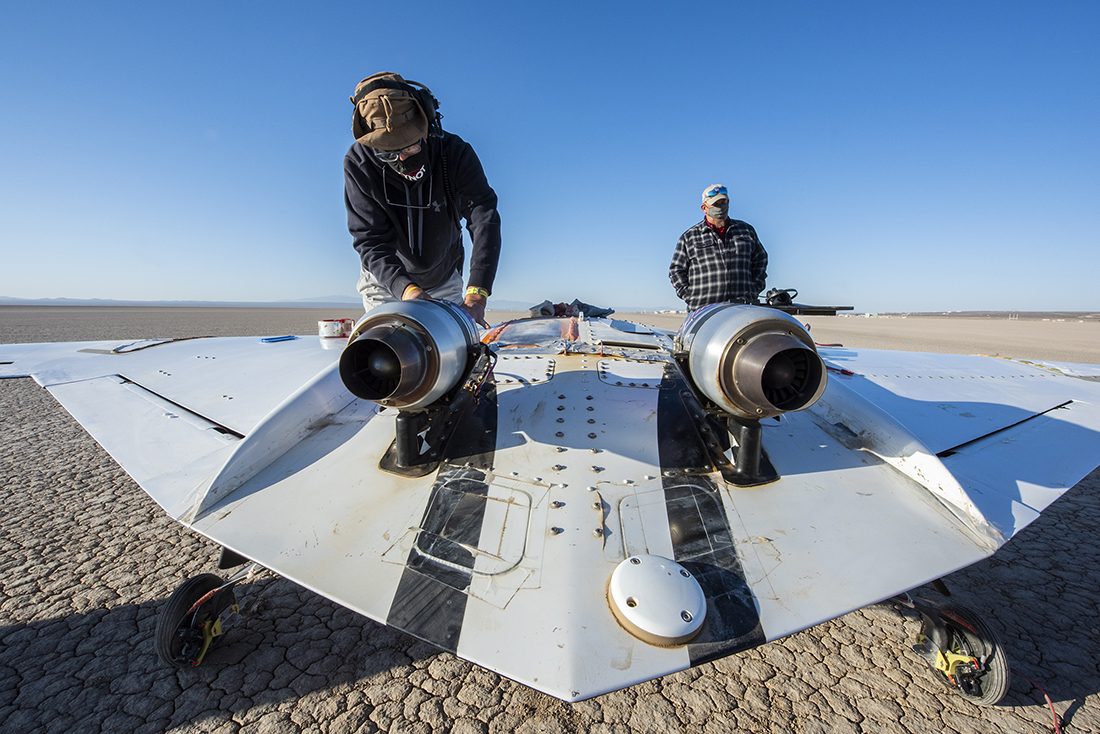
One man manages engine speed with a hand-held controller, while another firmly holds the subscale aircraft in place.
Justin Link, left, holds the subscale aircraft in place, while Justin Hall manages engine speed during preliminary engine tests on Friday, Sept. 12, 2025, at NASA’s Armstong Flight Research Center in Edwards, California. Link is a pilot for small uncrewed aircraft systems at the center’s Dale Reed Subscale Flight Research Laboratory and Hall is the chief pilot.
NASA/Christopher LC Clark

Flight expertise

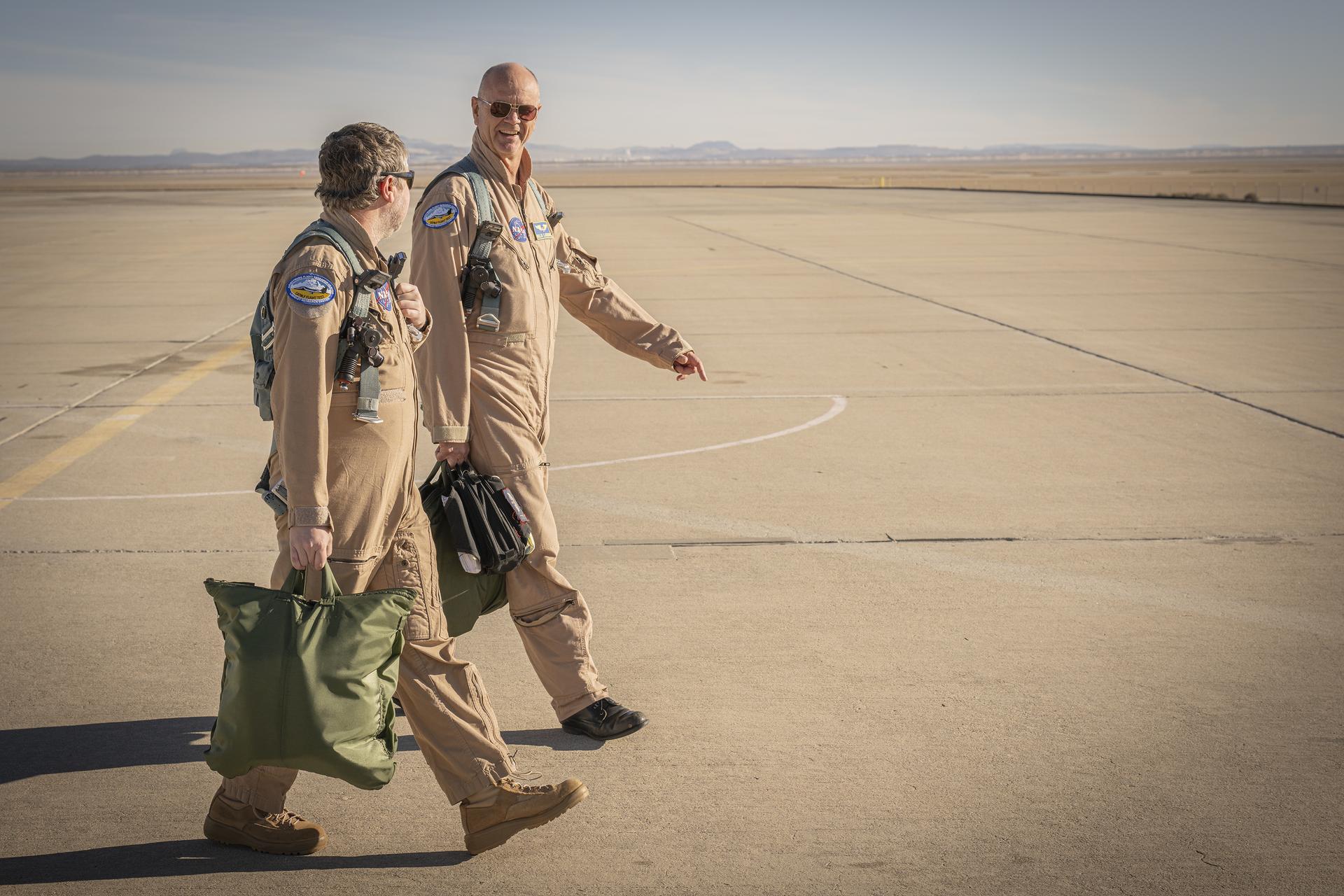
Each staff member serves as an experienced and certified subscale aircraft pilot and is prepared to fly unique one-of-a-kind or modified commercial aircraft wherever the mission requires.

NASA’s FireSense project conducted flights in the Geneva State Forest, located about 100 miles south of Montgomery, Alabama. NASA Armstrong flight research staff integrated the instrument onto an Alta-X drone and tested the system before deployment. Two team members then transported the drone and sensor to the forest, prepared the vehicle for flight, and operated it during the mission. The NASA sensor was flown on the drone to demonstrate how remotely piloted aircraft can gather localized weather data that influences smoke movement and fire behavior. This information may help operational agencies improve wildfire decision-making and better allocate firefighters and resources.

Other missions occur closer to NASA Armstrong, such as the Enhancing Parachutes by Instrumenting the Canopy (EPIC) project. EPIC involved air‑launching a capsule containing a parachute and flexible sensor from the Alta‑X. Laboratory staff piloted the flights, supported flight operations, and worked with the EPIC team to design and integrate the parachute‑drop mechanism and safety system into the aircraft.

These tests demonstrated that a flexible sensor could help researchers study supersonic parachutes. Continuation of this work can help fill gaps in computer models, making supersonic parachutes safer and more reliable for delivering science instruments and payloads to Mars.

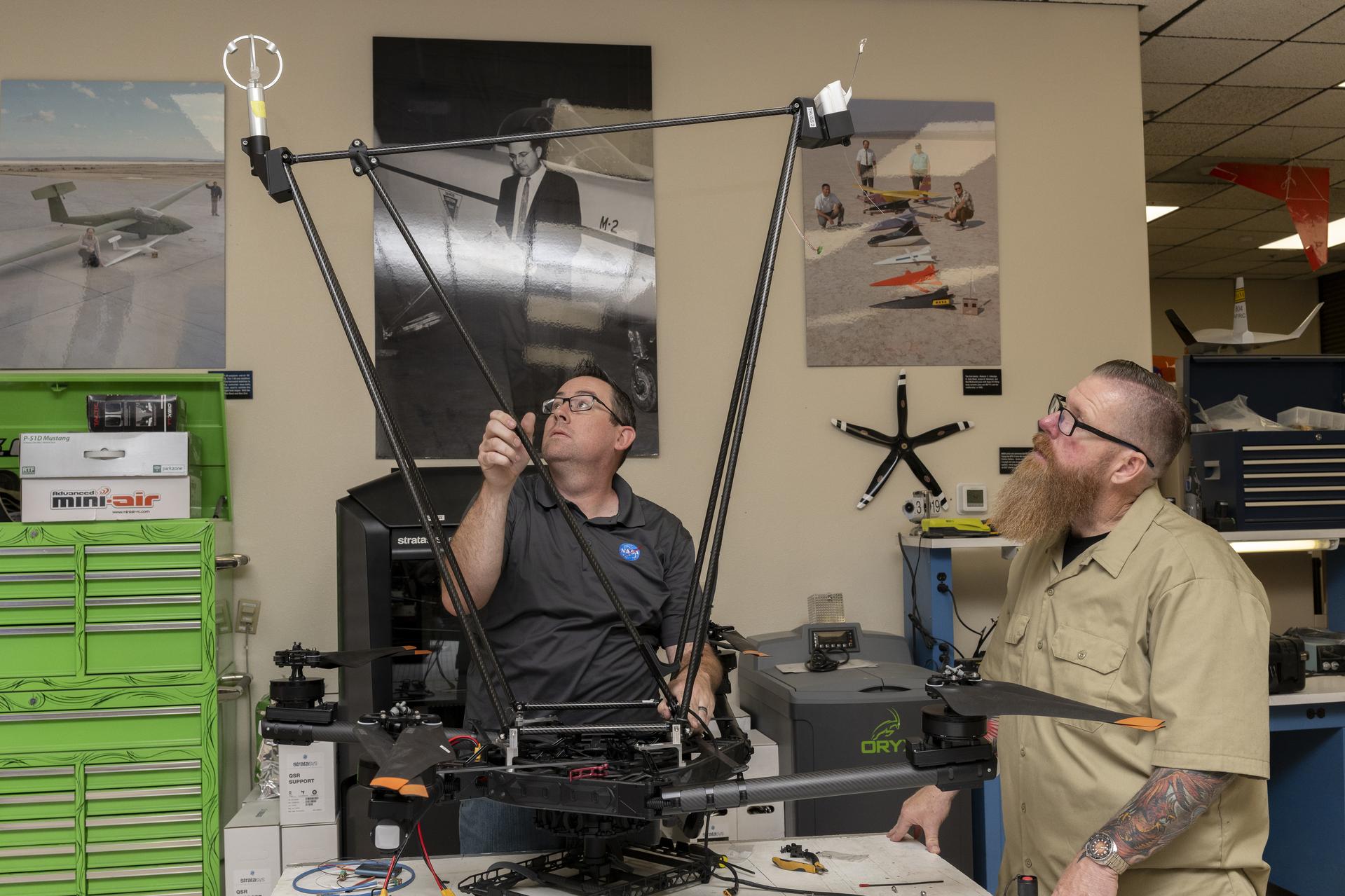
Two men integrate instruments onto a drone.
Justin Link, left, pilot for small uncrewed aircraft systems, and Justin Hall, chief pilot for small uncrewed aircraft systems, install weather instruments on NASA’s Alta X drone at the agency’s Armstrong Flight Research Center in Edwards, California. Members of the center’s Dale Reed Subscale Flight Research Laboratory used the Alta X to support the agency’s FireSense project in March 2025 for a prescribed burn in Geneva State Forest, which is about 100 miles south of Montgomery, Alabama.
NASA/Steve Freeman

Advancing challenging research

The Dale Reed Subscale Flight Research Laboratory uses rapid design and testing capabilities to help small aircraft fly big ideas. These concepts could lead to future breakthroughs that support NASA’s missions across aeronautics, science, and exploration.

For decades, NASA and its partners have advanced Automatic Collision Avoidance Technology. The research demonstrated an autopilot could detect and recover from an imminent ground collision – a capability now helping save lives in high‑performance U.S. military jets. NASA Armstrong had key roles in that work and developed a simplified version, the Automatic Ground Collision Avoidance System, which was installed on the DROID for testing.

The system demonstrated on the DROID — developed to assist general aviation pilots as well as remotely piloted and autonomous aircraft — performed well and led to further research toward a version that provides alerts and steering cues. The NASA Armstrong Technology Transfer Office is working to license the technology for U.S. businesses to develop the system as a commercial product.

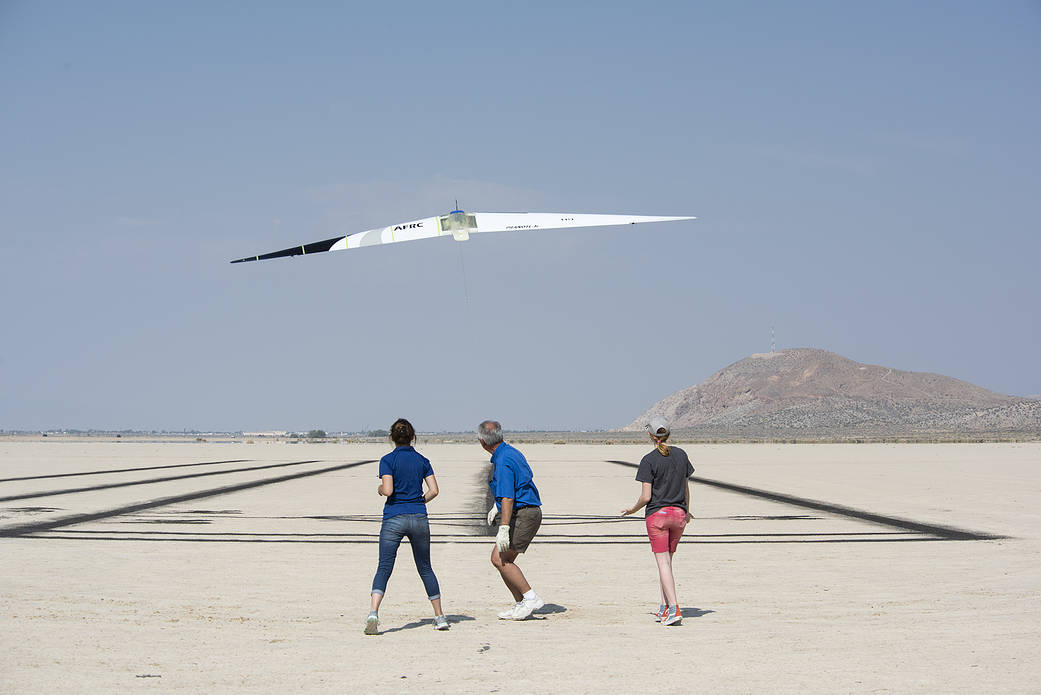
The Prandtl‑D (Preliminary Research Aerodynamic Design to Lower Drag) flying‑wing glider was also designed, fabricated, and flown at NASA Armstrong. Researchers found that its twisted wing design could reduce drag and generate thrust at the wingtips, advancing concepts that may support greater fuel economy for future aircraft. The original Prandtl‑D is now part of the Smithsonian National Air and Space Museum collection in Washington, and the Prandtl-D3 is at the California Science Center in Los Angeles. Researchers continue developing the next generation of the design in the laboratory.

A wide range of capabilities in the laboratory help transform promising concepts into flight-ready test structures. These include rapid prototyping using traditional and advanced 3D manufacturing techniques, as well as composite and conventional fabrication processes. The team of engineers and technicians also provides custom component design and specialized fabrication to meet unique research needs.

The laboratory supports electrical and mechanical design, hardware and software integration, and the safety and flight-readiness processes required for successful missions. Additional technical facilities, such as the Experimental Fabrication Branch and the Environmental Laboratory at NASA Armstrong, further enhance these capabilities. Together, they support development, testing, and validation activities that advance NASA’s aeronautics and exploration goals.

Deborah Jackson, Al Bowers and Abbigail Waddell successfully launch the subscale Prandtl-D 3C glider.
NASA

Share

Details

Last Updated
Jul 15, 2026
Editor
Dede Dinius
Contact

The post NASA Uses Subscale Aircraft to Accelerate Flight Innovation appeared first on NASA Science.
  •  
❌