❌

Reading view

When will SpaceX and Blue Origin fly to the moon? NASA reveals lunar lander timelines (and an Artemis III update)

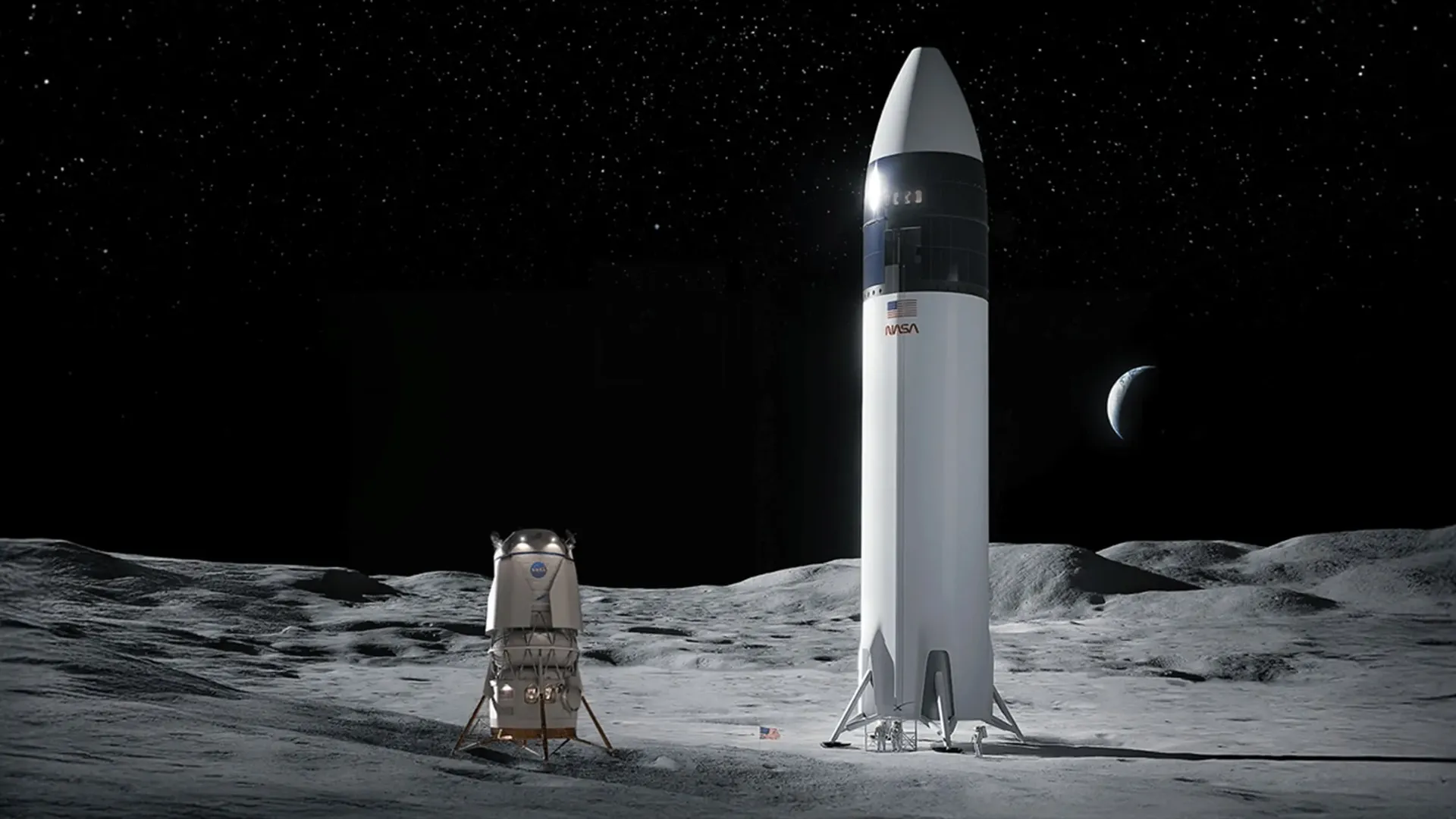
NASA has revealed new details about its plans to return astronauts to the surface of the moon, outlining a series of upcoming milestones for SpaceX and Blue Origin as both companies race to ready their lunar landers for the agency's Artemis program.

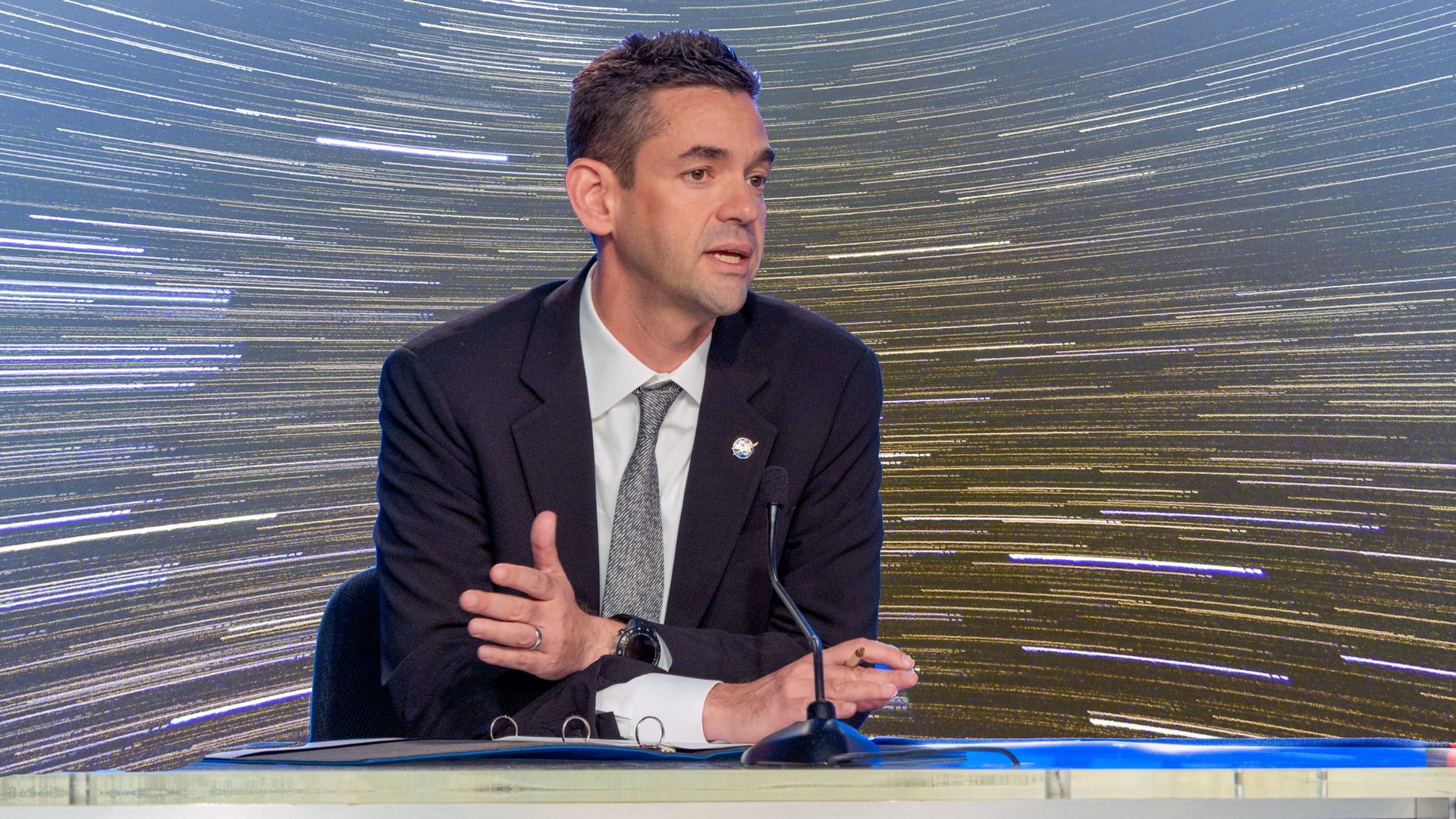
During an Oct. 5 presentation at the Astronautical Congress (IAC) in Antalya, Türkiye, Steve Creech, acting manager of NASA's Human Landing System (HLS) Program, laid out development timelines for both spacecraft, with key demonstrations planned through early 2028 that include orbital refueling and uncrewed lunar landing tests to qualify the vehicles to fly astronauts to the surface of the moon.

A more pressing deadline, however, is NASA's Artemis III mission, which is targeted for the third quarter (Q3) of 2027. Artemis III will launch four astronauts aboard NASA's Orion spacecraft to low Earth orbit (LEO), where they will rendezvous and dock with test versions of both companies' landers for interoperability checkouts. Those demonstrations will help inform NASA's determination about which lander the agency will choose to carry astronauts to the moon's surface on Artemis IV, targeted for early 2028.

SpaceX and Blue Origin were both awarded NASA contracts to develop HLS vehicles — Starship and Blue Moon, respectively — and have spent the past several years refining their respective lunar lander designs and dealing with various delays along the way. In the face of those delays, and in an effort to better structure its mission progression for success, NASA overhauled its Artemis program architecture in February to maintain its goal of landing astronauts on the moon by the end of 2028 and establish a more regular cadence of uncrewed landings in the meantime.

As part of that shakeup, Artemis III, previously the program's first crewed lunar landing mission, was moved up a year and repurposed for the lunar lander vehicle tests the agency is preparing to fly to LEO next year. The program's first moon landing remains scheduled for 2028, but was shifted to the manifest for Artemis IV.

Between now and then, both SpaceX and Blue Origin have more than a dozen test demonstrations and vehicle milestones to achieve, including success during Artemis III and flights afterward. This will all lead up to a key decision NASA must make: Which vehicle will carry out the first crewed landing on the surface of the moon since the Apollo program ended in 1972?

Starship reached for the first time on its most recent test flight, which occurred on Sept. 28 from SpaceX's Starbase site in South Texas. NASA lists several other important goals for the vehicle to achieve in 2026, including (in the order listed during the IAC presentation) the first return and catch of the rocket's upgraded Version 3 (V3) booster at its launch pad; the first-ever return and catch of a Ship upper stage; the first Starship launch from one of SpaceX's launch pads still under construction on Florida's Space Coast; and, possibly, the first V3 booster reflight.

NASA also expects SpaceX to complete the initial build of the crew cabin for its lunar lander Starship variant. SpaceX released renders of Starship's interior last year, as well as images of the test elevator astronauts are using to train for Starship egress on the lunar surface, but little else has been made public about the progress the company has made on the cabin's design.
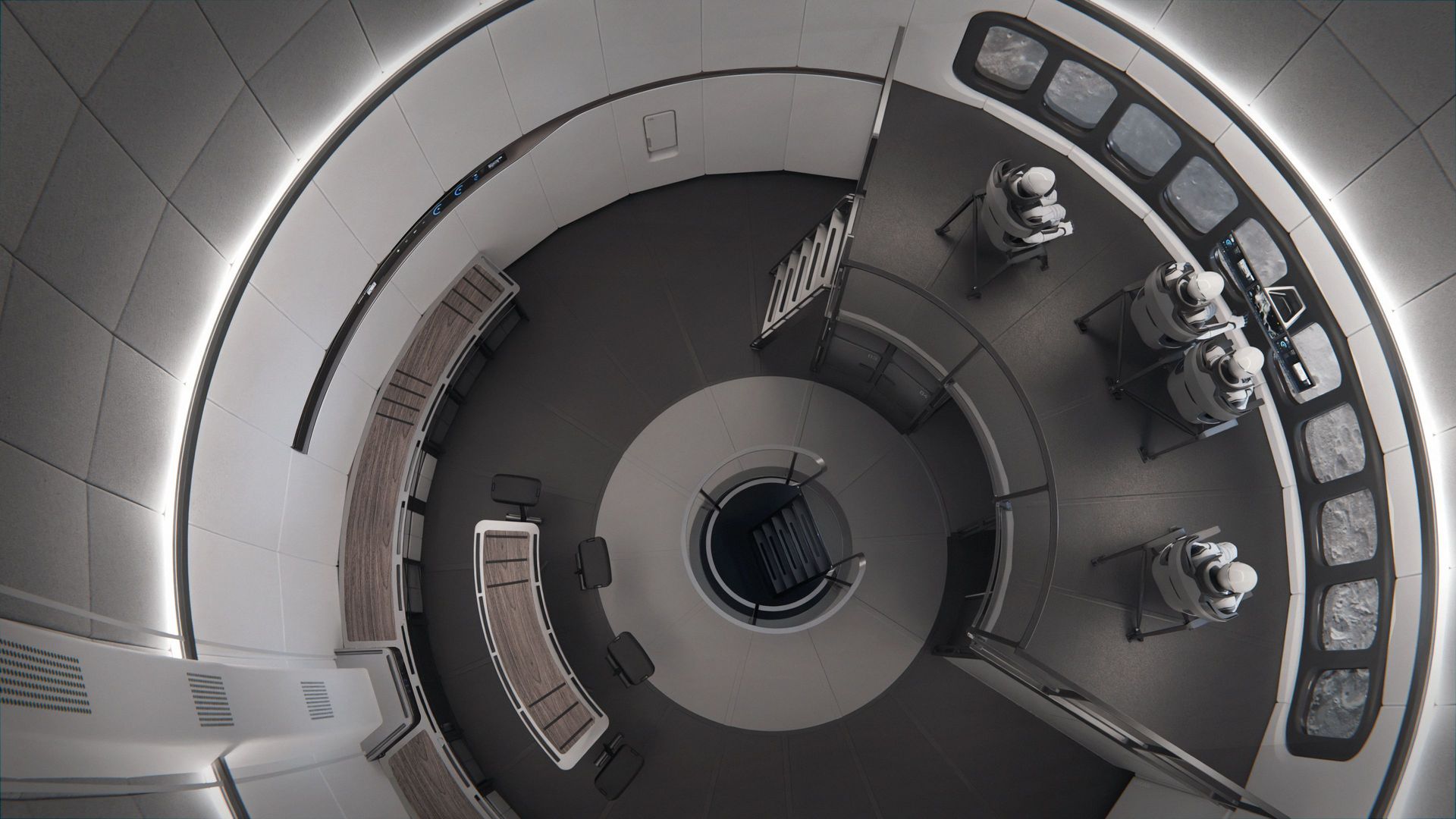
Artist's rendering of the cabin of SpaceX's Starship vehicle during an Artemis moon mission for NASA.

Artist's rendering of the cabin of SpaceX's Starship vehicle during an Artemis moon mission for NASA. (Image credit: SpaceX)

Should the cabin's initial build wrap up by the end of the year, as NASA's presentation suggested, SpaceX will use Q1 2027 to complete integration of the systems that Starship will need to communicate with Orion during Artemis III, and deliver a cabin simulator for astronauts to train on leading up to the mission. SpaceX plans to continue Starship test flights through Q2 of next year, complete a landing leg demonstration and begin crew cabin airlock tests.

Blue Origin's lunar lander mockup is ready for NASA Artemis astronaut training

For Artemis III, SpaceX plans to fly one of its existing V3 Starship upper stages, with some slight modifications. Starship and Orion will dock as part of Artemis III but the SpaceX vehicle won't be equipped with a crew cabin for the mission's astronauts to enter. Between the end of this year and the beginning of the next, SpaceX is expected to complete the addition of a docking system and nosecone cover to the Artemis III Starship vehicle, which, NASA documents suggest, has already completed its mechanical fit checks.
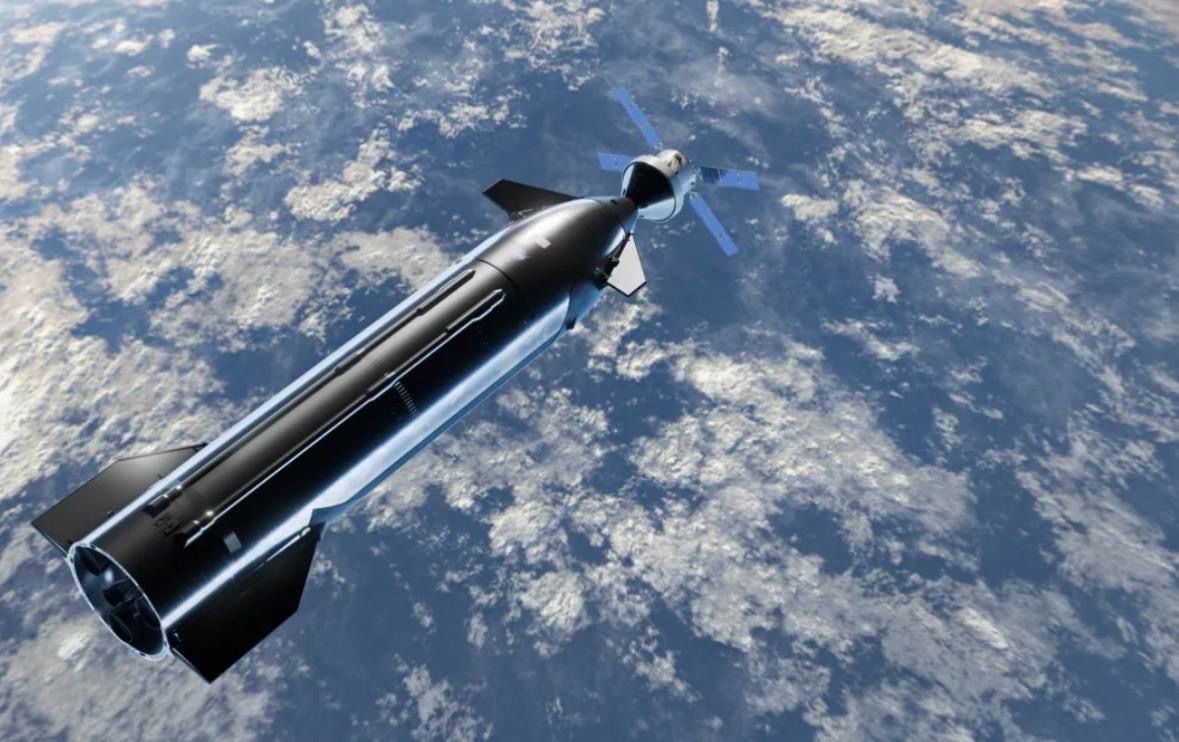
A giant chrome rocket and a small space capsule dock in low Earth orbit.

Render of SpaceX Starship and Orion docked in low Earth orbit. (Image credit: SpaceX)

Other notches on SpaceX's checklist leading up to Artemis III include the first propellant transfer demonstration with Starship in orbit. As the first-ever launch vehicle and spacecraft designed for full reusability, Starship's fuel constraints require that its tanks be topped off in order to fly beyond LEO. For a moon landing mission, this could mean up to a dozen launches of SpaceX's Starship "tanker" spacecraft to an orbiting fuel depot, which the moon-bound Starship will visit. To pull that off, though, SpaceX has to show it can successfully transfer those cryogenic fuels on orbit, and also store them effectively enough to prevent too much boil-off.

Starship won't require any refueling flights to complete its objectives for Artemis III, but SpaceX is expected to launch its first Starship tanker vehicle within a few months of that mission as it gears up for the Artemis IV moon landing mission. To that end, a launch of an uncrewed Starship lunar lander variant is targeted sometime toward the end of Q3/beginning of Q4, with an uncrewed lunar landing mission carried out before the end of 2027.

Blue Origin, meanwhile, has its own set of milestones to meet as it develops its Blue Moon Mark 2 (MK2) lander — a 52-foot-tall (16 meters) spacecraft powered by three BE-7 engines. Unlike the bare-bones V3 Starship that SpaceX will launch on Artemis III, Blue Origin plans to fly a completed test vehicle, incorporating the crew cabin, partial life-support, flight software and other systems needed to allow astronauts to enter the lander from Orion during their time docked in LEO. Astronauts will be able to enter Blue Moon from Orion to get a feel for the lander in zero-g and test some of its systems.
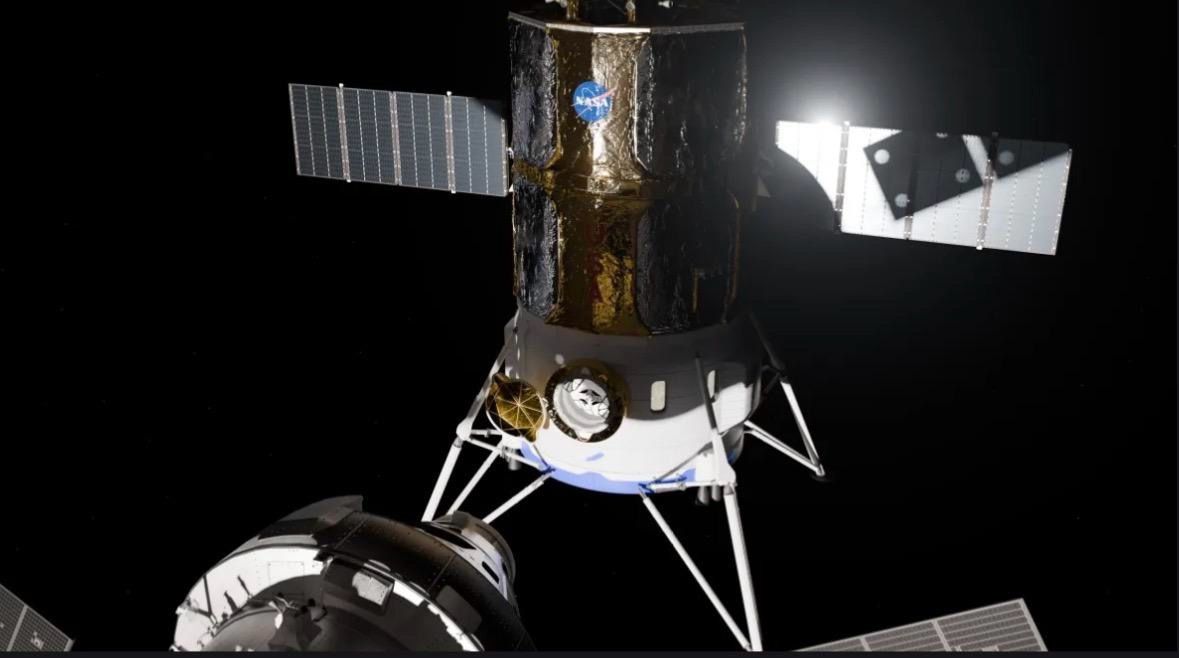
A lunar lander rendezvous with Orion in space.

Render of Blue Origin's Blue Moon lander and Orion prior to docking in low Earth orbit. (Image credit: Blue Moon)

NASA's timeline shows the company working to complete a series of manufacturing and testing milestones in the last few months of 2026, including continued BE-7 testing and qualification of Blue Moon's BT-7 maneuvering thrusters. The company also faces its Artemis III interim design review and a critical design review for an upcoming landing demonstration mission in 2028.

Blue Origin is also working to restore its pad at Cape Canaveral Space Force Station's Launch Complex-36 (LC-36) to operation and return its New Glenn rocket to flight, following an explosion of the rocket in May that caused extensive damage to the facility. NASA's presentation places that milestone in Q4 2026, a timeline the company has also been very vocal about maintaining. A recent Reuters report, however, suggests that may not happen until early 2027.

By early 2027, the company expects to complete the spacecraft's communications systems and finalize its flight software, with assembly, integration and testing continuing into Q2. Q1 2027 is also when Blue Origin's Blue Moon MK1 lander (a smaller, uncrewed version of its MK2 successor) will launch to the lunar surface as a part of NASA's Commercial Lunar Payload Services (CLPS) program of robotic moon missions.

During Q2 2027, as the Artemis III mission approaches, Blue Origin is expected to complete integration of its test lander with New Glenn and conclude qualification of its BE-7 engine. Throughout next year, the company plans to continue construction and refurbishments at its launch facilities and hopes to have a new launch pad ready to support the upgraded, more powerful New Glenn 9x4 rocket l by the end of Q3. The first flight of that rocket variant is scheduled for Q4 2027, alongside a second MK1 lunar mission and the launch of an uncrewed MK2 demonstration lander.

That spacecraft is expected to attempt its own uncrewed lunar landing in Q1 2028, around the same time Blue Origin has scheduled a third MK1 flight. Like SpaceX, Blue Origin will need to demonstrate that its lander can safely reach the moon's surface,operate there and return to lunar orbit before NASA clears it to carry astronauts on a future Artemis mission.

NASA's overall timeline remains the same as it has been since the February revamp, with Artemis III expected to launch in mid-2027, followed by a crewed lunar landing on Artemis IV in 2028, and possibly another on Artemis V that same year. There may be changes on the horizon, though. NASA will host a press conference on Friday (Oct. 23) with Administrator Jared Isaacman and Associate Administrator Amit Kshatriya, as well as Artemis program director Jeremy Parsons. During the event, which you'll be able to watch here at Space.com, they will discuss the status of the upcoming moon missions and an "Artemis acceleration."

SpaceX and Blue Origin still face tight schedules to complete their respective uncrewed landing demonstrations before Artemis IV. With SpaceX targeting Q4 2027 and Blue Origin Q1 2028, both are pushing the margins against NASA's hopes to return astronauts to the lunar surface that same year. Which company ultimately gets the green light for that first landing mission will depend on the progress each makes between now and then, and whether their landers can demonstrate the readiness that NASA requires to safely carry astronauts to the surface of the moon and back again.
  •  

Japan launches historic MMX sample-return mission to Mars' moon Phobos (video)

Japan's groundbreaking mission to Mars is officially underway, headed to the Red Planet's mysterious moons Phobos and Deimos for a historic sample-return attempt.

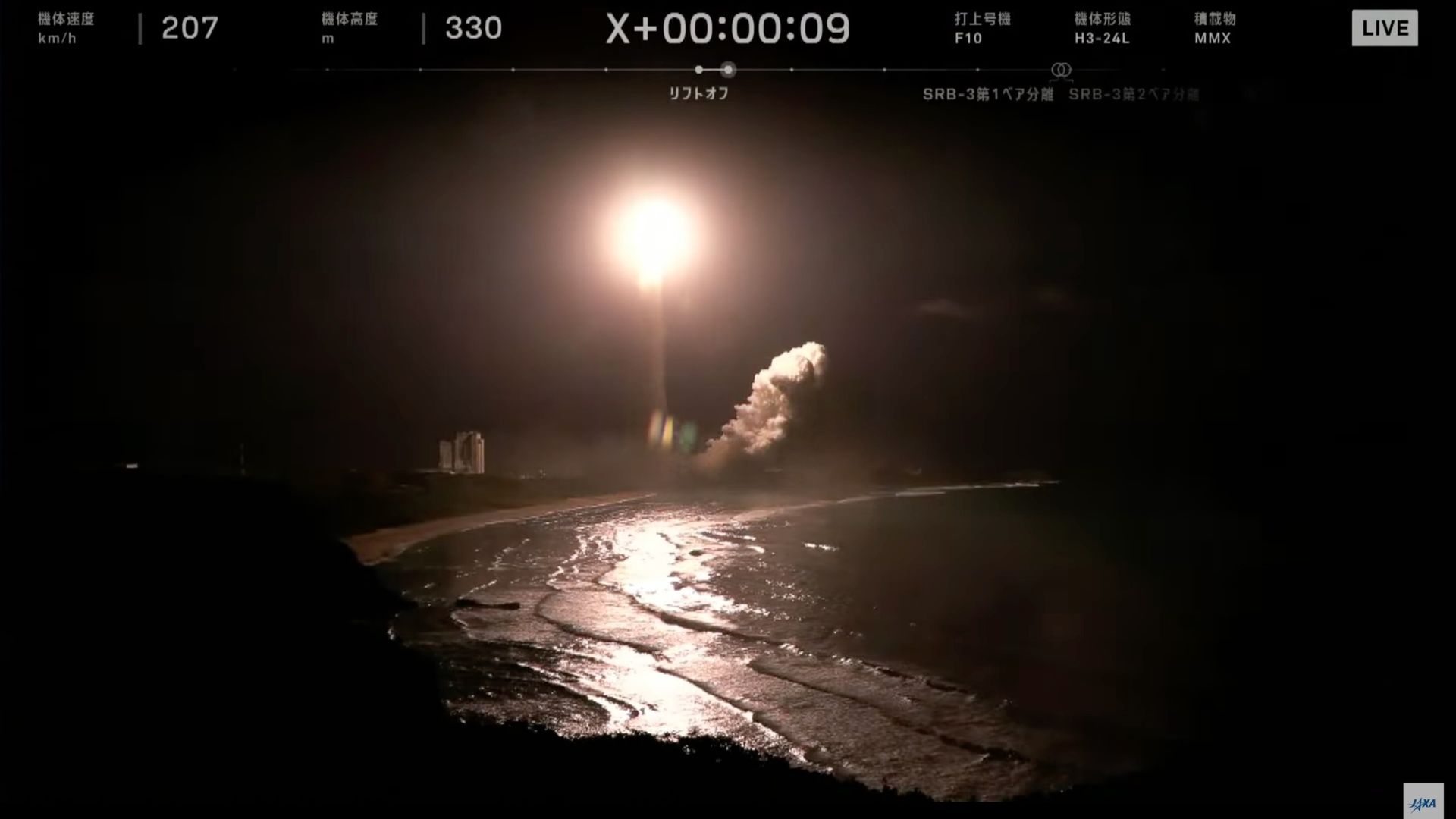
The Martian Moons eXploration (MMX) mission launched today (Oct. 19) from Tanegashima Space Center in Japan, riding an H3 rocket that lifted off from Pad-2 at Tanegashima's Yoshinobu Launch Complex at 3:41 p.m. EDT (1941 GMT; 4:41 a.m. local time in Japan on Oct. 20).

The JAXA (Japan Aerospace Exploration Agency)-led MMX mission is bound for Mars orbit, where it will study the planet's two moons, Phobos and Deimos. If everything goes according to plan, MMX will become the first spacecraft to land on and return samples from Phobos for study back on Earth, which scientists think could shed light on a decades-old mystery about the moons' origins and reveal clues about the formation of the early solar system.

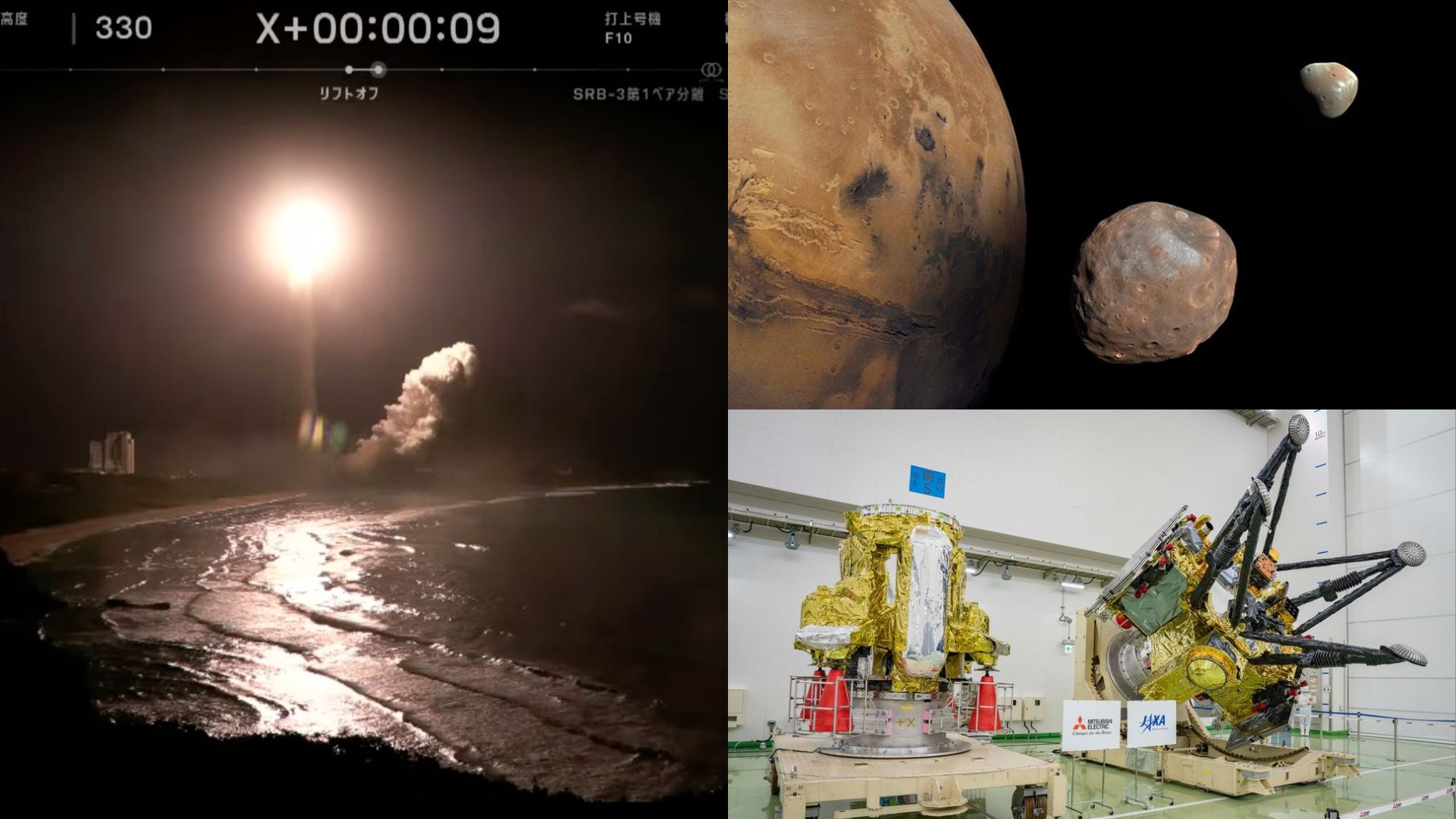
Japan's MMX mission to Mars' moon Phobos launches from Tanegashima Space Center on Oct. 19, 2026.

a rocket launches into a night sky from a seaside pad (Image credit: JAXA)

It was the 10th liftoff of Japan's expendable, two-stage H3 rocket, which was jointly developed by JAXA and Mitsubishi Heavy Industries. After clearing its launch pad today, the 207-foot-tall (63 meters) launch vehicle flew a nominal trajectory through its ascent corridor over the Pacific Ocean, jettisoning its four solid boosters in pairs just before the flight clock reached two minutes. The rocket shed its payload fairings about one minute and 20 seconds later, exposing MMX to the vacuum of space for the first time.

H3's first stage, powered by two LE-9 rocket engines, channels a mixture of liquid hydrogen and liquid oxygen to produce a combined thrust of 331,000 pounds (1,471 kN), according to Mitsubishi Heavy Industries. As the mission clock approached T+5 minutes, H3 executed its main engine cutoff procedure and separated from the second stage, which ignited its engines for a 5.5-minute burn about 10 seconds later.

All continued to go to plan after that. The H3's upper stage ignited its engine for a second time for a trans-Mars injection burn about one hour and four minutes after liftoff, a maneuver that lasted roughly six minutes and 25 seconds and took MMX to a maximum velocity of about 24,145 mph (38,858 kph).

MMX was released from the rocket's upper stage right on schedule, about one minute after the completion of that burn and roughly 71 minutes after liftoff. The success elicited loud cheers in mission control, which viewers saw and heard on JAXA's launch webcast.

MMX is now under its own power, and on course for Mars. The interplanetary transit will last about 10 months, with the spacecraft scheduled to arrive at the Red Planet in August 2027. When it does, MMX's propulsion module will execute an orbital insertion burn to place itself in a quasi-satellite orbit (QSO) around Phobos, which places MMX within the space around the moon as both circle Mars.

MMX will spend about three years in the Martian system, devoting much of that time to studying the 14-mile-wide (22 km) Phobos with its science instruments. The spacecraft also carries the IDEFIX rover, a joint effort of the space agencies of France and Germany, which is scheduled to deploy to the surface of Phobos in late 2028 or early 2029.

After a mapping campaign to select suitable landing sites, MMX will perform two separate touchdowns on Phobos to collect and stow samples in the spacecraft's return capsule. Following its second landing and sample collection, MMX will briefly return to QSO with Phobos before transferring to a more elongated orbit around Mars that intersects with the planet's smaller moon, Deimos, which is just 8 miles (14 km) in diameter.

During the last several months of its time around Mars, MMX will perform a series of Deimos flybys before departing for Earth in November 2030. If all goes according to plan, the MMX sample-return capsule will land in Australia in 2031.

Scientists are counting on those samples, and other data collected during MMX's time around Mars, to answer a decades-old question surrounding the Martian moons' origins. Competing theories and conflicting evidence point to two possibilities for how Mars got its moons.

Their near-circular, equatorial orbits suggest a narrative similar to how Earth's moon is thought to have formed — as a result of a massive planetary impact between Mars and some other giant space rock, which broke off pieces of the planet that eventually coalesced to form the natural satellites that orbit there today.

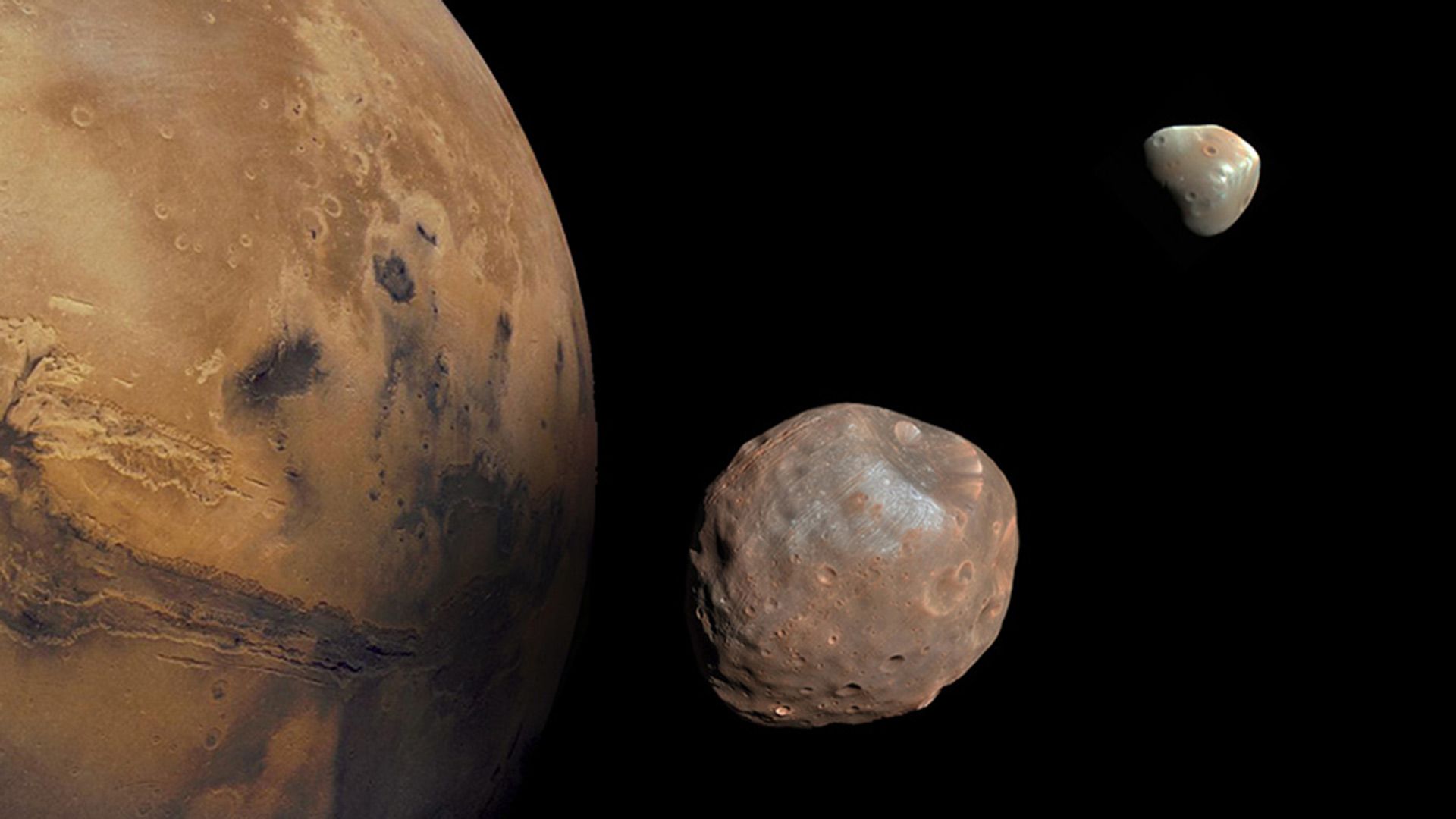
Mars and its two moons, Phobos and Deimos.

A composite image with Mars and its two moons, Phobos and Deimos. (Image credit: NASA/JPL/University of Arizona)

Neither Phobos nor Deimos is spherical, isntead; both are oblong and lumpy, like potatoes. That fact — along with their chemical composition, as far as we have been able to tell using telescopic spectroscopy — point to the possibility that Phobos and Deimos were asteroids from the early solar system that were captured by Mars' gravitational pull. Figuring out the moons' true origin story would provide key clues about Mars' geological past, the solar system's early history and the formation of the inner planets, mission team members have said.

Once the MMX samples are safely returned to Earth, scientists will study their composition and mineralogy, then compare such chemical fingerprints with those of Martian rocks and asteroid material. These analyses, combined with data collected by MMX during its mission, will help nail down the origin of Phobos — and by extension, Deimos. — by

While JAXA leads MMX, the mission is an international effort, with interagency partnerships between JAXA, NASA and the European Space Agency (ESA), as well as U.S. and European companies, which supplied a handful of the spacecraft's scientific hardware and communications equipment.

NASA's contributions to MMX include the Mars-moon Exploration with Gamma rays and Neutrons (MEGANE, pronounced "meh-gah-nay") device, which is a gamma-ray and neutron spectrometer built by the Johns Hopkins Applied Physics Laboratory (APL); a Honeybee Robotics-built pneumatic sampler; and communications support using the agency's Deep Space Network.

NASA has also invested approximately $87 million through the end of the mission, which includes funding for United States scientists and astromaterials experts on the MMX team. The agency is getting something concrete for such contributions: At least 15% of the planned 10-gram (0.35 ounces) returned Phobos sample will be reserved for NASA's study. Those materials will be transferred and maintained at the agency's Johnson Space Center in Houston for analysis and long-term preservation.

MMX is not the first Phobos sample-return project to take flight, by the way. That distinction goes to Russia's Phobos-Grunt ("Phobos-Soil") mission, which launched in November 2011 but failed to get out of Earth orbit due to a rocket glitch. The 14.5-ton spacecraft eventually crashed back to Earth over the Pacific Ocean in January 2012.

Editor's note: This story was updated at 5 p.m. ET on Oct. 19 with news of MMX's successful separation from the H3 rocket's upper stage.

  •  

Returning the first samples from a Martian moon: Inside the science of Japan's bold MMX mission to Mars

Editor's note: Japan launched its bold MMX sample-return mission to the Mars moon Phobos on Oct. 19) at 3:41 p.m. EDT (1941 GMT).
Watch a replay of the liftoff and read our launch story here.

Japan's mission to Mars is one of the most ambitious in spaceflight history. It aims to become the first spacecraft to return to Earth from Mars orbit, carrying with it the first-ever samples from the Red Planet system.

The mission, known as Martian Moons eXploration (MMX), is a first-of-its-kind endeavor to study the origin of Mars' moons Phobos and Deimos. The robust undertaking includes a landing on Phobos to collect the samples — which will likely be the first from the Mars system to return to Earth — and a search for evidence that could shed light on events during the formation of the solar system billions of years ago.

MMX launched on an H3 rocket from Japan's Tanegashima Space Center on Monday (Oct. 19) at 3:41 p.m. EDT (1941 GMT; 4:41 a.m. local time in Japan, Oct. 20). After a 10-month journey to reach Mars, the spacecraft will spend about three years studying Phobos, deploying a rover and landing to collect its samples. The mission will then shift its focus to Deimos for a series of flybys before departing for Earth in November 2030. If all goes according to plan, the MMX sample-return capsule is scheduled to land in Australia in 2031.

The spacecraft

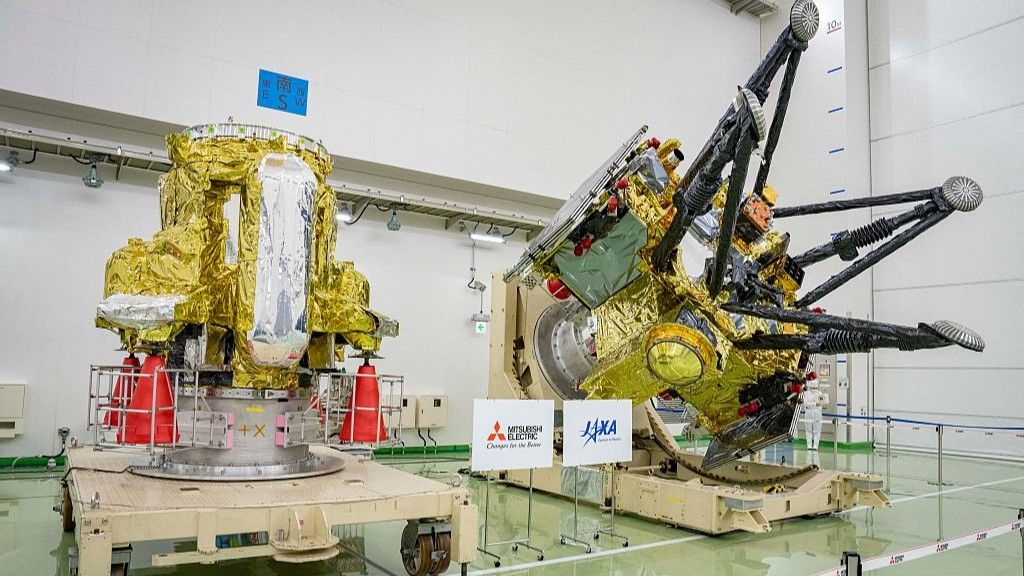
The MMX spacecraft is comprised of three main parts, as well as a small rover. After release from its H3 launch vehicle, a propulsion module will provide the boost to put MMX on course for Mars. MMX's main exploration module carries the microwave-size IDEFIX rover and most of the mission's scientific instruments, while the return module houses the sample-return capsule.

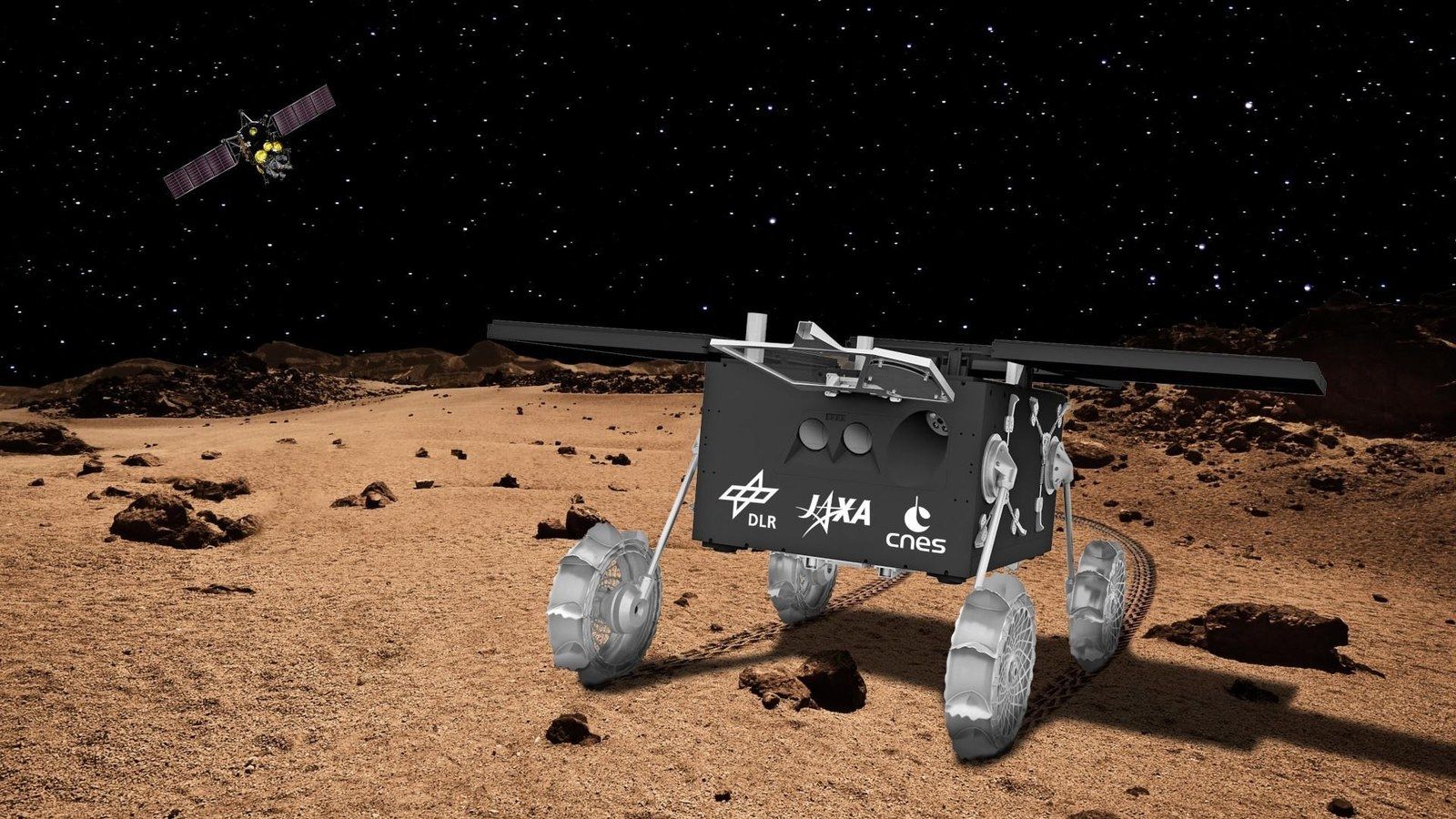
Japan's Mitsubishi Electric built MMX's three main modules, with the French space agency CNES (Centre National d'Études Spatiales) and Germany's DLR (Deutsches Zentrum für Luft-und Raumfahrt) jointly developing IDEFIX. The little rover is named for a dog in the 1960s French comic "Asterix," in a nod to the country's first satellite, Astérix, which launched in 1965.

IDEFIX carries a suite of cameras, as well as the Raman Spectrometer for MMX (RAX) and miniaturized radiometer (miniRAD) instruments to analyze Phobos' surface composition and temperature.

The Propulsion Module (left) and Exploration and Return Modules (right), which together make up Japan’s Martian Moons eXploration (MMX) spacecraft, are seen at the Tanegashima Space Center in Minamitane, Kagoshima prefecture on Aug. 13, 2026.

The Propulsion Module (left) and Exploration and Return Modules (right), which together make up Japan’s Martian Moons eXploration (MMX) spacecraft, are seen at the Tanegashima Space Center in Minamitane, Kagoshima prefecture on Aug. 13, 2026. (Image credit: Yuichi YAMAZAKI / AFP via Getty Images))

Most of MMX's scientific instruments are housed on the exploration module, like NASA's Mars-moon Exploration with Gamma rays and Neutrons (MEGANE, pronounced "meh-gah-nay") device, a gamma-ray and neutron spectrometer built by the Johns Hopkins Applied Physics Laboratory (APL), and France's MIRS (MMX InfraRed Spectrometer) instrument.

The exploration module also houses the Japanese-built TENGOO (TElescopic Nadir imager for GeOmOrphology) tight-zoom camera, wide-angle OROCHI (Optical RadiOmeter composed of CHromatic Imagers) multispectral camera, laser altimeter (LIDAR) and Mass Spectrum Analyzer (MSA). The return module, meanwhile, carries Japan's Circum-Martian Dust Monitor (CMDM) and Interplanetary Radiation Environment Monitor (IREM).

The mission

MMX will arrive in orbit around Mars in August 2027, at which point it will shed its propulsion module and transition into a quasi-satellite orbit (QSO) around Phobos that allows the probe to fly in a sort of formation with the small, asteroid-sized moon as they both circle the Red Planet.

The spacecraft will spend its first few months in the Martian system observing Phobos from different altitudes, using its TENGOO and OROCHI cameras, LIDAR and MSA to map the moon's surface, study its composition and select potential landing sites.

IDEFIX will be released in late 2028 or early 2029, during the first of two MMX landing rehearsals, at about 130 feet (40 meters) above Phobos. Due to the 14-mile-wide (22 kilometers) moon's extremely low gravity, the rover will be able free-fall to the surface damage-free (hopefully), right itself after a few bounces and begin exploring to gather data on the terrain and surface conditions.

a four-wheeled black cartoon rover stands on the surface of a planet hued in light browns. A starry night space scape is seen above with a satellite in the upper left.

An artists render of IDEFIX on the surface of Phobos. (Image credit: CNES/DLR/JAXA (ASTERIX® OBELIX® IDEFIX® © Année LES EDITIONS ALBERT RENE / GOSCINNY-UDERZO))

MMX sample collection could begin as early as December 2028, the acting director of NASA's Planetary Science Division, Lindsay Hays, said during a mission briefing on Oct. 15. The spacecraft will attempt two collection landings, with its exploration and return modules descending and returning to orbit as one vehicle.

On Phobos' surface, two different sampling mechanisms — the Corer Sampling Mechanism (C-sampler) and Pneumatic Sampling Mechanism (P-sampler) — will extract and collect at least 10 grams (0.35 ounces) of material for stowage inside the spacecraft's return capsule before MMX lifts off again for orbit. After its first touchdown and sample collection, MMX will return to QSO near Phobos before descending to a second landing site for a similar attempt and subsequent return to orbit.

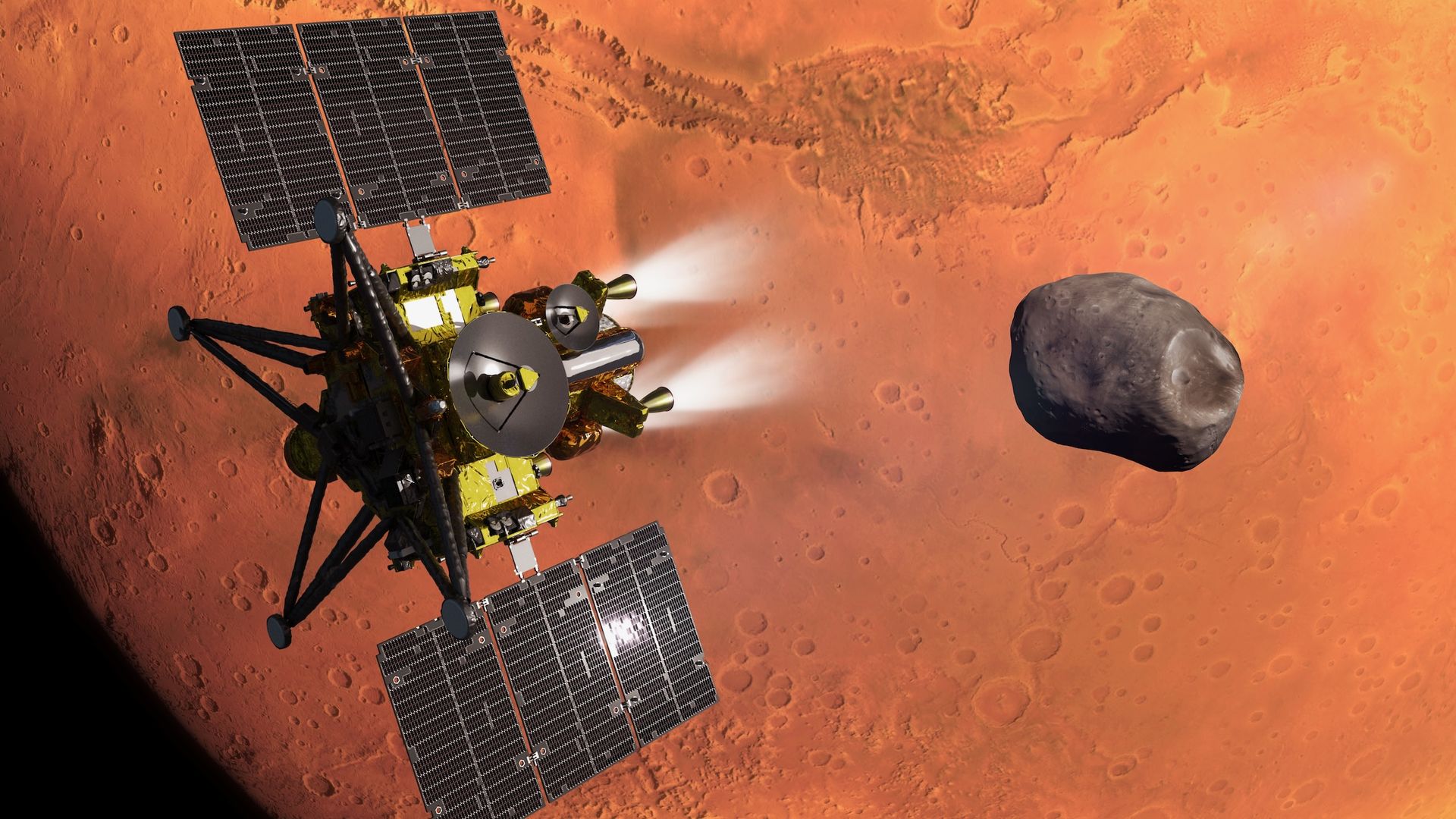
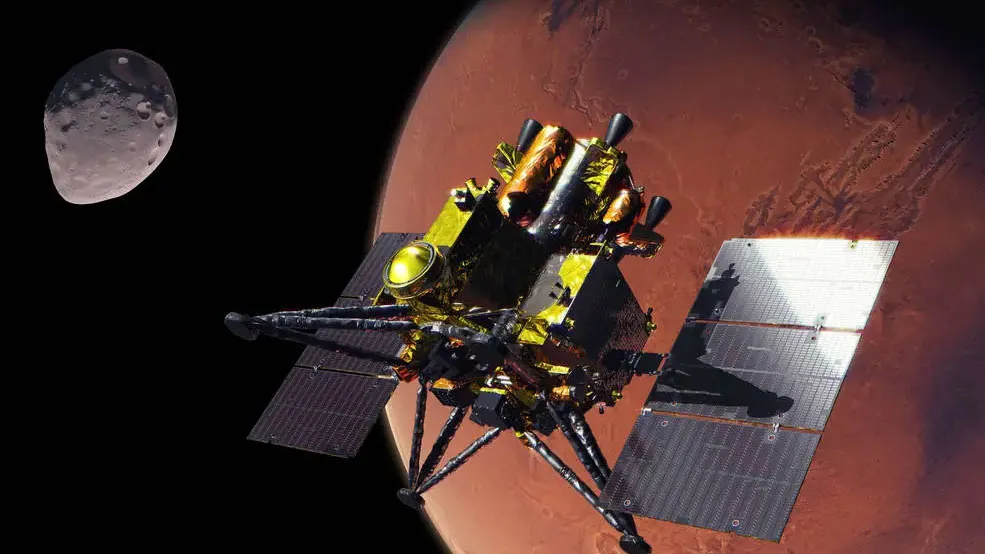
An artist’s concept of JAXA’s MMX spacecraft during its Mars’ orbit insertion. The Martian moon Phobos, which MMX will explore and sample, is in the background.

An artist’s concept of JAXA’s MMX spacecraft during its Mars’ orbit insertion. (Image credit: JAXA)

MMX will end its observations of Phobos after about three years focused on the Martian moon, and will transition into a higher, resonant orbit around Mars in 2030. That course will repeatedly intersect Deimos' path for a series of flybys to collect and compare data with those from Phobos observations as scientists aim to investigate the moons' origins.

Near the end of 2030, the exploration module will separate, leaving the return module to fire its engine out of Mars' gravitational influence and begin an eight-month journey back to Earth with the collected samples. As MMX closes the last stretch of void during its approach to Earth in 2031, the sample-return capsule will separate and enter the atmosphere for a targeted parachute landing in Australia's Woomera region, where its contents will be recovered for laboratory analysis by Japan and its mission partners.

Phobos and Deimos

Those samples, and the data collected by MMX, could tell scientists a lot — about the moons' composition, geography and, perhaps most importantly, how they came to exist in the first place. There are two leading theories for Phobos and Deimos' origins, both of which point to very different versions of ancient Martian history.

"Phobos and Deimos are interesting, but not just in their own right. Their presence is a key piece of the larger story of the Mars system," said Tom Statler, MMX program executive and scientist in NASA's Planetary Science Division, during the Oct. 15 mission briefing. "By uncovering the moons' origin, we'll gain new insights into the history of both Mars and Earth, especially those events that shaped both planets billions of years ago and helped create the worlds we see today."

Both Phobos and Deimos are relatively small and irregularly shaped, and bear several resemblances and spectral characteristics to primitive D-type asteroids — ancient bodies thought to preserve material dating back to the solar system's formation about 4.6 billion years ago. Those similarities suggest Phobos and Deimos may have formed elsewhere in the solar system and were later captured by Mars' gravity.

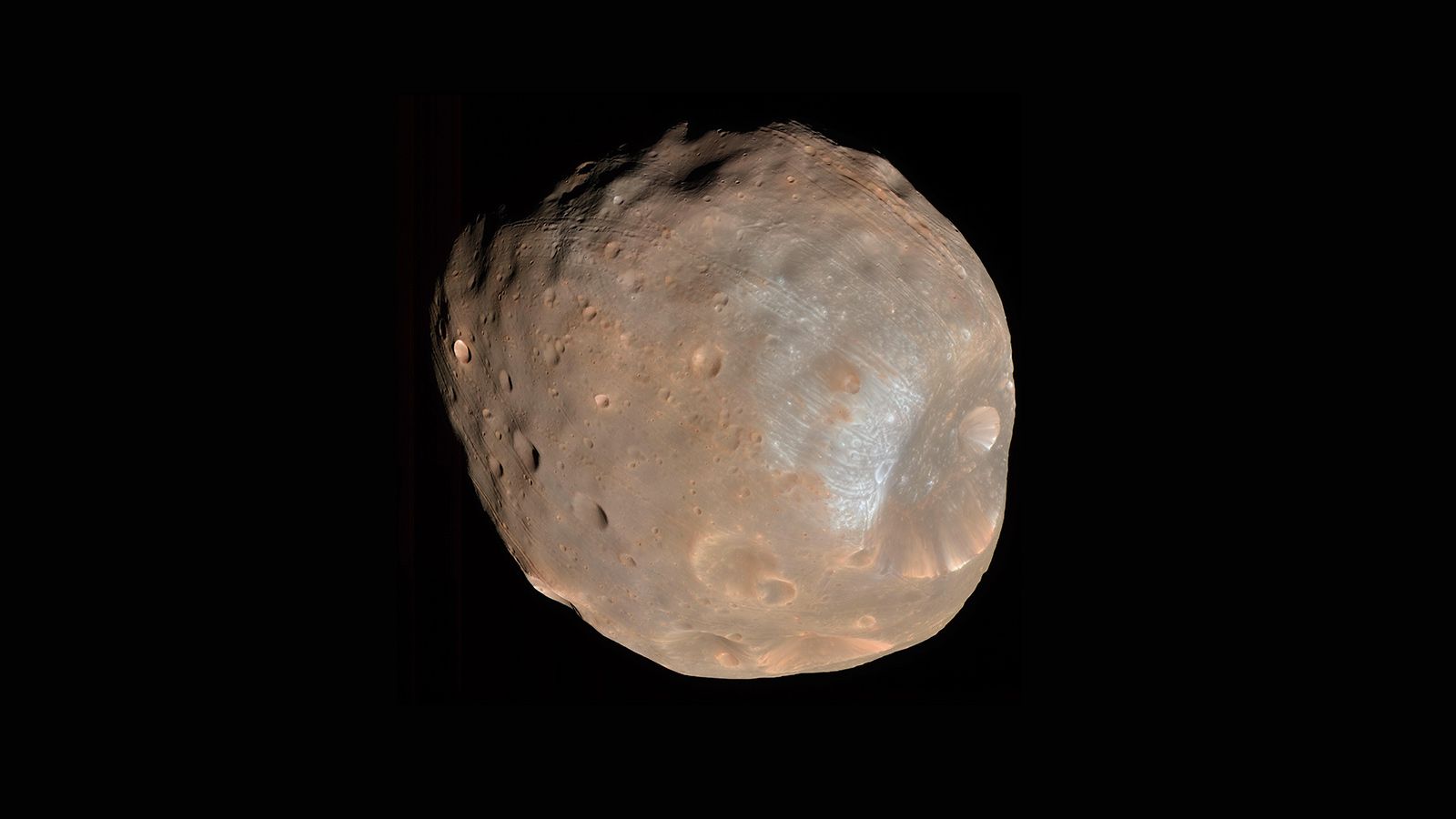
Phobos is the larger of Mars' two small moons and bears the scars of millennia of small impacts.

Phobos is the larger of Mars' two small moons and bears the scars of millennia of small impacts. (Image credit: NASA/JPL-Caltech/University of Arizona)

Their near-circular, equatorially-aligned orbits around the Red Planet, however, somewhat complicate that theory. For example, a captured asteroid would be much more likely to have entered an elongated and tilted orbit akin to the direction and velocity of its original approach, scientists say. A competing hypothesis, therefore, offers a much more violent, but somewhat familiar, narrative for the moons' origins.

An enormous collision with ancient Mars could have blasted material into orbit to form a debris disk from which the two moons eventually coalesced. Such a process, which would be similar to the formation of Earth's moon, could explain their circular, equatorial orbits.

The contradicting geological and orbital observations for Phobos and Deimos collected to date have prevented scientists from definitively establishing one hypothesis over the other. MMX aims to provide an answer.

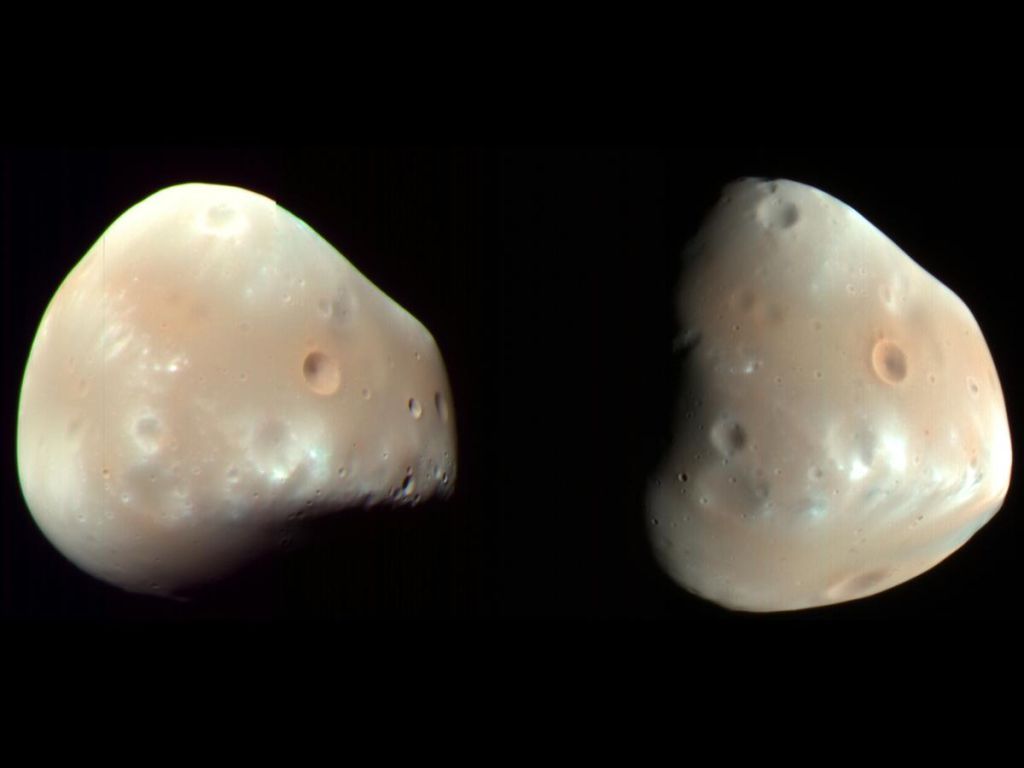
Images captured by NASA's Mars Reconnaissance Orbiter reveal that the surface of Deimos is mostly smooth, marred only by recent impact craters.

Images captured by NASA's Mars Reconnaissance Orbiter reveal that the surface of Deimos is mostly smooth, marred only by recent impact craters. (Image credit: NASA/JPL/University of Arizona)

"It's two totally different lines of evidence that point in two different directions. That's what makes it an interesting puzzle," Statler said. Several theories have also been presented for hybrid scenarios combining the two, he added.

"There's all kinds of different ways, all kinds of different combinations of those two basic scenarios," Statler explained. "But that's the puzzle from the start, the two seemingly contradictory lines of evidence that are pointing us to what … the real history was, but we don't know what it is yet."

The science

Each theory for where Mars' moons came from predicts different chemical characteristics for their surfaces. Presumably, captured asteroids would preserve chemical signatures of material originating elsewhere in the solar system, potentially rich in volatile elements like hydrogen. Moons formed through a planetary impact, however, would contain a mixture of Mars and impact material, altered by the intense heat of such a violent collision.

Determining which scenario is more likely could reveal whether Mars experienced a massive moon-forming collision or acquired its moons from elsewhere in the early solar system. Either answer could offer new insights into the planet's evolution and the events that shaped the terrestrial planets like Earth billions of years ago, mission team members say.

"At this point, we know nothing about the composition of Phobos," David Lawrence, MEGANE principal investigator at APL, said during the Oct. 15 briefing. "We have information about mineralogy, but no elemental composition. And so, elements are really a key way to get at some of these foundational questions."

MMX's scientific suite has been carefully calibrated to make those determinations. The cameras and sensors on the MMX exploration module's TENGOO, OROCHI and LIDAR instruments will map Phobos' terrain, geological features and variations in surface materials from orbit, to provide clues about the moon's formation and evolution. Complementing those measurements, MIRS is designed to detect and classify Phobos' surface minerals and search for organic compounds to further differentiate its possible origin as an asteroid or ancient chunk of Mars.

The RAX spectrometer and miniRAD instrument aboard IDEFIX will add localized context to those observations by examining surface mineralogy and their thermal properties up close.

Back in orbit, NASA's MEGANE instrument will measure Phobos' elemental composition through gamma-ray and neutron spectroscopy that can scan tens of centimeters beneath the moon's surface for signs of volatile elements. Higher abundances of hydrogen, chlorine, sodium and potassium, for instance, would favor the asteroid-capture hypothesis, while lower abundances of those compounds could point to the heat and chemical deterioration associated with a planetary impact.

"In Japanese, 'megane' means eyeglasses," Lawrence said. "So we like to think of MEGANE as being an instrument that will look at Phobos with gamma ray and neutron glasses."

a split image. a dark background looks at microscopic pieces of mars rock. on the right, a mars rock.

A martian meteorite under the microscope and hand specimen. (Image credit: Open University, CC BY-NC-SA)

When compared to the samples MMX will return to Earth, MEGANE's findings could help scientists determine if volatile depletion found on Phobos reflects the intense heat of a post-impact formation or billions of years of subsequent erosion from the natural effects of space exposure.

MSA, meanwhile, will measure charged particles around Phobos, searching for evidence of subsurface ice and investigating how solar wind exposure has altered the moon's surface. It will also study atmospheric particles escaping from Mars. CMDM will measure dust around Mars, including particles potentially ejected from its moons by impacts.

Comparative observations of Deimos after MMX's final departure from Phobos will help establish whether the moons share similar compositions and, potentially, a common origin.

Once safely returned to Earth, laboratory analysis of the Phobos samples will allow scientists to examine chemical composition and mineralogy with a precision beyond that of MMX's onboard instruments. Tests like isotopic analyses — measuring subtle differences in the atomic makeup of elements — can help identify the samples' origins by comparing their chemical fingerprints with those of Martian rocks and asteroid material.

JAXA (Japan Aerospace Exploration Agency) scientists think some returned material could even originate from Mars itself, deposited on Phobos after ancient asteroid impacts blasted rocks off the Red Planet's surface, potentially holding evidence of its geological past.

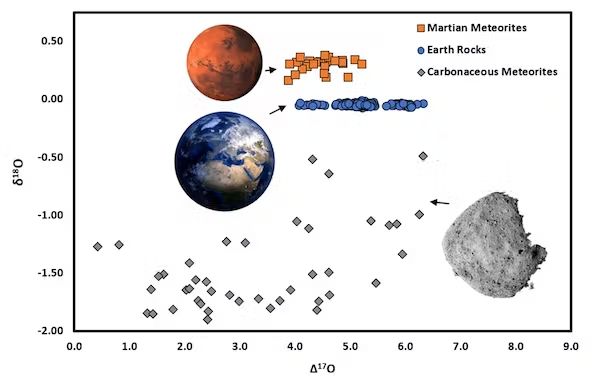
a plot graph shows grey dots along the bottom with a grey asteroid on the bottom right. earth hangs middle left, with mars above. both planets have many dots, blue and orange, respectively, a crowded near the top right area of each planet.

Oxygen isotope plot showing the stark differences in oxygen between the Earth, Mars and asteroids. If Phobos does indeed represent an ancient fragment of Mars, it could comprise the most primitive of Martian material. (Image credit: Open University, CC BY-NC-SA)

International effort

The JAXA-led mission represents interagency partnerships with NASA and the European Space Agency (ESA), which are providing hardware and communications support through the Deep Space and Estrack networks.

NASA's contributions to MMX also include MEGANE, the Honeybee Robotics-built P-sampler, and an approximately $87 million investment through the end of the mission. NASA is funding the United States scientists on the MMX team, who will, alongside NASA's astromaterials experts, "be fully involved in the examination and scientific analysis of the Phobos samples when they are delivered to Earth," Hays said during the mission briefing. "We get all of the value and all of the scientific participation at a lower cost total [than funding the entire mission]."

For its role, NASA will receive at least 15% of the returned samples, with materials to be maintained at the agency's Johnson Space Center in Houston for analysis and long-term preservation. To that end, MMX's scientific impact could extend far beyond the mission's conclusion.

"The Phobos samples will be historic," Statler said, with the potential "for future research to answer the questions we don't even know yet how to ask."

  •  

'We are getting a lot of pressure from the administrator himself': How NASA is racing to obey Trump's 'Super Intelligence' order

NASA has begun replacing references to artificial intelligence with "super intelligence" following an executive order from President Donald Trump, which directs government agencies not to acknowledge the terminology change in their external communications.

An internal NASA document obtained by Space.com lays out plans to update the agency's websites, publications, organizational titles and digital infrastructure with a four-phase "super intelligence" implementation schedule extending into December. And the changes go beyond NASA's public-facing communications, with at least one planned technical update described as "a breaking change" expected to disrupt existing software integrations.

The terminology shift arrives as NASA continues expanding its use of AI across missions and research programs, from autonomous Mars rover navigation to models capable of analyzing enormous amounts of scientific data. The technologies themselves aren't changing, but NASA's effort to implement the nomenclature introduces new obstacles for scientific communication and the agency's digital infrastructure.

Trump's executive order (EO), called "Inaugurating the Era of Super Intelligence," was signed on Sept. 29. It directs federal agencies to replace any mention of "artificial intelligence" and "AI" with "super intelligence" and "SI" in all official government communications. The White House argues that AI has advanced beyond simple automation or imitations of human intelligence, and that language befitting "a new era of Super Intelligence" is needed to better reflect the technology's emerging capabilities.

Despite introducing the new name, the order retains the federal government's existing definition of artificial intelligence, which broadly covers machine-based learning systems capable of making predictions, recommendations or decisions. That means technologies already classified as AI can now be designated "super intelligence" without demonstrating any additional capabilities.

To follow suit, NASA's Office of Communications (OCOMM) and Office of the Chief Information Officer (OCIO) distributed an internal implementation schedule that outlines the span of work that the agency's multiple comms teams now have ahead of them.

"Effective immediately, we must use "super intelligence" and "SI" in all in-scope content/publications," the document says, bolding the key terms.

It covers both internal and external communications and instructs NASA employees to use "super intelligence" and "SI" in all new "presentations, exhibits, printed materials, media interviews, or other collateral or content for external audiences."

Internally, the policy applies to all official employee communications, NASA style guides, intra-agency websites and IT systems referenced in public-facing communications or official materials. And NASA's instructions echo Trump's directive forgoing any kind of transitional language.

"NASA is … adopting the terminology ‘Super Intelligence’ as the agency continues to expand the use of these rapidly advancing technologies across its missions," agency officials told Space.com in an emailed statement. "NASA is already applying SI to advance mission planning, autonomous systems, scientific research, and the analysis of complex datasets."

Orders from the top

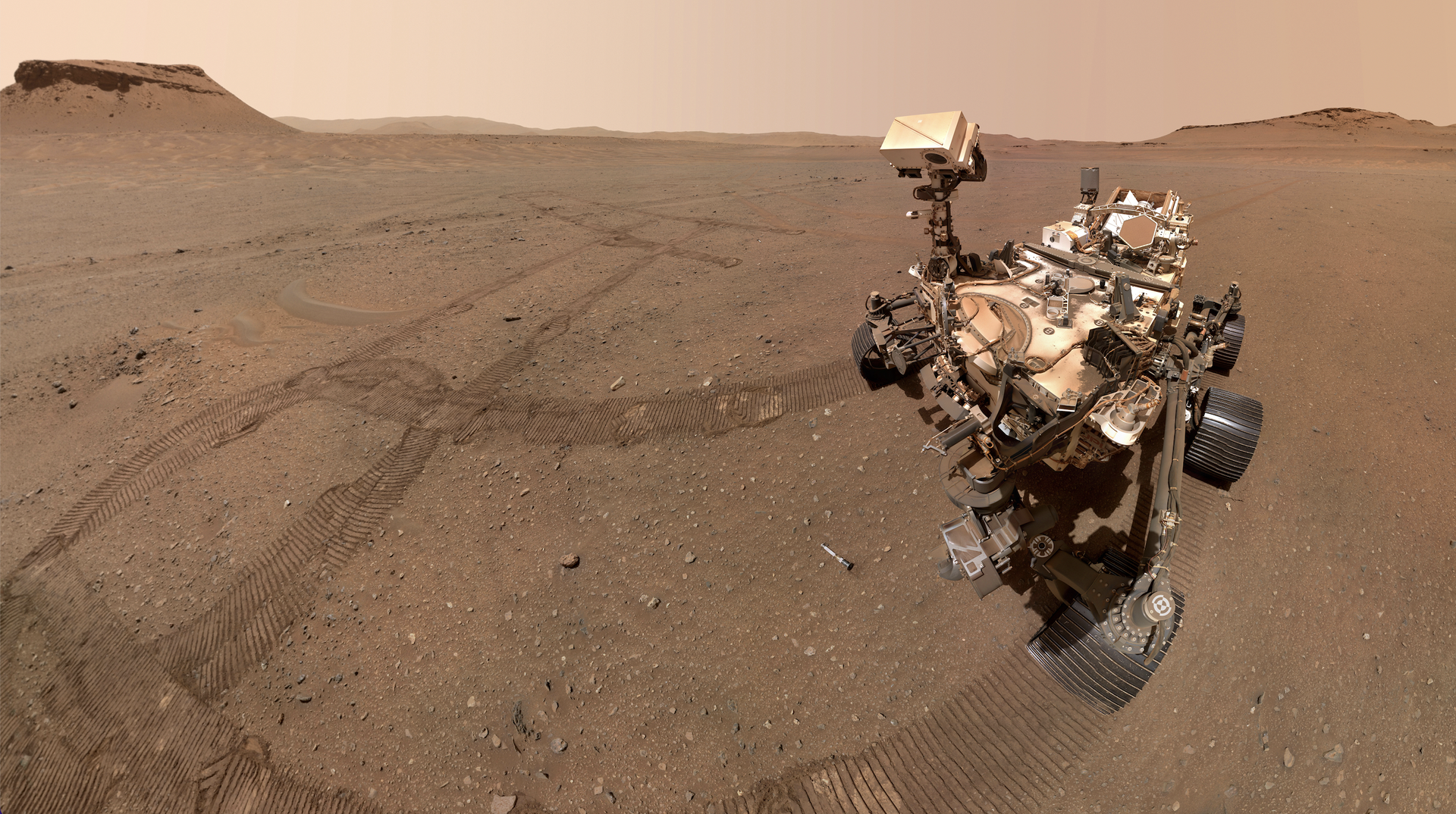
NASA's Perseverance Mars rover selfie.

NASA's Mars rover Perserverance team began using a vision-based artificial intelligence system to plan safe driving routes on Mars without a human controller in December 2025. (Image credit: NASA/JPL-Caltech/MSSS)

Agency leadership has generally been aligned with the current administration's agenda, adjusting NASA's priorities to meet the president's goals when needed. NASA Administrator Jared Isaacman has helped lead that charge since his appointment to the position in December 2025; he has been a champion of Trump's human spaceflight-heavy vision for the agency since his first day. That should come as no surprise; NASA is, after all, part of the executive branch, and the agency is obliged to abide by executive orders.

But Isaacman's relationship with Trump is, perhaps, more visible than that of past NASA chiefs. The duo have shared several jovial public interactions, including an unexpected phone call from Trump during a press conference celebrating the launch of NASA's Roman Space Telescope on Aug. 30. One month later, Isaacman attended a White House luncheon with more than a dozen AI tech executives, on the same day that Trump signed his super intelligence EO.

While he's not an AI company executive, Isaacman is a member of the tech-billionaire community. Before beginning his tenure at NASA, Isaacman founded and served as CEO for Shift4 Payments, a payment processing company. He used some of that fortune to charter a pair of private astronaut launches with SpaceX — Inspiration4 and Polaris Dawn, which were the first-ever all-civilian orbital spaceflight and the flight that featured the first-ever private spacewalk, respectively.

"I was honored to have an opportunity to join that luncheon," Isaacman said when asked his opinion of AI during a post-launch press conference for the SpaceX Crew-13 astronaut mission on Oct. 1. By that point, he had already added the SI nomenclature to his lexicon. "I made clear when it was my turn to speak … I am the space guy here [not an 'AI' guy]," he added as a caveat, before saying that the "potential super intelligence has … [can] change the course of civilizations."

Isaacman's embrace of the new lingo may be partially behind NASA's own accelerated efforts to bring the agency's comms in line with the administration's. One NASA employee told Space.com, "We are getting a lot of pressure from the administrator himself to act on this."

Internal difficulties

Beyond just substituting one term for the other, NASA personnel have been told not to acknowledge the previous nomenclature at all, including short-term phrases such as "SI, also/formerly known as AI."

The changes extend to related terms such as "generative AI" becoming "generative SI," with NASA's guidance directing agency messaging away from "automation." They'll now put an emphasis on how today's technologies "amplify human ingenuity and unlock new forms of creativity," the NASA document says, quoting Trump's order.

The use of the term "SI," and the direction not to use "AI," applies across all NASA's centers and mission directorates, including contractors and personnel at NASA's Jet Propulsion Laboratory (JPL) in Southern California, which is run by Caltech.

Specific technical citations, like "machine learning," "large language models" and "chatbot," remain acceptable, but the new terminology may run the risk of carrying different meanings in different contexts.

Technical exceptions aside, some at NASA responsible for implementing the changes think it may present more obstacles than expected. "There's concern that there's going to be a lot of confusion in the scientific community and in the general population," a NASA employee knowledgeable of the plan told Space.com, under the condition of anonymity.

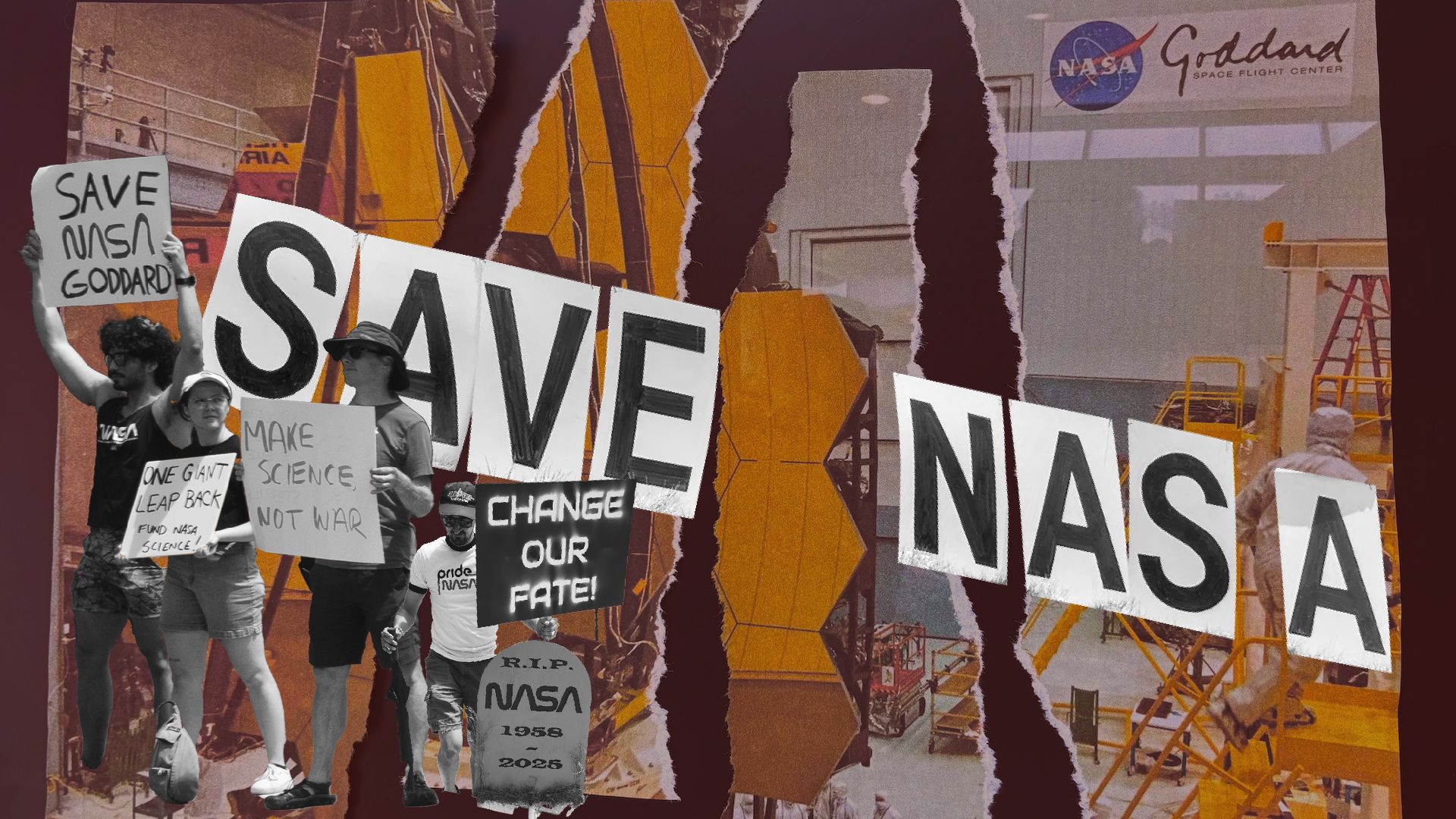
a collage of nasa stuff

(Image credit: Space.com)

In recordings of an internal NASA communications meeting obtained by Space.com, employees echoed the same concerns to their direct management and voiced some frustration over their inability to relay to the public that the changes are being made in the first place.

"We're not even supposed to use AI as a term ... it's being talked about like Voldemort or Macbeth, with people calling it 'the technology that must not be named,'" the NASA employee said.

"Super intelligence and artificial intelligence — they have two different meanings. They both are already separate things," one meeting participant said. "As a science communicator … I feel like it's our responsibility to raise our hand and say, 'Hey, this is going to confuse people. This doesn't make sense.'"

To Isaacman's credit, those worries may have a chance of being heard by him and NASA's top brass, thanks to a management culture that seems to encourage concerns at any level being brought up the ladder without reprisal.

One meeting leader references "the idea box," an anonymous online system that allows employees to submit feedback directly to agency leadership, and reminded participants that "using the tools that we have at our disposal to make those concerns heard at the top level will not hurt."

In contrast, during the transition at the start of Trump's second term last year, before Isaacman was appointed to NASA's top seat, things at some NASA centers did not always feel as open when it came to voicing concerns to management. At the time, NASA was operating under interim leadership, first by former Kennedy Space Center Director Janet Petro, from January to July 2025, then by Transportation Secretary Sean Duffy from July to December.

In a statement to Space.com, NASA officials said the agency "is taking a coordinated approach to incorporating this direction across agency communications and digital resources while maintaining the functionality and accessibility of its systems and services."

"The agency will continue to communicate its research, findings, and technological advancements accurately and transparently,” the statement said.

NASA already ahead of the game

While artificial intelligence encompasses a broad range of technologies, super intelligence has traditionally referred to a far more advanced, and often hypothetical (and sometimes sci-fi-level), capability that surpasses the limits of human cognition.

Beyond NASA, AI has entered into the space industry's ongoing realm of conversation in recent years, with several companies exploring the possibility of data centers in low Earth orbit (LEO). SpaceX is already operating the world's largest satellite network — there are currently more than 11,000 of the company's Starlink satellites in LEO, providing internet connectivity around the globe — and has proposed a constellation of up to 1 million satellites functioning as "orbital compute" for CEO Elon Musk's AI endeavors.

NASA began integrating AI into a number of its missions, both current and upcoming, well before conversations about SI stepped into the picture. One of the first to try on that hat was the agency's Perseverance rover on Mars, which used machine learning to plan and complete its first drive on the Red Planet using routes mapped out by generative AI in December 2025.

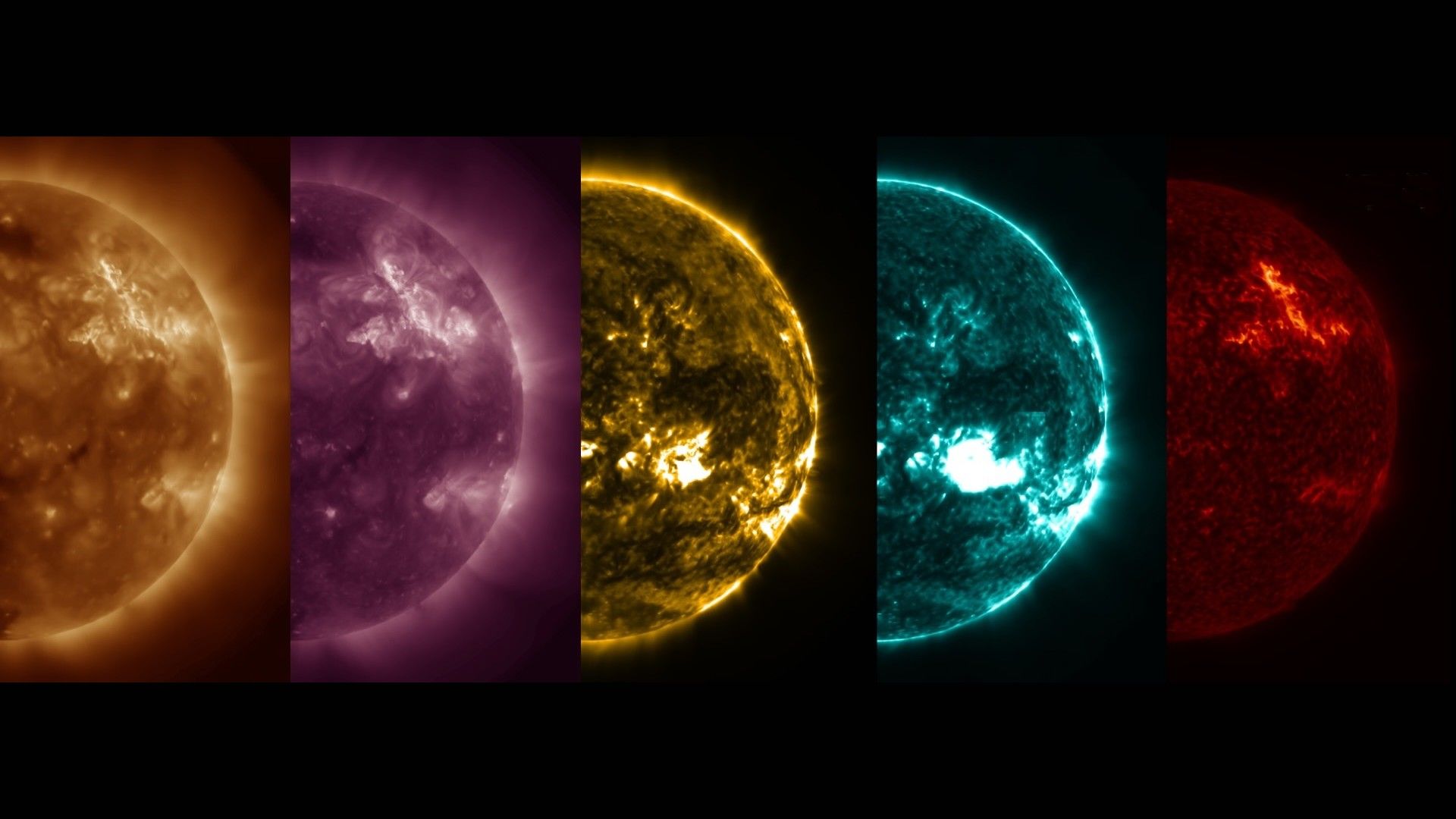
four half-orbs, each in a different color, on a black background

The Surya model from NASA and IBM processes high-resolution images from NASA's Solar Dynamics Observatory.  (Image credit: NASA/SDO/IBM)

NASA has also put AI to work analyzing massive amounts of data. Surya, an AI-powered foundation model introduced by NASA and IBM last year, was trained on nine years of NASA heliophysics data to help improve space weather and solar activity forecasting. A more recent lunar collaboration between NASA and IBM was introduced last month to help researchers investigate the surface of the moon for potential deposits of water ice, and AI is central to NASA's plan for processing the massive amounts of data expected once Roman is operational.

"Foundation models" like Surya fall under the acceptable precise-language usage that NASA still considers best practice when communicating with scientific audiences, according to the agency's internal guidance. However, separate instructions for scientific publications and research documents are still being developed internally, leaving some uncertainty over how NASA researchers will reconcile the new terminology with established language used by universities, international space agencies and other scientific institutions that may not adhere to Trump's EO.

According to the agency's internal plan, a determination for scientific publications and research documents will be issued by NASA's Scientific and Technical Information, Science Mission Directorate and Chief Science Data Officer teams, along with separate guidance for official agency policy documents, both of which are listed on a page titled "Forthcoming Guidance."

Implementation

Retroactively, certain already published web pages, including applicable evergreen content in active use, will be marked for update or given an added disclaimer with an archival notice. Titles, descriptions and other metadata for older videos and podcasts may also be revised to reflect the new terminology, while the original recordings, transcripts and captions will remain unchanged. NASA's page for Perseverance's AI-guided trek across Mars' surface, for instance, is now titled, "Mapping Perseverance’s Route With SI," but "AI" is still present in the page's URL — for the time being, at least.

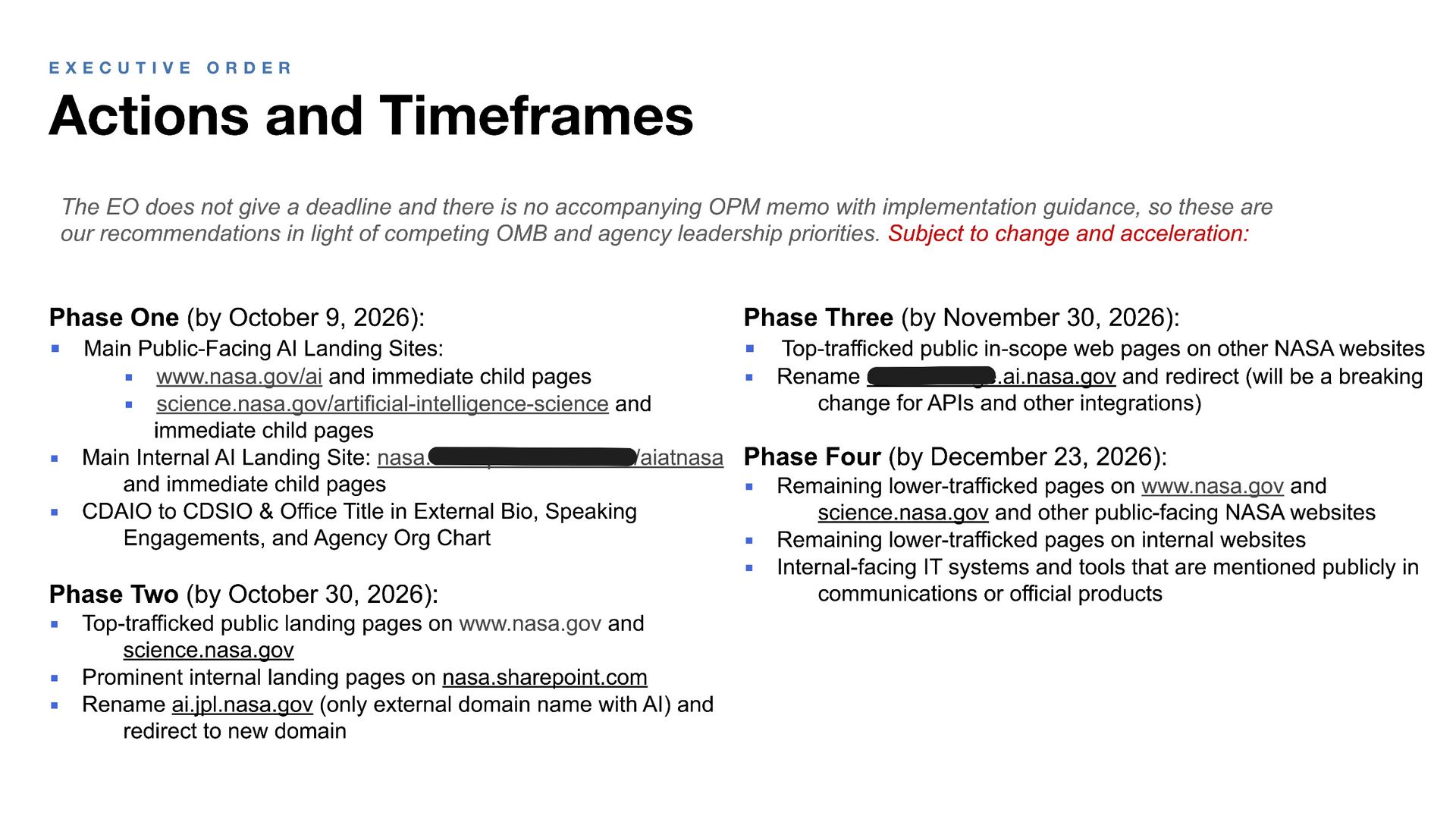
Soon, that URL will redirect to a new one, with "SI" in its place. NASA's internal plan divides its implementation into four phases, with proposed deadlines stretching from Oct. 9 through Dec. 23.

"Every agency is doing it at their own pace," one NASA employee told Space.com. "You'll see some places have not implemented the change yet, and others, like NASA, are pushing it forward sooner rather than later."

a presentation slide with phase text for implimentation of super intelligence.

Internal NASA slide for Super Intelligence implementation (image approximation). (Image credit: Space.com recreation of an internal NASA presentation)

Phase One, which went into effect Oct. 9, included NASA's primary AI-related websites and agency personnel titles, such as that of Kevin Murphy. He is now "acting chief data and super intelligence officer," not "acting chief data and artificial intelligence officer."

Phase Two will expand the overhaul to heavily visited pages on nasa.gov and science.nasa.gov, and rename the website for JPL's Artificial Intelligence Group, ai.jpl.nasa.gov, to redirect visitors to an address reflecting the new SI terminology. The second phase's completion was initially set for implementation by Oct. 30. Sources familiar with the agency's progress, however, said that timeline was accelerated and the changes made ready to go live starting today (Oct. 16), two weeks ahead of schedule, according to a NASA employee.

Phase Three is marked for implementation by Nov. 30. It includes additional high-traffic NASA websites and the renaming of its URL for Ask Sage, a generative AI platform used by federal agencies. NASA's internal plan describes the change as a "breaking change for APIs and other integrations," meaning existing software connections may need to be updated.

According to NASA officials, "any necessary technical changes will be evaluated and implemented through established agency processes."

Finally, Phase Four, targeted for Dec. 23, will scoop up NASA's remaining, lower-traffic websites, as well as internal IT systems and tools. NASA's guidance notes that Trump's EO doesn't designate a deadline for affected agencies, and that, without accompanying direction from the Office of Personnel Management, its framework ultimately represents the authors' recommendations "in light of competing OMB (Office of Management and Budget) and agency leadership priorities."

Editors note: This story was updated at 10:10 a.m. EDT (1410 GMT) on Oct. 16 to include Statments from NASA sent after publication.

  •  
❌