
❌

Normal view

Ask me anything: Tania Kendrick – ‘There’s something really satisfying when everything starts to click’

12 October 2026 at 14:00

Tania Kendrick studied physics at the University of Bristol in the UK before joining the Civil Service fast-stream development programme, which saw her have postings at the UK’s Ministry of Defence, the Department for Environment, Food and Rural Affairs, and the Cabinet Office. After completing the scheme, she decided to stay in the Cabinet Office, where she now works full-time on relations between the UK and the European Union.

What skills do you use every day in your job?

One key skill I use every day is communication. A large part of my job involves taking complex and detailed information, understanding what is most important, and communicating it clearly and concisely to different audiences. This can vary from briefing senior colleagues and ministers, where I need to distil a lot of information into the key points they need to know to make a decision, to producing guidance and written products that need to be clear and accessible to a wide range of stakeholders. Being able to adapt how I communicate depending on the audience, and being able to do this quickly, while making sure the key messages are understood, is vital.

Although a physics degree and a career in policy may not seem to have an obvious connection, I constantly use the analytical skills I developed at university. I need to look at complex information and evidence, identify the key issues, and consider how different factors should feed into decision-making. Then I need to make sure that recommendations and advice are grounded in evidence, while also considering different perspectives, potential risks and the wider context. Being able to analyse information critically – and use it to support informed, evidence-based decision-making – is crucial.

What do you like best and least about your job?

What I love most about working in the Civil Service is that I’m constantly learning something new. Policy covers such a wide range of issues, and I really enjoy the challenge of getting to grips with a new topic, understanding how it works, and gradually seeing the bigger picture. There’s something really satisfying about that moment when everything starts to click and you understand why something is done in a particular way, or realize there are considerations you would never have thought about when you started. I like that no two days are exactly the same and that there is always something new to learn.

What I like least about my job, which is something I’m still getting to grips with, is finding time to properly switch off. Policy development can take time, and it’s easy to find yourself thinking about a problem outside work, such as trying to devise a potential solution or wondering if there is a better way to frame something. It’s really important to build things into your routine that help you switch off. For me, that means setting clear boundaries, exercising straight after work, particularly running and playing hockey, and making time to catch up with friends.

What do you know today, that you wish you knew when you were starting out in your career?

Something I wish I could tell my past self, especially throughout university and coming up to graduation, is not to worry so much about having everything figured out. I focused too much on trying to work out my exact “dream” physics job. But looking back, I realize I didn’t necessarily need a clear plan. As a teacher once said to me, studying physics opens so many doors. You develop skills that can take you into a wide range of careers from finance and technology to consulting and, of course, the Civil Service. So my advice to others would be: you don’t need to know exactly what you want to do straight away. Try things, get some work experience, speak to people in different careers, and be open to opportunities you might not have considered. The world really is your oyster.

The post Ask me anything: Tania Kendrick – ‘There’s something really satisfying when everything starts to click’ appeared first on Physics World.
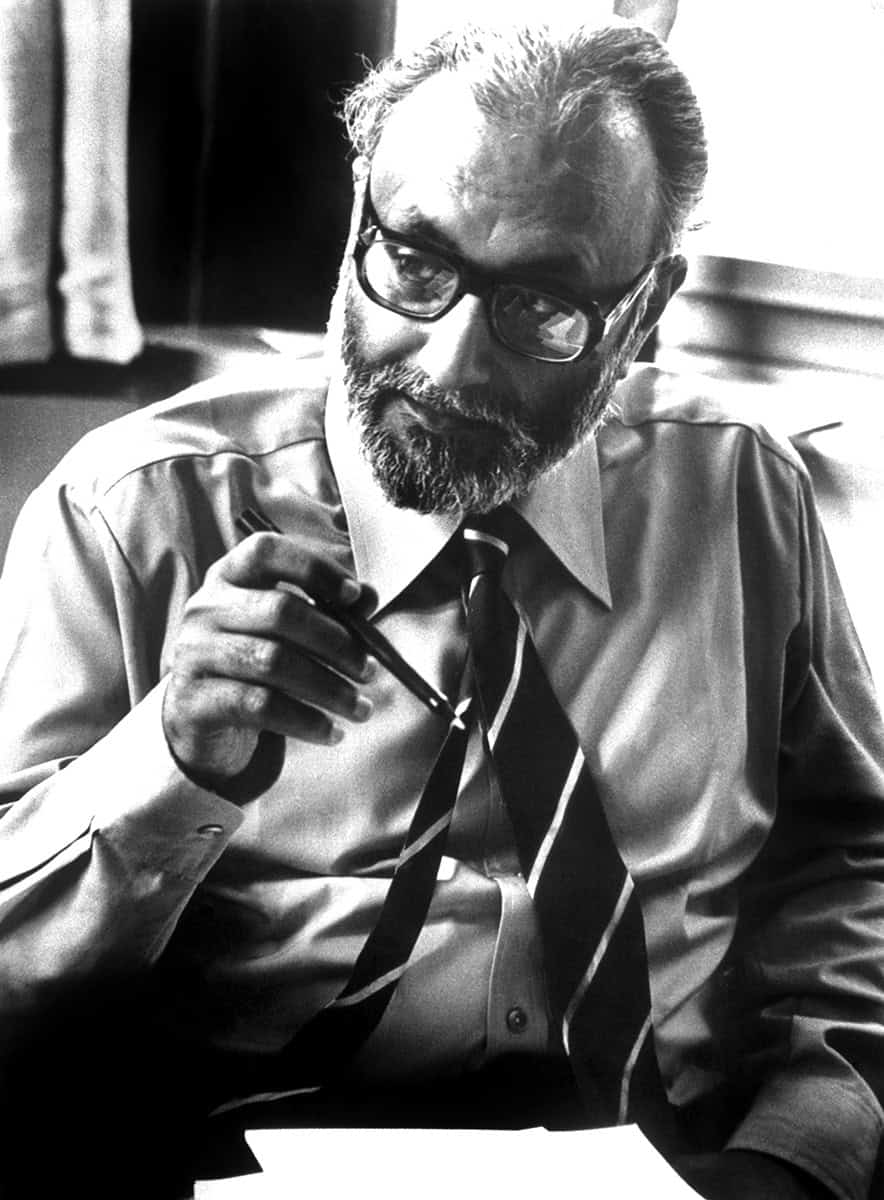
Abdus Salam: Pakistan’s first (and so far only) physics Nobel prize-winner

2 October 2026 at 15:00

The facts are simple enough.

Abdus Salam shared the 1979 Nobel Prize in Physics with Sheldon Glashow and Steven Weinberg for “their contributions to the theory of the unified weak and electromagnetic interaction between elementary particles, including, inter alia, the prediction of the weak neutral current”.

What Salam had done was to incorporate the Higgs mechanism – co-discovered by his colleague at Imperial College London Tom Kibble – into electroweak theory, which unifies the electromagnetic and weak forces.

As the Imperial theorist Claudia de Rham said in a 2024 interview with Physics World, Salam’s work “changed the way we see the world by underlining the importance of symmetry and by showing how some forces – which may appear different – are actually linked”.

But Salam, who died in 1996 after suffering from a cruel neurodegnerative disease, did more than unify the weak and electromagnetic interactions. He also became the first – and so far the only – person from Pakistan to win a science-related Nobel prize, yet for a long time remained overlooked in his homeland.

Great minds

Salam was born on 29 January 1926 in the Punjabi city of Jhang in what was then British India. A child genius, he studied mathematics at Government College, Lahore, completing his master’s degree in 1946 with record marks (getting 765/850 or 90%).

Later that year Salam moved to the UK after winning a scholarship to study at St John’s College, Cambridge, studying initially mathematics and then physics, gaining a double first-class honours in 1949.

Back home, India was in turmoil, with a growing demand for independence from the British, and the Muslims seeking a homeland for themselves.

As a Muslim himself, Salam would no doubt have celebrated when Pakistan was created during the partition of India, with the country coming into existence at the stroke of midnight (0.00 a.m.) on 14 August 1947.

After completing his PhD in quantum electrodynamics at Cambridge in 1951, Salam returned to Pakistan, taking up a teaching post at Government College, keen to establish a research base in the fledgling country. But lacking journals, colleagues or any proper scientific infrastructure in Pakistan, Salam realized he would have to go abroad again.

“Either I must leave my country or leave physics,” he said. “And with great anguish I choose to leave my country.”

In 1954 Salam went back to Cambridge for three years before appointed a professor of applied mathematics at Imperial in 1957. He later switched to Imperial’s physics department, where he set up a renowned theoretical-physics group that he led for much of the rest of his life.

In 1964 Salam also founded the International Centre for Theoretical Physics (ICTP) in Trieste, Italy, to help support physicists from developing nations.

Home at heart

But Pakistan was always in his heart. Salam served for 13 years as presidential science adviser in Pakistan and in the 1970s also played a slighly murky role in the country’s nuclear-weapons programme.

Upon winning a Nobel prize in 1979, Pakistan had existed for only 32 years, meaning it, along with Austria, is the joint 13th quickest nation to win a Nobel Prize in Physics, according to our Physics World infographic.

Abdus Salam
Genius in action A portrait of Abdus Salam taken in 1979. (Courtesy: Giovanni Montenero, ICTP Photo Archives)

At the official Nobel banquet in Stockholm on 10 December 1979, Salam thanked the Nobel Foundation and the Royal Swedish Academy of Sciences. “Pakistan,” he declared, “is deeply indebted to you for this.”

Yet back home, little was made of Salam’s impressive award. Most Pakistanis are Sunnis but Salam was an Ahmadi, part of a minor Islamic movement founded in the late 19th century by the religious leader Mirzā Ghulām Ahmad (1835–1908).

Such was the opposition in Pakistan to the Ahmadis that in 1974 the country’s parliament declared them non-Muslims – heretics essentially – and the constitution was altered to reflect that fact.

Pakistan’s decision to outcast the Ahmadis profoundly affected Salam. As he wrote in his diary: “Declared non Muslim. Cannot cope.” Having previously been largely a “cultural Muslim”, Salam now saw his religious beliefs re-awakened.

Belatedly, Pakistan did offer some formal recognition in the form of a two rupee stamp in 1998, but it is surprising the country has not done much more. In 2016 Physics World reported that then Pakistani prime minister Nawaz Sharif was going to rename the National Centre for Physics at Quaid-i-Azam University in Islamabad as the Professor Abdus Salam Centre for Physics – but, as far as I can tell, that has not taken place.

Imperial, in contrast, renamed its main library in honour of Salam in 2023 and this year has been celebrating the centenary of his birth. The ICTP was also renamed after him in 1997.

A few years ago Zakir Thaver and Omar Vandal produced a wonderful documentary film called Salam: the First ****** Nobel Laureate. Directed by the physicist Anand Kamalakar, it explores in detail the strange relationship between Salam and Pakistan, which surely should have done more to honour its greatest physicist.

I can’t imagine other countries doing so little for their first Nobel prize winners as Pakistan has for Salam.

SmarAct Group logo

SmarAct proudly supports Physics World‘s Nobel Prize coverage, advancing breakthroughs in science and technology through high-precision positioning, metrology and automation. Discover how SmarAct shapes the future of innovation at smaract.com.

The post Abdus Salam: Pakistan’s first (and so far only) physics Nobel prize-winner appeared first on Physics World.

❌