❌

Normal view

Apple’s new A20 Pro smartphone chip around 25% faster than its predecessor in leaked benchmark — the 2nm CPU in the iPhone Duo and 18 Pro hits nearly 5 GHz clocks

10 September 2026 at 17:04

We reported on the new Apple A20 Pro system-on-a-chip (SoC) for smartphones yesterday, an integral attraction within Apple’s first foldable, the iPhone Duo, and in the iPhone 18 Pro devices. Now the first A20 Geekbench 6 benchmark results are starting to pop up online, and they’re very impressive, particularly in single-core performance. If the result spotted by Longhorn is a typical one, the 4,719 single-core and 12,677 multi-core scores mean the new A20 is around 25% faster than its predecessor. Its single-core score can also make some of the best PC CPUs look anemic.

huhApple A20 Pro Geekbench 6 numbers 🫠https://t.co/py5rdZ1ekk pic.twitter.com/Snrn9lTks9September 10, 2026

Apple’s official performance claims are interesting, as usual, but we’re always happy to see the third-party performance indicators start to emerge ahead of independent reviews. Heralding its new 2nm silicon yesterday, Apple might have actually understated the boost the A20 can deliver, with the official line about this “desktop-class” processor being the “fastest CPU in a smartphone,” and a claim that it is ‘just’ 20% faster than the previous gen. However, Geekbench isn’t the best indicator of real-world performance, and this is just a sample of one to sprinkle salt upon.

What are numbers without relevant comparisons, though? For more perspective on Apple’s newest silicon, which might also be thrown into a new Neo laptop (or desktop) in the coming months, check out the table below.

Apple A20 performance leak

Apple A20 Pro

Apple A19 Pro

Apple M5 Max

Qualcomm SD X2E-94-100

AMD 9950X3D2

GB6 1T

4,719

~3,800

~4,300

~3,800

~3,600

GB6 nT

12,677

~10,000

~29,000

~22,750

~28,000

Cores

2P + 4E

2P + 4E

6P + 12E

6P + 12E

16C / 32T

Clocks

4.93 GHz

4.26 GHz

4.61 GHz

4.7 GHz

4.3 GHz

Above, we’ve pitted the Apple A19 Pro from last year’s iPhone 17 Pro as the second comparison column entrant. Apple has worked on multiple angles to deliver improvements over last year. It says that it has both new super-cores and efficiency cores in play. Then there’s the refined 2nm process and the faster clocks, too.

For some wider context, we’ve also tabulated one of Apple’s newest M5 computer chips, a modern Qualcomm Snapdragon Elite X2 laptop chip, and the AMD Ryzen 9 9950X3D2, for a fun desktop PC angle. Less fun is the comparison with the Asus Zephyrus G16 2024 laptop I’m using now, with an AMD Ryzen AI HX 370 chip. Its Geekbench 6 scores of roughly 2,800 / 14,500 are easily outclassed by Apple’s new smartphone processor in 1T tests, but retain a little dignity by winning by ~1,800 points in nT tests.

Apple is opening up pre-orders for its new iPhones with A20 silicon shortly, with retail release on Friday, September 18. It usually lifts review embargoes a few days before retail. We should therefore see a broader range of benchmarks and tests from good sources in the coming week.

Minecraft-spawned crypto kingpin faces 20 years for $245 million heist — mastermind's role in hacking campaign fueled their supercar, bodyguards, and private jet habit

10 September 2026 at 15:25

The ringleader of a cybercrime gang, which reportedly formed after meetups in Minecraft online, has pleaded guilty to a racketeering charge. Sentencing is yet to be finalized, but 22-year-old Singaporean and Miami resident Malone Lam could face 20 years behind bars. Lam is accused of helping to steal and launder hundreds of millions of dollars in cryptocurrency. Here are the full United States District Court for the District of Columbia documents (PDF), via The Register.

According to the court documents, Lam visited the U.S. to meet fellow Minecrafters Jeandiel Serrano and Veer Chetal, for the first time in real life, in 2023. Soon, Lam’s role in the cybercriminal gang seems to have become an important one. The Singaporean reportedly found high-net-worth crypto holders to target, supported social engineering operations, leveraged technology to trigger account access alerts on target devices, and was involved in laundering the pilfered digital booty.

Lam’s crypto fraud gang reportedly totaled 12 members, and this criminal fraternity operated for about two years. Documents indicate that the individual crypto thefts ranged from $800,000 to tens of millions of dollars. One crypto heist purportedly netted $245 million from a single victim.

Cybergang members enjoyed lavish lifestyles due to their swindling successes. The court documents mention members of the gang owning “a fleet of 31 exotic cars, ranging in value from $100,000 up to $3,800,000.” They would also run up nightclub service bills of up to $500,000 a night, buy luxury watches, clothing, and more. As well as rent prestigious homes in locations like Los Angeles, the Hamptons, and Miami – traveling around in private jets and protected by a team of security guards.

Court document screenshot of car fleet

(Image credit: Future)

Lam was arrested in September 2024, though, so they didn’t really get to enjoy that lavish luxury lifestyle for very long. Since that time, their suspected criminal activities have been under deeper investigation. The last members of the ‘Minecraft crew’ threw in the towel around May 2025. Lam has now pleaded guilty to RICO violations, and a status hearing is scheduled for December 8 this year; the Singaporean faces up to 20 years in jail. The Register notes that another member of Lam’s fold, Marlon Ferro, was handed a 6.5-year sentence back in May. Ferro’s role was effectively a ‘physical plan B,’ and they reportedly took part in multiple physical burglaries at the behest of the gang if/when social engineering attacks weren’t enough.

Old MacBook uses a mirror, webcam, and AI agent to code its own AMD GPU drivers — 'agent-first' Omarchy Linux debugs itself, AI can check its own progress on screen in real-time

10 September 2026 at 14:00

A Linux developer has shared a photo of their laptop using realtime visual feedback during an AMD Radeon GPU driver tuning task. Justin Schroeder (@jpschroeder) explains that “the MacBook is using its webcam to look at its screen in a mirror to improve AMD Radeon chip support in Omarchy.” Linux distro Omarchy is tailored “for the age of agents,” a field in which Schroeder is something of an expert. So, we assume the MacBook is running some kind of programming agent like Claude Code, and it is watching its own screen to assess the GPU driver tweaks it is making.

Can’t make this up…the MacBook is using its webcam to look at its screen in a mirror to improve AMD Radeon chip support in Omarchy. pic.twitter.com/pw5Yu0JVJ7September 9, 2026

Schroeder’s quirky hack has gained many admirers. We note that the Epic Games boss, Tim Sweeney, humorously commented on this use of AI, giving him “HAL 9000 lip-reading vibes.” Of course, HAL 9000 was the increasingly unhinged superintelligent computer from Kubrick’s 2001: A Space Odyssey. In the movie, it famously read the lips of astronauts plotting to limit its operational scope.

Since the MacBook is working on itself, it must be an older Intel Mac with an AMD GPU inside. Thus, the coding agent can refine Radeon hardware support and actually benefit from the webcam’s visual feedback.

Omarchy can be a good fit for users of older Intel-based Macs due to its specialized drivers and configurations. However, this interesting flavor of Linux is headlined as a handsome Linux distro designed for the age of agents. The OS’s homepage also boasts of a lightning-fast installation, with built-in agents that can debug issues. In short, users can “vibe your way through every alteration, tweak, or trouble.”

More details about this operating system can also be found on its GitHub repository. Omarchy isn’t just for ‘vintage’ Intel Macs like Schroeder’s image shows. It is available for Apple Silicon Macs and modern x86 PCs. Moreover, it is also suitable for ‘potato PCs’ like “a 2011 ThinkPad X220 with 2GB of RAM,” according to the developers. Omarchy is distributed under the MIT license.

Developer uses Claude to vibe code a Windows 3.1 shell in an hour — reanimated 12MB retro launcher runs on both Windows 11 and Apple Silicon

10 September 2026 at 12:00

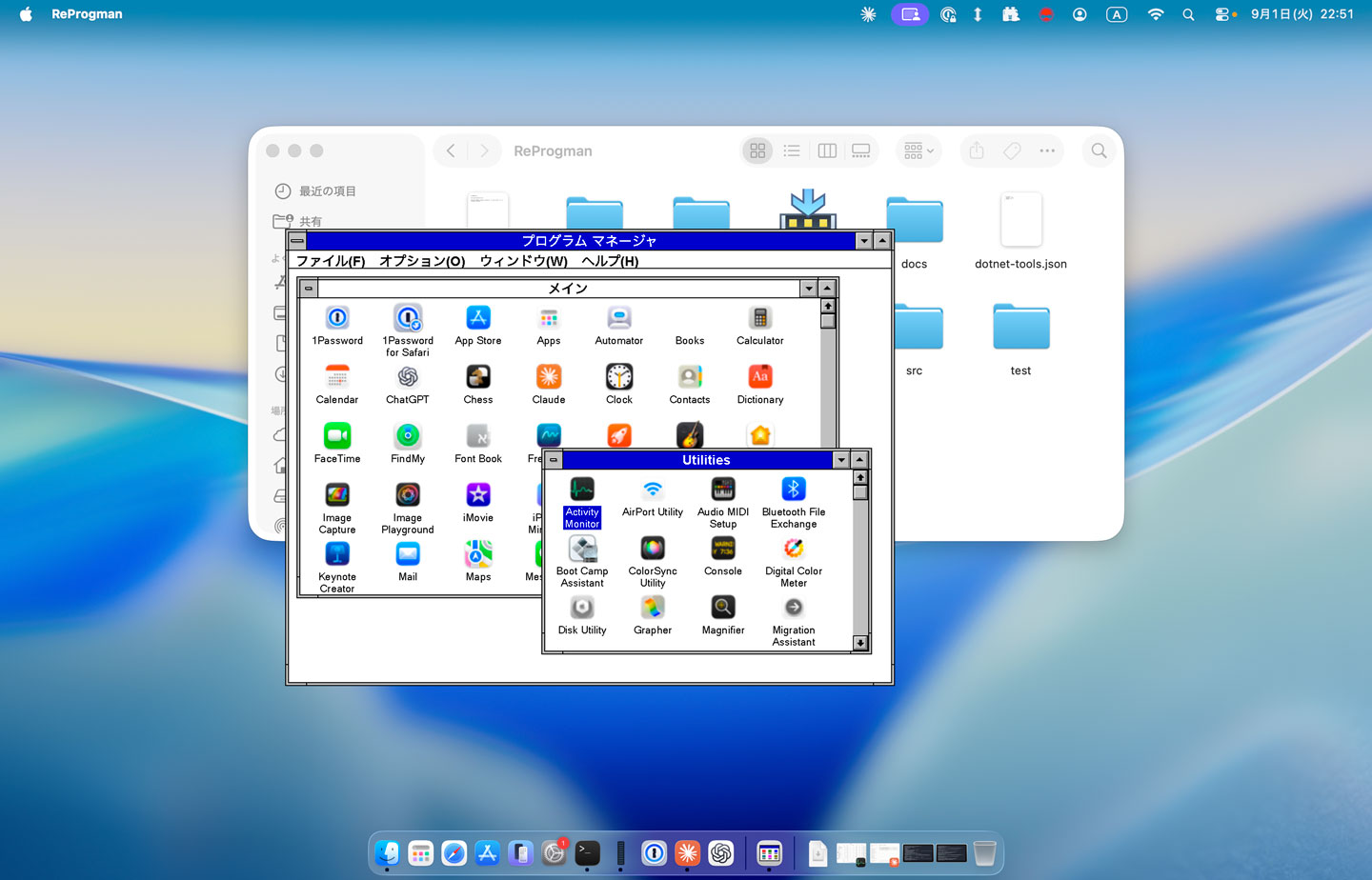
If you are yearning for a quick-shot retro Windows experience on your modern Windows 11 or macOS system, then there’s a new vibe-coded clone of the Windows 3.1 Program Manager that may interest you. Developer Mayuki has released a neat little nostalgia project dubbed ReProgman – named after the ancient Windows 3.1 ‘progman.exe ’, which was the primary shell of the era – until Windows 95 swept it away three decades ago.

ReProgman macOS screenshot

ReProgman macOS screenshot (Image credit: Developer Mayuki on GitHub)

ReProgman looks pretty authentic to my eyes, and it brought back memories of why I wasn’t sad to see it shrivel away from Windows machines. In a social media post about the release of ReProgman, Mayuki seems to agree with my sentiments. “I asked Claude to create a clone of the Windows 3.1 Program Manager,” wrote the developer (machine translation). “I think you'll enjoy reminiscing with it for about 30 seconds.”

Claude Code worked pretty swiftly to churn out this clone of the Windows 3.1 shell. The first version that was precipitated in about an hour was “pretty decent” but needed some effort to iron out the wrinkles. Then Mayuki complains again that actually using ReProgman induced boredom after about half a minute of usage.

The end-user-ready releases of ReProgman weigh in at between 12 and 16MB, so they are quite a trivial download and don’t need installing. Thus, it isn’t very taxing to give them a try for a spot of nostalgia-tinted navigation around your present system’s programs and files. Mayuki says that building and running this application needs the .NET SDK 10.0+. The code has been released on GitHub under the MIT license.

In conclusion, Miyuki’s ReProgman provides an easy trip down personal computing's memory lane, specifically to the Windows 3.X era of the early to mid-1990s. However, some will prefer to get their retro computing kicks by running the actual MS-DOS/Windows 3.1 combo on real hardware. As we discovered recently, that doesn’t limit users to dusting off an old i486 or similar. Back in April, an enthusiast demoed Windows 3.1X on ultra-modern bare metal with a system using a Ryzen 9 9900X and RTX 5060 Ti.

Self-taught tinkerer demos working room-sized Cold War-era supercomputer with vacuum tubes — takes 15 minutes to warm up and smells like burning dust, 8-bit design uses 460 recycled 1950s Soviet tubes

10 September 2026 at 11:00

A self-taught electronics tinkerer called Mike recently shared details of his retro-computing project on Hackaday. It certainly is retro, as the design eschews modern computer component niceties like microprocessors or microcontrollers. Instead, Mike’s computer is “a modern 8-bit design, built with recycled 1950s vacuum tubes.” It uses 460 Soviet-era 6N3P (Cyrillic 6Н3П-ЕВ) double triode tubes, which were manufactured around 50 years ago, combined with era-appropriate germanium diodes.

The wall-mounted vacuum tube-based computer you see in the video above is apparently the third tube computer Mike has engineered this decade. Previous iterations have sometimes come to an explosive end…

Of course, there have been a number of famous historically significant computers based on arrays of these tubes or valves, which offer similar functionality to the transistors that largely succeeded them. There are plenty of reasons the computer industry moved from tubes to transistors, and then silicon ICs, but enthusiasts aren’t bound by such practicalities.

Mike notes a few drawbacks with vacuum tubes, actually. Most notably, this simple 8-bit computer design needs 460 of these fragile, rather bulky, white-hot glowing tubes to run. Furthermore, these used/old stock 6N3P models only have about a 500-hour operational life, so a few handy spares are required, as is a stepladder to reach the whole array of tubes, which may fizzle out at any time. The tubes run hot, so Mike's computer room is always toasty whether the season makes that a nice thing or not. A fire extinguisher is always kept handy, and the room smells of burning dust.

Performance and capabilities are about as limited as one might expect. Mike notes that starting The Tube Computer (MK3) means waiting 10 to 15 mins after power-on for the machine to literally warm up. This is followed by a mandatory reset to get the tubes into a unified operational state.

For compute functionality, Mike’s Tube Computer architecture uses an arithmetic logic design to perform just the five essential functions needed for its instruction set (sum, carry, not, increment, and XNOR). Meanwhile, its instruction cycle relies on a non-pipelined architecture with a six-step fetch and single-execute cycle.

Components:

  • 460 × 6N3P vacuum tube
  • 46 × 10 tube pcbs
  • 1 × 190cmx130cm 4mm acrylic panel
  • 3 × 2m 30mmx30mm Aluminium box section
  • 5 × Backplane pcbs

User interaction with this wall-mounted homemade computer varies depending on the program in use. Currently, Mike has it set up to run an Airship Simulator piloting a British R80 airship from Brighton to Paris. “By pressing controls on the image of the bridge of the R80, you can direct the airship software,” says Mike. “These membrane buttons simply put 5 volts directly to the input board of The Tube Computer. You can control the ballast, gas release, engine power, elevators, rudder and the bow mooring gear, which is used to release the airship from the tower.”

Another charming feature of this admittedly “build it now, fix it later” computer design is the very audible accompanying ex-British Rail flip-digit display. That add-on will invoke another entirely different flavor of nostalgia for some of our readers.

❌