❌

Normal view

Mathematicians say these 60-sided dice are the fairest in the world. Designing them took 15 years.

5 September 2026 at 16:00

Over dinner at a gaming convention around 2010, board game designer James Ernest turned to his friend Eric Harshbarger and asked a question: Could you design a set of dice so that each player in a group — whether two people or any number — could grab one, roll and have a perfectly equal shot at going first? The rule is simple: Roll your dice, and whoever lands the highest number goes first. The hard part is making that outcome truly fair for every player, no matter how many are at the table.

There could be no ties and no rerolls.

Harshbarger, a mathematician at Auburn University in Alabama, didn't have an answer that night. But the question stuck. Over the next 15 years, he and a loose network of collaborators casually worked to crack what became known as the "go first dice" problem.

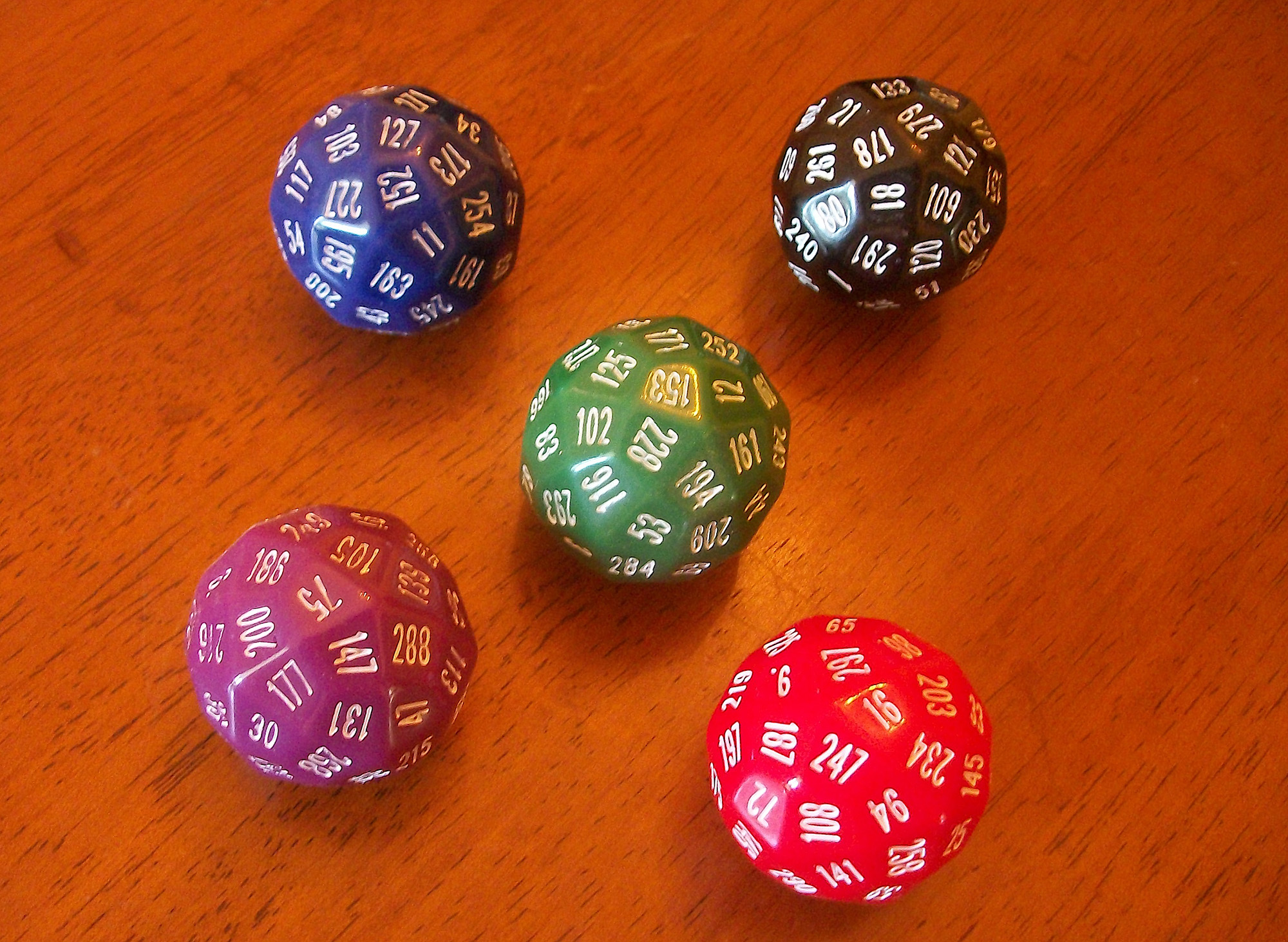
Now, they finally have the answer: a set of five 60-sided dice, collectively engraved with every number between 1 and 300, with no repeats. To mark the achievement, Harshbarger built five giant, wooden replicas of these hexecontahedrons (60-sided 3D shapes), each carved from a different type of wood. They are now on permanent display in Auburn's new mathematics building.

The problem with dice

To understand why it was so hard to crack the problem, it helps to understand the simple part.

"The easy thing is to avoid ties; you just put different numbers on all the dice," Harshbarger told Live Science. "The problem comes in how you distribute those different numbers across the dice so that the probability is equal not only for the whole set but for any subset."

That second condition is what makes the problem devilish. Ernest's request wasn't just that eight players could roll fairly; it was that any subset of players could grab any dice from the bag roll and still have equal odds. If five people are playing, each takes a die. Three people? Same thing. The numbers on each die had to be arranged so that the fairness held no matter how many people showed up to play.

Harshbarger looped in his childhood friend Robert Ford, a mathematician at Dalton State College. Within weeks, they had a three-player solution: numbers 1 through 18, spread across three standard six-sided dice in exactly the right arrangement. Four 12-sided dice, Ford later worked out entirely by hand, could accommodate four players fairly.

By 2012, Harshbarger was giving talks about the four-player set at math conferences, and The Guardian covered the story. His inbox erupted. He started selling handmade sets from home — buying blank, 12-sided dice; etching numbers onto each face with a laser cutter in his workshop; and then inking every number by hand. At his peak, he was dropping off 30 envelopes at the post office at a time, several times a week, shipping sets to customers around the world.

But as the team dug deeper into the math, they discovered that the dice were doing something even more remarkable than they'd realized: The configurations determined not only who went first but also the entire turn order, with every possible sequence of players equally likely to come up.

"If four people rolled, the chance that players finished in the order A, B, C, D was just as likely as C, B, D, A, or any of those combinations," Harshbarger said. "'Go first dice' is actually a bit of a misnomer, because they do much more than just determine who goes first; they actually determine the ordering of all the players."

This property, which the team calls permutation fairness, became the standard they chased for every set of dice from that point on.

More combinations than atoms in the universe

Four players was one thing. Five was another entirely.

Mathematically, the team knew a five-player same-shape set was feasible. But finding it meant searching an incomprehensibly large space of possible number arrangements.

"We're talking literally more than the number of atoms in the universe ‪—‬ like 10 to the 128th power combinations," Harshbarger said. "There's just no way, even if we had a billion billion years and all the computers, all the AI. We still couldn't do it today."

They couldn't brute-force their way to an answer. They needed mathematical shortcuts: symmetries and patterns to shrink the search space. But even then, years passed without a practical solution. Every path they found hit the same wall: dice too large to hold, too many sides to manufacture.

"My goal was a set for five players that can actually be manufactured, that you can hold in your hand, that board gamers could buy and roll," Harshbarger said. "Even for a problem that is silly and pointless as far as gameplay — just mathematically, can you buy these things and roll them, and they work? You can't do that with 180-sided dice."

A series of multi-sided colorful dice against a wooden surface

The five go-first dice, each with 60 sides, are designed so that any subset of players can grab one, roll and have an equal chance of winning. Each of these dice carries a unique set of numbers from 1 to 300. (Image credit: Eric Hashbarger )

Then, in mid-2023, Canadian software engineer Paul Meyer emailed Harshbarger out of the blue. He had been studying patterns in Harshbarger's four-player data and had written a program to exploit them. He hadn't expected it to work right away.

It did. Meyer found a configuration of five 60-sided dice that satisfied every condition.

"I double-checked his work and went, 'Oh my goodness; we've been searching for so long for this. This is amazing,'" Harshbarger said.

From workshop to gallery wall

The four-player set had long since been picked up by retailers — Maths Gear in the U.K. and Math Art Fun in the U.S. — so Harshbarger had stopped hand-making those years earlier. Now, the five-player version was real and small enough to manufacture.

But the story had one more turn. Auburn University was building a new home for its mathematics department and was looking for sculptural ideas to fill it. Harshbarger proposed building giant versions of the five new dice out of wood. The department agreed.

He spent months in his wood shop, constructing five oversize dice. Each is from a different type of wood: pine, poplar, oak, walnut or mahogany. The five sculptures now stand in Auburn's new math building, which opened this fall.

For Harshbarger, the whole point is making math impossible to walk past.

"When people see giant dice or little dice, they're fascinated just by the geometry," he said. "The hope is, they see these things and go, 'Oh, this is math too, and this is interesting.' Some of the most fun math problems are ones that are easily understood and not easily answered."

Some sea stars channel light like fiber-optic cables

31 August 2026 at 11:30

Chocolate-chip sea stars are famous for the rows of dark, pointy bumps that cover each of their arms. The animals really look like they’re dotted with chocolate chips. But what’s inside their arms is even more surprising, a new study finds.

Researchers have discovered tiny structures deep inside the skeleton at the tip of each arm. These channels work like mini fiber-optic cables. That’s the tech that carries internet signals around the world. In a sea star, these bony structures collect and channel light deep into the animal’s body. They might help a sea star find its way around — if enough light can get through its skin.

The overall effect “looks like short fiber-optic cables made out of their skeleton,” says Sönke Johnsen. “I was really impressed by what they found.” A biophysicist, he studies how animals sense light. He works at Duke University in Durham, N.C. and did not take part in this study.

The chocolate-chip sea star (Protoreaster nodosus) lives in shallow tropical waters. Its five arms grow out from a central disk. A network of small, interlocking plates make up its skeleton. Each plate is made of a chalky mineral called calcite. At the tip of each arm sits a heart-shaped piece called a terminal plate.

Ling Li wasn’t looking for light-guiding structures when he started studying these animals. He’s a materials scientist at the University of Pennsylvania in Philadelphia. His team wanted to know how sea stars build such strong calcite skeletons. It’s a weak and brittle mineral of calcium carbonate, the same stuff used in some classroom chalk.

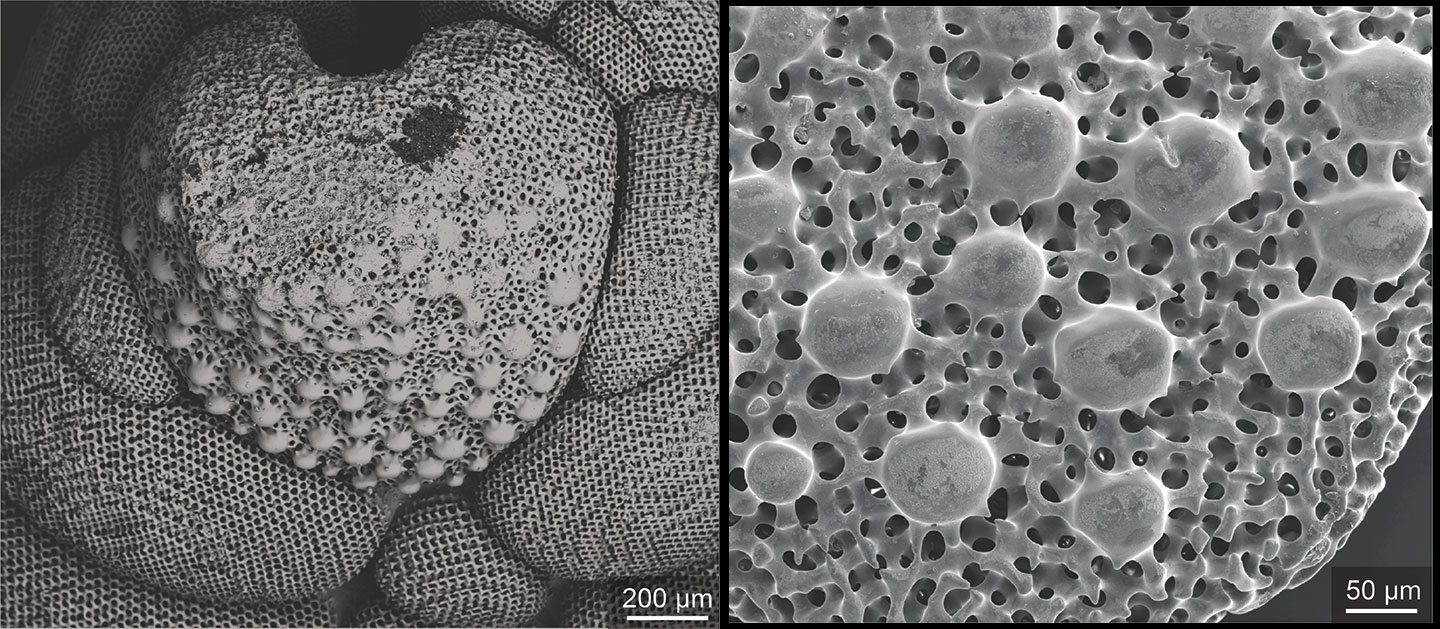
His team scanned sea stars’ terminal plates with an X-ray machine. This revealed a surprise. Each plate held 90 to 100 cone-shaped structures. Each extends deep into the skeleton. All the cones aim toward a hollow space inside the plate.

“It seems like something purposely made,” Li says. “Very prominent, very consistent.”

Light collectors

Left: An electron microscope image shows a heart-shaped piece of the skeleton at the tip of a sea star’s arm. Rounded bumps cluster across the surface of this terminal plate.

two electron microscope images of a sea star's arm
Liuni Chen and L. Li

Right: An extreme close-up of the terminal plate shows the rounded tops of the light-channeling cones. Each dome is a point where light enters a cone.

Tiny cables of bone

Each cone is built from a single crystal of calcium carbonate. This mineral bends light more than the surrounding seawater does. Scientists describe it as having a higher refractive index. That means that light hitting the wide part of a cone refracts — bends — inward.

Its angle and the high refractive index make the light bounce back — or reflect — off the cone’s inner walls. This is called total internal reflection. Light bounces within the crystal until it exits out the narrow end of a cone.

“It’s the same physical phenomenon as fiber optics,” says Pupa Gilbert at the University of Wisconsin–Madison. She was not involved in the work. She does, however, study biomineralization (By-oh-min-er-al-ih-ZAY-shun). It’s how living things build structures out of minerals.

A 3-D model showing cone structures inside the heart-shaped bony plate at the tip of a sea star's arm.
This 3-D reconstruction shows the heart-shaped bony plate at the tip of a sea star’s arm. Each colored shape is one of the roughly 90 to 100 cone-shaped structures scientists found hidden inside. Liuni Chen and L. Li

Each cone transmits about 70 percent of the light that enters it. As light reaches the narrow part of a cone, it’s “concentrated and intensified,” Gilbert says.

All cones in a terminal plate work together, gathering light from one-third of the field of view around it. As cones funnel that light in toward a cavity below, they amplify its intensity as much as eight times.

Li’s team tested the cones in the lab to confirm they channel light. When they shined light at a terminal plate, a bright spot appeared in the cavity below. Other bits of the sea-star skeleton had no such effect. Light shined on them simply scattered. Only the terminal plate’s cones focused light this way.

Li and his team shared these findings on June 8. Their work appears in Proceedings of the National Academy of Sciences.

a chocolate-chip sea star on a sandy ocean bottom
Like other sea stars, the chocolate-chip species can move toward light. Tiny, light-channeling structures in the tips of its five arms might explain how it navigates. Placebo365/E+/Getty Images Plus

Why does the sea star do this?

Sea stars move toward light. It’s a process known as phototaxis (Foh-toh-TAK-sis). Li’s team thinks the cone arrays might explain how they do this. A sea star could compare how much light is reaching the light-collecting plates at the tips of each arm.

“They can compare the illumination level in different directions,” Li says. “So they can detect which side is darker, which side is brighter.” The brightest light would point them to the light’s source.

His team doesn’t know for sure that the animals use the cones this way. For one thing, no one has yet found light-sensitive cells beneath the cones. These would make the light signal useful to the animal. Right now, Gilbert says, “The light detector is the part that’s missing.”

“The optical stuff is interesting,” says Samuel Powell. “But,” he adds, “it doesn’t seem biologically relevant, as far as I can tell.” Powell has spent years studying vision in marine animals. He used to work at the University of Queensland in Brisbane, Australia.

A simple experiment, he says, could help show whether sea stars use their cones to detect light. “Just shine light at the animal. Does it respond?” If it does, that would suggest those cones indeed are helping the animal sense light.

Li’s team plans something like that. In a future study, they aim to cover four of the sea star’s five arms to see if one is enough to use in navigating toward light.

A bonus: tougher armor

Even if the light-sensing idea doesn’t pan out, the cones have one confirmed benefit: strength. Computer models show that these structures about triple the stiffness of the terminal plates compared to other parts of the skeleton.

“A three-times improvement in strength without adding that much material is pretty neat,” says Powell.

Where this bonus strength shows up may be strategic, Johnsen says. “This structure is in the very tip of the arm, which looks quite pointy and thorny,” he notes. The tips are the animal’s most exposed parts. They are the first things to scrape against rocks or catch a predator’s attention. “Having the tips of your spines be extra strong seems like it makes a lot of sense,” Johnsen says.

When engineers design a material, they may build it to be strong, or to transmit light. Rarely would they try for both at once, notes Gilbert. But the sea star may show a way to do just that.      

What excites her most is that the cones may do both jobs — channel light and reinforce the skeleton — with a single structure, made of a single material. “You don’t have to make those hard choices,” says Gilbert. “You can find the best compromise and have the same structure perform different functions.” Engineers could use this idea to build lightweight materials that carry loads and deliver light at the same time.

Do you have a science question? We can help!

Submit your question here, and we might answer it an upcoming issue of Science News Explores

❌