❌

Normal view

Pursuing a Dream of Working for NASA

12 August 2026 at 16:38
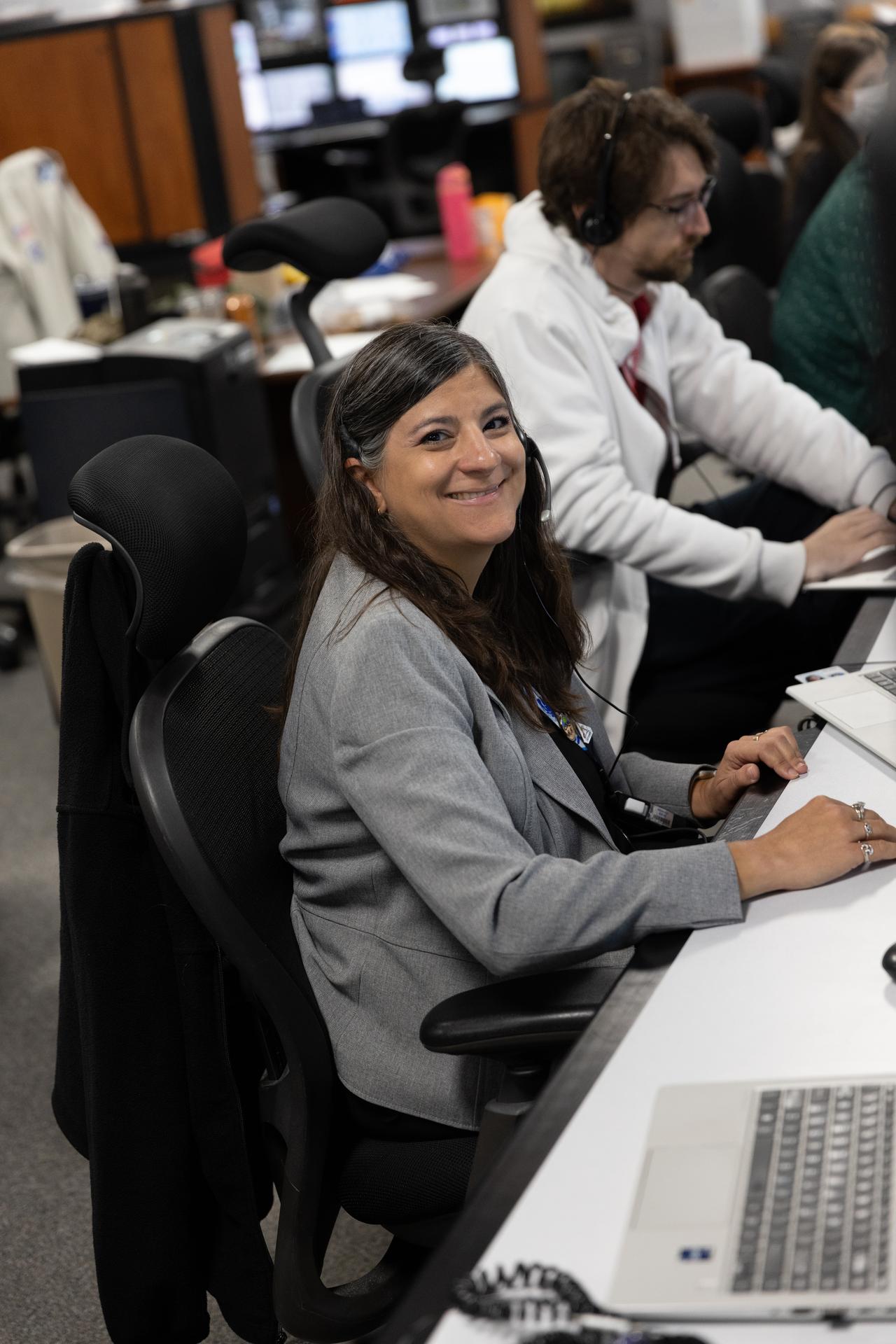
A women with dark brown hair smiles at the camera for a photograph. The woman is wearing a grey jacket and a headset while she sits at the desk with a computer;
Lindsey Waitt, engineer with NASA’s Exploration Ground Systems Program, participates in a terminal countdown simulation for Artemis III on Thursday, Aug. 6, 2026, inside Firing Room 1 of the Rocco A. Petrone Launch Control Center at NASA’s Kennedy Space Center in Florida.
NASA/Clayton Rougelot

As a young girl raised in Worcester, Massachusetts, Lindsey Waitt dreamed of working for NASA. Her dream is now a reality as she embarks on her role as a NASA test project engineer with the Artemis launch team – an integral part of the agency’s missions that will enable humans to return to the surface of the Moon after launching from NASA’s Kennedy Space Center in Florida.

When she was in middle school in the late 1990’s, Waitt recalls meeting NASA Space Shuttle astronauts Michael Lopez-Alegria and Albert Sacco, Jr., a former professor at the college, during a visit to Worcester Polytechnic Institute (WPI) in Worcester, Massachusetts. She was inspired while listening to them recount their spaceflight experiences including an experiment on conducting research for growing cells on the Moon. She even posed for a picture and got their autographs. Little did young Waitt know, these would not be the only astronauts she would meet.
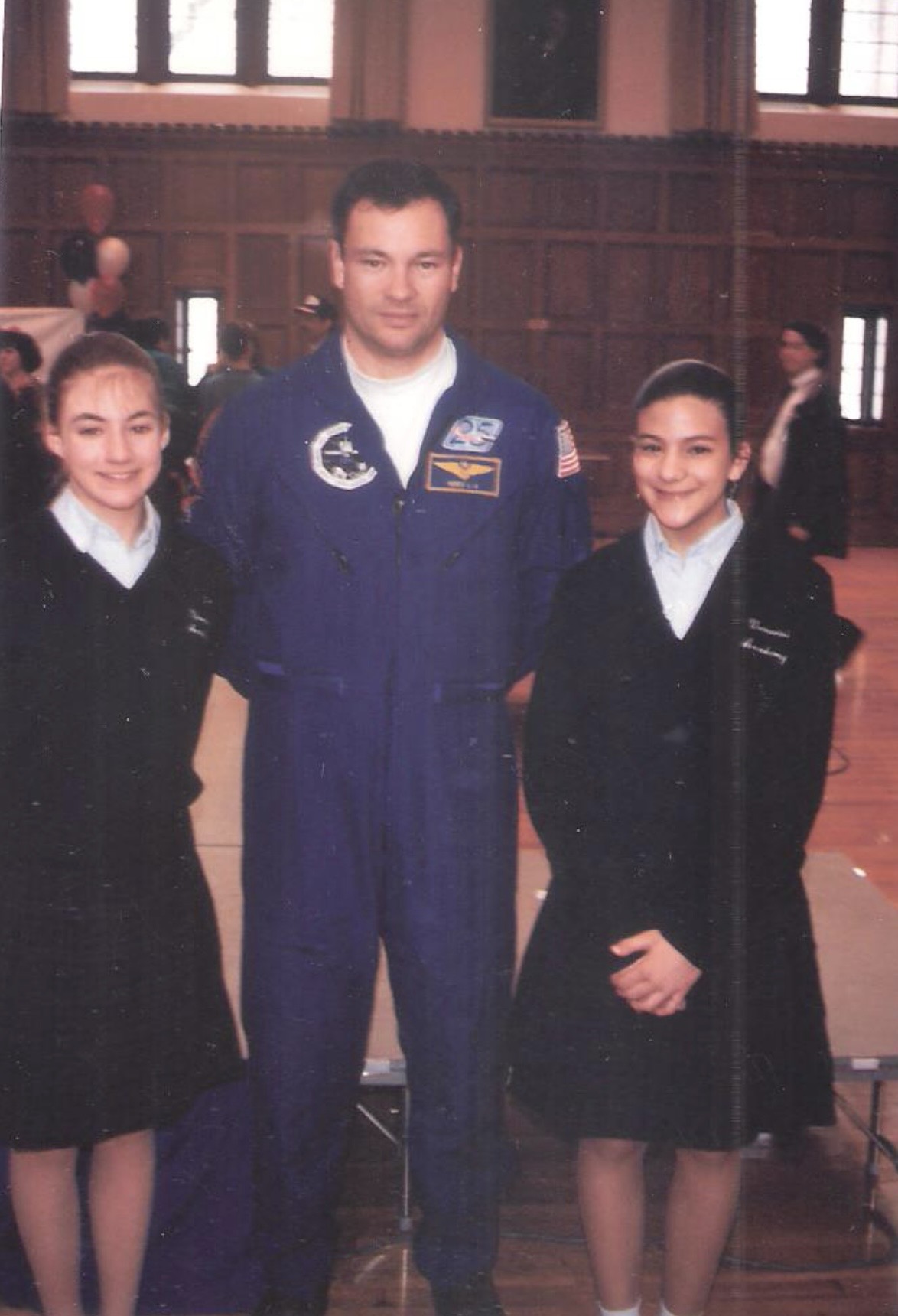
The photo features two young ladies in black dresses posing for a photograph with a NASA astronaut Michael Lopez-Alegria standing in the middle between the two young ladies.
Lindsey Waitt (far right), poses for a photograph with NASA astronaut Michael Lopez-Alegria and her cousin at Worcester Polytechnic Institute in Massachusetts.
Photo credit: NASA/Lindsey Waitt

Her passion for learning about all things space and engineering led Waitt back to WPI where she studied engineering, absorbing different disciplines. She received her Bachelor of Science degree in Mechanical Engineering with a concentration in aerospace engineering and she left the school fueled by her passion to be a part of America’s space agency.

After graduation, she worked as a systems engineer on radar flight test missions for a defense contractor, and while excelling in her role, she realized it wasn’t the aerospace engineering field that she desired.

“It was an exciting program, and it was meaningful to be a part of a project focused on protecting the country from enemy attacks. But it wasn’t space,” Waitt said.

As the wife of a now retired sergeant first class officer in the United States Army, Waitt and her family traveled around the world during her husband’s enlistment, and she continued to follow NASA missions from around the globe. While Waitt was dedicated to raising her three young boys, she simultaneously pursued her master’s degree in Space Operations from the University of Colorado in Colorado Springs. Twelve years later, she made the courageous decision to fully return to her first career passion – working for NASA – despite nay-sayers suggesting too much time had passed for her to return to the industry.

The sky is not the limit, it's wide open now. The universe is the limit.

Lindsey waitt

Lindsey waitt

Test project engineer

Waitt vividly remembers watching NASA astronauts Doug Hurley and Bob Behnken soar skyward during NASA’s first commercial crew mission to the International Space Station in 2020. Watching alongside her family, she even set up a rocket-shaped tent, and she and her children pretended to blast off from their yard as they cheered excitedly as the astronauts lifted off from what would be her future place of work.

After moving to Florida in 2022 to work at a small satellite company in Cape Canaveral, as a systems engineer and program manager, she continued to search for opportunities to work for the agency. Waitt vividly remembers watching Artemis I with her family. They had just moved to the Sunshine State, and she woke up in the early hours of the morning to watch the historic launch, having no idea she would be working on the next Artemis mission – the first time NASA sent humans around the Moon in over 50 years!

In 2024, Waitt began her career at Kennedy working for a contractor as a test project engineer during the Artemis II launch. As “problem-solvers,” test project engineers are the main hub of experts for technical tests and launch activities and they work to coordinate resolutions across the different subsystems that may arise during the dynamic operations associated with a rocket launch. Leading up to the Artemis II launch in April, Waitt quickly became certified to sit on the launch console during the dynamic pre and post-launch operations for the massive SLS (Space Launch System) rocket and Orion spacecraft and she eagerly watched from outside Kennedy’s Launch Control Center as the four crew members lifted off the launch pad towards the Moon.

When NASA announced its insourcing initiative earlier this year, Waitt seized the opportunity to fully realize her dream. She applied for a position and is now a NASA civil servant supporting the Artemis launch team as a test project engineer for NASA– a core position for the agency’s launch team. With Artemis III in front of her, Lindsey will see the buildup of launch operations from start to finish.

As the only female of the 14 test project engineers who work on the Artemis launch team, Waitt said she was fully embraced by the colleagues she stands beside.

“Everybody’s very open and welcoming,” Waitt said. “I’ve worked on teams before, but it’s never been like this. Everyone is so passionate about the mission, and everybody is working together to get things done quickly, but safely – that’s always first priority.  We Are Going.”

This opportunity didn’t happen by chance. Waitt is embracing life’s journey and focused on making her dream come true, one launch at a time. “The sky is not the limit – it’s wide open now,” Waitt said. “The universe is the limit.”

NASA Completes Astronaut-Deployed Science Instrument for Lunar Surface

11 August 2026 at 20:41
Rectangular box-shaped device resting on a metal table. The front face is covered with a grid of many small black rectangular panels bordered in white. Metal components, brackets, and small box units are mounted along the top. The background shows a large windowed wall with a blurred American flag and an Artemis flag visible behind the device.
The fully-integrated LEMS (Lunar Environment Monitoring Station) ready for environmental testing. A small suitcase-size instrument suite built at NASA Goddard, LEMS is designed to carry out continuous, long-term monitoring of the seismic environment at the Moon, including surface motion caused by moonquakes and meteorite impacts in the lunar south polar region.
NASA Goddard/Mike Guinto

NASA has declared “wrenches down” on the first completed payload designed for Artemis astronauts to deploy on the Moon’s surface. Engineers working on NASA’s Lunar Environment Monitoring Station, or LEMS, have completed hardware development and testing and the payload is ready for its permanent home near the lunar South Pole. With the hardware complete, LEMS is ready to support one of the Artemis program’s core goals: enabling sustained lunar science and exploration.

The LEMS instrument package contains two highly sensitive seismometers that will monitor ground vibrations from moonquakes and meteorite impacts, providing scientists with insights into the Moon’s interior and the seismic hazards astronauts might encounter at the surface. Its modular design allows the system to be adapted or expanded to host new instruments in the future, creating a reusable platform that can evolve as scientific priorities grow.

The payload will remain in a clean room at NASA’s Goddard Space Flight Center in Greenbelt, Maryland, where it was built, until it is assigned to an Artemis mission for deployment to the lunar surface.

“The completion of the LEMS scientific instrument is a major step in a new era of lunar surface science. Innovative science experiments will uncover, measure, and reveal the Moon’s secrets while astronauts open new frontiers for discovery,” said Joel Kearns, deputy associate administrator for exploration, Science Mission Directorate, NASA Headquarters in Washington. “And, behind the scenes, countless teams across NASA and our partners are pushing the boundaries of what surface instruments can do, building the tools that will make future exploration possible and safer.”

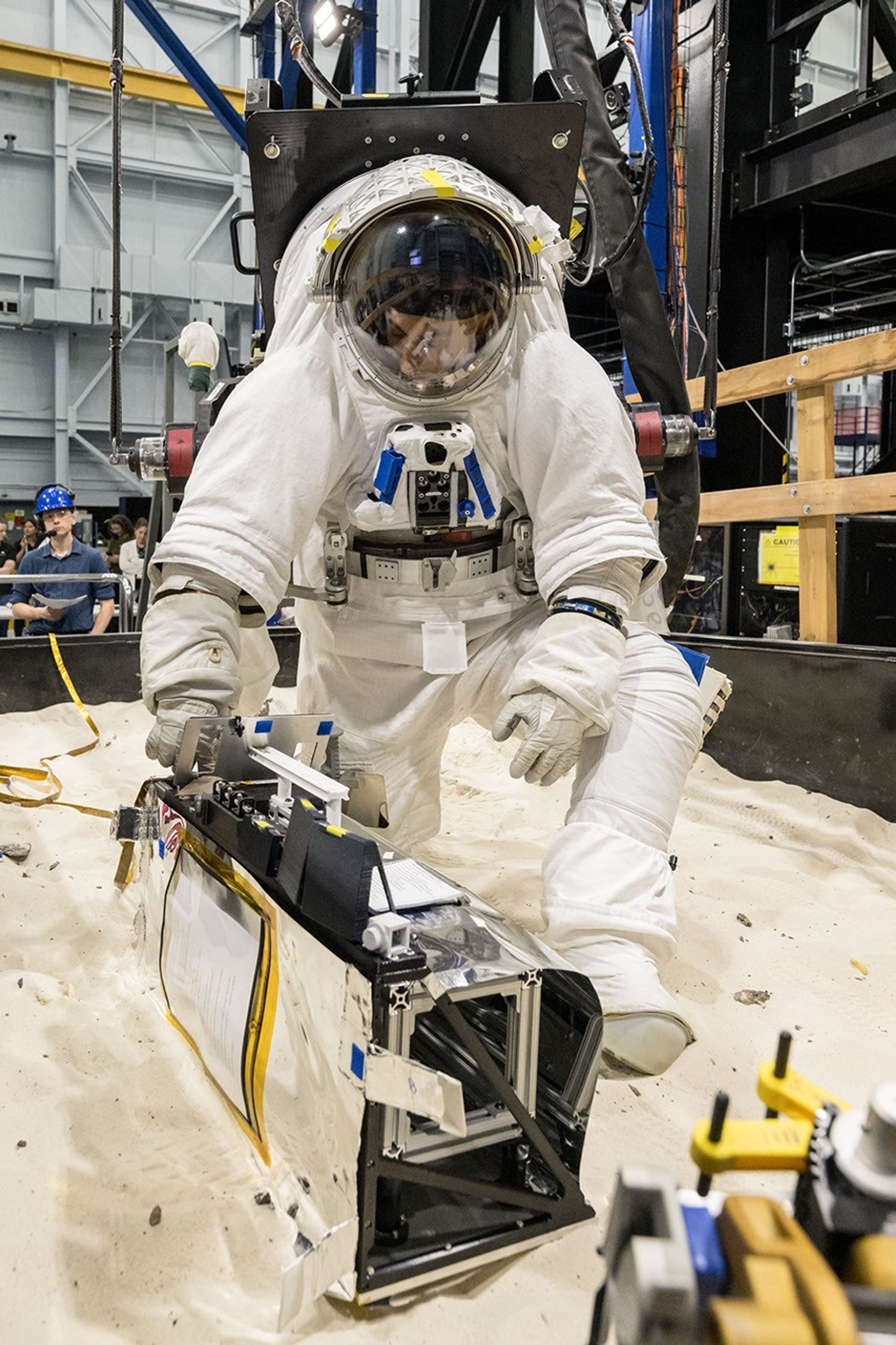
An astronaut in a white spacesuit kneels in simulated lunar soil while working with scientific equipment in a large testing facility. Staff members and support structures are visible in the background.
A scientist wearing NASA’s xEMU prototype space suit is testing the handling of a mockup version of NASA’s Lunar Environment Monitoring Station, or LEMS. The testing took place at the Active Response Gravity Offload System, a simulated reduced gravity environment at NASA’s Johnson Space Center in Houston.
NASA Johnson

The LEMS payload builds on a legacy of lunar seismic tracking. Apollo astronauts deployed a network of seismometers on the Moon’s nearside equatorial region between 1969 and 1972. Those instruments operated until 1977, recording about 13,000 moonquakes and other ground vibrations that helped scientists begin to understand the composition of the Moon’s interior. For decades, researchers have hoped to spread more seismometers, updated with new technologies, across the lunar surface.

Now, LEMS will carry the first seismometers to be deployed by future astronauts to listen for faint ground vibrations, collecting new clues to the Moon’s internal structure and ongoing seismic activity. The sensors will be the most compact, sensitive, and energy-efficient seismometers ever built for planetary exploration.

LEMS itself is about the size of a small suitcase, weighing 11 pounds in the Moon’s low-gravity environment. It will carry not just these seismic sensors, but everything it needs to function independently of humans after deployment. LEMS is built to manage its own power production via a lightweight, flexible solar array that conforms to the shape of the LEMS unit. It also will manage its operational activities to ensure continuous data collection based on a preset plan, and monthly data transmission to Earth. The payload will do all this while maintaining a stable internal temperature throughout the massive day-to-night temperature swings of the South Pole region.

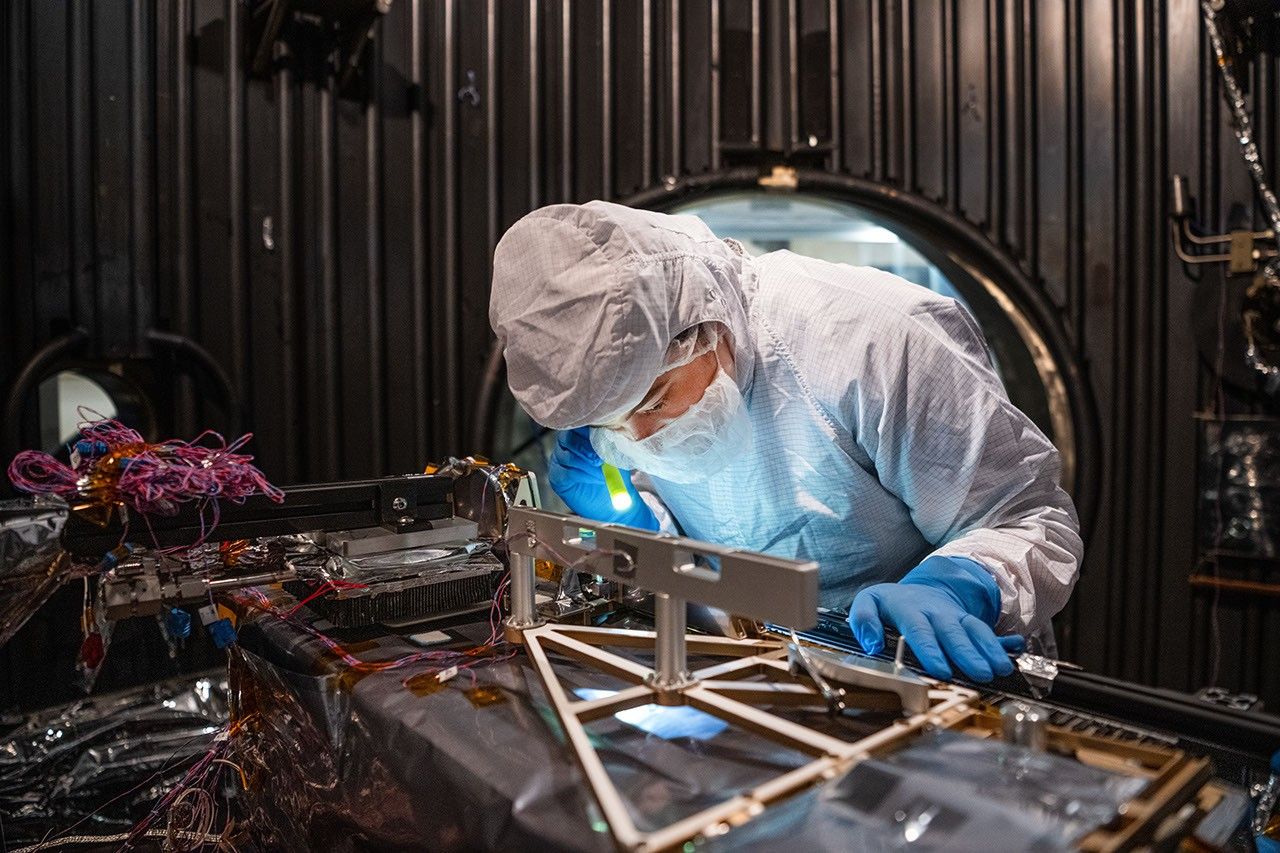
A technician in a white clean-room suit and blue gloves uses a small flashlight to inspect a spacecraft instrument inside a dark testing chamber. Colorful wires and metallic components surround the instrument.
Mechanical Engineer Brie Ludwig inspects the Lunar Environment Monitoring Station (LEMS) in preparation for testing in a thermal vacuum chamber at Goddard Space Flight Center in Greenbelt, Maryland, on March 31, 2026. LEMS is a compact, autonomous, and self-sustaining seismometer suite designed to carry out continuous, long-term monitoring of the lunar seismic environment at the South Polar region.
NASA/Denny Henry

“When we conceived of LEMS, we weren’t just thinking about the next mission, we were thinking about the next generation of lunar exploration,” said Mehdi Benna, a University of Maryland Baltimore County scientist who leads LEMS from NASA Goddard. “Our vision was to create a scientific buoy for the Moon. Like an ocean buoy on Earth, LEMS is designed to be easy to build, adaptable to different scientific objectives, and capable of operating independently for years.”

Before any surface science could happen, Benna and his team had to ensure that LEMS could survive the trip to the Moon and the harsh environment of its surface. Over the past five months, LEMS and its components have been subjected to a demanding series of environmental and operational tests. Engineers verified LEMS can endure the violent shaking of launch, the journey to the lunar surface, and the Moon’s temperature and radiation environment. The team also showed that the instrument package’s mechanical and electrical design is safe for astronaut handling.

The LEMS payload was built to operate through the lunar night, which lasts two Earth weeks, without external power assistance or a heat source. Past lunar surface instruments relied on radioisotope heaters for warmth and power. But LEMS instead will withstand temperatures that dip to minus 400 degrees Fahrenheit in some areas by using advanced insulation materials, low-thermal-conductivity cables that minimize heat loss, and a thermal regulator that conducts heat away during the day to prevent overheating and helps retain heat at night.

These innovations reduce mass and power needs, setting the stage for lighter, energy-efficient instruments that can operate continuously at future Artemis landing sites and the NASA-led Moon Base.

The LEMS payload is led by University of Maryland Baltimore County and University of Maryland College Park. Technical implementation is led by NASA Goddard. The University of Arizona, in partnership with Silicon Audio, Inc., supplied LEMS’ two state-of-the-art seismometers. Morehead State University in Kentucky provided LEMS’ telecommunication system and will operate the instrument on the surface. Washington University in St. Louis will manage the instrument’s data processing and dissemination to the larger scientific community.

❌