
❌

Normal view

Missing a Night’s Sleep Has an Effect on Your Brain You May Not Believe

24 June 2026 at 13:00

Experiments exploring the effects of missing a night’s sleep on the human brain have found indications that a sleepless night actually increases connections between brain cells instead of impeding growth. However, the lack of sleep could also create brain “fatigue” and pressure, resulting in burnout.

The Forschungszentrum Jülich Institute of Neuroscience and Medicine team behind the discovery said that their findings might support the idea that sleep plays an important role in restoring the brain’s cellular balance.

Missing a Night’s Sleep Could Disrupt Cellular Balance

In a statement announcing the surprising discovery, study leader David Elmenhorst and colleagues note that scientists still are not in complete consensus about why humans and other animals need sleep. One proposal involves restoring synaptic connections between brain cells during certain stages of sleep, helping the brain maintain a form of cellular ‘homeostasis.’

For example, previous research has shown that synaptic connectivity increases during wakefulness. This increased activity also increases energy consumption, potentially resulting in problematic protein buildup. Conversely, scientists suspect that sleep helps restore baseline synaptic connections and protein levels, thereby maintaining a healthy cellular balance.

“Sleep is essential for synaptic homeostasis, a proposed mechanism whereby wake­fulness leads to synaptic potentiation, and sleep facilitates synaptic down-selection,” the research team explains in a recently published study.

Although previous studies suggest that missing a night’s sleep could disrupt this balance, the team notes that there is very little experimental data to support these conclusions.

Study Reveals Elevated Synaptic Activity After 28 Hours Awake

To explore the role of sleep in cellular homeostasis in the human brain, the researchers used an advanced brain-scanning technology called positron emission tomography (PET). According to the team’s statement, this tool can scan the human brain for signs of synaptic vesicle glycoprotein 2A (SV2A),  which they describe as a “marker” of brain synapses.

The team started by enlisting 40 study volunteers. Next, each volunteer was given a PET scan to establish baseline marker levels. After their first scan, 20 of the volunteers were told to get a normal night’s sleep. According to the study authors, the second half were assigned to “the sleep deprivation condition,” where they were told to miss a night’s sleep.

The next day, the team used the PET scan to search for telltale brain synapse markers. As hoped, the scans revealed a distinct difference between the two groups. Where the normal sleep group’s levels were within expected ranges, the synapse markers of the volunteers who had missed a night’s sleep were elevated.

A closer analysis found that once people passed 28 hours of continued wakefulness, their SV2A markers were higher “in several brain regions.” Notably, these increased markers were detected in the hippocampus, which plays an important role in memory, and in the thalamus, which is critical for information relay within the brain.

“Sleep deprivation led to significant increases in synaptic vesicle glycoprotein 2A binding in multiple brain regions, including the thalamus (+4.6%), hippocampus (+5.6%), and parietal cortex (+3.2%), whereas no changes were observed in controls,” the study authors write.

Sleep Deprivation Causes Fatigue and CHanges Neural COnnections

When discussing the study’s limitations, the authors note that the SV2A marker used is a “proxy” for connections between brain cells, not a direct measure. They also note that the observed changes after a missed night’s sleep “were relatively small.” Still, they add, the results in several regions across several study participants “suggest a biological connection between the need for sleep and the buildup of cell connections.”

“During sleep deprivation, the brain remains awake longer and continues to process stimuli and information,” they write. “Our study shows that after approximately 28.5 hours of wakefulness, a marker for synaptic density increases in several brain regions. This suggests that sleep deprivation not only causes fatigue but is also accompanied by measurable changes in neural connections.”

The study “Sleep deprivation increases levels of the synaptic density marker SV2A in the human brain” was published in PLOS Biology.

Christopher Plain is a Science Fiction and Fantasy novelist and Head Science Writer at The Debrief. Follow and connect with him on X, learn about his books at plainfiction.com, or email him directly at christopher@thedebrief.org.

Interstellar Visitor 3I/ATLAS Is Bursting With an Unexpected Chemical

Artist’s Impression of 3IATLAS Passing the SunAstronomers have found that interstellar comet 3I/ATLAS contains an unusually large amount of methanol. Every interstellar object that passes through our solar system offers a rare chance to sample material forged around another star. Now, new observations of comet 3I/ATLAS using the Atacama Large Millimeter/submillimeter Array (ALMA) have revealed a chemical surprise: the comet is [...]

Black Holes Reveal Their Seeds

23 June 2026 at 17:00

Illustration of an active galactic nucleus

Editor’s Note: Astrobites is a graduate-student-run organization that digests astrophysical literature for undergraduate students. As part of the partnership between the AAS and astrobites, we occasionally repost astrobites content here at AAS Nova. We hope you enjoy this post from astrobites; the original can be viewed at astrobites.org.

Title: A GLIMPSE of Intermediate Mass Black Holes in the Epoch of Reionization: Witnessing the Descendants of Direct Collapse?
Authors: Qinyue Fei et al.
First Author’s Institution: University of Toronto
Status: Published in ApJ

In the late 2010s, astronomers were getting hints of something strange going on in the early universe. Using the most powerful telescopes on the ground, we were able to find black holes in the centers of some of the most distant galaxies. The light from these active galactic nuclei (AGNs) was emitted over 12 billion years ago, revealing conditions close to the beginning of cosmic time.

To an astronomer, that’s the mundane part. I’m only half joking — thousands of AGNs had already been identified in the previous half century. However, the most distant of these sources were startling because their central black holes appeared much more massive than expected. To be specific, we know how much mass black holes can start with, and we can write down equations to predict how quickly they should grow. The AGNs we observed seemed to violate these predictions. This raised some serious questions and was highlighted as a major point of inquiry to focus on going into the 2020s.

Then JWST launched, and the mystery grew deeper. No matter where we looked, enormous black holes kept cropping up in astonishing numbers. Astronomers who model the universe with equations and computer simulations have tried to explain these results, but this has been a serious challenge. Some researchers have broken the emergency glass and reached for a highly theoretical tool: the direct-collapse black hole. Unlike the normal pathway for forming black holes (the deaths of massive stars), this model suggests that an enormous cloud of gas could directly collapse into a black hole without forming a star at all. The resulting black holes could have as much mass as a hundred thousand Suns put together — orders of magnitude more than a “normal” black hole. Although this pathway can explain the presence of huge black holes so early in the universe’s history, we’ve never directly seen this happen, so for now it remains just a theoretical possibility.

However, if direct-collapse black holes were widespread at early times, there is one indirect signature we might be able to detect: a large population of intermediate-mass black holes with masses between a hundred thousand and a million times that of the Sun. If we can find such a population, we’ll have strong evidence for the direct-collapse model. Let’s go looking!

Intermediate Mass, Impossible Difficulty

Identifying intermediate-mass black holes requires a tricky combination of spectral resolution and sensitivity. Light from an object must be examined very finely in order to detect the telltale features of an intermediate-mass black hole. However, these sources are already quite faint, so spreading their emission this thin means that any potential signal is very likely to get lost in the noise.

The authors of today’s article use an unprecedented set of observations to leap over this hurdle and directly probe intermediate-mass black holes. They not only use the most sensitive spectroscopic instrument (NIRSpec) on the most powerful space telescope (JWST), but they take advantage of a phenomenon known as gravitational lensing.

According to Einstein’s general theory of relativity, gravity is the result of matter curving spacetime. Areas with more concentrated matter will experience stronger curvature. When an object traveling in a completely straight line moves through curved space, its path appears bent. This same effect happens to light. Intriguingly, a large concentration of matter can redirect diverging rays of light to a focus, acting like an enormous magnifying glass.

Astronomers take advantage of gravitational lensing by pointing telescopes at massive clusters of galaxies. The intense gravity of these regions can magnify sources in the background by tens or even hundreds of times. Galaxies that would be impossibly faint to see under normal conditions can thus be observed if they are strongly lensed, making this a powerful technique to examine otherwise hidden objects.

Putting Faint AGNs Under a Lens

The Galactic Legacy Infrared Mid-Plane Survey Extraordinaire (GLIMPSE) program took extremely powerful observations of a galaxy cluster called Abell S1063 using JWST. The long exposure time, combined with the lensing power of the cluster, allows extremely faint sources in the background to be seen in unprecedented detail. The researchers scoured the data to search for signs of active black hole growth in the observed galaxies. Specifically, they carefully studied the emission lines in the spectrum of each object.

Normally, emission lines appear narrow. However, gas surrounding a massive black hole circulates at rapid speeds. A phenomenon known as the Doppler effect then comes into play. This is the same effect responsible for the characteristic rise and fall in the pitch of a siren from an emergency vehicle passing by. Emission from gas moving toward our line of sight appears bluer than it otherwise would, and gas moving away from us appears redshifted. The net effect is that a single emission line is widened, and we see characteristic “broad wings.” The width of the emission line can be used to estimate the mass of the central black hole, where broader wings imply a more massive black hole.

The researchers uncover 10 AGNs that display broadened Balmer series lines. Strikingly, they estimate that these galaxies have central black holes with masses as low as 400,000 times that of the Sun. While that might sound like a lot, it’s practically nothing compared to the monstrous 100-million-solar-mass black holes that JWST consistently turns up in other studies. Detecting such lightweight black holes, pushing into the realm of intermediate-mass black holes, is only possible due to the incredible sensitivity of these observations.

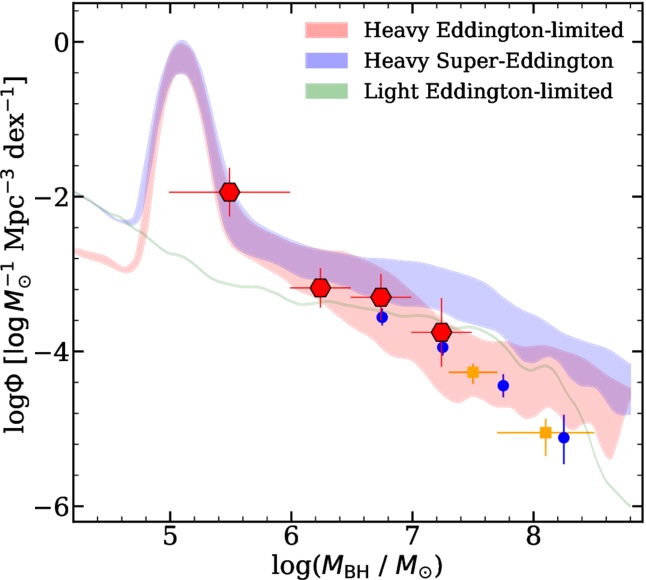
The researchers also compute what’s known as the black hole mass function. This is a measure of how many black holes exist at each mass. In other words, the black hole mass function measures how common lightweight black holes are compared to heavy ones. The mass function computed in this work and several other points of comparison are shown in Figure 1.

comparison of black hole mass functions

Figure 1: A comparison of black hole mass functions from various previous works and today’s article. The red hexagons are data points computed using the AGNs observed in this work, while blue circles and yellow squares are measurements computed using AGNs observed in previous articles. The red, green, and blue shaded areas represent the expected black hole mass function from various theoretical models. [Adapted from Fei et al. 2026]

Because the AGNs analyzed in today’s article host central black holes with much lower masses than any that have been observed in the past (at this early time in the universe), the authors are able to probe a completely new region of the black hole mass function. As seen in Figure 1, the leftmost red hexagon (lowest-mass data point) deviates from the roughly straight line traced by the other data points. This suggests that there are substantially more black holes with a few hundred thousand solar masses than previously expected.

Amazingly, this is exactly the measurement you would get if direct-collapse black holes (the hypothetical kind of massive black holes mentioned earlier in this article) were common in the early universe. If you scatter huge seeds across a large field, then you shouldn’t be surprised to see a sea of barely larger plants a few months later. Likewise, since these black holes start off so massive, they only need to grow a tiny bit to reach the threshold of that first red hexagon.

So is this proof that the early universe was filled with direct-collapse black holes, with this study probing the tip of an astonishing iceberg? It’s too early to tell for sure. While this is certainly an exciting result that sheds light on a previously unexplored population of objects, one can only do so much with a sample size of 10. More follow-up observations will be needed to measure the black hole mass function more precisely. Still, it’s amazing to think how much has changed in just a few years. JWST continues to provide unprecedented insight into some of the most breathtaking questions in all of astronomy.

Original astrobite edited by Tori Bonidie.

About the author, Ansh Gupta:

I’m an astronomy graduate student at the University of Texas at Austin working with Steven Finkelstein. I use data from JWST to study the formation and growth of the first galaxies and black holes in the universe. In my spare time, I enjoy playing piano, reading, and making YouTube videos.

The post Black Holes Reveal Their Seeds appeared first on AAS Nova.

Scientists Release New Images Captured by the Lucy Spacecraft Flyby of Asteroid Donaldjohanson

22 June 2026 at 12:50


Scientists have released a series of previously unseen images of the asteroid Donaldjohanson captured by NASA’s Lucy spacecraft during an April 2025 flyby.

The team behind the photos’ release said the Lucy spacecraft, which was named for the infamous hominin fossil discovered by anthropologist Donald Johanson, captured critical details about the small main-belt asteroid’s surface features and motion that could help clarify the space rock’s origin and evolution.

The data could also inform studies of the Solar System’s formation, including how asteroids move and evolve over extended timescales.

Craters on Asteroid Donaldjohanson Confirm Its Age

According to a statement from team leader Simone Marchi and colleagues, images captured during the deep-space rendezvous revealed that the oddly shaped rock consists of two cratered ‘lobes’ connected by a comparatively smooth central “neck” section. The researchers noted that Donaldjohanson measured over 8.8 kilometers by 4.4 km by 3.1 km.

An analysis of the surface features helped the team pinpoint the asteroid’s likeliest age to a set of asteroids belonging to the Erigone family, a group that broke apart a larger “parent” body into smaller fragments. The team notes that this ancient age “implies that DJ is a fragment of a larger parent body that was destroyed in a collision about 155 million years ago.”

asteroid Donaldjohanson, Lucy spacecraft
A grey-scale optical image, acquired with the L’LORRI instrument, of the main belt carbonaceous asteroid (52246) Donaldjohanson as observed by the NASA Lucy Spacecraft on April 20, 2025. Distance: 1272.5 km
Phase: 34.4 deg. Image Width: 6.5 km. Image Credit: NASA/GSFC/SwRI/JHU-APL.

Although an examination of the craters helped place the asteroid’s likely age, they noted that craters less than 0.4 kilometers “have been preferentially erased.” The researchers suggest that this preferential erasure of smaller craters might have been caused by “seismic shaking” following a more recent impact event.

“DJ Rotates Slowly in a Tumbling State”

Along with surface features, the newly released images revealed the asteroid’s motion. Specifically, the team determined that Donaldjohanson has a slow, tumbling movement rather than a simple rotation.” Instead of an impact, the team suspects that the asteroid’s motion could have been produced gradually by “torques” resulting from thermal radiation.

“DJ rotates slowly in a tumbling state, likely owing to spin-down by radiative forces,” the team writes.

Lucy spacecraft, asteroid Donaldjohanson
The main belt carbonaceous asteroid (52246) Donaldjohanson as observed by the NASA Lucy Spacecraft on April 20, 2025. Here, the grey-scale optical image, acquired with the L’LORRI instrument, is overlaid with a false-color map indicating the gravitational slopes on the asteroid’s surface. Distance: 1059 km. Phase: 50.5 deg. Image Width: 5.4 km. Image Credit: NASA/GSFC/SwRI/JHU-APL/DLR.

A spectral analysis of the rock’s cratered surface also revealed a similar composition to other Erigone family asteroids, particularly the presence of iron-bearing phyllosilicates. The team notes these phyllosilicates indicate an “aqueous evolution” on the parent body. However, they also note that the water-induced mineral alteration was likely halted “at an early stage” due to insufficient water or heat.

Next Mission Encounter Planned for 2027

Although the newly released Lucy images were captured in 2025, the team notes that the Donaldjohanson flyby mission was one leg of a larger set of 8 planned Lucy asteroid flybys, with the entire set expected to take 12 years to complete.

“Over its 12-year mission, Lucy will explore a record-breaking number of asteroids: it will fly by three in the belt of asteroids that circle the Sun between the orbits of Mars and Jupiter, and then eight Trojans, which includes five asteroid targets and the satellites of three of those,” a NASA statement explained. “Lucy also will fly by Earth three times to get a push from its gravity, making it the first spacecraft to return to the vicinity of Earth from the outer solar system.”

The study “​The Lucy flyby of asteroid (52246) Donaldjohanson:​ ​A bilobed object with a tumbling rotation” was published in Science.

Christopher Plain is a Science Fiction and Fantasy novelist and Head Science Writer at The Debrief. Follow and connect with him on X, learn about his books at plainfiction.com, or email him directly at christopher@thedebrief.org.

❌