Using the James Webb Space Telescope, astronomers have discovered that the well-known "Pink Planet" harbors a salty surprise and an exotic atmospheric chemistry. The discovery marks an advancement in the study of cold objects beyond the solar system.
Initially discovered in 2013, GJ504b orbits a sun-like star located around 57 light-years from Earth. With a mass around 25 times that of Jupiter, this Pink Planet may not be a planet at all despite its moniker. It may instead be a brown dwarf, a failed star that formed like a star but was unable to gather enough mass to achieve the nuclear fusion of hydrogen to helium in its core. Thus, astronomers refer to it as a "planetary-mass companion," which means a planet-size object orbiting a parent star.
GJ504b remains one of the coldest planetary-mass companions discovered using ground-based telescopes, with a temperature of around 550 degrees Fahrenheit (290 degrees Celsius). Although, that still makes it hot enough to bake bread. Now, James Webb Space Telescope (JWST) data reveals it has a key ingredient for bread making too: salt located in its atmospheric clouds, unlike anything astronomers have seen before.
"The Pink Planet is the coldest companion ever discovered using ground-based instruments," team leader Aneesh Baburaj of Northwestern University said in a statement. "Many teams all around the world performed follow-up observations to study its light, but it was too faint for ground-based instruments. That made it a perfect target for JWST.
"When we finally obtained its spectrum, it immediately looked interesting. But once we started digging deeper into the data, we realized it was not like anything we have analyzed before."
The Pink Planet is cold and old
The team studied this planetary companion by measuring its faint electromagnetic radiation emissions and filtering out the bright glare of its parent star.
They found the relative coolness of the Pink Planet is a result of the planet's age. Both gas giant planets and brown dwarfs are born blisteringly hot but cool off as they get older. This new research estimated that GJ504b is between 2.5 billion and 4 billion years old.
Breaking down light from the Pink Planet into individual wavelengths, the team was also able to determine its chemical composition. This is possible because elements absorb and emit light at characteristic wavelengths, meaning they leave "fingerprints" on light passing through their atmospheres.
"In the past, other astronomers observed the companion for an entire night with some of the biggest telescopes in the world to obtain a spectrum," Baburaj said. "And they could not see the object. With JWST, our entire observation took around two hours, and we were successful."
The JWST data revealed a rich cocktail of chemicals in the atmosphere of the Pink Planet that included water, carbon dioxide, methane, and ammonia. However, these observations didn't match modeling of the planetary companion's atmosphere until the team factored in something completely unexpected: clouds of salt deep in the atmosphere.
An illustration of the JWST which has become a vital tool in the investigation of exoplanets and brown dwarfs. (Image credit: ESA)
"We ran simulations with clouds, and the results aligned with what we know about cold planets," Baburaj said. "We tried three different types of clouds, and salt clouds fit best. When we accounted for salt clouds, it subdued the signature of molecules hidden deeper in the companion’s atmosphere. Then, the results became physically possible.
"This is the first time we've found that salt clouds are critical to explaining the spectrum of an object. It's a good reminder to account for clouds in our models."
Though this mystery may be solved, there are still questions surrounding GJ504b that will only be solved with further investigation. The Pink Planet seems to be unusually rich in elements heavier than hydrogen and helium, which astronomers call metals. This means the team still can't pin down the origin of the Pink Planet; did it form like a planet, or like a star?
That means they aren't quite ready to determine if GJ504b is a gas giant planet or a brown dwarf... or should that be Pink Dwarf?
It’s not the kind of thing astronomers expect to see while observing the powerful effects of a distant supermassive black hole: an unprecedented UFO sighting.
However, that’s precisely what one group of scientists now reports in a preprint paper, who detail the successful detection of one of the strongest UFOs—a black hole phenomenon otherwise known as “ultra-fast outflows”—that astronomers may have ever seen.
The landmark detection was made possible with the XMM-Newton space observatory and NuSTAR X-ray telescope, which allowed the researchers behind the discovery to observe a luminous quasar with origins that date back to “cosmic noon,” revealing a pair of outflow wind components being blasted from the black hole in question.
These winds become known as ultra-fast outflows (UFOs) when their strength propels them to greater than ten percent of light speed, and astronomers currently believe they are an important part of what helps black holes regulate their growth, which may also hold for their host galaxies.
One way this occurs is that UFOs help to heat galactic gases that give rise to star formation, a quenching process that most astronomers believe occurred during a period called “cosmic noon,” which occurred between 1.6 and 3.5 billion years after the birth of the universe.
Cosmic Fingerprints of Powerful UFOs
Astronomers can detect ultra-fast outflows based on the “dips” they create in their powerful gusts, which are caused by ionized iron present in their outflow gases. These gases also absorb X-rays along their path away from their black hole originators, which leave “fingerprints” in the form of absorption features that are detectable using X-ray telescopes.
Significantly, these “dips” manifest as a blueshift since they are shifted to higher energies as they move at such high speeds (again, roughly 10% of the speed of light). From the blueshifted energy signatures they comprise, astronomers can determine not only the presence of UFOs, but also the wind speed of their gusty outflows.
In the past, most detections of these high-powered cosmic phenomena have relied on gravitationally lensed quasars. These celestial objects occur when a galaxy or similar feature closer to Earth appears in front of them, magnifying the quasar’s light and significantly brightening its luminosity from our Earthly perspective.
However, lensing of this variety can also present problems, and so astronomers led by Giorgio Lanzuisi of INAF Bologna designed a special system to target more than a dozen hyper-luminous quasars at cosmic noon, as a means of getting a better feel for the dynamics of non-lensed quasars.
“WISSHFUL” Thinking
WISSHFUL is an XMM-Newton multi-year heritage program that Lanzuisi and his colleagues designed for this purpose, whose initial target became a quasar designated WISSH13, whose redshift at 3.294 marks the object’s existence as it appeared approximately 2 billion years after the Big Bang.
WISH13’s black hole also weighs in at close to 2 billion times that of our Sun, which causes it to shine far brighter than normally expected for an object of its estimated mass.
Their work began in the autumn of 2024 by combining observations from XMM-Newton and NuSTAR initially obtained in 2017. From these X-ray images of WISSH12, a pair of distinctive absorption features became evident, which the team determined to have been generated by two separate sources from within the same ultra-fast outflow.
These components were found to travel at different speeds: one moving at close to 30% of the speed of light, while the other at only about 10% of light speed. The slower of these two appears to have been an enduring component of the UFO, while the faster one showed signatures that indicated a more recent appearance. This could mean that it emanates from events that are shorter in duration.
By matching theoretical predictions of a layered wind structure surrounding the black hole, the researchers say their observations align with models that indicate a fast-moving inner “spine” launched from the accretion disk’s innermost regions. Meanwhile, a slower outer “sheath” is also believed to emanate farther from the black hole. The combined outflow components produce an estimated 21 to 24 solar masses of material annually.
The Most Massive UFO Ever Observed?
Such figures, the team says, represent what is believed to be among the most massive and energetic ultrafast outflows ever observed, a discovery which also marks the highest-redshift ultrafast outflow yet detected in a non-lensed quasar.
Despite their remarkable energetic output, the team says these outflow winds seem to conform to the same essential relationships observed in active galaxies much closer to Earth, suggesting that the processes driving these outflows have remained remarkably consistent across cosmic time.
Going forward, the team says they hope to make additional observations of these powerful cosmic phenomena with help from the new Athena X-ray mission, which they say could help uncover similar winds in even more distant quasars.
The team’s discoveries were detailed in a recent paper, “The WISSHFUL program: the highest redshift UFO discovered in a non-lensed QSO,” which appeared at the preprint arXiv.org server.
Micah Hanks is the Editor-in-Chief and Co-Founder of The Debrief. A longtime reporter on science, defense, and technology with a focus on space and astronomy, he can be reached atmicah@thedebrief.org. Follow him on X @MicahHanks, and at micahhanks.com.
Astronomers have a cosmic mystery on their hands, investigating a celestial crime scene to determine if a distant star has eaten a super-Earth exoplanet. The star may have had an accomplice — a failed star or "brown dwarf" companion — which may have steered the unfortunate planet toward its fiery doom.
The team charged with investigating this mystery first discovered hints of the crime when they found the star, TOI-5882, located around 1,300 light-years away, is surprisingly rich in the element lithium.
"You are what you eat, right?" team leader Brooke Kotten of the University of Michigan said in a statement. "We know that there's much more lithium in planetary material than there is in stars. So if a star eats a planet, it's going to take on a bunch of lithium."
So-called engulfment events such as this one occur very rapidly, on a timescale of a few days to a couple of weeks, which means catching stellar beings in the act of enjoying a planetary meal is extremely rare. Thus, astronomers have to act as cosmic crime scene investigators to reconstruct these events with the evidence at hand.
"That's what makes this field so exciting. You really are solving a mystery," Kotten said. "We can't just watch the crime happen, so we have to work with all the clues we're given to figure out whodunit."
One of the aims of these investigations is to discover the ways in which a star can devour a planet. One of the most common engulfment scenarios happens when a star runs out of hydrogen at its core at the end of its main sequence lifetime. This results in it swelling out to up to 100 times its original diameter, engulfing its attendant planets during its so-called red giant phase. This will occur in the solar system in around 5 billion years when the sunwill puff out to around the orbit of Mars, swallowing the inner rocky planets, including our own.
However, Kotten and colleagues know this isn't what has happened in the TOI-5882 system, as this star hasn't yet become a red giant. Instead, the researchers think the sun-like star had assistance from its brown dwarf companion.
Companion brown dwarf of partner in crime?
Brown dwarfs get their slightly unfortunate nickname of "failed stars" because, despite forming from collapsing clouds of gas and dust, just like stars, they fail to grow to the masses needed to trigger the nuclear fusion of hydrogen to helium in their cores, the process that defines what a main-sequence star is. They're quite mysterious by existing in this sort of limbo between planet and star.
This particular brown dwarf has around 20 times themass of Jupiter, or around 2% of the mass of the sun. That's not massive enough to trigger nuclear fusion, but is massive enough for it to have enough of a gravitational influence over planets orbiting TOI-5882. That means the team suspects this brown dwarf could have perturbed the orbit of this unfortunate planet enough to send it plummeting into its star.
This is something the scientists will need to investigate further. They may not have enough information yet to determine this planet's cause of death, but they do have some evidence that helps them identify the kind of world it would have been before it was obliterated. This comes from observations of the chemical composition and lithium content of 62 stars with similar ages and masses to TOI-5882.
"Lithium atoms delivered by planetary engulfment to a star are like sports fans arriving at a stadium," team member Seth Jacobson of Michigan State University said. "There may already be a few early arriving fans present, representing the initial amount of lithium in the stellar atmosphere, but they are quickly outnumbered."
An illustration of the lithium-enriched star TOI-5882 with its brown dwarf. (Image credit: Robert Lea (created with Canva))
From the lithium abundance they measured, the team has determined that this planet was a so-called super-Earth with a mass somewhere between two times that of our planet and the mass of the solar-system ice giant Neptune, which is around 18 times as massive as Earth.
"The fact that we can look at a star 1,300 light-years away and say with confidence, 'This star has more lithium than you would expect,' is a testament to both the precision of modern instrumentation and the hard interpretive work that goes into making sense of that signal," said Melinda Soares-Furtado, a senior author of the study and assistant professor at the University of Wisconsin. "And it's not like you have to cherry-pick the data to make it stand out. It's robust. No matter how you slice it, TOI-5882 is so enriched in lithium it shows up as being at least in the 97th percentile."
Soares-Furtado added that TOI-5882 is one of the few stars she has seen demonstrating evidence of planetary engulfment, although a few of the other stars in the control sample were enriched in lithium, albeit not to the extent of TOI-5882. That leaves another mystery for the team to solve, something that Soares-Furtado may well be quite content with.
"When I was growing up, I dreamed about becoming a private investigator," she said. "I think that explains a lot about where I ended up. I do feel like a detective."
Sally Ride made history aboard the Space Shuttle Challenger on June 18, 1983, becoming the first American woman in space 20 years nearly to the day after Soviet Valentina Tereshkova’s flight. In 1977, as she was finishing her Ph.D. in physics, Ride saw a newspaper ad placed by NASA to recruit astronauts. For the firstContinue reading "June 18, 1983: Sally Ride is the first American woman in space"
A new study reveals why black holes let out massive radio "burps" years after eating stars, giving astronomers a chemical blueprint to predict them early.
NASA’s Fermi Mission Uncovers Possible Sibling Supernova Remnants
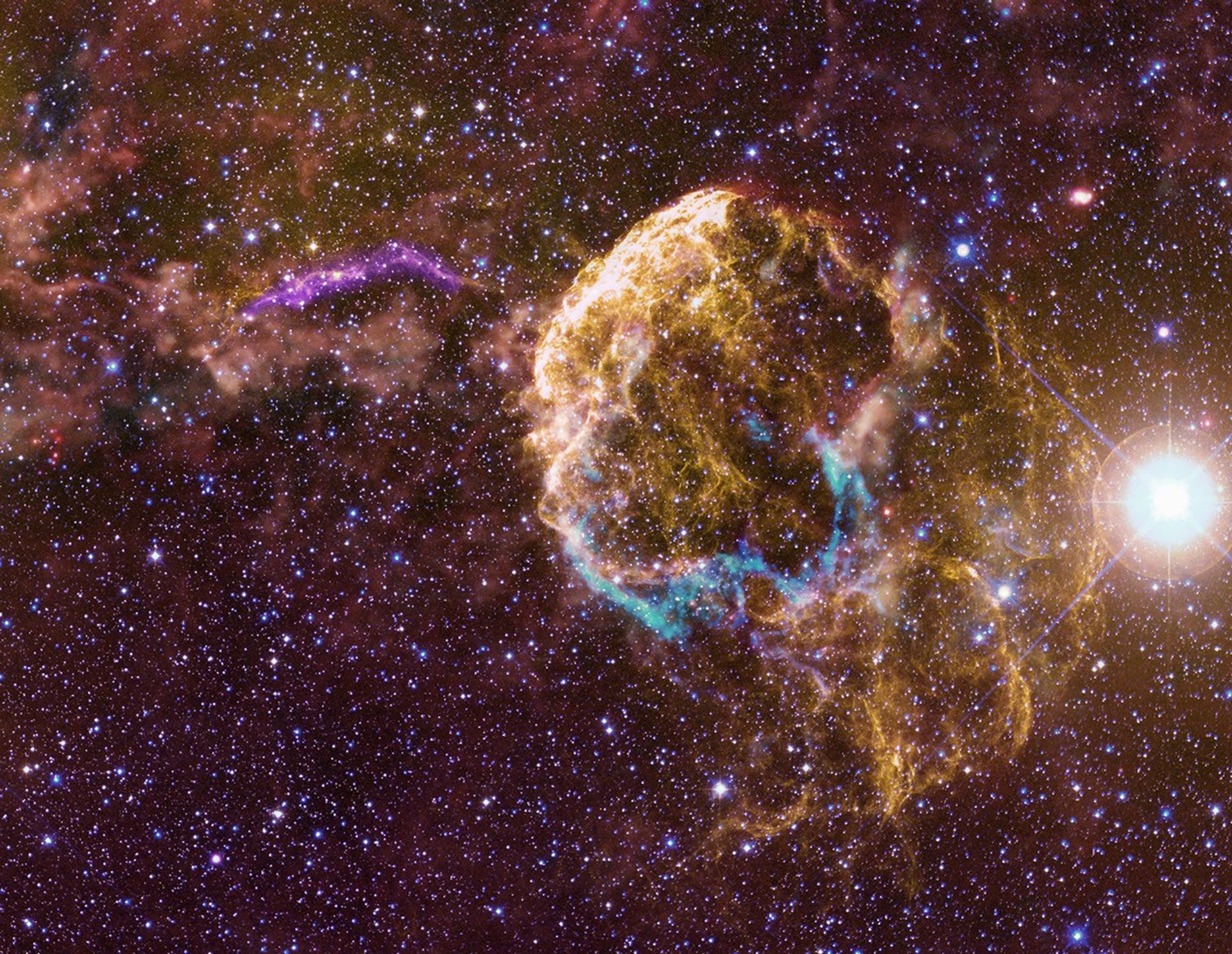
A new study of two supernova remnants, the debris left behind after stars explode, suggests the explosions came from stellar siblings that once orbited each other. The first star’s detonation sent its binary companion hurtling through space, and then, after traveling for thousands of years, the surviving star blew up too.
This multiwavelength scene shows the Jellyfish Nebula supernova remnant (right), the interstellar cloud it’s interacting with, and a distinctive curving filament to its upper left. The filament, which is shown here both in optical and ultraviolet (UV) light, is the visible part of an overlapping supernova remnant, G189.6+3.3, that is more prominent in radio and X-rays. Visible light is shown in yellow, UV from NASA’s Neil Gehrels Swift Observatory is shown in violet, and infrared light from NASA’s retired WISE (Wide-field Infrared Survey Explorer) mission appears in cyan, red, and orange. Both remnants are located about 6,000 light-years away in the constellation Gemini. The brilliant star at far right is Propus, also known as Eta Geminorum.
NASA Goddard Space Flight Center and M. Michailidis et al. 2026; optical: DSS; infrared: NASA/WISE/JPL-Caltech/UCLA; ultraviolet: NASA/Swift
“Using 16 years of data from NASA’s Fermi Gamma-ray Space Telescope, our analysis uncovered gamma rays associated with a supernova remnant that was hidden in the glare of its neighbor, the Jellyfish Nebula, one of the brightest gamma-ray-emitting supernova remnants known,” said Miltiadis Michailidis, a postdoctoral fellow in the physics department at Stanford University in California. “There are so many striking connections between the two remnants that we conclude they’re likely related, giving us the first known example of a binary system where both stars have undergone supernova explosions.”
Michailidis presented the findings Wednesday at the 248th meeting of the American Astronomical Society in Pasadena, California. A paper describing the results will appear in a future edition of Nature Communications.
The study focused on a faint supernova remnant called G189.6+3.3, which is mainly visible in X-rays. It is upstaged by its brighter and better-known neighbor, the Jellyfish Nebula (IC 443). The two star wrecks, both located in the constellation Gemini, appear to partially overlap as seen in X-rays. Recent X-ray evidence suggests that hot plasma likely associated with G189.6+3.3 may extend across the entire region, a hint that the overlap may be nearly total.
A massive star explodes when its energy-producing core runs out of fuel and collapses under its own weight, triggering an explosion that blows the star apart. The explosion’s shock wave encloses a hot cloud of debris that rapidly expands into space. So far, astronomers have cataloged about 300 supernova remnants in our galaxy.
The Fermi mission is part of NASA’s fleet of observatories monitoring the changing cosmos to help humanity better understand how the universe works. More than a decade ago, observations from Fermi’s LAT (Large Area Telescope) showed that the shock waves of supernova remnants accelerated particles to within a fraction of the speed of light, a process first proposed by physicist Enrico Fermi — the mission’s namesake — in 1949.
These high-speed particles, called cosmic rays, interact with interstellar gas to produce gamma rays, the highest-energy form of light. Protons make up 99% of cosmic ray particles. To prove that accelerated protons are responsible for the glow, astronomers search for a specific gamma-ray feature. When cosmic-ray protons smash into interstellar gas, they produce a short-lived particle called a neutral pion, which almost immediately decays into a pair of gamma rays. This emission occurs within a specific band of energies associated with the neutral pion’s mass and lies within the range detected by Fermi’s LAT instrument.
In 2013, Fermi observations proved that the Jellyfish Nebula, which is interacting with part of a glowing cloud of hydrogen gas known as Sharpless 249, produced gamma rays through this mechanism. Its neighbor, G189.6+3.3, was discovered in 1994 as part of an X-ray survey by the German-led ROSAT (Roentgen Satellite) mission.
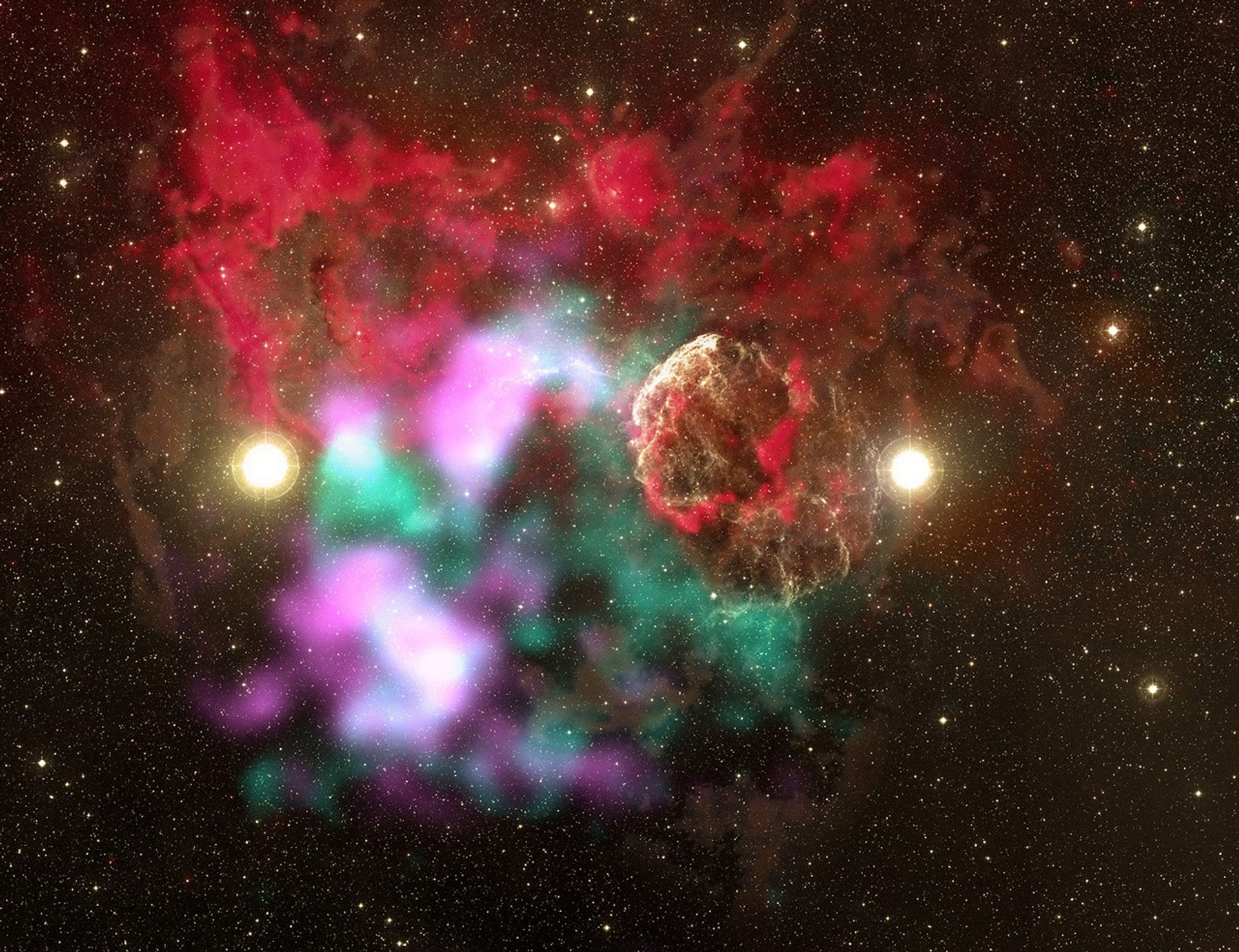
A bright filament of gas lies between the overlapping remnants. New observations of this feature reveal that the shock wave from G189.6+3.3 slammed into dense interstellar gas there and dramatically slowed, key evidence that both remnants are interacting with the same cloud system.
The well-known supernova remnant IC 443 (right) has an older, fainter neighbor (shown here in blue-green and magenta) called G189.6+3.3. A filament of gas between them, glowing in visible and ultraviolet light (violet arc at center), traces the neighbor’s shock wave and shows that both remnants are interacting with the same molecular cloud, shown in red, orange, brown for infrared and radio data and yellow for visible light. Blue-green shows X-rays from the fainter remnant, while magenta shows gamma rays with energies greater than 10 billion electron volts; for comparison, visible light has energies between about 2 and 3 electron volts. In this view, high-energy light from the much brighter IC 443 has been removed for clarity. Gamma-ray emission near the filament stems from protons accelerated in the supernova’s shock wave as it expands into the cloud.
NASA Goddard Space Flight Center and M. Michailidis et al. 2026; radio, MWISP and ESA/Planck; infrared: NASA/WISE/JPL-Caltech/UCLA; optical: DSS; ultraviolet: NASA/Swift; X-ray: SRG/eROSITA; gamma ray: NASA/DOE/Fermi LAT Collaboration
Astronomers think the Jellyfish Nebula is also a candidate PeVatron, a cosmic particle accelerator capable of boosting protons to energies so high they could nearly escape our galaxy. Such particles can produce gamma rays with trillions of times more energy than visible light. Finding a second particle accelerator near the Jellyfish Nebula could offer scientists new clues for how supernova remnants develop into PeVatrons.
“The overlapping remnants, a connecting gas filament, and the availability of data from Fermi and other facilities motivated us to delve into this complex but little-studied region,” said co-author Marianne Lemoine-Goumard, an astrophysicist at the French National Centre for Scientific Research (CNRS) based at the University of Bordeaux. “With Fermi’s LAT instrument, we found gamma-ray emission associated with accelerated protons in the northern part of the fainter remnant. If both remnants are interacting with the same structure, then they must share a common distance from us.”
The team concludes the remnants lie about 6,000 light-years away, their explosion centers are separated by roughly 40 light-years projected onto the plane of the sky, and the original stars may have been 20 or more times the Sun’s mass.
Estimates of the remnants’ ages vary widely, but the team concludes that the age of the Jellyfish Nebula is 8,000 to 9,000 years, while G189.6+3.3 is between 20,000 to 110,000 years old. This means the delay between the explosions could have extended for up to 100,000 years.
In addition, the team conducted computer simulations of a million massive binary systems. They show that systems where the stars orbit close enough to exchange matter and interact during their lives can readily produce dual supernova explosions with similar separations and time delays as those found for the remnants. The team also estimated that the chance of randomly encountering this combination of observed spatial alignment and compatible distances to be less than 1%, strongly supporting a physical association.
“The evidence we’ve compiled — including observations across the spectrum, the chemical and physical properties of the remnants, simulations, and more — paints a compelling picture of a dual supernova event,” said Michailidis.
This study identifies a unique possible example of a binary system where both stars exploded as supernovae and left behind separate, detectable supernova remnants. Astronomers think that most massive stars form in binary or multiple-star systems. The Jellyfish Nebula/G189.6+3.3 complex offers astronomers a rare opportunity to study how massive binary stars evolve, exchange matter, explode, and experience velocity changes — called kicks — induced by the supernova blast. It also provides a powerful new laboratory for understanding how coupled supernova remnants behave, including how they accelerate particles, generate gamma rays, and shape their surrounding environments.
“Fermi’s gamma-ray observations of supernova remnants continue to reveal the dynamic lives of stars,” said Elizabeth Hays, the Fermi project scientist at NASA’s Goddard Space Flight Center in Greenbelt, Maryland. “We can now connect the glowing remains of two massive stars to a powerful pair that evolved together over thousands of years.”
A new study suggests that the collapse of a massive star could spark the creation of a tiny expanding universe rather than a black hole. The resulting object, called a gravastar, would avoid the singularity and event horizon that make black holes so puzzling. Massive stars produce light and heat through nuclear fusion in their [...]
New Webb and Hubble data not only confirm the existence of two distinct populations of stars in the ancient stellar system Terzan 5, once classified as a globular cluster, but also provides evidence for two more recent rounds of star formation.

 Login