❌

Normal view

Untangling the cosmic web

10 June 2026 at 20:23

There is a pattern found in nature. It is indeed the largest pattern there is. It is so vast that it spans the universe, filling up its observable volume. The pattern is made of individual units in the same way your body is made of cells — if each of your cells were a galaxyContinue reading "Untangling the cosmic web"

The post Untangling the cosmic web appeared first on Astronomy Magazine.

Shot from the Heart of the Milky Way: Discovery of an Old Hypervelocity Star

10 June 2026 at 17:39

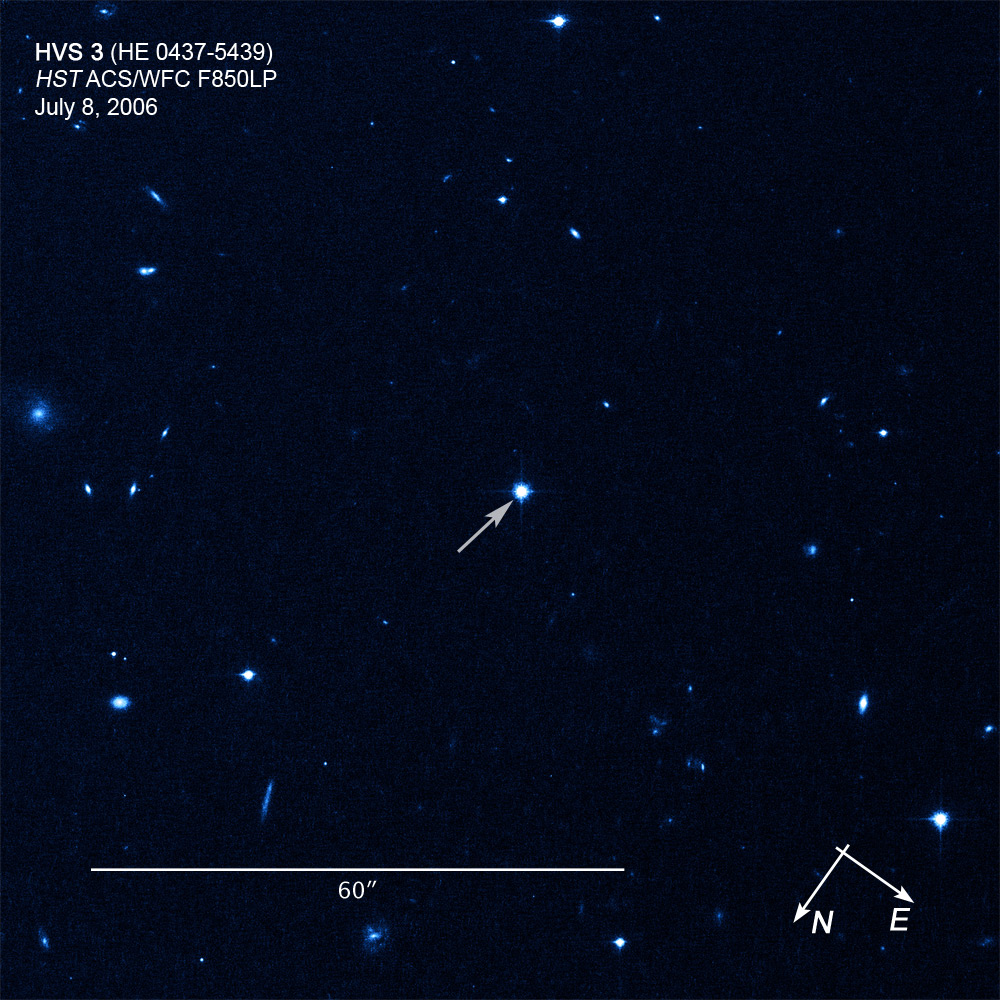
Hypervelocity stars in galaxy

Zooming through the galaxy faster than they should, hypervelocity stars are a curious population of stars whose origins are often difficult to determine. A recent study presents the first evidence of an old, low-mass hypervelocity star launched from the Milky Way’s center, providing clues into this elusive set of fast-moving stars.

Flinging Fast Stars

Astronomers have caught a number of hypervelocity stars zipping through the Milky Way since their first discovery in 2005. With speeds fast enough to escape the galaxy, hypervelocity stars were launched off course by some strong dynamical interaction. One such method, known as the Hills mechanism, predicts that when a binary star system approaches the Milky Way’s central supermassive black hole, one binary member is captured by the black hole and the other is flung away with high velocity.

However, constraining a hypervelocity star’s origin to the galactic center is limited by uncertainties in distances and proper motions, muddling how well researchers have been able to trace their orbits backward. Among a number of candidate galactic center–origin hypervelocity stars, only one has been confidently identified as having been kicked from the galaxy’s center. Intriguingly, this hypervelocity star and most galactic center–origin candidates are young, massive stars — old, low-mass hypervelocity stars from the galactic center have yet to be identified.

What does this dearth of old, low-mass zooming stars mean? Either stars in the galactic center are preferentially young and massive, with fewer than expected old and small stars, or low-mass hypervelocity stars are missed by selection effects, challenging to detect in current surveys. Searching for hypervelocity stars with higher precision and sensitivity may allow astronomers to tease out this missing population and trace back more zooming stars to a Hills mechanism origin.

Discovering An Old Hypervelocity Star

Leveraging high-quality spectra from the Dark Energy Spectroscopic Instrument (DESI) survey and precise astrometry from Gaia, Shunhong Deng (University of Chinese Academy of Sciences; China West Normal University) and collaborators reported the discovery of the hypervelocity star DESI-HVS1. From the spectroscopic and astrometric analyses, the authors determined that DESI-HSV1 is a ~14-billion-year-old low-metallicity star with a mass about 80% that of the Sun’s, moving through the galaxy at 523 km/s.

Backward orbit integration

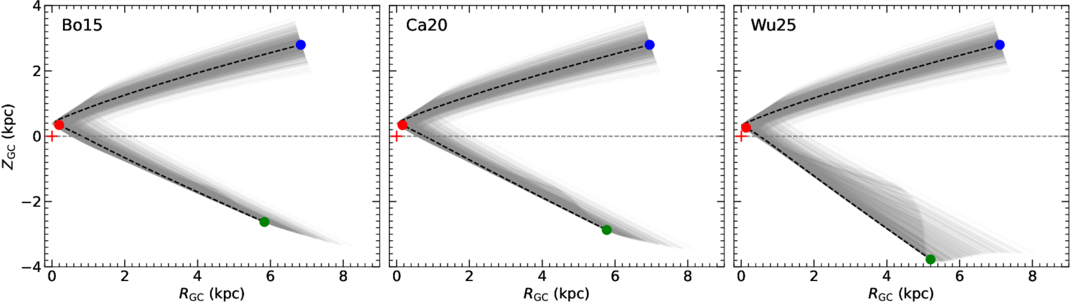
Backward-integrated orbits of DESI-HVS1 for three different galactic potential models. The blue, red, and green points show the star’s current position, closest approach to the galactic center, and position 50 million years ago, respectively. Click to enlarge. [Deng et al 2026]

Exploring the possible origins of this hypervelocity star, the authors integrated the star’s orbit backward in time for one billion years. The backward orbit integrations show the star approaching the galactic center where it then turns around, traveling away faster than the local escape velocity of the galaxy. Even when varying the galactic potential and constants, all orbit integrations suggest DESI-HVS1’s motion through the galaxy is most naturally explained by the Hills mechanism.

While more refined galaxy models and comparison to other candidate galactic center–origin hypervelocity stars are necessary to fully confirm its origins, DESI-HVS1 provides the first compelling evidence for an old, low-mass hypervelocity star candidate consistent with a galactic center launch. This suggests that the observed lack of such stars is likely not a reflection of the Milky Way’s central stellar population, but rather a consequence of observational constraints making such small hypervelocity stars particularly difficult to detect. As large spectroscopic and astrometric surveys continue to advance, the sample of galactic-center hypervelocity star candidates will grow, enabling further exploration of the stellar environment and dynamical processes at the Milky Way’s core.

Citation

“An Old, Low-mass, Metal-poor Hypervelocity Star Candidate Consistent with Galactic Center Origin,” Shunhong Deng et al 2026 ApJL 1003 L9. doi:10.3847/2041-8213/ae6505

The post Shot from the Heart of the Milky Way: Discovery of an Old Hypervelocity Star appeared first on AAS Nova.

Could a White Dwarf–Black Hole Pair Explain the Longest Gamma-Ray Burst Ever Seen?

9 June 2026 at 23:36

illustration of GRB 250702B

What’s the story behind the longest gamma-ray burst ever observed? Researchers explore how repeated interactions between a white dwarf and an intermediate-mass black hole could explain GRB 250702B’s unusual properties.

An Exceptional Gamma-Ray Burst

GRB 250702 host galaxy

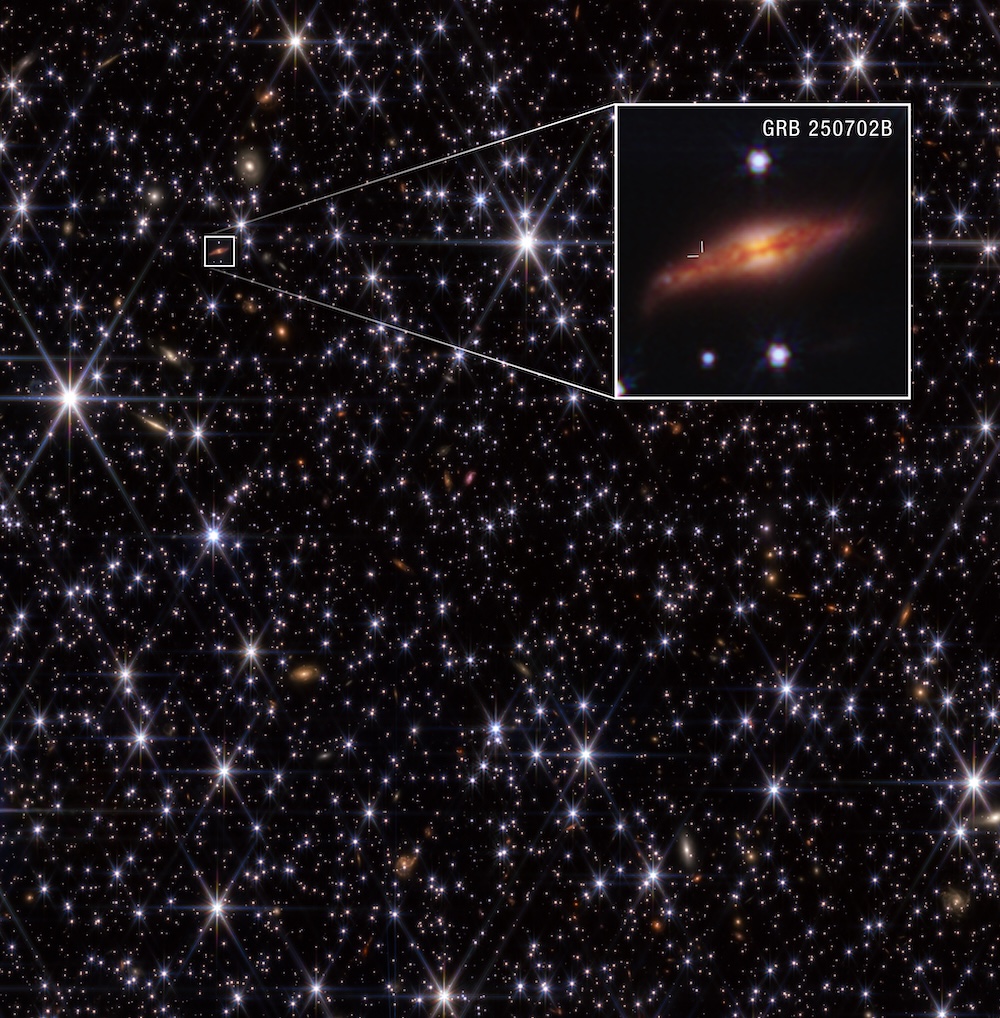
An image of GRB 250702B’s location within its host galaxy. [NASA, ESA, CSA, H. Sears (Rutgers). Image Processing: A. Pagan (STScI)]

In 2025, the Fermi Gamma-ray Space Telescope spotted an intense flash of gamma rays from a distant, dusty galaxy, and a fleet of spacefaring and earthbound telescopes soon revealed the remarkable characteristics of the event. GRB 250702B featured multiple bursts spanning several hours, individual flares lasting roughly 100 seconds, and X-ray emission in the 24 hours leading up to the gamma-ray activity — something never seen before in a gamma-ray burst.

These characteristics have been challenging to explain with typical models of long gamma-ray burst formation, such as collapsing massive stars, but researchers have developed numerous promising alternatives. In a new research article, astronomers have shown how GRB 250702B’s behavior might be explained by repeated close encounters between a white dwarf and an intermediate-mass black hole.

Eccentric Close Encounters

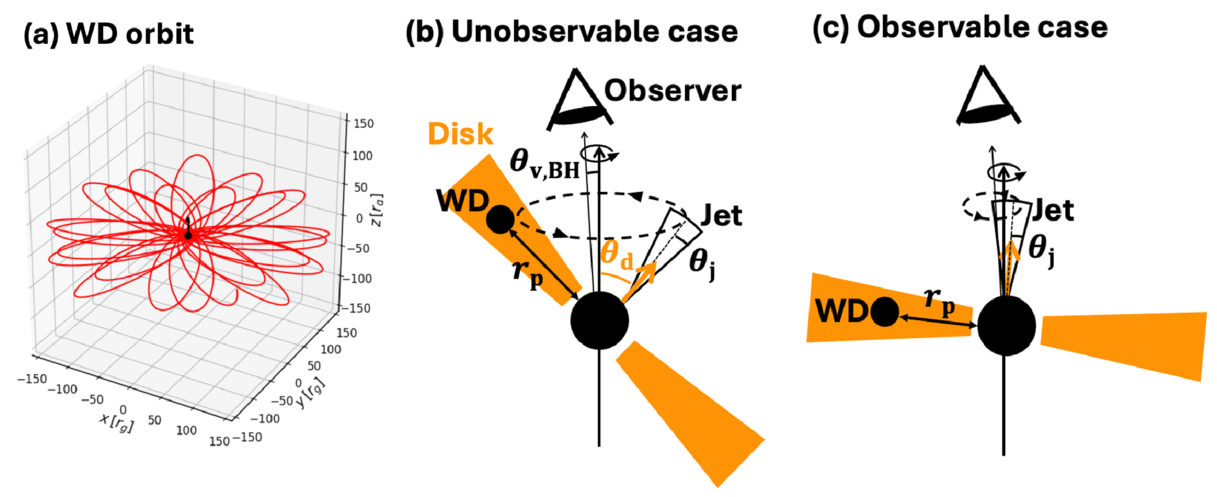
Yuri Sato (Tohoku University) and collaborators modeled the source of GRB 250702B as a white dwarf that has been captured into orbit around an intermediate-mass black hole. In their model, the white dwarf travels on an extremely eccentric orbit, drawing close to the black hole roughly once an hour. Each time the white dwarf ventures close, the black hole’s tidal forces strip away part of the star until, after about 40 such encounters, the white dwarf is completely destroyed.

geometry of the GRB 250702B system

Schematics showing the orbit of the white dwarf (WD; left) and the geometries that produce observable and unobservable jets. Click to enlarge. [Sato et al. 2026]

When the black hole peels material away from the white dwarf, some material swirls into an accretion disk, and some is cast off into space. Accretion from the disk powers a narrow relativistic jet: the source of the event’s powerful gamma-ray flares. This should mean that there is one jet produced each time the white dwarf is partially disrupted — 40 times — yet astronomers detected only a handful of flares from GRB 250702B.

Jet Precession and Model Predictions

The discrepancy can be resolved if the angle between the jet and the black hole’s spin axis precesses over time so that only some of the jets are pointed toward us. This can occur if the accretion disk is misaligned relative to the black hole’s spin. As an alternative, disk instabilities or other processes could keep all but a few of the expected jets from being launched.

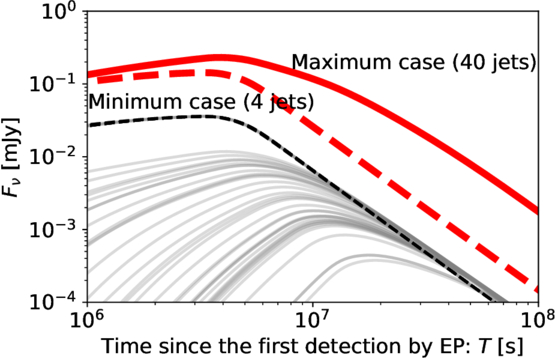
radio afterglow predictions for GRB 250702B

Predicted strength of the radio afterglow for the jet precession case (maximum case) and the case in which only four jets were launched due to disk instabilities or jet choking (minimum case). The x-axis shows the time since the burst was detected in X-rays by the Einstein Probe (EP). [Sato et al. 2026]

Sato and coauthors found that these two scenarios have different long-term outcomes, providing a potential way to ascertain what’s going on at the source; in the jet precession scenario, the jets that are launched away from our line of sight produce an order of magnitude more radio emission at late times.

This work by Sato and collaborators demonstrates how the repeated partial tidal disruption of a white dwarf by an intermediate-mass black hole can match the properties of one of the most remarkable recent transient sources — one that has pushed astronomers to consider new ways of producing gamma-ray bursts.

Citation

“Successive Partial Disruptions with Orbital Precession in a White Dwarf–Black Hole System for Repeating GRB 250702B,” Yuri Sato et al 2026 ApJL 1003 L44. doi:10.3847/2041-8213/ae6a8f

The post Could a White Dwarf–Black Hole Pair Explain the Longest Gamma-Ray Burst Ever Seen? appeared first on AAS Nova.

❌