❌

Normal view

Minimus Unveils New Supply Chain Protection Proxy and Command-Line Interface for Container Management

8 June 2026 at 17:46

Cloud software security firm Minimus today expanded its product portfolio with the general availability of Minimus Supply Chain Protection and minicli. The tools introduce a unified approach to managing third-party software risks and container image configurations.

The release of Supply Chain Protection directly targets vulnerabilities found within the application package universe, where interwoven dependencies are frequently maintained by isolated third parties. Operating seamlessly as a pull-through proxy for NPM and PyPI, the solution evaluates public packages based on popularity, commit data, and cooling-off periods before they reach CI/CD pipelines. Platform teams can deploy multiple configurations tailored to the risk tolerances of different development environments.

In tandem, Minimus has launched minicli, a public command-line tool downloadable for macOS and Linux (AMD and ARM). The utility allows developers to inspect custom image structures—including internal file bundles and environment variables—and manage private images directly from the terminal. By converting image recipes into YAML files, teams can easily integrate change controls and automation into their existing technology stacks.

Together with Minimus Images, which eliminate up to 98% of standard container base image vulnerabilities, these updates offer an end-to-end strategy for securing both OS packages and application dependencies.

About Minimus

Minimus delivers a modern foundation for secure container software, open-source dependency management, and software supply chain security. The company was founded in October 2022 by container security pioneers Ben Bernstein, Dima Stopel, and John Morello (co-authors of NIST SP 800-190 and founders of Twistlock) to solve the ongoing operational burden of cloud vulnerability remediation. By engineering high-security container images directly from upstream project sources with only the absolute minimum software required to run, Minimus completely neutralizes 98% of typical cloud software vulnerabilities. Minimus offers a highly scalable, developer-friendly solution that deploys instantly via standard tools, and is backed by a $51M seed investment from YL Ventures and Mayfield. 

Dead Sloths at Florida Wildlife Facility Reveal Trade Dangers While Iowa Farmers Break Ranks on Water Regulations — Today’s Environmental Briefing for Mon, Jun 8 2026

8 June 2026 at 14:01
Deceased sloth being examined by veterinary pathologist in laboratory setting

**

Across the stories today, a common thread emerges: the gap between environmental promises and practice is forcing communities to take matters into their own hands, even as powerful interests dig in their heels.

The day’s coverage points to growing momentum around local action filling spaces where larger systems have failed. In Iowa, farmer James Hepp is breaking ranks with agricultural tradition, calling for mandatory water quality standards after voluntary programs fell short on his 1,600 acres. Meanwhile, in Ghana, marine biologist Issah Seidu has convinced fishing communities to trade endangered guitarfish for giant snail farming—creating economic opportunity that doesn’t depend on depleting the ocean.

These grassroots shifts are happening against a backdrop of institutional retreat. The aviation industry quietly admitted its 2050 net-zero pledges will likely miss the mark, just five years after making them. Democratic politicians are avoiding climate messaging despite electoral benefits, a phenomenon researchers call “climate hushing.” And the Trump administration invoked wartime powers to pour $700 million into coal revival, framing fossil fuels as national security.

Yet nature itself is sending mixed signals that complicate neat narratives about environmental decline. UK waters are experiencing an unprecedented octopus population boom that’s reshaping marine ecosystems from England to Scotland. Tuna populations are showing remarkable recovery through strict international fishing regulations. But for every success story, there’s a reminder of fragility: critically endangered Chinese pangolins discovered thriving in Nepal’s community forests, or 119 sailors’ graves from 1801 now threatened by Norfolk’s rising seas.

It’s a reminder that progress and pressure often arrive together. The same regulatory changes that created UK electric vehicle loopholes will pump an extra 17 million tonnes of carbon into the atmosphere by 2030. North Carolina legislators are simultaneously curbing data centers’ massive electricity consumption while boosting fossil fuel incentives—an environmental paradox wrapped in a single bill.

Behind the numbers are real communities adapting in real time. Over 600 Thai residents just completed a 42-mile “peace walk” demanding government action on heavy metal river pollution. In the Dominican Republic, 65-year-old Leoncia Ramos wants to leave the home she’s known her entire life, fleeing gold mine pollution while Canada’s corporate watchdog office sits empty. Long Island residents in Brookhaven are discovering that decades of landfill contamination now threatens their groundwater.

These stories reveal something crucial about this environmental moment: when institutions fail or retreat, communities don’t wait. They organize marches, develop alternative livelihoods, break with traditional alliances, and demand accountability. Whether it’s Michigan’s farm training program addressing agricultural crisis through hands-on education, or Malawi’s Elephant Marsh feeding thousands while facing conservation pressures, local knowledge and local action are filling critical gaps.

The tension between extraction and protection remains fierce—Shell operated leaking Nigeria pipelines for years despite knowing the risks to mangrove forests, while Colorado opens 156,000 acres of critical wildlife habitat to oil drilling. But today’s coverage also suggests that the most durable environmental progress might be happening at smaller scales, in communities that can’t afford to wait for global agreements or corporate promises.

As the week unfolds, all eyes will be on whether these grassroots innovations can scale up fast enough to match the challenges revealed in today’s headlines.

The post Dead Sloths at Florida Wildlife Facility Reveal Trade Dangers While Iowa Farmers Break Ranks on Water Regulations — Today’s Environmental Briefing for Mon, Jun 8 2026 first appeared on EnviroLink Network.

EU’s cloud sovereignty push leaves room for US hyperscalers

8 June 2026 at 12:45

The European Commission published its tech sovereignty package last week, including the clearest signal yet of its intention to strengthen European cloud sovereignty and reduce its dependence on US hyperscalers.

It’s a response to growing concerns among European organizations and regulators about the reliance on US tech firms and legislation such as the US CLOUD Act, which could give US officials access to data — even if it is stored in Europe.

But any shift toward local, sovereign cloud providers will necessarily be gradual, analysts, said as the Cloud and AI Development Act (CADA) proposals leave plenty of room for US providers to continue supplying cloud computing services to European public sector customers.

“The direction is right. The execution will be slow,” said Fernando Pereiro, senior director analyst at Gartner.

While the Commission has correctly identified areas where the EU is most dependent on foreign providers, delivering on its ambitions is another challenge, he said. Scaling alternatives to US suppliers “takes time, capital, and coordination at a level that is difficult to sustain in Europe.”

Dario Maisto, senior analyst at Forrester, played down the prospect of a major short-term shift towards European cloud providers as a result of the CADA proposals, even after recent interest in local European vendors for mission-critical workloads and highly sensitive data.

“I do not expect an immediate impact on the cloud infrastructure market,” Maisto said. “Full-blown migrations are costly and take several years. They are not going to happen in the near future.”

Instead, Pereiro expects the gradual emergence of “sovereign enclaves” or controlled environments for sensitive workloads, particularly in government and regulated sectors. “Outside of those areas, the market will remain global, but increasingly shaped by European rules,” he said.

Nevertheless, the three US hyperscalers that account for around 70% of the European cloud market – Amazon Web Services (AWS), Google, and Microsoft —  will likely see a more competitive environment.

“The real shift is symbolic and structural: hyperscalers move from being the default choice to one option among others, and their competitiveness will increasingly depend on how well they align with European control requirements, not just on technology or price,” said Pereiro.

What is CADA and what could it mean for Europe’s cloud market? 

CADA is part of a range of policy and legislative proposals — known as the Tech Sovereignty Package — published by the Commission, alongside Chips Act 2.0, the Open Source Strategy, and Strategic Roadmap for Digitalization and AI in Energy.

CADA includes measures to boost European tech sovereignty. Among other things, it aims to triple data center capacity in the next five to seven years by easing restrictions on new infrastructure projects across the EU, as well as efforts to support research and development of cloud and AI technologies.

It also includes a sovereignty framework that, if enacted, would require EU public bodies to assess sovereignty risks and procure cloud services that meet four assurance levels.

The various levels portray “a political vision with many open questions,” said Maisto. In more detail:

  • Level 1 requirements are achievable by hyperscalers, Maisto said, with requirements focused mostly on data residency. 
  • Level 2 is “more controversial,” he said, as it includes requirements around third-country access to data and disruption of services.
  • Level 3 leaves room for US providers to win procurement contracts — particularly where they enter a joint venture with a European cloud provider such as S3NS, a Thales subsidiary that has partnered with Google.
  • Level 4 applies to only a small proportion (1%) of the most sensitive workloads.

The first two levels could be open to US hyperscalers, said Maisto, with 70% of existing EU public sector workloads falling under Level 1 and 20% at Level 2, according to Commission’s own impact assessment. Just 9% of the workloads would require Level 3. 

The most stringent Level 4 would require cloud providers that “have full transparency and control over their software supply chain and no interference from a third country,” the Commission said.

For public sector organizations, the CADA rules could create more clarity around procurement, said Pereiro. “Today, the concept of ‘sovereign cloud’ is often vague and inconsistently applied in providers’ marketing and messaging,” he said. “This package standardizes what sovereignty must look like in practice, effectively ending the era of ‘sovereign washing.’”

The proposals give public sector organizations a “stronger set of requirements with which to assess risk, especially around jurisdiction and access to data,” he said.

“For enterprises, it’s less about regulation and more about leverage,” said Pereiro. “They gain clearer benchmarks and more viable alternatives, particularly through open source and emerging European providers.”

European cloud industry sees ‘a step in the right direction’

The Cloud Infrastructure Services Providers in Europe (CISPE) — a nonprofit trade group — welcomed the “strong definitions” of Levels 3 and 4, and said that, if implemented well, the proposed rules could “help to challenge the commercial dominance of established foreign cloud and AI vendors.”

However CISPE also called the current Level 1 and 2 criteria “confusing and non-sensical,” and said they should not be designated as “sovereign” since US hyperscalers can meet the requirements. “This will continue to confuse the market, both public and private customers, and encourage more sovereignty washing attempts,” CISPE said in a blog post Thursday.

CISPE also said the proposals fail to require public authorities to check whether a European service exists before opting for a foreign supplier. “We see a significant risk that assessments become a ‘rubber-stamp’ exercise that allow IT departments to continue to buy non-sovereign services out of convenience,” the organization said.

French firm OVHcloud — one of the leading European cloud computing and web hosting companies — welcomed the proposals, though it said any rules must be carefully scoped to ensure they are effective.

“This text is a step in the right direction and represents an opportunity to strengthen European strategic autonomy — something unthinkable just a few years ago,” an OVHcloud spokesperson said. “It provides a useful framework, but one that must not leave too much room for exceptions and workarounds. 

“Europe must and can move much faster, with very clear rules and a genuine European preference. Beyond this text, the Commission has demonstrated with its sovereign procurement call that it is possible to act right now to reduce critical dependencies. The time for waiting is over. We must accelerate. We must clarify. We must own it. 

“Europe has the players and the expertise,” the spokesperson said. “It is time to turn political ambition into European industrial capability.”

The overall tech sovereignty package “marks the overdue shift from diagnosis to treatment,” said a spokesperson at Ionos, a German cloud and hosting company. Ionos pointed to the EC’s claims that more than 80% of digital products, services and infrastructures in the EU originate from non-European providers, while 264 billion euros flow from EU organizations into predominantly US-based IT products.

“This is a strategic failure that must now be corrected,” the spokesperson said. While the company applauded the Commission’s focus on “secure and sovereign cloud and AI infrastructure for highly critical use cases,” it argued the CADA proposals fall short. “The central weakness of the package: the approach remains predominantly supply-side. The decisive lever — the demand side – is missing. Public procurement is the most powerful instrument for digital sovereignty. The public sector as anchor customer is critical for scaling sovereign cloud and AI solutions.

“Europe will remain dependent on Nvidia and AMD for GPU computing, the spokesperson said. “What matters is not whether to cooperate, but on what terms: data under European law, operations by European providers, no extraterritorial access. …If EU funding earmarked for ‘sovereign cloud’ ends up with the European subsidiaries of US hyperscalers, the package will have failed its objective.”

The real impact on hyperscalers

The proposed rules could require hyperscalers to change tactics to cater to European customers, or to at least ramp up existing sovereign cloud strategies. “For vendors, this is essentially a shift in what ‘competitive’ means,” said Pereiro. “For the last decade, scale and hyperscaler alignment were enough. That’s no longer the case.”

Cloud providers will need to demonstrate real control over data, infrastructure, and operations, he said, and not just label solutions as “sovereign.”

“The bar has been raised, and some existing offerings simply won’t clear it,” he said.

While the CADA rules are designed to favor European providers in some cases, the proposals stop short of barring US providers from public sector contracts. “It doesn’t shut them out,” said Pereiro, “but it changes competitive conditions substantially.”

The proposed procurement requirements make sovereignty a “gating factor” for sensitive workloads, said Pereiro, and “create real friction for providers whose operating models depend on centralized control or non-EU jurisdiction.”

US tech firms tout support

US hyperscalers publicly welcomed the proposals, and indicated plans to work with policy makers and ensure the importance of customer choice in cloud service procurement.

“We look forward to reviewing the proposed rules and continuing to work alongside our partners to ensure European organizations have the power of choice and sovereign control,” a Google spokesperson said.

An AWS spokesperson said the company has invested ”tens of billions of euros” in European cloud infrastructure, which it claims has “already advanced the continent’s competitiveness, helped organizations innovate and grow, and supported the development and resilience of both public and private services that Europeans now rely on every day.

“European organizations deserve access to the best technology available from trusted providers, chosen on the basis of security, performance, verifiable controls, and value,” the AWS spokesperson said. “We look forward to working with policymakers to ensure the Cloud and AI Development Act promotes technology choice and rewards long-term investment in Europe’s digital future.”

A Microsoft spokesperson said the company shares the EU’s “ambition to strengthen technological sovereignty and global competitiveness in AI, grounded in openness, partnership and fair competition.

“Achieving this will depend on access to world-class infrastructure and technologies at scale,” the Microsoft spokesperson said. “That means enabling European companies and public administrations to make procurement choices based on a broad, risk-based assessment in an open and competitive market.

“Microsoft offers secure and sovereign cloud solutions that put customers in control, and we stand ready to help build a strong, resilient and globally connected AI ecosystem in Europe.”

While the proposals present potential hurdles for US hyperscalers, those that adapt to the new regulatory direction — and concerns of European organizations — will benefit, said Pereiro. “If your offering aligns with sovereignty requirements, your company will be likely to see more opportunities, not fewer,” he said.

NASA’s New Technology Lets Spacecraft Switch Between Networks

By: NASA
8 June 2026 at 12:42
Polylingual Experimental Terminal (PExT)NASA just demonstrated a technology that lets spacecraft communicate across multiple networks, paving the way for a more flexible and reliable space internet. NASA’s experimental Polylingual Experimental Terminal (PExT) has successfully completed its primary technology demonstration, marking an important step toward more flexible communications in space. Because the project met its original goals and continues [...]

Lithium mining impacts local waters

8 June 2026 at 12:00

Electric vehicles and other clean energy devices rely on batteries that use a metal called lithium. The expanded use of lithium has made lithium mining a rapidly growing industry. Lithium is most often found in volcanic rocks called pegmatites. Researchers have studied how much carbon and water pegmatite mining uses, but they don’t know how it affects local water quality. 

Pegmatite mining releases not only lithium but also other metals commonly found in pegmatite, such as rubidium and cesium. These trace metals are under-researched in terms of their environmental effects and possible human toxicity, though the EPA has linked high levels of lithium to adverse health effects in kidney function, neurological development, and thyroid function. As such, there’s currently no established safe level for lithium in drinking water, but the U.S. Geological Survey suggests a preliminary safety level of 10 micrograms per liter (μg/L). 

Researchers at Duke University recently tested how much pegmatite mining increased lithium levels in local waters, and how long those effects lingered after mining processes ended. To do so, they measured metal concentrations in waters downstream from 2 lithium mines and adjacent processing plants. They hypothesized that mining activities would increase interactions between rocks and the surrounding surface water and groundwater, impacting their lithium concentrations.

The researchers collected 99 water samples from surface streams and 93 samples from groundwater wells surrounding the Kings Mountain and Hallman Beam lithium mines, in a zone of about 40 kilometers (25 miles) along the border of South Carolina and North Carolina. The researchers took 51 surface water samples upstream of the mines to evaluate natural metal levels, and compared these with 48 downstream samples showing the mining-impacted metal levels. 

The researchers measured lithium and other trace elements, like rubidium, cesium, arsenic, and strontium, in the waters using an instrument called an inductively coupled plasma mass spectrometer. They found that lithium concentrations in the surface waters increased from a background of 0.2 to 79 μg/L to concentrations of 785 to 1,249 μg/L within 10 kilometers (6.2 miles) of the mines and processing facilities. The groundwater lithium levels were as high as 4,500 to 47,000 μg/L in the wells at the mines, but were not affected at downstream wells where lithium levels ranged from 0.5 to 890 μg/L. 

They suggested that lithium in the groundwater downstream from the mines came from natural interactions of the pegmatite rocks with the water, rather than from the mines themselves. This natural process was confirmed when the researchers noticed that lithium levels in the groundwater rose after rainfall, which caused more water-rock interaction.

The researchers also measured ions like calcium, sulfate, and chloride in the waters using a tool that can analyze compound molecules, called an ion chromatograph. They found that calcium and sulfate concentrations increased in surface waters within 10 kilometers (6.2 miles) downstream of the processing facilities. These downstream waters had 50 to 120 milligrams per liter (mg/L) of calcium and 100 to 300 mg/L of sulfate, compared to 5 to 20 mg/L of calcium and 3 to 10 mg/L of sulfate in the background surface waters. These ions are also byproducts of pegmatite processing, produced from a waste product made up of calcium sulfate, called gypsum. 

The team explained that active mining has been discontinued at this site for approximately 3 decades, meaning that the lithium concentrations they measured reflect the long-term release of lithium from inactive mines and mining waste. Drawing from historical data, they estimated that while the mines were active, they likely released 10 to 30 times the amount of trace metals they measured at the same location today. 

The researchers concluded that hard-rock processing impacts downstream metal and ion concentrations more than the mining itself. As lithium mining operations expand, the researchers suggested that future researchers examine lithium toxicity as well as the potential effects of its co-occurring metals, like rubidium and cesium. They also emphasized the need to find solutions for removing the trace metals and dissolved gypsum from water systems, or preventing them from leaking into the water systems to begin with.

The post Lithium mining impacts local waters appeared first on Sciworthy.

Aviation Industry Admits 2050 Net Zero Climate Pledges Will Likely Miss the Mark

8 June 2026 at 11:03
Aviation Industry Admits 2050 Net Zero Climate Pledges Will Likely Miss the Mark

The aviation industry is backtracking on its ambitious climate commitments, with airline leaders now acknowledging that their landmark pledge to achieve net zero carbon emissions by 2050 will probably fall short. This admission comes just five years after global airlines made the collective promise in 2021, following similar commitments from national aviation authorities and governments in 2020.

Willie Walsh, head of the International Air Transport Association (IATA), is pointing fingers at multiple industry players for the anticipated failure. He places blame squarely on fuel suppliers for not delivering sufficient sustainable aviation fuel, governments for inadequate policy support, and aircraft manufacturers for delays in developing cleaner technologies. Walsh argues that the industry now needs to establish a more “realistic timeline” for achieving carbon neutrality.

The setback highlights the enormous challenges facing one of the world’s most carbon-intensive industries as it grapples with growing environmental pressure. Airlines are simultaneously dealing with a staggering $100 billion increase in jet fuel costs this year, making air fare increases virtually inevitable for passengers. This financial strain further complicates efforts to invest in the expensive clean technologies needed to reduce emissions.

The aviation sector’s struggle to meet its climate goals underscores the broader difficulties industries face in transitioning away from fossil fuels. With air travel demand continuing to rebound post-pandemic, the gap between ambitious environmental pledges and practical implementation continues to widen, raising serious questions about the industry’s commitment to meaningful climate action.

The post Aviation Industry Admits 2050 Net Zero Climate Pledges Will Likely Miss the Mark first appeared on EnviroLink Network.

Jouets dotés d’IA : les experts s’inquiètent des conséquences potentielles sur le cerveau des enfants

8 June 2026 at 06:03
Ils racontent des histoires, répondent aux questions et semblent devenir les meilleurs amis des enfants. Mais derrière les promesses éducatives des jouets dopés à l'intelligence artificielle, des experts alertent sur des risques encore largement méconnus pour leur développement, leur vie privée...

Digging Back in Time in the UAE

8 June 2026 at 05:01
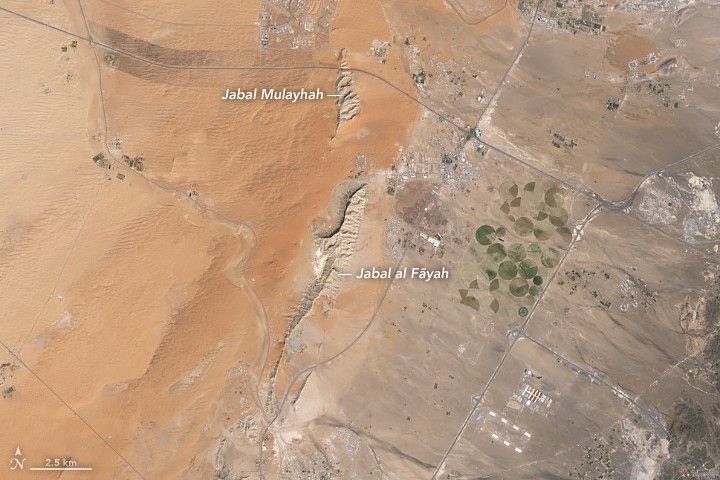
Limestone ridges appear as linear features running north–south with orange-toned desert to the west and a darker-toned mountain range to the east.
Jabal al Fāyah rises from the Rub’ al Khali desert in an image captured by the OLI (Operational Land Imager) on Landsat 8 on October 23, 2025.
NASA Earth Observatory / Lauren Dauphin

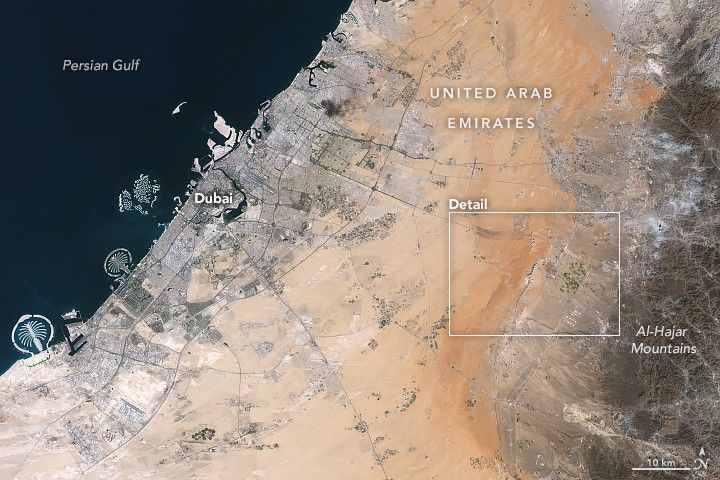
About an hour’s drive east of Dubai’s gleaming towers and artificial islands, a quieter, more natural landscape takes shape. At the far northern edge of the Rub’ al Khali, a saffron-colored sand sea laps against the Al-Hajar Mountains. A series of pale ridges rises finlike from the desert plain, with the largest—Jabal al Fāyah—standing 412 meters (1,352 feet) above sea level.  

The Landsat 8 satellite captured this image of the ridges cutting across the Emirate of Sharjah in the northern part of the United Arab Emirates on October 23, 2025. To geologists, the limestone ridges are a reminder of the region’s watery past, signs that this land lay underwater tens of millions of years ago when the sedimentary rock layers were deposited.

Jabal al Fāyah functions as a barrier, trapping windblown sand in dune fields to its west. The weathering of iron-bearing minerals in the sand grains gives the dune fields their orange hue. To the east, the branching channels of overlapping alluvial fans extending from the Al-Hajar Mountains carry gravels and eroded sediments from basalts and other dark mafic rocks. 

The dark rocks to the east—part of the Samail Ophiolite—are known to geologists for being among the world’s largest, best-preserved, and most accessible exposures of ancient oceanic lithosphere, the rigid outer layer of Earth that includes both the crust and upper mantle. Oceanic lithosphere like this is normally subducted and recycled back into the mantle when tectonic plates collide. But in this area, a large section from beneath the Tethys Sea was scraped off and thrust onto the Arabian plate in a process called obduction.  

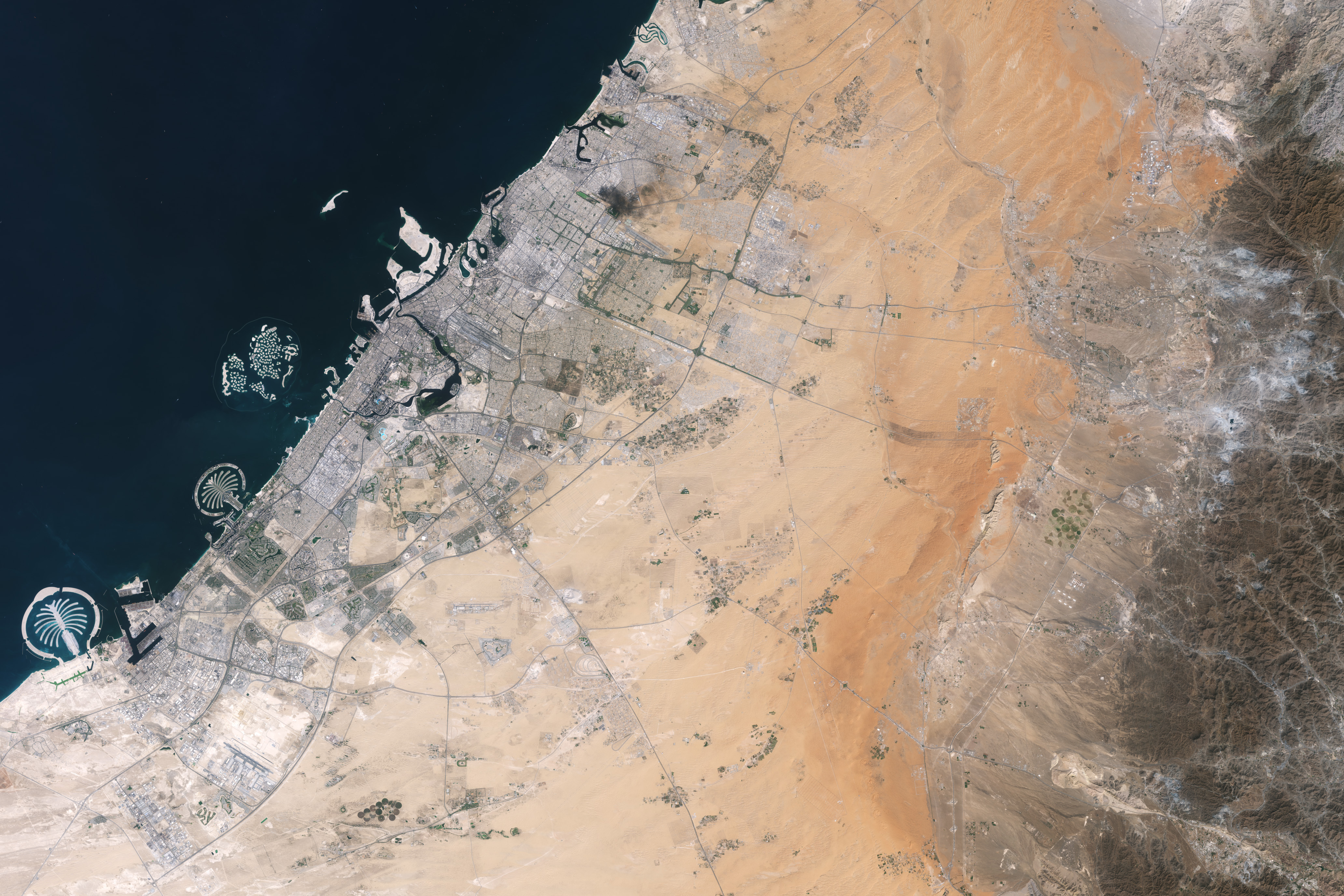
Development associated with Dubai appears as a light gray zone along the coast of the Persian Gulf with the dark gray Al-Hajar Mountains on the far right side of the image. A ridge lies in the middle of the image in a sandy area.
Dubai lies to the west of the limestone ridges, and the Al-Hajar Mountains lie to the east, in an image acquired by the OLI (Operational Land Imager) on Landsat 8 on October 23, 2025.
NASA Earth Observatory / Lauren Dauphin

The Jabal al Fāyah ridges themselves are made up of marine limestone that was deposited on top of the ophiolite over tens of millions of years spanning the late Cretaceous through the early to mid-Paleocene. Limestone typically forms along continental margins in warm, shallow oceans, often in lagoons and coral reefs, out of the calcium carbonate found in the shells and skeletons of marine life. In many parts of the ridges, coral fragments and marine invertebrate fossils are visible embedded in the rock. A feature called Fossil Rock sits a few kilometers north of Jabal al Fāyah and adjacent to the limestone ridge Jabal Mulayḩah. It contains an abundance of snail, clam, and sea urchin remains. 

For archaeologists, the ridges are at the center of a much more recent tale of human adaptation and survival that has played out in just the past few hundred thousand years. The ridges and parts of the surrounding landscape—inscribed as a UNESCO World Heritage site in 2025—are dotted with dozens of archaeological sites that trace human occupation on the Arabian Peninsula back to between 210,000 and 120,000 years ago, to the Middle Paleolithic. That was a period when waves of anatomically modern humans (Homo sapiens) migrated out of Africa and shared the planet with other groups such as Neanderthals.   

Many of the sites contain stone flakes, blades, scrapers, hand axes, and other stone tools. The archaeological treasure trove offers early evidence of modern humans surviving in a harsh desert environment and raises questions about the routes modern Homo sapiens may have taken on their journey out of Africa.  

Geological evidence indicates that lakes periodically formed on the east side of the ridge, providing critical food and water resources that would have supported early inhabitants in this unforgiving climate. Rocky overhangs along the ridge would have provided shelter from the heat and wind. Some of the sites show evidence of intermittent occupation beginning as early as 210,000 years ago, making this one of the earliest signs of human habitation on the Arabian Peninsula.   

NASA Earth Observatory images by Lauren Dauphin, using Landsat data from the U.S. Geological Survey. Story by Adam Voiland.

Downloads

Development associated with Dubai appears as a light gray zone along the coast of the Persian Gulf with the dark gray Al-Hajar Mountains on the far right side of the image. A ridge lies in the middle of the image in a sandy area.

October 23, 2025

JPEG (3.89 MB)

References & Resources

You may also be interested in:

Stay up-to-date with the latest content from NASA as we explore the universe and discover more about our home planet.

Thailand’s Krabi Coast
3 min read

The coastal province features striking tropical karst landscapes and sandy beaches alongside a mix of natural land cover and developed…

Article
A Bit of Gray on an Emerald Isle
3 min read

Ireland is best known for its many greens, but the striking grays of the island’s Burren region also stand out…

Article
Eyeing the Richat Structure
3 min read

The circular geologic feature in northwestern Africa can be hard to recognize from the ground, but it is obvious when…

Article

The post Digging Back in Time in the UAE appeared first on NASA Science.

❌