❌

Normal view

How Tilted Orbits Impact Supermassive Black Hole Collisions

22 April 2026 at 17:00

merging galaxies

What factors impact how long it takes for a supermassive black hole binary to merge? New research investigates the influence of orbital inclination on the population of merging black holes in our universe.

One Merger Leads to Another
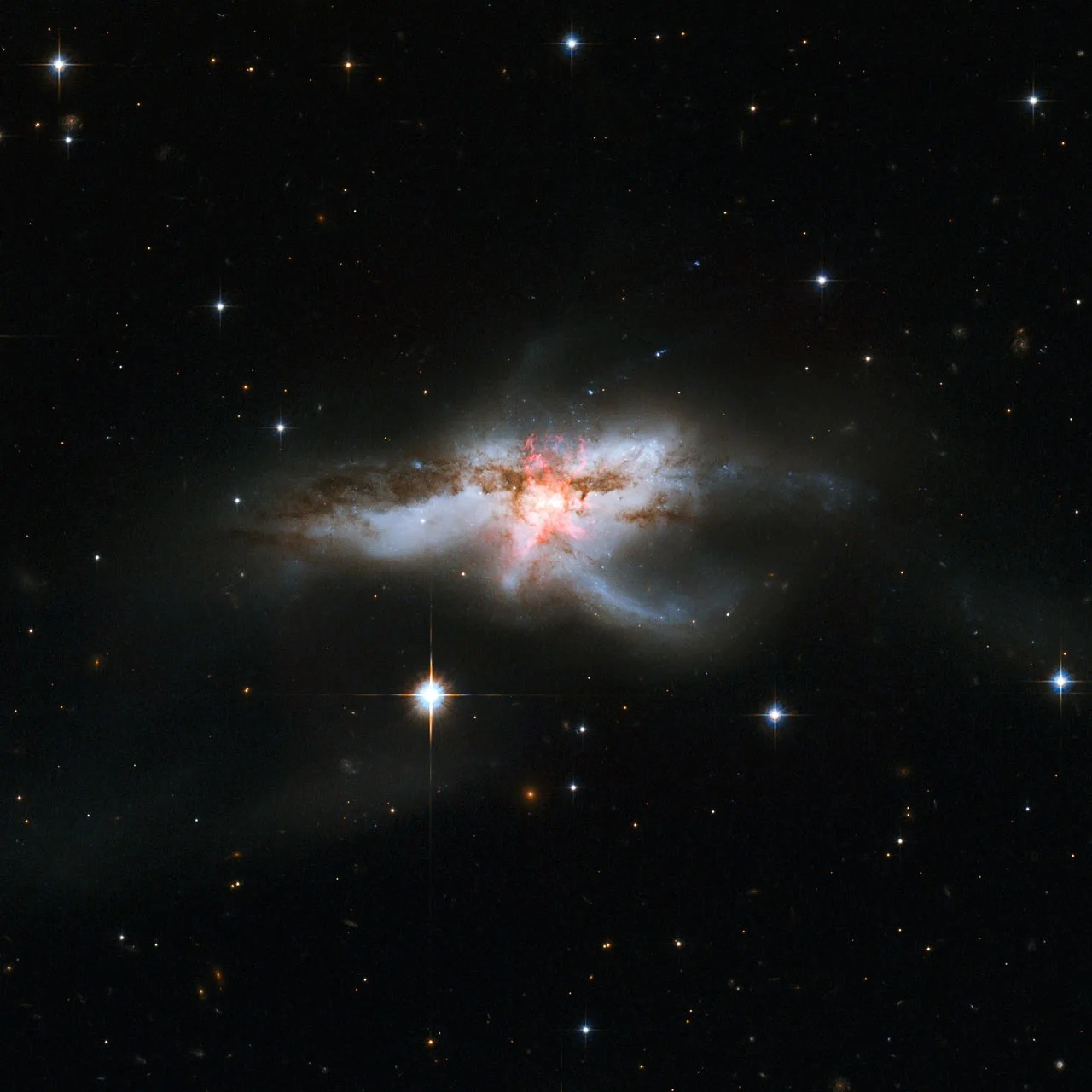
NGC 6240

This image from the Hubble Space Telescope shows NGC 6240, the result of a three-galaxy merger that contains three nuclei, two of which appear to have active supermassive black holes. [NASA, ESA, the Hubble Heritage (STScI/AURA)-ESA/Hubble Collaboration, and A. Evans (University of Virginia, Charlottesville/NRAO/Stony Brook University)]

When galaxies merge, the supermassive black holes at their centers are thought to link up in a binary system and eventually merge as well. Evidence for these supermassive black hole pairs and their collisions is piling up: researchers have identified a small but growing number of galaxies containing two accreting supermassive black holes, and the compelling evidence for the gravitational wave background points to the existence of an immense population of supermassive black hole binaries.

With observational evidence for supermassive black hole mergers taking shape, theorists are exploring the details of these mergers. One aspect of this process that hasn’t yet been examined fully is how the relative inclination of the merging galaxies impacts the time it takes for their central black holes to merge — a factor that has the potential to shape the demographics of merging supermassive black holes across our universe.

Ready, Set, Spiral

Sena Ghobadi (Georgia Institute of Technology) and collaborators used 3D dynamical models to explore how the angle at which galaxies collide — and therefore how the black holes’ orbits are tilted relative to one another — impacts the time it takes the supermassive black holes at their centers to merge.

In the simulations, Ghobadi’s team placed a 106–108-solar-mass black hole at the center of a disk galaxy. Then, they sent a second, smaller black hole spiraling toward it from a distance of 1 kiloparsec (3,300 light-years).

The team varied the inclination of the incoming black hole’s orbit relative to the disk of the target galaxy from 0 to 75 degrees. They also explored the impact of changing the black hole masses and the galaxy’s central gas density, disk rotation speed, and gas mass fraction. For each simulation, they recorded how long it took for the incoming smaller black hole to get within 10 parsecs of the larger black hole.
simulated black hole orbits

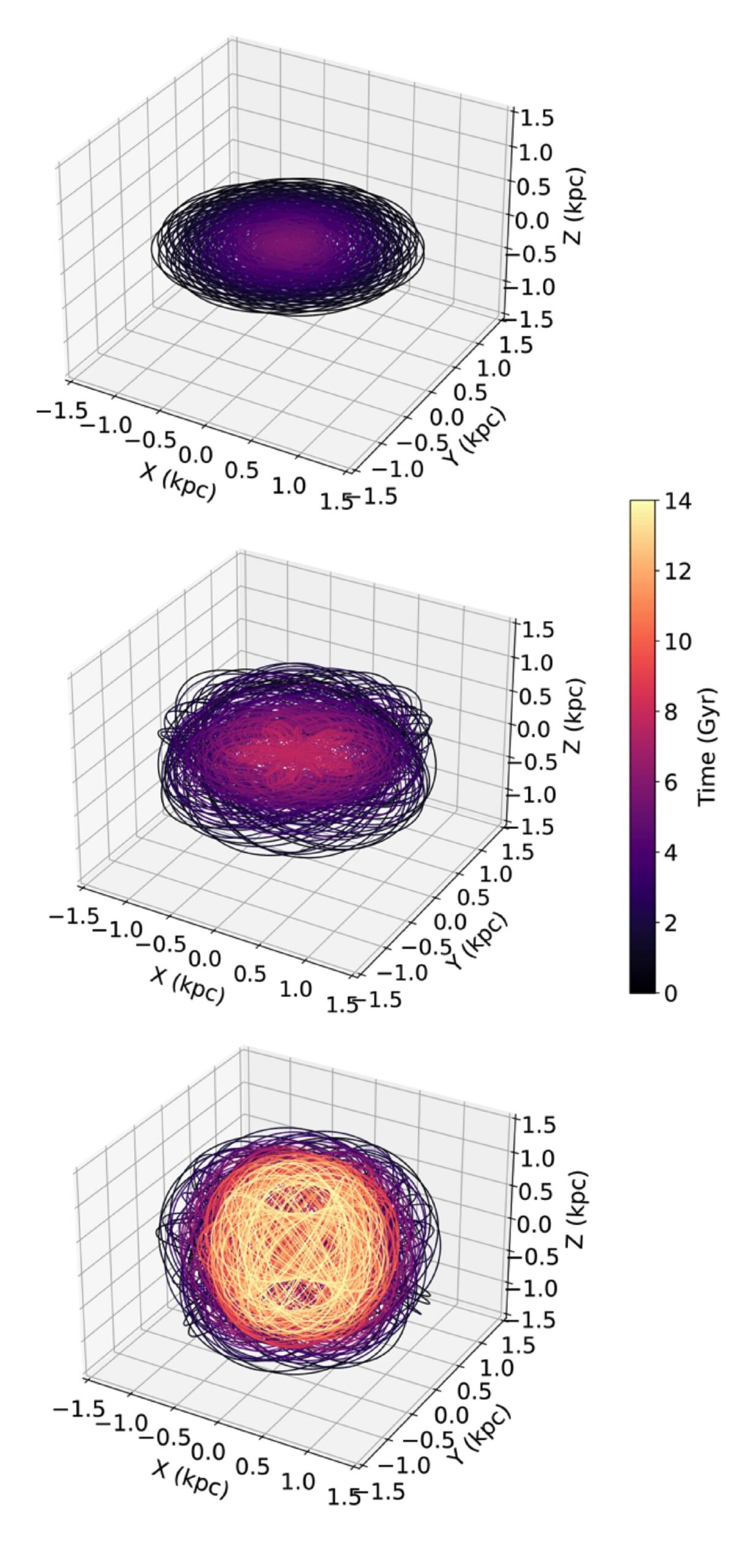
Simulated orbits of black holes with initial inclinations of 0 (top), 25 (center), and 45 (bottom) degrees. For the 0-degree simulation, the black holes merge in 5.75 billion years. For the 25-degree simulation, the merger occurs at 7.90 billion years. The 45-degree simulation fails to merge within the lifetime of the universe. [Adapted from Ghobadi et al. 2026]

(Dis)inclined to Merge

The simulations showed a clear trend with changing inclination: a black hole with an orbital inclination greater than 20 degrees took longer to merge than those with inclinations of 0–20 degrees. For black holes approaching the merger on slightly inclined orbits, dynamical friction between the black hole and the stars and gas of the galaxy worked to drag the black hole down into the disk, decreasing its inclination over time and guiding it toward a merger. Aside from the influence of inclination, the team also found that higher-mass supermassive black holes and more rapidly rotating galactic disks tended to lead to faster mergers.

For inclinations greater than roughly 45 degrees, a dramatic transition took place, with the orbits of the incoming black holes becoming more inclined over time rather than settling down into the disk. These simulated black holes failed to merge in the allotted time of 14 billion years.

With highly inclined binaries failing to merge within the lifetime of the universe, this suggests that the dual active galactic nuclei and the supermassive black hole binaries that produce gravitational waves in the universe today are the result of binaries with initial inclinations of 20 degrees or less.

Citation

“Evolution of Supermassive Black Hole Pairs on Inclined Orbits in Postmerger Galaxies,” Sena Ghobadi et al 2026 ApJ 999 131. doi:10.3847/1538-4357/ae40bc

The post How Tilted Orbits Impact Supermassive Black Hole Collisions appeared first on AAS Nova.
Water Vapor Around a Sizzling Supergiant: High-Resolution Spectroscopy of B[e] Supergiant LHA 115-S 18

17 April 2026 at 17:00

blue supergiant

Prior to exploding, massive stars advance through action-packed evolutionary stages that are exciting but often difficult to fully decipher. A recent study focuses on a unique late-stage star to better understand its properties and evolution.

To B[e] a Supergiant

HD 62623 disk image

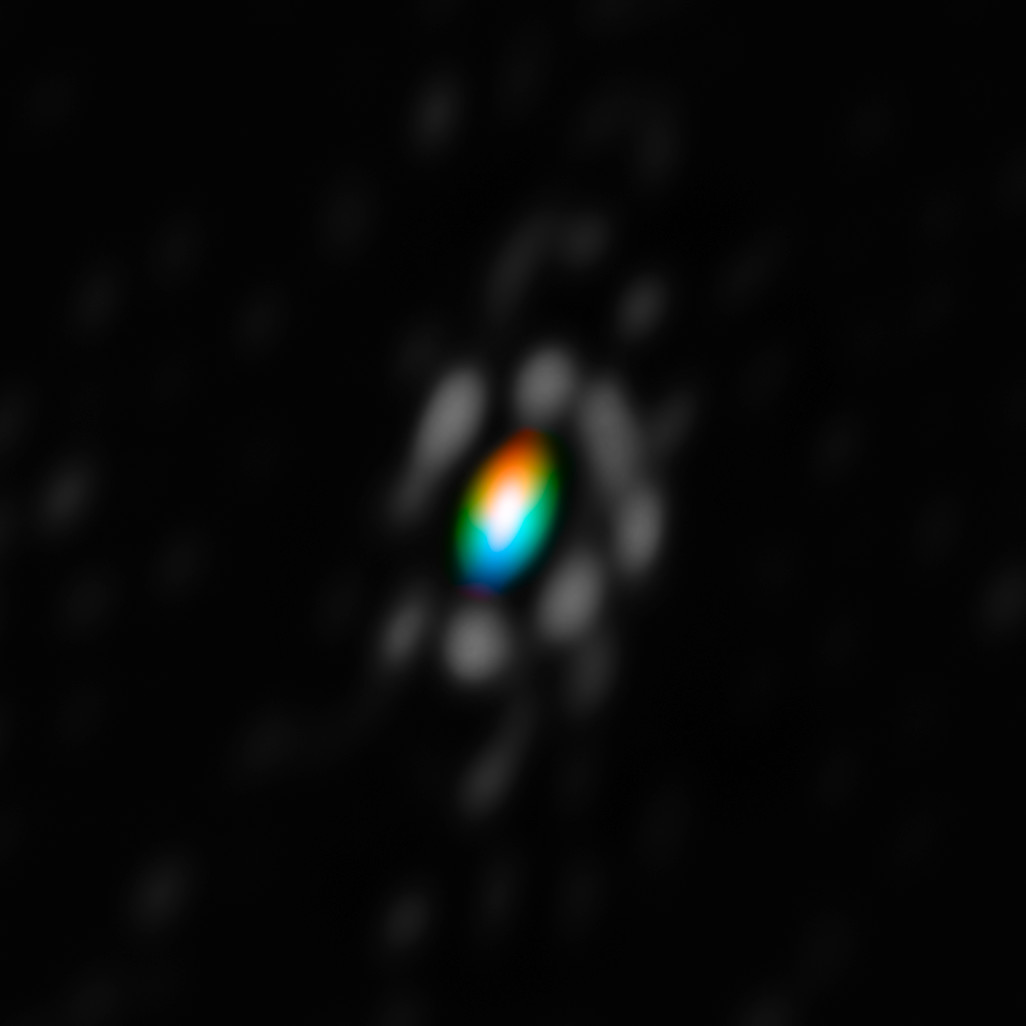
Very Large Telescope Interferometer image of the circumstellar disk around the B[e] supergiant star HD 62623. The colors indicate the rotation of the disk with blue coming toward us and red going away. [ESO/F. Millour; CC BY 4.0]

After depleting their cores of hydrogen, massive stars journey off the main sequence through a series of evolutionary phases before ending in dramatic supernova explosions. A massive star’s post-main-sequence evolution is intense, often sloughing off layers of material that can settle into a circumstellar disk. The B[e] supergiant phase describes a blue supergiant star surrounded by a cool, dense circumstellar disk where oxygen is more abundant than carbon. These environments often lock up carbon atoms in carbon monoxide molecules, leaving excess oxygen available to form other molecules including SiO, TiO, and water vapor. These molecules can survive under different physical conditions, making them key tracers of the environments around B[e] supergiants.

One particularly interesting B[e] supergiant, LHA 115-S 18, has been the subject of numerous studies but remains poorly constrained. The star exhibits significant variability both in brightness and emission features on timescales of days to years, and previous works have suggested that the star may have an as-yet unconfirmed binary companion. Molecular line emission from CO and TiO have been identified in LHA 115-S 18, indicating a circumstellar disk, but to date, water vapor emission has not been identified in any B[e] supergiant. Identifying more complex oxygen-bearing molecules like water will further reveal the physical properties and possible binary companion of LHA 115-S 18.

Identifying Emission in LHA 115-S 18

To characterize the emission around LHA 115-S 18, María Laura Arias (Institute of Astrophysics La Plata; National University of La Plata) and collaborators obtained high-resolution near-infrared spectroscopy of the star using the Immersion Grating Infrared Spectrometer on the Gemini South telescope. From the high-resolution spectra, the team identified several atomic emission lines indicative of the star’s gaseous envelope, revealing the structure of material around the star: an inner hot disk of ionized material and an outer cool disk of neutral material. Looking at molecular emission from carbon monoxide — a tracer of both gas motions and stellar age — the authors confirmed the presence of a rotating ring of gas around LHA 115-S 18 and determined that the star is an evolved, post–red supergiant object.

LHA 115-S 18 spectrum

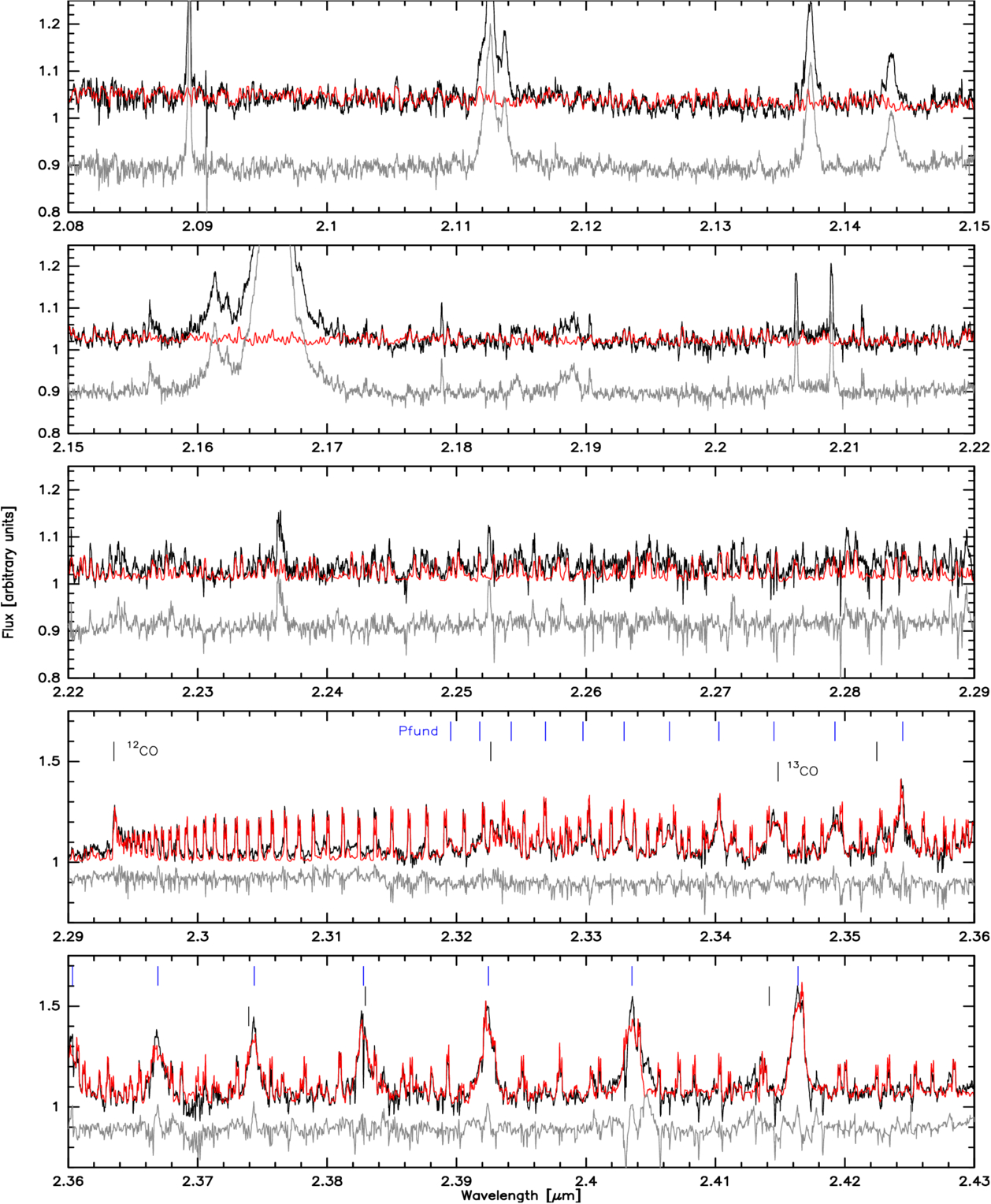
Spectrum of LHA 115-S 18 (black) with the model spectrum composed of water vapor (red, top three panels) and water vapor, CO, and hydrogen emission (red, bottom two panels) overplotted as well as residuals (gray). [Arias et al 2026]

Through computing a synthetic spectrum to compare to the observed spectrum, the authors identified many water vapor emission lines in the circumstellar environment around LHA 115-S 18. While water vapor has been detected in other evolved late-type stars, this is the first detection of water vapor from a B[e] supergiant star. For water vapor to survive the star’s intense radiation, it must exist in a dense, cool, heavily shielded disk around the B[e] supergiant.

Sustaining a cool disk around such a hot star indicates that the circumstellar environment around LHA 115-S 18 is complex and likely shaped by binary interaction. With emission features characteristic of both cool and hot evolved stars, this particular B[e] supergiant presents itself as a unique object holding critical insights into the late-stage evolution of massive stars. Further multiwavelength observations of LHA 115-S 18 will constrain its potential binarity and reveal a possible evolutionary link between B[e] supergiants and other late-stage evolutionary phases of massive stars.

Citation

“High-resolution Near-Infrared Spectroscopy of the B[e] Supergiant LHA 115-S 18: Discovery of Hot Water Vapor Emission,” María Laura Arias et al 2026 ApJL 1000 L49. doi:10.3847/2041-8213/ae524a

The post Water Vapor Around a Sizzling Supergiant: High-Resolution Spectroscopy of B[e] Supergiant LHA 115-S 18 appeared first on AAS Nova.

Supernovae, Shocks, and Spindown: A Possible Origin Story for Ultra-Long-Period Pulsars

16 January 2026 at 17:00

Researchers have recently discovered a number of ultra-long-period pulsars that are difficult to explain with typical pulsar models. A new article explains how these pulsars might arise from massive stars in close binary systems.

Strangely Slow Sources

Crab Nebula

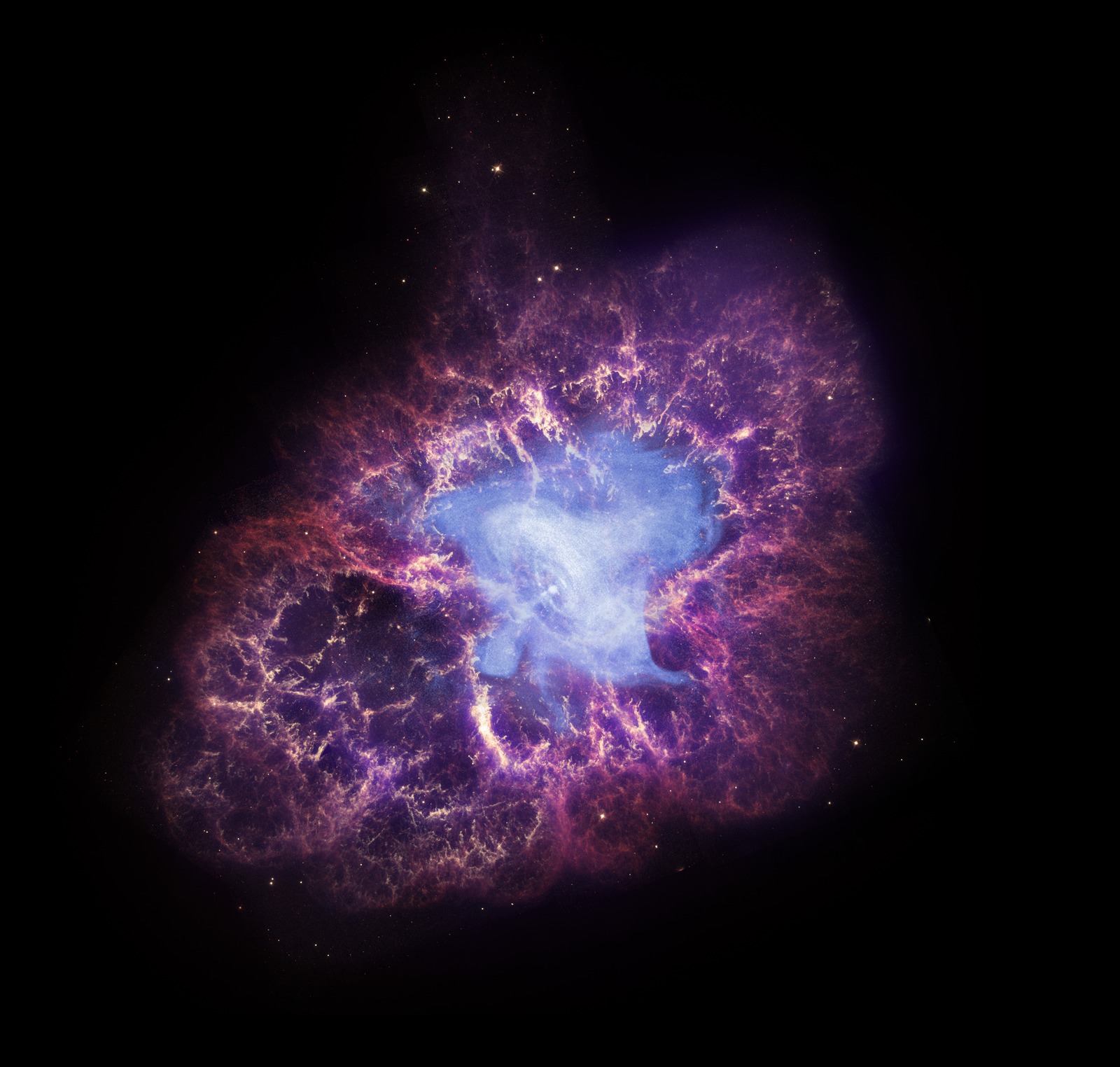
A multi-wavelength view of the Crab Nebula, the remnant of a supernova that birthed a neutron star. The neutron star powers a pulsar wind nebula, shown in blue. [X-Ray: NASA/CXC/J.Hester (ASU); Optical: NASA/ESA/J.Hester & A.Loll (ASU); Infrared: NASA/JPL-Caltech/R.Gehrz (Univ. Minn.)]

When massive stars go supernova, the explosion can leave behind the condensed stellar core in the form of a neutron star. Neutron stars that spin rapidly become pulsars, whose fast rotation powers beams of radio emission along the star’s poles.

Until not too long ago, pulsars appeared to have periods no longer than 12 seconds. Above that “sluggish” rotation rate, researchers suggested, pulsars could no longer produce electron–positron pairs and channel them along polar magnetic field lines to generate their characteristic radio signals.

So it seemed, until unexpectedly slow pulsars began to crop up. The first trend-breaking pulsars had periods of a few dozen seconds, and objects with pulse periods of minutes or hours have now been found. What could these strange objects be?

Neutron Star Origin Story

In a recent article led by Savannah Cary (University of California, Berkeley), researchers proposed that these strange radio sources are pulsars, but pulsars that rotate slowly and have magnetically powered (rather than rotationally powered) radio emission.

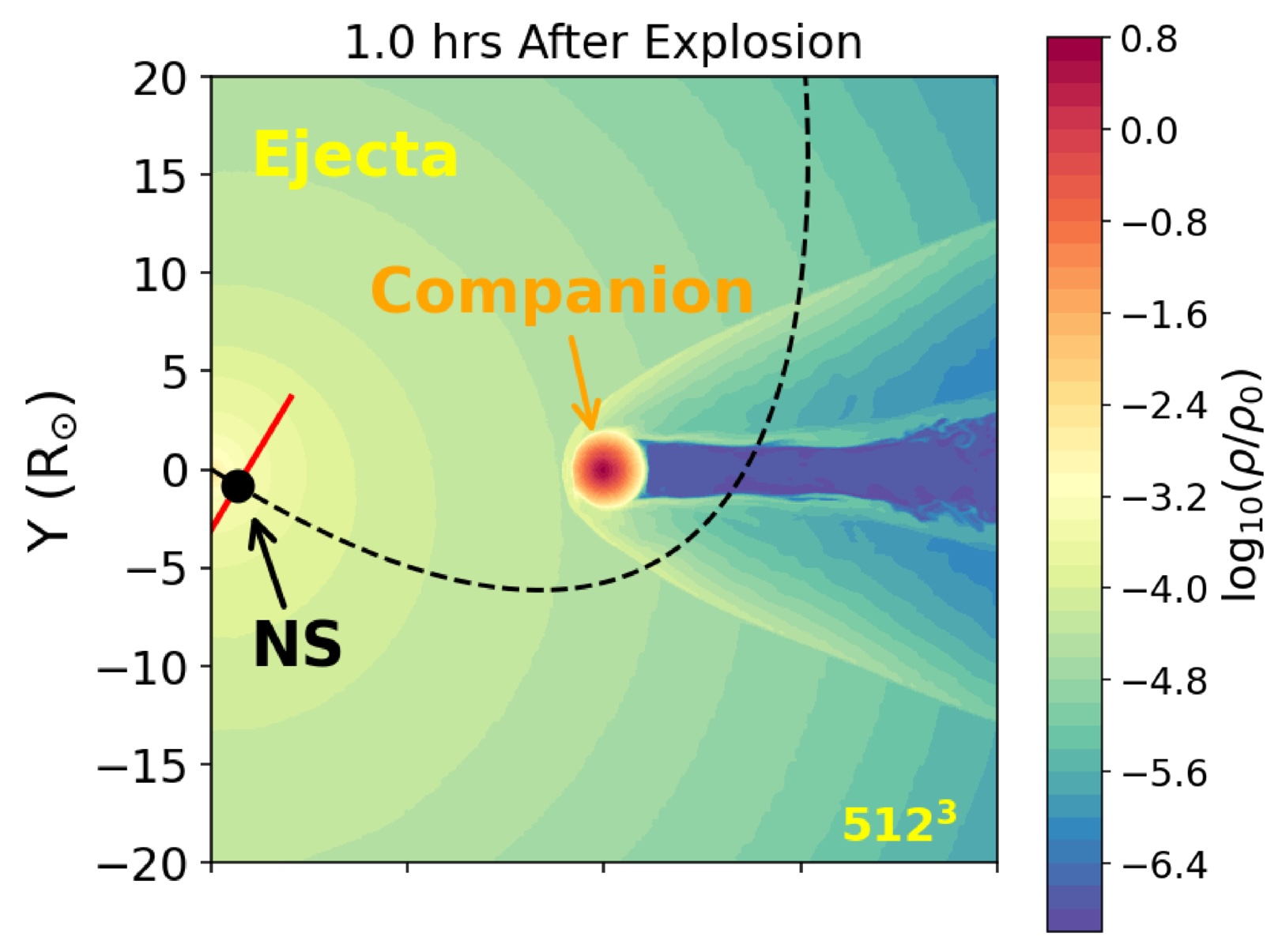
The proposed origin story for these ultra-long-period pulsars begins with a binary system containing a massive star and a close stellar companion. As the massive star evolves, it transfers its outer layers to the companion and expires as a stripped-envelope supernova that births a rapidly spinning neutron star. As the supernova ejecta crashes into the companion star, the star heats up and expands to 5–100 times its original radius.

simulation of supernova ejecta colliding with a star

Simulation snapshot taken one hour after the supernova explosion. The black dashed line shows the path the neutron star (NS) will take through the companion star’s outer layers. Click to enlarge. [Adapted from Cary et al. 2026]

Meanwhile, the explosion delivers a ferocious kick to the newborn neutron star, likely unbinding the binary system. This sets the neutron star on a new course that could take it through the puffed-up outer layers of its former companion, where it may collect gas from the star and ejected material from the supernova into an accretion disk.

Slowing Down

Cary’s team explored the outcomes of this scenario with a trio of simulations: hydrodynamical models for the shock heating of the companion star, numerical models for the formation of the disk around the neutron star, and analytical models for the interaction between the disk and the neutron star.

For a binary system containing stars of 6.4 and 4.0 solar masses and a separation of 20 solar radii — values drawn from observations and simulations — the resulting unbound neutron star collects a disk in 8–10% of cases. The neutron star’s mass, radius, rotation rate, and magnetic field strength determine whether the neutron star and the disk will interact. If they don’t, the neutron star remains rotating rapidly like a typical pulsar. If they do, the neutron star’s rotation will slow to a relative crawl over about a million years. For modest magnetic fields between 1013 and 1014 Gauss, this means rotation periods in the realm of 102 seconds, whereas stronger magnetic fields, above 1015 Gauss, yield periods of roughly a day.

This work suggests that close binary systems could be the source of ultra-long-period pulsars, of which Cary’s team estimates there may be 10–1,000 in the Milky Way. Future work will explore this possibility further, examining broader swaths of parameter space to learn more about how this scenario could contribute to the population of ultra-long-period pulsars in our galaxy.

Citation

“Accretion from a Shock-Inflated Companion: Spinning Down Neutron Stars to Hour-Long Periods,” Savannah Cary et al 2026 ApJ 996 141. doi:10.3847/1538-4357/ae1d43

The post Supernovae, Shocks, and Spindown: A Possible Origin Story for Ultra-Long-Period Pulsars appeared first on AAS Nova.

Rapid Recurrent Nova May Be Challenging Perceptions

10 October 2025 at 17:00

nova

Flashing on and fading quickly, recurrent novae are captivating astronomical phenomena. A recent study identifies one system that challenges our current understanding.

Rapid Recurrent Novae

When a white dwarf — the white-hot remnant of a dead star — has a close binary companion, the white dwarf can pull material from the companion star onto its boiling surface. Ignited in a bright flash, the accreted material is blown out from the white dwarf in a nova explosion that gradually expands and fades over time. Some novae, known as recurrent novae, repeat on observable timescales, creating a “new” star in the sky on periods ranging from one to one hundred years.

M31N 2017-01e light curves

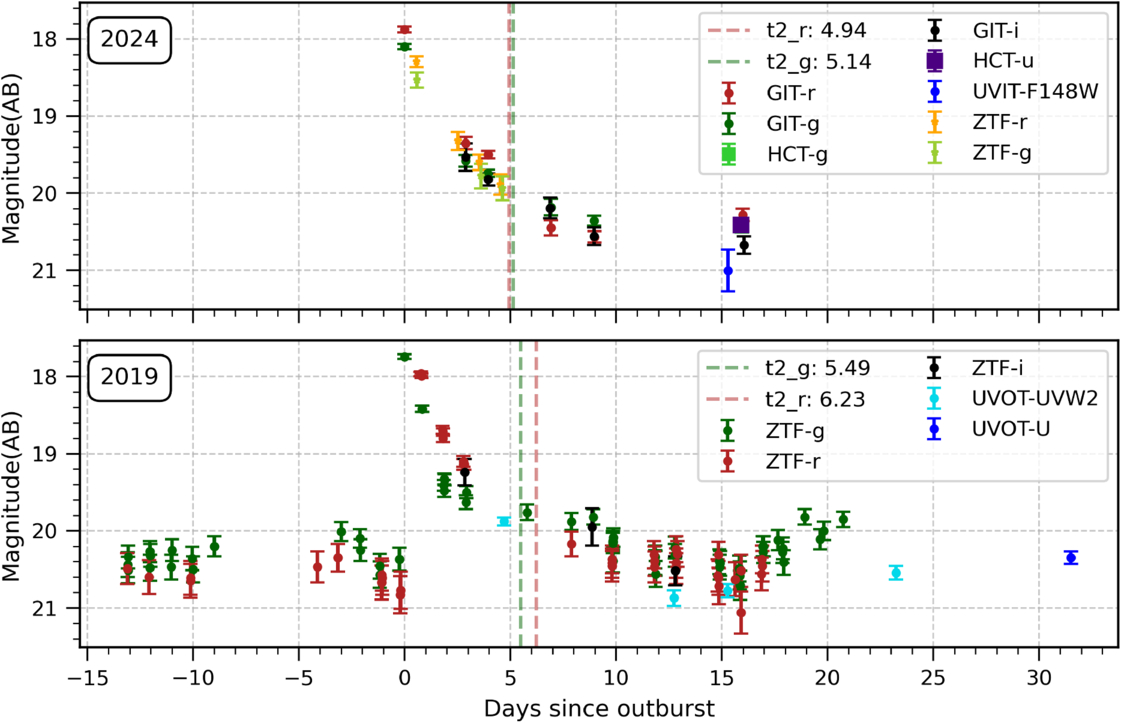
Two light curves of M31N 2017-01e outbursts from 2024 (top) and 2019 (bottom) showing how the light evolves over time. Click to enlarge. [Chamoli et al 2025]

Our nearest galactic neighbor, Andromeda, hosts the most rapid recurrent novae observed to date, including the shortest-period known recurrent nova, M31N 2008-12a. M31N 2008-12a has erupted once a year for millions of years and will eventually meet its fate in a supernova explosion. 

Discovered in 2017, the second-shortest-period nova M31N 2017-01e has an outburst about every 2.5 years. This nova has sparked intrigue among researchers due to its low-amplitude outbursts and rapid evolution compared to other recurrent novae. While M31N 2017-01e exhibits some emission features typical for recurrent novae, recent studies have suggested that the system’s companion star may be a moderately young, blue B-type star. Most novae occur in systems where the white dwarf’s companion is a late-type main-sequence, subgiant, or giant star, making M31N 2017-01e an unusual case requiring further investigation. 

M31N 2017-01e Progenitor search

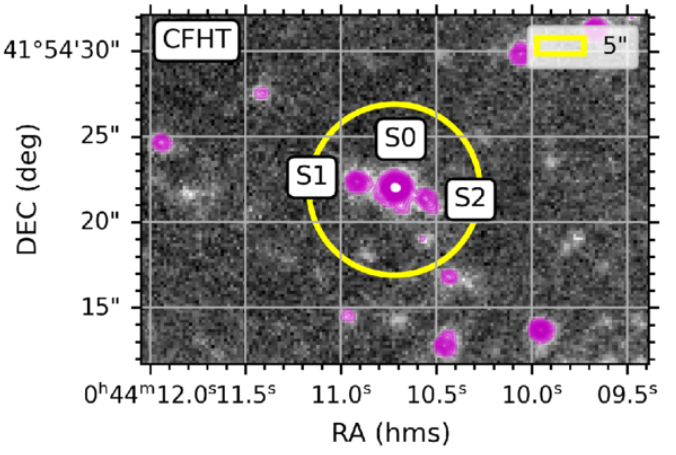
Optical image showing the location of sources near the location of M31N 2017-01e. The yellow circle corresponds to a radius of 5 arcseconds and is centered on the nova. Labeled S0, the source coincides with the location of the nova with sub-arcsecond resolution. Click to enlarge. [Modified from Chamoli et al 2025]

Dialing In on M31N 2017-01e

Aiming to constrain the nature and companion star of the nova, Shatakshi Chamoli (Indian Institute of Astrophysics and Pondicherry University) and collaborators performed a multiwavelength analysis using ultraviolet and optical observations of M31N 2017-01e.

In monitoring the nova during and in between outbursts, the authors identified a source at the reported location of M31N 2017-01e that exhibited variability and color consistent with previous observations of the system. Through a detailed photometric analysis, the authors found that the color and emission properties of the source are consistent with a hot, early-type star as was previously suggested. Though all the observational signs point toward a B-type companion, there’s one glaring obstacle to that scenario: such a massive star would typically be unable to transfer the amount of mass necessary to fuel the nova’s frequent eruptions without the accretion becoming unstable.

Be a Companion

What else, then, could the companion be? The authors considered another stellar companion known as a Be star — a rapidly rotating, early-type star that occasionally hosts a disk of loose stellar material. With a blue color and spectral features similar to B-type stars, a Be star could match the observational properties of the nova’s companion while solving the problem of its accretion. Outbursts of M31N 2017-01e likely arise due to the white dwarf lying very near or within the Be star’s circumstellar disk, siphoning material and adequately fueling the system’s recurring eruptions. To confirm this hypothesis, researchers will need to perform follow-up infrared observations to search for the tell-tale signs of a dusty disk around the companion star. 

This system is rare and challenges the assumed properties of recurrent novae. From this study, it is clear that nova progenitors are potentially quite diverse and require further multiwavelength observational programs to identify more systems like M31N 2017-01e.

Citation

“Challenging Classical Paradigms: Recurrent Nova M31N 2017-01e, a BeWD System in M31?” Shatakshi Chamoli et al 2025 ApJ 991 174. doi:10.3847/1538-4357/adf843

The post Rapid Recurrent Nova May Be Challenging Perceptions appeared first on AAS Nova.
Planetary Hide and Seek

1 October 2025 at 17:00

illustration of a planetary system

Editor’s Note: Astrobites is a graduate-student-run organization that digests astrophysical literature for undergraduate students. As part of the partnership between the AAS and astrobites, we occasionally repost astrobites content here at AAS Nova. We hope you enjoy this post from astrobites; the original can be viewed at astrobites.org.

Title: The Gap–Giant Association: Are Planets Hiding in the Gaps?
Authors: Caleb Lammers and Joshua Winn
Authors’ Institutions: Princeton University
Status: Published in ApJ

The Kepler space telescope played an almost decade-long game of hide-and-seek. After nine and a half years of operation, Kepler detected more than 2,700 planets outside of our solar system primarily by using the transit method, which is particularly efficient at detecting planets that orbit close to their host stars. Astronomers have also been detecting planets with the radial velocity technique, which is better at finding larger planets at longer orbital periods. By looking for planets with both the transit and radial velocity techniques, astronomers can look for both close-in and far-out planets to paint a more complete picture of other solar systems in our galaxy.

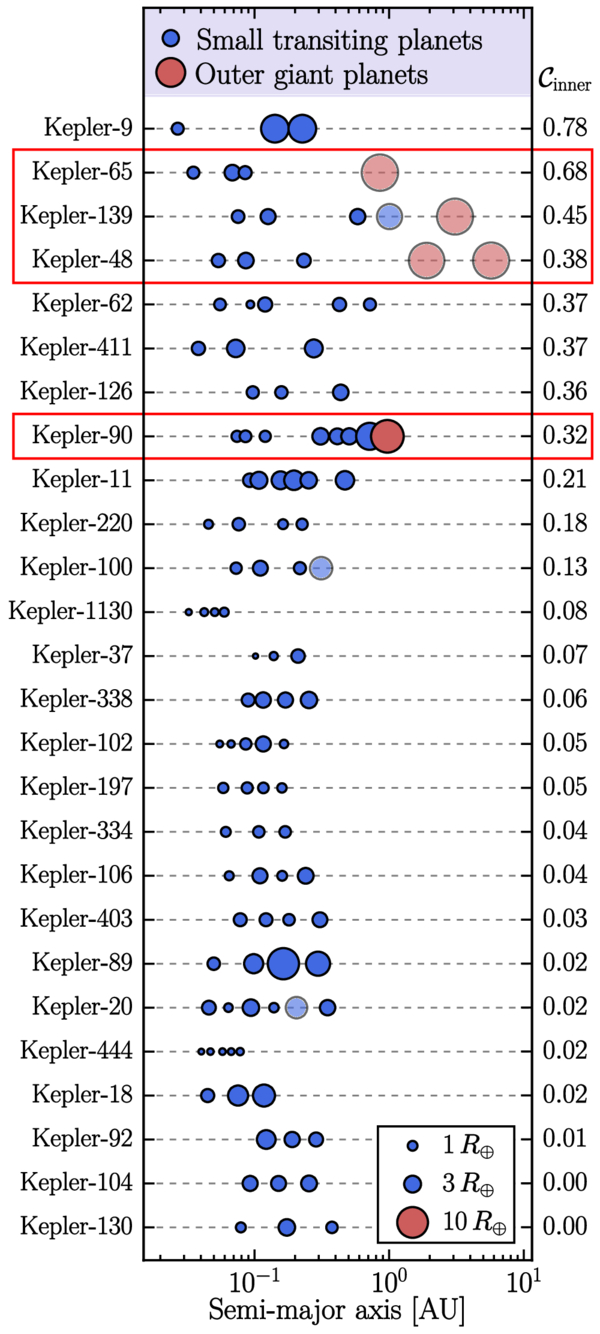
Using the Kepler Giant Planet Survey, the authors of today’s article found that among the 26 systems with three or more transiting planets, four were found to also have an outer giant planet. They quickly noticed that instead of an evenly spaced out inner system of planets, every single one of these four systems with the outer giant planets revealed a notable gap between two of their inner planets. They dubbed this phenomenon the “gap–giant association” — in other words, when an outer giant planet exists in a planetary system, there is evidence of a large gap between two of the inner planets, as shown in Figure 1. This pattern has been observed before, but there has been little theoretical work to explain the effects of outer giants on orbital spacings. In today’s article, the authors ask the question: are there planets inside the gap hiding from us? To address this, they conduct simulations to see if (a) these systems can host a hiding planet in their gaps without becoming dynamically unstable and (b) if such a planet can remain hidden when looked for with the transit method.

Plot of the orbital spacing of planets

Figure 1: Orbital spacings of systems in the Kepler Giant Planet Survey with three or more transiting planets in the inner planetary system. The parameter C is a metric denoting the regularity of orbital spacings, where a smaller value would indicate a more uniform spacing. The four systems of interest all have large orbital gaps between two adjacent inner planets, and therefore high values of C. [Lammers & Winn 2025]

Close Your Eyes and Count to N

The authors of today’s article model these four systems (Kepler-48, Kepler-65, Kepler-90, and Kepler-139) with a planet added to their gaps and use an N-body simulation (i.e., fancy physics calculations that track how planets gravitationally interact) to evolve the systems over time and evaluate their long-term stability. They find that each of these injected planets has a high survival rate, which means that each of these four systems could stably host an additional ~2–20 Earth-mass planet in its gap for billions of years without falling apart. The authors then calculated whether the outer giants could “hide” these theoretical gap planets by tilting the planets’ orbits enough so that they would not be detectable with the transit method. In order to do this, the outer giant would have to exert a large enough gravitational force on the gap planet to cause it to precess at a rate independent of its neighbors, allowing its orbital inclination to grow. However, they found that the outer giant planets are either too far away or not massive enough to do the job.

Only one system, Kepler-90, has an outer giant that could potentially tilt the gap planet’s orbit enough for it to fly under the radar if the giant were also on a modestly inclined orbit. However, previous detections of Kepler-90’s outer giant suggest that its orbit is well-aligned with those of the inner system, making this hypothesis implausible. They therefore concluded that it is unlikely that planets between ~2 and 20 Earth masses are hiding within these gaps.

Seeking Out Another Option

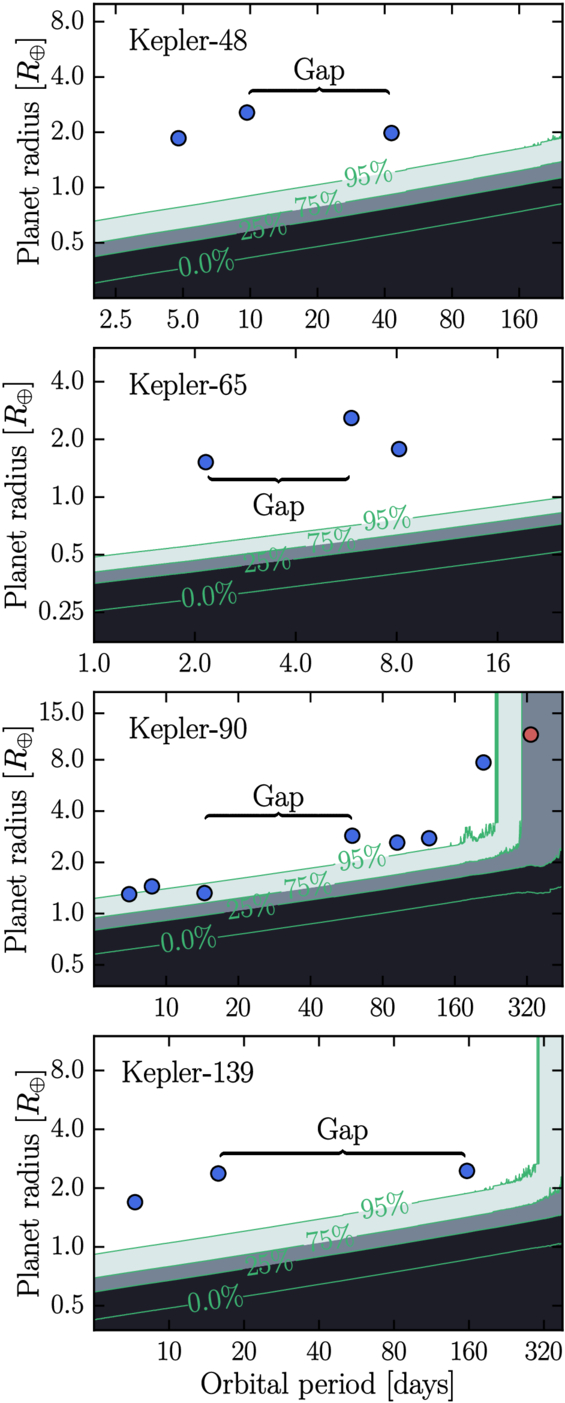
Before completely abandoning this hypothesis, the authors propose that maybe the gaps do contain planets, but they’re just too small for Kepler to detect. They calculate the detection efficiencies as a function of planet radius and orbital period for each of the four systems and find that planets smaller than about ~0.5–1 Earth radius could have gone unnoticed (as shown in Figure 2). While this would make these systems slightly unusual (most multiplanetary systems have relatively uniform planet sizes), it’s not completely impossible. However, they don’t rule out the possibility that these gaps are truly empty, and that the presence of an outer giant could prevent planets from forming in certain regions or disrupt their orbits after formation. While it is hard to draw any firm conclusions with a sample size of four systems, this study highlights how much we still don’t understand about planetary system architecture, and therefore planetary formation and evolution.

Plots of transit detection efficiency as a function of planetary radius and orbital period

Figure 2: Transit detection efficiency as a function of planetary radius and orbital period for each planetary system. The inner planets and location of the gap are overplotted. The darker contours show regions where Kepler is not sensitive to detecting planets. In order to avoid detection, the planets in each of these systems would have to be much smaller relative to their neighbors, except for the Kepler-90 system, where a hidden planet would only have to be marginally smaller. This suggests that there could exist a demographic of exoplanets that are evading detection within these gaps. [Lammers & Winn 2025]

Though the Kepler mission has come to an end, ongoing radial velocity surveys will continue to expand the sample of systems like these four so astronomers can get a clearer picture of what’s behind this gap–giant association.

Original astrobite edited by Annelia Anderson.

About the author, Tori Bonidie:

I am a 5th-year PhD candidate studying exoplanet atmospheres at the University of Pittsburgh. Prior to this, I earned my BA in astrophysics at Franklin and Marshall College where I worked on pulsar detection as a member of NANOGrav. In my free time you can find me cooking, napping with my cat, or reading STEMinist romcoms!

The post Planetary Hide and Seek appeared first on AAS Nova.

From Globs to Gravitational Waves: A Simulated Cosmic Choreography

25 August 2025 at 17:00

Messier 13

Editor’s Note: Astrobites is a graduate-student-run organization that digests astrophysical literature for undergraduate students. As part of the partnership between the AAS and astrobites, we occasionally repost astrobites content here at AAS Nova. We hope you enjoy this post from astrobites; the original can be viewed at astrobites.org.

Title: Formation and Evolution of Compact Binaries Containing Intermediate-Mass Black Holes in Dense Star Clusters
Authors: Seungjae Lee et al.
First Author’s Institution: Seoul National University
Status: Published in ApJ

A delicate dance goes on in astronomy between theory and observation. Most astronomy research, by and large, fits into one of two categories. In one category, you start with a theory, model, or simulation, and attempt to figure out what observations you might expect given those initial assumptions. The other approach begins with raw data and attempts to determine what kinds of theories, models, and fundamental astrophysical assumptions might give rise to it. Accepted knowledge usually happens when these two approaches agree and reinforce each other, but a lot of the actual science occurs when one side dances ahead of the other — either we have theories and models that make predictions that cannot yet be observationally tested, or we have data that defy attempts at fitting underlying models.

Another dynamical dance goes on in globular clusters between binary black holes. Today’s article investigates intermediate-mass black holes, or IMBHs, a pristine example of an astronomical topic in which theory has danced ahead of observations. IMBHs fill the gap between stellar mass and supermassive black holes. We can observe black holes in multiple ways, usually from the electromagnetic radiation of the gas disks surrounding some black holes (either stellar or supermassive), or the gravitational waves of two orbiting or merging black holes. Unfortunately, each method requires some extra component — either gas to accrete or a companion to orbit — and IMBHs are far more challenging to observe through these methods. Hence, we have a lot of ideas about how they might form, and scarce observational evidence for their existence.

That hasn’t stopped many researchers from trying to make better models and predictions. One of the most commonly proposed mechanisms for forming IMBHs is in dense globular or nuclear star clusters (up to a million times denser than our region of the Milky Way). In these dense environments, stars and the black holes they produce might have a chance to find and run into each other often enough to reach the masses of the IMBH regime through mergers. Today’s authors use a series of N-body simulations to study these dense stellar clusters, into which they embed IMBHs. Their study investigates the detectability of gravitational waves from intermediate-mass-ratio inspirals (IMRIs). Because so many mergers occur in dense clusters, it allows for more mergers between objects with greater mass differences. The mass ratio between the two objects (usually denoted as ‘q’) is one of the most important parameters for characterizing a merger, and a high q value creates a gravitational wave signature that is different from a low q, even if the total mass of the system is the same.

To investigate the formation and detectability of IMRIs, the authors conducted a suite of direct N-body simulations of star clusters with total masses between 5×10⁴ and 105 solar masses, containing ~105 particles. They include initial conditions for how densely packed the particles should be, given how far they are from the cluster’s center (called a Plummer profile). They also include a rule for how the initial masses of the stars are distributed (called a Kroupa initial mass function). Then, they use a code called Stellar EVolution for N-body (SEVN) to follow the evolution of the stars in the system for 100 million years.

In that time, massive stars in the simulation can evolve into neutron stars and stellar-mass black holes. In addition to simulating the clusters’ stars, the authors embed an IMBH of 300–5,000 solar masses into the clusters. The key to this article is that some of the stellar-mass binary black holes will interact with the IMBH, creating an IMRI, which gives off gravitational waves. This article’s primary goal is to characterize these IMRIs and to test how well current and future gravitational wave detectors will measure them.

In the simulation, when a stellar-mass binary black hole and an IMBH come close, the authors must create a “merger criterion” — essentially, how it is decided whether the two objects merge, and what the subsequent “gravitational wave” would look like. Once they model the wave itself, they turn to five current or future detectors to see how well they will measure those waves if they were at particular astronomical distances from Earth.

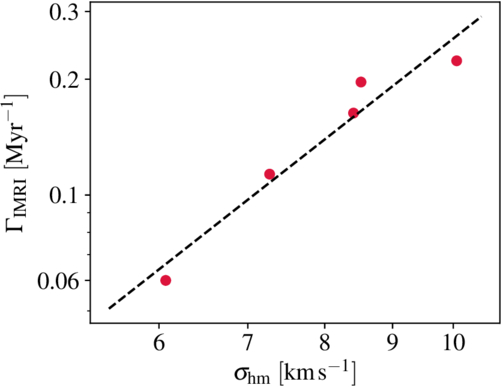
One of the primary relationships the authors look at in the cluster is the half-mass radius velocity dispersion of the cluster and the number of IMRI encounters between the IMBH and stellar-mass objects. One can think of the velocity dispersion as a more complicated “average velocity” of the stars in the cluster (a high velocity dispersion means, on average, the stars are moving faster, the half-mass radius is the distance from center that separates the inner half of the stars and outer half of the stars, and we use it because it is more representative of stellar motion in the overall cluster than the packed center or the mellow edge). Figure 1 shows the relationship between the number of IMRI events (y-axis) vs. the velocity dispersion (x-axis) of the cluster where the IMBH sits. Note that the y-axis is logarithmic, so a small increase in velocity dispersion actually results in a large increase in the number of IMRIs. This tells us that the number of events is much more dependent on the properties of the larger cluster than the IMBH itself.

plot of IMRI event rate as a function of cluster half-mass velocity dispersio

Figure 1: IMRI event rate as a function of cluster half-mass velocity dispersion (σhm) for 1,000-solar-mass IMBHs in the simulations. The IMRI merger rate is highly sensitive to the velocity dispersion of the cluster as a whole, making it a key observable of how efficiently IMRIs can form and merge in a given cluster. [Lee et al. 2025]

In addition to analyzing the dynamics of the clusters and the mergers within them, the authors go further and attempt to characterize what specific detectors will see. They chose five detectors. The first is advanced LIGO (aLIGO), the current incarnation of the LIGO detector network. Next is the Einstein Telescope (ET), a future proposed European ground-based detector. Following that is the Laser Interferometer Space Antenna (LISA), a space-based detector set to launch in the 2030s that is designed to observe supermassive black hole mergers. Next are two detectors that are less established, the advanced Superconducting Omni-directional Gravitational Radiation Observatory (aSOGRO) and the Deci-hertz Interferometer Gravitational Wave Observatory (DECIGO). aSOGRO is a proposed Earth-based detector that could theoretically measure gravitational waves at lower frequencies than the current LIGO-Virgo-KAGRA (LVK) detectors, and DECIGO is a proposed space-based detector designed to observe gravitational waves in the frequency range between the LVK network and LISA.

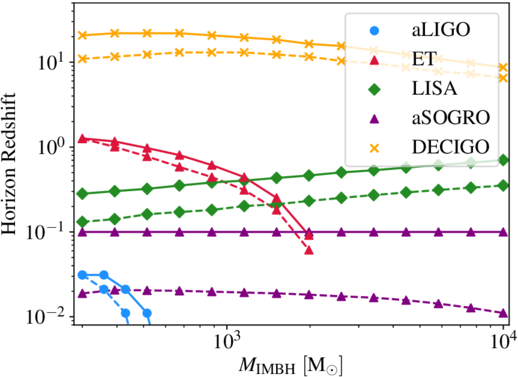
How do the authors translate the gravitational wave signal from the IMRI into what might be observed on Earth? First, they must pick a signal-to-noise ratio threshold, which is the ratio of the gravitational wave signal to the background noise in the detector. In this case, they chose a signal-to-noise ratio of 8, a commonly chosen threshold in the gravitational wave literature. From the signal-to-noise ratio, the authors can calculate a horizon distance. The horizon distance is the distance that a detector can measure a specific gravitational wave event with a given set of properties at or above the threshold chosen. Figure 2 shows the horizon distances (y-axis) for each detector for sets of gravitational wave sources with different properties vs. the mass of the IMBH generating the gravitational wave (x-axis). The solid and dotted lines represent two chosen masses of the IMBH’s stellar-mass companion. The figure shows that aLIGO (blue circles) can detect only low-mass IMBHs (≲ 300 solar masses) at a redshift of z ≲ 0.05. ET (red triangles) is sensitive to lower-mass IMBHs, and LISA (green diamonds) excels at detecting higher-mass IMBHs. aSORGO (purple triangles) covers a broad mass range but at lower redshifts. DECIGO (yellow Xs) offers the broadest mass range at the highest redshift.

plot of horizon redshift versus intermediate-mass black hole mass

Figure 2: Horizon redshift vs. IMBH mass for several gravitational wave observatories (aLIGo represented by blue circles, ET by red triangles, LISA by green diamonds, aSOGRO by purple triangles, and DECIGO by yellow x‘s). Solid vs. dotted lines represent the mass of the stellar-mass black hole interacting with the IMBH, with the dashed line representing a 10-solar-mass companion and the solid lines representing a 60-solar-mass companion. [Lee et al. 2025]

Today’s authors offer a glimpse into globular clusters as dynamic environments where we might see IMRIs. They also predict how those signals might be received by our current, future, and proposed gravitational wave detectors. As next-generation observatories prepare to listen for these cosmic mergers, this work helps chart a path for where and how we might first detect the elusive IMBH.

Original astrobite edited by Kasper Zoellner.

About the author, William Smith:

Bill is a graduate student in the astrophysics program at Vanderbilt University. He studies gravitational wave populations with a focus on how these populations can help inform cosmology as part of the LIGO Scientific Collaboration. Outside of astrophysics, he also enjoys swimming semi-competitively, music and dancing, cooking, and making the academy a better place for people to live and work.

The post From Globs to Gravitational Waves: A Simulated Cosmic Choreography appeared first on AAS Nova.

GitHub adds new Copilot features as usage-based billing takes effect

5 June 2026 at 18:32

GitHub is expanding Copilot beyond the IDE with a new desktop application and a new collaborative work surface called canvas as part of its broader efforts to pitch the AI-assisted coding tool as the control center for agent-native software development.

The desktop application announced at Microsoft’s annual Build conference this week is designed to give developers a dedicated environment for working with AI agents throughout the software development lifecycle, rather than limiting those interactions to code-generation tasks inside an editor, the company wrote in a blog post.

The application includes a collaborative workspace called canvas where developers can brainstorm ideas, refine requirements, generate plans, and iterate on projects alongside AI, it said.

It also has new Agent Merge and code review features that enable developers to automate Copilot to combine tasks of different agents to complete a specific goal or conduct autonomous code reviews according to set standards, it said.

These new features could reduce context switching, increase engineering efficiency, and accelerate delivery cycles, said Phil Fersht, CEO of HFS Research.

Shift in pricing justified?

However, despite the new features, much of the conversation among developers in recent weeks has centered on a different topic: this week’s shift to a usage-based billing model for GitHub Copilot that it announced in April.

The changes were met with a wave of criticism on the GitHub community forum, where some users accused the company of a “bait and switch,” while others requested refunds or announced plans to cancel their subscriptions.

For analysts, though, the pricing change was, at least from GitHub’s point of view, necessary and justified.

“The pricing change is justified by where GitHub is going, not by where the product is today. Running multiple agents in parallel with sandboxes, canvas reviews, and Agent Merge looping through CI is closer to cloud compute than an IDE plugin, and you cannot price compute on a flat seat fee. So metered billing is the right call structurally,” said Advait Patel, a senior reliability engineer at Broadcom.

Fersht said developers and CIOs need to focus on Copilot’s metamorphosis from being a coding assistant into a platform for orchestrating software-development agents and workflows.

“That changes the ROI conversation significantly. CIOs should stop thinking about Copilot as a seat-license productivity tool and instead evaluate it as an AI-powered software delivery platform,” he said. “The metrics shift from ‘lines of code generated’ to broader operational outcomes such as release velocity, code quality, defect reduction and engineering efficiency.”

GitHub is not the first company offering vibe-coding tools to rethink its pricing strategy as AI agents proliferate across enterprises and evolve to take on more complex software-development tasks that are computationally more intensive.

Over the past year, platforms such as Claude Code, Replit, Cursor, and Kiro have repeatedly adjusted their pricing structures to account for mounting infrastructure costs, limited GPU availability, and the expense of serving increasingly sophisticated AI models and agents, despite furor among their users.

For CIOs, the challenge is proving ROI

That common pressure across AI coding vendors is why Amit Chandak, chief analytics officer at IT consulting firm Kanerika, thinks developers and CIOs should focus less on GitHub’s pricing mechanics and more on whether these increasingly capable tools are delivering measurable business value.

“The new features that GitHub announced can act as productivity multipliers as well as features that increase consumption without delivering proportional business value. Without productivity baselines established before adoption, enterprises risk absorbing higher costs with no clear line back to delivered value,” Chandak said.

For Fersht, developers and CIOs will need to focus on governance, monitoring and financial controls as the pricing model is changing.

“The governance challenge is very real. Autonomous agents can continuously reason, test, revise and interact with multiple systems in ways that create far less predictable consumption patterns than traditional SaaS tools,” he said.

Patel, however, advised users and decision-makers to be more skeptical, especially since the new features are currently in technical preview.

“Customers are being asked to pay variable rates now for value that has not been validated in production. Do not assume new capabilities justify higher spend,” he said. “Instead, run a 90 day pilot, measure PRs merged per dollar before and after, and let the data decide. If the ratio improves, the pricing is fair. If it does not, you are paying for promise, not delivery,” Patel added.

Hole in GitHub’s browser-based VSCode editor could lead to stolen token

4 June 2026 at 02:35

A vulnerability in GitHub’s browser-based VSCode editor could lead to the theft of a developer’s token under certain circumstances, says a researcher.

The issue, revealed this week in a blog by Ammar Askar, has apparently been already addressed by GitHub owner Microsoft. But it raises a questions about both DevOps security, and about the researcher’s allegation that, because Microsoft doesn’t treat bug discoveries seriously, he can justify giving it short notice before openly publishing vulnerabilities he finds.

First, the bug: Users of github.com may not realize it, but when they are on any repository, they can shift to github.dev and its browser-based version of VSCode just by changing the URL.

Why do this? Because the browser instance of VSCode is pretty powerful, Askar says in his blog. “You can view all the files in the repo (even if it’s a private one), you can send out pull requests, and even make commits.”

Rob Enderle, a IT consultant who heads the Enderle Group, agrees that jumping into VSCode this way is “an incredibly useful tactical tool for quick tasks. By just hitting the ‘.’ key in any GitHub repo, you instantly get a browser-based VS Code interface without having to clone gigabytes of data locally. It’s perfect for rapid PR reviews, quick documentation edits, or navigating code on the fly without breaking your workflow. Just keep in mind that it runs entirely in the browser sandbox; there’s no compute backend, no terminal, and no code execution.”

For any heavy lifting or actual compiling, he added, the developer will still need the raw compute of a local workstation, or a full cloud environment like Codespaces.

The problem, Askar says, is that this functionality is achieved by github.com POSTing over an OAuth token to github.dev that allows it to interact with GitHub on your behalf. “The token is not scoped to the particular repo you interacted with, meaning it has full access to every other repo that you have access to,” he wrote in the blog.

“The presence of this token, and the fact that this web app is running almost the entire brunt of VSCode’s million line Typescript codebase, makes it a great target for anyone looking into VSCode bugs,” he wrote.

The exploit

Askar said that a threat actor could install an extension in a repository using a Jupyter notebook, a web application for creating and sharing computational documents that has the ability to install a malicious local workspace extension while skipping the publisher trust check. In his proof of concept, Askar said that once his payload runs, the newly installed extension will grab the GitHub API token, run a query to get the private repos the developer has access to, and then print out the replies and the token.

This vulnerability also exists in the desktop version of VSCode, Askar said, though it’s harder to exploit, since a threat actor would need to convince the victim to clone their repo and open the notebook containing the webview script payload. “Of course,” he added, “if you [the hacker] had some other XSS [cross-site scripting attack] in a webview that you can get a victim to open, you get effectively full RCE [remote code execution] on their computer.”

In an email, he said this vulnerability was “about as serious as it gets. Any website on the internet could have redirected you to a github.dev link that could have provided an attacker a token to read and modify your code repos. If one could convince the maintainer of a popular software project to click a link, they could have made whatever modifications they wanted to their project.”

This means, said Enderle, “we have to start treating developer endpoints with strict, isolated, zero-trust parameters, because we clearly cannot rely on vendor complacency to protect us.”

This issue reinforces the point that you should never follow any links unless you know exactly where they will take you, added Dwayne McDaniel, principal developer advocate at GitGuardian.

Short notice

Here’s where things get complicated. Because of an unhappy experience when disclosing a previous VSCode vulnerability to Microsoft — the bug was fixed, but Askar wasn’t given credit — this time he only gave GitHub one hour notice that this new discovery was going to be published. Microsoft applied what Askar calls a “stopgap” fix by adding a confirmation when a developer opens notebooks in web VSCode, and by not allowing the trusted publisher requirement to be skipped by commands.

[Related content: When responsible disclosure becomes unpaid labor]

An ethical question

Askar’s short notice raises an ethical question: How far in advance should a responsible researcher give notice to a vendor about a vulnerability before publicly revealing it?

These days, most infosec pros agree that notice must be given, or else a threat actor can quickly exploit a hole. Not only that, but the researcher risks damage to their reputation if reasonable notice isn’t given. Experienced researchers often give vendors at least 30 days to create and distribute a patch.

For their part, vendors often create bug bounty programs, or partner with bug bounty programs, to reward researchers for their work. Unfortunately, some vendors don’t always credit researchers, or downplay the damage a vulnerability can cause. In fact, last month Microsoft and a prominent cybersecurity researcher got into a public spat about one such alleged incident.

An imbalance of power

Asked for comment about Askar’s most recent discovery, a Microsoft spokesperson said, “we value the critical role that the security research community plays in strengthening the security of our products, services, and the broader technology ecosystem. While independent researchers determine when and how to publish their findings, we remain committed to rapidly assessing reported issues, mobilizing the appropriate engineering and security response resources, and delivering mitigations, guidance, and protections as quickly as possible to help safeguard our customers.”

The spokesperson added that the issue Askar reported “has been mitigated for our services and no customer action is required.”

[Related content: Is the vulnerability disclosure process glitched?]

There is a balance between coordinating disclosure with a software vendor (CVD) and full disclosure, Askar told us. But, he added, there’s an imbalance of power. “A security researcher can pour countless hours into an issue, ensuring they develop a good proof of concept and provide all the steps to recreate the issue. With this, they hope to at least get an acknowledgement for their efforts, which they can use to further their security track record or, in the best case, a monetary bounty reward.”

However, he added, “If security vendors don’t adhere to their side of the bargain, public disclosure is one of the few options security researchers have (if they don’t want to sit on their vulnerabilities or sell them on the black market). It forces the vendor to acknowledge the security issue publicly and usually leads to a much faster resolution than any private communication would.”

This, said Enderle, creates problems for enterprises: “When vendor bureaucracy penalizes responsible disclosure, it alienates the security community and forces public zero-day drops, ultimately leaving enterprise customers holding the bag.”

❌