❌

Normal view

Siloton secures £8.4m to speed development of portable retinal imaging system

16 October 2026 at 14:30

UK medical technology start-up Siloton has been awarded an £8.4 million contract to accelerate the development of its portable eye imaging system. Based on optical coherence tomography (OCT), the company’s GiraffeOCT device generates detailed retinal images for detection and monitoring of a range of treatable eye diseases.

OCT is a non-invasive optical technique that creates high-resolution, depth-resolved images of biological tissue. While OCT is the clinical gold standard for diagnosing retinal diseases, existing systems are large and expensive and typically only available in hospitals and optometry clinics. By using photonic chip technology to shrink the bulky optical components onto a single coin-sized chip, Siloton is developing an easy-to-use, handheld binocular-style system.

The contract, from Innovate UK, will massively accelerate development of both the in-clinic GiraffeOCT system and the at-home version, which will have built-in automation and guidance so that users can reliably image themselves. “The contract will reduce the time to market for the medical device by one to two years,” says Alasdair Price, CEO of Siloton. “It will also allow us to grow the company, bringing in new skills around manufacturing and regulation, both of which are critical to the next stage of the business.”

Continuing clinical trials

In 2024, Siloton was the first commercial organization to demonstrate sub-surface imaging of a human retina, using its first-generation Akepa OCT photonic chip. The following year, the company trialled its device with patients for the first time, imaging their retinas to identify the presence and progression of age-related macular degeneration (AMD). Testing continued as the system developed, with a second cohort of patients imaged earlier this year.

In addition, the Project Ginan consortium in Australia has purchased a GiraffeOCT research system and independently evaluated its retinal imaging performance with a group of healthy volunteers.

Over the course of the two-year Innovate UK contract, Siloton will work with Sunderland Specialist Eye Hospital in the UK to perform clinical trials of the in-clinic device, giving patients access to the technology during its development. “These trials will be based around the prototype for the full medical device, providing additional post-processing and improved ergonomics compared to our research-use only product line,” Price explains.

The funding will also support the development and internal testing of Siloton’s second-generation CheetahOCT system, a research-use device that will measure different layers of the retina, expanding the number of conditions that it can detect. CheetahOCT incorporates the company’s second‑generation BlueJay chip – the same architecture used in the system that Siloton is building for astronauts – and will be available from early 2027.

“The image performance will be significantly improved, increasing the number of biomarkers that it can be used to measure. This means you will be able see more of the eye and in finer detail,” Price tells Physics World. “CheetahOCT will also be much more compact, as we continue to miniaturize other parts of the system that fall outside the photonic chip.”

The post Siloton secures £8.4m to speed development of portable retinal imaging system appeared first on Physics World.

Una carta de 1571 descubierta en Budapest confirma la autenticidad del misterioso Códice Rohonc y revela que el escriba que lo redactó estaba aterrorizado

14 October 2026 at 19:06
Hay manuscritos medievales que nadie sabe leer y hay uno, el manuscrito Voynich, que se ha vuelto casi una marca registrada del misterio. Guardado en la Universidad de Yale y fechado en el siglo XV, ha servido de inspiración para novelas y teorías de todo tipo. Pero existe otro libro que los especialistas suelen colocar […]

Miniature microprobe enables internal imaging of smaller blood vessels than ever before

23 September 2026 at 09:00

Cardiovascular disease is the leading cause of death globally, with atherosclerotic disease – caused by the build-up of fatty plaques in the arteries – responsible for around three-quarters of these deaths. Modern intravascular imaging allows us to see these fatty plaque build-ups in detailed cross sections, revolutionizing atherosclerosis diagnosis and treatment planning. A research team in China is pushing this imaging technique to smaller blood vessels and higher resolution than ever before. Their approach could even enable imaging of the cerebrovasculature – the network of tiny vessels within the brain.

Intravascular optical coherence tomography (IV-OCT) uses near-infrared light emitted and received at the end of a catheter to image the walls and texture of the blood vessel. It works by comparing the wavelength and phase offset of reflected light from tissues with reference light reflected from a mirror, with 360° sensor rotation generated by electromagnetic motors.

The two most common designs of OCT catheters are proximal (where rotational force is generated outside of the body) and distal (with rotational force generated by a small motor inside the catheter). However, proximal systems suffer from friction-induced rotational distortion in smaller vessels, while distal scans are blocked from full 360° vison by wire artefacts.

Size is a major limitation in IV-OCT imaging. The catheters traditionally used are around 2 mm in diameter and perform optimally in vessels of 10 mm in diameter – medium/large arteries in the body. This diameter is limited by the size of electromagnetic motors needed to induce the sensor rotation and the wiring of these motors.

In this latest work, the researchers – led by Dawei Wu at Nanjing University of Aeronautics and Astronautics and Rui Liu at Nanjing University Medical School – show that it is possible to make a tiny 0.55 mm diameter probe, optimal for imaging 2 mm vessels, whilst retaining 360° field-of-view. The piezoelectric microprobe achieves this small size, and resolves both the rotational distortion and limited field-of-view difficulties, by exploiting a functionally different miniature drive mechanism.

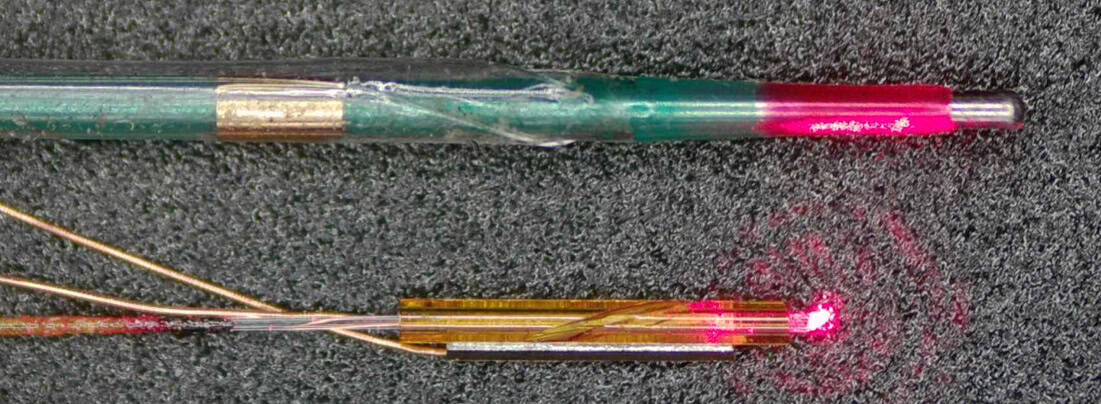
A piezoelectric micro probe and a commercial balloon dilatation catheter
Dimension comparison The piezoelectric micro-optical probe (bottom) and a commercial balloon dilatation catheter (top). (Courtesy: Dawei Wu, Nanjing University of Aeronautics and Astronautics)

The microprobe uses a single-phase AC circuit and piezoelectric crystal to vibrate a glass tube. A 10° groove in the glass translates this longitudinal vibration into torsional vibration, thus generating elliptical motion of the lens in a similar way to a crank and slider. When AC voltage is applied, the piezoelectric crystal expands and contracts and the lens rotates, thereby producing the required optical scanning.

Device testing

First author Boquan Wang and colleagues first tested whether their probe reduces rotational distortion by imaging metal tubes arranged around a small, curved vessel. The probe was able to scan the tubes at 50 revolutions per second while maintaining angular deviation of just 1° – a significant improvement compared with the 9° found in traditional proximal IV-OCT catheters. They note that this test also demonstrated the probe’s full 360° field-of-view and that the single-phase voltage required to rotate the lens meant that the wiring was minimal.

The researchers confirmed the probe’s ability to navigate and image small vessels via successful tests on leaf microveins, a vascular stent and ex vivo pig vessels. In an important milestone in assessing the suitability of the probe for imaging the cerebrovascular system, the probe successfully traversed through a full-scale human vascular model to reach the middle cerebral artery.

Finally, to verify the efficacy of the probe in identifying pathological lesions, the team compared images of human plaques acquired by the probe with histological analyses. The OCT and histology findings agreed well in identifying locations of plaque rupture sites and regions high in collagen fibres.

Why does this matter?

By putting a novel miniature rotational motor directly inside the probe and powering it with a single-phase AC circuit, the team created a probe that’s smaller than traditional IV-OCT probes and eliminates rotational torsion artefacts while achieving full 360° imaging.

Importantly, the improved catheter navigation could allow access to high-resolution images of the structure of arterial walls in smaller, more curved vessels than is currently possible clinically. This opens the door to assessment of plaque pathology and planning of stent positions in the heart–brain system.

“Although the probe would need more development and testing to be used clinically, intravascular OCT could one day give physicians a much closer look at what is happening inside the small arteries of the brain,” says Wu in a press statement.

The researchers describe the microprobe in Biomedical Optics Express.

The post Miniature microprobe enables internal imaging of smaller blood vessels than ever before appeared first on Physics World.

New Scale Reveals How Culture Shapes What We Call Child Abuse

11 October 2026 at 09:09

Where is the line between firm discipline and child abuse? For millions of families in the United States, the answer depends on where they grew up, what their parents did, and how their culture defines good parenting. A new study published in the Journal of Child and Family Studies tackles this thorny question with an ambitious goal: building a scientific instrument that can measure how people from different backgrounds judge parenting practices that are accepted in some communities but condemned in others. The Parenting Practices and Discipline Scale, or PPDS, developed by Kevin Ortiz Diaz, Maureen C. Kenny, and Helia Baez at Florida International University, is one of the first tools designed specifically to capture culturally situated discipline practices that existing measures simply ignore.

The stakes are enormous. Child abuse is recognized as a global health issue, and in the United States it occurs at what researchers describe as epidemic proportions. Federal data show 546,159 victims of child abuse and neglect in 2023 alone, and the vast majority of these cases, roughly 89 percent, are committed by one or both parents. Children from minority groups are often the most affected, with Black or African American children among the most likely to experience abuse, second only to American Indian or Alaska Native children. Yet the definitions of what constitutes abuse vary dramatically across countries and cultures, creating a legal and ethical minefield for immigrant families who may not realize that practices considered normal at home are illegal in their new country.

The problem is particularly acute for Hispanic families, who make up 19 percent of the American population and represent the largest share of recent immigrants. Hispanic culture is far from monolithic, encompassing communities from South and Central America and the Caribbean with distinct traditions, but certain common threads run through the research. The concept of familismo, a cultural orientation and sense of obligation to family, has been linked to greater parental warmth in some studies. At the same time, physical violence as a disciplinary method remains common in many Hispanic cultures, and the chances that such behaviors are carried over by families immigrating to the United States are high. The result is a potential collision between generations of cultural practice and a legal system, anchored by the Child Abuse Prevention and Treatment Act of 1974, that defines abuse in terms of serious physical or emotional harm.

What makes the new study distinctive is its grounding in intersectionality theory, a framework rooted in feminist scholarship that examines how multiple categories of identity, such as race, ethnicity, gender, and nativity, interact to shape experience. Rather than treating demographic characteristics as independent variables, the researchers designed their analyses to test whether these dimensions jointly predict how individuals classify discipline practices as culturally acceptable or abusive. The framework has practical urgency: racial and ethnic disparities exist in both the reporting and substantiation of child maltreatment, and current child protection policies can disproportionately affect women of color who use social services and face heightened surveillance and risk of reports to child protective services.

The scale itself emerged from a careful two-stage piloting process. First, four experienced mental health clinicians specializing in child abuse, with 10 to 20 years of experience each, reviewed a draft pool of 54 items describing parenting behaviors and case vignettes. Then ten first-generation Hispanic immigrants from a range of nationalities, including Puerto Rican, Cuban, Colombian, Mexican, Dominican, and Nicaraguan participants, examined the refined items and identified which behaviors they would associate with parents in their own cultures and whether they would label those behaviors abusive or acceptable. Consensus required agreement from at least 70 percent of the pilot group. Eighteen items survived, ten identified as culturally acceptable behaviors such as yelling, using the chancla, the slipper famously wielded in many Latino households, or letting a child sleep with parents, and eight identified as abusive behaviors such as spanking, leaving a child alone in a car, or forcing a child to bathe with an adult.

The main study recruited 1,477 undergraduates at a large Hispanic-Serving Institution in Miami, ultimately yielding an analytic sample of 1,089 participants after exclusions for failed attention checks, missing data, and groups too small for meaningful analysis. The final sample was 72.2 percent Hispanic, 16.3 percent non-Hispanic Black, and 11.6 percent non-Hispanic White, nearly 70 percent U.S.-born, and predominantly female at 88.8 percent. Participants rated each of the 18 behaviors on a three-point scale: not abusive, inappropriate but not abusive, or abusive. The choice of a college population was deliberate, since emerging adults are on the cusp of parenthood, attitudes at this life stage predict later parenting intentions, and parenting practices tend to be transmitted intergenerationally.

Psychometrically, the study unfolded in two parts. Study 1 established the scale’s initial properties using exploratory factor analysis with principal axis factoring and oblique rotation on a polychoric correlation matrix, an approach suited to the ordinal, non-normally distributed responses. The analysis supported a two-factor structure: Factor 1 captured discipline and psychological aggression, including spanking, yelling, the chancla, cursing, ignoring, comparing, fighting, and religion, while Factor 2 reflected neglect and physical endangerment, such as using drugs in front of a child, refusing treatment for illness, and allowing smoking. The two factors accounted for 29.5 percent of the variance and were moderately correlated. Internal consistency for the full 18-item measure was acceptable at a Cronbach’s alpha of 0.71, though the abusive subscale showed weaker reliability, a limitation the authors acknowledge candidly.

Study 2 then deployed regression models to test how demographic identities shaped perceptions, and the results were revealing. Gender and parental status emerged as the strongest and most consistent predictors: women and parents were significantly more likely to classify culturally acceptable practices as abusive. Among Hispanic participants, those not born in the United States were more likely than U.S.-born Hispanics to view behaviors like spanking as abusive, a finding that ran counter to the researchers’ hypothesis and suggests that acculturation may shift parenting beliefs toward American child protection norms. Across racial and ethnic groups, Hispanic participants were more likely than Black participants to classify culturally acceptable practices as abusive. Notably, for the more overtly harmful behaviors in Factor 2, parental status was the only significant predictor, suggesting broad agreement that neglecting a sick child or encouraging substance use transcends cultural and gendered expectations.

The effect sizes were small, with the models explaining roughly 1 to 6 percent of the variance, a reminder that unmeasured cultural and contextual factors account for most of the variation in how people judge discipline. Still, the patterns carry real implications for prevention. The authors suggest that father-focused education programs may be valuable, since men were less likely to identify physical discipline as harmful and may therefore be at greater risk of normalizing such practices. Culturally adapted interventions have already shown promise, from brief summer parent training programs benefiting Hispanic children to the multinational Triple P Positive Parenting Program, and the PPDS could help practitioners identify which disciplinary practices are perceived as acceptable within specific communities, allowing messaging to be tailored rather than uniform.

The researchers are careful to frame their findings as preliminary. The sample was heavily female and drawn from a single Miami institution in a minority-majority city, socioeconomic status was not assessed, and social desirability bias may have influenced responses to questions about parenting. The abusive subscale needs refinement, and future work should apply confirmatory factor analysis and measurement invariance testing across cultural groups. Yet the core contribution stands: a novel measure that captures culturally situated discipline practices invisible to existing tools like the Alabama Parenting Questionnaire or the Child Abuse Potential Inventory. As parenting practices pass from generation to generation and families cross borders into legal systems with different rules, understanding exactly how culture shapes perceptions of abuse may be the first step toward protecting children without criminalizing the traditions their parents brought with them.

Subject of Research: Development and validation of a scale measuring cultural perceptions of parenting and discipline practices

Article Title: Development and Validation of the Parenting Practices and Discipline Scale in an Ethnically Diverse Sample

Article References: Ortiz Diaz, K., Kenny, M. C., & Baez, H. (2026). Development and Validation of the Parenting Practices and Discipline Scale in an Ethnically Diverse Sample. Journal of Child and Family Studies. https://doi.org/10.1007/s10826-026-03370-6

Image Credits: AI Generated

DOI: 10.1007/s10826-026-03370-6

Keywords: child abuse, parenting practices, discipline, Hispanic families, intersectionality, psychometrics, scale development, cultural perceptions, child welfare, corporal punishment, acculturation, exploratory factor analysis

MacVoices #26261: Live! – CarPlay and AI, Apple Rethinks Training Data, and WordPress Drama

By: Chuck
21 September 2026 at 22:22
The continuation of AI chatbots arriving in CarPlay, Apple’s opt-in approach to using customer data for AI training, and turmoil surrounding WordPress leadership are the topics for this MacVoices Live! discussion. The conversation also examines Bending Spoons’ latest billion-dollar acquisition, Apple’s international iCloud+ bundles, the potential for services to expand Apple’s global ecosystem, and Michael Dell’s support for new youth investment accounts.

💾

Hurricane Polo Explodes in Pacific, UK Aphid Swarm Wipes Out 30 Million Lettuces, Glasgow Braces for Rubbish Pileup — Today’s Environmental Briefing for Thu, Sep 24 2026

24 September 2026 at 14:00
Satellite view of Hurricane Polo swirling over the Pacific Ocean with visible eye structure

Across the stories today, a common thread emerges: the planet is speaking in signals — some subtle, some deafening — and the question is whether our institutions can listen fast enough to act.

Start with the signals themselves. El Niño has surged to record strength weeks ahead of schedule, and its fingerprints are already visible — from Hurricane Polo’s explosive intensification in the Pacific to the climate volatility rippling through global weather systems. In the UK, an aphid outbreak wiped out 30 million lettuce heads almost overnight, a small but telling example of how shifting conditions can upend food systems in ways no one budgets for. In Malawi, an unexplained weed overgrowth has choked Chia Lagoon, stranding farmers and fishers in flooded fields nearly seven months after the rains should have drained. These aren’t isolated oddities. They’re the planet’s early warning system, written in crop yields and clogged waterways.

Then there’s the human response — uneven, but not absent. Germany’s landmark pledge to phase out fossil fuels by 2045 marks a rare moment of policy catching up to urgency, moving beyond vague “carbon neutrality” language toward something more concrete. The UK’s decision to declassify a once-suppressed intelligence report — warning that climate breakdown is a direct threat to global security — suggests governments are quietly acknowledging what scientists have said for years, even if political will lags behind. And at UN climate talks in New York, amid what The Guardian describes as a genuinely grim mood, solar power’s continued growth offered rare, tangible hope. As Al Gore noted twenty years after An Inconvenient Truth, he’s surprised by the ferocity of fossil fuel pushback — but still believes, cautiously, that the fight can be won.

Behind the numbers are real communities adapting in real time. In the Andes, villagers near Villa de Arma are turning to ancient wetland systems as glaciers they once walked across vanish into bare rock. In Guam, resident Leevin Camacho learned his family’s water contained a pesticide banned since 1987 — a stark reminder that militarization and environmental cost are often intertwined, especially in the Pacific. And in Sarawak, Indigenous communities are still reckoning with displacement from the Bakun megadam three decades later, a cautionary tale as the world races toward a “clean” energy future that doesn’t always ask who pays for it.

It’s a reminder that progress and pressure often arrive together. Endangered birds on South Australia’s Eyre Peninsula won last-minute protection from a rocket launch site — a genuine conservation victory — even as a Norfolk Broads housing levy was quietly slashed, raising fears that environmental safeguards elsewhere are eroding. Meanwhile, olive ridley sea turtles nesting for the first time ever on California beaches offer something rarer: wonder. A signal, too, but one that invites curiosity rather than alarm — proof that the natural world is still capable of surprising us.

As the week unfolds, all eyes will be on whether momentum from Climate Week — bolstered even by a monster from Sesame Street reminding children it’s okay to feel both fear and courage — translates into follow-through. The data, the disasters, and the small human stories all point the same direction: the era of asking “if” is over. What remains is the harder work of “how fast,” and “for whom.”

The post Hurricane Polo Explodes in Pacific, UK Aphid Swarm Wipes Out 30 Million Lettuces, Glasgow Braces for Rubbish Pileup — Today’s Environmental Briefing for Thu, Sep 24 2026 first appeared on EnviroLink Network.

Alzheimer précoce : cette boisson très courante pourrait accélérer le vieillissement de votre cerveau

24 September 2026 at 07:00
Une nouvelle étude révèle les effets néfastes d'une boisson populaire sur notre santé cognitive. Les chercheurs mettent en garde contre sa consommation excessive, qui pourrait accélérer le déclin cérébral. Découvrez les résultats alarmants de cette recherche et les recommandations des experts...

Blockchain-inspired DNA storage codec recovers data from heavily damaged sequences

23 September 2026 at 20:40
A research team at the Faculty of Engineering at The University of Hong Kong (HKU), led by professor Ruibang Luo of the School of Computing and Data Science and professor Can Li of the Department of Electrical and Computer Engineering, has developed Gungnir, a blockchain-inspired DNA data storage codec. The framework improves digital information recovery from severely damaged DNA sequences, potentially extending the practical lifespan of DNA data archives from less than a decade to centuries. The paper is published in the journal Nature Communications.

Distributed system groups English text more accurately than conventional methods, tests find

23 September 2026 at 18:40
A distributed computing framework can group large volumes of English text more accurately and efficiently than older methods, according to research published in the International Journal of Intelligent Information and Database Systems. The system could support faster analysis in education, government and business by automatically sorting related blocks of text into groups, or clusters.

Ce monde à -180 °C serait plus sûr pour l'humain que Mars, et l'explication tient à son ciel

23 September 2026 at 09:00
Une atmosphère dense qui filtre les rayonnements cosmiques, une pression au sol comparable à celle de la Terre, du méthane en abondance : Titan cumule des atouts que Mars ne possède pas. Un premier sommet scientifique vient d'examiner sérieusement l'hypothèse d'une présence humaine sur cette...

More than puppy love: How therapy dogs bring students together

18 September 2026 at 16:00
Students may come for the dog, but new research from UBC Okanagan published in the Journal of College Student Mental Health suggests that's not always what they leave with. In a study of 676 students—most in their first year—researchers asked an open-ended question about what made a therapy dog visit meaningful and found the answers extended well past the animals themselves.

In 2025, the ozone hole shrunk to one of its smallest sizes in decades

18 September 2026 at 15:00
The Antarctic ozone hole in 2025 was one of the smallest in decades—a testament to the continuing success of international action to protect Earth's ozone layer, which shields us from the sun's harmful ultraviolet rays, according to a new report from the World Meteorological Organization (WMO).

Are bots changing how people talk? Language in the age of AI

18 September 2026 at 13:51
A Facebook post about your trip to Peru. An Amazon review of a new toaster oven. An email to the super about the inflatable reindeer blocking the hallway. You phrase and rephrase things all day without thinking that anyone—or anything—is putting words in your mouth. But what happens when AI joins the conversation? Are chatbots changing the way you write, talk and interact with others?

❌