 Login
How Galileo Figured Out Nearly 400 Years Ago Why Human Giants from Folklore Could Never Actually Exist
8 September 2026 at 14:06
 Without different anatomical proportions, a scaled-up body would collapse under its own weight.

 Without different anatomical proportions, a scaled-up body would collapse under its own weight.
A recent analysis of bones found in two separate underwater cave systems in South Australia has provided researchers with a new framework for investigating how animal remains, including those of extinct megafauna, came to rest in these submerged environments.
Well-preserved bones have often been found in submerged caves, but interpreting how they accumulated and what happened to them afterward has been difficult. Researchers have had limited tools for determining the environmental processes that alter remains over time.
The new study, led by Griffith University PhD candidate Meg Walker and Professor Julien Louys of the Australian Research Centre for Human Evolution, identifies physical, chemical, and molecular markers that can provide clues about the environmental conditions each specimen experienced. The findings were published in PLOS One.
With help from specialist cave divers from the Cave Divers Association of Australia, Walker’s team examined animal bones recovered from Green Waterhole and Gouldens Sinkhole, two underwater cave systems near Mount Gambier, South Australia. Gouldens Sinkhole reaches 63 meters deep through a nearly 30-meter-wide shaft.
The researchers used radiocarbon dating methods on 41 specimens and examined them at various scales, starting with a visual evaluation of spatial distribution and surface wear before progressing to portable X-ray fluorescence, scanning electron microscopy, and protein analysis. Using these techniques, the researchers identified chemical residue, signs of bacterial damage, and traces of ancient DNA. The group also identified changes associated with different preservation environments by comparing submerged bones with those recovered from nearby dry caves.
Light played an important role in some of the most noticeable changes to the bones. Near the cave entrances, where sunlight was available, algae and aquatic plants grew on the bone surfaces and left black biological stains, while cyanobacteria produced circular etchings and tunnels on the outer surfaces. Deeper within the caves, in areas where sunlight did not reach, the bones mostly stayed the same and retained their original characteristics.
This distinction is important because it shows that staining alone does not indicate that a bone was buried in sediment or fully submerged, as previously assumed. Instead, it shows that the bone was simply exposed to light.
Bones from the dry sections of the cave systems showed different patterns. In the absence of water and algae, land-based bacteria penetrated the bone from within, while plant roots created long grooves on the surface as they grew in search of nutrients. These features are distinct from those observed in submerged specimens.
The bones in the team’s study were not from ancient megafauna, belonging instead to cattle, kangaroos, emus, sheep, pigs, dingoes, rabbits, possums, quolls, and swamp rats. European settlers likely deposited the specimens in the caves after they arrived in the Mount Gambier region in the 1840s. DNA tests showed that one bone came from a Merino sheep.
The ultimate goal is to apply this framework to older material. Caves in the Mount Gambier region, such as Tank Cave and Englebrechts Cave, have yielded remains of Australia’s Pleistocene megafauna, including Diprotodon, a large marsupial similar in size to a rhinoceros, Thylacoleo carnifex, the largest known marsupial predator, and short-faced kangaroos that reached about 2 meters in height. Some of these fossils have remained undisturbed for more than 60,000 years.
Using Walker’s framework when looking at these specimens might help researchers understand how Australia’s megafauna fossils accumulated and could also provide a method for investigating factors such as human activity and environmental change that caused their extinction.
“This study has delivered the first framework for interpreting how megafauna fossils formed, survived, and changed in underwater caves,” Walker said. “It will provide archaeologists and paleontologists worldwide with a powerful new tool for reconstructing past environments and histories in these challenging conditions.”
Austin Burgess is a writer and researcher with a background in sales, marketing, and data analytics. He holds an MBA, a Bachelor of Science in Business Administration, and a data analytics certification. His work focuses on breaking scientific developments, with an emphasis on emerging biology, cognitive neuroscience, and archaeological discoveries.
Italian archaeologists have discovered a previously unidentified, nearly 4,000-year-old “Tomb of the Giants,” or “Giant’s Tomb,” at Carrarzu Iddia in central-western Sardinia.
The researchers behind the historic discovery said the new structure is part of a larger group of ancient, ‘enigmatic’ burial complexes on the island known as Giant’s Tombs erected by the Nuragic civilization as collective burial sites beginning around 1800 B.C. due to their megalithic structure.
According to Finestre sull’Arte, the newly discovered Giant’s Tomb had been covered by thick vegetation, helping it to remain hidden for nearly four millennia. However, surveyors from Sardinia’s two Superintendencies of Archaeology, Fine Arts, and Landscape were already involved in the restoration and excavation of the nuraghe located at the same site when they made the unexpected discovery.
Located at an elevation of approximately 800 yards, the newly identified Giant’s Tomb is located on the southern slope of Crastu Littu. The Italian team suspects the site “is of particular interest” due to its strategic location.
For example, the Giant’s Tomb offers a sweeping view of the Macomer plain. The location also includes a clear vantage point to observe the highlands of Abbasanta and Paulilatino, and an unobstructed view as far as the hills of the Nuoro area and the Gulf of Oristano. The team said this view likely conveys the site’s importance within the wider settlement network of Nuragic Sardinia.
After identifying and surveying the new Giant’s Tomb’s location, the two project leaders worked with the landowners to clear away the dense overgrowth and earthen debris that had kept it hidden. Ironically, once the site was fully revealed, the team noted that the covering had likely helped to maintain and preserve its excellent condition over the nearly 4,000 years since its construction.
The most prominent features identified on the vast site were two large stone platforms, called protonuraghi, a sacred well, a residential settlement, and an extensive burial ground. A closer examination confirmed that the Giant’s Tomb, which is made from trachyte blocks, retained the expected architectural elements found in similar collective burial sites.
One identifying feature is the site’s exedra preceding its entrance. According to the Italian team, this architectural component is one of the most representative aspects of previously identified Giant’s Tombs, distinguishing this “monumental” construction type clearly within that of protohistoric Sardinia
Unfortunately, the excavation revealed that some portions of the ancient site had not survived the intervening four millennia completely intact. The authorities suspect that past illegal excavations that have affected many ancient sites could be part of the cause.
Luckily, previous illegal invasions of the site did not remove everything of historical value. For example, the team found ceramic materials inside the structure that document human occupation of the site, in some cases dating back to the earliest stages of the Nuragic civilization.
Alongside the site’s more familiar features, the team also identified an internal feature they described as ‘rare’ for a Giant’s Tomb: a second level near the entrance. Future studies of this unusual feature may offer insights into this society’s funerary practices and its construction techniques, which the team notes are still poorly understood.
The Italian team also noted the site’s greater significance when within the larger archaeological context of Carrarzu Iddia, noting that the area has yielded traces of human use and occupation covering the times before, during, and after the Roman era.
When discussing the site’s historical significance, the Italian team pointed to the value of so many extraordinary structures and monuments concentrated within one specific area. This overlap allows researchers to chronologically date the new Giant’s Tomb and place its significance within the wider context of the Island’s inhabitants.
Christopher Plain is a Science Fiction and Fantasy novelist and has spent the last six years as Associate News Editor and Head Science Writer at The Debrief. Follow and connect with him on X, learn about his books at plainfiction.com, or email him at christopher@thedebrief.org
Multiple research teams have turned to the famous red supergiant Betelgeuse in search of a possible companion star hiding in its glare. A carefully designed spectroscopic search has placed new constraints on the identity of Betelgeuse’s stellar buddy.
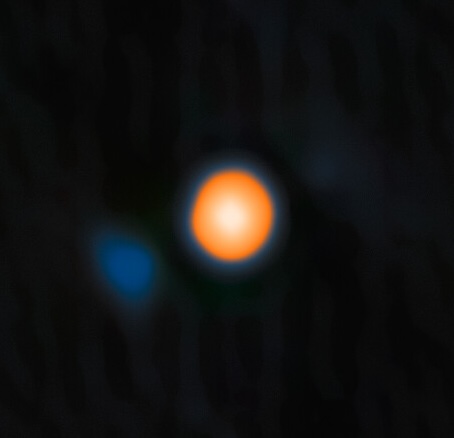
An image of Betelgeuse and its probable companion star from the ‘Alopeke instrument on the Gemini North telescope. [International Gemini Observatory/NOIRLab/NSF/AURA; Image Processing: M. Zamani (NSF NOIRLab); CC BY 4.0]
Betelgeuse, a nearby red supergiant, is a variable star with a 400-day primary pulsation period and a 2,100-day secondary variation period. Recent studies have speculated that this secondary period is due to the presence of an 0.5–2.0-solar-mass companion star (often nicknamed “Betelbuddy”), and researchers using a speckle imaging technique likely spotted this companion earlier this year.
As is often the case when there’s an intriguing astronomical possibility, multiple research teams have sought out Betelgeuse’s purported stellar companion in different ways. One avenue recently described in a published paper was spectroscopic, searching for signs of ultraviolet emission lines from a growing young star.
In just 10 million years, Betelgeuse has sped through its main-sequence lifetime and taken on a new starring role as a red supergiant. In contrast, a 0.5–2.0-solar-mass companion star would not have even reached the main sequence in the same span of time. How is it possible to spot a tiny young stellar object next to a much brighter supergiant?
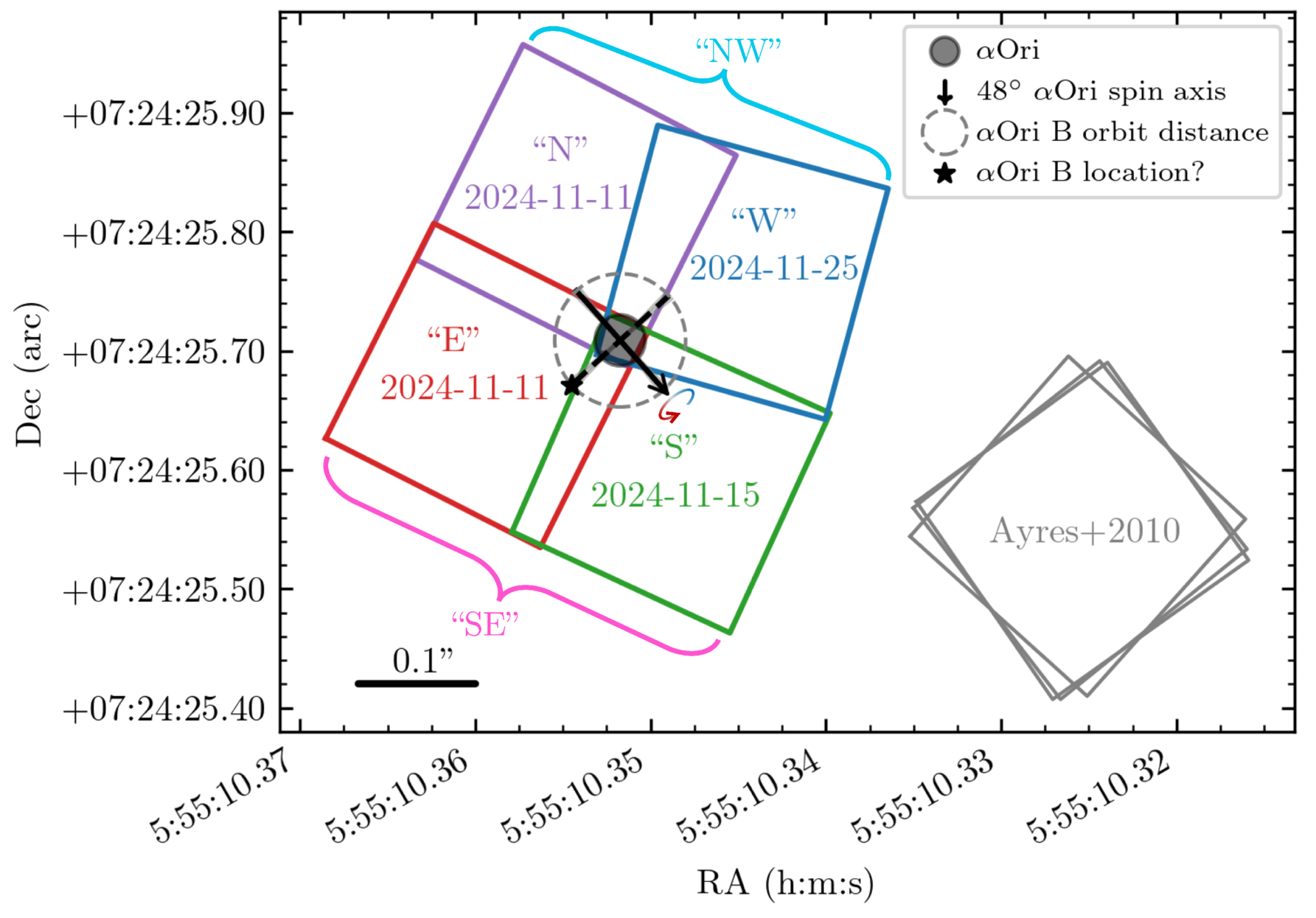
Hubble observing pattern, showing how the quadrants are arrayed around Betelgeuse. Click to enlarge. [Goldberg et al. 2025]
The search is on: Goldberg and collaborators observed Betelgeuse with the Hubble Space Telescope in November 2024, timed to when the companion star’s emission lines would be shifted relative to Betelgeuse. The observations split Betelgeuse’s disk into quadrants, only one or two of which should contain the companion, helping the team tease out the signal from the smaller star, if present. Ultimately, though, no statistically significant signals were found.
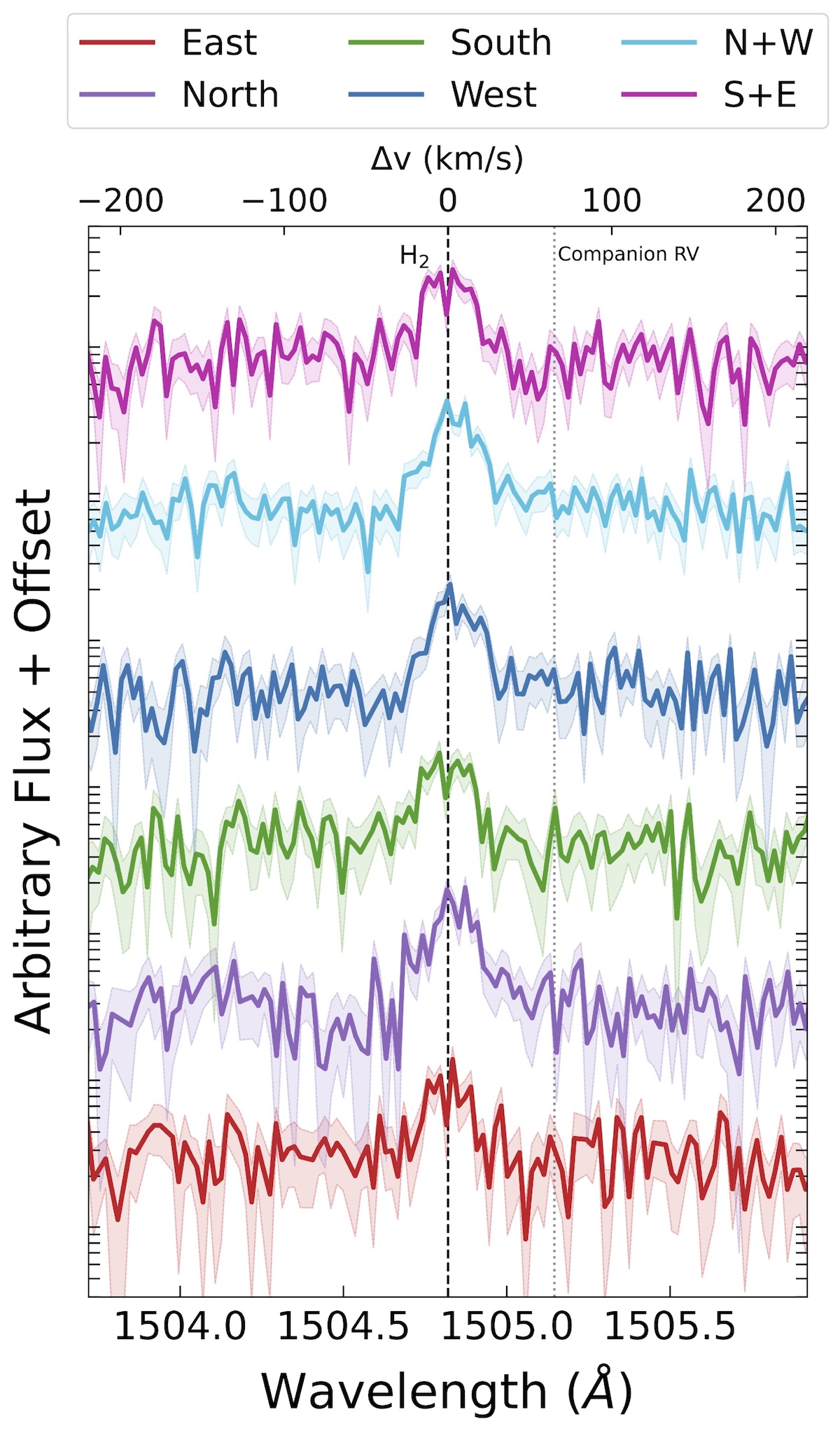
Emission around Betelgeuse’s 1504.82 Angstrom H2 line from each of the four observed quadrants as well as combinations of two quadrants. No significant signals were detected at the expected radial velocity of the companion star. [Goldberg et al. 2025]
A lack of a significant detection doesn’t mean that the companion isn’t there, but it does place constraints on its identity. The data confidently rule out a companion star twice as massive as the Sun, marginally permit a star in the 1.1–1.5-solar-mass range, and favor a star lower than 1.1 solar masses.
Researchers assigned a likely mass of about 1.5 solar masses to the probable companion star imaged earlier this year. Though this is at the limit of what’s permitted by the ultraviolet observations, Goldberg and coauthors note that the companion star’s ultraviolet output could be suppressed due to tidal coupling with Betelgeuse or other processes. If the star’s ultraviolet emission is lower than expected, a 1.5-solar-mass companion remains consistent with Hubble’s non-detection of the star.
This is a fantastic example of how multiple lines of inquiry can converge on similar solutions. With the companion star expected to swing around to a favorable observing position again in 2027, this is certainly not the last chapter in the tale of Betelgeuse and Betelbuddy.
“Betelgeuse, Betelgeuse, Betelgeuse, Betel-buddy? Constraints on the Dynamical Companion to α Orionis from HST,” Jared A. Goldberg et al 2025 ApJ 994 101. doi:10.3847/1538-4357/ae0c0c
The post Hubble on the Hunt: A Spectroscopic Search for Betelbuddy appeared first on AAS Nova.
Current gravitational wave detectors are primarily sensitive to powerful sources like black hole–black hole mergers — what types of events may next-generation gravitational wave detectors reveal? A recent study explores stripped subgiant stars around supermassive black holes and how their gravitational waves may be detected in next-generation missions.
The immense gravity of supermassive black holes at the centers of galaxies drives complicated dynamics that could generate so far undetected gravitational wave signals. One predicted source of gravitational waves is a rare event known as an extreme-mass-ratio inspiral (EMRI) — a prolonged inspiraling of a stellar-mass object around a supermassive black hole, driven inward by gravitational waves. EMRIs are thought to arise when a stellar-mass object is captured into a close-in nearly circular orbit around a supermassive black hole, emitting gravitational waves due to the object’s proximity to the black hole.
To date, most studies have explored EMRIs involving compact objects like black holes, but an EMRI with an inspiraling star is possible, though not yet well explored nor understood. In addition to generating gravitational waves, a stellar EMRI will also emit light as the supermassive black hole rips up siphoned material from the star. These events may explain recent observations of peculiar X-ray transients, but their gravitational wave counterparts remain undetected as EMRIs’ predicted signals fall outside the sensitivity range of current ground-based gravitational wave detectors. However, the Laser Interferometer Space Antenna (LISA), a space-based gravitational wave detector expected to launch in the mid-2030s, will be sensitive to the gravitational waves of EMRIs. In order to properly identify them, we must better understand what to expect.
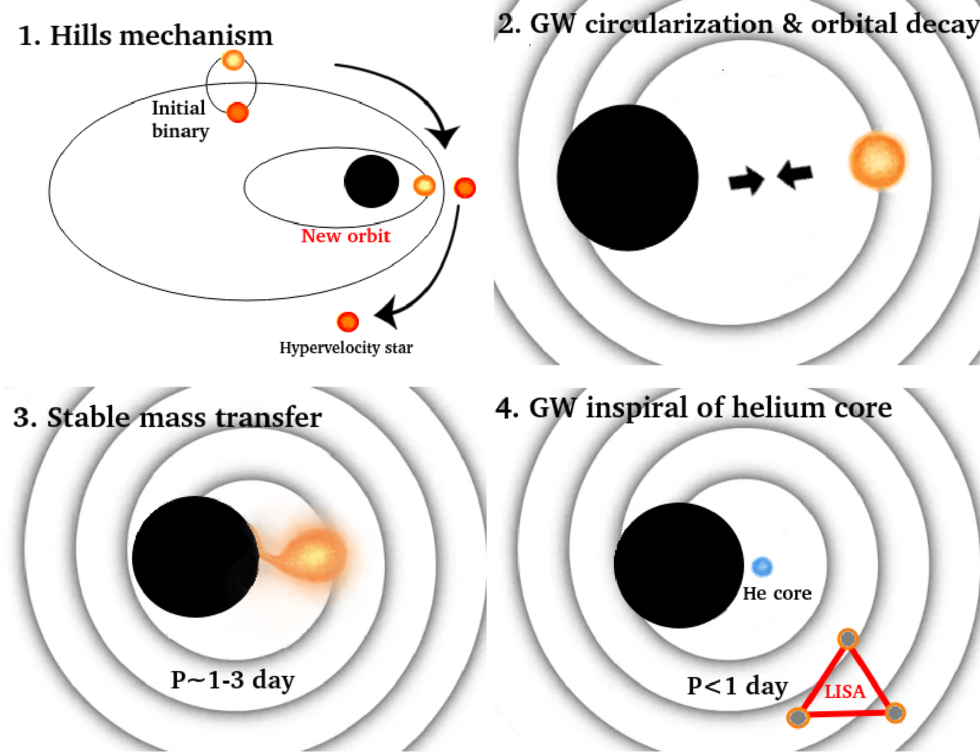
Diagram showing the evolutionary steps of a supermassive black hole capturing a subgiant star that subsequently undergoes mass transfer and gravitational wave-driven inspiral. Click to enlarge. [Olejak et al 2025]
Seeking to better predict what the gravitational waves of stellar EMRIs may look like and what LISA may detect, Aleksandra Olejak (Max Planck Institute for Astrophysics) and collaborators used stellar evolution code to simulate the evolution of a subgiant star as it transfers mass to a supermassive black hole and gravitational waves draw in its orbit. In their models, the supermassive black hole captures the star through scattering between stars or tidal interactions with a stellar binary in which the black hole catches one star and ejects the other.
Once the star is captured, its orbit becomes circularized around the black hole, pulled in closer over time until mass transfer of the star’s outer envelope begins. During this stage, the gravitational wave signal remains too weak to be detected. However, as the star is stripped down to just a helium core, it contracts and experiences an extended gravitational wave–driven orbital decay.
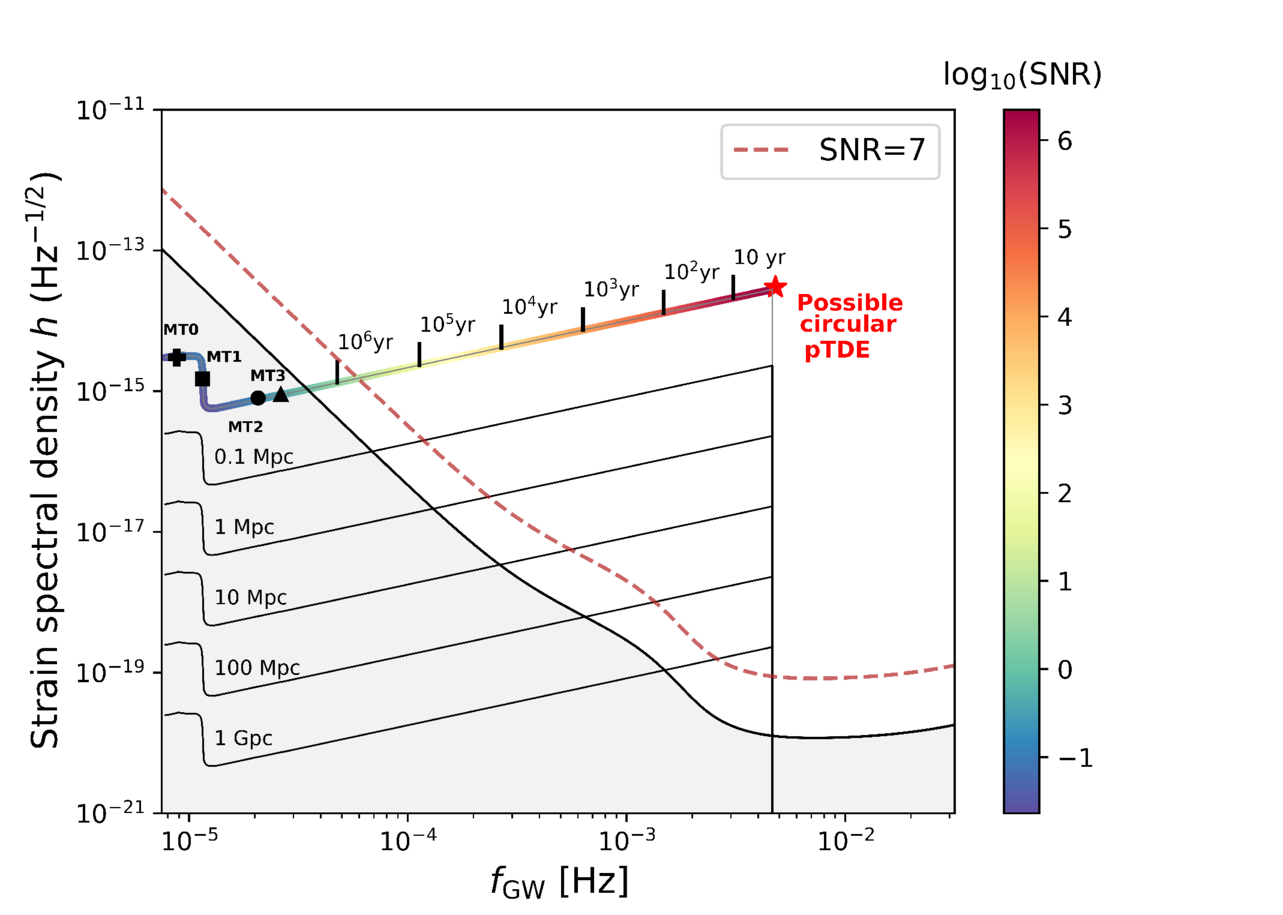
The strain spectral density as a function of the detected frequency of the gravitational wave. The colorful line indicates the signal from a stripped subgiant at the Milky Way’s center, and the gray lines are what would be observed at greater distances. LISA’s sensitivity to gravitational wave signals is shown with the black and red lines with detectable sources falling to the right of or above the line. Click to enlarge. [Olejak et al 2025]
This study provides exciting potential for what is possible with LISA, and future detections of gravitational waves will shine further light onto the complicated dynamics of galactic centers and the evolution of stars around supermassive black holes.
“Supermassive Black Holes Stripping a Subgiant Star Down to Its Helium Core: A New Type of Multimessenger Source for LISA,” Aleksandra Olejak et al 2025 ApJL 987 L11. doi:10.3847/2041-8213/ade432
The post Supermassive Black Holes and Stripped Subgiants: Significant Signals for Future Gravitational Wave Detectors appeared first on AAS Nova.
Astronomers may have directly imaged a companion star to the famous red supergiant Betelgeuse at last. Though the tentative detection only loosely constrains the star’s physical properties, it appears to be a 1.6-solar-mass pre-main-sequence star. The discoverers suggest the name Siwarha, Arabic for “Her Bracelet,” given that the star circles Betelgeuse, “Hand of the Giant.”

A photograph of the constellation Orion. Betelgeuse is the bright yellow star located left of center. [E. Slawik/NOIRLab/NSF/AURA/M. Zamani; CC BY 4.0]
Betelgeuse is a variable star. On top of its well-constrained 400-day pulsation period, the star has exhibited two behaviors that have drawn interest in recent years: a deep, prolonged dimming episode in 2019–2022 that is thought to be due to an immense ejection of mass from the star’s surface, and a 6-year variation in the star’s photometry, astrometry, and radial velocity.
Multiple studies have attributed the 6-year variability to one or more companion stars. In general, these studies predict that the companion star circles Betelgeuse on a tight, 6-year, nearly edge-on orbit. As reported in a new article published in the Astrophysical Journal Letters, observations have likely proved these predictions correct.
Steve Howell (NASA Ames Research Center) and collaborators searched for Betelgeuse’s predicted companion star using the 8.1-meter Gemini North telescope. The team used the ‘Alopeke instrument in speckle imaging mode, which involves taking thousands of milliseconds-long snapshots to avoid smearing due to atmospheric fluctuations.
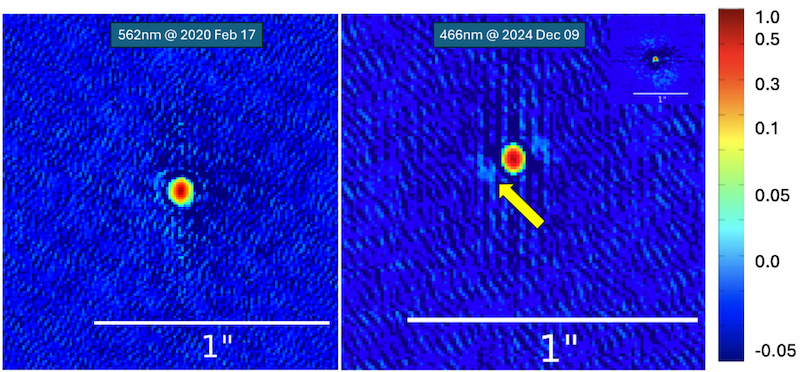
Observations of Betelgeuse from 2020 (left) and 2024 (right). An arrow points to the companion. Note that the image processing introduces a 180º ambiguity in the location of the companion, which is resolved by analyzing phase information. [Howell et al. 2025]
Howell and coauthors performed additional analyses to rule out interference from hot pixels, cosmic rays, or atmospheric diffraction. They also considered that the star could lie in the background or foreground, but they found both possibilities unlikely. After further calculations, the team estimated that the companion is six magnitudes fainter than Betelgeuse and separated by just 52 milliarcseconds at an angle of 115º. These quantities agree well with predictions for the companion’s position.

The on-sky proper motion of Betelgeuse from 2020 to 20204. The companion is shown as the small black circle. This shows that if the companion star were actually a background star, it would have been plainly visible in the 2020 observations. [Howell et al. 2025]
The team closed with a call to the community to turn their instruments toward Betelgeuse on 26 November 2027, when the companion will once again be at its greatest angular separation. Our exploration of this long-sought-after star has just begun!
“Probable Direct Imaging Discovery of the Stellar Companion to Betelgeuse,” Steve B. Howell et al 2025 ApJL 988 L47. doi:10.3847/2041-8213/adeaaf
The post Betelgeuse’s Companion Star May Have Been Seen at Last appeared first on AAS Nova.
