❌

Normal view

Betelgeuse is not alone

21 August 2026 at 12:00

Astronomers have found the best evidence yet for a companion star to Betelgeuse, the brightest star in the constellation Orion. Based on data obtained by the SPHERE instrument on the European Southern Observatory’s Very Large Telescope (VLT) in Chile, they say this companion may be responsible for the red supergiant star’s periodic changes in brightness, which have puzzled scientists for decades.

Betelgeuse is a red supergiant star located about 548 light-years away. As the 10th brightest star in the night sky, it is generally visible even in locations with substantial light pollution. However, its brightness varies over a period of roughly 420 days, superimposed on a longer 2200-day modulation.

For decades, astronomers have suspected that some of these variations could be caused by a companion star that modifies the distribution of cosmic dust that Betelgeuse produces and expels. These changes in cosmic dust would, in turn, change the amount of its light that reaches us here on Earth.

A few years ago, two studies (published in The Astrophysical Journal in 2024 and 2025, but available as preprints beforehand) predicted that in December 2024, this companion star would be at its greatest distance (maximum elongation) from Betelgeuse, making it easier to detect. To take advantage of this opportunity, researchers led by Miguel Montargès of the Observatoire de Paris – PSL, France, requested observing time on the VLT. Although the same studies predicted that the companion would not be massive enough to be detectable with current instrumentation, Montargès and colleagues nevertheless hoped to place upper limits on its stellar parameters.

A difficult analysis

The astronomers used the SPHERE instrument on the VLT to image light from the region where the companion was expected to be, followed by advanced post-processing techniques originally developed to search for exoplanets. Betelgeuse’s brightness and large angular size made this analysis difficult, explains Montargès, but he and his colleagues were nevertheless able to gather enough data to identify a “Betelbuddy” with a confidence of 6σ. As Montargès points out, this is better than the previous upper limit of 1.5σ reported by astronomers at NOIRlab in 2025, and above the usual 5σ threshold that constitutes an “observation” or “discovery”.

Despite this, the astronomers say that before they can be certain that they have really detected a companion that it is indeed gravitationally bound to Betelgeuse, they will need to perform additional observations next year. At that point, they will attempt to confirm the companion’s presence by observing it half a period after the initial detection, on the other side of the red supergiant. “We will then continue observing it to get a precise characterization of its orbit (semi-major axis, eccentricity and inclination, among other parameters),” Montargès says. “These will be required to understand the past and future evolution of the system.”

What happens next

As a mature supergiant star, Betelgeuse is expected to undergo a supernova explosion at some point. The presence of a companion star could affect how this process plays out, and even dictate when the eventual explosion occurs. “It is clear to me that this companion detection will now trigger a wave of new studies on the evolutionary status of Betelgeuse,” Montargès says. “Depending on past, present and future interactions between the two stars, the supernova could possibly be advanced or delayed.

“Betelgeuse is a star that has been observed throughout history,” Montargès continues. “It was even depicted in prehistoric paintings, yet we are discovering one of its fundamental characteristics only now.”

And that is not all: “30% of red supergiants in our galaxy show the type of light variations that led to the discovery of Betelgeuse’s companion,” he tells Physics World. “We may have opened a new avenue to find such binary systems, when the primary star is an evolved star like Betelgeuse.”

The new study is detailed in Astronomy and Astrophysics.

The post Betelgeuse is not alone appeared first on Physics World.
Powerful cosmic winds may have destroyed galaxies in the early universe

10 July 2026 at 09:00

A galaxy that formed around a billion years after the Big Bang is in its death throes thanks to a powerful galactic wind that is blasting its gas into space, say astronomers at Australia’s Swinburne University of Technology. The discovery, which is based on data from the James Webb Space Telescope (JWST) and the Atacama Large Millimeter/submillimeter Array (ALMA) in Chile, could help explain why some of the universe’s earliest massive galaxies ceased to form new stars.

One of the JWST’s most surprising discoveries is that when the universe was between one and two billion years old, it already contained large numbers of massive galaxies. Astronomers think these galaxies may have acquired most of their mass in intense bursts of star formation. But at some point, that process stopped: in technical terms, the galaxies became quiescent.

“These galaxies seemed to have formed all their stars very quickly and then they suddenly died, all within the first two billion years of the universe being formed,” says Rebecca Davies, who led the new research.

The CRISTAL-02 galaxy

One possible explanation for the onset of quiescence is that when galaxies collide with each other, the resulting winds “blow away” the hydrogen fuel required for new stars to form. To investigate this hypothesis, Davies and colleagues focused on a galaxy called CRISTAL-02, which was one of 20 galaxies in the recent ALMA-CRISTAL survey of early star-forming galaxies.

“When we looked at the data, it stood out because it was the only one that showed strong evidence for a galaxy wind,” Davies explains. “We saw this as an excellent opportunity to study how winds impacted the evolution of galaxies in the early universe.”

The light from CRISTAL-02 travelled for approximately 12.7 billion years to reach us, meaning that we see it as it was one billion years after the Big Bang. Because the universe has been expanding since then, the galaxy’s spectra appear highly red-shifted. This meant the Swinburne astronomers needed the JWST’s infrared-sensing capabilities to analyse a spectral feature known as the hydrogen-alpha (Hα) line that is normally red. They also used ALMA to analyse CRISTAL-02’s C II line, which comes from ionized carbon and has a (non-redshifted) wavelength of 158 mm. Both emission lines can yield important information about the properties of early galaxies.

Living fast and dying young

From the ALMA-CRISTAL survey’s measurements of Hα luminosity, astronomers knew that CRISTAL-02 forms stars at a rate of around 260 M☉ per year. This is about three times the average value for “main-sequence” star-forming galaxies at similar mass and redshifts.

The latest observations, however, suggest that it won’t maintain this pace for long. Davies and colleagues identified a huge plume of C II emissions that extends as far as 7 kiloparsecs (kpc) to the north-east of CRISTAL-02, making it almost as long as the galaxy itself. This is a telltale sign that gas is being driven out of the galaxy. The fact that the gas in this plume is blue-shifted by 100 km s-1 lends further support to this explanation.

If this rapid blowout continues, Davies says that CRISTAL-02 will cease to exist in less than 50 million years. But the team’s findings may have implications beyond the fate of this single galaxy. “Our results could help to explain how some of the earliest massive quiescent galaxies in the universe behave,” she tells Physics World. “When the JWST started observing distant galaxies in 2022, it found far more evolved galaxies in the early universe than models predicted. These galaxies seemed to have formed all their stars very quickly and then suddenly died, all within the first two billion years of the universe. The galaxy we discovered seems to be following this path.”

Learning about the early universe

Davies explains that because the early universe was much more compact than it is now, collisions between galaxies were common. During such collisions, gas funnels towards the galactic centres, triggering strong bursts of star formation but also producing strong winds that eventually drive the gas away. “If many early galaxies collide and experience rapid growth, then it may not be surprising at all that we see so many dead galaxies in the early universe,” she says.

The researchers stress that the present work, which is detailed in the Monthly Notices of the Royal Astronomical Society, is based on a case study of just one galaxy. They now need to observe other early, massive galaxies caught during periods of intense growth to determine whether they, too, experience powerful winds that could rapidly expel their gas and stop them from forming stars.

The post Powerful cosmic winds may have destroyed galaxies in the early universe appeared first on Physics World.

Can we create a shield to protect Earth from solar storms?

24 June 2026 at 15:00

An artificial buffer composed of a photoionizing material released into space at the edge of Earth’s magnetic field could hold off powerful solar storms that potentially pose a risk to modern civilization.

The plan to put a buffer in place is called StormWall, proposed by space plasma dynamicist Brian Walsh of Boston University, and Dan Welling and Zhenguang Huang of the University of Michigan.

Solar storms are triggered when a coronal mass ejection (CME) on the Sun launches a vast cloud of charged particles towards us. If this cloud hits us, the charged particles can overwhelm Earth’s magnetic field. Magnetic reconnection, the process of magnetic-field lines snapping under pressure from the solar storm and joining back together, inputs much of the CME’s energy into Earth’s magnetosphere, where it can make its way down to the surface via charged particles stored in Earth’s radiation belts.

“Magnetic reconnection is the gateway by which energy comes from the Sun into Earth’s space environment,” Walsh tells Physics World.

The efficiency with which magnetic reconnection accomplishes this is governed by the magnetic field’s strength and direction, plus the density of plasma – ionized atoms and molecules – in Earth’s magnetosphere. The stronger the field strength and the lower the plasma density, the more energy reconnection deposits on the Earth.

Bolstering our defences

Although we cannot change the magnetic-field strength, “we can increase the plasma density by depositing material into space that can be photoionized,” says Walsh.

Nature already does this to a modest extent. Atoms and molecules leak from the upper atmosphere and are photoionized by solar ultraviolet light. This involves knocking an electron off an atom or molecule, thereby giving it an electric charge that allows it to interact with the magnetic field. The ionized materials follow natural “drift paths” along magnetic-field lines to the edge of the magnetosphere.

StormWall intends to bolster these natural defences by adding large quantities of material. In their work, Walsh, Welling and Huang suggest that a group of six spacecraft placed in geosynchronous orbit and each carrying the equivalent of a dozen fuel tankers’ worth of material would provide enough of a shield to ward off a solar storm. However, Walsh says that ultimately a greater number of smaller spacecraft might be more efficient.

“There is an economy of scale and the potential for international collaboration when the number of spacecraft becomes bigger,” he says. “The beautiful thing is that there’s not a lot of complicated technology in it.”

The key component is the material, and Walsh and his team have looked at a range of materials, particularly alkalines such as lithium and sodium.

“The most important thing is that it has to photoionize relatively quickly, and alkaline materials are great for that,” says Walsh, who highlights salt water, which is rich in sodium, as one possibility.

Simulations indicate that such a plasma buffer could cut the intensity of a solar storm by half as the bulk of the solar plasma is diverted around us, in the same way that stream-water flows around a stone.

Expensive problems

StormWall would not be a perfect solution. For one thing, it would be mightily expensive to launch – Walsh’s estimate is in the same region as the $4 billion Artemis II mission, maybe a little less. Furthermore, StormWall is a one-shot deal. After the photoionizing material is released, the space tankers will be left dry and more spacecraft will have to be launched to replace them.

StormWall would also require perfect timing. The photoionizing material would only remain in Earth’s magnetosphere for about six hours before dissipating into space. Releasing it at the right time to coincide with the arrival of the CME is paramount. This would require consistent accuracy in predicting space weather, which would be dependent on better modelling and more spacecraft observing the Sun in stereo so that CMEs can be tracked.

Walsh’s team is currently exploring ways to bring the cost down and make the process more efficient, such as a staged release of material that lasts longer in the magnetosphere, or a more suitable orbit that enables a more targeted release of material.

The Carrington Event revisited

In 1859, a solar storm of such ferocity hit Earth that it prompted telegraph wires to catch fire from the energy that it dumped into electrical systems. This storm is known as the Carrington Event and, if it took place today, the total damage could exceed $2.4 trillion. Our entire modern way of life, revolving around electrical grids, data centres, banking systems, the Internet, satellite GPS and communications, would be affected. Following the powerful solar storms of May 2024, which saw the Northern Lights visible for several nights as far south as the Bahamas and the Canary Islands, the cost to farmers in the US alone who lost GPS signal for their precision tractor farming was at least $500 million. So while several billion dollars to launch StormWall is expensive, the cost of not launching could be far higher, argues Walsh.

Unfortunately, Walsh does not see a great deal of movement from governments or businesses to try and protect ourselves.

“There is a very small United Nations group that thinks about this, but there’s little action,” says Walsh. “In 2018 the US’s Department of Homeland Security reported on the most likely threats that we are not paying attention to. Number one was a pandemic, and number two was a solar storm.”

With private companies now owning more assets in space than governments, the onus is increasingly on both billionaires and politicians to take pre-emptive action to mitigate the effects of a catastrophic solar storm.

“We are vulnerable, but StormWall would be in a good position to do something about it,” says Walsh.

Walsh, Welling and Huang report their proposal in Space Weather.

The post Can we create a shield to protect Earth from solar storms? appeared first on Physics World.

Parker Solar Probe Makes 28th Close Pass of Sun

11 June 2026 at 17:10

NASA’s Parker Solar Probe completed its 28th close approach to the Sun on June 8, again matching its record distance of 3.8 million miles from the solar surface. The flyby allowed the spacecraft to continue its measurements of the solar wind and solar activity at their source, while adding to our understanding of how the Sun’s atmosphere changes throughout the solar cycle.

The spacecraft checked in with flight controllers at the Johns Hopkins Applied Physics Laboratory (APL) in Laurel, Maryland — where Parker Solar Probe was designed and built — on Thursday, transmitting a beacon tone that indicated its systems were operating normally. Zooming around the Sun on a trajectory that limited communications with Earth, Parker had been out of contact and operating autonomously for nine days around its closest approach, as planned.
 
During this solar encounter, which started June 3 and ends Saturday, June 13, Parker’s four scientific instrument packages gathered data from inside the Sun’s atmosphere, or corona. Parker will begin returning detailed spacecraft telemetry on June 14, with science data transmission set to run from Wednesday, June 17 to Tuesday, June 30.
 
Parker’s observations of the solar wind and solar events, such as coronal mass ejections and the aftermaths of flares, are critical to advancing humanity’s understanding of the Sun and the phenomena that drive high-energy space weather events that pose risks to astronauts, satellites, air travel, and even power grids on Earth. Understanding the fundamental physics of space weather enables more reliable prediction of astronaut safety during future deep-space missions to the Moon and Mars.
 
Parker also equaled its record-setting speed of 430,000 mph — a mark that, like Parker’s distance to the Sun, was set during a close approach on Dec. 24, 2024, and matched during five flybys since, most recently on March 11. Parker will continue matching these speed and distance records during future flybys.
 
Through all six close approaches, mission leads say, the spacecraft has remained in excellent condition. While Parker doesn’t have a temperature sensor on the front of its heat shield — known as the Thermal Protection System, or TPS — the team can estimate through models that the heat shield reaches temperatures of about 1,700 degrees Fahrenheit at closest approach.

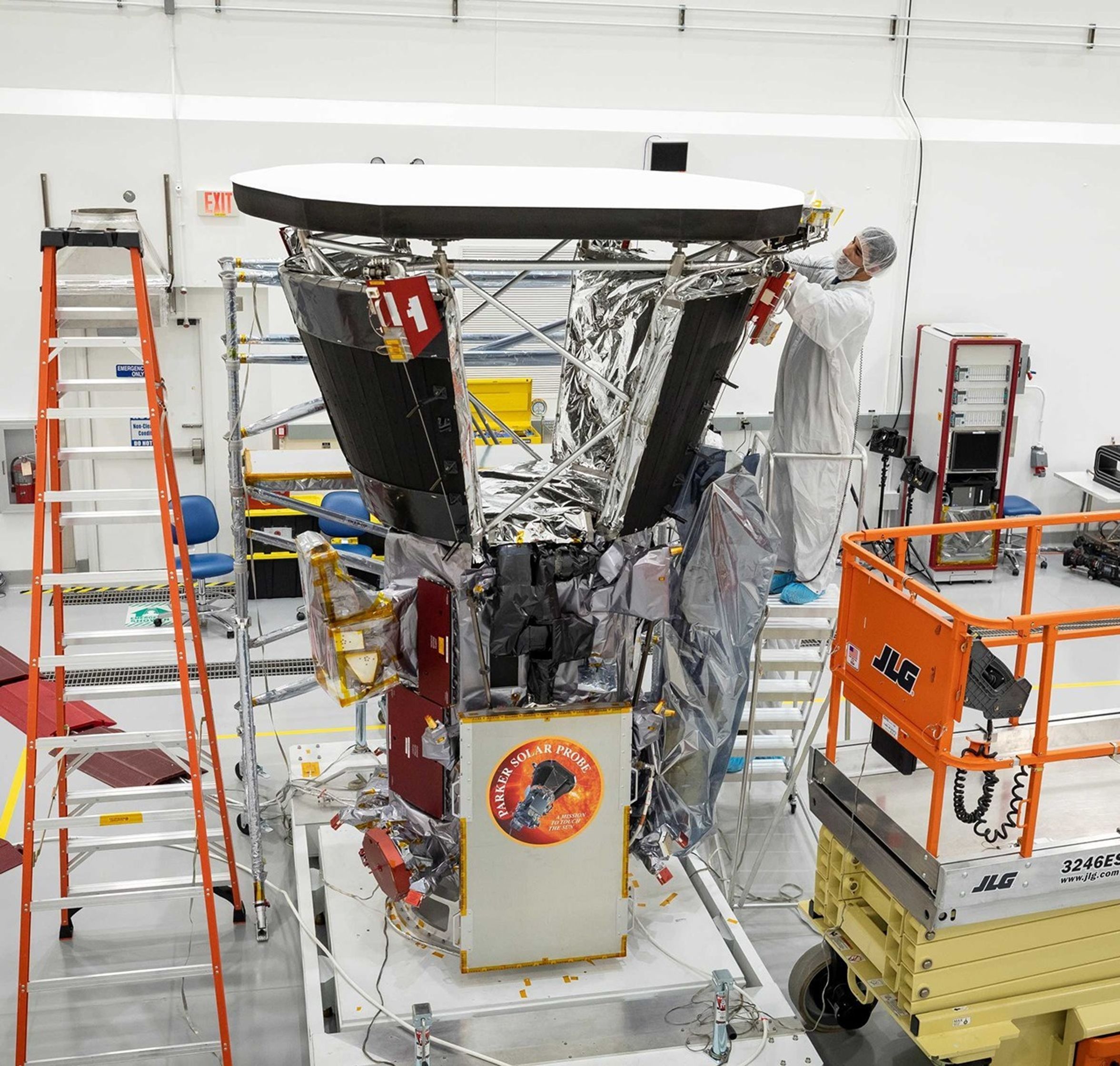
An image of a spacecraft in the center of the photo, with an orange round sticker on the bottom of the spacecraft, identifying it as Parker Solar Probe. A person in a clean-room outfit, right, is installing black thermal shield panels on the spacecraft.
In this image from June 2018, about two months before Parker Solar Probe’s launch, technicians put the final touches on the thermal blankets below the spacecraft’s signature heat shield, the Thermal Protection System (TPS). After nearly eight years in space and through 28 solar en-counters, the TPS remains in excellent condition, even after withstanding temperatures of about 1,700 degrees Fahrenheit during its closest approaches to the Sun.
NASA/Johns Hopkins APL/Ed Whitman

“The heat shield material is incredibly light and fragile, but the thermal design, as well as the software that keeps the spacecraft pointing the TPS toward the Sun, have been outstanding,” said John Wirzburger, Parker Solar Probe mission systems engineer at APL. “It’s a real tribute to the team that designed, built, and operates Parker Solar Probe.”
 
Meanwhile, the team can measure the temperature of the barrier blanketing below the heat shield, and the actual spacecraft temperature has remained consistent on each pass.
 
“That temperature consistency is a major indicator of spacecraft health,” said Wirzburger. “It tells us the heat shield isn’t degrading. If it were cracking or weakening, we’d see temperatures drift upward as more heat leaked through.”
 
Parker launched in August 2018. At the time, the Sun was near the minimum of its 11-year activity cycle. In 2024, representatives from NASA, the National Oceanic and Atmospheric Administration (NOAA), and the international Solar Cycle Prediction Panel announced that the Sun had reached its solar maximum period. Parker’s 28 encounters with the Sun reflect this change over time, sampling the Sun’s atmosphere from quiet to very active periods. Parker Solar Probe will remain in this orbit around the Sun and continue making observations into the declining phase of solar activity.
 
The next steps for the mission in late 2026 and beyond are under NASA review.
 
Parker Solar Probe was developed as a part of NASA’s Living With a Star (LWS) program to explore aspects of the Sun-Earth system that directly affect life and society. The LWS program is managed by the agency’s Goddard Space Flight Center in Greenbelt, Maryland, for NASA’s Science Mission Directorate in Washington. Johns Hopkins APL manages Parker Solar Probe for NASA and designed, built, and now operates the mission.
 
Mike Buckley, Johns Hopkins Applied Physics Laboratory

The post Parker Solar Probe Makes 28th Close Pass of Sun appeared first on NASA Science.

How Solar Flares Hint That They’re About to Happen

1 December 2025 at 17:00

Images of a solar flare at different wavelengths

Forecasting solar flares is one of the major challenges facing solar physicists today. New research finds that non-thermal emission can precede a solar flare by more than an hour, and this early emission may signal whether the flare will be accompanied by an explosion of plasma.

Flare Flavors

photograph of a coronal mass ejection

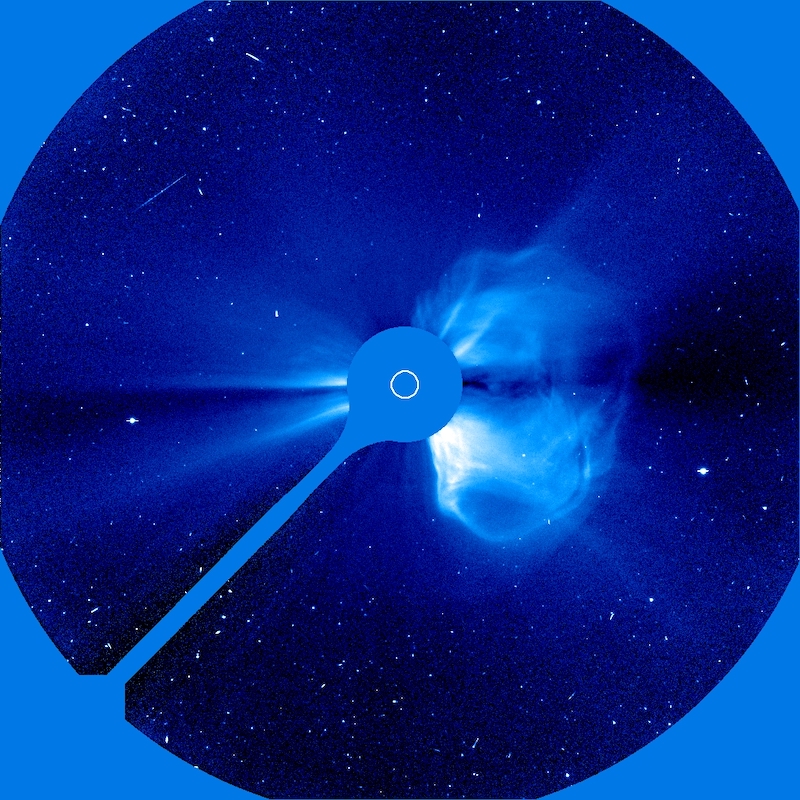
The Solar & Heliospheric Observatory (SOHO) took this coronagraphic image of a coronal mass ejection on 20 April 1998. [SOHO (ESA & NASA)]

Solar flares come in two basic flavors: eruptive and confined. Eruptive flares are accompanied by the launch of tangled clouds of plasma and magnetic fields called coronal mass ejections. Confined flares, so called because the solar plasma remains confined to the Sun, feature only a brief blast of high-energy radiation.

Both solar flares and coronal mass ejections can disrupt everyday life on Earth, with flares knocking out radio communications and coronal mass ejections threatening spacecraft electronics and power grids. Given these real-life risks, as well as the potential for probing the physics behind the activity on the Sun and other stars, it’s critical to be able to identify signs of upcoming flares.

Looking at the Lead-Up

Luckily, there’s growing evidence that the Sun sends out subtle signals that a flare is soon to happen. One early sign of an impending flare is an increase in the non-thermal velocity of the plasma at the flare’s location. This phenomenon has been spotted in individual flares, but it hasn’t been studied and characterized for a large sample of flares — until now.

example of increasing non-thermal velocity before a solar flare

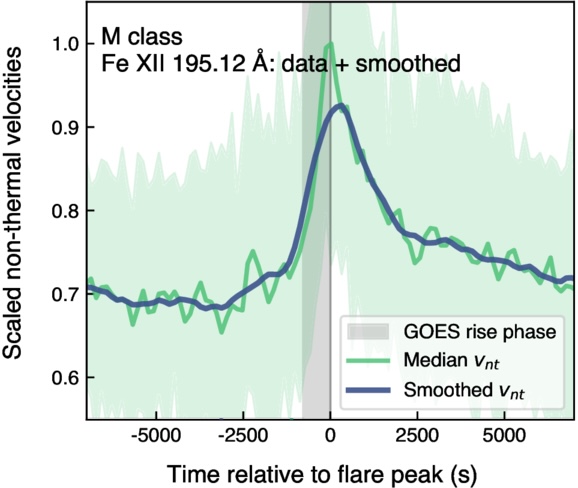
Demonstration of the increase in non-thermal velocity seen in an M-class flare compared to the onset and rise time of the soft X-ray flux (gray shaded area). [Adapted from To et al. 2025]

A recent research article led by Andy S. H. To (European Space Agency) takes the first systematic, large-scale approach to studying the non-thermal velocity changes that precede solar flares. The team amassed a sample of 1,449 solar flares that were seen by the Hinode spacecraft, the Geostationary Operational Environmental Satellite (GOES), and the Solar Dynamics Observatory (SDO). Hinode provided the spectral information needed to identify increases in the non-thermal velocity, GOES provided the flare start times, and SDO provided detailed information on the location and appearance of each flare.

Of the flares in the sample, 83% were moderately powerful C-class flares, 18% were stronger M-class flares, and 1% were the most powerful X-class flares. To’s team identified a clear trend across all types of flares: the non-thermal velocity increases 4–25 minutes before the flare’s X-ray emission begins to rise, peaks when the X-ray emission peaks, and decays as the flare decays. The team found some evidence that for smaller flares, the velocity increase begins in spectral lines that trace cooler plasma before spreading to lines probing hotter plasma, but more work is needed to confirm this trend.

More Details

Examples of flares with and without coronal mass ejections

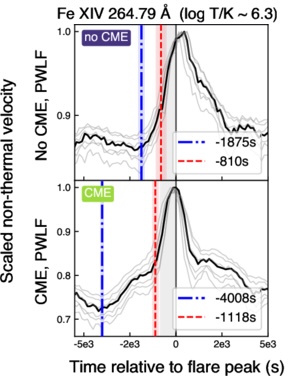
Examples of flares with and without coronal mass ejections. [Adapted from To et al. 2025]

Certain flares give even earlier hints of upcoming activity. M-class flares and some C-class flares exhibit what To’s team calls “precursor emission,” which emerges roughly 30–60 minutes before the flare’s X-ray emission peaks. The team also identified differences in precursor emission between confined and eruptive flares: eruptive flares display precursor emission over a broad range of spectral lines starting 45–74 minutes before the flare peaks, while confined flares show precursor emission later (31–54 minutes before peak) and in only a few spectral lines.

These results suggest that changes in the non-thermal velocity of solar plasma can not only signal when and where a flare is likely to arise, but also whether the flare will be accompanied by a potentially destructive coronal mass ejection. Upcoming missions like the Multi-slit Solar Explorer and SOLAR-C will give an even better view of the early stages of solar flares, helping to illuminate the physics behind them and enhancing our ability to forecast them.

Citation

“Systematic Nonthermal Velocity Increase Preceding Soft X-Ray Flare Onset: A Large-Scale Hinode/EIS Study,” Andy S. H. To et al 2025 ApJ 993 102. doi:10.3847/1538-4357/ae07de

The post How Solar Flares Hint That They’re About to Happen appeared first on AAS Nova.

❌