He developed a program that became a model for hospitals around the world, making it easier for poor Black patients to navigate an onerous bureaucratic system.
New laws coming into force this week aim to streamline age checks although old-style plastic IDs will still be allowed
Younger drinkers in England and Wales will be able to prove their age with a digital ID starting this week as new laws give pubs, off-licences, nightclubs and restaurants the right to use biometric scanning technology to check customers are over 18.
Customers will be able to download software that scans their faces into their own phone to generate a QR code proving their age based on a stored proof of age. Other tech under consideration as part of the government push to digitise age verification for alcohol sales include a device which scans the veins in a drinker’s finger to verify their age. That system has not yet been approved for use.
It was the fastest-growing emoji in 2025 – but if you’re older than 16, it has probably passed you by. Now, just as twentysomethings are catching up, it’s over
In the 2025 hit Netflix show Adolescence, DI Luke Bascombe’s 13-year-old son, Adam, has to explain to his father the way his generation use heart emojis. “Red means love, purple: horny, yellow: ‘I’m interested, are you interested?’, pink: ‘I’m interested but not in sex,’ orange: ‘You’re going to be fine,’” he explains. “It all has a meaning. Everything has a meaning.”
And those meanings are constantly evolving. Take the skull (), for example, which has come to be used as a reaction for finding something funny – a visual shorthand for the slang phrase: “I’m dead.” Or the wilting rose () which was, according to Google data analysed by the New York Times, the fastest-growing emoji in terms of popularity in 2025 – and was the 93rd most used. That the previously obscure wilting rose is now in the top 100 emojis is thanks to generation Alpha (those born between 2010 and 2024), who use it in place of the broken heart emoji () to signify sadness, or ironically, to suggest mock-heartbreak.
Humans will have to compete with AI-powered virtual employees in the near future. Here are our tips for the last human holdouts
Futureproofing your career with an AI-resistant degree is a tough ask, says Charlie Ball, an expert on graduate employment for Jisc, the UK’s higher education digital, data and technology agency.
“What you’re trying to do is futureproof a 45-year career in a time of rapid technological change – and that’s really quite hard to do. What’s likely is that jobs that hinge a lot on human, face-to-face interaction are unlikely to be replaced.”
A drinking fountain marked “colored,” a segregated waiting room, or a sign separating public spaces by race could tell the story of an entire social system. During the Jim Crow era, these ordinary sights became symbols of a country where racial separation was woven into everyday routines, shaping where people could go, what services they […]
If you’re called by an unidentified number, the advice is to remain silent until you’re sure there’s a human being on the line. Is this the end of an era?
When Star Trek premiered in 1966, it introduced audiences to a vision of the future filled with advanced technology, distant worlds, and a diverse crew working together aboard the USS Enterprise. Alongside its groundbreaking ideas about space exploration and human progress, the series also became known for its distinctive visual style, particularly the futuristic uniforms […]
China has made astounding scientific progress over the past decade, with the country outperforming all others in the world according to a recent analysis by Nature. Based on data from 2025, its 2026 Research Leaders study puts China ahead of the US (in second), Germany (third) and the UK (fourth).
Across all disciplines, Nature reports that most (51) of the top 100 institutions in the world are in China, with only four in the UK. The picture is slightly different if you judge academic institutions based only on their work in the physical sciences, but China still has 30 of the top 100 institutions, with only seven from the UK.
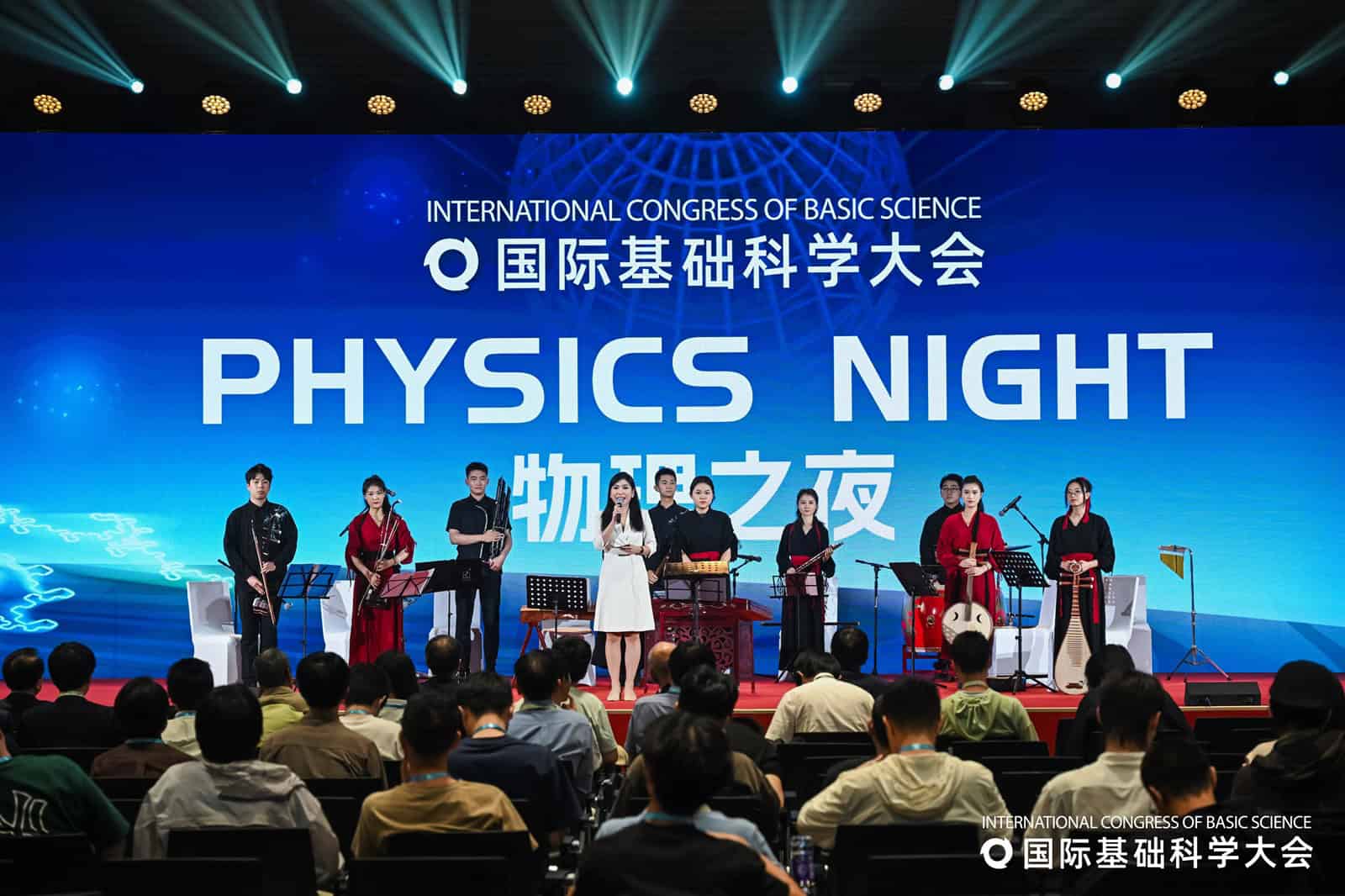
Professional physicists may not care much for such league tables but they do reveal just how far China has come in recent years. The country’s scientific strength was particularly evident at the fourth International Congress of Basic Science (ICBS) in Beijing, which I recently attended.
Founded in 2023 by the Fields-medal-winning mathematician Shing-Tung Yau, this year’s ICBS ran from 9-21 August at the Beijing Institute of Mathematical Sciences and Applications (BIMSA), of which Yau is president. Its international character is evident from the fact that a total of 50 of its 140 full-time researchers are from outside China.
Awards and honours
Over 800 participants from more than 30 countries attended the congress, which had the theme “Advancing science for humanity”, with my participation supported by the organisers. The programme was huge, featuring over 500 academic sessions covering topics from generative AI reasoning to quantum information.
Meanwhile, Frontiers of Science Awards were given to over 500 researchers from 20 countries who had done work of “excellent and of outstanding scholarly value” over the last 5-10 years in the three fields represented at the ICBS. Authors from many Chinese institutions were among the recipients, underscoring the growing international impact and vitality of China’s basic science research.
Youth focus Student nights wre held at the congress. (Courtesy: ICBS)
There were 20 plenary sessions, over 400 Frontiers of Science Awardee talks, plus events for entrepreneurs and school and university students. Especially engaging were the “nights of mathematics, physics and engineering”, enlivened by dance amd music performances by students. An exchange meeting was held too for research institutions in Beijing seeking to integrate basic science with frontier technologies
The closing ceremony saw the winners of this year’s ICBS Innovation Fellowships announced. They are all researchers under 50 who work full-time in China and have demonstrated potential in mathematics, physics, information sciences, and other fundamental and interdisciplinary fields. Each receives research funding and can work with a partner institution in China for an agreed period.
AI surges ahead
Artificial intelligence (AI) was one of the major themes of ICBS 2026. Fields medallist Martin Hairer from EPFL Lausanne, for example, said AI won’t end mathematics, but will transform how it’s carried out. It may speed up certain areas while others might fall away.
Caucher Birkar from Tsinghua University – another Fields medallist – pointed out that AI is highly capable in computation, searching for examples, and completing proofs of mathematical lemmas, but it remains difficult for AI to generate truly original ideas.
As for Robert Endre Tarjan, a Turing award laureate from Princeton University, he encouraged young researchers to be curious and commit themselves to long-term scientific exploration. Researchers, he said, can train AI to be a powerful tool for scientific discovery, but they must also develop their own ability to identify meaningful questions and establish independent judgment.
The last word was left to congress chair Shing-Tung Yau, who emphasised that while AI will enhance scientific research, the essence of scientific discovery will always depend on human creativity, imagination and independent thinking.
Record store shelves once told stories long before anyone dropped a needle on vinyl. A cover was an artist’s first impression, a single image meant to stop browsers mid-flip and pull them toward the turntable. Between the 1970s and the 1990s, that impulse produced some genuinely brilliant design work, alongside a wave of album art […]
Open any box of decades-old family photographs and there is a good chance one image will stop the scroll: a man in a belted sweater, knee-high boots, and a print bold enough to make modern eyes squint. Vintage menswear advertisements from the 1970s are full of moments like this, and viewed through a 21st-century lens, […]
On December 12, 1972, Château de Ferrières, the grand 19th-century estate owned by the Rothschild family outside Paris, became the setting for one of the most unusual private gatherings of the era. Hosted by Marie-Hélène de Rothschild, the event was not a traditional formal ball but a carefully staged surrealist spectacle filled with bizarre costumes, […]
American swimwear manufacturers entered the 1950s with a design philosophy borrowed directly from the corset makers and eveningwear tailors of the previous decades. Rather than treating the swimsuit as simple beachwear, companies like Catalina, Cole of California, and Jantzen engineered garments meant to shape and flatter the body with the same precision applied to formal […]
In the 1950s, Italy was a country where centuries of history blended naturally with everyday life. Ancient churches, medieval streets, Renaissance buildings, and traditional neighborhoods still stood largely untouched by the rapid changes that would come with mass tourism and modern development. A remarkable collection of Kodachrome photographs from 1956 offers a rare glimpse of […]
Sun-drenched shores, tailored wool swimsuits, and a newfound sense of freedom all came together to define one of the most stylish decades in beach history. The 1930s transformed swimming from a rare luxury into a beloved national pastime, and with that shift came a wave of fashion innovation that still captures attention nearly a century […]
The geometric earthwork structures, carved into the ground with embankments and ditches, are in some cases more than 2,500 years old, researchers said.
A century ago, a virus swept across the planet with a speed and lethality the modern world had never witnessed, reshaping societies from crowded cities to remote villages in a matter of months. The 1918 influenza pandemic remains one of the deadliest public health disasters in recorded history. Within roughly fifteen months, it claimed more […]
I am writing from Argentina as a researcher working within the country’s national scientific system. While discussions about science funding are often framed in terms of budgets and economic indicators, the reality is experienced in laboratories, offices and research facilities where scientific knowledge is produced.
Today, many of us in Argentina are witnessing a progressive deterioration of Argentine science, both in terms of infrastructure and human capital.
The impact became tangible when my colleague Paula Alderete, an experienced electron microscope specialist, lost her position. Alderete, who has published two papers with me, was responsible not only for operating a highly specialized instrument, but also for maintaining it and supporting dozens of research projects.
Without Paula Alderete’s expertise, our lab’s electron microscope has become largely unusable. It is a quiet reminder that scientific infrastructure depends as much on people as on expensive equipment.
Faramarz S Gard
Without her expertise, the microscope has become largely unusable. Every morning I pass her empty desk on my way to the laboratory. It has become a quiet reminder that scientific infrastructure depends as much on people as on expensive equipment.
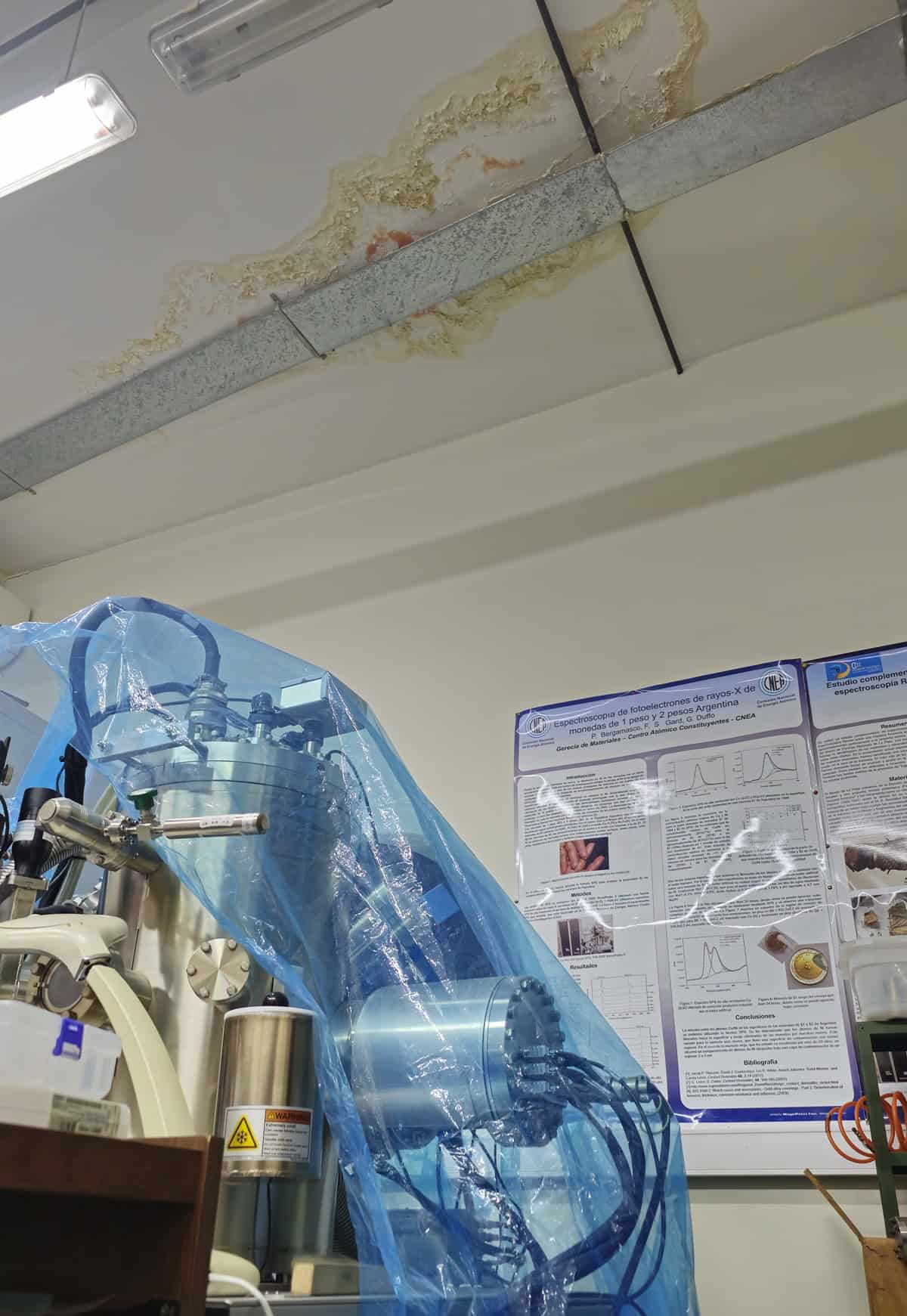
The deterioration extends beyond personnel. In my laboratory, an X-ray photoelectron spectroscopy (XPS) instrument worth more than $1m must sometimes be protected with plastic sheets because rainwater leaks through the roof.
Equipment designed to operate under tightly controlled environmental conditions is now exposed to circumstances that threaten its long-term reliability. Similar situations are becoming increasingly common across Argentina’s universities and research institutes as maintenance budgets shrink and infrastructure ages.
Argentina has a scientific tradition that reaches far beyond its borders. The country has produced five Nobel laureates, including three in the sciences, and has made internationally recognized contributions to nuclear technology, medicine, agriculture, astronomy and materials science. Institutions such as CNEA, CONICET (Argentina’s national research council) and the national universities have trained generations of researchers whose work has strengthened international collaborations and advanced scientific knowledge worldwide.
Scientific systems rarely collapse through a single dramatic event. They decline incrementally: one technician dismissed, one laboratory left unrepaired, one instrument taken out of service, one young scientist deciding to build a career elsewhere. These individual losses accumulate into a weakening of scientific capacity that may take decades to rebuild.
When a country loses the expertise required to operate advanced laboratories or maintain unique scientific infrastructure, the consequences extend beyond national borders.
Faramarz S Gard
This should concern more than Argentina. Modern science depends on international networks of researchers, shared facilities and long-term collaboration. When a country loses the expertise required to operate advanced laboratories or maintain unique scientific infrastructure, the consequences extend beyond national borders.
Damaged goods This X-ray photoelectron spectrometer at the author’s lab has to be protected from water leaking through the ceiling. (Courtesy: Faramarz S Gard)
Knowledge is lost, collaborations weaken, and opportunities for discovery diminish.scientific infrastructure is more than buildings and instruments; it is the people whose expertise gives those resources value. Once that expertise disappears, replacing it is far more difficult than preserving it.
The empty desk of a single scientist may seem insignificant, but multiplied across laboratories and institutions, it becomes a warning of how a research system is quietly dismantled. Argentina’s experience is therefore not only a national concern but also a reminder that scientific capacity, wherever it exists, is a global resource that is remarkably difficult to rebuild once lost.
I write this letter not only to describe a difficult situation but also to call attention to the broader consequences of sustained disinvestment in science. The international scientific community should recognize that the erosion of research systems in countries such as Argentina represents a loss not only for those nations but for global science itself.
Science is built by people, sustained by institutions, and enabled by infrastructure. Today, all three are under increasing strain in Argentina.
How do we make good, well-informed decisions? This is the central question of author Helen Pearson’s new book Beyond Belief: How Evidence Shows What Really Works. It examines evidence-based decision-making and compares it with “conventional wisdom and questionable opinion”. Pearson is interested in how we can use scientific reasoning to empower decision-making using empirical evidence, rather than choices based on opinion or public sentiment.
Pearson uses human stories and historical narratives to outline “the evidence revolution”, in which academics, policy-makers and civilians have tried to embed evidence into decision-making. She tackles disciplines where evidence is seldom used, such as people management, or where its absence is surprising, like environmental conservation. Throughout Beyond Belief, Pearson asks us to understand what makes for good evidence, and how evidence can be better used in daily life.
An award-winning science journalist and editor at the journal Nature, Pearson is particularly good at establishing clear narratives based on a host of different scientific studies. She begins with the field of medicine, focusing on Iain Chalmers, one of the founders of the Cochrane Collaboration. Formed in 1993, it is considered to be a trailblazer in evaluating evidence-based healthcare. Indeed, the institution has influenced important changes to treatment, including the use of corticosteroids to save the lives of premature babies.
It seems obvious, Pearson suggests, that doctors would choose treatments based on rigorous evidence. Instead, she shows us that evidence-based medicine is a young field that only emerged in the 1970s. One particularly personal example she gives is the standard practice of shaving knee cartilage in meniscal tears – a procedure I nearly underwent in 2015 – which was shown to be no better than exercise therapy after a landmark trial in 2016. Beyond Belief offers a glimpse into how recent, and as-yet fragile, our reliance on evidence-based treatment is; as well as how much opposition it has faced from institutional inertia and scepticism.
The book is not just about medicine. It includes examples ranging from the roll-out of the pioneering Mexican social welfare scheme, PROGRESA, which helped to decrease poverty and improve health and education in the country; to the ineffective use of bat bridges over the UK’s A11 dual-carriageway. She also discusses using evidence to make management decisions, as opposed to relying on corporate wisdom or management consultancy. The examples are often surprising, underscoring Pearson’s central argument that evidence allows for better decisions, but getting people to use good evidence consistently is challenging.
Throughout the book, Pearson is engaging and often witty, while still discussing the complexities of implementing evidence-based best practice. Beyond Belief is highly readable too – even when navigating difficult concepts in meta-analyses. Pearson outlines the difficulties of teaching people how to use evidence, how to design studies well, and how studies can easily be misleading. She presents the enormous challenge of encouraging institutions to use evidence correctly, while remaining hopeful about our direction of travel.
There are places where tensions arise, one being in the chapter on policing. Pearson describes how evidence can be used in effective policing, for example, to support increasing patrols or stop-and-search in crime hot-spots. This reveals an interesting question about what the role of successful policing is – crime reduction, retributive justice or rehabilitation – and whose definition of justice that evidence is being used to support.
In these cases, the author’s arguments would have been strengthened if she had engaged more with the central premise of the book: that evidence always makes for better decisions. There are nuances that arise between evidence-based policy and harm reduction, and broader questions of trust that cause people to rebuke evidence entirely. A more serious conversation about these reservations might have deepened the argument in favour of empirical evidence, particularly in questions of social policy.
This discussion is not entirely absent. One particular strength of Beyond Belief is Pearson’s examination of COVID, drawn from her experience as a Nature editor during the pandemic. In this chapter, close to the book’s end, Pearson presents the difficulties of using evidence-based trials in acutely developing crises, in which scientists and public-health bodies have to adapt quickly to minimize harm. At a time when discussions about public health responses to COVID are so polarized, Beyond Belief provides a nuanced analysis of how we can arrive at a scientific conclusion under immense pressure.
At the heart of this book is Pearson’s passion and advocacy for a scientific approach to decision-making. She includes a call to action, empowering readers to be champions of evidence in their lives. Although only present in the short chapters towards the book’s end, her anecdotes about childcare, artificial intelligence and using your vote to support evidence through democracy, are useful reference tools. She also succeeds in her goal of starting a conversation about how we can best use evidence.
Ultimately, Beyond Belief sets out to demonstrate the ways in which evidence enters our lives and improves them. Pearson asks us to advocate for science in a world of increasing misinformation, and to challenge conventional wisdom while equipping us with the tools to do so. For that alone, her book is well worth reading.

 Login