Une forêt située à une centaine de kilomètres d’Helsinki cachait depuis près d’un millénaire un ensemble archéologique hors norme. Repéré grâce à un détecteur de métaux, ce trésor pourrait désormais éclairer les échanges commerciaux qui traversaient le nord de l’Europe à la fin du premier...
The largest hoard of Viking Age silver ever found in Finland — which contains almost 10 pounds (4.5 kilograms) of coins and jewelry — has been unearthed by a metal detectorist about 95 miles (150 kilometers) north of Helsinki.
The hoard had been divided into two deposits and buried in birch-bark containers. Although the coins and jewelry likely date to between A.D. 1000 and 1050, it's unknown exactly when they were buried, Esko Tikkala, an archaeologist at the Lahti Historical Museum who excavated the hoard, told Live Science in an email.
The hoard has not yet been fully cleaned, separated and counted yet, but there are thousands of pieces, Tikkala said. "There are quite a lot of coins in this hoard," he said. "I have not had time to go through them."
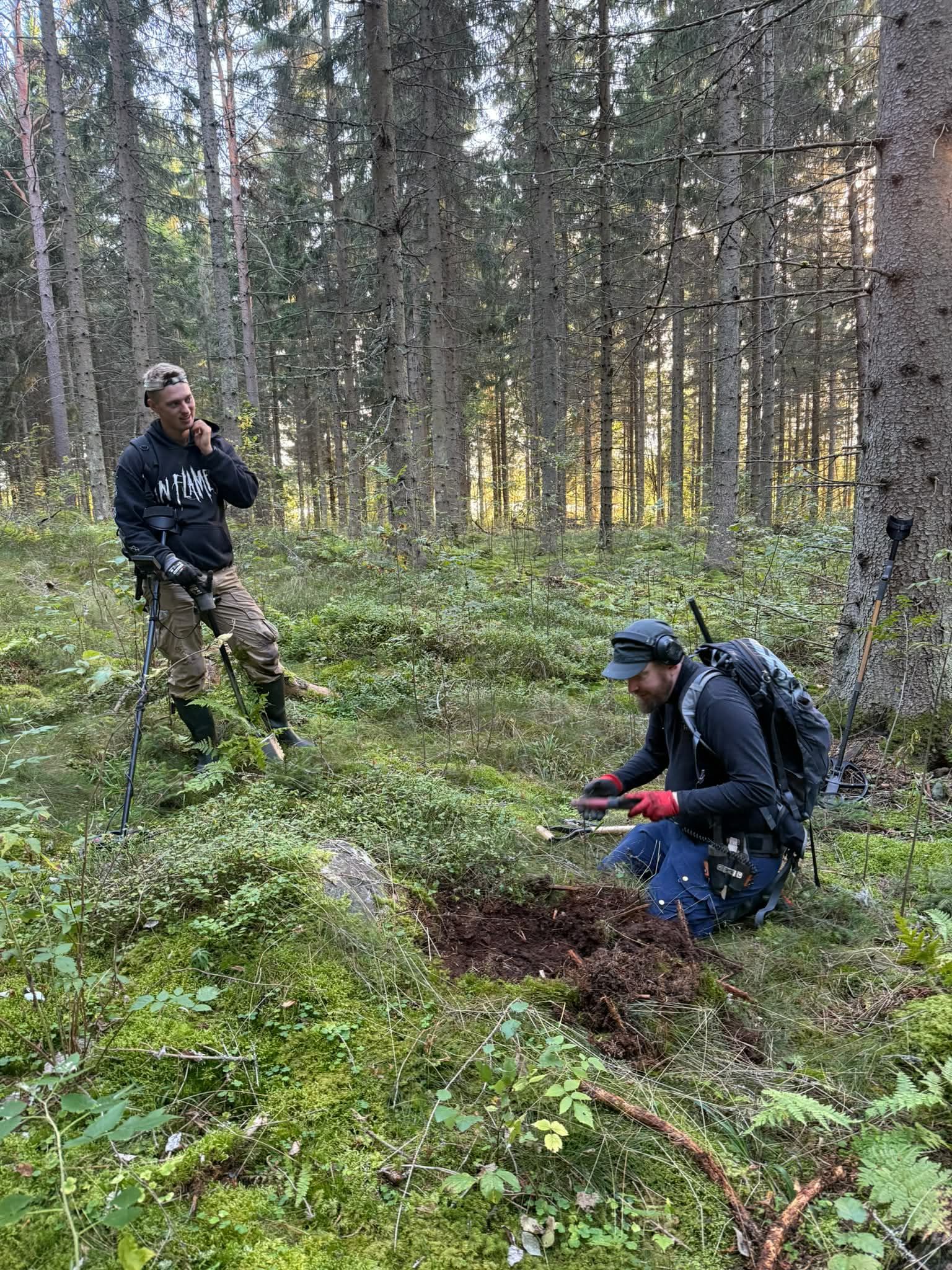
Metal detectorist Kalle Lappinen found the two deposits Sept. 3 and immediately contacted the museum. Archaeologists inspected and properly excavated the finds the next day, according to atranslated statement.
The coins were discovered in early September by metal detectorist Kalle Lappinen (right). (Image credit: Kalle Lappinen)
Tikkala described the hoard site as beside a rock outcrop in a forest near the town of Sysmä. Several other buried hoards had been found in the same region of Finland over the past 10 years, Tikkala said.
Although it's challenging to determine why specific hoards were buried, a recent study of more than 15,000 Roman-era (the eighth century B.C. to the fifth century A.D.) hoards found that they were hidden for multiple reasons, including for tax evasion, votive offerings, and safe storage in times of uncertainty.
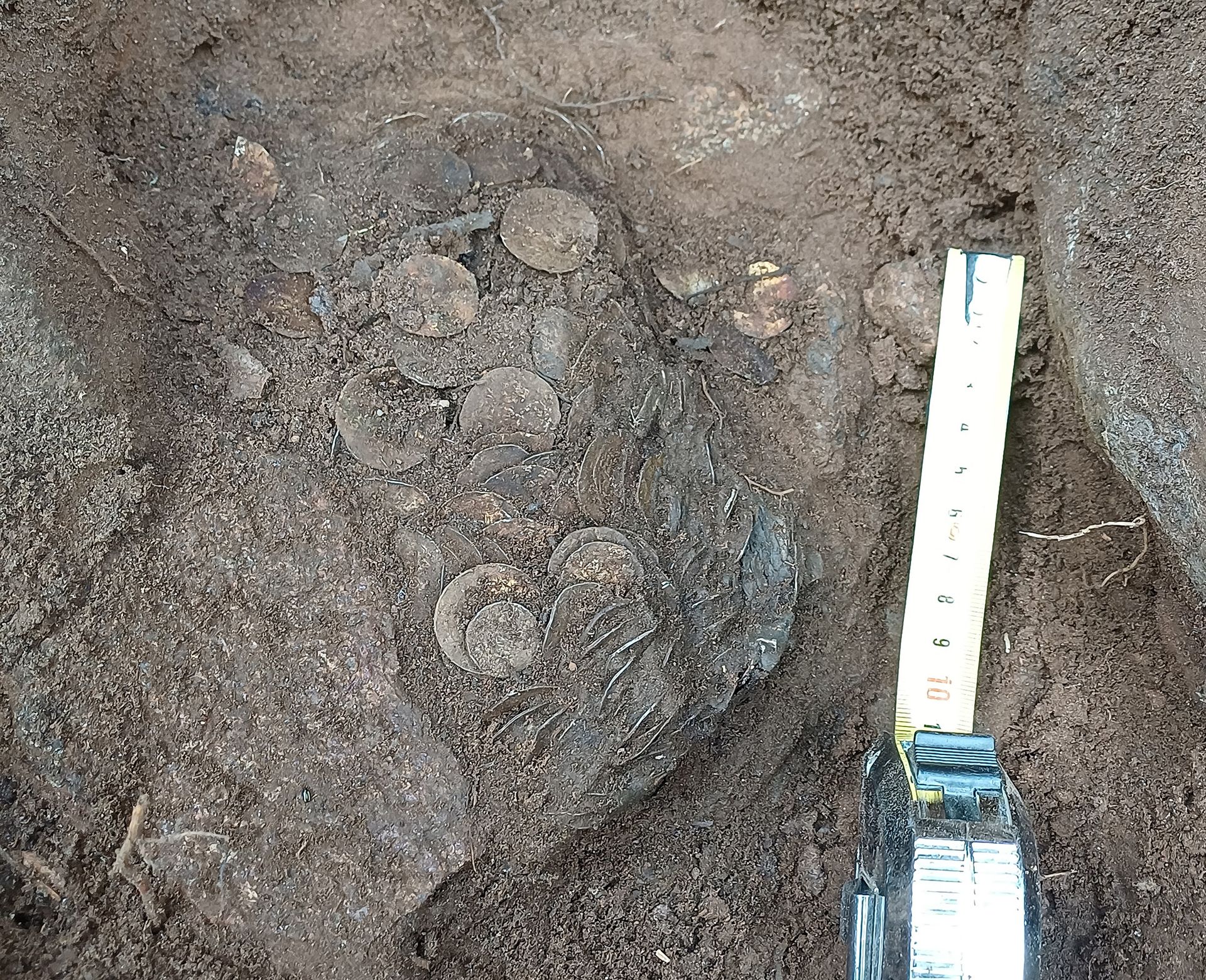
Tikkala said the two deposits of the silver hoard were buried between two stones about 18 inches (45 centimeters) below ground and about 39 feet (12 meters) apart. There were no signs of any burials nearby, but the surrounding area had not been properly studied, he said.
Tikkala added that the coins came from areas that corresponded to present-day Germany, Sweden and Great Britain. There were also some dirhams — silver coins made in the Islamic world. Dirhams previously found in Finland generally date to between about 800 and 1050, he said.
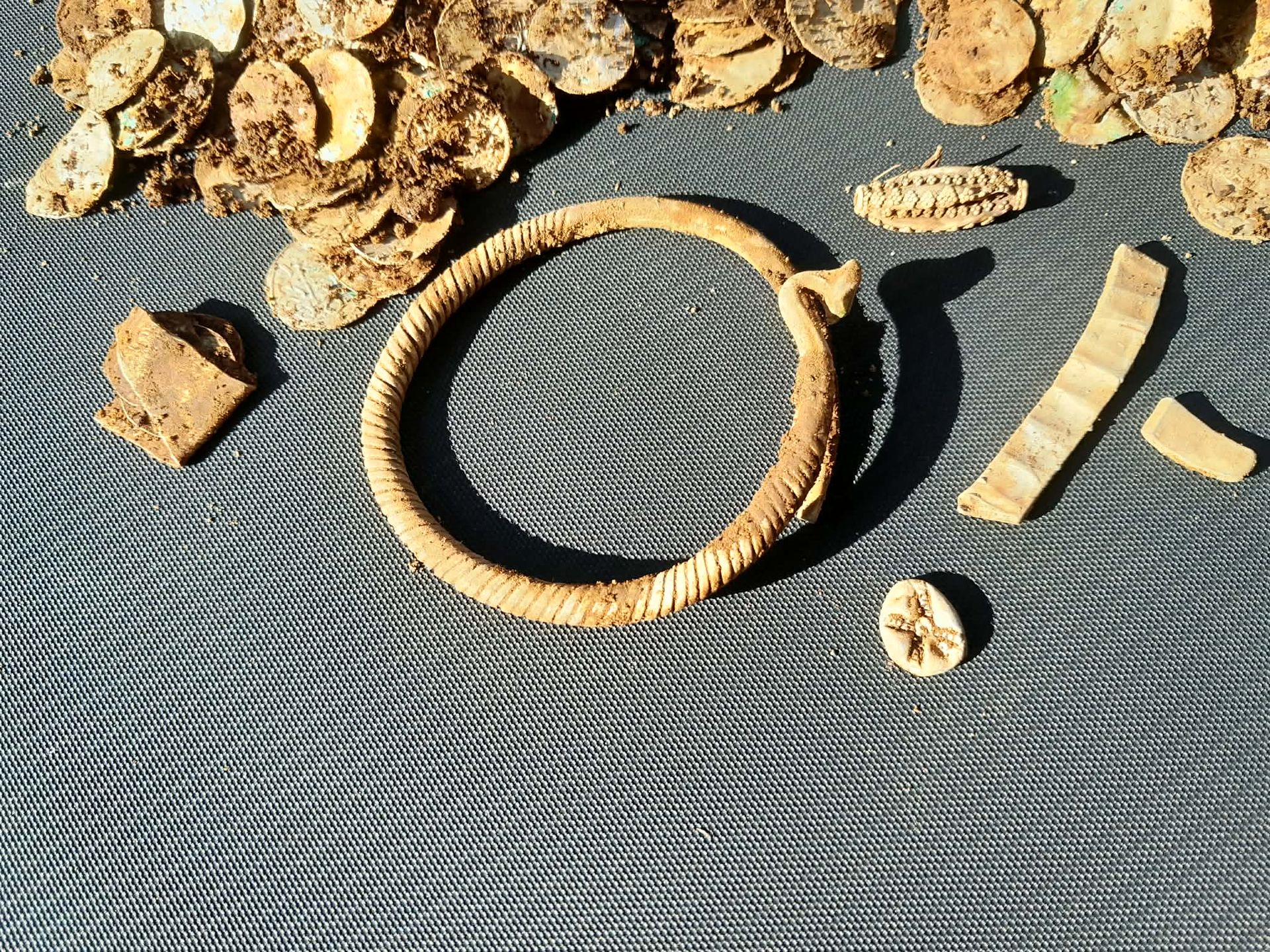
In addition to the silver coins from many places, the hoard contains items of silver jewelry and "hack silver" used for payments. (Image credit: Lahti Museum)
The hoard also contains several pieces of jewelry, including a silver bracelet, and "payment silver" in the form of hack silver (also called hacksilber) — pieces of silver that could be cut into smaller pieces for payments according to their weight.
The weight of the precious metal alone would make the hoard worth almost $10,000 today.
From the Viking Age, but not from Vikings
Although the hoard is from the Viking Age (traditionally, from the793 attack on Lindisfarne until the 1066 defeat of a Viking army at Stamford Bridge in England), that doesn't mean it was buried by Vikings, Tikkala said.
"The term Viking Age does not imply that there were Vikings in Finland," he said. "We have no sources suggesting that Finland was 'Viking' in the same sense as regions of present-day Sweden, Norway, and Denmark."
Instead, Finnish historians and archaeologists had adopted the term to designate the period, he said. But the area now known as Finland was not culturally or politically part of Viking Scandinavia.
The hoard had been placed in two bark containers that were then buried several feet apart. (Image credit: Lahti Museum)
The next stage of the archaeological investigation will be to properly study the site where the two deposits were found, as well as their surroundings, Tikkala said; after that, specialists in Viking Age coins will try to identify the coins and prepare a detailed report.
"There will definitely be scientific articles published on the hoard as a whole, as well as more detailed studies of the coins themselves," he said.
Until now, Finland's largest Viking Age hoard was found in 1895. Buried at Nousiainen, about 130 miles (210 km) southwest of Sysmä, it contained more than 1,700 silver coins but weighed only about half as much as the newfound hoard.
While building a terrace in their backyard, a homeowner in Denmark discovered the treasure of a lifetime: more than 40 pounds (18.5 kilograms) of thousand-year-old silver buried in the ground. An analysis revealed that the finding is the country's largest Viking Age (793 to 1066) silver hoard known to researchers.
The hoard has approximately 700 silver objects, including silver bars, jewelry, 47 whole coins and coin fragments, and a small Thor's hammer, an object that was often interpreted as a sign of protection and a clue that its owner believed in the Norse pantheon of gods. About 320 of those objects were contained in a clay vessel, while the rest lay in the soil nearby. The treasure is nearly three times larger than the previous largest silver hoard from Denmark's Viking Age, according to a translated statement.
One of the silver bars is engraved with runes, a writing system used by people in Scandinavia during the Viking Age. The inscription might say "hutu," which may represent a person's name or an owner's mark, according to the statement.
The anonymous individual found the roughly 1,100-year-old hoard while building a terrace in the municipality of Rebild this past spring. Unexpectedly, they hit something that emitted a strange sound. "It should have just been a few hours of hard gardening work removing stubborn grass, stones and gravel for a new tiled terrace, but it turned out to be the biggest surprise of my life," they said in the statement.
The coins include two Anglo-Saxon silver pennies minted during the reign of King Edward the Elder (ruled from 899 to 924), according to the statement. This suggests that the hoard dates to sometime in the 10th century.
North Jutland MuseumsNorth Jutland Museums
There are also Islamic coins in the hoard, and together with the Anglo-Saxon coins, they offer evidence that Viking Age Denmark had strong connections with vast regions of Europe as well as with distant eastern regions, according to Torben Sarauw, cultural heritage manager at the North Jutland Museums. There is already ample evidence of the Islamic world's connections with Scandinavians during the Viking Age, including a recent discovery that Viking pennies in a hoard found in Denmark were made from melted Islamic money.
The newfound hoard sheds light on how people in Viking Age Denmark could store, organize and hide their wealth. "When we analyze the weight of the silver objects, the treasure reveals information about the economic practices of the Viking Age," Sarauw said. "The treasure does not only consist of beautiful objects. Most of them are part of a structured value system by weight."
Some of the objects discovered in the person's backyard were inside a clay vessel. (Image credit: North Jutland Museums)
In fact, all the silver bars and some of the bracelets and silver fragments can be organized into specific weight groups. This indicates that the collection represented an important storage of wealth and not a random assortment.
"The treasure so clearly shows how silver functioned as wealth and a means of payment in the Viking Age," Sarauw added in the statement. "It's like finding a safe from the Viking Age."
It's unclear why the hoard was buried. It may have been hidden close to a Viking settlement, along a now-bygone road, or placed in a more remote, secret location, according to the statement. Answering that question would require major archaeological investigations, which are impossible in the developed area where the hoard was discovered.
The hoard is now being submitted for assessment at the National Museum of Denmark.
See how much you know about ancient norsemen with our Viking quiz!
A metal detectorist in Norway dismissed a rare 900-year-old silver coin as a button, before researchers realized it was a one-of-a-kind piece linked to Magnus Barefoot (also known as Magnus Berrføtt), the warrior ruler often called Norway's last Viking king.
The coin, found in a field near Utstein Monastery in southwest Norway, dates to Barefoot's reign from 1093 to 1103. It is the first coin of its type ever discovered on Norwegian soil, according to a December 2025 translated statement from the University of Stavanger Museum of Archaeology.
"It is a fascinating thought that we may be just one large treasure find away from having a completely different view of Magnus Berrføtt's coinage as well, and it underlines the importance of all new discoveries that are made," museum representatives said in the statement.
The button that wasn't
The metal detectorist, Morten Eek, found the object in April 2025. It came from the plow layer in the soil, about 4 to 6 inches (10 to 15 centimeters) below the surface.
One side looked bright and silvery, but the other was covered by copper and had a dark spot in the middle, giving it a button-like appearance. Eek took it home and placed it with other buttons, worn modern coins and pieces of scrap metal he had collected.
It was only months later, when Eek showed his treasures to his fellow metal detectorists, that they noticed the silver side looked like a medieval coin. Its design resembled an illustration in the 1865 reference work "Norge's Coins from the Middle Ages," by C.I. Schive.
The detectorists then contacted the University of Stavanger Museum of Archaeology, where researchers took a closer look.
A close up of the other side of the coin looking like a button. (Image credit: H. Hollund, Archaeological Museum, UiS)
A coin with a second life
To the experts, the coin seemed strange because someone had altered it after it was minted. A copper plate had been placed over one side, and the coin's outer edge had been folded around it. Two rounded notches on the edge show where a chain or loop may have been attached, suggesting the coin was later worn as jewelry.
Researchers could have removed the copper plate to see what was underneath, but doing so would have damaged the object's fragile state.
The artifact's unique transformation reveals "something about people's relationship to what was initially a coin," museum representatives said in the statement.
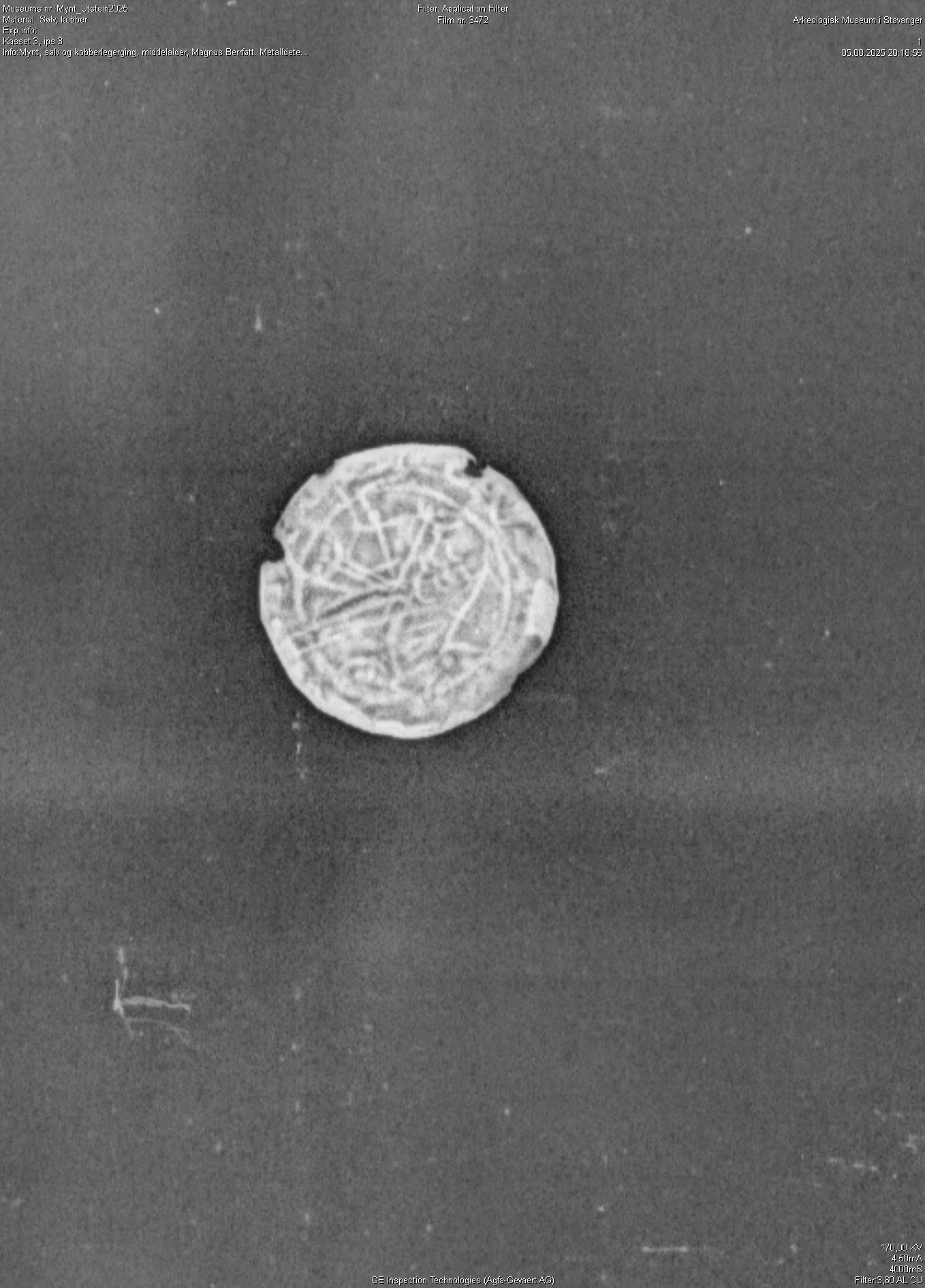
An X-ray image of the coin shows a griffin design. (Image credit: Hege Hollund, Archaeological Museum, UiS. )
To investigate the coin's covered side, the team X-rayed it. The scan revealed a griffin, a mythical creature with the body of a lion and features of a bird of prey. The motif has sometimes been interpreted as the lion of St. Mark, a Christian symbol, but the museum noted that the animal on these coins closely resembles a griffin. In medieval Christian art, griffins were used to symbolize Christ's dual nature as both human and divine.
The visible side revealed a "cross-over-cross" motif, with double-lined arms and small semicircles or bowl shapes at the ends. The pairing of the cross and griffin is what makes the coin so rare.
"Two-sided coins with the motif combination of griffin and cross over cross are only known from four copies," the statement said, with one coin from the Sandur hoard, found in the Faroe Islands in 1863, and three others from Denmark's Mørstad hoard, which was found this past spring and contains nearly 5,000 coins.
The rarity of such coins "may tell us something about the extent of Magnus Berrføtt's minting," museum representatives said in the statement.
In total, about 100 coins, spread across 12 discoveries, are known from Magnus Barefoot's reign, according to the museum. That makes every new example valuable for understanding how coins were produced and circulated in Norway in the late Viking Age and early Middle Ages.
Who was Magnus Barefoot?
Magnus Barefoot is sometimes called Magnus Barelegs, thanks to the kilts he wore. He became king in 1093 after the death of his father, Olav Kyrre (also called Olaf III of Norway), whose reign was remembered as a relatively peaceful period. Barefoot followed a different path. Like his grandfather Harald Hardrada, the Norwegian king killed at the Battle of Stamford Bridge in 1066, Barefoot built his reputation through warfare.
Barefoot spent much of his reign campaigning overseas. He sought to extend Norwegian power across the western sea routes, including the Isle of Man and parts of the Irish Sea. The museum noted that he was associated with the saying that a king was meant "for honor and glory, and not a long life." His death reflected this, as he died at around age 30, in 1103, when he was ambushed and killed during a campaign in Ireland.
The coin points to more than Barefoot's military ambitions. According to the museum, it also reflected one of his domestic reforms. Earlier Norwegian rulers had reduced the silver content of their coins, but Barefoot restored a high silver standard, with coins that were around 90% silver.
Whether the coin was lost at the Utstein Monastery during Barefoot's lifetime is impossible to know. Because it was turned into jewelry at some point, it may have circulated for years, or even generations, after it stopped being used as money.
See how much you know about ancient norsemen with our Viking quiz!

 Login