Oracle’s proposed investment in 2 gigawatts of renewable energy projects for New Mexico comes as local opposition could delay development of the Project Jupiter data center that Oracle is building for OpenAI.
The two tech companies are developing the $165 billion Project Jupiter data center in Santa Teresa, New Mexico, as part of the broader Stargate AI infrastructure project announced by President Donald Trump in 2025. But Project Jupiter faces local protests and court battles over concerns about its environmental impacts—and the latest Oracle announcement on September 8 seeking proposals for renewable energy projects does not change the fact that the data center will be powered by fuel cells that consume natural gas.
“Like all matching programs, this would be synthetic in the sense that 2 GW of renewables wouldn't directly power the data center,” wrote Michael Thomas, CEO of the Cleanview data platform that tracks renewable energy and data center projects, in a LinkedIn post.
When Edward Emerson Barnard peered through the 36-inch refractor at Lick Observatory on Sept. 9, 1892, and spotted Amalthea, it marked the first discovery of a moon of Jupiter in 280 years. Galileo had discovered the four largest jovian moons – Io, Europa, Ganymede, and Callisto – in 1610. Though this fifth moon was closerContinue reading "Sept. 9, 1892: Edward Emerson Barnard sees Amalthea"
An unexpected discovery by archaeologists has revealed an ancient cult object in the suddenly shallow waters of one of Europe’s longest rivers.
The discovery involves a portion of a limestone altar found near Dunaújváros in Hungary, uncovered during surveys of a riverbed located near Szalki Island.
Taking advantage of unusually low water levels in Europe this summer, archaeologists with the Intercisa Museum and Attila J. Tóth, a diver who specializes in underwater archaeology, had initially been searching for the possible remains of a medieval Pentelic Monastery in a portion of the Danube River.
The current drought conditions in Europe have revealed portions of the riverbed that are normally inaccessible. In recent days, the falling waters of the Danube and other waterways have also revealed several examples of archaeological features left over from the ancient Roman world.
Instead of the Pentelic Monastery they had hoped to find, Intercisa Museum archaeologists uncovered a fragmentary portion of a Roman altar dedicated to Jupiter, whose worship comprised the supreme public religion of ancient Rome.
Additional discoveries included fragments of tablets also made from limestone, adding to the surprises low water levels in the region have helped reveal this summer.
Ancient Intercisa’s Mysteries Emerge
Approximately 1,800 years ago, the Roman settlement of Intercisa was located where Dunaújváros stands today. This ancient military complex formed a significant part of the military infrastructure that connected parts of ancient Europe, and at such sites, it was common for Roman military personnel to establish altars devoted to Jupiter.
In past discoveries, many of these altars display explicit links to the military sites where they were found, including names of personnel, units, or other information linking them to sites like Intercisa, offering a look at the religious devotion undertaken as part of daily life at Roman frontier military outposts.
Discoveries—and Dangers—of Field Archaeology in Europe
Complicating archaeological work in the area had been the additional discovery of what was suspected of being an unexploded World War II munition, although the object was removed so that it could be disarmed.
According to some estimates, there are as many as millions of tons of unexploded ordnance leftover from World War II that are still buried across Europe. Around 10% of all the explosives dropped by Allied and Axis forces reportedly failed to detonate upon impact.
The discovery of these long-dormant explosives is a fairly common occurrence in Europe at construction sites, archaeological digs, and river dredging. The discovery of these objects sometimes also results in emergency evacuations and transit shutdowns.
A View of the Ancient Roman World at Intercisa
Right now, the discoveries are revealing new insights into the known activities that were undertaken at Intercisa.
In the days ahead, archaeologists with the Intercisa Museum hope that additional discoveries can be made while the Danube’s waters remain so low, although they warn that anyone who discovers artifacts in such newly exposed areas of the riverbed must report archaeological discoveries and also be wary of the possible discovery of remnant World War II explosives.
The limestone altar is only one of many archaeological features from the ancient Roman world that drought conditions in Europe have revealed recently in the Danube. Previously, The Debrief also reported that portions of Constantine’s bridge have recently resurfaced from the famous river’s waters.
Archaeologists with the Intercisa Museum also report recent discoveries that include a fragment of a Roman tombstone that still features traces of paint, as well as a large and nearly intact statue that they have retrieved from the Danube’s shallow or empty riverbeds—all of which add to the archaeological heritage that has long been preserved beneath Europe’s waterways.
Micah Hanks is the Editor-in-Chief and Co-Founder of The Debrief. A longtime reporter on science, defense, and technology with a focus on space and astronomy, he can be reached atmicah@thedebrief.org. Follow him on X @MicahHanks, and at micahhanks.com.
Traversing through the solar system, a comet split in two, and a recent study used six months of observations to investigate when and why.
A Split Comet
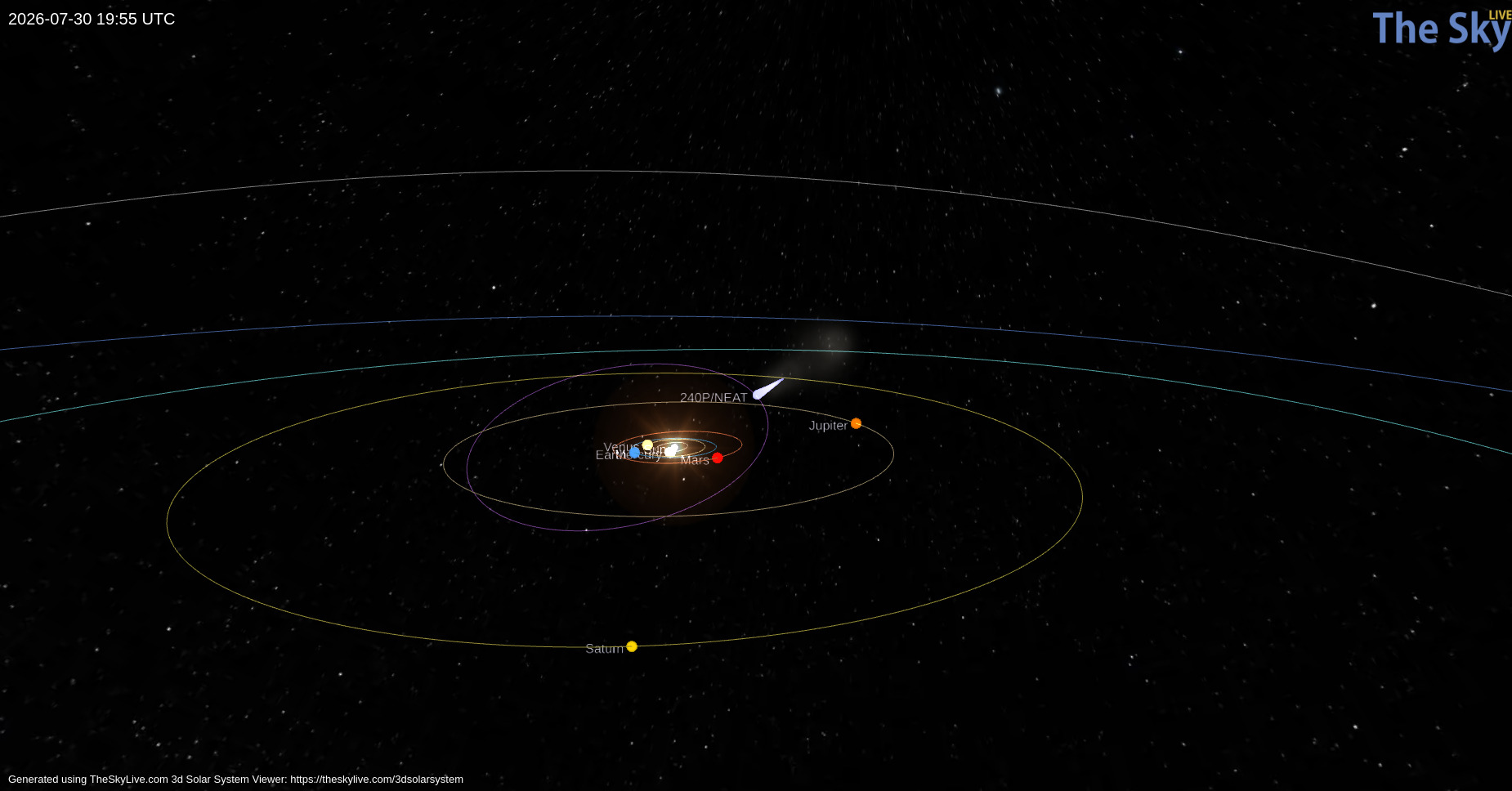
Orbital path of 240P/NEAT (purple) and the position of the comet on 30 July 2026 (light blue teardrop). Click to enlarge. [TheSkyLive]
While we often think of comets as icy remnants of the solar system’s formation that populate the Kuiper Belt and Oort Cloud, some comets make their homes closer to the Sun. One such class, known as Jupiter-family comets, traveled from the Kuiper Belt to short orbital periods (less than 20 years) whose paths through the solar system are shaped by Jupiter’s gravity. Discovered in 2002, 240P/NEAT is a Jupiter-family comet that loops between Jupiter and Mars on a 7.6-year orbit. Making close approaches to Jupiter, 240P experiences frequent, strong interactions with the gas giant that can alter the comet’s orbit and cause sudden bursts in brightness as ice and dust are heated and outgassed from the comet’s surface.
Most recently, 240P swept closest to Jupiter in July 2007, shifting the comet’s perihelion distance (closest approach to the Sun) from 2.5 to 2.1 au, and several long-lived bursts in brightness in 2018/2019 could have been spurred by this orbital shift. Excitingly, a fainter comoving object, 240P-B, was first reported in June 2025 as the comet headed toward perihelion — at some point recently, 240P had split in two!
Over the last century, numerous split comets have been recorded, but detailed physical studies of these objects are rare. With growing evidence suggesting splitting and disintegration are the primary mechanisms of comet destruction, understanding the properties and cause of 240P’s split is imperative.
Observing 240P
With 240P on the move to perihelion, David Jewitt (University of California, Los Angeles) and collaborators monitored the comet from October 2025 to April 2026 to establish the likely cause of its split. Employing the Alhambra Faint Object Spectrograph and Camera on the 2.56-meter Nordic Optical Telescope, the authors obtained detailed imaging of the comet from two months before to four months after perihelion to characterize both components.
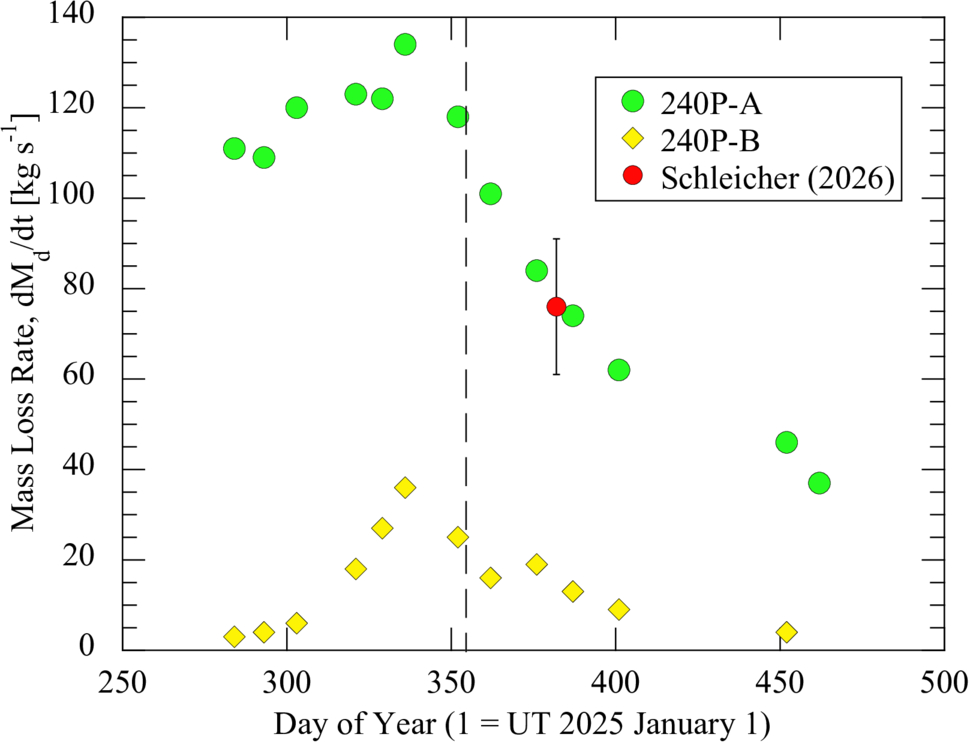
Tracking both photometric and morphological changes across their observations, the authors estimated the dust-loss rates, physical sizes, and separation speed of 240P-A and 240P-B. The brighter component, 240P-A, has an estimated radius between 400 and 600 meters and a dust-loss rate almost four times higher than 240P-B. Because 240P-B is fainter, its radius is harder to constrain observationally. From its lower dust-loss rate and lower brightness, the authors estimated a radius around 300 meters (and no smaller than 50). Based on how the separation of the two comet pieces changes over time, the authors determined that the split of 240P occurred at least three years before their observations.
Dust mass-loss rates for 240P-A (green circles) and 240P-B (yellow diamonds) over the course of the observations. Both components peak shortly before perihelion (dashed vertical line). Click to enlarge. [Jewitt et al 2026]
Source of the Split
How exactly did this fragmented comet get this way? The authors considered a number of comet-splitting mechanisms: tidal forces, asteroid impact, pressure buildup below the comet’s surface, thermal stresses, and rotational instability. Given the comet’s orbit, it has not had close enough encounters with the Sun or other planets for tidal forces to be the culprit, and it traverses well above the asteroid belt, avoiding collisions. Pressure buildup and thermal stresses can fracture comets, but both are unlikely to launch such a large fragment as seen in this system.
This leaves rotational instability as the likely source of 240P’s split. Outgassing torques lead to rotational instability, especially in subkilometer comets like 240P, and 240P has exhibited recent outgassing. In addition, the separation speed between the 240P components is comparable to the escape speed of the primary comet, which is expected for rotational breakup. To confirm this hypothesis, future observations measuring the rotation period of 240P are necessary, but this study adds to the small number of split-comet observations that aid in understanding comet destruction.
Scientists have measured temperatures beneath the surface of Jupiter's volcanic moon Io, offering the first-ever glimpse of the hidden heat driving the most volcanically active world in the solar system.
During close flybys of Io in late 2023 and early 2024, NASA's Juno spacecraft turned its Microwave Radiometer (MWR) instrument toward the moon, probing roughly six to 20 feet (two to six meters) beneath its surface. Originally designed to peer through Jupiter's thick clouds, the instrument instead revealed a powerful new way to study how heat moves through planetary crusts, according to a statement from the space agency.
"The surprising discovery that we could see below a rocky moon's surface has important implications for studying Earth's volcanoes," Scott Bolton, coauthor of the study and Juno's principal investigator, said in the statement. "Juno has taught us that if we look with an MWR-type instrument near a volcano on Earth, we might see a similar signature in the subsurface temperature gradient, providing new information on how terrestrial volcanoes work."
Until now, researchers had relied almost entirely on infrared observations, which detect only the temperature of Io's surface. By probing several feet underground, Juno has revealed how heat moves through the moon's crust for the first time.
The measurements showed temperatures rising by more than 40 degrees Fahrenheit (22 degrees Celsius) just a few feet below the surface — far more than sunlight alone could explain. Juno's subsurface heat map also revealed localized regions of elevated heat, with temperatures measuring between 18 and 36 degrees F (10 to 20 degrees C) warmer than the surrounding terrain, according to the statement.
Juno's observations uncovered another surprise, too. Despite being known for its towering mountains and active volcanoes, much of Io's surface appears remarkably smooth and composed of unusually low-density material. Researchers think the moon is blanketed by porous layers of volcanic ash, sulfur frost and other eruptive debris that continually resurface Io, burying older terrain beneath fresh deposits.
Scientists think the heat detected beneath Io's surface could be rising steadily from the moon's molten interior through a conductive crust or coming from pockets of cooling lava flows trapped just below the surface. Either way, the data provide the clearest picture yet of how Io transports heat from its interior.
Unlike Earth, where volcanism is driven largely by heat from radioactive decay, Io is continuously stretched and squeezed by Jupiter's immense gravity as it orbits the giant planet. This constant tidal flexing generates enormous amounts of internal heat, fueling hundreds of active volcanoes and making Io the most volcanically active object in the solar system. By improving scientists' understanding of how heat and magma move beneath a planet's surface before eruptions, the same microwave techniques used by Juno could one day help researchers better monitor Earth's volcanoes and improve eruption forecasting.
"Io provides a unique window into learning how tidal heating works throughout the cosmos, a fundamental process that provides energy and heat to worlds that are far from their parent star," Bolton said in the statement. "This process can not only create the most volcanic body in the solar system, in the case of Io, but also fuels the subsurface oceans on the moons of giant planets, such as Europa and Ganymede. Up until this point we could only observe the heat escaping at the surface or through eruptions. Now we can characterize how the heat is moving from the interior toward the surface."
Because Io is an extreme example of volcanic activity, it serves as a natural laboratory for studying how heat moves through planetary crusts. Those insights could help scientists better understand ancient volcanism on Mars, Venus, and Earth's moon, whose landscapes were shaped by massive eruptions billions of years ago.
The technique could also aid the search for life elsewhere. While Io itself is far too hostile to support life, microwave instruments can also probe beneath icy surfaces. Juno has already used the same instrument to study Jupiter's moons Europa and Ganymede, where scientists believe vast oceans lie hidden beneath thick shells of ice. Understanding how heat moves through those crusts is key to determining whether they could harbor environments suitable for life as we know it.
Their findings were published July 22 in the Journal of Geophysical Research: Planets.
Scientists discovered a rare planet larger than Jupiter orbiting a distant star once every 180 days. A planet nearly five times as massive as Jupiter circles a distant star once every 180 days. Known as NGTS-38 b, it is an exoplanet, meaning a world that orbits a star outside our solar system. NGTS-38 b is [...]
New data from NASA’s Juno spacecraft show temperatures spike more than 20 degrees Celsius just a few meters under Io’s surface, providing the first look at what’s happening below the crust of the Solar System’s most volcanic world.
NASA’s Juno mission scientists have reported the first successful temperature measurements below the surface of Jupiter’s moon Io, including indications of significant heating within the moon’s shallow subsurface.
Collected during a pair of close flybys of the Solar System’s most volcanically active world, the Juno mission measurements were described as a complete “surprise” since the instrument was designed for a different purpose.
“[The readings] break new observational ground for both fiery and icy worlds beyond our planet,” the team said.
MWR Instrument Designed to Probe Jupiter’s Atmosphere Provides Double Duty
Due to the extreme gravitational pull of its host planet, Jupiter, Io is repeatedly stretched and pulled as its slightly elliptical orbit carries it around the massive gas giant. This repeated motion generates a tremendous amount of heat, which the scientists note is “many times greater” than the same type of heat generated on Earth.
However, a detailed understanding of this process has remained elusive, as the only data on the moon’s inner heat came from infrared telescope observations. The team notes this data is limited to the temperature of Io’s upper rocky surface layer.
Conversely, Juno is equipped with an instrument called the Microwave Radiometer (MWR). According to the team’s statement announcing the successful subsurface temperature detection, Juno’s Microwave Radiometer was custom designed by Scott Bolton, the mission’s principal investigator at Southwest Research Institute in San Antonio and a co-author of the study detailing the team’s findings, to “peer beneath Jupiter’s top clouds” for a closer look at the gas giant’s complex atmosphere.
“The MWR’s six microwave antennas serve as a single instrument, simultaneously detecting microwaves at a wide range of wavelengths, from about half an inch to 20 inches (1.3 to 51 centimeters),” the team explains.
“Everywhere We Looked, We Found the Temperature Rising”
Bolton said the team’s novel approach allowed the instrument to observe wavelengths from different depths, “providing a new way to characterize the deep atmosphere of giant planets and the subsurface crusts of icy and rocky moons.” This included observations of Jupiter’s other ‘Galilean’ moons, Ganymede and Europa.
“At Ganymede and Europa, we explored tens of miles below the surface, assuming their ice shells were mostly pure water,” the mission scientists explained.
However, Bolton added, using the instrument to successfully probe into Io’s volcanic rock “was an unexpected discovery.”
This map represents data captured by the Microwave Radiometer instrument aboard NASA’s Juno, indicating heat rising from just beneath the surface of Jupiter’s moon Io. The colors illustrate a distinct temperature gradient across the moon, with the most extreme, localized heat output in red. Image Credit: NASA/JPL-Caltech/SwRI/USGS.
The feat was accomplished during a pair of flybys on December 30, 2023, and February 3, 2024, where Juno came within roughly 930 miles (1,500 km) of Io’s surface. Shannon Brown, the paper’s lead author at NASA’s Jet Propulsion Laboratory in Southern California, said that during these flybys the MWR instrument measured the moon’s thermal emission “at depths ranging from a few inches down to tens of feet.”
“Everywhere we looked, we found the temperature rising by more than 40 degrees Fahrenheit just several feet into the surface — a gradient far steeper than solar heating alone can explain,” Brown said.
This graphic illustrates the areas of Io sampled by the Microwave Radiometer instrument aboard NASA’s Juno spacecraft during two close flybys of the Jovian moon. Image Credit: NASA/JPL-Caltech/SwRI/USGS.
Although more information is likely needed to make a conclusive determination, the team said that the data suggests two possible explanations for the readings. The first option is heat rising steadily through what the team termed a “conductive crust.”
“While this background heat flow — measured at 1 to 3 watts per square meter — is relatively gentle on a local scale (roughly equivalent to a small nightlight glowing under every square yard), across the entire moon it represents a release of energy up to 30 times Earth’s average,” they explained.
Another possibility proposed by the joint research team suggested that the heat signal detected by Juno’s MWR could be coming from cooling lava flows covered by 30 to 35 feet (9 to 11 meters) of solidified crust that cover approximately 10% of Io’s surface “at any given time.”
A Similar Instrument Could be Used to Scan Earth
When discussing the implications of the team’s findings, Bolton said the “surprising” ability to see below Io’s surface “has important implications for studying Earth’s volcanoes.” He also noted that if scientists used a similar instrument to measure areas on Earth near volcanoes, they might see a similar heat signature in the planet’s subsurface temperature gradient, “providing new information on how terrestrial volcanoes work.”
“Io provides a unique window into learning how tidal heating works throughout the cosmos, a fundamental process that provides energy and heat to worlds that are far from their parent star,” Bolton explained. “This process can not only create the most volcanic body in the solar system, in the case of Io, but also fuels the subsurface oceans on the moons of giant planets, such as Europa and Ganymede.”
“Up until this point, we could only observe the heat escaping at the surface or through eruptions,” the mission scientists added. “Now we can characterize how the heat is moving from the interior toward the surface.”
Christopher Plain is a Science Fiction and Fantasy novelist and has spent the last six years as Associate News Editor and Head Science Writer at The Debrief. Follow and connect with him on X, learn about his books at plainfiction.com, or email him at christopher@thedebrief.org.
Una nueva investigación sugiere que la luna helada de Júpiter no tiene la actividad geológica necesaria en su fondo marino para sostener ecosistemas como los de la Tierra, lo que obliga a replantear cómo y dónde buscar señales de vida más allá de nuestro planeta.
Europa, uno de los satélites más estudiados de Júpiter, ocupa desde hace años un lugar privilegiado en la lista de mundos potencialmente habitables del sistema solar. Bajo una corteza de hielo de varios kilómetros de espesor, los científicos creen que se esconde un océano global de agua líquida, con un volumen comparable o incluso superior al de todos los mares terrestres juntos. La combinación de agua, energía y química ha convertido a este mundo helado en un objetivo prioritario para la astrobiología.
Sin embargo, una nueva investigación publicada en Nature Communications introduce un matiz importante —y poco alentador— en este escenario. Según el estudio, el fondo oceánico de Europa podría ser geológicamente inactivo, incapaz de generar las fracturas y procesos que en la Tierra alimentan algunos de los ecosistemas más antiguos y resistentes del planeta. De confirmarse, esta característica limitaría de forma significativa las fuentes de energía química disponibles para la vida.
El papel clave del fondo oceánico en la Tierra
En nuestro planeta, gran parte de la vida marina profunda no depende del Sol. En lugar de fotosíntesis, numerosos organismos obtienen energía de reacciones químicas que se producen en torno a fuentes hidrotermales del fondo oceánico. Estas chimeneas se forman cuando el agua de mar se filtra por grietas de la corteza terrestre, se calienta al contacto con rocas calientes y emerge cargada de compuestos químicos reducidos.
Este proceso, conocido como serpentinización y otras reacciones agua-roca, libera hidrógeno, metano y minerales que sirven de combustible para comunidades microbianas complejas. Alrededor de estas fuentes prosperan bacterias, arqueas y organismos multicelulares, demostrando que la vida puede florecer incluso en condiciones extremas y sin luz solar.
Durante décadas, los científicos han especulado con la posibilidad de que un proceso similar ocurra en Europa. La presencia de un océano profundo, estimado en unos 97 kilómetros, y el calentamiento interno generado por las fuerzas de marea de Júpiter parecían ingredientes suficientes para sostener actividad geológica en el fondo marino.
Un cálculo detallado de las fuerzas internas
El nuevo estudio se propuso poner a prueba esa suposición con un enfoque cuantitativo. Los investigadores calcularon cuánta tensión mecánica sería necesaria para activar fallas y fracturas en el fondo rocoso de Europa. A continuación, compararon ese umbral con las fuerzas reales que actúan en el interior de la luna.
La principal fuente de energía considerada fue la fuerza de marea ejercida por Júpiter. Europa orbita al gigante gaseoso cada 84 horas, lo que provoca que el satélite se estire y se comprima de forma rítmica. Este efecto es responsable, por ejemplo, de la intensa actividad volcánica de Ío, otra luna joviana. En el caso de Europa, esas mismas fuerzas son las que mantienen el océano en estado líquido bajo el hielo.
No obstante, los resultados muestran que la tensión generada por las mareas apenas alcanza alrededor del 3 % de la necesaria para reactivar fracturas en el fondo oceánico. Incluso suponiendo que la roca esté debilitada tras miles de millones de años de deformación, la energía disponible seguiría siendo entre diez y doce veces inferior a la requerida para un proceso tectónico sostenido.
Otros mecanismos que no alcanzan
El equipo también analizó otras posibles fuentes de deformación interna. Una de ellas es la convección en el manto, la capa situada entre el núcleo rocoso y el océano. En teoría, el movimiento lento de materiales calientes podría generar tensiones suficientes para fracturar la base del océano.
Sin embargo, incluso en los escenarios más optimistas, la fuerza resultante de esa convección sería cientos de veces demasiado débil. Otra posibilidad considerada fue la contracción del interior de Europa a medida que se enfría con el paso del tiempo. Para que este proceso generara fracturas, el núcleo rocoso tendría que reducir su tamaño en aproximadamente un kilómetro, una cifra considerada poco realista dadas las propiedades físicas del satélite.
En conjunto, estos cálculos apuntan a un fondo oceánico estable y rígido, sin la dinámica necesaria para mantener un intercambio continuo entre el agua del océano y las rocas profundas.
El problema del equilibrio químico
La falta de fracturas activas tiene implicaciones directas para la química del océano de Europa. Sin grietas profundas, el agua solo puede interactuar con las capas superiores del fondo rocoso, limitando las reacciones químicas a unos pocos cientos de metros. Con el tiempo, esa zona alcanza un equilibrio químico con el océano que la cubre.
Cuando se llega a ese punto, las reacciones dejan de liberar energía aprovechable. Para organismos que dependan de la química agua-roca, esto supone una pérdida progresiva de su fuente de “alimento” energético. A diferencia de la Tierra, donde la tectónica de placas renueva constantemente la corteza oceánica, Europa carecería de un mecanismo comparable para reactivar el sistema.
Este escenario no descarta por completo la vida, pero sí reduce las probabilidades de encontrar ecosistemas extensos y dinámicos similares a los que rodean las fuentes hidrotermales terrestres.
Energía alternativa en un mundo helado
A pesar del panorama poco alentador, el estudio no cierra la puerta a la habitabilidad de Europa. Los autores destacan que existen fuentes de energía independientes de la tectónica activa. Una de ellas es la radiolisis, un proceso en el que la radiación procedente del decaimiento de elementos radiactivos como el uranio, el torio o el potasio rompe las moléculas de agua y produce hidrógeno.
En la Tierra, este mecanismo sostiene comunidades microbianas en rocas muy antiguas, a varios kilómetros de profundidad, completamente aisladas de la superficie. Estos microorganismos utilizan el hidrógeno generado como fuente de energía, demostrando que la vida puede subsistir en entornos extremadamente limitados.
La gran incógnita es si este tipo de energía sería suficiente para mantener un ecosistema completo en Europa o solo pequeñas poblaciones microbianas dispersas. La eficiencia del proceso y la disponibilidad de elementos radiactivos en el interior del satélite siguen siendo cuestiones abiertas.
Implicaciones para la exploración espacial
El hallazgo llega en un momento clave para la exploración de Europa. La misión Europa Clipper de la NASA, lanzada en 2024 y con llegada prevista al sistema joviano en 2030, tiene como objetivo principal evaluar la habitabilidad de la luna. El orbitador realizará decenas de sobrevuelos cercanos, utilizando instrumentos capaces de medir el grosor del hielo, la composición química de la superficie y el flujo de calor interno.
Uno de los aspectos más esperados de la misión es la posible detección de géiseres o plumas de agua que emerjan a través de la corteza helada. Si existen, estas columnas podrían transportar material del océano al espacio, permitiendo analizar su composición sin necesidad de perforar el hielo.
Aunque Europa Clipper no está diseñada para estudiar directamente el fondo oceánico, sus mediciones ayudarán a refinar los modelos internos del satélite y a comprobar si las predicciones del nuevo estudio se ajustan a la realidad observada.
Un cambio de enfoque en la búsqueda de vida
La idea de un fondo oceánico inactivo obliga a replantear algunas estrategias de búsqueda de vida en Europa. En lugar de centrarse exclusivamente en analogías con las fuentes hidrotermales terrestres, los científicos podrían explorar otros escenarios, como microhábitats químicos sostenidos por radiación o procesos superficiales que introduzcan oxidantes en el océano.
Este cambio de perspectiva no resta importancia a Europa como objetivo científico, pero sí subraya la complejidad de evaluar la habitabilidad de mundos lejanos. La presencia de agua líquida, aunque fundamental, no garantiza por sí sola la existencia de vida.
A largo plazo, responder de forma definitiva a estas preguntas requerirá misiones aún más ambiciosas, capaces de penetrar la corteza helada y explorar directamente el océano oculto. Hasta entonces, estudios como este ayudan a afinar las expectativas y a comprender mejor los límites y posibilidades de uno de los mundos más intrigantes del sistema solar.
HD 80606b has one of the most extreme orbits of any known exoplanet and the NASA/ESA/CSA James Webb Space Telescope just caught it getting flash-fried as it whipped past its star.
Astronomers have long wondered whether life on Earth might have had origins somewhere else in the cosmos. The idea that the key ingredients for life, or even simple organisms, might be carried through space by non-animate objects—a concept known as panspermia—has been proposed as one way such “seeding” of life on Earth might have occurred.
But what if it could also happen in reverse? In other words, what if life were one day found on an alien moon, which could later be traced back to Earth?
This is the very idea presented in a new study that explores the provocative idea that Jupiter’s frozen moon Europa may not only be hospitable, but that life from Earth could be thriving there.
In the new study, published in the International Journal of Astrobiology, astrophysicist Zaza Osmanov of the Free University of Tbilisi explored whether Earthly bacteria might have been able to escape our planet by traveling on microscopic dust particles, which, after escaping Earth’s gravity, could have drifted through space until they reached Europa.
There, a vast subsurface ocean is believed to exist beneath the moon’s icy crust, meaning that any simple organisms capable of escaping from Earth on tiny spacefaring rafts of dust might have found their way to a new home, and one that could support life.
Panspermia, but in Reverse
The long-debated idea of panspermia already presents the general idea for how this might work. However, Osmanov’s study investigates this idea in reverse order: not only might life on Earth have originated from elsewhere, but our planet could also hypothetically be the source of similar “seeding” events that might occur on alien worlds.
Based on mathematical models, Osmanov calculated how bacteria-rich dust grains could be launched into space, resulting from collisions with incoming dust in Earth’s upper atmosphere. Upon escaping the planet’s gravity, some of these bacteria might be able to sail along toward distant locales like Europa with the help of pressure generated by solar radiation—essentially the same concept as a solar light sail spacecraft, albeit much smaller.
With the help of solar radiation and occasional gravitational interactions, Osmanov theorizes that some particles might eventually be “steered” by such natural processes over time, eventually making their way to Jupiter.
Tiny Earthling Alien Invaders
Based on Osmanov’s estimates, there could potentially be as many as hundreds of millions of Earth-originating dust particles that might make their way to Europa every second. That’s a significant number, and although he estimates that the majority would be destroyed on impact, a small fraction could arrive at extremely shallow angles, which he believes may be able to survive landing on Europa’s surface.
However, even if a few bacterial invaders managed to survive, the next challenge they would face would be to reach the moon’s ocean that astronomers believe to be concealed beneath its icy exterior. Based on past studies, tidal forces generated by the massive host planet Jupiter offer a solution: such events are believed to likely cause fractures in Europa’s icy shell, which lead to the creation of entry points where surface materials might be capable of migrating downward.
Adding to this, Osmanov also points to instances where ice melting may also provide a means for the movement of material from the surface down into the moon’s hidden ocean. Over periods of thousands of years, some of these tiny bacterial invaders might make their way past the harsh surface environment and down into the moon’s far more hospitable subsurface ocean.
Osmanov estimates that there may be considerable numbers of Earth-derived particles that could reach Europa’s ocean over geological timescales. This could mean that terrestrial particles, Earthly microbes that have made the journey, may have had time to establish themselves as microbial colonists—if, of course, current presumptions about the moon’s conditions for supporting life are correct.
While the theory remains speculative, and Osmanov concedes that it cannot be tested directly at present, it suggests something fascinating: that the eventual discovery of life on an alien world could have ancestral links to our own planetary home.
Micah Hanks is the Editor-in-Chief and Co-Founder of The Debrief. A longtime reporter on science, defense, and technology with a focus on space and astronomy, he can be reached atmicah@thedebrief.org. Follow him on X @MicahHanks, and at micahhanks.com.
Using NASA’s Goldstone Solar System Radar and NSF’s Green Bank Telescope, astronomers from the University of California, Los Angeles, confirmed that the icy surface of Jupiter’s moon Europa scatters radio energy in an unusually strong and complex way not seen on rocky worlds.
Ce soir, deux points brillants dans le ciel pourraient attirer votre regard : deux planètes presque collées l’une à l’autre. De quoi vous faire patienter un peu jusqu’à un autre rendez-vous avec la Lune dans quelques jours.
Jupiter’s upper atmosphere is hundreds of degrees hotter than it has any right to be, and for decades astronomers could only study it in brief, seemingly chaotic glimpses. New global maps built from years of observations have finally revealed the big picture — and it is surprisingly calm.
Order from Chaos
Although we’re well acquainted with Jupiter, having sent eight spacecraft on close passages and lived with it dominating the night sky for millennia, some of its simplest characteristics continue to puzzle us. For example, high above Jupiter’s cloud bands, temperatures exceed 800 K — far hotter than we’d expect given the meager sunlight that reaches that distance. Astronomers have long suspected that this excess is deposited by energy from the planet’s brilliant polar auroras, but previous observations provided only localized, sporadic snapshots that collectively painted a confusing picture of an ever-changing landscape.
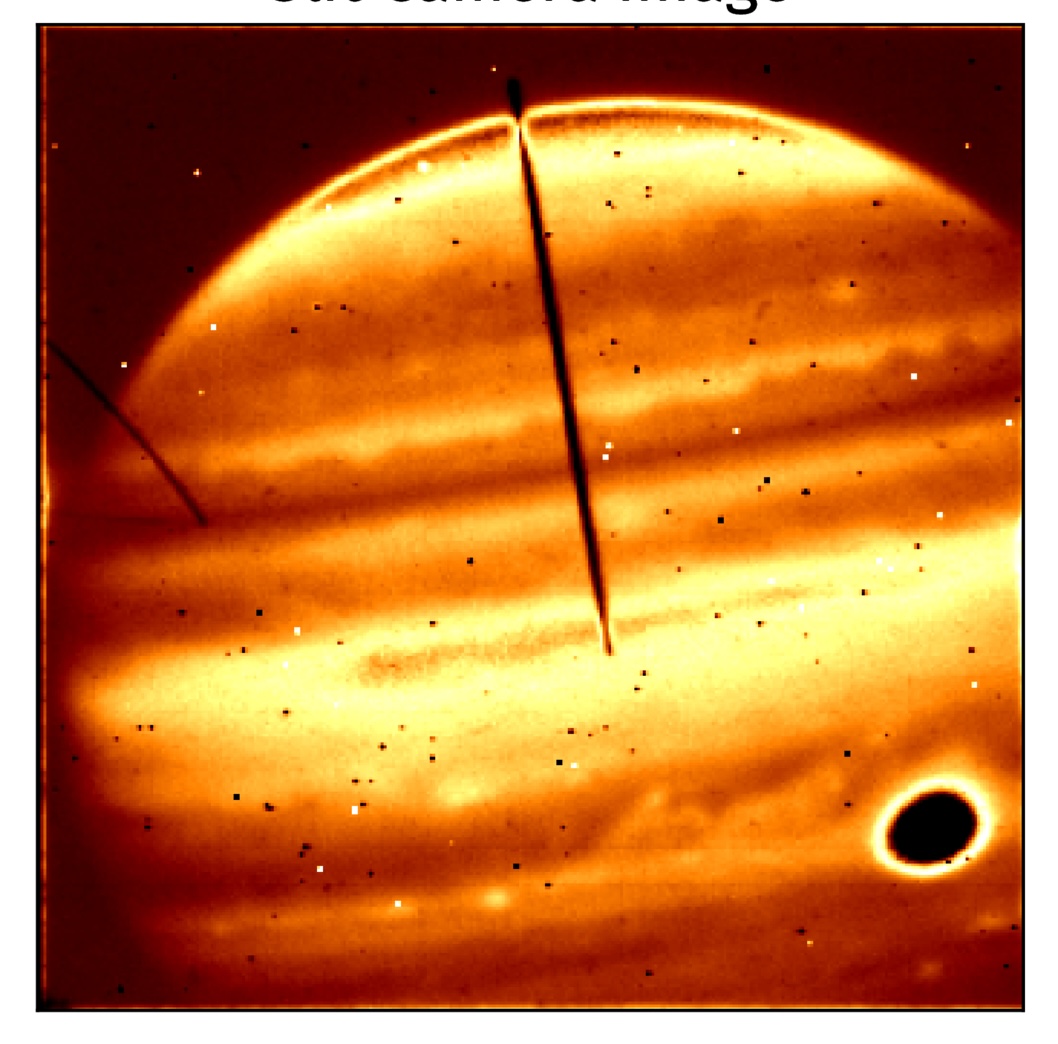
Jupiter as seen by the slit camera on the Keck telescope during one of the team’s observations. The spectrograph slit is the dark vertical band stretching from the equator to the north pole, and the Great Red Spot appears in black at the lower right. [Adapted from Roberts et al. 2026]
To truly understand how Jupiter’s upper atmosphere got so hot and whether it was actually changing over time, astronomers needed to construct a global, comprehensive map — and then do so repeatedly over several years and look for any changes. A team led by Kate Roberts (Boston University) has now assembled just this sequence using the NIRSPEC instrument at the Keck Observatory. The researchers collected over 175,000 high-resolution infrared spectra across 14 nights from 2022 to 2025; they then processed the massive dataset to extract the emission from a charged form of hydrogen, H3+. This species is a standard natural thermometer that glows at infrared wavelengths, and by mapping the spectra to their corresponding specific locations on Jupiter, the team could construct the first true global maps of Jupiter’s upper atmospheric temperature, density, and radiance.
Consistency is Key
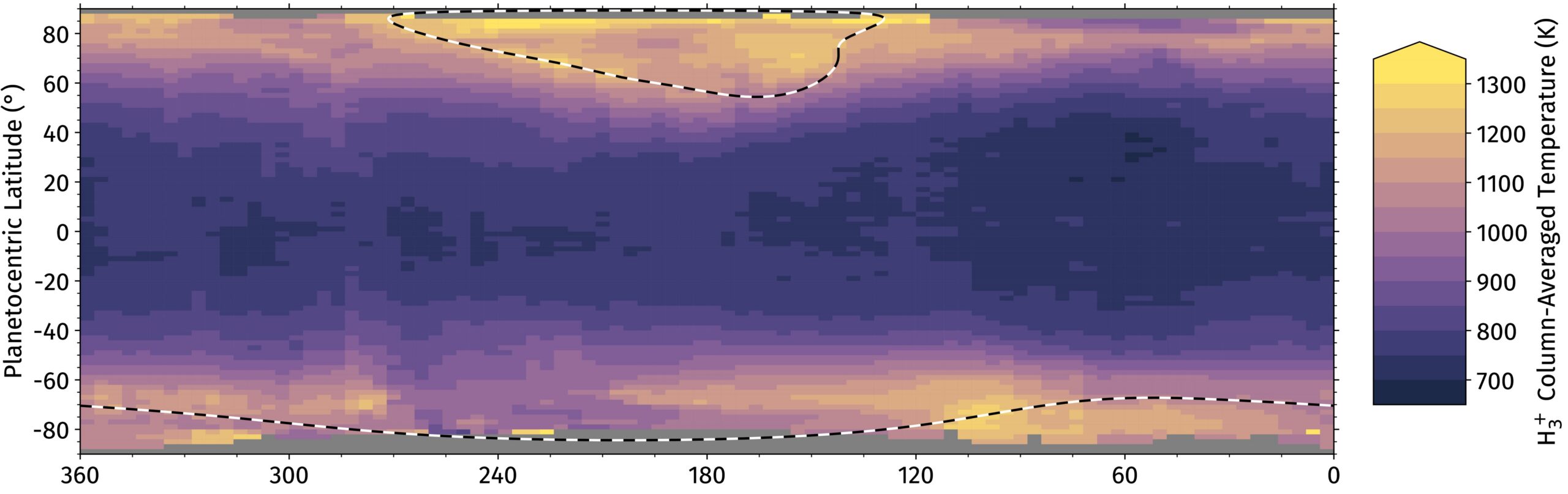
A look at how the maps evolved over time revealed striking order: the spatial patterns remained nearly constant, and the temperatures barely changed even over years. In general, the team noted that temperature decreases smoothly from the auroral regions near the poles (~1,150 K) to the equator (~750 K) at every longitude, and that although there is some night-to-night temperature variation, things stay remarkably steady over the years-long baseline.
A map of the average temperature of Jupiter’s upper atmosphere, as measured by the new Keck NIRSPEC data. Click to enlarge. [Adapted from Roberts et al. 2026]
What once “appeared stochastic,” the authors write, “exhibits predominantly spatial rather than temporal variability.” Earlier observations were simply sampling different longitudes at different times, mistaking geography for weather.
The conclusion that the upper atmosphere is complex but steady has implications beyond just Jupiter, as the team notes that JWST has already observed spatial patterns in the temperatures of the upper atmospheres of both Uranus and Neptune. As Roberts and colleagues note, “similar physical mechanisms could give rise to comparably stable structures” on those distant ice giants, meaning this analysis could ground our understanding of the upper atmospheres of giant worlds across the solar system.
Citation
“A Global View of Jupiter’s Upper Atmosphere Through H3+,” Kate Roberts et al 2026 ApJL998 L13. doi:10.3847/2041-8213/ae3c9b
By piecing together observations from dozens of radio telescopes in Chile, planetary scientists recently completed the first-ever map of Callisto’s emission at millimeter wavelengths.
Old and Cold
In striking contrast to Io’s frenzied volcanism and Europa’s cracking ice shell, Jupiter’s moon Callisto is much quieter and colder than its Galilean siblings. Though a liquid water ocean hypothetically sloshes beneath its frigid surface, it’d be hard to infer that just by looking at the moon. Callisto’s terrain is ancient, static, and bears the scars of the millennia of exposure to space. There are no volcanoes, plate tectonics, or any other features to disturb what researchers call “evolved ruins” of the numerous craters. These have names like Valhalla, Asgard, and Lofn, since Callisto’s geologic features are named after settings and characters in Norse mythology to further reinforce their freezing existence.
This never-reset canvas makes Callisto an ideal laboratory for studying the long-term effects of asteroid impacts, dust accumulation from nearby natural satellites, and other processes that modify a planetary surface over time. One way to infer the composition and structure of the first few meters of material is to observe the way the temperature changes over the course of a day. For example, ice and rock respond differently to temperature changes; similarly, small-grains of either material warm up and cool down at different speeds than their larger-grain counterparts.
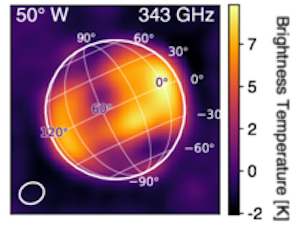
The residuals from one of ALMA’s observations of Callisto. [Adapted from Camarca et al. 2025]
In theory, planetary scientists can measure the temperature of a moon by noting how bright each patch of its surface appears in millimeter-wavelength observations. However, this is easier said than done, as only a handful of telescopes are capable of seeing Callisto as anything more than a fuzzy blob at those wavelengths. Back in 2016–2017, planetary scientists used the Atacama Large Millimeter/submillimeter Array (ALMA), a radio interferometer in Chile, to attempt the challenging feat of making a map of Callisto’s surface.
Mapping from Afar
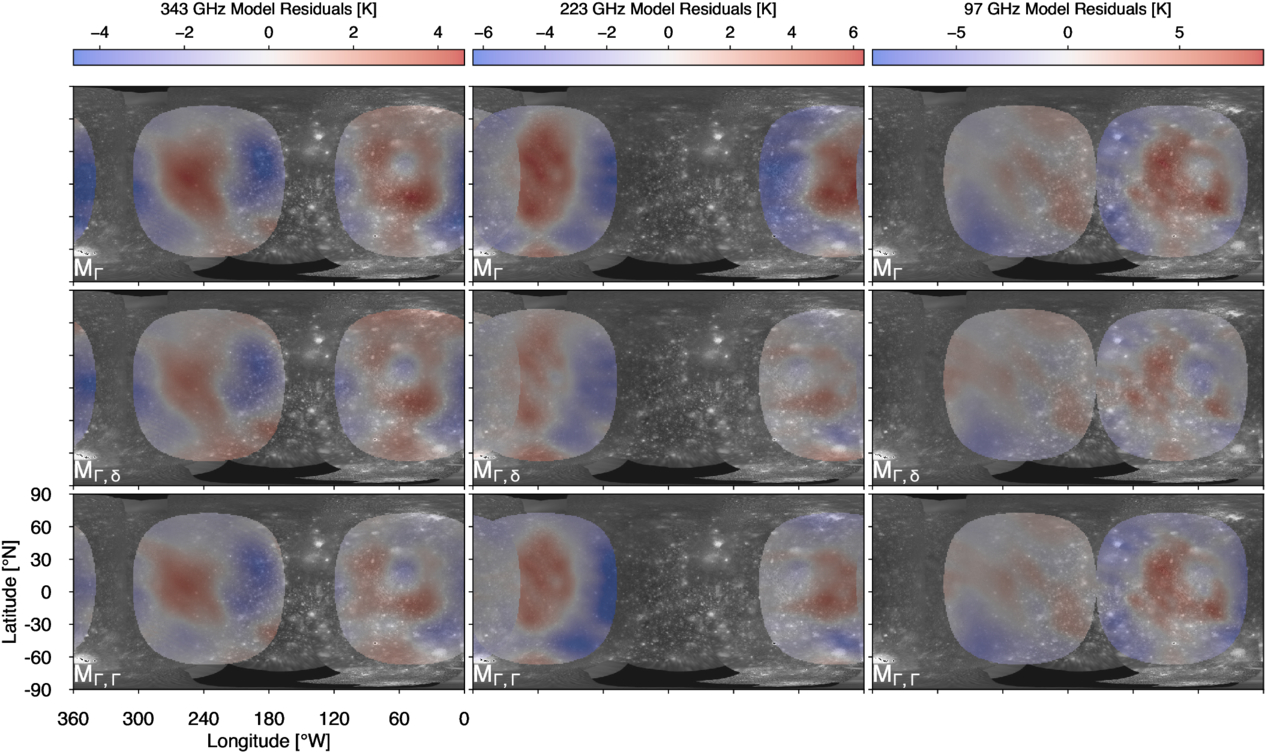
A team led by Maria Camarca, California Institute of Technology, just finished churning through all of the data and assembling their map of Callisto’s temperature residuals. Though the final spatial resolution was at best a few hundred kilometers, meaning a comparable map of Earth would blur all of New England together, this represents the most detailed thermal map of Callisto yet. The map was detailed enough to easily spot the largest craters, and several impact craters including Valhalla stood out as being 3–5K colder than all of the surrounding terrain. The team spotted another anomalously cold region that coincides with the location of maximum carbon dioxide gas density recently seen with JWST.
A map of Callisto’s thermal emission (red/blue) overlaid atop visible images of the surface collected by spacecraft. Click to enlarge. [Camarca et al. 2025]
The team also found that their data could not be explained by a simple model for Callisto’s surface that assumed one dominant material and structure. Instead, their images were better explained by more complex simulations that use two different thermal inertias. Though they are not sure yet why this may be, it is clear that Callisto, often overlooked compared to its flashier siblings, is a complex world worthy of further study. Luckily, the upcoming Jupiter Icy Moons Explorer mission and ALMA’s Wideband Sensitivity Upgrade will bring new knowledge of Callisto’s ancient surface.
Citation
“A Multifrequency Global View of Callisto’s Thermal Properties from ALMA,” Maria Camarca et al 2025 Planet. Sci. J. 6 183. doi:10.3847/PSJ/ade7ee
The giant planet’s bow shock isn’t just deflecting the solar wind, it’s acting as a powerful particle accelerator, firing electrons to relativistic energies of at least 1 MeV, according to a new analysis of data from NASA’s Juno spacecraft.

 Login