 Login
Spain Opens Advanced Quantum Nanofabrication Facility in Barcelona
16 September 2026 at 17:00
Spain opens a €6M quantum chip facility in Barcelona, adding fabrication capacity as Europe expands its quantum and semiconductor infrastructure.

 Researchers have directly observed the optical Magnus effect for the first time, revealing a tiny shift in laser interactions that could affect the precise control of qubits in quantum computers. Anyone who has watched a spinning soccer ball curve around a defensive wall has seen what happens when spin changes an object’s path through the [...]A new invention could significantly improve electron microscopy by integrating a small quantum computer directly into the microscope. For delicate samples such as individual proteins, electron microscopy faces a fundamental tradeoff. Producing a clearer image generally requires sending more electrons through the specimen, but increasing the dose also raises the risk of damaging the very [...]

NEC was one of the first developers of quantum computers back in the 1990s, but it is now among the first companies that originally researched quantum computing technologies to quit development of quantum computing hardware, according to a Diamond Online report. However, the company will continue to investigate practical applications for quantum computers.
NEC has been involved in superconducting quantum computing research since the technology's earliest days. In 1999, NEC researchers demonstrated the world's first superconducting solid-state qubit, which became a foundation of superconducting quantum computing. Variations of this technology are now being used by Google and IBM to build their quantum computers. However, it turns out that the Japanese technology giant quietly ended development of physical quantum computing machines in March 2026, and many of its researchers subsequently moved to rival Fujitsu.
Despite its historical role, NEC has apparently concluded that developing commercial quantum computing hardware will take too long to generate adequate returns. As a result, the company quietly discontinued development of quantum computing machines at the end of March, according to Diamond. A number of researchers involved with the program — reportedly including a key research leader — have since moved to Fujitsu, which continues to invest heavily in superconducting quantum computing hardware.
Meanwhile, NEC does not formally characterize the move as a withdrawal from quantum computing. In response to Diamond, the company declined to comment on whether it had exited quantum computer development and said that it continues to evaluate practical applications and industrialization of quantum technologies as well as conduct proof-of-concept projects with customers. Therefore, the move appears to represent an exit from development of actual quantum computers rather than from quantum technology altogether. NEC can continue working on quantum applications, software, algorithms, and customer projects without assuming the cost and risks associated with designing and building quantum processors and complete quantum computing systems.
For Fujitsu, the arrival of experienced NEC researchers could strengthen an already advanced superconducting quantum computing operation. Last year Fujitsu and Riken launched a 256-qubit superconducting quantum computer and have been working toward a machine with more than 1,000 qubits in 2026. In addition, Fujitsu has outlined plans to develop systems exceeding 10,000 superconducting qubits by fiscal 2030.
NEC's withdrawal is particularly notable because virtually none of the major corporate laboratories that pioneered quantum computing in the 1990s and remain intact today have completely abandoned quantum-computer hardware. IBM, the other major corporate participant in some of the earliest experimental quantum computers, has instead become one of the industry’s largest developers of quantum computing systems.
NEC is no stranger to leaving businesses that have significant prospects ahead but require massive capital investments immediately. In 1990, NEC ranked No. 1 globally in semiconductor sales, ahead of Toshiba, Hitachi, Motorola, Intel, and Fujitsu. Intel subsequently overtook NEC during the 1990s as the PC microprocessor market exploded, but in 1990, NEC was significantly ahead. So, NEC's 1999 superconducting-qubit breakthrough did not come out of nowhere, but from a company with a huge semiconductor R&D organization and deep expertise in solid-state devices. By then, NEC was no longer the No. 1 semiconductor supplier, but it remained one of the world's major semiconductor companies.
The demise of NEC's semiconductor business was not sudden. NEC dismantled its semiconductor business in stages over roughly a decade. NEC effectively gave up doing DRAM alone in 1999, when it spun off its DRAM operations into NEC-Hitachi Memory, which was named Elpida. In November 2002, NEC spun its remaining semiconductor operation — MCUs, system LSIs/SoCs and other devices — into a separate company called NEC Electronics and later renamed Renesas Electronics.
Now, NEC is reportedly stepping away from quantum computer hardware as its commercialization remains distant, but development costs continue to mount. Furthermore, given NEC's current business focus — IT services, enterprise systems, aerospace and defense, telecom infrastructure, and AI and security — quantum computers are not exactly a natural fit.
Qubits are delicate and often misbehave. A qubit’s advantage over an ordinary bit is that in addition to “0” or “1”, it can hold values of 0 and 1 at once, in a specific combination; that combination is what quantum algorithms actually run on. But any stray interaction with the surrounding world (a vibration, a stray field, a single errant photon) leaks out a bit of information about which state the qubit is in – and that’s enough to collapse the combination back into an ordinary, classical either/or state. Coupling to the environment leads to high decoherence, meaning high error rates, and is normally how we lose good quality qubits. As such, most of the engineering effort in quantum computing goes into avoiding this coupling.
Yet recently, a team at the Institute of Science and Technology Austria (ISTA), working with collaborators in Munich and Madrid, has defied this norm.
Writing in Physical Review X, Alejandro Andrés-Juanes, Johannes Fink and colleagues show that two superconducting transmon qubits, separated by a metre of coaxial cable, can settle into an entangled state by being exposed to the same quantum-correlated microwave field. Avoiding synchronized pulses, heralding, post-selection and feedback (techniques usually used to actively generate and verify entanglement, rather than to fix decoherence), the entanglement can be generated and maintained for as long as the field is on. In other words, the researchers have managed to exploit noise to generate entanglement, rather than losing their qubits to it.
This idea of entangling by using fields belongs to a family of techniques known as dissipation engineering. “The common understanding is that the environment is bad, and it will decohere your qubits,” Andrés-Juanes tells Physics World. “The main idea [here] is that one can engineer a specific interaction with the environment that is not detrimental but – like in this case – prepares your qubits in an interesting state without you having to actively apply any action on the system.”
This proposal dates back more than 20 years, to work performed by Barbara Kraus and Ignacio Cirac, but this is its first experimental realization.
The correlated environment comes from a superconducting device (a Josephson parametric converter) that splits each pump photon into a pair of photons at gigahertz frequencies. The two photons of this pair are entangled with one another and each is sent down its own coaxial cable to one of the qubits, half a metre away in either direction.
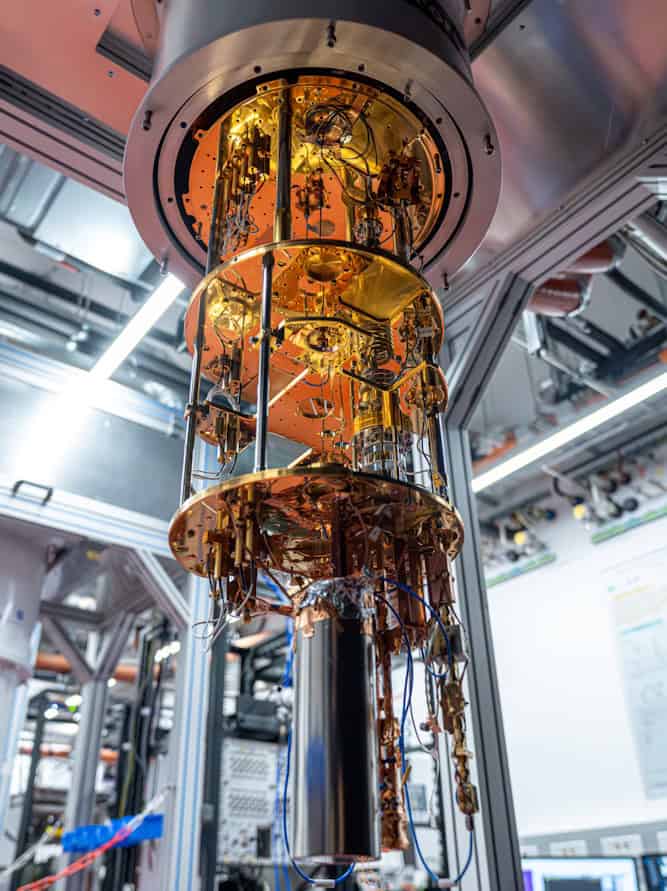
Because the noise reaching the two qubits is correlated, relaxing into it does not scramble them (specifically, it does not wash out the fixed phase relationship between them, as independent noise on each qubit would). They settle instead into a superposition, for which absorbing a photon from the field and emitting one into it interfere destructively: “the destructive interference between a photon emission event in the first waveguide and a photon absorption process at the location of the second qubit,” as the authors explain.
Once there, the qubits stop evolving and the field passes through unchanged: the entangled state is dark, invisible to the very field that created it. What the experiment does, in effect, is convert the continuous-variable (CV) entanglement carried by the two microwave beams into ordinary entanglement between two conventional transmon qubits – “we obtain qubit entanglement from CV entanglement,” Andrés-Juanes confirms – with roughly a tenth of it inherited.
Most entanglement-distribution schemes deliver entanglement as events: a pulse sequence runs, a detector clicks, a pair is announced, and the state then decays until the sequence runs again. The author’s autonomous version could enable the elimination of this machinery.
“It removes a lot of overhead on the pulse sequences you need to run to get the entanglement,” says Andrés-Juanes, an advantage that’s expected to matter most at scale, since one correlated photon source can drive many pairs at once. “Another differential feature of this protocol is that the entanglement is ‘always on’ for when you need to use it. In active protocols, you would have to reinitialize the entangled state because it would decohere after a while.”
The practical limit of this setup is temperature: “We use microwave frequencies, which are only quantum at very low temperatures,” Andrés-Juanes explains. “The real limit in the separation is how big your dilution refrigerator is”, with the longest such link so far being 30 m, at ETH Zurich. He positions the work as an intermediate-distance technology rather than a long-distance one. At optical frequencies, the constraint would lift, though achieving the same strong qubit–waveguide coupling in an atomic system would be its own problem.
For now, the numbers are modest: two qubits, entangled with a concurrence of just 0.10 (on a scale where 1 is a perfect pair), inheriting only about a tenth of the entanglement carried by the microwave beams. The group is working on a module with more than one qubit per node.
But critically, the idea is no longer theoretical. The team has now realised an entangled link that is always “there”, bringing us one step closer to distributed quantum computing (linking separate processors into one machine via entanglement), networked sensing (detectors sharing entanglement to jointly see what none could alone) and quantum repeaters (relay stations for long-distance quantum links, needed because a quantum state can’t be copied and amplified like a classical signal).
The post Noise that entangles may accelerate the dawn of quantum technologies appeared first on Physics World.
Researchers at the Flatiron Institute in New York City have used a new tensor network (TN) scheme to simulate how Ising spin glasses evolve in time. In many cases, their classical method is more accurate than the latest quantum annealers running the same problem. The results scale in two and three dimensions and raise the bar in the ongoing competition between classical and quantum computers for simulating many-particle quantum systems.
Quantum many-particle systems provide a good way of comparing computational techniques because their complexity grows exponentially with the number of particles. In theory, quantum computers hold an advantage rooted in entanglement and superposition. In a classical computer, the spin of a particle (up or down) is encoded in bit that is either zero (down) or one (up), but never both. In a quantum computer, the spin can be encoded in a qubit holding a quantum superposition of up and down. This is a much more natural way to represent what the simulated system is actually doing.
Recently, a team of quantum computing researchers used the D-Wave’s Advantage2 quantum annealer to simulate Ising spin glass dynamics and claimed that classical computers could not match their results. But now, Joseph Tindall and colleagues at the Flatiron Institute have shown that a classical scheme can do just as well -and sometimes better- than the annealer.
In this occasion, the competition involved the simulation of the Ising spin glass model, which describes spins on a lattice pointing in random directions. This disordered state is product of different nearest-neighbor interactions for different pairs of spins. The difficulty of this famous problem grows with the system size, which makes it a good benchmark for comparing classical and quantum performance.
The tensors used by Tindall and colleagues can be thought of as LEGO pieces. Just as LEGO bricks have knobs and tubes that snap together to build a bigger array, tensors have legs (bond indices) that join through a process called contraction to form networks. In a many-particle simulation, each tensor represents a site along with its physical attributes: for instance, the type of particle it hosts, which could be a spin or an electron. Connected together, the tensors form a network that encodes how those particles interact and how entangled they are. Widening the legs (increasing the bond dimension in technical terms), allows the network to capture the correlations more accurately.
In simple terms, the pattern of connections describes how particles can move or interact, and what Tindall and colleagues built is a tensor network representation of both the Ising spin glass Hamiltonian and wave function. The first specifies the interactions between spins and the second describes the state of spins. Writing quantum states this way has proved enormously useful for accessing large systems, where the sheer number of particles rules out any exact solution.
Tindall’s group used these tensor network ideas to simulate the spin glass model’s dynamics. But there is a catch: as a TN wave function evolves forward in time, entanglement builds up between different parts of the system and the bond indices must widen to keep track of the growing correlations. This increases the computational cost of finding the ground state of the system at different times, making it more difficult and sometimes impossible.
To compensate for this, the team used a belief propagation (BP) message passing approach to perform the contraction. In this scheme, each tensor receives a compact summary of what the rest of the network “looks like” from its perspective (the effective environment of each tensor). This unlike the conventional approach of accounting for every single contribution exactly. As Tindall points out, their approach can be understood as a mean field approximation on each tensor’s environment since the pieces of information reaching a particular given tensor from each of its neighbours are assumed to be independent.
By implementing this TN–BP approach, their classical implementation could evolve the system to much longer times than conventional TN schemes and manage far enough to reach the regime the quantum annealer operates. Conceptually, passing messages about an effective environment lets the computation to keep pace with the entanglement inherent to the system’s time evolution. The researchers then measured how the spin at one site relates to the spin elsewhere on the lattice (the two-point correlator) at various times and system sizes on two and three-dimensional lattices with cylindrical, diamond and cubic geometries.
Starting with a cylindrical lattice, the team compared the error in the two-point correlator error from the annealer with that from the TN-BP message passing approach. Once the bond dimension was large enough, the classical error was markedly lower error than the quantum counterpart at different annealing. On the diamond lattice, the classical error obtained again came in below the annealer’s, while on the cubic lattice the error was of the same order at a fixed annealing time.
This work, which is described in Science, shows how fast classical simulation of quantum physics is advancing and how the on-going competition between classical and quantum computation is driving this progress. In the future, Tindall and colleagues want to apply the TB-BP to interacting electronic systems such the Hubbard model. Additionally, the group is also extending their scheme to finite temperature problems as well as maintaining their open-source tensor network quantum simulator library.
The post No quantum advantage (yet) in the world of tensor networks appeared first on Physics World.
Building a useful quantum computer is not simply a matter of adding more qubits. The greater challenge is making these qubits reliable enough to perform long computations without errors overwhelming the result. Quantum error correction addresses this problem by encoding each logical qubit across many physical ones, but it comes at a cost: many of the operations required for a general-purpose or “universal” quantum computer become highly resource intensive once fault-tolerant error correction is introduced.
To address this resource challenge, researchers at the University of California, Davis, US have developed a classical simulation method that efficiently models the preparation of some of the most demanding quantum states. The method, which they describe in PRX Quantum, works even for large, high-fidelity protocols that were previously beyond reach.
Logical operations in fault-tolerant (that is, error-corrected) quantum computing architectures fall into two broad categories. The first category is a set of operations known as Clifford gates that are relatively straightforward to implement and, importantly, can be simulated efficiently on a classical computer. By themselves, however, Clifford gates are not computationally universal. For that, you also need non-Clifford operations, which lie outside the set of classically-simulable gates and provide the missing ingredient for universal quantum computation.
To realize these non-Clifford operations in a fault-tolerant way, some qubits need to be in a special state known as a magic state. Preparing these magic states with sufficiently high fidelity is expected to dominate the cost of large-scale error-corrected quantum computers, so quantum computing theorists are searching intensively for more efficient preparation protocols. The problem is that this search contains a challenge of its own: how can we compare the efficiency of these approaches?
To assess a magic-state preparation protocol, we need to simulate it under realistic levels of error-inducing circuit-level noise. Yet the same non-Clifford operations that make magic states indispensable for quantum computation also make them difficult to simulate. Existing methods therefore become prohibitively expensive as protocols grow, limiting exact simulations to relatively small logical circuits.
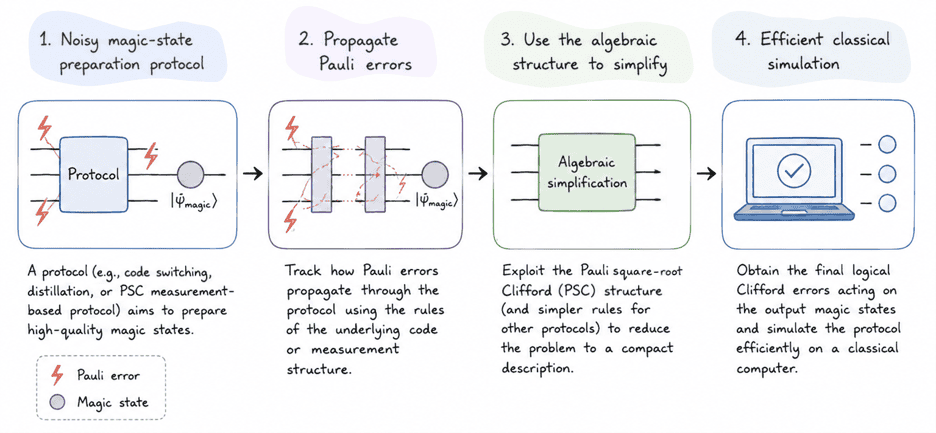
Rather than searching for a more efficient simulation algorithm directly, the UC Davis team of Samyak Surti, Lucas Daguerre and Isaac Kim first asked a more fundamental question: what mathematical structure do these protocols share?
Their framework for answering this question encompasses three broad classes of logical magic-state preparation protocols: code switching, magic state distillation, and Pauli-square-root Clifford (PSC) measurement-based protocols. In the first two classes, error propagation is relatively straightforward to analyse, but PSC protocols require a more sophisticated mathematical treatment. Rather than viewing these protocols simply as quantum circuits, Surti, Daguerre and Kim characterized their underlying algebraic structure, showing that Pauli errors (the fundamental types of qubit errors) propagate in a highly constrained and predictable way under sequential commutation. This commutation preserves the algebraic relationships between errors and logical operators, while anti-commuting operations exhibit predictable transformations rather than generating uncontrolled complexity.
These properties mean that commuting operations can be systematically reordered without changing the outcome, allowing much of the circuit’s complexity to be absorbed into its algebraic structure. Hence, rather than tracking an exponentially large quantum state, the simulator follows how a compact description of logical Pauli and Clifford errors evolves through the protocol.
The paper formalizes these ideas through a sequence of lemmas, propositions and theorems that establish the mathematical properties of PSC protocols. The result is a series of algorithms for simulating realistic, noisy, logical magic-state preparation protocols with a computational cost that scales polynomially with both the number of qubits and what is termed the stabilizer rank of the target magic state, which is a measure of its non-Clifford complexity. Since the standard single-qubit magic state has a stabilizer rank of only two, this complexity remains manageable even as the underlying error-correcting code grows, in marked contrast to state vector simulations that scale exponentially with qubit number. The team’s advance therefore makes large-scale logical simulations practical for the first time.
Although the new framework does not reduce the physical resources required to prepare logical magic states, it does change how those protocols can be analysed and designed. By exposing the algebraic structure underlying a broad class of logical magic-state preparation schemes, the UC Davis team transformed a computationally hard problem into one that admits efficient classical simulation. Researchers can therefore evaluate, compare and refine candidate preparation protocols under realistic circuit-level noise without resorting to exponentially expensive simulations or uncontrolled approximations.
“The main motivation behind our work was to speed up the development of fault-tolerant quantum computer,” Kim tells Physics World. “I believe there is a large amount of uncertainty in how we will design and optimize magic state factories, which will likely remain as a bottleneck in the foreseeable future.”
As quantum computing progresses from proof-of-principle demonstrations to large-scale fault-tolerant architectures, the ability to characterize and benchmark logical operations efficiently will become increasingly important. This work offers more than just a faster simulator; instead, it provides a new theoretical foundation for designing one of the most resource-intensive building blocks of future quantum computers. “My hope is that this line of work can help us better design the fault-tolerant quantum computers we will be getting over the next few years,” Kim says.
The post Shortcut for simulating logical magic states could accelerate the design of fault-tolerant quantum computers appeared first on Physics World.
This episode of the Physics World Weekly podcast features Yonatan Cohen, who is co-founder and chief technology officer of Quantum Machines.
The company was started in 2018 by three physicists from Israel’s Weizmann Institute. It develops control systems for quantum computers and has about 300 employees and 500 customers worldwide.
Cohen explains why hybrid quantum–classical control systems are increasing in importance as quantum computers scale-up to include more and more qubits. He also talks about Quantum Machines’ strategy to support a wide range of qubit types – including superconducting circuits, trapped ions, neutral atoms, spins and NV centres.
We chat about some of the company’s products and its collaborations with quantum-technology companies including Rigetti Computing and Diraq. Cohen also gives career advice for physicists who want to work in the quantum sector.
The post Building bridges between quantum and classical computing appeared first on Physics World.
A German startup has debuted the world's first diamond-based quantum computing system to exceed 10 qubits.
The machine, built by engineers at Saxon Q, is a nitrogen-vacancy (NV) quantum computer, meaning it uses defects in synthetic diamonds as quantum bits (qubits) to perform quantum operations. Qubits can be manipulated to represent the 0s and 1s of data, as well as quantum states that are superpositions of both the 0s and the 1s.
The hardware is currently available in rack-mounted systems featuring up to 128 qubits, with 512-qubit configurations available for delivery next year. According to the company's road map, the goal is to scale to 10,000 qubits and beyond after 2030.
Although the technology existed before this debut, scientists have found it difficult to build systems beyond 10 qubits due to the difficulty of creating nitrogen vacancy qubits.
Although Live Science saw a technical white paper outlining how the technology works, there didn't appear to be any published research demonstrating a functional quantum computer based on the NV architecture operating with more than 10 qubits before this launch. It's still unclear exactly how well the firm's quantum computers stack up against other platforms.
In the 1970s, scientists discovered that certain diamonds shone with a brilliant red light when illuminated in a specific way. Subsequent research determined that the optical shift was caused by annealing radiation damage that attracted isolated substitutional nitrogen atoms. In other words, nature occasionally produces a diamond that has a nitrogen atom where a carbon atom should be.
The unintegrated nitrogen atoms are drawn to the vacancy in the otherwise perfectly ordered carbon atoms inside the diamond. Although these flawed diamonds occur rarely in nature, scientists can create diamonds with nitrogen vacancies in laboratories.
Functionally, the single nitrogen atoms inside the vacancies act as if they were "trapped," and their electrons can "spin" independently of the electrons inside the surrounding carbon atoms.
Scientists exploit this "spin" feature by using special lasers to put the nitrogen atom's electrons in a specific state they measure as "zero." They can then use microwave pulses to precisely manipulate the electrons into numerous configurations, including quantum states that binary "bits" can't achieve.
We have a fully functioning quantum computer.
Marius Grundmann, professor of experimental physics at Leipzig University and co-founder of Saxon Q,
Marius Grundmann, a professor of experimental physics at Leipzig University and co-founder of Saxon Q, said the breakthrough that allowed his firm to push past the 10-qubit barrier was a materials discovery.
When the Saxon Q team creates the vacancy inside its lab-grown diamonds, they co-implant sulfur. Per Grundman, “That's the key technology point. Because the sulfur lifts the chemical potential to a point that it's negatively charged. The sulfur supplies the electron; the sulfur also makes the vacancy attached to the nitrogen with a very high yield."
In other words, by co-implanting sulfur atoms, the Saxon Q researchers can express greater control over the individual qubits. Once the qubits are set with lasers and subjected to microwave pulses, they're ready for error correction. In a statement, Saxon Q representatives said the qubits achieved a 99.92% fidelity rate — fewer than one error per 1,000 operations — before error correction.
However, Grundmann told Live Science that the latest numbers as of July 22 showed 99.98% fidelity in single-qubit operations. That's comparable to state-of-the-art error correction results reported by other quantum computing labs, such as those from IBM and MIT, although it wasn't possible to independently verify the results.
It's difficult to compare Saxon Q's diamond-based NV systems with more established quantum computing platforms, such as superconducting qubits. Most recent research on NV systems has focused on quantum sensing applications, though at least one preprint study discusses hybrid NV/superconducting systems.
"We have a fully functioning quantum computer," Grundmann told Live Science. According to Grundmann, the company's quantum computers are on a par with those using other modalities. "We have a quantum computer that can execute quantum code that you can reach via the network, and it is a multiuser, multitasking, multicore system," he said.
If the Saxon Q systems ultimately prove comparable to existing solid-state quantum computing architectures, they'd be among the first generation of room-temperature quantum computers to reach performance similar to systems that require cryogenics and on-site monitoring.
The ease of setup is notable. Saxon Q's devices can be slotted into a standard computer rack and plugged directly into alternating-current power.
This provides a clear near-term advantage for clients who want to run algorithms on a quantum system without operating through the cloud. Grundmann said this could be especially important in edge computing scenarios, such as autonomous driving or robotics, where cloud communication could produce unacceptable latency.
Research comparing solid-state quantum systems indicates that superconducting quantum computers would typically operate faster than diamond-based NV systems. It's unclear, however, what the trade-off between processing speed and cloud latency would be or whether it could be addressed through scaling.
The current challenge to scaling diamond-based NV quantum computers beyond the 512-qubit range is the size of the chips. Saxon Q's current chips are limited to supporting either eight or 16 qubits. For more powerful systems, scientists will need to squeeze hundreds — or even thousands — of qubits onto a single array to support operations requiring hundreds of thousands or millions of qubits.
Can you match these ancient devices to their pictures? Find out with our computing quiz!
D-Wave is a bit of an oddity in the quantum computing space, having been founded back in the last century. And its initial offering wasn't a quantum computer like those being developed by IBM or Google. Instead, the company built what's now called a quantum annealer, a machine that isn't general-purpose but can solve a large class of optimization problems. While the hardware shares some similarities with the qubits used in gate-based quantum computers, it operates in a fundamentally different way.
But a few years back, D-Wave started working on gate-based hardware, apparently choosing a somewhat unusual qubit technology called fluxonium. And this year, the company acquired a startup called Quantum Circuits that spun out of Yale University and has been developing what's called a dual-rail qubit (the same technology used by Amazon), which promises to make most errors very easy to detect, simplifying error correction.
On Wednesday, the company is publishing a paper in Nature that describes a key step in validating this dual-rail technology, showing that two of the qubits can be entangled without altering their best feature: Most are a single type that is easy to detect.
© D-Wave
Researchers demonstrated that braiding and fusing particles known as non-Abelian anyons can perform every operation required by a quantum computer. A quantum computer becomes broadly useful only when it can perform any computation rather than a limited set of specialized tasks. Physicists have now demonstrated that unusual quantum objects called non-Abelian anyons can provide that [...]Scientists at IBM and partner institutions say they've reached "quantum advantage" in a trio of experiments demonstrating quantum computing capabilities that even the fastest classical supercomputers can't match.
In a purported major milestone for quantum computing, the experiments show how these machines could perform useful computational tasks, such as computing chemical reactions, within minutes. By comparison, a supercomputer would take years.
In a statement, IBM representatives said these experiments show that quantum computers can provide trusted solutions more efficiently, more cheaply or more accurately than any classical computing method.
At a July 28 news conference, representatives from IBM, Algorithmiq, Qedma, and the University of Chicago described three experiments demonstrating quantum advantage over classical computers in three different challenges.
Each used IBM's Quantum Heron R3 superconducting quantum computer system running novel error mitigation techniques. The experiments focused on both demonstrating and verifying quantum advantage.
The first study, conducted in partnership with Qedma, investigated the Floquet transverse-field Ising model, a system physicists use to study how a material's magnetic properties evolve when rhythmically driven by external pulses. This is an extremely difficult problem for classical computers because the model's math becomes exponentially more difficult to process as the problem scales. Scientists published the study, which has not been peer-reviewed, on the arXiv preprint server July 27.
But quantum computers can perform deeper computations using the Floquet transverse-field Ising model than their classical counterparts due to quirks of quantum mechanics that allow quantum bits (qubits) to represent not just the 1s and 0s of binary data but also a superposition of the two values, so that calculations can run in parallel.
When physicists use a classical supercomputer to run the model — in this case, the Fugaku supercomputer in Kobe, Japan — they have some trust that the results will be computed correctly and without significant error.
Quantum computers, by contrast, are far more prone to error. They're extremely sensitive to any form of noise, including interference from Earth's magnetic field. One of the chief challenges in quantum computing is finding ways to mitigate the errors caused by this noise.
Scientists can compare a classical supercomputer's results with those of a quantum computer using the Floquet transverse-field Ising model, but only to a certain point. When the classical computer reaches the limit of its ability to compute complex problems, the quantum computer still has plenty of runway left.
But, as IBM principal research scientist Abhinav Kandala explained in an interview with Live Science, the problem lies in trusting the results.
"You want to perform computations that outperform classical, right? But you've relied on classical results for the longest time," he said. "So when you now begin to outperform, or you go beyond classical, how do you know you had the right result? This is a question that's independent of application. For any computation that you want to do, you want to [ask], 'OK, is this really something that I can trust?"
The experiment was designed to create a trusted stack that essentially allowed scientists to verify the quantum computer's results. They used Qedma's quantum error suppression and error mitigation (QESEM) software to provide consistent results, and then compared those results against the Fugaku supercomputer's.
Once the results matched, they cranked up the difficulty until the classical computer could not keep up. Then, to replicate the results, they brought in additional quantum computers.
The team ran the same experiment on multiple quantum computers. To ensure they were getting enough errors to test the error mitigation strategy, Kandala said, they purposely injected each system with different levels of artificial noise and corruption.
"We measured the same circuit on five different quantum computers," Kandala told Live Science, including a superconducting quantum computer from IBM Boston and another at IBM Pittsburgh.
They also ran the experiments on two of Quantinuum's quantum computers, using the same error mitigation techniques. In each measurement, the noise and corruption injected into the system was different, but the computational results were consistent.
In the second experiment, conducted by IBM and Algorithmiq, researchers applied the Floquet transverse-field Ising model to a different set of problems and used a different method for error mitigation. As the researchers scaled the problem on both the classical and quantum computers, the classical systems began to produce inconsistent results. The quantum systems, by contrast, maintained consistency at measured intervals, thus demonstrating verifiable outputs, the team reported in a preprint paper posted to arXiv July 28.
The third study, uploaded to arXiv July 28 and conducted in partnership with the University of Chicago, approached quantum advantage from a different angle. Researchers designed a system of "Clifford gates," a type of circuit that is intentionally easy for classical computers to simulate. Then, they made the circuits progressively harder for classical systems to solve by injecting them with more difficult gates called T gates.
The nature of the experiment allowed physicists to guarantee error mitigation at complexities beyond what a classical supercomputer could handle. Any computations run through the circuit — even those that would be impossible for a classical computer — would be trustworthy by design.
Based on these three technical papers and other press information provided by IBM, it appears that each of the experiments demonstrated a clear quantum advantage over classical computers. Whether it will stay that way, however, remains to be seen.
There have been numerous reports of laboratories achieving "quantum supremacy," "quantum utility" and "quantum advantage" over the past few years — each, essentially, claiming to have surpassed the abilities of classical computing. However, most of those achievements ended up being topped. It isn't possible for physicists to imagine every possible mathematical method for conducting classical computations when they test quantum computers against state-of-the-art supercomputers.
IBM and its partners said they expect classical computer scientists to try disproving their claims.
"The classical back-and-forth — that'll keep going on, I think," Kandala said. "And that should; that's how science progresses. And that's precisely [why we have] the Quantum Advantage Tracker, a benchmark for measuring quantum advantage. "A lot of these problems have been on the tracker for a while now," Kandala said, "and I'm sure getting the papers out will get more eyes on it."
There are many algorithms for which it has been mathematically proven that a quantum computer can generate results that would take a classical computer an unreasonable amount of time to generate. Unfortunately, today's quantum computers either can't run those algorithms or can only run simplified versions that classical computers can also handle. This has left the field facing a challenging question: Can we demonstrate the promise of quantum computers on today's noisy, limited hardware?
That's a more difficult question than it may first appear. If you generate a result that's out of reach of today's regular computers, it may not be possible to verify that you got the right result. And given that today's quantum computers are somewhat error-prone, getting the wrong result is a distinct possibility. Further, in the absence of a mathematical proof of the capabilities of quantum hardware, it's possible that a better classical algorithm could outperform the quantum hardware.
These issues inspired IBM to launch a quantum advantage tracker. On Thursday, the company announced three new entries that it says clearly show a quantum advantage, each using a different approach to overcoming errors and validating quantum results. "Trusted computing when you can do classical simulations is irrelevant," IBM's Jay Gambetta told Ars. "Trusted computing when you can't do classical simulations is a big deal."
© IBM
If you follow quantum computing news for long enough, it can start to seem like any quantum system that can alternate between two well-separated energy states can be used as a qubit. Atoms, ions, photons, electrons, and manufactured devices all have their backers. One of the key things that attracts backers is the tech's ability to scale. We'll need a lot of high-quality qubits to start doing any complex computations, and the ability of any technology to get us there is the subject of debate.
So even as some technologies can now support thousands of qubits, some competitors are still working on a small handful of qubits—the companies behind them are convinced that they have the potential to scale more effectively.
One of those technologies involves quantum dots that hold a single electron. Their advantage is that we can manufacture them using the same tech we use to build traditional processors, an approach that has proven to be scalable. This week saw two new papers describing different ways of using quantum dots, one of which was appealing enough that IBM bought the company that developed it. Separately, another company has released a processor showing 100 individual electrons being held in diamond defects, technology that wasn't obvious could scale.
© HRL Laboratories
Bosonic quasiparticles such as magnons show much promise for enabling on-chip quantum information technologies that can be scaled down to the nanoscale, but their too-short lifetime has held back such applications until now. An international team of physicists says it has now increased this lifetime by a hundredfold, thanks to the discovery of a new class of magnons known as short-wavelength dipole-exchange magnons.
Magnons are the collective oscillations of coupled magnetic spins in a material. They are particularly promising for next-generation computing because they could allow for information processing based on the wave-like dynamics of these spins rather than the flow of electrons, thereby significantly reducing energy losses. They can also naturally couple to many other fundamental quasiparticles, such as phonons and photons, which makes them ideal as the building blocks for hybrid quantum systems.
The main drawback of magnons, however, is that they die too fast, explains Andrii Chumak of the University of Vienna, who led this latest study. “Indeed, their lifetimes are typically limited to a few hundred nanoseconds, something that puts a hard ceiling on what we can do with them in a quantum architecture.”
In this work, which is detailed in Science Advances, the researchers discovered short-wavelength dipole-exchange magnons in highly pure, single-crystal yttrium iron garnet (YIG) spheres held at millikelvin temperatures. These magnons last for up to 18 µs, which is nearly two orders of magnitude longer than that previously observed for these quasiparticles.
As often in science, the discovery was accidental, says Chumak. “We had prepared three YIG spheres with varying degrees of purity for planned quantum experiments with superconducting qubits, and we simply wanted to characterize these spheres and identify the one that hosted the longest magnon lifetime,” he recalls.
“An 18 microsecond lifetime places magnon coherence on a par with that of typical transmon superconducting qubits used in today’s quantum processors,” he tells Physics World. “This reshapes the role magnons can play in hybrid quantum architectures – from lossy intermediaries to robust quantum memories and low-loss links able to mediate interactions between distant qubits on a chip.”
And that’s not all: long-lived magnons coupled to superconducting circuits could act as a programmable on-chip “quantum bus”, entangling many distant quantum bits (qubits) made from these hybrid structures along a common waveguide, rather than only nearest neighbours, he adds. The results also point to a clear materials-science route to push magnon lifetimes even further, in particular by continuing to reduce rare-earth impurity concentrations in YIG.
There is a way to go before real-world applications see the light of day, however. For one, the researchers still have some physics to understand, but that is what makes the project so intriguing for them, they say.
Chumak says that the most immediate future step in his team’s work will be an echo-type experiment to measure the lifetime of these magnons directly, rather than inferring it from the so-called parametric instability threshold, as was done in this work. “In parallel, we will need to learn how to excite and detect these short-wavelength magnons efficiently using nanoscale transducers, which is essential before they can be integrated with superconducting qubits.”
“The field of quantum magnonics is still very young compared to other quantum platforms,” Chumak notes, “so it will take some time before we reach actual quantum computing applications – but the path is now much more concrete than it was a year ago.”
The post New class of magnons live a hundred times longer appeared first on Physics World.
Celebrity gossip might break the Internet, but not in the way that quantum computers could. “The advent of quantum computers poses a critical threat, as they could break widely deployed encryption schemes,” warns Lily Chen, a cryptography expert from the US National Institute of Standards and Technology (NIST). Systems at risk include banking encryption, digital signatures, secure messaging, secure shell tunnelling, cryptocurrency and more.
Today’s quantum computers are still too small and error-prone to defeat gold-standard encryption. However, new results from Google Quantum AI and start-up Oratomic suggest that could change, with two widely used cryptographic systems – elliptic curve cryptography (ECC) and the Rivest-Shamir-Adleman (RSA) algorithm – potentially coming under threat sooner than many scientists predicted.
At present, anyone who wants to access encrypted information needs a secret digital key. To obtain this key, an attacker must first solve a difficult mathematics problem. For example, breaking the RSA algorithm boils down to factoring a large number into its prime components. Breaking ECC involves finding a secret number that connects two points on an elliptic curve.
Classical computers might take billions of years to solve these problems. But if an attacker had access to a powerful enough quantum computer, they could solve the problems in mere minutes using an algorithm devised by Peter Shor in 1994.
Several years ago, experts estimated that cracking a typical RSA scheme with 2048-bit keys (RSA-2048) would require tens of millions of physical quantum bits (qubits), which are the building blocks of quantum computers. A year ago, this value dropped to a million. By February 2026 it was down to 100,000. The latest results from California-based Oratomic push the floor even lower, to 10,000 physical qubits. The largest neutral-atom qubit array – realized last year in the lab of Oratomic co-founder Manuel Endres – stands at 6100 qubits. This makes the benchmark of 10,000 feel alarmingly close, though Endres’ array hasn’t yet been used for computation.
There are, however, trade-offs. Quantum computers that use fewer qubits or more space-efficient hardware generally have longer computation times. Oratomic’s proposed 10,000-qubit platform would require three years to crack ECC with 256-bit keys (ECC-256) and 120 years to crack RSA-2048. The company’s predicted time-efficient alternative could solve ECC-256 in 10 days, but that would require 26,000 qubits. Solving RSA-2048 in 97 days would take 100,000 qubits.
Oratomic’s numbers have not yet been peer-reviewed, and outside experts say they depend on different assumptions about future hardware developments. “The space-efficient [architecture] is mostly based on assuming aspects that have been demonstrated to work individually in state-of-the-art academic labs,” explains Maria Violaris, a quantum physicist at Oxford Quantum Circuits, who was not involved in the research. “Meanwhile, the time-efficient one relies on more speculative assumptions that need future innovation.”
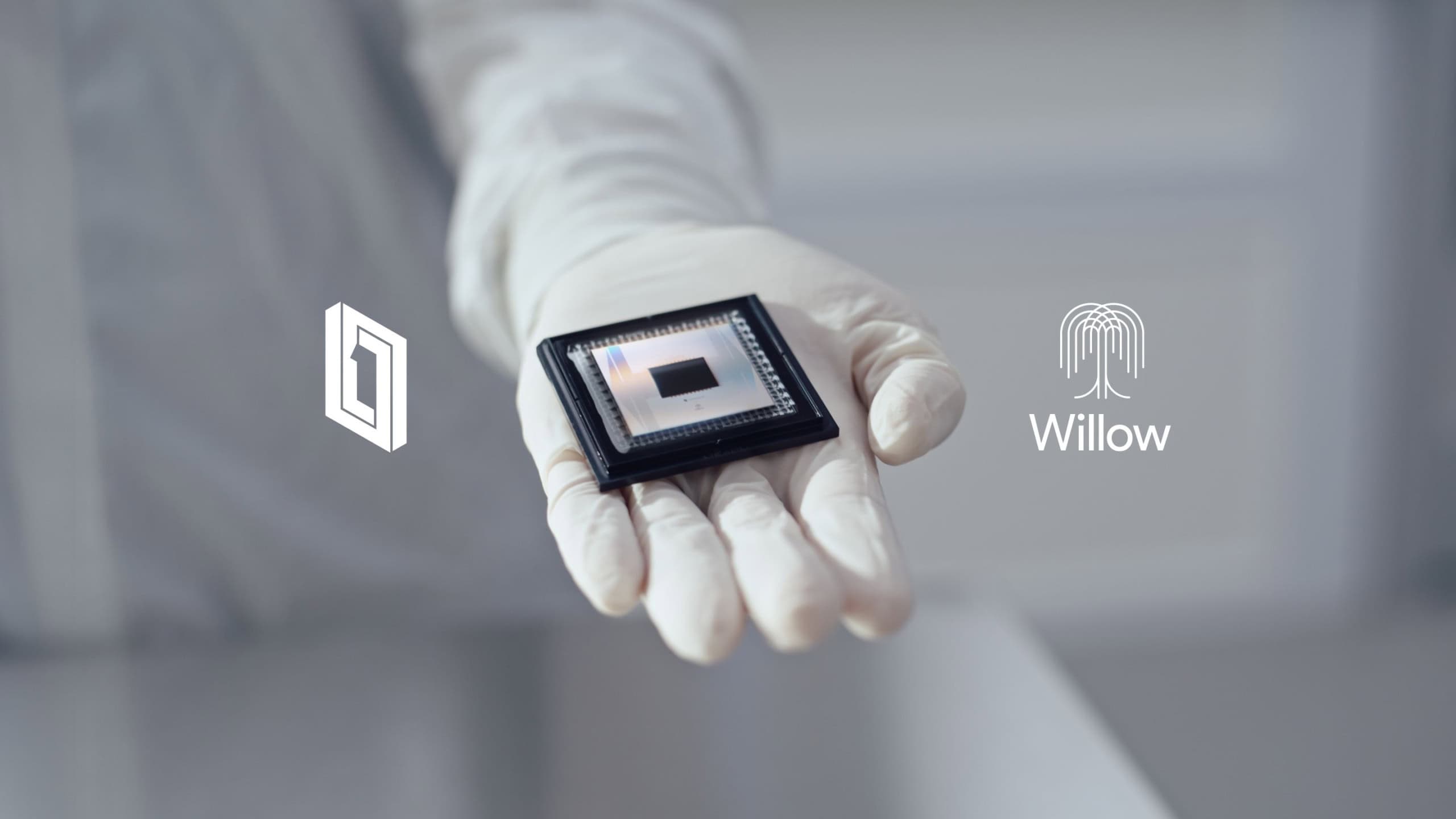
On the same day as the Oratomic team posted its findings on the arXiv preprint server, researchers at Google Quantum AI released a white paper with their own updated resource estimates. They report that a computer with 500,000 physical qubits made from superconducting circuits could solve ECC-256 in 18 minutes – and potentially even less (see box). Google’s current state-of-the-art processor, Willow, has 105 physical qubits. However, the researchers warn against assuming gradual and predictable progress because quantum computing developments are driven by overcoming scaling barriers rather than by steady increases in processor size.
Elliptic curve cryptography (ECC) underpins the security of most blockchain networks, including Bitcoin and Ethereum. Bitcoin transactions take an average of 10 minutes, so if a quantum computer can crack ECC and determine the secret key during that window, the transaction could be intercepted and funds stolen in real time.
While Google Quantum AI’s results predict that it would take 18 minutes to solve ECC on a 500,000-qubit quantum computer, they argue that the run time could be effectively shortened in some circumstances. To understand how, imagine planning a heist in which you need to open a safe. Although you won’t know the exact combination until you get your hands on the safe, if you know the model number in advance, you can prepare some tools to help you crack it faster.
A quantum computer could do something similar. According to the Google Quantum AI researchers, half the ECC algorithm only depends on the elliptic curve and not on the specific transaction. A quantum computer could precompute this half, wait in a primed state until a Bitcoin transaction begins, then quickly solve the second half in only nine minutes, dropping below the 10-minute threshold.
Quantum computing platforms that use superconducting, silicon, and photonic qubits are well-positioned for real-time attacks because they tend to compute faster than neutral-atom and ion-based computers. However, the latter could still pose a serious risk through “at-rest” attacks. Such attacks involve adversaries collecting archived and publicly available data, then decrypting it later with few time constraints.
Which threat arrives first will depend on how different quantum computing architectures mature and scale, a path still marked with considerable uncertainty. “Ultimately, feasibility is difficult to say as it depends on how challenging it will be to increase scale or to take a novel approach by engineering [new] hardware,” notes Maria Violaris of Oxford Quantum Circuits.
The high number of physical qubits required for quantum computation comes from the need to detect and correct errors. Google Quantum AI’s estimate is based on a well-known error-correction method known as the surface code. In this approach, physical qubits are arranged in a rectangular grid and interact with their nearest neighbours. Quantum information is spread redundantly across this grid, allowing errors on one physical qubit to be found and fixed. The entire grid is considered one logical qubit, and the ratio of logical to physical qubits is called the encoding rate.
In the surface code, reducing error amounts to adding more physical qubits per logical qubit, and typical encoding rates range from a few hundred to a few thousand. In contrast, the Oratomic team based its estimates on a newer method of error correction called quantum Low-Density-Parity-Check (qLDPC), which reduces error more efficiently by making the physical qubits interact over large distances. Hengyun (Harry) Zhou, a physicist at the Massachusetts Institute of Technology in the US who was not involved in the research, explains that this longer-range connectivity can significantly increase the encoding rate. For qLDPC codes, a typical rate is around 1 to 10, but rates can now go as high as 1 to 2.
Because neutral atoms are highly reconfigurable, neutral atom platforms like those used by Oratomic (and other companies, including QuEra Computing, Infleqtion, Pasqal, planqc and Atom Computing) are naturally suited to the required long-range connectivity that qLDPC codes require. However, Zhou argues that it’s “not completely out of the question” that superconducting qubit platforms could use these codes too. “There is some additional cost that the lack of reconfigurability in those platforms currently leads to, but I would say if we’re thinking about a beyond-10-year timescale, it’s quite imaginable that things could also change for other platforms as well,” he says.
Google Quantum AI’s white paper may represent a turning point in another respect. Rather than being open about their circuit designs, its authors hid them behind a “zero-knowledge proof”, which provided enough information to verify claims while hiding details that they say could provide bad actors with an “instruction manual”.
This is a relatively novel approach within the quantum computing community, which has thus far followed the conventional academic practice of publishing results with full transparency. A Google blog post expresses hope that “our approach to responsible disclosure can spur an important conversation among quantum computing researchers and the broader public”.
Certainly, it has already spurred a conversation among experts. “This is the first time I’ve ever seen a new mathematical result actually announced that way,” Scott Aaronson, a quantum physicist at the University of Texas at Austin, US, wrote on his blog. “I’m not sure how much it will actually help, as once other groups know that a smaller circuit exists, it might be only a short time until they’re able to find it as well.”
Zhou echoes this sentiment. “These are the kind of results that could potentially have a lot of general societal safety implications, so you want to make sure that they’re safeguarded responsibly,” he observes. “That being said, I think it is also possible that other people, now that they know what is possible, might come up with related constructions.”
In the long run, protecting against threats likely means migrating away from RSA and ECC and towards new mathematical problems that are difficult for both classical and quantum computers to solve. Google recently introduced 2029 as an internal deadline for migrating major system to so-called post-quantum cryptography (PQC), and many experts believe the migration ought to begin now.
“Migrating to PQC is a massive undertaking that won’t happen overnight. Starting migration today is a necessary risk management strategy,” urges Chen from NIST. She notes that NIST has been instrumental in guiding this migration, beginning with its 2016 call for cryptography experts to design and evaluate new algorithms for PQC, and culminating in its publication of the three most promising ones in 2024.
The Google Quantum AI researchers also outline recommendations to help cryptocurrency communities and policymakers prepare for the PQC era. And while urgency permeates their white paper, ongoing PQC efforts prompted them to end it on a positive note. “These trailblazing projects demonstrate that transition to post-quantum cryptography is realistic and instil hope that it will have been completed before the first [cryptographically relevant quantum computers] come online,” they write.
The post New findings shorten the road to cryptographically relevant quantum computers appeared first on Physics World.
Quantum materials could transform technologies ranging from powerful computers and highly secure communications to advanced energy systems, but one major obstacle has long stood in the way. Most quantum materials reveal their unusual properties only when chilled to temperatures near absolute zero. At room temperature, continual atomic vibrations caused by heat can overpower the fragile [...]