Login
Chimpanzee Mothers Appear to Teach Their Babies How to Use Tools
16 September 2026 at 13:15


Orcas have been known to slap around stingrays, punt seals into the air and otherwise play with their food. But orcas, or killer whales, don’t just toy with live prey. Some also seem to enjoy destroying the corpses of their kills like piñatas.
Scientists documented this brutal activity in the Gulf of California in 2024 and 2025. In both cases, one adult orca held a dead sharp-tail sunfish steady. A second then slammed into it with enough force to smash the sunfish to smithereens.
Killer whales might pulverize sunfish to break them into smaller bites for young orcas. Or they might just find it entertaining.
@sciencenewsofficial Orcas are known for brutal hunting tactics. A researcher has filmed one using a new strategy.
♬ original sound – Science News – Science News
Researchers shared the findings July 23 in Frontiers in Ethology.
“I was absolutely gobsmacked,” says Marianne Nyegaard. “I thought it was the coolest thing I had ever seen.” Nyegaard is a marine biologist at Auckland Museum in New Zealand who did not take part in the work. She’d seen a couple videos of orcas battering sunfish on social media. The new paper now does a deep dive into this behavior.
Nyegaard is not surprised that orcas have come up with a creative way to deal with sharp-tail sunfish. Those humungous fish can get up to a few meters (10 feet) long.
“Orcas will do all sorts of things,” Nyegaard says. “They are so clever at figuring out how to hunt and deal with a ton of different prey types.” That hunting is often a team sport. Orcas band together to ambush blue whales and whale sharks. They also team up to make waves to knock penguins off ice.
Orcas most likely smash sunfish into small pieces to help feed their young, says Francesca Pancaldi. After one of the sunfish explosions described in the paper, a young orca fed on the small bits of carnage, she notes. Pancaldi is a marine biologist who also was not involved in the study. She works at the marine science center in La Paz associated with Mexico’s National Polytechnic Institute.
Feeding may not be the only reason orcas play sunfish piñata, Pancaldi adds. “Killer whales are highly social animals.” A single activity, she explains, can provide nutrition, help orcas bond and offer a way for young orcas to learn how to hunt.
The 2025 Fat Bear Week champion is back and ready to rumble (or at least eat a lot of fish). Bear #32, better known as Chunk, returned to view this week on the explore.org live cameras stationed throughout Katmai National Park in Alaska. With the kickoff of Fat Bear Week 2026 slated for Friday, his timing couldn’t be better.
Chunk reigned supreme in 2025, racking up 96,350 votes—30,000 more than second place finisher, Bear 856. Chunk is a fan favorite for his hefty size (estimated at more than 1,200 pounds) and distinct look. In addition to his narrow-set eyes, dark brown fur, large muzzle scar, and prominent brow ridge, Chunk also has misaligned the jaw. In 2025, he emerged from slumber and made an appearance at Brooks River with a noticeably broken jaw that rangers guessed was a result of a fight with another bear.
“Chunk proved immediately adaptable,” explore.org explained. “He adjusted his behavior to avoid most direct confrontations with other large male bears. He quickly learned to eat salmon without the full use of his mandible. Additionally, his large body size still gave him easy access to many productive fishing spots. He remains one of the largest bears at Brooks River.”
Despite the potential challenges of chomping on salmon with a broken jaw, Chunk persevered. Cameras first spotted him this season all the way back in April. Bears are not seen as frequently during the spring, so the early glimpse of Chunk walking across a patch of ice was exciting. Typically, Katmai bears emerge in June when the salmon run begins at Brooks River.
Chunk wasn’t always a fan favorite though. In 2024, he lost the Fat Bear Week crown for the second year in a row to mama bear Grazer. The two bears had been involved in an incident in which two of Grazer’s 2024 cubs were attacked by Chunk after falling over a waterfall. Grazer put up a fight against Chunk to defend her cubs, but one cub died after the encounter.
Tune in Friday, September 18, for the Fat Bear Week 2026 bracket reveal to see if Chunk will have the chance to defend his title. And you can always tune in to explore.org live cameras to see what our favorite chunky bears are up to.
This year, Fat Bear Week begins on Tuesday, September 22, and a winner will be crowned on Tuesday, September 29.
Votes may be cast from noon to 9 p.m. EDT (9 a.m. to 6 p.m. PDT and 8 a.m. to 5 p.m. ADT)
from September 22 and 29 at fatbearweek.org.
Photographs comparing the bears from earlier in the summer and later in the summer will be shown, so voters can get an idea of just how much weight the bears put on during their salmon fest. An adult male bear can go from roughly 700 pounds in the early summer to over 1,200 pounds by fall.
Voters are also encouraged to get familiar with each bear’s life history and the unique challenges they face to survive.
The 2026 Fat Bear Week Bracket will be released on Friday, September 18.
Donations can be made to Katmai Conservancy’s Otis Fund. The Otis Fund is named after Bear #480 (Otis), who won four Fat Bear Week titles before his death around 2024. All donations made between September 22 and October 3 will be matched by explore.org.
This year’s livestream featured an example of how wild (and upsetting to humans) nature can be. On Tuesday, July 28, cameras captured a young brown bear cub being killed and eaten by an unrelated mother bear (Bear #806).
On Sunday, August 2, one of Bear #335’s (Jolly) cubs died, after following three unrelated cubs up a tree. The mother of the cubs already in the tree attacked Bear #335’s cub, who did not survive the encounter. The identity of the mother bear who killed the spring cub was not confirmed.
Following the first cub’s death, naturalist Mike Fitz and park rangers Christine Loberg and Sarah Bruce said this likely the first documented case occurring at Brooks River. While there is no one answer as to why mother bears are killing cubs, some experts suspect bear adoption, food scarcity, and fights for dominance all play a role.
Additionally, this year also saw the cub with silver-hued fur, a cub who hopefully learned important lesson about porcupine quill safety, the unique fishing stylings of Bear #164 (Bucky Dent), and Bear #284’s (Electra) family who can “walk on water.”
The post Big boy Chunk returns ahead of Fat Bear Week 2026 appeared first on Popular Science.

Despite major strides in education and conservation efforts, rabies remains a serious public health issue. The Center for Disease Control (CDC) estimates around 90 percent of cases occur in wildlife, but their consequences still reverberate across ecosystems and routinely endanger humans. Combating the viral disease costs the United States over $300 million every year, but the hefty price tag is justified. Contracting one of the oldest known diseases invariably causes severe symptoms like abnormal sensations, violent movements, hydrophobia, and loss of consciousness. Rabies is fatal in virtually every documented case, and still kills around 59,000 people around the world each year.
Once primarily associated with dogs, rabies has since spread to wildlife such as raccoons, skunks, bats, and foxes—making the issue much more difficult to track and control. Since 1995, the United States Department of Agriculture (USDA) has overseen a National Rabies Management Program in cooperation with state and federal departments, university researchers, and other organizations. After over 30 years of work, one of the most preferred mitigation methods is regularly placing oral rabies vaccine (ORV) bait in strategically selected wildlife areas. The easiest way to spread millions of bait blocks across thousands of square miles? Airdrops.
Next month, the USDA will once again begin tossing fishmeal-coated ORV packets from planes throughout the Southeastern states of Virginia, North Carolina, Tennessee, Georgia, and Alabama. These tiny edibles are specifically crafted to target the most prominent rabies variants seen in raccoons, coyotes, and gray foxes.
“The goal is to prevent westward spread of raccoon rabies by creating a continuous vaccine barrier that stays in front of rabies occurrence on the landscape,” a USDA spokesperson recently told FOX Carolina News. The representative added that although the distribution’s scope doesn’t currently include South Carolina, they are “very close to establishing an ORV area in South Carolina counties bordering North Carolina and Georgia in the next few years.”
If all goes as planned, the National Rabies Management Program’s geographic scope will shrink over time as the disease is regionally eliminated. Until then, anyone who accidentally comes into contact with an ORV bait brick shouldn’t worry about contracting the disease. The vaccine inside each brick is proven safe for over 60 animal species, including cats and dogs. If you happen to locate one in a residential area, the USDA recommends to either simply leave it alone, or use gloves to move it to a more remote location for its intended recipients. Always wash your hands thoroughly after handling ORV bait—and try to ignore the pungent odor of fishmeal.
The post It’s almost time to airdrop rabies vaccines again appeared first on Popular Science.
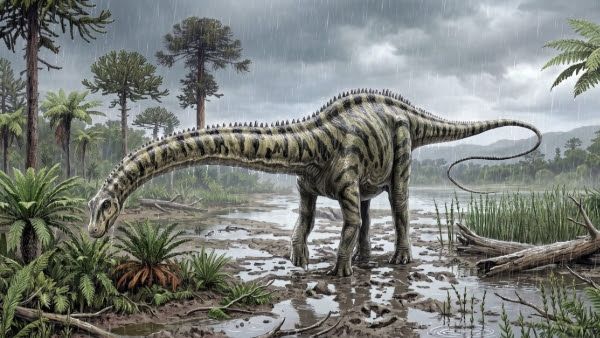
Paleontologists have identified the first confirmed remains of Diplodocus — "Dippy," for short — outside the western U.S., revealing that the iconic long-necked dinosaur reached what is now Spain roughly 150 million years ago.
The findings show that the enormous sauropod didn't live only in North America, as was long thought. Instead, it may have rambled across a land bridge all the way to Europe, the new study suggests.
The discovery, made at the La Tejería site near the small village of El Castellar in eastern Spain, provides some of the strongest fossil evidence yet that dinosaurs could move between North America and Europe during the Late Jurassic, when the Atlantic Ocean was still in its early stages of opening after the breakup of the supercontinent Pangaea. The researchers published their findings Tuesday (Sept. 15) in the Journal of Vertebrate Paleontology.
"Paleontological studies like this one help us better understand the history of life on Earth, reconstruct ancient ecosystems, and understand how they changed through time," study first author Sergio Sánchez Fenollosa, a doctoral student who studies biodiversity and evolutionary biology at the Joint Paleontology Foundation Teruel-Dinópolis (Dinópolis Foundation), a paleontological research institution, told Live Science via email.
Dippy is one of the best-known dinosaurs. After its fossils made their grand debut at the Carnegie Museum of Natural History in Pittsburgh in the early 1900s, life-size fossil replicas of the towering herbivore were sent around the world, including to England, France, Spain, Argentina and Russia.
But until now, Diplodocus' Late Jurassic fossils were known only from the Morrison Formation in the western United States — and the latest discovery shows that Dippy wasn't a homebody.
The newly unearthed Diplodocus specimen consists of 14 well-preserved tail vertebrae and several chevrons — bones that helped support blood vessels and muscles within the dinosaur's tail.
Study co-author and managing director of the Dinópolis Foundation, Alberto Cobos, said it was a friend who "thought he had spotted some bones on a mountainside," Cobos told Live Science via email. "That very day, I went to the site near El Castellar (a village in the province of Teruel). Sure enough, we saw a couple of sauropod vertebral centers."
Although only part of the skeleton has been recovered, the bones show a series of characteristics associated with Diplodocus, including large cavities corresponding to where air sacs would have been, along with deep grooves running alongside the underside of the tailbones.
"It was an exciting and continuous process of seeing the pieces of the puzzle gradually fall into place," Sánchez Fenollosa said in a statement. "From the early stages of the osteological study, we noticed strong similarities with several diplodocine sauropods … With each new result, the picture became clearer: we were looking at a Diplodocus."
It's unclear which species of Diplodocus the new specimen is, but like others of its genus, it was a huge dinosaur with an extremely long neck and whip-like tail.
"The Diplodocus from El Castellar was approximately 25 meters [82 feet] long (comparable in size to its North American relatives), making it another of the giant sauropods of the Spanish Jurassic," Cobos said in the statement.
Between 195 million and 170 million years ago, the supercontinent Pangaea broke apart as the Atlantic Ocean opened. But the ocean was much narrower than it is today, and the continents were not necessarily as isolated as their modern geography is now.
Evidence indicates that temporary land bridges may have allowed some animals to move between the two regions. The most famous prehistoric land bridge is the Bering Land Bridge that humans used to move between Asia and what is now Alaska. Previous research showed the Bering Land Bridge also existed around 68 million years ago, and it may have allowed an Asian ancestor of Tyrannosaurus rex to trek into North America.
One possible route for Diplodocus into Spain may have been a land bridge that connected what is now Newfoundland with the Iberian Peninsula.
Geological conditions may have allowed dinosaurs like Diplodocus to move between continents, Sánchez Fenollosa told Live Science in an email. "This interpretation is supported not only by the fossil record but also by geological evidence," he said.
The newfound Diplodocus fossils also suggest that the distribution of giant sauropods was more complicated than the fossil record previously indicated.
"More complete specimens will be essential to understand this story in greater detail, particularly to determine which Diplodocus species inhabited Europe: whether it was one already known from North America or a previously unknown species," Sánchez Fenollosa said. "This discovery reminds us that even for such iconic dinosaurs, there are still many unanswered questions about their evolutionary history and biogeography."
A brown bear cub learns a lot in its first year of life—how to fish, how to steer clear of trouble. Two curious cubs recently learned a valuable (and wet) lesson about the strength of currents.
At Alaska’s Katmai National Park and Preserve, home to Fat Bear Week, Bear #224 took her cubs on a journey near Brooks Falls. Early in summer, Brooks Falls is a hot spot for salmon munching by the park’s resident brown bears. By September, most bears move to the lower Brooks River to eat the dead and dying salmon near the river’s mouth.
As Bear #224 navigated the upper part of the falls with her two spring cubs, the young bears toddled up a rock and each hopped off. The strength of the current pulled the bears over the waterfall, despite their best efforts to paddle upstream. No other bears were present at the falls during the incident and mama bear eventually made her way down to join her cubs and move down river to calmer waters.
Brown bears are strong swimmers, moving up to 5mph in the water, according to the Alaska Wildlife Conservation Center. They use all four legs to paddle and their body fat helps provide buoyancy. They also shake like dogs to remove excess water after a swim.
Fat Bear Week kicks off September 22. Votes may be cast from noon to 9 p.m. EDT (9 a.m. to 6 p.m. PDT and 8 a.m. to 5 p.m. ADT) from September 22 and 29 at fatbearweek.org.
The post Katmai bear cubs tumble over waterfall appeared first on Popular Science.
There’s nothing better than sinking your teeth into a sweet, creamy chocolate bar. Rats think so, too—and they may announce their chocolate-infused joy to the world at ultrasonic frequencies.
Researchers have previously linked ultrasonic rat vocalizations with different emotional and motivational states in the animals, such as in reaction to rewarding stimuli. For example, the rodents vocalize in this way when eating something sweet.
Now, a team of researchers in Japan have discovered that rats emit a particular ultrasonic vocalization while eating chocolate. Their findings are detailed in a study recently published in the journal eNeuro.
To come to this conclusion, the researchers compared ultrasonic vocalizations that rats emitted when they had access to chocolate, with those they made when they didn’t have access to the candy. The team also compared them with a chocolate-free control group of rats. Researchers then used AI to analyze the vocalizations’ acoustic features, identifying a distinct ultrasonic vocalization—officially 40 kHz inverted-U—strongly associated with chocolate snacking.
“When rats eat something delicious such as chocolate, they emit a distinct ultrasonic call that humans cannot hear,” Koshi Murata, a study co-author and researcher at the University of Fukui, said in a statement. “This call drops sharply when the brain’s opioid ‘pleasure’ system is blocked. This suggests that rats may be vocally expressing the enjoyment of eating, offering a new window into whether animals experience pleasure as we do.”
To see if this distinct vocalization was related to the tastiness of food or just eating in general, Murata and colleagues compared chocolate-eating vocalizations with the sounds the rats produced while eating regular food. And while the rats ate similar amounts of both, they emitted significantly more 40 kHz inverted-U USVs while eating chocolate.
In a separate food-choice test, the rats also demonstrated an obvious preference for chocolate: 15 out of 16 rats picked chocolate over the regular food (and can we blame them?). In two experiments, researchers also found that the vast majority of 40 kHz inverted-U USVs were emitted within one second of a feeding event.
“Our discovery suggests that animal vocalizations could serve as a real-time, non-invasive readout of internal emotional states—specifically, how much an animal is enjoying its food,” said Murata. “Such a tool would allow researchers to measure ‘pleasure’ more directly than current methods permit, and could accelerate research into the brain mechanisms that generate positive emotions.”
Understanding more about how the brain processes rewarding experiences could shed light on behaviors like overeating, as well as conditions like anhedonia, or the inability to feel pleasure and a common symptom of depression.
The post Rats make an ultrasonic sound when they eat chocolate appeared first on Popular Science.
There are some skills that people think set us apart from other animals. These usually include language, tool use or the ability to do some types of math. But at least some cows can use tools and cockatoos can make their own. Other animals appear to have language. And now, it seems, we’re not even the only ones with a head for math.
A new study compared preschool kids, monkeys and groups of adults who hadn’t studied geometry (the math of shapes). All appeared to understand shapes in similar ways.
Researchers shared what they learned July 20. The work appeared in Proceedings of the National Academy of Sciences.
People spend a lot of time asking what it is that makes us different from other, similar animals, such as monkeys. “We look around, we notice how weird we are in the world and we want to know how something like this happens,” says Jessica Cantlon. A cognitive neuroscientist at Carnegie Mellon University in Pittsburgh, Pa., she studies how humans and animals think.
One thing scientists thought might make us different from other primates is how we think about geometry, notes Jialin Li. She, too, is a cognitive neuroscientist at Carnegie Mellon. Tens of thousands of years ago, she notes, people were drawing “right angles, parallel lines, equal size, equal lines.” These are basic ideas behind geometry.
That led some to suspect that the human mind must process shapes in a different way than a monkey’s — a way that has nothing to do with whether we’ve been to a geometry class.
To test this, Cantlon and Li needed some shapes, clever games and a bunch of people. Oh, and monkeys, too. Don’t forget the monkeys.
The scientists studied how well different groups matched shapes in a game. They compared two groups of people: Tsimane’ people from Bolivia and Himba people from Namibia. Neither group goes to schools where they would study shapes, as most U.S. students do. The scientists also compared U.S. preschoolers and two groups of monkeys — rhesus monkeys in a lab and olive baboons in a zoo.
All had to complete tests on a screen, matching shapes and angles. The monkeys worked for treats, Li notes, and some really enjoyed the games. Preschoolers worked for stickers and were a little harder to convince. “Sometimes kids reject you,” she says. “You have to bargain with them.”
For some tests with monkeys, Cantlon and Li’s team worked with Caroline DeLong. She studies animal minds at the Rochester Institute of Technology in New York. Together, the researchers developed a Primate Portal. It let a group of olive baboons at the Seneca Park Zoo in Rochester play math games.
The portal is a cabin inside the olive baboon enclosure. Outside the hut, a screen displays games for the monkeys to play. Inside the hut sits a scientist putting games on the screen and giving out treats. One big male monkey, Kalamata, is an avid gamer. “He will play for hours a day,” DeLong says. The problem is trying to give other monkeys a chance!
The researchers looked at how well each group did — and what mistakes they made. Then, they compared those mistakes to two computer models. The models were meant to mimic different ways of thinking about shapes.
Both monkey species and all of the humans made similar types of mistakes. This hinted that their minds were thinking about shapes in similar ways.
“Humans are not unique in this,” Li concludes, “but we are better.”
It’s exciting to see scientists looking at how geometric thinking came to be, says Moira Dillon, who did not take part in the study. She works at New York University in New York City, where she studies how minds develop. A model can offer one way to explain something, she says. But computer models aren’t minds. And, she notes, scientists can’t get into minds to follow how a monkey or kid thinks while playing a math game. So, she says, “I think there still remains the question of whether the mind is doing it that way.”
The new work used only two computer models, points out Véronique Izard. “Could they model it even better?” she wonders. Perhaps monkeys and humans seem very similar now, but a different model might find differences that these two missed. Izard works at the University of Paris Cité and the National Centre for Scientific Research in France. There, she studies how minds develop.
Preschoolers weren’t the only kids involved in this research. Elementary school students are now programming games for the baboons.
To test shape knowledge, for instance, monkeys played a game called match-to-sample. A shape pops up, like a square. Then two shapes pop up, a square and a triangle. The monkey needs to pick which shape matches the first. If the monkey gets it right, it receives a piece of fruit cereal.
“It’s like a weird Froot Loop, and it does not taste good,” says Michael Sufra. Michael, 11, is a student at QUEST Elementary School in Hilton, N.Y. He coded his own match-to-sample games for monkeys. “It’s just really fun to make your own games,” he says.
He was part of a program where every kid got to code their own match-to-sample game. Michael used rocket shapes and a cartoon cat. Not only do students have to think about code, but also about the pictures, explains Cora Dimino, 12. If images are too much alike, “monkeys can’t really do that,” she says. (Her game had monkeys match animal images in different colors.)
Cora and Michael are two out of several hundred kids who have been able to make monkey games. They also watched monkeys play them. “There’s real joy in their faces when they see that,” DeLong says. And she’s shown that coding games for monkeys helps kids get better at problem-solving. DeLong hopes to even use some of the kids’ games in her monkey research.
Both Cora and Michael enjoy coding and were interested to learn that games like theirs showed that monkeys think about math much as we do. “I feel like monkeys are pretty smart, based off of what we saw,” Cora says. “It’s justice for the monkeys.”
Submit your question here, and we might answer it an upcoming issue of Science News Explores
Mammals are a diverse group of animals. They include about 6,600 known, living species. Many of them, including humans, cats and dogs, live on land. Others, such as dolphins and whales, live underwater. And some — bats — even fly.
Mammals tend to share a few distinguishing traits. All are vertebrates. That means they have a backbone. Almost all have fur or hair, even if it is just a tiny bit. Most mammals give birth to live young. And mother mammals produce milk to feed their babies.
Some exceptions to these rules do exist. Whales, for instance, are mostly hairless. This helps them swim faster. Even so, many whales have whiskerlike hairs on their chins or heads to detect their surroundings.
Biologists sort mammals into three groups based on how they reproduce. Those groups are placentals, marsupials and monotremes.
Most mammals are placentals. These mammals give birth to live, somewhat developed, young. Humans are placental mammals.
Marsupials come with built-in pouches and give birth to live, less-developed young. Kangaroos, for example, give birth to babies about the size of jellybeans. Infant kangaroos then clamber into their mother’s pouch as a safe harbor to grow. Most marsupials live in Australia. North America’s only native marsupial is the Virginia opossum.
Monotremes are a weird bunch that break some rules of being a mammal. They do not give birth to live young. Instead, they lay eggs. Only five species of these mammals exist today: the duck-billed platypus and four kinds of echidnas.
The urine from marine mammals can help disperse nitrogen and other nutrients throughout the ocean.
Check out the full list of Scientists Say.
From a cappy-cafe owner in Japan to an escaped capybara in the UK, this homespun film takes the temperature of an international obsession
One of Midlands-based film-maker Sharon Walia’s previous works was The Keepers of the Pigs, proudly described on her production company’s website as “the first ever documentary about guinea pigs”. So it makes zoological sense that her latest film takes on capybaras, guinea pigs’ ridiculously cute semi-aquatic cousins that are indigenous to Latin America, and relatively recently became ubiquitous on social media in memes and short films alike. As glimpsed here, there was even a capybara in the recent Academy Award-winning animated feature Flow, some pro-cappy boosterism that captured the creatures’ chill vibe and snuffly sweetness.
Walia’s celebration of the species stays on script, rejoicing in the animals’ natural geniality, friendliness to other species in their natural habitat, and their compelling, remunerative charm that seems to have bolstered the fortunes of several animal attractions around the world.
Continue reading...
© Photograph: PR
© Photograph: PR
© Photograph: PR
Staff at St. Louis Zoo in St. Louis, Missouri recently opened up a very special delivery in the mail: an overnight shipment of 500 adult Partula snails.
Their journey began at the Detroit Zoo in Royal Oak, Michigan, and it’s not quite over yet. The small invertebrates’ final destination is Tahiti, where they will be released into the wild as part of an international effort to reestablish wild populations of Partula snails.
“The snails are sent ‘priority overnight’ via either FedEx or UPS. The snails are carefully packed using insulating materials and special ‘phase change’ packs to stabilize the temperature inside,” Mark Vassallo, Curator of Amphibians at the Detroit Zoological Society, tells Popular Science. “Currently the Detroit Zoological Society bred snails are taking a pit-stop at St. Louis Zoo where they will be fed a special diet in order to prepare them for the wild.”
Partula snails are small, tree-dwelling native to islands in French Polynesia. In Polynesian cultural heritage, each unique Partula snail shell represents an island. When humans introduced the predatory rosy wolf snail to the region to manage another invasive snail species, it wrecked Partula snail populations.
For decades, the Detroit Zoo has been breeding and raising Partula snails and helping return them to their native habitat by the thousands in Tahiti. In fact, the 500 en route right now were all bred at the zoo. Each of their shells features an orange dot of animal-safe paint that glows in UV light, which identifies them as one of the snails released in 2026. Each year has a different color, and the dots also allow conservationists to easily monitor them in their natural habitat.
This upcoming release is part of an international recovery program that has returned 11 different Partula species formerly deemed extinct in the wild to their native environments, consisting of over 17,000 individual snails. The Audubon Nature Institute in New Orleans, Louisiana, also recently sent 200 Partula snails to Tahiti.
When asked what “success” looks like, Vassallo explains that, “Success for a conservation project can be defined in stages but ultimately, a self-sustaining population with consistent reproduction and very importantly, proper habitat that is protected to sustain that species to allow long term recovery and stabilization of that population.”
Some species of Partula snails are already extinct in the wild, such as Partula nodosa. In the wake of reintroductions of the species, however, experts were excited to observe offspring born in the wild.
The post 500 snails mailed to Tahiti to reclaim their natural habitat appeared first on Popular Science.