 Login
Oppenheimer’s Demon Is “9/11 Times a Thousand”
10 September 2026 at 22:31
For the 25th anniversary of 9/11 you may be wondering what to read or watch for the occasion. I have a few suggestions.

Chinese scientists at the Beijing Institute of Technology have run satellite proximity simulations to extend potentially hostile observation of U.S. space assets in Geostationary Earth Orbit (GEO), seemingly inching both countries closer to a potential war in space.
Although the new simulations focus on orbital adjustments to extend observation times and increase proximity to U.S. satellites, including critical missile warning and other space defense-oriented systems, Chinese scientists also plan to integrate reinforcement learning methods into future space assets to give satellites even more independence from human operators.
In the 20th century, the concept of war in space remained mostly in the realm of science fiction, as depicted in popular films like Star Wars. Today, advances in space access, orbital maneuvering technologies, and weapons systems have made the possibility of a future conflict in space a very real security concern, and several nations engage in espionage using reconnaissance spacecraft to obtain information on valuable defense targets in Earth’s orbit.
According to the authors of the new study, “acquiring multi-aspect payload information of non-cooperative targets to infer their functions and mission statuses is of great significance for space security assessment.”
The study authors highlight a series of relative motion configurations that modern spy satellites employ, including fly-around, hovering, and drifting flight. They also point to real-world “adversarial” U.S missions they suggest were designed to gather intelligence on their GEO defense assets.
“Since 2014, the US GSSAP (United States Geosynchronous Space Situational Awareness Program) satellite has carried out hundreds of maneuvers and has conducted close observation operations on dozens of normally working satellites near GEO orbit,” the Beijing University of Technology scientists write.
The study authors also include a specific July 2021 accusation, where they charge that “the U.S. satellite ‘USA-271’ deliberately approached the operational ‘Practice 20’ satellite in geostationary orbit and flew in close proximity.”
In an email to The Debrief, a U.S. Space Command Spokesperson did not address the specific incident or the accusations of “dozens” of similar operations, but offered some insight into the agency’s thinking.
“USSPACECOM, working with allies and partners, plans, executes, and integrates military spacepower into multi-domain global operations in order to deter aggression, defend national interests, and when necessary, defeat threats,” the spokesperson told The Debrief, adding that “we have nothing additional to add in response to the article.”
In a step toward potential dogfights between satellites, the Chinese scientists looked at several challenges faced by current spy satellites.
For example, they explain, since most spacecraft observation cameras are mounted in a fixed position, “frequent large-angle attitude maneuvers are time-consuming and consume substantial fuel.” The researcher also noted that several different angles and approaches could yield different categories of intelligence data.
However, changing angles and orbital planes requires fuel, an extremely limited resource in GEO. Therefore, the researcher accounting for all the variables required to gather intelligence on adversarial spacecraft as efficiently as possible “has become a key bottleneck in enhancing space situational awareness capabilities.”
To find an optimized solution, the team designed what they called a “waypoint trajectory planning scheme” and a “multi-impulse maneuver strategy” using a common game-theory tool called “minimum integral squared control” theory. Unlike previous research aimed at extending spy satellite observation time and fuel efficiency, the Chinese scientists said their use of sequential coalition game theory “is introduced for the first time into the multi-model combined observation problem.”
Next, the researchers designed a “game tree.” A press release said this approach lets the spacecraft select the “optimal combination of initial motion points and close-range operation models at each stage under minimum fuel constraints, thereby generating an optimal observation strategy sequence.”
Finally, the researchers ran simulations to see whether their approach improved sensor observation times and field of view while reducing fuel use.
As hoped, the Beijing University of Technology team said their simulations supported the theories. Specifically, the study authors said the simulations showed that their spacecraft efficiency algorithm “can successfully generate a multi-model combined observation strategy sequence under minimum fuel constraints.”
“The effective observation time increases with larger observation distances and field-of-view angles, and reducing the model configuration size also contributes to improved observation performance,” they explained. The study authors also said that the simulation results “demonstrate that the algorithm can successfully generate the optimal combined observation sequence under minimum fuel constraints.”
When discussing next steps, the Chinese scientists said they will explore optimal initial points to further improve maneuver efficiency. They also plan to explore a “reinforcement learning method,” suggesting future spacecraft could learn and adapt to evolving conditions to further enhance their cold war in space information-gathering capabilities.
To understand the potential implications of the Chinese study, including its impacts on a potential future war in space, The Debrief reached out to former U.S. Air Force officer Shelli Brunswick, CEO and Founder, SB Global LLC.
According to the author and futurist, the Chinese team’s research matters not just because it proves China has deployed a “new operational surveillance capability.” Instead, Brunswick said that the work is significant because it “illustrates how sophisticated coordination and optimization could make spacecraft observation more efficient, persistent, and strategically useful.”
The Blue Marble Space Visiting Scholar also told The Debrief that the work “should not be interpreted as demonstrating a complete pursuit-and-evasion capability against a spacecraft that is actively responding,” since the work assumes a stationary target without maneuvering capabilities. Still, Brunswick noted, the Chinese framework “shows how game-theoretic planning could help an observing satellite gather information from multiple angles while managing limited resources.”
When discussing the potential implications for the broader U.S.-China space-security competition, including how such enhanced spacecraft could lead to more activities that could be construed as hostile, the space strategist said this area of research “extends beyond any single algorithm.”
“As rendezvous and proximity operations become more sophisticated, the line between inspection, space situational awareness, intelligence gathering, and potentially threatening behavior becomes increasingly difficult to interpret,” she explained.
When suggesting what potential strategic responses the U.S. and its allies might employ in the emerging cold war in space, Brunswick told The Debrief that they should include “more resilient architectures, improved space-domain awareness, clearer expectations for close approaches, stronger communication mechanisms, and deeper coordination with commercial and international partners.”
“The challenge is not simply detecting another spacecraft—it is understanding capability and intent early enough to respond responsibly and effectively,” Brunswick explained.
The study “Spacecraft Proximity Operation Model-Based Sequential Coalitional Observation Game Strategy Design” was published in Space: Science & Technology.
Christopher Plain has spent the last six years as Associate News Editor and Head Science Reporter at The Debrief. Follow and connect with him on X, learn about his novels at plainfiction.com, or email him at christopher@thedebrief.org.

Whether consciousness arises entirely within the brain or involves processes beyond it has long been debated in scientific and philosophical circles. Historically, most academics have associated consciousness with neurons firing and communicating information; however, precisely how neural activity gives rise to subjective experience remains an open question.
Neuroscientist and consciousness researcher Christof Koch, a former faculty member at institutions including MIT and Caltech, challenges academics to take a closer look at what philosophers call the “hard problem” of consciousness: how the physical processes of the brain could produce subjective experiences in humans.
Earlier this year, Koch presented his arguments at the “Behind and Beyond the Brain” Symposium organized by the Bial Foundation, where he argued that the nature of consciousness, as well as phenomena like near-death experiences, may require a broader scientific framework.
Koch focused on three areas. First is the physical brain itself; second is the question of how we can truly agree on what is “real.” What does blue actually look like to you? What does pain feel like? These questions are difficult to answer scientifically as universal truths.
Third are unexplained experiences that may not fit neatly within a materialistic scientific framework, such as near-death experiences.
Looking at older philosophical models might lead researchers toward new understandings or modern ways of approaching consciousness. Koch points to concepts such as idealism and panpsychism.
Idealism holds that consciousness or mind is fundamental to reality—mind comes first, matter second—while panpsychism holds that consciousness is a fundamental feature of the universe.
If mainstream science adopted such a shift, it could profoundly change how we understand ourselves. A paradigm shift of sorts may be coming for humanity, potentially through the integration of these ideas and a move away from strictly materialistic approaches to consciousness.
Koch points to these concepts as potential frameworks in which consciousness remains a fundamental aspect of reality. He also supports the controversial Integrated Information Theory (IIT), which proposes that systems possessing sufficiently integrated information may have some form of subjective experience.
For additional perspectives, The Debrief reached out to Julia Mossbridge, a neuroscientist and Sr Distinguished Fellow in AI, Mind and Society at Florida Atlantic University, and co-author of Transcendent Mind: Rethinking the Science of Consciousness (2017), the first American Psychological Association textbook on consciousness to not assume consciousness is reducible to brain activity.
“To many neuroscientists, the brain is starting to seem more like a radio receiver and potentially also a transmitter of consciousness,” Mossbridge said in an email to The Debrief. “The idea that’s losing more ground with every new credible report of so-called ‘anomalous cognition’ is the old one—that the brain creates consciousness like the gallbladder creates bile. Maybe it’s more apt to compare the brain to the heart—it doesn’t create blood, it circulates it. But because you can use a machine to circulate the blood, it’s very clear the heart is important, but in modern times, not essential for circulation.”
Mossbridge points to reports of what she calls “veridical conscious observations” that occur when a patient’s brain shows little or no measurable activity to researchers, or what is described as “brain death,” as proof that consciousness may not be produced entirely by the brain.
These experiences led Mossbridge to consider the brain as a “transformer of consciousness rather than a creator of it.” She compares the relationship to a broken radio: “If you have a disruption in your brain, like a broken radio, you might have a disruption of consciousness.”
To test this hypothesis, Mossbridge says researchers could investigate whether people can perceive and later accurately recall “veridical information” while in deep sleep or under general anesthesia. Although she acknowledges that even positive findings might have another explanation, noting that they “could be explained by basic psychic functioning using some unknown physical mechanism.”
“So if that kind of experiment produces a positive result, and is replicated, you either have to argue that psychic ability is real but is something the brain does nonlocally (like maybe through entanglement) or that consciousness can wander from the body and observe things, or both,” Mossbridge concluded.
“The physical but nonlocal explanation is a bit like a heart pumping the blood, the brain guiding consciousness. The consciousness-wandering explanation is a bit like a heart being fully separated from the blood–and another method is used to circulate consciousness.”
“Either way, the standard model fails,” she added.
Taken together, Koch and Mossbridge’s perspectives point to a provocative possibility: that understanding consciousness may ultimately require science to reconsider some of its most fundamental assumptions about the relationship between mind, brain, and reality.
Chrissy Newton is a PR professional and founder of VOCAB Communications. She hosts the Rebelliously Curious podcast, which can be found on The Debrief’s YouTube Channel. Follow her on X: @ChrissyNewton and at chrissynewton.com.
A universal quantum state, long the subject of theoretical predictions, has been achieved for the first time in simulated quantum matter, according to researchers.
As materials reach tipping points, like the boiling of water or the loss of magnetic attraction, they begin to act universally. For the first time, scientists now say they have observed such an effect at the quantum level.
An international team of researchers from Caltech, the Université Paris-Saclay, and the Technical University of Munich revealed their quantum breakthrough in a recent paper published in the journal Nature. The work experimentally explores decades-old theories for the first time, providing new insight into quantum behaviors.
Tipping points are the liminal spaces of physics. In them, behavior can become universal, following the same rules, until differentiation occurs as a new state is entered. It could be compared to the orderly behavior usually seen in hotel hallways, while anything can happen behind closed doors.
To explore this concept, physicists use a theoretical framework known as conformal field theory.
“Physicists call this trait universality—the messy, microscopic details wash out, and only a few essential features survive,” explained co-author Jason Alicea, a Professor of Theoretical Physics at Caltech.
Using simplified quantum computers called quantum simulators, the researchers tested two varieties of conformal field theories, Ising and tricritical Ising, both named for physicist Ernst Ising. The theories attempt to describe the emerging universal behavior of a quantum system at a tipping point into an exotic state like superposition or entanglement.
In conventional physics, these tipping points are driven by heat, but in this new work, the team is investigating exotic quantum effects that occur in the same temperature range, close to absolute zero. Like climbing the rungs of a ladder, laser manipulation can push the material through different quantum states once it reaches the tipping point.
Conformal field theory has allowed physicists to theoretically calculate the distance between these rungs for decades, but this is the first time they have been experimentally observed.
In these quantum simulators, specialized lasers called optical tweezers trap arrays of neutral atoms. This experiment focused on strontium atoms, which the optical tweezers first trapped before other lasers excited them into high-energy Rydberg states. In this high-energy state, the atoms interact so strongly that they behave as a single entity. Finally, lasers were then also used to push the strontium atoms to the tipping point.

Many-body modulation spectroscopy is a new technique that researchers developed to measure the energy ladder. The technique uses lasers set to varying frequencies to shake the chain of strontium atoms and then measure the response. When a certain frequency caused a spike in the response measurement, the team identified a rung in the ladder. Notably, various settings produced results consistent with tricritical Ising theory.
“Even though we believed these theories to be true, it’s important to have an experimental realization, something you can poke and prod,” Alicea says. “To see those predictions borne out is a beautiful thing.”
Next, the researchers hope to scale up their work to study the effect on atoms in a two-dimensional grid, instead of in a single-file line. These theories are far less well understood in two dimensions, which intrigues the team.
“What excites me is that the technique doesn’t require knowing the answer in advance. Here we could check our measurements against exact predictions,” co-author Manuel Endres of Caltech concluded. “The next step is to point this at systems where nobody knows the response of the system quantitatively—including regimes that classical computers can’t reach.”
The paper, “Observation of Conformal Field Theory Spectra in a Quantum Simulator,” appeared in Nature on August 19, 2026.
Ryan Whalen covers science and technology for The Debrief. He holds an MA in History and a Master of Library and Information Science with a certificate in Data Science. He can be contacted at ryan@thedebrief.org.
Nicolas Seriot (Hacker News, Reddit):
The core Unicode algorithms (normalization, casing, bidi, collation) are deliberately bounded, but UTS #35 transliteration rules, under their natural unbounded semantics, are not. This is a result I haven’t found published before.
These rules ship as locale data in ICU, the Unicode library shipped in operating systems, browsers, runtimes, and databases. Whether a given rule file terminates on a given input is undecidable.
[…]
To prove UTS #35 universality, we compile 2-tag systems (Post, 1943), a model proven universal (Cocke & Minsky, 1964), into transliteration rules.
[…]
Transliteration rules were designed to turn “é” into “e”. Three lines of them can compute the Collatz function.
Inspired by this, I tried creating an implementation that “solves #Sudoku” using only UTS#35 transformation rules 😎
Previously:
Engineering folklore holds that Jira (Atlassian’s project-tracking tool) is Turing-complete. Existing claims point vaguely at automation features without exhibiting a reduction. This article supplies a proof, with setup instructions and execution trace.
[…]
Minsky proved this model Turing-complete (1967). Exhibiting it in Jira’s automation language therefore establishes the reduction. Here is how the model maps onto Jira:
Minsky Machine Jira Register A Count of linked issues of type Bug Register B Count of linked issues of type Task Program Counter Status of a single Epic issue Dispatch Table Jira Automation rules, one per instruction state Clock Automation-triggered transitions, or external re-triggering past chain caps
Scientists who were instrumental in shutting down the Covid lab-leak theory admitted in private "we can’t rule it out" months after publishing a paper closing down the possibility, newly released messages show.
The post The Messages That Show Covid Scientists Secretly Suspected a Lab Leak appeared first on The Daily Sceptic.
Üçağızlı II Cave on Türkiye’s Mediterranean coast has yielded a rare and detailed record of two Homo species living the same way of life, one after the other, over more than 20,000 years, offering new evidence that the transition from Neanderthals to modern humans in the region was far more culturally seamless than previously understood.
The post Ancient Turkish Cave Reveals Neanderthals and Homo sapiens Shared Same Way of Life appeared first on Sci.News: Breaking Science News.
An entropy-based solver shows why the best guess is the one that narrows down your options the most.Researchers at Binghamton University have applied a 70-year-old theory of information to the viral word game Wordle, revealing how a carefully chosen first guess can dramatically improve a player’s chances of solving the puzzle.
The post Scientists Use Math to Solve Viral Word Game ‘Wordle’ with 99% Success Rate appeared first on Sci.News: Breaking Science News.
In a groundbreaking advancement poised to redefine core principles in theoretical physics, researchers from Kyushu University and esteemed international collaborators have unveiled insights into the nature of continuous parameters within quantum gravity. This study challenges the long-standing assumption that such parameters are freely adjustable external inputs by demonstrating—under particular theoretical conditions—that they inherently originate from operators embedded within the physical theory itself. This resolution not only revitalizes Albert Einstein’s century-old assertion regarding the intrinsic completeness of physical laws but also propels forward our comprehensive understanding of the quantum structure of spacetime.
Central to this revelation is the concept of exactly marginal operators within the framework of conformal field theory (CFT), a pivotal branch of modern physics that explores systems invariant under scale transformations. CFT serves as a formidable bridge between quantum theory and gravitational physics, especially through the lens of the anti-de Sitter/conformal field theory (AdS/CFT) correspondence. This correspondence posits a deep equivalence between gravitational theories in a curved AdS spacetime and lower-dimensional CFTs residing at its boundary, rendering CFT an indispensable tool to probe quantum gravity’s elusive traits.
At the heart of the research lies the structure known as the conformal manifold—an abstract space parameterizing a continuous family of CFTs interconnected via exactly marginal deformations. These deformations represent operators that tweak a theory’s parameters without sacrificing its conformal symmetry. The pressing theoretical puzzle was whether the existence of such a manifold necessarily implies that continuous variations in the theory’s parameters emerge from operators already encoded within the theory, rather than arbitrary, external parameters appended to the formalism.
To rigorously examine this, the interdisciplinary team led by Associate Professor Yuya Kusuki embraced an innovative approach involving conformal interfaces, mathematical constructs that serve as boundary layers interpolating between two related CFTs situated on a conformal manifold. The researchers posited that as two nearby CFTs approach equivalence, the conformal interface connecting them should become trivial. Under the plausible assumption that certain correlation functions transition smoothly as this interface dissolves, they utilized the interface’s displacement operator—which quantifies the response of the interface to infinitesimal positional shifts—to reconstruct an exactly marginal operator governing motions on the manifold.
This reconstruction represents a monumental stride because it conclusively ties continuous parameters characterizing a family of theories not to arbitrary external dials but to concrete operators intrinsic to the theory’s internal dynamics. By examining the perturbative behavior of the conformal interface, the team effectively identified the fundamental origin of parameters that might otherwise have seemed freely tunable.
What does this imply for the broader quest of quantum gravity? Through the prism of AdS/CFT duality, the intimate relationship between conformal manifolds in CFT and the moduli space of vacua in quantum gravity theories becomes transparent. This newly established principle supports the profound conjecture that quantum gravity forbids arbitrary external parameters, with all continuous couplings traceable to internal degrees of freedom—a concept resonant with a widespread expectation but hitherto unproven with such clarity.
Importantly, the present findings apply specifically to two-dimensional CFTs, a fertile domain where theoretical control is well established. Nevertheless, the researchers have expressed optimism that their methods and conceptual revelations will motivate extensions to higher-dimensional CFTs and more general quantum gravity landscapes. Extending these results could illuminate the landscape of string theories and the parameters governing candidate quantum gravity models.
Moreover, these results have significant implications for the so-called “Swampland program,” a burgeoning field striving to delineate which consistent-looking effective field theories can be embedded into quantum gravity. By constraining continuous deformations to those generated by internal operators, this study offers fresh constraints on the space of viable theories and sharpens the boundaries between the “landscape” of consistent theories and the “swampland” of inconsistent ones.
The research underscores an increasingly vital notion: the parameters defining fundamental physics are not arbitrary selections but emergent phenomena anchored within the theory’s operator framework. This insight advances a vision in which the fabric of physical law is self-contained, avoiding unexplained fundamental constants, and aligning with Einstein’s aspiration for a theory without ad hoc inputs.
Led by Kusuki alongside collaborators Shota Komatsu of CERN, Marco Meineri from the University of Turin, and Hirosi Ooguri of the California Institute of Technology, the project utilized sophisticated computational simulations combined with analytic operator algebra techniques to bring these abstract mathematical objects into clearer physical focus.
Published in the prestigious journal Physical Review Letters on June 16, 2026, the paper titled “Continuous Family of Conformal Field Theories and Exactly Marginal Operators” delineates these technical breakthroughs and their broader theoretical implications, offering a compelling blueprint for future explorations in the intersection of quantum theory and gravity.
As the physics community absorbs the ramifications of this breakthrough, it heralds a renewed momentum for using conformal field theory and holographic dualities as guiding principles to unravel the enigmatic quantum nature of gravitation, spacetime, and the universe’s foundational constants.
—
Subject of Research: Not applicable
Article Title: Continuous Family of Conformal Field Theories and Exactly Marginal Operators
News Publication Date: 16-Jun-2026
Web References: Kyushu University Institute for Advanced Study, Kyushu University
References: Shota Komatsu, Yuya Kusuki, Marco Meineri, and Hirosi Ooguri, Physical Review Letters, 16 June 2026.
Image Credits: Yuya Kusuki/Kyushu University
Quantum Gravity, Conformal Field Theory, Exactly Marginal Operators, Conformal Manifold, Quantum Moduli Space, AdS/CFT Correspondence, Operator Reconstruction, Displacement Operator, Conformal Interface, Fundamental Constants, Theoretical Physics, Swampland Conjecture
Particle physics is the epitome of ‘big science’. To answer our most fundamental questions out about physics requires world class experiments that push the limits of whats technologically possible. Such incredible sophisticated experiments, like those at the LHC, require big facilities to make them possible, big collaborations to run them, big project planning to make dreams of new facilities a reality, and committees with big acronyms to decide what to build.
Enter the Particle Physics Project Prioritization Panel (aka P5) which is tasked with assessing the landscape of future projects and laying out a roadmap for the future of the field in the US. And because these large projects are inevitably an international endeavor, the report they released last week has a large impact on the global direction of the field. The report lays out a vision for the next decade of neutrino physics, cosmology, dark matter searches and future colliders.
P5 follows the community-wide brainstorming effort known as the Snowmass Process in which researchers from all areas of particle physics laid out a vision for the future. The Snowmass process led to a particle physics ‘wish list’, consisting of all the projects and research particle physicists would be excited to work on. The P5 process is the hard part, when this incredibly exciting and diverse research program has to be made to fit within realistic budget scenarios. Advocates for different projects and research areas had to make a case of what science their project could achieve and a detailed estimate of the costs. The panel then takes in all this input and makes a set of recommendations of how the budget should be allocated, what should projects be realized and what hopes are dashed. Though the panel only produces a set of recommendations, they are used quite extensively by the Department of Energy which actually allocates funding. If your favorite project is not endorsed by the report, its very unlikely to be funded.

Particle physics is an incredibly diverse field, covering sub-atomic to cosmic scales, so recommendations are divided up into several different areas. In this post I’ll cover the panel’s recommendations for neutrino physics and the cosmic frontier. Future colliders, perhaps the spiciest topic, will be covered in a follow up post.
For those in the neutrino physics community all eyes were on the panels recommendations regarding the Deep Underground Neutrino Experiment (DUNE). DUNE is the US’s flagship particle physics experiment for the coming decade and aims to be the definitive worldwide neutrino experiment in the years to come. A high powered beam of neutrinos will be produced at Fermilab and sent 800 miles through the earth’s crust towards several large detectors placed in a mine in South Dakota. Its a much bigger project than previous neutrino experiments, unifying essentially the entire US community into a single collaboration.
DUNE is setup to produce world leading measurements of neutrino oscillations, the property by which neutrinos produced in one ‘flavor state’, (eg an electron-neutrino) gradually changes its state with sinusoidal probability (eg into a muon neutrino) as it propagates through space. This oscillation is made possible by a simple quantum mechanical weirdness: neutrino’s flavor state, whether it couples to electrons muons or taus, is not the same as its mass state. Neutrinos of a definite mass are therefore a mixture of the different flavors and visa versa.
Detailed measurements of this oscillation are the best way we know to determine several key neutrino properties. DUNE aims to finally pin down two crucial neutrino properties: their ‘mass ordering’, which will solidify how the different neutrino flavors and measured mass differences all fit together, and their ‘CP-violation’ which specifies whether neutrinos and their anti-matter counterparts behave the same or not. DUNE’s main competitor is the Hyper-Kamiokande experiment in Japan, another next-generation neutrino experiment with similar goals.

Construction of the DUNE experiment has been ongoing for several years and unfortunately has not been going quite as well as hoped. It has faced significant schedule delays and cost overruns. DUNE is now not expected to start taking data until 2031, significantly behind Hyper-Kamiokande’s projected 2027 start. These delays may lead to Hyper-K making these definitive neutrino measurements years before DUNE, which would be a significant blow to the experiment’s impact. This left many DUNE collaborators worried about its broad support from the community.
It came as a relief then when P5 report re-affirmed the strong science case for DUNE, calling it the “ultimate long baseline” neutrino experiment. The report strongly endorsed the completion of the first phase of DUNE. However, it recommended a pared-down version of its upgrade, advocating for an earlier beam upgrade in lieu of additional detectors. This re-imagined upgrade will still achieve the core physics goals of the original proposal with a significant cost savings. With this report, and news that the beleaguered underground cavern construction in South Dakota is now 90% complete, was certainly welcome holiday news to the neutrino community. This is also sets up a decade-long race between DUNE and Hyper-K to be the first to measure these key neutrino properties.
While we normally think of particle physics as focused on the behavior of sub-atomic particles, its really about the study of fundamental forces and laws, no matter the method. This means that telescopes to study the oldest light in the universe, the Cosmic Microwave Background (CMB), fall into the same budget category as giant accelerators studying sub-atomic particles. Though the experiments in these two areas look very different, the questions they seek to answer are cross-cutting. Understanding how particles interact at very high energies helps us understand the earliest moments of the universe, when such particles were all interacting in a hot dense plasma. Likewise, by studying the these early moments of the universe and its large-scale evolution can tell us about what kinds of particles and forces are influencing its dynamics. When asking fundamental questions about the universe, one needs both the sharpest microscopes and the grandest panoramas possible.
The most prominent example of this blending of the smallest and largest scales in particle physics is dark matter. Some of our best evidence for dark matter comes analyzing the cosmic microwave background to determine how the primordial plasma behaved. These studies showed that some type of ‘cold’, matter that doesn’t interact with light, aka dark matter, was necessary to form the first clumps that eventually seeded the formation of galaxies. Without it, the universe would be much more soup-y and structureless than what we see to today.
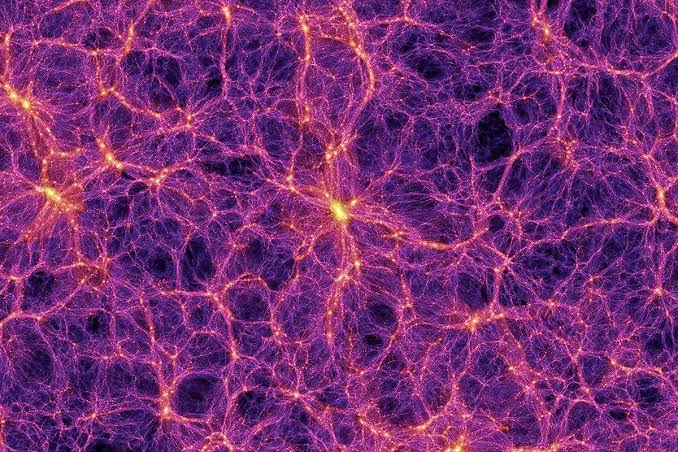
To determine what dark matter is then requires an attack from two fronts: design experiments here on earth attempting directly detect it, and further study its cosmic implications to look for more clues as to its properties.
The panel recommended next generation telescopes to study the CMB as a top priority. The so called ‘Stage 4’ CMB experiment would deploy telescopes in both the south pole and Chile’s Atacama desert to better characterize sources of atmospheric noise. The CMB has been studied extensively before, but the increased precision of CMS-S4 could shed light on mysteries like dark energy, dark matter, inflation, and the recent Hubble Tension. Given the past fruitfulness of these efforts, I think few doubted the science case for such a next generation experiment.

The P5 report recommended a suite of new dark matter experiments in the next decade, including the ‘ultimate’ liquid Xenon based dark matter search. Such an experiment would follow in the footsteps of massive noble gas experiments like LZ and XENONnT which have been hunting for a favored type of dark matter called WIMP’s for the last few decades. These experiments essentially build giant vats of liquid Xenon, carefully shield from any sources of external radiation, and look for signs of dark matter particles bumping into any of the Xenon atoms. The larger the vat of Xenon, the higher chance a dark matter particle will bump into something. Current generation experiments have ~7 tons of Xenon, and the next generation experiment would be even larger. The next generation aims to reach the so called ‘neutrino floor’, the point as which the experiments would be sensitive enough to observe astrophysical neutrinos bumping into the Xenon. Such neutrino interactions would look extremely similar to those of dark matter, and thus represent an unavoidable background which would signal the ultimate sensitivity of this type of experiment. WIMP’s could still be hiding in a basement below this neutrino floor, but finding them would be exceedingly difficult.

WIMP’s are not the only dark matter candidates in town, and recent years have also seen an explosion of interest in the broad range of dark matter possibilities, with axions being a prominent example. Other kinds of dark matter could have very different properties than WIMPs and have had much fewer dedicated experiments to search for them. There is ‘low hanging fruit’ to pluck in the way of relatively cheap experiments which can achieve world-leading sensitivity. Previously, these ‘table top’ sized experiments had a notoriously difficult time obtaining funding, as they were often crowded out of the budgets by the massive flagship projects. However, small experiments can be crucial to ensuring our best chance of dark matter discovery, as they fill in the blinds pots missed by the big projects.
The panel therefore recommended creating a new pool of funding set aside for these smaller scale projects. Allowing these smaller scale projects to flourish is important for the vibrancy and scientific diversity of the field, as the centralization of ‘big science’ projects can sometimes lead to unhealthy side effects. This specific recommendation also mirrors a broader trend of the report: to attempt to rebalance the budget portfolio to be spread more evenly and less dominated by the large projects.

Any report like this comes with some tough choices. Budget realities mean not all projects can be funded. Besides the pairing down of some of DUNE’s upgrades, one of the biggest areas that was recommended against were ‘accessory experiments at the LHC’. In particular, MATHUSULA and the Forward Physics Facility were two experiments that proposed to build additional detectors near already existing LHC collision points to look for particles that may be missed by the current experiments. By building new detectors hundreds of meters away from the collision point, shielded by concrete and the earth, they can obtained unique sensitivity to ‘long lived’ particles capable of traversing such distances. These experiments would follow in the footsteps of the current FASER experiment, which is already producing impressive results.
While FASER found success as a relatively ‘cheap’ experiment, reusing detector components from and situating itself in a beam tunnel, these new proposals were asking for quite a bit more. The scale of these detectors would have required new caverns to be built, significantly increasing the cost. Given the cost and specialized purpose of these detectors, the panel recommended against their construction. These collaborations may now try to find ways to pare down their proposal so they can apply to the new small project portfolio.
Another major decision by the panel was to recommend against hosting a new Higgs factor collider in the US. But that will discussed more in a future post.
The P5 panel was faced with a difficult task, the total cost of all projects they were presented with was three times the budget. But they were able to craft a plan that continues the work of the previous decade, addresses current shortcomings and lays out an inspiring vision for the future. So far the community seems to be strongly rallying behind it. At time of writing, over 2700 community members from undergraduates to senior researchers have signed a petition endorsing the panels recommendations. This strong show of support will be key for turning these recommendations into actual funding, and hopefully lobbying congress to even increase funding so that more of this vision can be realized.
For those interested the full report as well as executive summaries of different areas can be found on the P5 website. Members of the US particle physics community are also encouraged to sign the petition endorsing the recommendations here.
And stayed tuned for part 2 of our coverage which will discuss the implications of the report on future colliders!
When students first learn quantum field theory, the mathematical language the underpins the behavior of elementary particles, they start with the simplest possible interaction you can write down : a particle with no spin and no charge scattering off another copy of itself. One then eventually moves on to the more complicated interactions that describe the behavior of fundamental particles of the Standard Model. They may quickly forget this simplified interaction as a unrealistic toy example, greatly simplified compared to the complexity the real world. Though most interactions that underpin particle physics are indeed quite a bit more complicated, nature does hold a special place for simplicity. This barebones interaction is predicted to occur in exactly one scenario : a Higgs boson scattering off itself. And one of the next big targets for particle physics is to try and observe it.

The Higgs is the only particle without spin in the Standard Model, and the only one that doesn’t carry any type of charge. So even though particles such as gluons can interact with other gluons, its never two of the same kind of gluons (the two interacting gluons will always carry different color charges). The Higgs is the only one that can have this ‘simplest’ form of self-interaction. Prominent theorist Nima Arkani-Hamed has said that the thought of observing this “simplest possible interaction in nature gives [him] goosebumps“.
But more than being interesting for its simplicity, this self-interaction of the Higgs underlies a crucial piece of the Standard Model: the story of how particles got their mass. The Standard Model tells us that the reason all fundamental particles have mass is their interaction with the Higgs field. Every particle’s mass is proportional to the strength of the Higgs field. The fact that particles have any mass at all is tied to the fact that the lowest energy state of the Higgs field is at a non-zero value. According to the Standard Model, early in the universe’s history when the temperature were much higher, the Higgs potential had a different shape, with its lowest energy state at field value of zero. At this point all the particles we know about were massless. As the universe cooled the shape of the Higgs potential morphed into a ‘wine bottle’ shape, and the Higgs field moved into the new minimum at non-zero value where it sits today. The symmetry of the initial state, in which the Higgs was at the center of its potential, was ‘spontaneously broken’ as its new minimum, at a location away from the center, breaks the rotation symmetry of the potential. Spontaneous symmetry breaking is a very deep theoretical idea that shows up not just in particle physics but in exotic phases of matter as well (eg superconductors).
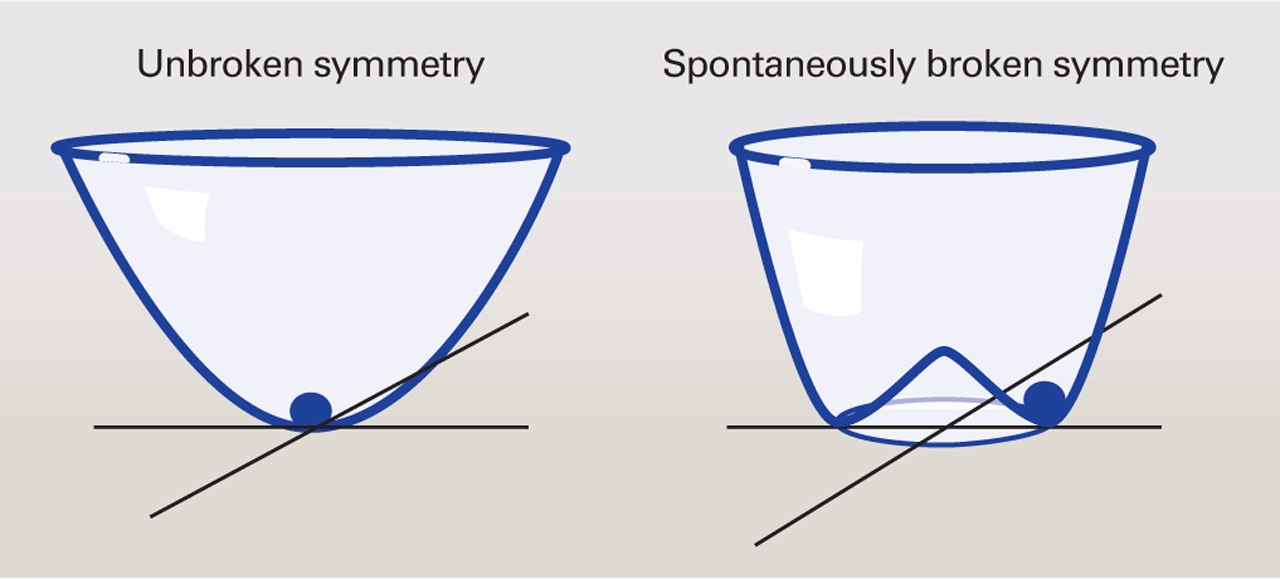
This fantastical story of how particle’s gained their masses, one of the crown jewels of the Standard Model, has not yet been confirmed experimentally. So far we have studied the Higgs’s interactions with other particles, and started to confirm the story that it couples to particles in proportion to their mass. But to confirm this story of symmetry breaking we will to need to study the shape of the Higgs’s potential, which we can probe only through its self-interactions. Many theories of physics beyond the Standard Model, particularly those that attempt explain how the universe ended up with so much matter and very little anti-matter, predict modifications to the shape of this potential, further strengthening the importance of this measurement.
Unfortunately observing the Higgs interacting with itself and thus measuring the shape of its potential will be no easy feat. The key way to observe the Higgs’s self-interaction is to look for a single Higgs boson splitting into two. Unfortunately in the Standard Model additional processes that can produce two Higgs bosons quantum mechanically interfere with the Higgs self interaction process which produces two Higgs bosons, leading to a reduced production rate. It is expected that a Higgs boson scattering off itself occurs around 1000 times less often than the already rare processes which produce a single Higgs boson. A few years ago it was projected that by the end of the LHC’s run (with 20 times more data collected than is available today), we may barely be able to observe the Higgs’s self-interaction by combining data from both the major experiments at the LHC (ATLAS and CMS).
Fortunately, thanks to sophisticated new data analysis techniques, LHC experimentalists are currently significantly outpacing the projected sensitivity. In particular, powerful new machine learning methods have allowed physicists to cut away background events mimicking the di-Higgs signal much more than was previously thought possible. Because each of the two Higgs bosons can decay in a variety of ways, the best sensitivity will be obtained by combining multiple different ‘channels’ targeting different decay modes. It is therefore going to take a village of experimentalists each working hard to improve the sensitivity in various different channels to produce the final measurement. However with the current data set, the sensitivity is still a factor of a few away from the Standard Model prediction. Any signs of this process are only expected to come after the LHC gets an upgrade to its collision rate a few years from now.

While experimentalists will work as hard as they can to study this process at the LHC, to perform a precision measurement of it, and really confirm the ‘wine bottle’ shape of the potential, its likely a new collider will be needed. Studying this process in detail is one of the main motivations to build a new high energy collider, with the current leading candidates being an even bigger proton-proton collider to succeed the LHC or a new type of high energy muon collider.

The quest to study nature’s simplest interaction will likely span several decades. But this long journey gives particle physicists a roadmap for the future, and a treasure worth traveling great lengths for.
Read More:
CERN Courier Interview with Nima Arkani-Hamed on the future of Particle Physics on the importance of the Higgs’s self-coupling
Wikipedia Article and Lecture Notes on Spontaneous symmetry breaking
Recent ATLAS Measurements of the Higgs Self Coupling

