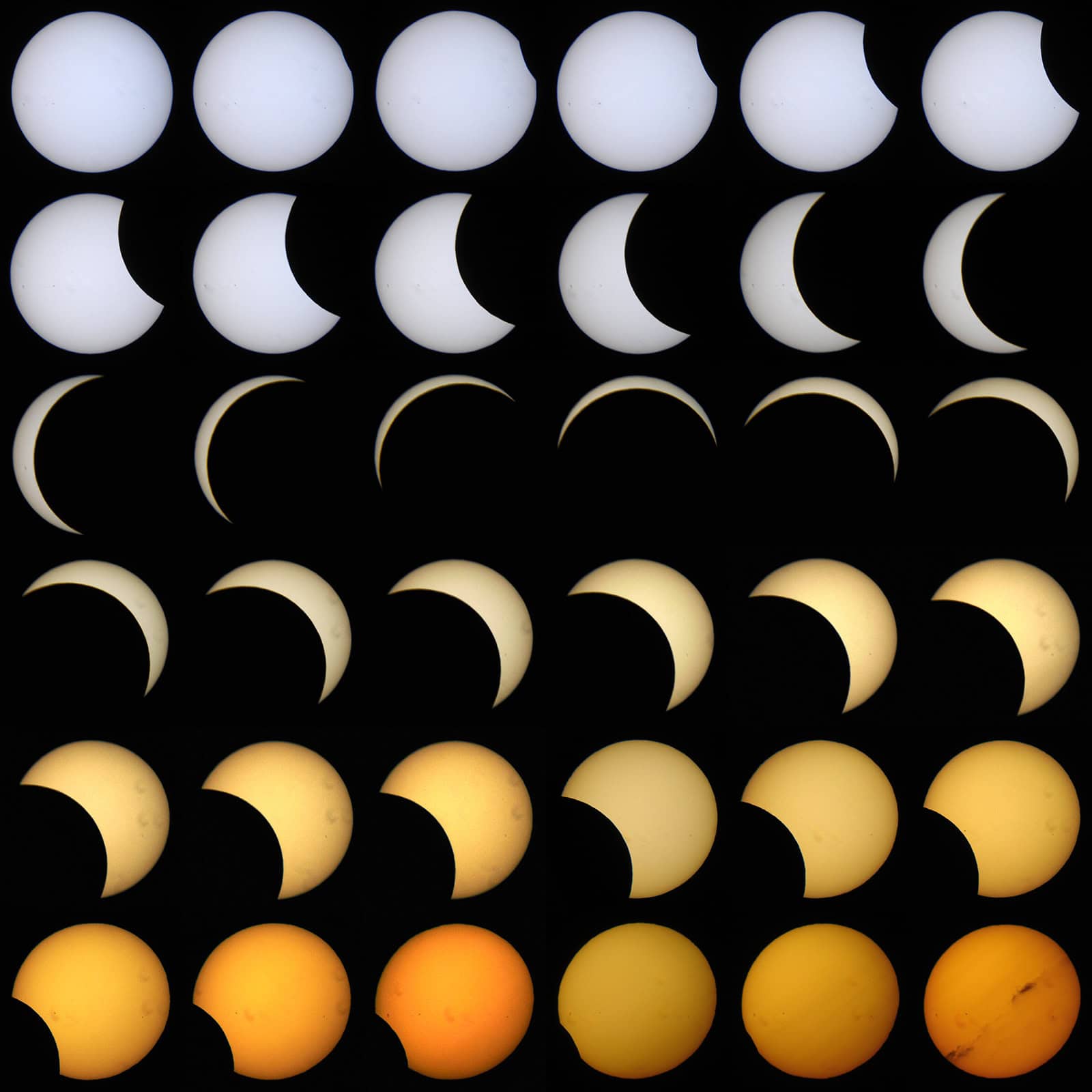
Packed with physics This photo montage of the 12 August 2026 solar eclipse as seen from the Isle of Wight, UK, holds a surprising amount of science. (Courtesy: Sean Ryan)
The UK’s hot, dry summer provided widespread clear skies for the solar eclipse that took place on Wednesday 12 August 2026. It was not a total eclipse – you had to be in northern Spain for that – but Britain still enjoyed a partial eclipse between around 6 p.m. and 8 p.m. BST, depending on location.
With typically more than 90% of the Sun’s disc covered – and with the event occurring after many people had finished work – the circumstances were ideal for a rare, immersive mass-engagement with physics.
Many people had got hold of eclipse glasses in advance or searched through kitchen cupboards for a colander to produce shadow patterns
Widespread public-awareness raising by professional and amateur astronomical societies had led to a strong build-up to the event in mainstream and social media. As a result, much of the public was aware the eclipse was coming, and many people had got hold of eclipse glasses in advance or, failing that, searched through kitchen cupboards for a colander to produce shadow patterns.
Here in the UK, friends and families gathered on west-facing hills, parks and village greens that evening with folding chairs, smartphones, cameras, telescopes and colanders, to enjoy the spectacle over a picnic tea. In built-up areas of towns and cities, many sought out west-facing windows of homes and offices.
I’m an old-school visual observer and recorded the eclipse sequence using 20-year-old equipment
While the eclipse on the UK mainland was deepest in Cornwall, I took my chances on the Isle of Wight, just off the coast of southern England.
Amateur astrophotography has been revolutionized over the last few years thanks to specialized high-sensitivity astronomical CMOS cameras, but I’m an old-school visual observer and recorded the eclipse sequence using 20-year-old equipment.
The montage presented here contains 36 frames spanning the entire eclipse sequence and packs in a wealth of physics. Besides the obvious relative motion of the Earth, Moon and Sun, three sunspot groups are visible, approximately delineating the solar equator; the camera was aligned with the sunspot groups and the equatorial mount maintained this orientation.
The Moon’s sharp-edged silhouette is a reminder that it has no atmosphere, whereas the Sun is brighter in the centre than the edge. Known as “limb-darkening”, it arises because of the temperature gradient of the tenuous solar photosphere – and is a reminder that the perceived edge of the Sun is merely a wavelength-dependent opacity transition.
While we often describe the Sun as yellow, the transmission profile with the OD5 solar filter that I used here gives it a slightly silvery-blue tinge. But as the Sun sank lower in the sky during the evening, wavelength-dependent extinction and scattering reddened the light, so the silvery disc progressively turns distinctly yellow and then orange.
Along with the colour change, the solar disc takes on an oblate form in the final row of frames due to differential atmospheric refraction close to the horizon. Terrestrial clouds close to the local horizon are seen in the final frame.
For many people viewing an eclipse for the first time, talk of intersecting orbital planes is perhaps already too much physics for one evening, but for those who wish to look a little deeper, more questions – and more physics – pop up the closer you look. What have you spotted in the montage that I haven’t?
The technical stuff
I took these images using a portable 90 mm diameter Maksutov-Cassegrain telescope (a Meade ETX-90) on an equatorial mount with a battery-powered drive, a full-aperture glass OD5 solar filter, and a 25 mm focal-length eyepiece paired in eyepiece-projection mode with a 5 megapixel Sony Cyber-shot CCD digital camera.
The camera was set for manual operation: minimum ISO (100), minimum aperture (f/5.6), fixed focus (achieved at f/2.8), and manually adjusted exposure time (1/400 – 1/13 s). Image processing was minimal, conducted using ImageJ software, which is widely used in biomedical imaging.
Shadowing of the sensor by dust on the lens surfaces was partially corrected by dividing through by a normalized clear-sky exposure. Frames were cropped manually and re-scaled in intensity to compensate for increasing atmospheric absorption as the Sun sank towards the horizon, and for changes of exposure duration.
This episode of the Physics World Weekly podcast explores how the innate curiosity of children can help make quantum mechanics more accessible to the public. My guest is Katia Moskvitch, who co-hosts The Quantum Kid video channel with her 10-year-old son Kai.
As well as interviewing leading lights in quantum science and technology – including Nobel laureates – the duo has toured science labs including CERN. Moskvitch explains how the programme’s child-led approach puts guests at ease and helps them explain difficult concepts to a general audience.
Moskvitch believes that children can be more receptive to counterintuitive quantum concepts than adults and argues that an early familiarity with quantum physics could inspire young people to study science. This, she believes, will provide a foundation for success in the burgeoning quantum sector.
This podcast is supported by American Elements, the world’s leading manufacturer of engineered and advanced materials. The company’s ability to scale laboratory breakthroughs to industrial production has contributed to many of the most significant technological advancements since 1990 – including LED lighting, smartphones, and electric vehicles.
How many times have you wanted to throttle a journalist? Do you ever get incensed about articles, podcasts or videos that simplify, dumb down or belittle your research? Don’t you ever want to teach a science writer the basics?
Earlier this summer the US quantum physicist Christopher Fuchs got the chance. Thanks to some funding at the end of a grant cycle, Fuchs arranged a face-off between science journalists and writers, and a philosopher (me) at Royal Holloway, University of London. But the meeting wasn’t all about Fuchs having a big fat moan; he also gave the journalists the chance to push back.
Fuchs, who is from the University of Massachusetts, Boston, is the principal expositor of QBism, originally an acronym for “Quantum Bayesianism”, a research programme devoted to trying to figure out what the world must be like if quantum formalism is correct. But even top-flight writers, Fuchs thinks, get it wrong. And so emerged his idea for the workshop, called “Communicating QBism”.
Attendees at the workshop, besides Fuchs himself, included his collaborator Rüdiger Schack from Royal Holloway – the gracious host of the meeting. There was also John DeBrota, who’s a postdoc at Ludwig Maximilian University, Munich, and Matthew Liefer, associate professor at the Institute for Quantum Studies at Chapman University, California.
The science writers were all experienced. One was Philip Ball, the author of some 30 books who has a PhD in physics and contributes regularly to Physics World. Jo Marchant, the sole female writer to attend, has a PhD in genetics and medical microbiology and is a New York Times bestselling author who recently wrote for New Scientist on QBism.
The four other writers were Robert Henderson, who has a PhD in quantum field theory; George Musser, who has a PhD in planetary science and is a contributing editor at Scientific American; Ulf von Rauchhaupt, a science editor at the Frankfurter Allgemeine Zeitung who has a PhD in extraterrestrial physics; and Zack Savitsky, a physics correspondent for Science.
I was invited at the last minute as a philosopher and writer who might find value in the event. I did.
Pugnacious and self-deprecating
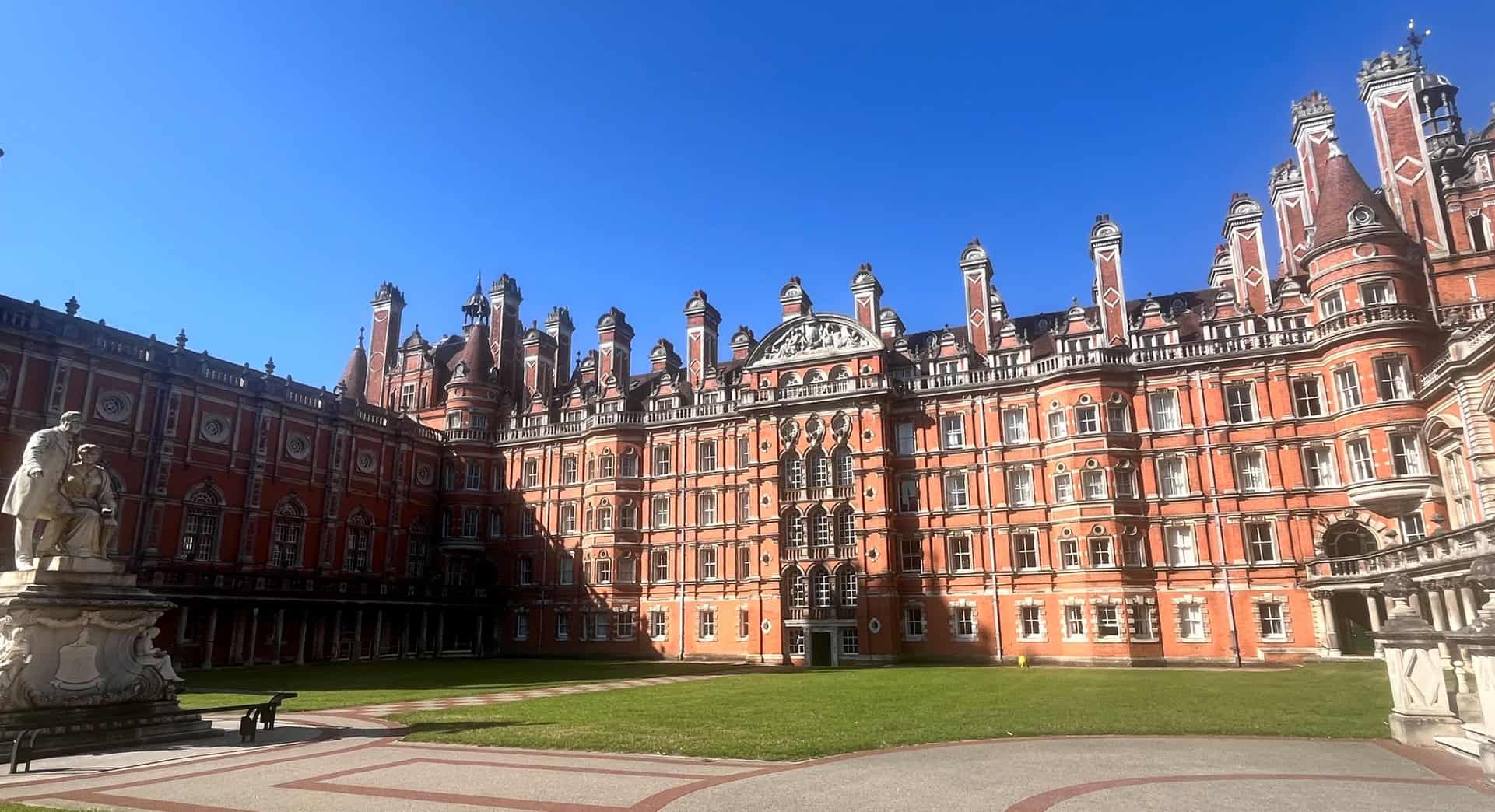
Royal Holloway’s wooded campus on the western outskirts of London is dominated by the Founder’s Building, a beautifully ornate late-19th-century red-brick castle-like structure modelled on a French chateau with a central courtyard. But that’s only where we ate. Fuchs’s face-off, which took place on June 18–19, was holed in a modest modern science building down the hill.
Fuchs, whom I’ve met and written about several times, including for Physics World and a philosophy journal, is charmingly pugnacious. He approaches talks and conversations with unwavering zest and easily out-talks critics. He is relentless in pointing out even years-old mistakes to journalists and writers [editor’s note: I can confirm this]. Yet Fuchs can also be endearingly self-deprecating.
If you didn’t know Fuchs, you might be forgiven for thinking that he had an inquisition in mind. “I explain the ideas until I’m blue in the face,” the invitation ran, but you journalists are “pretty deficit in getting QBism right”. He continued, “What is it that makes QBism so damned hard to understand for journalists and the lay public?”
Fuchs then described himself as “communication impaired” – which was disingenuous. Based on Shack’s estimate, he’s sent about 150,000 QBism-related e-mails, he’s got “3 Million Miler” status from American Airlines thanks to his trips to give talks, and he was a lead speaker at the Helgoland conference on the centenary of quantum mechanics last year.
Some invitees were cautious, even sceptical. “QBism isn’t just another quantum physics interpretation”, Marchant replied to Fuchs’s invitation. “You’re challenging ideas of what physics is even about and requiring a radically different conception of what nature is”. Ball, meanwhile, perceptively reminded Fuchs that QBism is so novel that “the misrepresentations don’t just come from journalists”.
As for Musser, he warned Fuchs that the encounter may not be pleasant. “We will need to have free, open and frank discussions”, he responded, that may be “infuriating to you”. He counselled Fuchs to bring “plenty of plushy toys” for participants to safely throw at each other.
Fuchs’s invitation, however, also expressed warm and genuine respect for the coterie of science writers, who all agreed to come. Still, Fuchs brought a box of plushies just in case.
Speaking about science
On the meeting’s first day, the writers listened and learned. Schack opened the workshop by going over QBism’s vocabulary. “Probability” is not a property of things but refers to the expectations that an experimentalist has about outcomes of an action they are about to take. “Measurement” is that outcome.
“Quantum formalism”, meanwhile, is a tool that any experimentalist can use for making the best estimate they can about which outcome they will get. “Quantum states” are not properties of the world but compendia of probabilities to inform the agent about which actions they ought to take to achieve their goals.
Scene of the action Royal Holloway, University of London, was the venue for the stand-off between scientists and science journalists. (Courtesy: Robert P Crease)
After Schack, Fuchs gave a talk showing that QBism is neither a philosophical add-on to quantum theory nor something motivated by an attempt to resolve issues to do with entanglement, Bell inequality violations, and so on. Rather, QBism is the only satisfactory coherent account of what the world must be like if the quantum formalism is correct.
Fuchs quashed the idea that QBism is solipsistic; quantum formalisms, he pointed out, have been hammered out for a century and can be picked up by anyone as the best guide to their laboratory experience. He vented ire over stories that use the word “observe” and visual images to characterize what experimentalists do as if they were flies on the wall rather than actors in measurement events.
When Fuchs complained about a clause in an article by Savitsky which suggested such an interpretation, the writers cried “Foul!”. They accused Fuchs of “niggling” about a few words in a lengthy 4000-word article. When Fuchs replied, “I want to niggle over words!” he dodged a plushie.
Learning about writing
On the second day of the meeting, it was the scientists’ turn to listen and learn. Henderson talked about his struggle to “think like a QBist”, explaining how, during the Covid-19 pandemic, he joined Fuchs’s weekly Zoom sessions known as “QBukis”. These made him feel like he had come across “a more advanced civilization of aliens maybe, to whom premises I’d never thought to question were deemed antiquated and naïve”.
Henderson had an epiphany one day when he saw a bird hopping across his snow-covered lawn. The bird, he realized, was not a thing-in-itself but “the designation of a bundle of expectations” that he was bringing to bear to recognize it. What’s most challenging in learning to think like a QBist, Henderson concluded, is that QBism is “playing a different game than the rest of physics, or even science”.
Marchant followed with a talk entitled “Why QBism keeps getting misheard”, in which she showed a picture of a tennis player about to smash a rocketing tennis ball. What was happening, she said, wasn’t just body movements and ball trajectories – but a process of unfolding and continually updated predictions of actions.
QBism sees experimentalists like that tennis player, Marchant said, shepherding new events into the world, but it’s unintuitive to think that way. “QBism isn’t just another quantum physics interpretation,” Marchant said; “you’re challenging ideas of what physics is even about and requiring a radically different conception of what nature is and how we are related to it”. This, she concluded “is always going to be difficult”.
Ball pointed out that journalists are forced to keep in mind “mental attractors” that entice the public, journalists and even scientists to think in classical rather than quantum terms.
Between talks, the writers cited other constraints, such as time, money, audience and the space allotted by editors, all of which shape and dictate their output. Furthermore, writers are sometimes forced to use words whose meanings vary from their technical use.
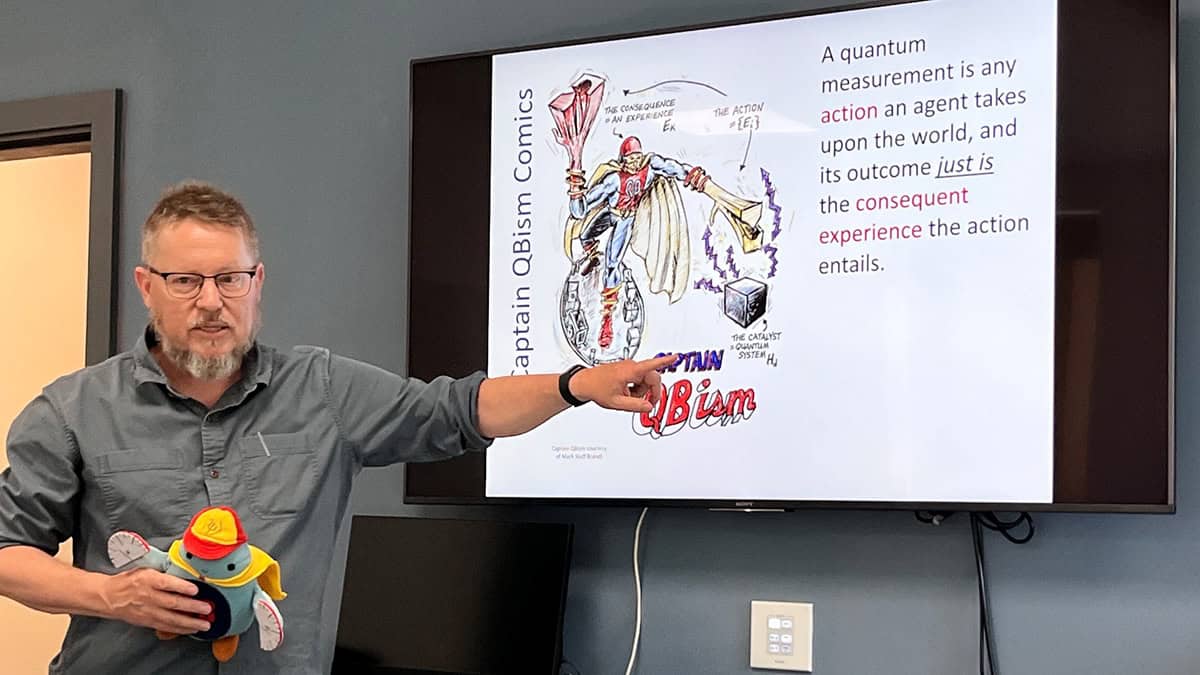
At one point Fuchs showed a slide of Marchant’s New Scientist article and complained about the word “perspectives” in the standfirst. But Marchant and others objected that Fuchs’s “Gotcha!” play was again committing a foul; writers must lead readers gently into difficult stories with prose that sometimes must violate what researchers mean. “We have to write so people keep listening,” Marchant pointed out.
Impressed, Fuchs had to admit that he does something similar in his lectures, not leading with his most radical ideas but holding off until later.
One scientist then asked why writers don’t routinely run stories by sources before publication. Even if you accurately regurgitate the sources’ words, the writers replied, they often insist on changes, demand that their editors alter or retract the story, heap abuse on you, or even threaten to sue, causing the magazine to drop your article.
Tread carefully QBism is an alternative interpretation of quantum mechanics, but woe betide anyone whose explanation of it fails to live up to Christopher Fuchs’s standards. (Courtesy: Robert P Crease)
When a writer asked why scientists should even care about representations of their work in the media, the answers were difficult to synthesize. They ranged from the noble wish to nurture a scientifically literate public to the self-interested hope that good coverage might influence public perceptions and thus lead to more money from funding agencies.
But what’s hardest writing about QBism, explained the writers, has to do with Henderson’s “civilization of aliens” and Marchant’s “keep ‘em listening” points. Readers instinctively think, contra QBism, that the world has permanent residents and chiselled-in laws. The tennis player’s dive for the ball can always be reconstructed afterwards from a god’s-eye perspective in terms of classical physics, and it’s second-nature for both the public and even scientists to assume that the end of physics is to make such reconstructions.
The critical point
Years ago I wrote a column “The press is a foreign country” whose message was that communicating science is like engaging with another culture. Science and the media, I wrote, are separate institutions with different values, traditions and methods and reasons for seeking and justifying knowledge. The cross-cultural interaction, though, cannot always be made trouble-free, with all conflicts reconcilable by facilitators or relationship counsellors.
Given the qualifications of the participants at “Communicating QBism” – all but Zack had PhDs – one might have thought that the cross-cultural interaction at the workshop would be relaxed. It was, for the most part. But good scientific communication, it emerged, is not always a matter of clear explanations, demonstrations of relevance, dazzling imagery, or scientifically literate journalists.
Positive interactions may require constantly negotiating trade-offs between accuracy and comprehensibility, as well as setting up flinty encounters in which both scientists and writers actively hunt down and expose their own assumptions. These encounters must risk conflict and discomfort on both sides. Good science communication, in short, can use some genial pugilism, and Fuchs’s workshop was an excellent example.
Credibility is a cornerstone of modern science and concepts such as reproducibility and peer review have evolved to ensure that the knowledge produced by scientists is high quality. However, for science to thrive and benefit everyone, scientists themselves must be seen as credible to the general public.
This episode of the Physics World Weekly podcast features Shumaila Bhatti and Dara Wald who are social scientists at Virginia Tech in the US. They have done a comprehensive study that reveals that the perceived motivation of a scientist plays an important role in how credible they appear to the public.
The study involved nearly 1000 subjects in the US and a key result is the identification of five audience classes that differ in terms of their perceptions of scientific credibility. Wald and Bhatti talk about their motivation for doing the study and its interpretation. One of their findings is that people in all classes don’t tend to doubt the expertise of scientists, but they would prefer scientists to honest and motivated by the public good.
Quantum theory is one of humanity’s great intellectual achievements, radically transforming our understanding of nature at the deepest level while delivering unprecedented technological advances. We have thus always felt it a great pity that most young people never get the opportunity to engage with the theory at a substantive level.
The solid-state physicist David Mermin, who has studied the fundamentals of quantum mechanics, once memorably wrote of quantum theory: “We now know that the Moon is demonstrably not there when nobody looks”. It was a comment that certainly captures the imagination, but it is difficult to appreciate what he meant meant without engaging with the mathematics that lies behind it.
In an attempt to see if we could change that, we ran our first Quantum in Pictures programme at the University of Hertfordshire earlier this month. A five-day, in-person course, it was attended by about 45 students aged 16–18 and was built around Quantum Pictorialism – a diagrammatic approach to quantum theory pioneered by Bob Coecke from the University of Oxford and collaborators.
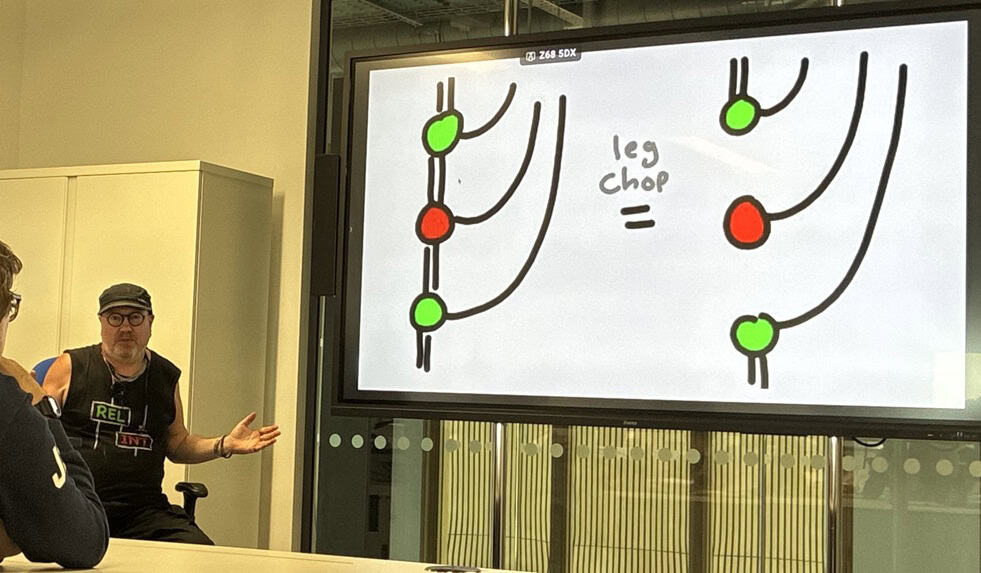
Seeing for real Bob Coecke using his pictorial approach to the subject (Courtesy: Shanti Pise and Leron Borsten)
The crucial point is that the pictures aren’t illustrations of some more fundamental mathematics hidden underneath. The pictures are the mathematics. A rigorous graphical calculus built from spider diagrams enables students to reason directly about quantum processes. Since this diagrammatic formulation is fully equivalent to the usual Hilbert space formalism, the students were doing quantum mechanics for real.
We felt truly privileged to share the mysteries of quantum mechanics with a fantastically friendly, interested and diverse cohort from schools across south-east England. What struck me was how readily they engaged with the material: asking excellent (and sometimes rather challenging) questions, debating ideas and working collaboratively through the problem-solving sessions.
The graphical problems proved particularly popular, with repeated cries for “more spider diagrams!”. The course was deliberately ambitious, but by the end, they were able to work through the complete quantum teleportation protocol. Indeed, one student was confident enough to get up and reason through it for the whole class (something we certainly would not have dared to do at their age).
As Maya, a year-12 student from Highams Park Sixth Form in London, put it: “I really enjoyed seeing how ideas in quantum physics could be explained through simple pictures and diagrams. I was surprised that concepts like quantum teleportation, which seemed very complicated at first, could become much easier to understand through this approach. The programme has made me even more interested in studying physics and exploring quantum theory in the future.”
The approach also worked for students without a traditional mathematics or physics background, such as Andrew, a year-12 student from Sir John Lawes School in Harpenden.
“The programme was captivating,” he said. “The concept of using diagrams was innovative and explained things in a logical manner to help me understand topics such as quantum teleportation. The programme showed the stark differences between classical and quantum physics through real-world examples, enriched by talks from industry experts and pioneers with different backgrounds.”
Muhammad Hamza Waseem, who helped develop the programme and joined us on the final day, captured the atmosphere perfectly. “I found the enthusiasm, curiosity, and irreverence of the students very inspiring,” he said, “and I hope that they take the same spirit into their university education and beyond.”
That sense of joy and excitement was, for me, the lesson of the week. We’ve been thoroughly convinced that quantum theory isn’t intrinsically beyond the reach of curious 16-year-olds. We just need to give them the right mathematical language. The next step is an optional graduate-level exam, which will put that claim to the test. Watch this space.
The authors would like to thank staff, researchers and students from the University of Hertfordshire who volunteered their time to make the programme possible. They are also grateful to Ian Loffler, Bob Coecke and Muhammad Hamza Waseem for their support and inspiring contributions.
Particle physics is the epitome of ‘big science’. To answer our most fundamental questions out about physics requires world class experiments that push the limits of whats technologically possible. Such incredible sophisticated experiments, like those at the LHC, require bigfacilities to make them possible, bigcollaborations to run them, big project planning to make dreams of new facilities a reality, and committees with big acronyms to decide what to build.
Enter the Particle Physics Project Prioritization Panel (aka P5) which is tasked with assessing the landscape of future projects and laying out a roadmap for the future of the field in the US. And because these large projects are inevitably an international endeavor, the report they released last week has a large impact on the global direction of the field. The report lays out a vision for the next decade of neutrino physics, cosmology, dark matter searches and future colliders.
P5 follows the community-wide brainstorming effort known as the Snowmass Process in which researchers from all areas of particle physics laid out a vision for the future. The Snowmass process led to a particle physics ‘wish list’, consisting of all the projects and research particle physicists would be excited to work on. The P5 process is the hard part, when this incredibly exciting and diverse research program has to be made to fit within realistic budget scenarios. Advocates for different projects and research areas had to make a case of what science their project could achieve and a detailed estimate of the costs. The panel then takes in all this input and makes a set of recommendations of how the budget should be allocated, what should projects be realized and what hopes are dashed. Though the panel only produces a set of recommendations, they are used quite extensively by the Department of Energy which actually allocates funding. If your favorite project is not endorsed by the report, its very unlikely to be funded.
The P5 report also created an awesome graphic that contains symbolism for the different aspects of the plan. The left side depicts oscillating neutrinos and the shape of the Higgs potential. The right side depicts dark matter and the large scale structure of the universe. The central ball of light is supposed to represent discoveries of the unknown. Source
Particle physics is an incredibly diverse field, covering sub-atomic to cosmic scales, so recommendations are divided up into several different areas. In this post I’ll cover the panel’s recommendations for neutrino physics and the cosmic frontier. Future colliders, perhaps the spiciest topic, will be covered in a follow up post.
The Future of Neutrino Physics
For those in the neutrino physics community all eyes were on the panels recommendations regarding the Deep Underground Neutrino Experiment (DUNE). DUNE is the US’s flagship particle physics experiment for the coming decade and aims to be the definitive worldwide neutrino experiment in the years to come. A high powered beam of neutrinos will be produced at Fermilab and sent 800 miles through the earth’s crust towards several large detectors placed in a mine in South Dakota. Its a much bigger project than previous neutrino experiments, unifying essentially the entire US community into a single collaboration.
DUNE is setup to produce world leading measurements of neutrino oscillations, the property by which neutrinos produced in one ‘flavor state’, (eg an electron-neutrino) gradually changes its state with sinusoidal probability (eg into a muon neutrino) as it propagates through space. This oscillation is made possible by a simple quantum mechanical weirdness: neutrino’s flavor state, whether it couples to electrons muons or taus, is not the same as its mass state. Neutrinos of a definite mass are therefore a mixture of the different flavors and visa versa.
Detailed measurements of this oscillation are the best way we know to determine several key neutrino properties. DUNE aims to finally pin down two crucial neutrino properties: their ‘mass ordering’, which will solidify how the different neutrino flavors and measured mass differences all fit together, and their ‘CP-violation’ which specifies whether neutrinos and their anti-matter counterparts behave the same or not. DUNE’s main competitor is the Hyper-Kamiokande experiment in Japan, another next-generation neutrino experiment with similar goals.
A depiction of the DUNE experiment. A high intensity proton beam at Fermilab is used to create a concentrated beam of neutrinos which are then sent through 800 miles of the Earth’s crust towards detectors placed deep underground South Dakota. Source
Construction of the DUNE experiment has been ongoing for several years and unfortunately has not been going quite as well as hoped. It has faced significant schedule delays and cost overruns. DUNE is now not expected to start taking data until 2031, significantly behind Hyper-Kamiokande’s projected 2027 start. These delays may lead to Hyper-K making these definitive neutrino measurements years before DUNE, which would be a significant blow to the experiment’s impact. This left many DUNE collaborators worried about its broad support from the community.
It came as a relief then when P5 report re-affirmed the strong science case for DUNE, calling it the “ultimate long baseline” neutrino experiment. The report strongly endorsed the completion of the first phase of DUNE. However, it recommended a pared-down version of its upgrade, advocating for an earlier beam upgrade in lieu of additional detectors. This re-imagined upgrade will still achieve the core physics goals of the original proposal with a significant cost savings. With this report, and news that the beleaguered underground cavern construction in South Dakota is now 90% complete, was certainly welcome holiday news to the neutrino community. This is also sets up a decade-long race between DUNE and Hyper-K to be the first to measure these key neutrino properties.
Cosmic Implications
While we normally think of particle physics as focused on the behavior of sub-atomic particles, its really about the study of fundamental forces and laws, no matter the method. This means that telescopes to study the oldest light in the universe, the Cosmic Microwave Background (CMB), fall into the same budget category as giant accelerators studying sub-atomic particles. Though the experiments in these two areas look very different, the questions they seek to answer are cross-cutting. Understanding how particles interact at very high energies helps us understand the earliest moments of the universe, when such particles were all interacting in a hot dense plasma. Likewise, by studying the these early moments of the universe and its large-scale evolution can tell us about what kinds of particles and forces are influencing its dynamics. When asking fundamental questions about the universe, one needs both the sharpest microscopes and the grandest panoramas possible.
The most prominent example of this blending of the smallest and largest scales in particle physics is dark matter. Some of our best evidence for dark matter comes analyzing the cosmic microwave background to determine how the primordial plasma behaved. These studies showed that some type of ‘cold’, matter that doesn’t interact with light, aka dark matter, was necessary to form the first clumps that eventually seeded the formation of galaxies. Without it, the universe would be much more soup-y and structureless than what we see to today.
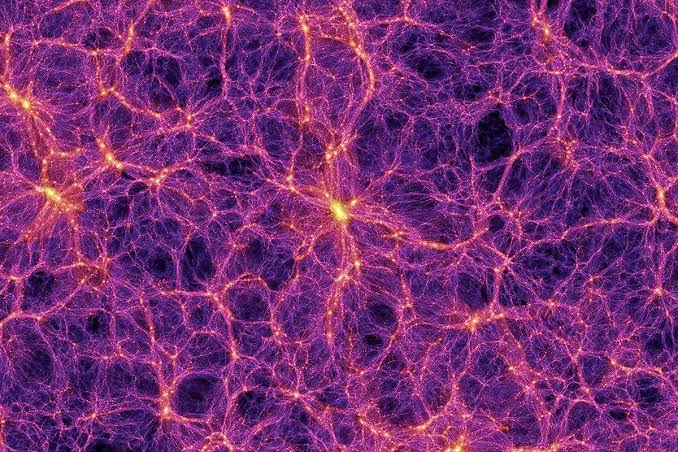
The “cosmic web” galaxy clusters from the Millenium simulation. Measuring and understanding this web can tell us a lot about the fundamental constituents of the universe. Source
To determine what dark matter is then requires an attack from two fronts: design experiments here on earth attempting directly detect it, and further study its cosmic implications to look for more clues as to its properties.
The panel recommended next generation telescopes to study the CMB as a top priority. The so called ‘Stage 4’ CMB experiment would deploy telescopes in both the south pole and Chile’s Atacama desert to better characterize sources of atmospheric noise. The CMB has been studied extensively before, but the increased precision of CMS-S4 could shed light on mysteries like dark energy, dark matter, inflation, and the recent Hubble Tension. Given the past fruitfulness of these efforts, I think few doubted the science case for such a next generation experiment.
A mockup of one of the CMS-S4 telescopes which will be based in the Chilean desert. Note the person for scale on the right (source)
The P5 report recommended a suite of new dark matter experiments in the next decade, including the ‘ultimate’ liquid Xenon based dark matter search. Such an experiment would follow in the footsteps of massive noble gas experiments like LZ and XENONnT which have been hunting for a favored type of dark matter called WIMP’s for the last few decades. These experiments essentially build giant vats of liquid Xenon, carefully shield from any sources of external radiation, and look for signs of dark matter particles bumping into any of the Xenon atoms. The larger the vat of Xenon, the higher chance a dark matter particle will bump into something. Current generation experiments have ~7 tons of Xenon, and the next generation experiment would be even larger. The next generation aims to reach the so called ‘neutrino floor’, the point as which the experiments would be sensitive enough to observe astrophysical neutrinos bumping into the Xenon. Such neutrino interactions would look extremely similar to those of dark matter, and thus represent an unavoidable background which would signal the ultimate sensitivity of this type of experiment. WIMP’s could still be hiding in a basement below this neutrino floor, but finding them would be exceedingly difficult.
A photo of the current XENONnT experiment. This pristine cavity is then filled with liquid Xenon and closely monitored for signs of dark matter particles bumping into one of the Xenon atoms. Credit: XENON Collaboration
WIMP’s are not the only dark matter candidates in town, and recent years have also seen an explosion of interest in the broad range of dark matter possibilities, with axions being a prominent example. Other kinds of dark matter could have very different properties than WIMPs and have had much fewer dedicated experiments to search for them. There is ‘low hanging fruit’ to pluck in the way of relatively cheap experiments which can achieve world-leading sensitivity. Previously, these ‘table top’ sized experiments had a notoriously difficult time obtaining funding, as they were often crowded out of the budgets by the massive flagship projects. However, small experiments can be crucial to ensuring our best chance of dark matter discovery, as they fill in the blinds pots missed by the big projects.
The panel therefore recommended creating a new pool of funding set aside for these smaller scale projects. Allowing these smaller scale projects to flourish is important for the vibrancy and scientific diversity of the field, as the centralization of ‘big science’ projects can sometimes lead to unhealthy side effects. This specific recommendation also mirrors a broader trend of the report: to attempt to rebalance the budget portfolio to be spread more evenly and less dominated by the large projects.
A pie chart comparing the budget porfolio in 2023 (left) versus the projected budget in 2033 (right). Currently most of the budget is being taken up by the accelerator upgrades and cavern construction of DUNE, with some amount for the LHC upgrades. But by 2033 the panel recommends a much more equitable balance between different research area.
What Didn’t Make It
Any report like this comes with some tough choices. Budget realities mean not all projects can be funded. Besides the pairing down of some of DUNE’s upgrades, one of the biggest areas that was recommended against were ‘accessory experiments at the LHC’. In particular, MATHUSULA and the Forward Physics Facility were two experiments that proposed to build additional detectors near already existing LHC collision points to look for particles that may be missed by the current experiments. By building new detectors hundreds of meters away from the collision point, shielded by concrete and the earth, they can obtained unique sensitivity to ‘long lived’ particles capable of traversing such distances. These experiments would follow in the footsteps of the current FASER experiment, which is already producing impressive results.
While FASER found success as a relatively ‘cheap’ experiment, reusing detector components from and situating itself in a beam tunnel, these new proposals were asking for quite a bit more. The scale of these detectors would have required new caverns to be built, significantly increasing the cost. Given the cost and specialized purpose of these detectors, the panel recommended against their construction. These collaborations may now try to find ways to pare down their proposal so they can apply to the new small project portfolio.
Another major decision by the panel was to recommend against hosting a new Higgs factor collider in the US. But that will discussed more in a future post.
Conclusions
The P5 panel was faced with a difficult task, the total cost of all projects they were presented with was three times the budget. But they were able to craft a plan that continues the work of the previous decade, addresses current shortcomings and lays out an inspiring vision for the future. So far the community seems to be strongly rallying behind it. At time of writing, over 2700 community members from undergraduates to senior researchers have signed a petition endorsing the panels recommendations. This strong show of support will be key for turning these recommendations into actual funding, and hopefully lobbying congress to even increase funding so that more of this vision can be realized.
For those interested the full report as well as executive summaries of different areas can be found on the P5 website. Members of the US particle physics community are also encouraged to sign the petition endorsing the recommendations here.
And stayed tuned for part 2 of our coverage which will discuss the implications of the report on future colliders!

 Login