❌

Normal view

Extreme weather reshapes how soils store and release carbon

11 September 2026 at 11:17

Beneath every step we take, soils hold one of the planet’s largest reservoirs of carbon, a vast, slow-moving bank of organic matter that quietly regulates how much of the world’s carbon stays locked away and how much escapes into the atmosphere as greenhouse gas. Now a sweeping new review warns that climate-driven extremes, droughts, floods, and wildfires, are rewriting the rules of that subterranean economy in ways that conventional models and land-management practices have not yet caught up with. The analysis, led by environmental scientist Nanthi Bolan of the University of Western Australia and colleagues, including a corresponding authorship by Bolan himself, synthesizes a substantial body of global evidence on how extreme weather reshapes carbon inputs to soil, microbial processing, erosion, and the sequestration of carbon that underpins soil health, water retention, nutrient cycling, and agricultural productivity.

The work, published in the journal Carbon Research, is notable for the scale of its underlying evidence base. On 14 January 2026, the authors searched Google Scholar, PubMed, and Web of Science using terms spanning climate change, extreme weather, soil carbon, microbial activity, decomposition, erosion, dissolved organic matter, and leaching. The initial sweep returned 14,218 records; after removing duplicates and screening for eligibility, 3,754 articles remained for bibliometric and qualitative analysis. From those, 187 publications were selected for detailed synthesis based on relevance, methodological rigor, and the substantive quality of their findings. Keyword co-occurrence patterns were mapped with VOSviewer, a bibliometric tool that reveals the intellectual architecture of a research field. The result is a critical review grounded in structured literature screening rather than new experimental data, but its synthesis offers one of the most comprehensive maps yet of how extremes rearrange the soil carbon cycle.

The review’s central finding is that no two extremes act alike. Drought, the most widespread disturbance, operates largely through the plant side of the equation. When rainfall fails, photosynthesis slows, plant biomass production falls, and the total flux of carbon entering soils through roots, residues, and litter declines. There is a nuance here: under moderate water stress, plants may temporarily shift a greater proportion of their fixed carbon belowground, investing in roots to chase moisture. But prolonged drought overwhelms that compensatory response. Microbial biomass shrinks, litter decomposition stalls, and the living engine of the soil carbon cycle idles. Then comes the deceptive twist: when rain finally returns, rewetting triggers a rapid pulse of carbon dioxide as starved soil microbes seize upon the accumulated substrates left behind by months of suspended activity. That post-drought CO₂ flush, the review emphasizes, can erase much of the apparent “savings” that accumulated during the dry period. Across the assembled evidence, repeated and multi-year drought was consistently associated with declining soil organic carbon, with grasslands and arable croplands showing particularly pronounced losses, ecosystems that happen to anchor much of the world’s food production.

Flooding tells the opposite story, but it ends in many of the same places. Water saturation chokes off oxygen diffusion through soil pores, forcing microbial metabolism into anaerobic pathways. That shift changes everything downstream. Prolonged waterlogging can drive the chemical reduction of iron oxyhydroxides, minerals that in oxygenated conditions act as microscopic glues binding organic carbon to soil particles. When those minerals dissolve, the carbon they held is released as dissolved organic carbon, which can then be stripped away by erosion and leaching and exported to rivers, lakes, and ultimately the ocean. The review stresses, however, that flooding is not unambiguously a carbon loss story. Wetlands and other periodically inundated ecosystems can accumulate and retain enormous carbon stocks precisely because water constrains decomposition. Whether a flood event releases carbon or banks it depends on the interplay between plant inputs, oxygen availability, and hydrological transport, a delicate balance that shifting rainfall regimes are actively destabilizing.

Wildfire is the most dramatic and immediately visible of the three forces, and its effects cascade on multiple timescales. Combustion directly strips vegetation, litter, and soil organic matter, transferring carbon to the atmosphere in hours. But fire also rearranges the physical and biological landscape of the soil in subtler ways: it can increase erosion by removing protective ground cover, alter soil wettability in ways that change hydrological behavior, restructure microbial communities, and expose previously protected carbon, once shielded inside aggregates or mineral associations, to fresh decomposition. There is a paradoxical bright spot. Pyrogenic carbon, the charcoal-like residue of incomplete combustion, is chemically recalcitrant and can persist in soils for centuries or millennia, functioning as a long-term carbon sink. Whether a fire leaves a landscape as a net carbon source or stabilizes some of its carbon in pyrogenic form depends on fire severity, soil moisture, fuel load, ecosystem type, and the trajectory of post-fire recovery. The review is clear that this balance cannot be predicted from fire alone; it is contingent, site by site, on conditions that vary widely across the globe.

Perhaps the most consequential theme running through the synthesis is that carbon responses cannot be inferred from the type of extreme event alone. Land use, soil mineralogy, hydrology, salinity, vegetation composition, microbial community makeup, and the timing of events within a season all determine whether carbon ends up stored, mobilized, or released. Iron and aluminum oxyhydroxides and clay minerals, for instance, provide mineral protection that can shield organic matter even under stress, while sandy or low-clay soils offer little such refuge. Managed croplands respond differently from native grasslands; saline coastal soils behave differently from acidic forest soils. And compound events, drought followed by wildfire, or alternating drought and flooding in rapid succession, may produce effects that are qualitatively different from those of isolated disturbances, as when a dried landscape burns more intensely, or when post-fire soils, stripped of vegetation, wash away in the first heavy rain. The review argues that the climate science and soil science communities have largely studied these disturbances one at a time, while the real world increasingly delivers them in combination.

The implications for climate mitigation and adaptation are substantial. Soil organic carbon is frequently invoked in national climate pledges and voluntary carbon markets as a bankable sink, yet the review suggests that the security of that bank depends heavily on how often and how severely extremes strike. If multi-year droughts steadily drain carbon from grasslands and croplands, or if fires repeatedly reset accumulation cycles, the effective permanence of soil carbon storage becomes far more fragile than many accounting frameworks assume. Conversely, protecting and rebuilding soil carbon delivers benefits well beyond climate: it improves water retention in drought-prone regions, supports nutrient cycling, stabilizes soil structure against erosion, and sustains the microbial diversity on which fertility depends. Carbon stewardship, in other words, is not separable from food security or ecosystem resilience; it is the same problem viewed from different angles.

The authors are candid about the limits of the current evidence base. The article does not report newly generated datasets and does not present a dedicated limitations section, and its conclusions rest on a qualitative synthesis of selected publications. Consequently, they call for improved and more consistent evidence across soil types, land uses, and both terrestrial and aquatic environments, and across multiple temporal scales, from the instantaneous CO₂ pulse after rewetting to the multi-decadal trajectory of carbon storage. Standardizing measurements of carbon pools, microbial functions, and event intensity, they argue, would make results comparable across ecosystems and enable more confident generalization, something the field currently struggles to achieve given heterogeneous methods and site-specific reporting.

Looking forward, the review sketches a research agenda that is as technologically ambitious as it is mechanistically focused. The authors recommend integrating high-resolution remote sensing with ground observations, advanced spectroscopy, molecular analyses, and integrated modeling to track carbon as it moves through soils and into waterways. They single out several priorities: characterizing microbial genomic and functional diversity as it responds to stress, quantifying carbon stoichiometry, probing the interactions between organic matter and iron and aluminum oxyhydroxides, understanding clay-mineral protection mechanisms, tracking long-term storage outcomes, and systematically studying the sequencing of compound extreme events. Each of these threads addresses a gap in the mechanistic chain that links a weather event in the atmosphere to a molecule of carbon, stabilized or released, in the soil.

What emerges from the review is a picture of the soil carbon cycle not as a stable background process but as a dynamic, contested system whose behavior under climate extremes is far less predictable than once assumed. The same storm that floods a rice paddy and exports carbon to a river delta may, a few hundred kilometers away, end a drought and briefly green a grassland, with opposite consequences for the atmosphere. As extremes grow more frequent and more compound, the review makes the case that understanding, and safeguarding, the carbon held beneath our feet will require science that is as interconnected and as restless as the weather itself.

Keywords

soil organic carbon, extreme weather, drought, flooding, wildfire, carbon sequestration, microbial activity, dissolved organic carbon, erosion, pyrogenic carbon, climate change, soil health

Subject of Research: Impacts of climate change-induced extreme weather events (drought, flooding, wildfire) on carbon dynamics in soil

Article Title: Impacts of climate change-induced extreme weather events on carbon dynamics in soil

Article References: Bolan, N., Messiga, A. J., Sharma, S., Mukherjee, S., Bolan, S., Salehin, S. M. U., Rupngam, T., Rajan, N., Zhang, T., Yang, Y., Jagadesh, M., & Siddique, K. H. M. (2026). Impacts of climate change-induced extreme weather events on carbon dynamics in soil. Carbon Research, 5(1), Article 58. https://doi.org/10.1007/s44246-026-00300-5

Image Credits: AI Generated

DOI: 10.1007/s44246-026-00300-5

Keywords: adaptation of land management practices to climate extremes, challenges to conventional soil carbon models, Climate change impacts on soil carbon storage, effects of droughts and floods on soil microbial activity, global evidence on soil carbon dynamics, implications for greenhouse gas emissions, influence of extreme weather on nutrient cycling and water retention, resilience of soil carbon reservoirs to climate, review of climate-driven soil carbon processes, soil erosion and carbon loss due to extreme weather, soil health and agricultural productivity under climate stress, wildfire influence on soil organic matter

One of Earth’s Driest Deserts Just Turned White

11 September 2026 at 11:16
Atacama Desert SnowIn August 2026, a series of powerful winter storms transformed parts of northern Chile’s Atacama Desert, covering the famously dry landscape in an unusual layer of snow. Snow is not unheard of in the Atacama. Significant falls occurred in 2025 and, before that, in 2011. But one of the August 2026 storms stood out because [...]

Puerto Rico Went From No Drought to Extreme Drought in Just Months

11 September 2026 at 00:17
Puerto Rico Drought 2026Puerto Rico went from no drought to widespread extreme drought in just months as rainfall collapsed and water shortages spread. Puerto Rico usually enters its wet season in May. In 2026, however, the expected rains largely failed to arrive through late August, leaving much of the U.S. territory in drought. The prolonged dry spell has [...]

New Mexico’s Largest Reservoir Was Nearly Full. Now It’s at 1.4%

10 September 2026 at 02:28
Elephant Butte Reservoir Runs LowNew Mexico’s largest reservoir plunged to just 1.4 percent capacity in July 2026, revealing the dramatic impact of prolonged drought and record early snowmelt. NASA is using satellite data to help water managers understand the shrinking supply and prepare for future shortages. When astronaut John Glenn remarked on the landscape below him while orbiting Earth [...]

Record-breaking rain in California was caused by abnormally high temperatures on the other side of the world, study finds

Abnormally high temperatures on the Tibetan Plateau triggered two catastrophic rainfall events halfway around the world in California and nearby states in early 2017 and 2023, a new study reports.

This is the first time that researchers have identified this link, known as a climate teleconnection. The results could improve forecasts of extreme weather in the western U.S., which, in turn, could improve warnings for coastal communities and potentially save lives as well as billions of dollars in property damage, the study's authors say.

In December 2016 and February 2023, the Tibetan Plateau was warmer than usual for these times of the year. Roughly one month after each of these hotspots appeared, parts of California, Nevada, Oregon, Utah and Arizona received record-breaking precipitation, causing a total of around $6.6 billion in damage, according to the study, and killing at least nine people.

State-of-the-art forecast systems, which rely heavily on ocean conditions like El Niño, failed to predict this extreme rainfall, said study first author Yongkang Xue, a distinguished professor of atmospheric and oceanic sciences at UCLA. The record precipitation occurred during La Niña years, which are typically associated with dry conditions in California and neighboring regions, further complicating the picture.

"This study provides the first evidence from observational data analysis and model simulations that abnormally high early-winter temperatures on the Tibetan Plateau led to stronger atmospheric rivers along the U.S. Pacific Coast, driving heavy regional precipitation," Xue told Live Science in an email.

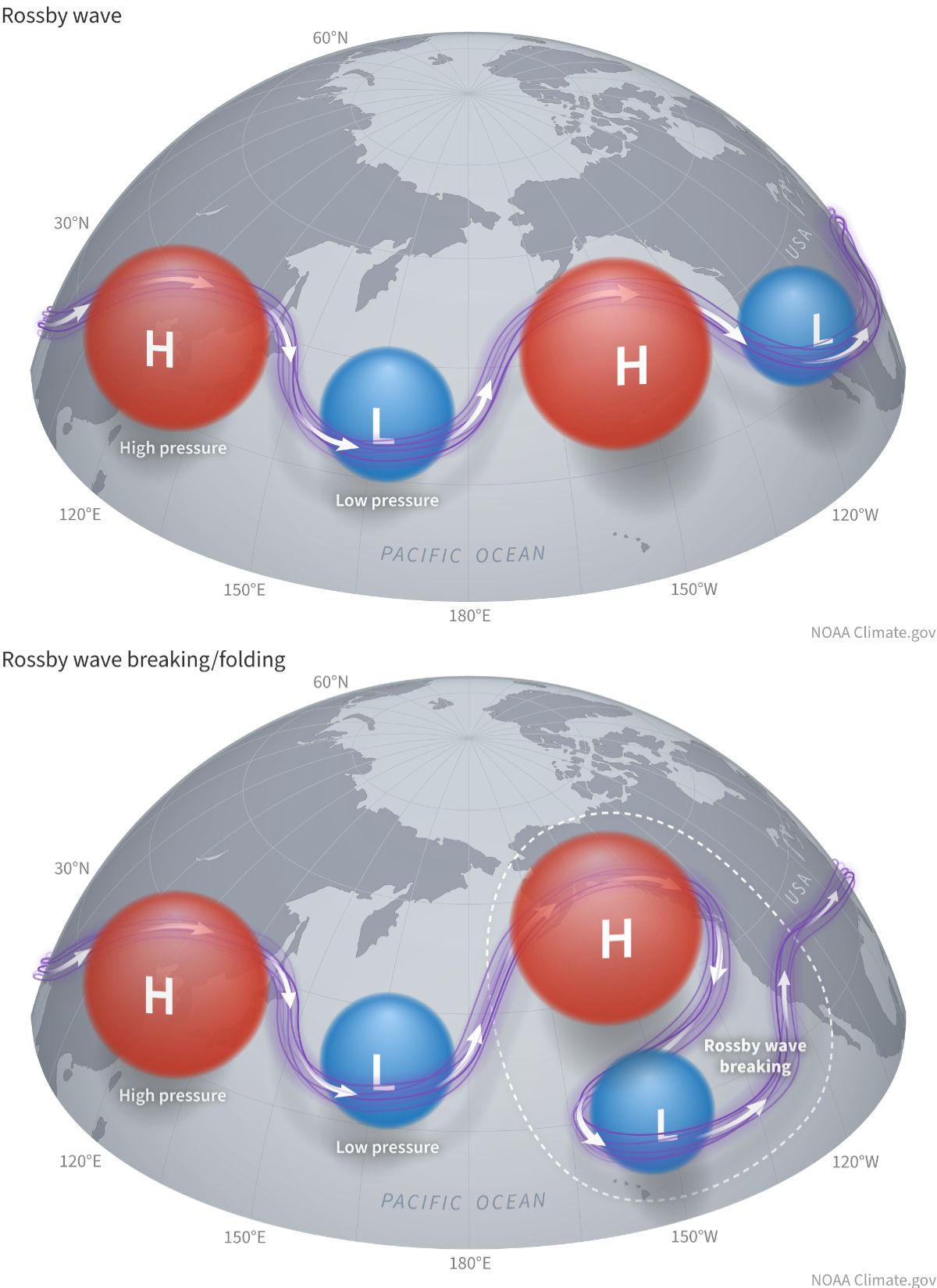
Atmospheric rivers are narrow, elongated corridors of intense water vapor transport. They are key drivers of precipitation and floods in the western U.S., and in this case, they interacted with giant waves in Earth's atmosphere, called Rossby waves, to produce devastating rainfall in the winters of 2017 and 2023.

As temperatures increased over the Tibetan Plateau in late 2016 and early 2023, a strong gradient formed with the regions north and south of the plateau. This generated an atmospheric disturbance that propagated eastward along the jet stream via Rossby waves, triggering what is known as a Rossby wave train between the Tibetan Plateau and the Rocky Mountains, Xue said.

Diagram of a Rossby wave and a Rossby wave breaking over the Northeast Pacific Ocean.

Rossby waves are waves in Earth's atmosphere that wrap around high- and low-pressure systems. When there is an atmospheric disturbance, it can propagate in what is known as a Rossby wave train. (Image credit: NOAA Climate)

A Rossby wave train is a series of waves traveling in the same direction and at regular intervals around alternating high- and low-pressure systems. As the wave trains initiated over the Tibetan Plateau reached the northeastern Pacific Ocean, they suddenly broke, and this supercharged the weather above California and adjacent states, Xue explained.

"Over the eastern Pacific, the wave breaks — much like a towering ocean wave crashing near the shore," he said. "This wave-breaking mechanism reduces static stability and significantly intensifies atmospheric rivers, ultimately driving extraordinary, heavy precipitation along the West Coast."

The findings, published Wednesday (Sept. 9) in the journal Science Advances, are based on complex modeling and analyses of precipitation and surface temperature data, among other observations. The results are part of a new body of research examining the influence of land temperatures on weather patterns, and this is the first study of a winter season, Xue said.

The analysis is a "very specific and impactful case study," said Matthew Huber, a professor in the Department of Earth, Atmospheric, and Planetary Sciences at Purdue University in Indiana, who was not involved in the research. The results build on the well-established idea that extra heat on a mountaintop affects Rossby waves almost as if the mountain had suddenly grown, Huber told Live Science in an email.

Large mountains and plateaus generate waves in the jet stream that are thousands of miles long — "so long that we also call them planetary waves," Huber said. An increase or drop in temperature so high up above sea level adds or subtracts from the atmospheric disturbance that already exists due to the elevation.

"You can imagine the waves in the jet are kind of like a motorcycle rider going off a jump," Huber said. "How far and how high they jump depends on how fast they are going and how big a ramp they are going over."

The models replicated the extreme weather with surprising accuracy, raising hopes that the Tibetan Plateau could be integrated into early warning systems for the western U.S., Xue said. "As similar, though less severe, events become more [frequent] and extreme weather escalates globally, understanding this teleconnection allows forecasting agencies to better warn coastal communities of impending extreme conditions," he said.

Huber agreed that the results could help to better prepare for weather hazards. "This study shows that accurate predictions of weather events in the U.S. West are very sensitive to tiny changes very far 'upstream' and these upstream features are identifiable and traceable," he said.

Blackout risk rises as heatwave stresses largest US electric grids

2 September 2026 at 13:16

US energy department warns of potential for outages in PJM Interconnection, serving 67 million from DC to Chicago

The risk ⁠of power outages ⁠is expected to ​escalate across a broad swath of the United States on Wednesday as intense heat will test the capacity of electricity supplies ⁠serving millions of homes and businesses from the midwest through the mid-Atlantic.

The US Department of Energy warned of the potential for heightened blackout risks in ⁠the PJM Interconnection, the largest US electric grid, which serves 67 million people in ​a territory stretching from Washington DC to ‌Chicago.

Continue reading...

© Photograph: Nam Y Huh/AP

© Photograph: Nam Y Huh/AP

© Photograph: Nam Y Huh/AP

New fabric stays cooler than white cotton—and it’s purple

31 August 2026 at 18:08

With the dog days of summer nearing an end, many are counting down the days until they can give the darker clothes in their wardrobe a bit more love. Though plenty of people flout seasonal rules and wear all-black year-round, light-colored fabrics are typically the better choice during  hotter months because they reflect sunlight and can help keep us cool. This heat-reflecting logic is also partly responsible for the old decree, “don’t wear white after Labor Day!” But what if fashion choices weren’t dictated by the weather? A team of researchers from China and Australia believes they may have cracked that code, and it starts with a rich purple fabric.

The researchers, hailing from Zhengzhou University and Adelaide University, set out to create a dark-colored material that was also effective at keeping people cool. They created an entirely new fabric made of a purple metal-organic framework and zinc oxide nanoparticles. The metal-organic framework which absorbs green light from the sun and gives the purple color, while the zinc oxide nanoparticles which reflect sunlight and radiate heat away. 

The material performed exceptionally well during testing. It reflected an average of nearly 88 percent of sunlight and stayed up to 11 degrees Fahrenheit cooler than conventional purple cotton outdoors. It was notably even 7.6 degrees cooler than white cotton. In a world where deadly hot summers are becoming more common, research suggests materials like this could provide outdoor workers with some much-needed relief. 

“We have traditionally had to make a choice between cooling performance and appearance,” Adelaide University materials engineer Jun Ma and study co-author said in a statement. “Our research shows that we can have both. We can make a fabric that looks purple, but at the same time reflects most of the sun’s energy and releases heat very efficiently.”

The team published their findings in the journal Small. 

Why do light colors feel cool?

Generally speaking, lighter colors are better bets for staying cool because they reflect more sunlight. White or unpigmented materials are the best at beating heat, whereas dark black material will feel the hottest.  This same idea applies to building and construction materials as well. Purple, while obviously dark, is also a unique choice for the research because it strongly absorbs green light, which is one of the strongest parts of the solar spectrum. 

Caveats are in order, though. Color isn’t the only factor in staying cool. Clothing material and fit are just as important, if not more so. Loose, breathable garments like cotton or linen allow far more airflow than tighter clothing. That’s why Bedouin nomads in the North African desert can wear mostly all black without collapsing from heat exhaustion. Still, all else being equal, lighter colors make for a cooler experience.

Making a cooling, purple fabric 

To create the fabric, the team combined a purple ZIF-67 metal-organic framework with zinc oxide nanoparticles. Using electrospinning, they spun the mixture into purple thermoplastic polyurethane fibers, which were then woven into fabric. They then cut the material into two-inch squares and exposed them to direct sunlight on a sunny day in Zhengzhou, China, alongside control squares of standard white and purple cotton.

The revised material reflected an average of 87.6 percent of solar radiation. In terms of overall cooling, at least in these tests, it was a resounding success. After a full day baking in the sun, the fabric remained 7.6 degrees cooler than white cotton and 11.2 degrees cooler than traditional purple cotton. The fabric also  achieved these thermal gains without sacrificing practical performance, and  was flexible, stretch-resistant, and highly breathable, allowing moisture to evaporate effectively rather than trapping sweat. It also maintained both its rich color and cooling properties after 50 wash cycles. Furthermore, UV accelerated-aging tests (simulating roughly 108 days of intense sunlight exposure) showed that the  cooling performance did not degrade over time.

Using science to stay cool in a warming world 

It’s still early in the process, but the team believes their new approach could make darker-colored materials less off-putting during warmer weather. While that’s potentially great news for all the goths out there, the researchers emphasize far more practical applications as well. These refined fabrics could be used to make workwear for construction workers, farmers, and others who endure long hours baking in the sun. For outdoor laborers, even modest cooling relief can make a life-saving difference.

“The long-term opportunity is to move beyond the idea that cooling fabrics have to be white,” Adelaide University Chemical Engineer PhD candidate and paper co-author Yangzhe Hou said in a statement.

This summer’s heat has moved from unpleasantly hot to deadly in many parts of the world, and it’s likely a sign of more to come. Both the fashion industry and the general public are already adapting to this brutal new reality. A 2022 New York Times report noted a marked rise in sales of shorts and sandals alongside a sharp decline in fleece and heavy outerwear in recent years, a shift attributed in part to rising global temperatures. Similarly, recent efforts to normalize wearing shorts in office settings and the gradual removal of neckties reflect a workplace culture adjusting to a hotter climate.

The new purple fabric research also joins a now lengthy list of other attempts to apply science and technology to make clothing cooler. An assortment of (often more expensive) cool-tech clothing brands with names Coolcore and Iso-Chill have gained popularity, promising to beat the heat. Kontoor Brands, which owns blue-jean giant Wrangler, even made an Insta-Cool shirt that used phase-change material initially used by NASA astronauts to stay cool. 

The post New fabric stays cooler than white cotton—and it’s purple appeared first on Popular Science.

Never-Before-Seen Vortices Are Swirling Across the Sun

Tiny Vortices on the SunThe world’s largest solar telescope and advanced computer simulations revealed vortices that are reshaping our understanding of the Sun. Across the Sun’s visible surface, hot plasma is constantly rising, cooling, and sinking. At the edges of these churning regions, researchers have now resolved tiny swirling structures that may help explain how the Sun twists, stores, [...]

NASA’s PUNCH Mission Cut Solar-Storm Arrival Uncertainty to 30 Minutes

10 August 2026 at 20:00

Forecasting a solar storm is a little like watching a wave leave a distant coast and trying to guess when it will reach the beach. Scientists can see a coronal mass ejection (CME) leave the Sun, but its speed and shape can change as it crosses space. By the time it reaches Earth, the warning […]

The post NASA’s PUNCH Mission Cut Solar-Storm Arrival Uncertainty to 30 Minutes appeared first on Curiosmos.

Starlink Satellites Reveal a Hidden Atmosphere 300 Miles Above Earth

9 August 2026 at 19:38
Modern Space Telecommunications Satellite Orbiting EarthSatellites designed to provide internet service are now serving an unexpected second purpose: helping scientists map the nearly invisible atmosphere at the edge of space. Researchers at Kyoto University have used orbital changes from about 1,200 Starlink satellites to map Earth’s thermosphere, a thin and difficult-to-observe region of the upper atmosphere. Their analysis produced the [...]

NASA’s PUNCH Mission Predicted a Solar Storm Arrival Within 30 Minutes

8 August 2026 at 18:00

NASA says a new four-spacecraft mission has completed an early test that could make one of the hardest parts of space-weather forecasting much more precise: estimating when a solar eruption will reach Earth. In a proof-of-concept exercise announced on August 4, NASA’s PUNCH mission used continuous images of a coronal mass ejection, or CME, to […]

The post NASA’s PUNCH Mission Predicted a Solar Storm Arrival Within 30 Minutes appeared first on Curiosmos.

This Atlantic hurricane season is looking like a dud, but there will be a price to pay

5 August 2026 at 20:19

The city of Houston, where I live, has been ground zero for the 2026 Atlantic hurricane season. So far this year there have been two named storms, Arthur and Bertha, that have formed. And the centers of both have passed near or directly over Houston.

Two "strikes" in a year might seem notable, but like the middling hurricane season to date, Arthur and Bertha were both middle-of-the road tropical storms in terms of intensity.

As a resident of a coastal region prone to hurricanes, one never wants to tempt fate. And in truth, since it is only early August, the bulk of seasonal activity definitely lies ahead of us. But all indications are we can look forward to a quiet season.

Read full article

Comments

© The Climate Brink

Testing local weather knowledge in the Bolivian Altiplano

3 August 2026 at 12:00

In the Bolivian Altiplano, fewer Aymara farmers are relying on local weather knowledge to schedule farming tasks, like choosing the best dates to plant crops and predicting a frost or drought. At the same time, there is growing doubt about whether these traditional indicators remain relevant today in the context of rapid social, economic, and climatic changes. 

Farmers are struggling because the National Weather Service of Bolivia (SEHNAMI) fails to provide useful weather forecasts due to the geographical complexity of the Andes and a scarcity of weather stations. In addition, many farmers can’t access this information because SEHNAMI lacks local outreach programs to deliver reports directly to them. In a region with a weak technical forecasting system, local knowledge is a vital resource, but its use is declining.

Scientists in the past focused on preserving local weather knowledge or discussing how it might help communities adapt to climate change. However, very few researchers have scientifically validated local weather indicators, since doing so requires many years of historical meteorological data to establish statistical “skill” in local forecasting. 

Faced with this gap, researchers in the US and Bolivia recently set out to validate indigenous indicators in 2 Bolivian municipalities: Umala in the Central Altiplano and Ancoraimes in the Northern Altiplano. To do this, they paired each traditional weather sign with a measurable variable, like temperature, that could approximate it. This approach allowed them to directly compare traditional observations with scientific data.

The researchers wanted to determine whether traditional weather knowledge is still accurate and relevant under current conditions, since validating these methods would strengthen local knowledge and benefit the schools and policies that promote it. To test this, the researchers worked with 6 Aymara communities. First, they conducted workshops with local leaders and experts to compile a set of weather-forecast indicators. Then, they surveyed 95 farmers to rank the reliability of these indicators. 

Through discussions with these communities, the team identified 13 weather indicators in the Central region and 20 in the Northern region. These indicators included specific plants, animals, and physical factors like constellations or winds that the farmers used to decide when and where to plant crops, and to predict weather conditions for the next season. The researchers focused on 2 key indicators that the farmers ranked as most reliable: the presence or absence of moisture under rocks on the Fiesta de San Juan on June 24th, and the flowering patterns of specific plants, called Thola and Sank’ayu. The farmers used the San Juan indicator to predict whether the upcoming year would be rainy or dry, and the plants to determine the most favorable dates for planting to avoid agricultural risks like frosts.

Finally, the researchers compared forecasts based on these 2 signs with over 30 years of meteorological data from nearby weather stations. In both cases, they used the minimum daily temperature as the measurable way to represent these local signs scientifically. Their results showed that the minimum daily temperature on the Fiesta de San Juan could explain more than half (55.5%) of the changes in rainfall during the growing season. They also confirmed that severe frosts that “burned” Thola and Sank’ayuthe flowers were followed by periods without rain, validating the farmers’ strategy of delayed planting.

The researchers concluded that local weather indicators used by Aymara farmers are most reliable for seasonal planning, especially in predicting the start of the rainy season. They stated that this result helps legitimize traditional knowledge and empower the community. For example, these communities now hold regular meetings to discuss forecasts and share this information with their neighbors via WhatsApp groups. 

However, the team acknowledged that local knowledge was limited to short-term forecasting, as it only provided warnings a few hours in advance. Farmers need alerts several days in advance to effectively reduce their vulnerability to events such as frosts or hail. For this reason, the researchers suggested that the next step will be to co-produce forecasts by combining meteorological science with traditional knowledge.

The post Testing local weather knowledge in the Bolivian Altiplano appeared first on Sciworthy.

Wildfire near Sizewell nuclear plant causes ‘total devastation’ to Suffolk landscape

Emergency crews say situation remains ‘dynamic’ as more than 100 firefighters battle Dunwich Heath blaze

A wildfire near Britain’s biggest nuclear power station has caused “total devastation” to one of the UK’s most important landscapes, as fire crews said the situation remained “dynamic”.

More than 100 firefighters have been battling the blaze on Dunwich Heath, near Leiston, on the Suffolk coast since Wednesday evening. The fire service said on Friday afternoon the situation was stabilising but remained a “major incident” that was “dynamic and potentially changeable”.

Continue reading...

© Photograph: Humphrey Nemar/PA

© Photograph: Humphrey Nemar/PA

© Photograph: Humphrey Nemar/PA

Britain’s Power Grid Has a Blind Spot for Extreme Solar Storms, New Research Reveals

30 July 2026 at 19:13

In May 2024, the strongest geomagnetic storm in two decades pushed the Northern Lights far enough south to become visible across much of the UK and beyond. Now, a study that appeared in Royal Society Open Science reveals that the incident also exposed important gaps in how the UK monitors and prepares its power grid, satellites, and aviation for future extreme space weather.

The storm reached a G5 rating, which is the highest level on the geomagnetic storm scale used by NOAA, as a result of five coronal mass ejections reaching Earth within a period of two days. Researchers with the Space Environment Impacts Expert Group (SEIEG) stated that although the storm caused only relatively minor disruption, it revealed shortcomings in the UK’s capacity to monitor and prepare for more severe space weather events.

The SEIEG then made 14 recommendations to the UK government addressing matters such as grid monitoring, satellite operations, and space weather forecasting. Richard Horne, chair of SEIEG and head of space weather at the British Antarctic Survey, recently gave a presentation on the findings at the Royal Astronomical Society’s National Astronomy Meeting in Birmingham.

A Storm That Tested the Limits

Researchers estimate that the May 2024 storm was a one-in-13-year event. By contrast, a Carrington-class storm, like the 1859 event that defines the standard for extreme space weather, has about a 1% chance of occurring in any given year. This means that a much more disruptive storm is still possible. The SEIEG report uses the 2024 storm as a practical example to assess how prepared the UK is for a more severe event.

“The Northern Lights were the most visible sign of the May 2024 storm, but they were only one part of a much broader space weather event that tested the UK’s critical infrastructure. The storm highlighted where we need better monitoring, better forecasting and more research so we’re prepared for a more severe event in the future,” Horne said.

The Blind Spot in Britain’s Power Grid

Geomagnetic storms create electric fields at Earth’s surface that can drive geomagnetically induced currents (GICs) through long conductive systems, including power transmission networks. High levels of GICs can overheat transformers, disrupt their normal function, and in severe cases cause damage that may lead to failures across parts of the power grid.

Currently, there are no GIC monitors in operation in England or Wales. The SEIEG report recommends establishing a network of monitors to assess how much current various transformer designs can tolerate before sustaining damage.

New Zealand as the Model

The report cites New Zealand as an example of effective monitoring. Since it is at a similar geomagnetic latitude, the country faces similar space weather risks, and its grid operators monitor around 93 transformers across 28 substations. Unlike in England and Wales, where monitoring is absent, these operators have verified their models using actual measurements and implemented operational mitigation procedures during the May 2024 storm.

Crowded Skies, Rising Risk

The storm also affected satellites in orbit. Almost 5,000 satellites adjusted their orbits during the storm. Satellites licensed in the UK saw their number of collision warnings rise by 35%. Since there are now so many objects in low-Earth orbit, a serious storm could raise the risk of collisions, possibly resulting in debris and causing additional incidents.

Preparing for Future Storms

SEIEG also recommends improving forecasts of coronal mass ejections and solar energetic particle events to provide two to three hours of warning before severe geomagnetic storms reach Earth. Improved forecasts could allow grid operators, satellite controllers, and airlines to take protective measures before severe geomagnetic storms arrive. 

“One of the biggest lessons from the May 2024 storm is that we still have important gaps in our monitoring and understanding of how severe space weather could affect UK infrastructure,” said Horne. “We were fortunate that this was not a one-in-100-year event. We now have an opportunity to strengthen our monitoring, improve our forecasts and make sure the UK is better prepared before a much larger storm occurs.”

The 14 recommendations are now under review by the UK government. Whether these steps will be taken before a Carrington-scale storm occurs remains uncertain. With this extreme class of storms remaining a realistic possibility, the researchers argue that improving monitoring and forecasting now could reduce the impact of a future extreme event.

Austin Burgess is a writer and researcher with a background in sales, marketing, and data analytics. He holds an MBA, a Bachelor of Science in Business Administration, and a data analytics certification. His work focuses on breaking scientific developments, with an emphasis on emerging biology, cognitive neuroscience, and archaeological discoveries.

Hidden Gambling Apps in Brazilian App Store

29 July 2026 at 21:45

Marcus Mendes:

Last April, Brazilian officials notified Apple and Google over an alleged lack of age controls in betting apps on their respective app stores.

9to5Mac:

Brazilian users browsing the App Store rankings in categories such as Navigation, Travel, and Weather have noticed a growing number of poorly made games appearing among the top results, many of them featuring AI-generated illustrations of animals as their app icons. Many carry an AL age rating, making them available to users of all ages, including children.

As it turns out, these are so-called jacket apps, which are just a front for hidden betting and gambling apps.

[…]

The repository also includes explicit instructions intended to prevent the apps from being flagged as suspicious during App Store review. These include giving each app uniquely named startup and remote-configuration codes, making it harder for reviewers to identify them as part of the same group.

Ironically, the App Store’s own recommendation system appears to have little trouble grouping the apps together, as the “You Might Also Like” section on several of these apps points users toward other suspicious apps more frequently than they point to genuine apps.

John Gruber (Mastodon):

Obviously the main problem is that these apps disguise themselves Trojan Horse-style, and slip through App Store review undetected. I don’t think it’s reasonable to think App Store review could catch every attempt at this sort of thing though — if the horses are disguised well-enough, some of them are going to slip through. That’s actually fine.

I agree that it’s unreasonable to expect App Review to catch all those, but then Apple should not be pretending that it can. This was all obvious from day one. The public perception of App Review is completely at odds with what it actually can and does do.

But the first example 9to5Mac cites isn’t well disguised at all. What sense does it make that “PotatoPlot Puzzle” — a game featuring a rabbit potato farmer — is a weather app? How is that not a red flag right there?

[…]

I always mention that the point of such a squad shouldn’t be to make the App Store 100 percent scammer-free — which I believe is an impossible goal that would set the team up for failure. The point should be only to make the App Store free of successful scams. Focus on the most popular apps and the most lucrative apps.

The App Store is more than 18 years old. The idea of patrolling the top charts probably occurred to Apple before it even shipped. They just don’t want to do it.

Nick Lockwood:

Apple only took 24 hours to approve my iOS app update that crashed instantly on launch. Such a blessing to have that extra level of reliability and security that only a manual review process can provide 🙏

Incidentally, the crash was due to a missing dylib - something that could easily have been detected by the automated scan process, if only that scan were designed to protect users’ and developers’ interests instead of Apple’s.

Kyle Hughes:

There is simply no other way to maintain a modern, healthy software ecosystem without making sure that apps that have been around for 7 years and 20 major versions can’t get a build looked at within 48 hours. There’s no other way. Probably needs to be longer, honestly.

I had to file an Expedited Review Request because this update is a legitimate emergency. Four hours later, App Review rejected the build because they didn’t follow the first sentence of the testing instructions (which haven’t changed in 7 years). Back to Waiting for Review! There’s no other way.

Previously:

Update (2026-07-30): Kyle Hughes:

We got rejected in the Expedited Review again, this time for not having an account deletion feature. Except we do, and it’s one button press away from the screen that the reviewer was on. And it has always existed. Is this how the expedited review works? Malicious incompetence?

Update (2026-07-31): Kyle Hughes:

If you were wondering how long one of the “you can ask us to approve this build and can fix this issue in the next release” App Review errors takes to resolve when you’re in the Expedited Review Queue… me too! So far, 18 hours. (Ignoring the fact that we have the feature the rejection was for.)

Kyle Hughes:

Certainly it means “within a week,” right? “Within a month,” please? “In your lifetime,” I can only hope.

❌