Em beta desde junho, os sistemas 27 reúnem uma série de novos recursos para a Apple Intelligence, além da nova Siri AI — vale lembrar, essas funcionalidades podem não ser compatíveis com todos os dispositivos em que os sistemas 27 estão disponíveis.
Em matéria de iPhone, um diferencial relevante para as gerações mais antigas é a implementação de um novo scheduler de CPU 1Central processing unit, ou unidade central de processamento. para gerenciar melhor as demandas de cargas de trabalho em iPhones a partir do 11, algo já visto anteriormente nos modelos mais recentes — além, claro, de melhorias mais amplas, como na velocidade de envio de arquivos no AirDrop.
No caso do macOS, o maior destaque — além da otimização de desempenho — é o fim do suporte aos Macs com processadores Intel.
NOTA DE TRANSPARÊNCIA: O MacMagazine recebe uma pequena comissão sobre vendas concluídas por meio de links deste post, mas você, como consumidor, não paga nada mais pelos produtos/serviços usando os nossos links de afiliado.
Notas de rodapé
1
Central processing unit, ou unidade central de processamento.
Leading chipmakers Samsung Electronics and Taiwan Semiconductor Manufacturing Co. announced plans to adopt ASML’s latest chipmaking machines in the next several years—and they also joined Intel in agreeing to a crucial technology change that could boost chip production on the new machines by 40 percent.
This signifies the semiconductor industry’s broader embrace of high NA EUV photolithography technology that can cost up to $400 million per machine and is only provided by the Dutch technology company ASML, Bloomberg reports. The technology would allow chip designers to implement even smaller features in potentially more powerful and efficient next-generation chips produced for AI data centers and consumer electronics such as smartphones, tablets, and laptops.
ASML’s EUV (extreme ultraviolet) lithography machines enable chipmakers to use powerful laser light to imprint patterns in silicon wafers, layer by layer, and gradually form the computer circuitry that makes silicon chips work. Compared to older deep ultraviolet lithography, EUV technology harnesses a more powerful source of light with a shorter wavelength to create even smaller features on silicon wafers.
A spirited panel debates whether AI companies should surrender part of their ownership to a public wealth fund. The conversation examines distrust of AI, job displacement, data-center energy and water use, income versus wealth taxation, billionaire resentment, corporate political influence, and the dangers of government owning stakes in companies it also regulates.
Uma novo estudo da CashNetUSA revelou que a Apple é a segunda Big Tech estadunidense com mais vagas de emprego de nível inicial abertas no LinkedIn, ficando atrás apenas da Tesla.
Mais precisamente, 57,4% das vagas publicadas pela gigante de Cupertino são de baixa senioridade — um ponto percentual a menos que a montadora do bilionário Elon Musk. Fecham o Top 5 a IBM (32,4%), a Intel (20,9%) e a NVIDIA, que aparece com 5,3% — o mesmo número da Uber, com a qual divide a quinta posição.
Divulgação/CashNetUSA
Isso, no entanto, não quer dizer que entrar para o quadro de funcionários da Apple é fácil — já que, apesar da abundância de vagas de nível inicial (54, para ser mais preciso), ela ainda tem uma relação candidato-vaga de 55:1. Em primeiro lugar no ranking supracitado, a Tesla conta com uma proporção de “apenas” 23,5:1 — a menor entre as Big Techs analisadas no estudo.
Quando consideramos todo o mercado (e não apenas empresas de tecnologia), a Maçã fica na quinta posição entre as empresas mais competitivas dos EUA. Na frente dela, temos a NVIDIA (68,4:1), a IBM (88,4:1), a The Walt Disney Company (164,8:1) e o Morgan Stanley (180,9:1).
Divulgação/CashNetUSA
Para montar seu estudo, a CashNetUSA analisou, como dito, dados de vagas do LinkedIn referentes a “13 grandes empresas de tecnologia dos EUA reconhecidas mundialmente”. A firma de pesquisa também classificou cada empresa com base no número de candidatos que se inscreveram para cada vaga disponível.
SteamOS is continuing its slow march to fuller support on a wider variety of non-Valve hardware. This weekend's release of the SteamOS 3.8.25 Beta includes "initial gamepad support" for a few recent gaming handhelds and improved support for a few others.
Those newly supported handhelds include MSI's Claw 8 EX AI+, the extremely expensive, extremely powerful handheld built around Intel's Arc G3 processor that launched this summer. While SteamOS has long included beta support for "other AMD powered handhelds," Valve has only recently been working on offering compatibility with Intel-based handhelds like the MSI Claw line. This weekend's update suggests the company hasn't abandoned those efforts and that Intel chips aren't being left out of the SteamOS conversation.
Intel proposed a massive $15 billion underwritten public offering of common stock to bolster its balance sheet and aggressively fund its expansion in the high-stakes AI and semiconductor markets.
Financial underwriters include J.P. Morgan Securities, Goldman Sachs, Morgan Stanley and Citigroup Global Markets. Intel stated the companies would have the option for 30-days to purchase up to an additional $2.3 billion in shares, a strategy to secure long-term competitiveness.
“Progress in emerging areas including physical AI, purpose-built silicon, advanced packaging and external wafers represent significant growth opportunities for Intel,” the company stated.
The additional capital targets soaring global demand for technology, as customer investments in AI compute power and physical iterations continue to grow rapidly.
Intel stated net proceeds would cover “general corporate purposes” including working capital and capital expenditures. The company expects the offering to help preserve its investment-grade credit rating during heavy infrastructure investment.
Intel appointed Marvell executive Dean Jarnac (pictured) as EVP and chief sales officer as the chipmaker seeks to bolster customer engagement and maintain momentum from recent high-profile foundry wins.
The incoming executive will lead Intel’s global sales organisation across its client, data centre, AI, networking and ASIC portfolios.
Jarnac brings over three decades of semiconductor industry experience. In addition to Marvell, he previously held senior leadership roles at Broadcom and AMD.
He will assume the role in September and report directly to CEO Lip-Bu Tan. Jarnac will take over from Greg Ernst, who is departing Intel after 27 years with the company.
Announcing the appointment, Tan highlighted customer focus and operational execution are central to Intel’s growth strategy. He cited Jarnac’s track record of building high-performance sales teams as critical to deepening client partnerships.
The change follows significant progress in Intel’s foundry turnaround strategy. Earlier this year, Google placed an order with Intel to manufacture more than 3 million custom tensor processing units (TPUs) in 2028.
In April, Intel revealed a plan to join Elon Musk’s Terafab AI chip project to build processors for the billionaire’s orbital data centres and humanoid robots.
Apple and Intel reportedly reached a preliminary agreement in May for the latter to manufacture some of the chips for iPhones, iPads and other devices.
Último Mac a trocar os chips PowerPC pelos processadores da Intel (transição que havia sido iniciada em 2005), ele chegou com o dobro de performance do Power Mac G5, seu antecessor direto — e de quem herdou a primeira iteração do design de “ralador de queijo”, que com certeza marcou época.
Com um preço inicial de US$2.500 (ou US$4.140, levando em conta a inflação até os dias de hoje), ele era parrudíssimo — tanto em termos de performance bruta quanto de conectividade. Extremamente “upgradeável”, ele vinha com dois processadores Intel Xeon de dois núcleos (2,0GHz, 2,66GHz ou 3,0GHz, dependendo da versão escolhida), bem como com a placa gráfica GeForce 7300 GT, da NVIDIA — componente que podia ser trocado por uma Quadro FX 4500 (também da NVIDIA) ou uma ATI Radeon X1900 XT (da AMD).
Contando com quatro espaços para unidades Serial ATA (dois a mais que o Power Mac G5), o Mac Pro de primeira geração também permita a instalação de até quatro GPUs 1Graphics processing units, ou unidades de processamento gráfico. via PCIe, além suportar até 32GB de RAM 2Random access memory, ou memória de acesso aleatório. — por padrão, ele vinha com “apenas” 1GB. O desktop também era equipado com 5 portas USB 2.0 e 4 FireWire 800, padrão ainda muito popular na época.
O queridinho de profissionais criativos, o Mac Pro parecia ser feito sob medida (ou vice-versa) para softwares como o Final Cut Pro, além de vir de fábrica com o clássico Mac OS X Tiger, lançado mais cedo naquele ano. Nem tudo eram flores, no entanto, já que alguns apps, como os da popular Adobe Creative Suite, ainda precisavam da camada de tradução Rosetta para rodar adequadamente em Macs com processadores x86, o que resultava em gargalos de performance — problema que foi solucionado com o passar dos meses.
Desde então, o Mac Pro original foi atualizado algumas vezes; o primeiro upgrade veio já em abril 2007, seguido por outro em janeiro de 2008. No início de 2009, o computador ganhou os processadores Intel Xeon 5500 e, um ano depois, passou a suportar até 64GB de memória e até 8TB de armazenamento — além de ter adotado os processadores da linha Intel Xeon 5600, é claro. A última dança desse primeiro design do desktop veio em 2012, com dois processadores Intel Xeon Westmere-EP de seis núcleos (2,4GHz).
O primeiro tropeço
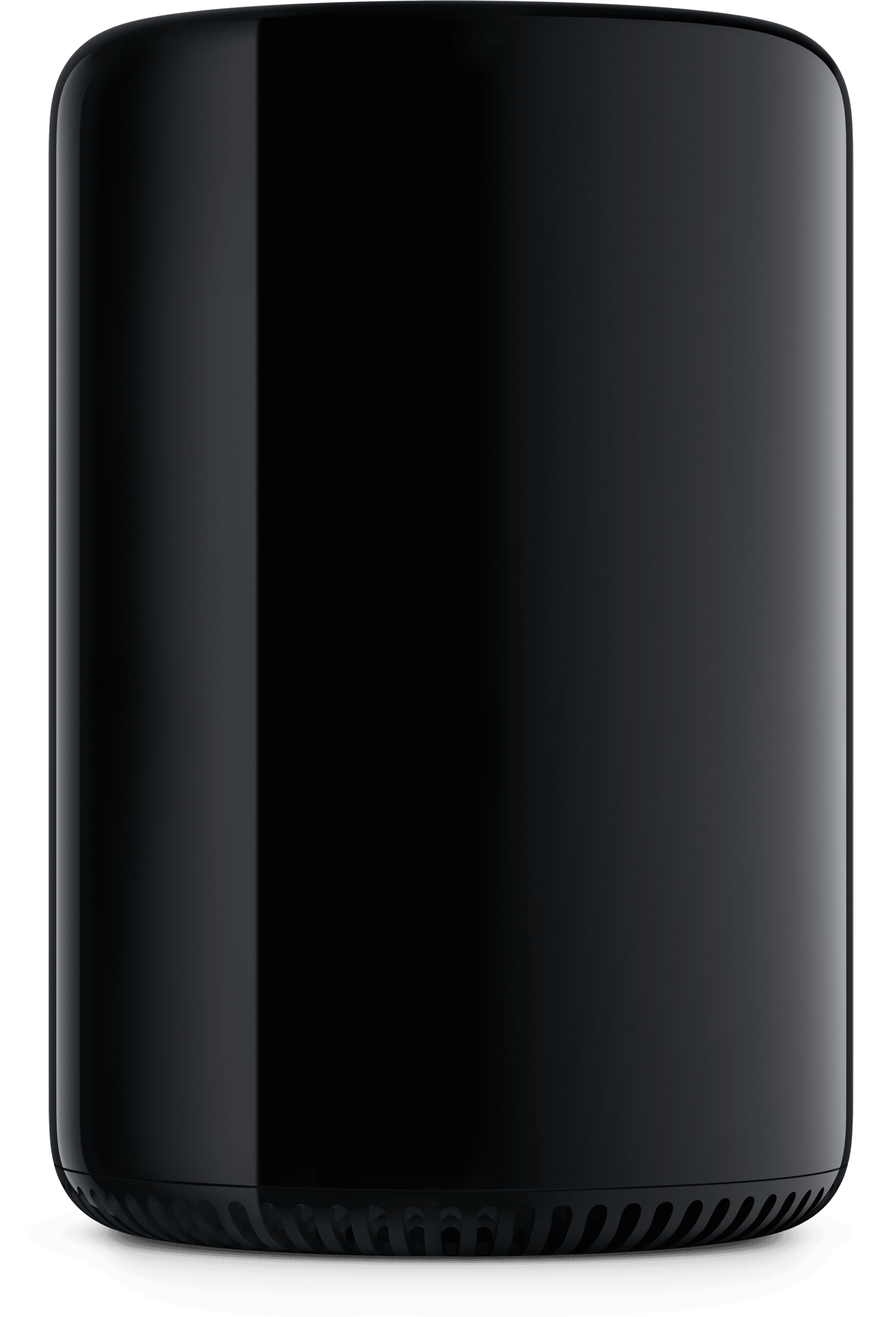
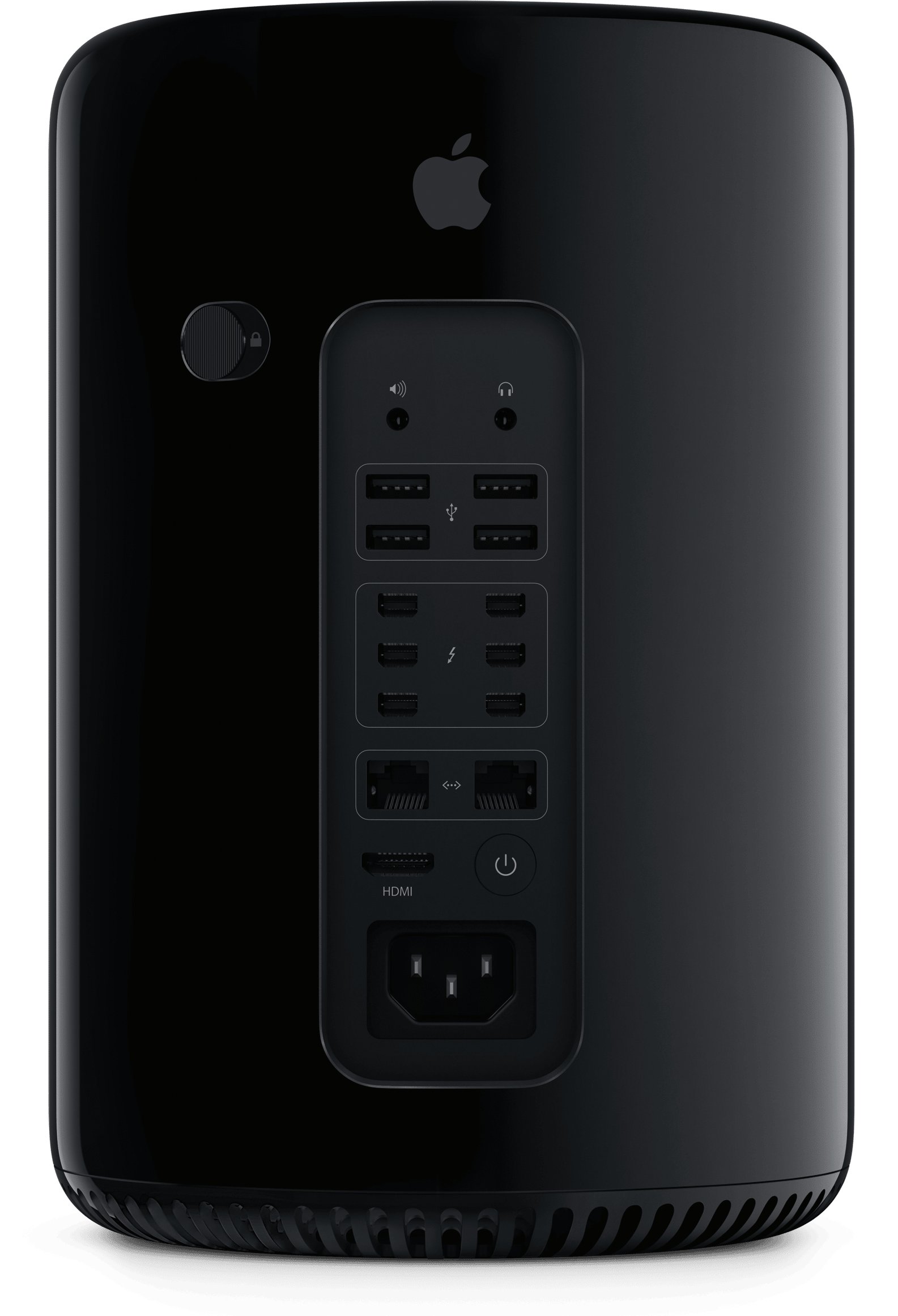
O ano de 2013 foi difícil para o Mac Pro, que recebeu um novo design tão compacto quanto polêmico. Cilíndrica, a nova geração do Mac Pro instigou comparações com latas de lixo, principalmente por conta da abertura para ventilação na parte de cima do computador.
Divulgação/Apple
Por falar em ventilação, é nessa área onde reside a maior fraqueza desse novo modelo: o sistema de resfriamento, construído em volta de um “núcleo térmico unificado” central que, embora fosse, sim, um conceito muito interessante, não era o suficiente para resfriar o seu processador Intel Xeon e as duas GPUs AMD FirePro.
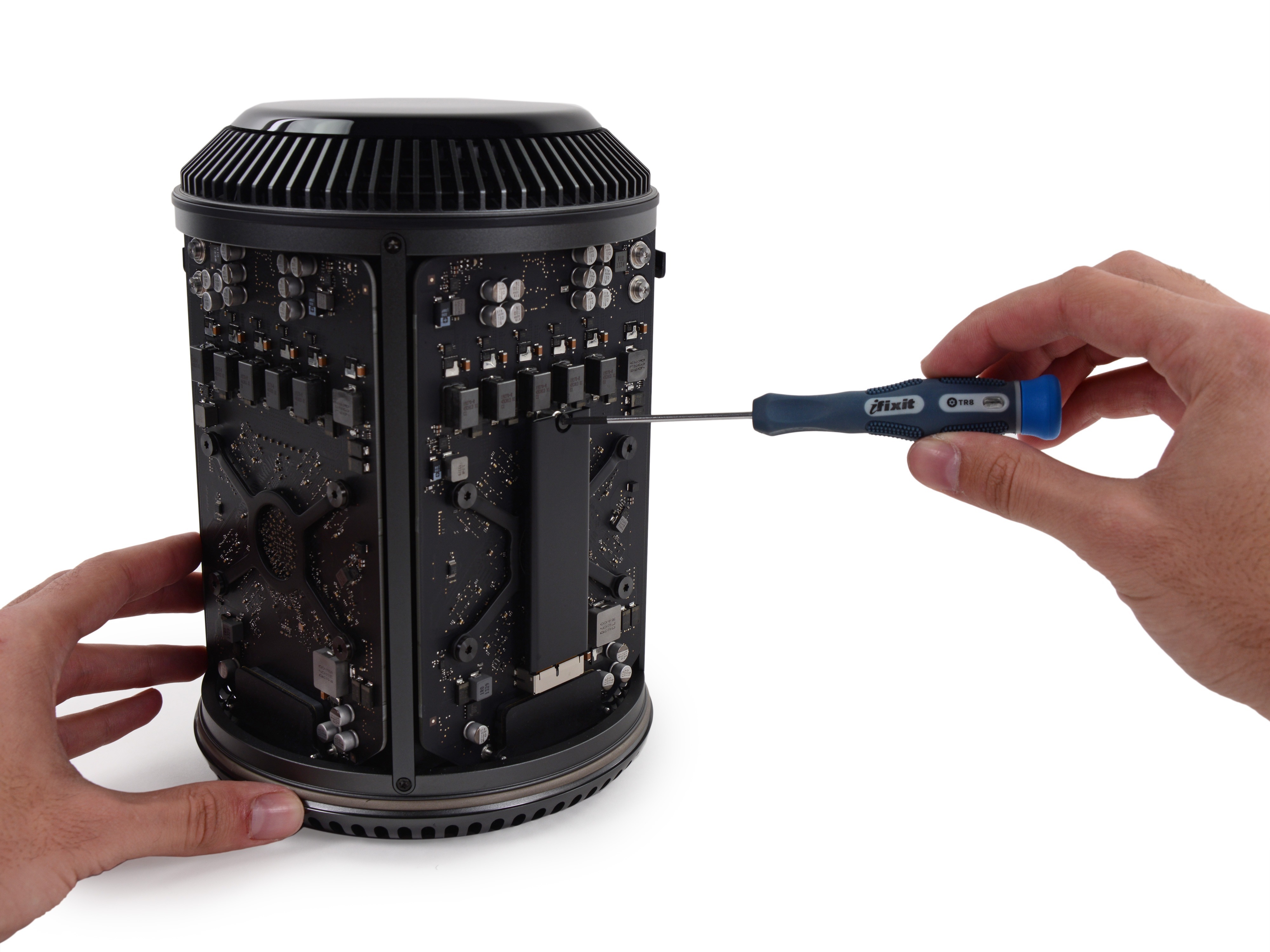
O novo design também fez a Apple abrir mão de duas outras características importantíssimas do Mac Pro: a vasta seleção de portas e a possibilidade de trocar praticamente todos os principais componentes do computador. Caso o usuário quisesse realizar algum upgrade, ele era obrigado a fazer isso por meio de uma das suas portas Thunderbolt 2, o que estava longe de ser o ideal.
Foto: iFixit
A má recepção fez o Mac Pro “lata de lixo” cair no ostracismo e ficar sem receber novas atualizações por nada menos que seis anos — um contraste e tanto em relação ao modelo anterior. A situação chegou até mesmo ao ponto de a própria Apple admitir, em 2017, que errou a mão na hora de projetar a mais nova versão do seu desktop profissional — atitude que foi seguida pelo lançamento do iMac Pro, que serviu como uma espécie de “tapa buraco” até o lançamento do último grande redesign do Mac Pro.
Um breve renascimento
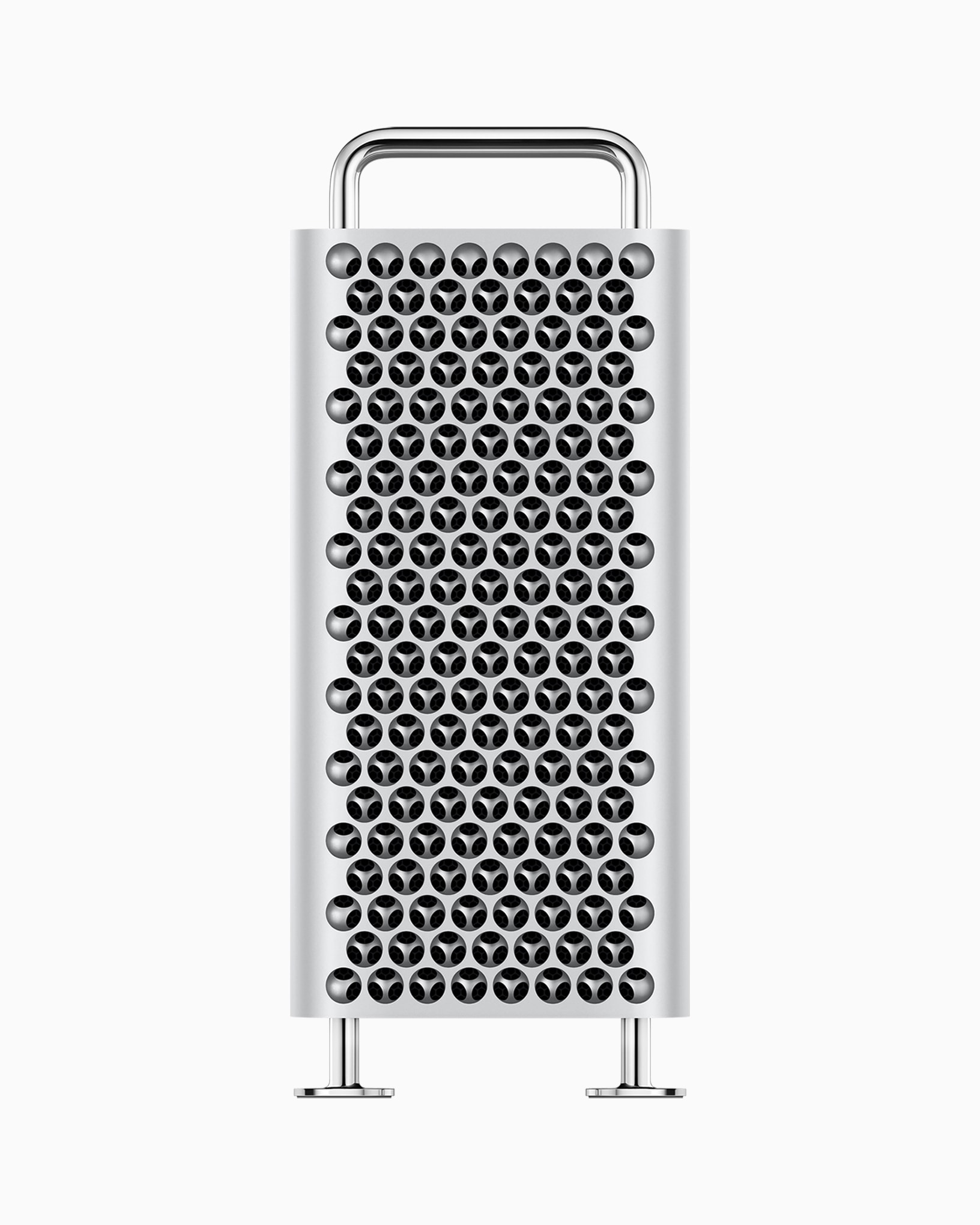
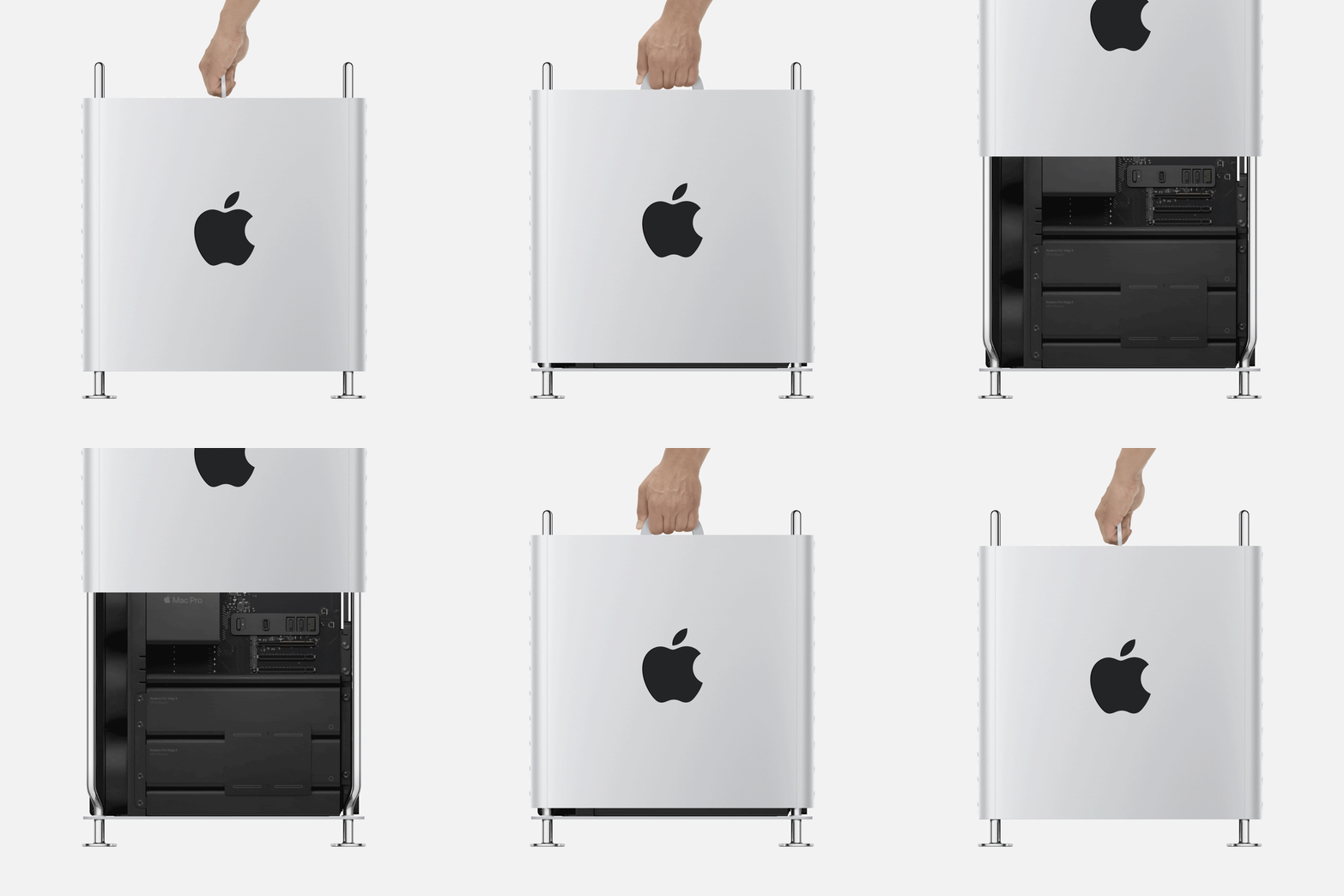
Em 2019, a Apple colocou ordem na casa ao lançar um novo Mac Pro muito mais parecido com o modelo original do que com o computador que o precedeu — ou seja, com um formato de torre tradicional.
Apostando mais uma vez no alumínio como seu material principal, o desktop passou a contar com furos para ventilação que, mais uma vez, provocaram comparações com raladores de queijo. Dentro, foram adicionada três ventoinhas bem parrudas, as quais davam conta de resfriar todos os componentes do computador, já que eles não contavam com coolers individuais.
Divulgação/Apple
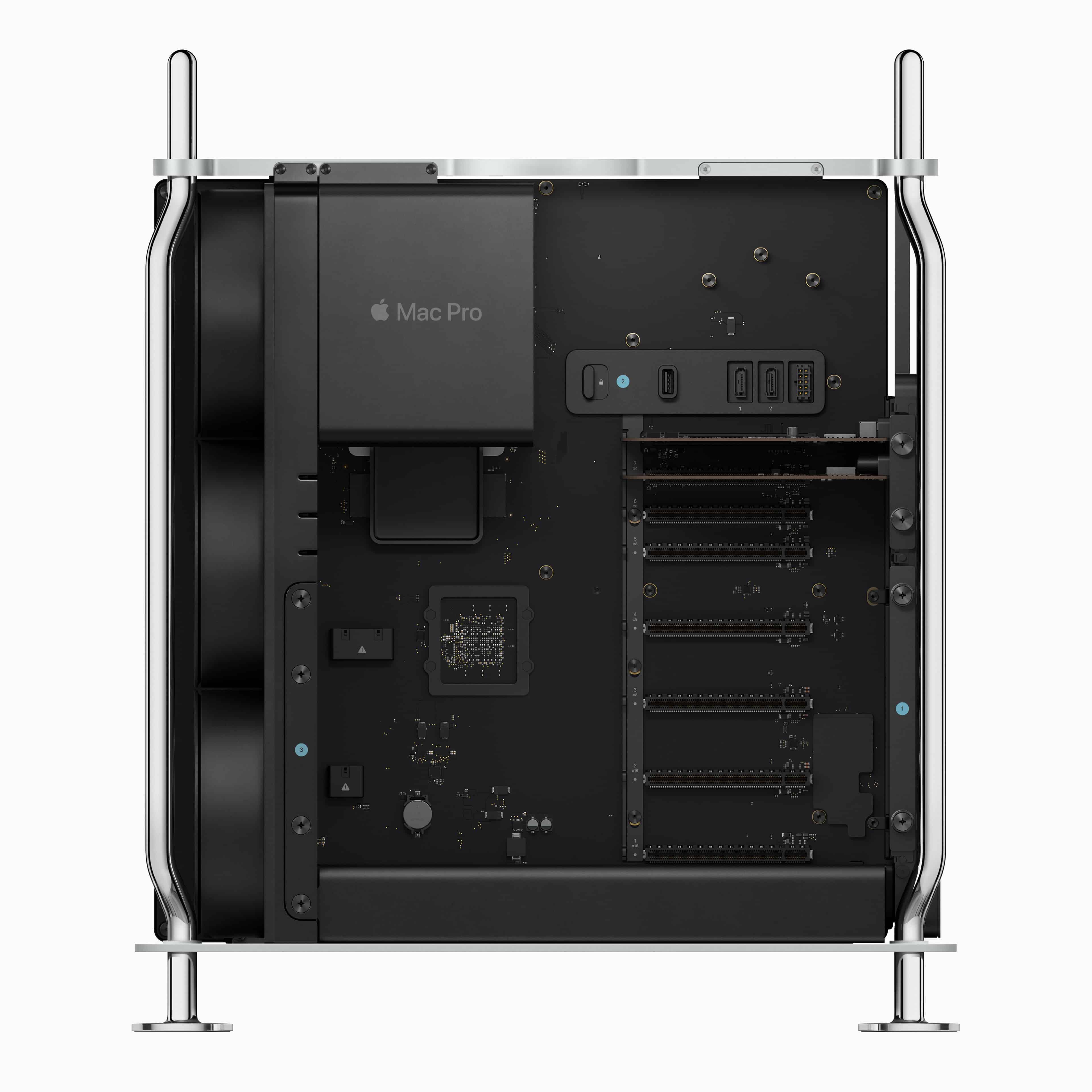
Equipado com um processador Intel Xeon de até 28 núcleos, ele suportava até 1,5TB de memória — número surpreendente até para os dias de hoje. Contando com nada menos que oito slots PCIe, ele podia ser configurado com as GPUs Radeon Pro 580X ou Radeon Pro Vega II, da AMD, bem como com a novíssima placa aceleradora Apple Afterburner, para a edição de vídeos.
O otimismo introduzido por esse novo design, porém, foi logo suplantado pela introdução, apenas um ano depois, dos chips da família Apple Silicon, bem mais rápidos e eficientes que os da Intel e que passariam a substituir os processadores da fabricante estadunidense nos Macs. Em outras palavras, isso fez com que muita gente pensasse duas vezes antes de adquirir um Mac Pro — afinal, uma versão bem mais poderosa com um chip ARM3Advanced RISC Machine. provavelmente já estava nos planos da Apple.
Isso, no entanto, só foi acontecer em 2023 — e de um jeito um tanto… agridoce. Embora a adoção do chip M2 Ultra tenha sido bem-vinda, o computador perdeu muitas das características que o faziam ser uma boa opção para usuários profissionais, como a possibilidade de fazer upgrades nas suas peças — uma consequência da natureza centralizada dos SoCs 4System on a chip, ou sistema em um chip. da Apple.
Além disso, a essa altura do campeonato, o Mac Studio (outro computador voltado a profissionais) já estava no mercado há cerca de um ano e oferecia a mesma performance de ponta que muitos esperavam do Mac Pro, além de ser bem mais compacto e, principalmente, “acessível” (a partir de US$7.000vs. a partir de US$2.000).
Embora rumores de uma atualização tenham circulado nos últimos anos, tudo isso levou a Apple a finalmente aposentar o Mac Pro em março de 2026, pouco meses antes do seu aniversário de 20 anos. No momento, os esforços da Apple parecem estar completamente voltados ao Mac Studio, que tomou o posto de “computador para profissionais” da Maçã.
Chipmaker Intel joined the OCUDU Ecosystem Foundation as a premier member, bolstering open-source RAN software development for 5G and future 6G networks.
Hosted by the Linux Foundation, the OCUDU Ecosystem Foundation operates as a vendor-neutral collaboration hub.
Its core mission is to establish reference architectures, validation programmes and continuous integration and testing pipelines designed to reduce integration complexity and streamline production rollouts for operators.
Intel’s entry brings technical weight to the initiative, particularly across cloud-native infrastructure, silicon platforms and telecommunications architecture.
Intel plans to contribute technical capabilities to help shape open, standards-based solutions and advance AI-native reference implementations capable of running on software-defined infrastructure.
Arpit Joshipura, GM of networking, edge, and IoT at the Linux Foundation, stated Intel’s leadership in cloud-native systems and telecommunications will bolster ongoing efforts to build an open, interoperable ecosystem, ultimately allowing operators to deploy AI-native open-source RAN solutions faster and with greater confidence as the market shifts from innovation to production.
The foundation’s technical work focuses heavily on the central processing components of open wireless networks: the central unit (CU) and distributed unit (DU). By providing a shared, software-defined reference platform built on open-source code, the initiative aims to address multi-vendor interoperability bottlenecks and eliminate the risk of proprietary vendor lock-in.
Intel joins a growing coalition of communication service providers, infrastructure vendors, system integrators and research institutions backing the open-source initiative following its launch earlier this year.
The foundation continues to invite operators and technology partners to participate in its technical working groups and contribute directly to open reference code, accelerating the transition toward scalable, production-ready open RAN deployments.
Até então, a ferramenta dependia do Rosetta 2 (a camada de tradução da Apple que será descontinuada em 2027 com o macOS 28), marcando um dos últimos passos na transição do x86 (dos chips Intel) para a arquitetura ARM 1Advanced RISC Machine. (dos chips Apple Silicon) no ecossistema da Apple — vale lembrar que o macOS Golden Gate 27 já não contará com suporte aos processadores da Intel.
O desenvolvimento da nova versão foi iniciado em 2023, baseando-se nos avanços sucessivos do Wine, além de passar a integrar o FEX (emulador que executa aplicativos x86 e que, originalmente feito para a versão ARM64 do Linux, agora foi portado para o macOS).
Algumas limitações incluem a ausência de suporte ao D3DMetal, a camada de tradução da Apple do DirectX 11/12 para a API 2Application programming interface, ou interface de programação de aplicações. Metal, a incompatibilidade com o inicializador de alguns jogos e a impossibilidade de migrar garrafas (bottles) para a arquitetura ARM.
Embora a empresa tenha confirmado o fim do suporte aos Macs Intel na nova versão do utilitário, o CrossOver 26 seguirá funcionando mesmo com o lançamento da nova versão.
A versão ARM64 do CrossOver 27 pode ser testada a partir do macOS 26.5; em versões anteriores do sistema, o CrossOver continua funcionando via Rosetta 2.
O CrossOver possui um teste gratuito de 14 dias para novos usuários e pode ser adquirido tanto por US$54 em sua versão com um ano de suporte quanto por US$494 com suporte vitalício.
I've liked the Framework Laptop 13 since the first time I used it, partly because I just think the idea of a repairable and upgradeable laptop is cool and partly because it's not Yet Another Ultraportable Trying To Be A MacBook Air Clone. But the design has always had real shortcomings—the most noticeable and serious being its mediocre battery life.
Enter the Framework Laptop 13 Pro. While all previous Laptop 13 refreshes have tinkered around the edges with the original design (a tweaked lid design here, new hinges or new speakers there), the Laptop 13 Pro is as close as we've gotten to a second-generation revision for the original design.
This means that it breaks backward compatibility for some (but not all) Laptop 13 components, most notably the bottom case, the keyboard and trackpad, and the original 55 WHr and 61 WHr battery designs. But by allowing itself to make larger changes to the design, Framework has made major strides in battery life and general fit and finish.
Intel forecast stronger-than-expected third-quarter revenue and profit on Thursday, fueled by surging demand for its data-center CPUs amid the agentic AI boom. Shares jumped more than 5% after hours as the company also raised its 2026 capital-spending plans, while lingering hopes of a high-profile manufacturing partnership with Apple continue to intrigue investors.
Intel expects third-quarter revenue between $15.8 billion and $16.8 billion, compared with analysts’ average estimate of $15.1 billion, according to data compiled by LSEG. Adjusted profit is expected to be 38 cents per share, compared with analyst estimates of 27 cents.
On a conference call with analysts, [CEO Lip-Bu] Tan said second-quarter developments prompted Intel to become “fully committed” to high-volume production of chips made with its forthcoming 14A manufacturing technology in 2028. Last year, Intel had warned it might be forced to abandon 14A if it could not find a major customer, which would have effectively put the U.S. out of the race to make the world’s fastest chips.
“I’m pleased to see the increasing momentum on customer engagements for Intel 14A, and I’m increasingly confident that the 14A will be a highly competitive process,” Tan said.
For the second quarter ended June 27, Intel said sales rose 25.4% to $16.13 billion and adjusted profit was 42 cents per share, compared with estimates of $14.42 billion and 21 cents per share. Adjusted gross margin came in at 41.8%, versus estimates of 38.8%…
Intel’s foundry business had $5.77 billion in second-quarter sales, compared with analyst estimates of $5.55 billion.
The unit secured Elon Musk’s Tesla as a customer for its next-generation 14A process for the “Terafab” AI chip project. Expectations of another high-profile win rose in April after President Donald Trump announced that Apple AAPL.O had agreed to make processors with Intel. Neither company has confirmed the deal.
MacDailyNews Take: Reported possibilities for Intel’s 14A node in regard to Apple Silicon (based on preliminary agreements and analyst/rumor commentary, none of which have been officially confirmed by Apple or Intel) include:
• Future iPhone A-series SoCs (e.g., successors around the A21/A22 generation) on 14A, potentially entering production toward the end of 2028.
• Certain M-series chips for Macs and iPads, though some reports lean toward earlier nodes like 18A-P for nearer-term Mac chips (around 2027) and 14A for later or higher-end parts.
The 14A node’s density and efficiency gains would suit Apple’s priorities: packing more transistors for stronger CPU/GPU/Neural Engine performance while keeping power consumption low enough for battery-powered devices. Mobile SoCs (especially iPhone chips) are often mentioned among analysts as a strong fit for new advanced nodes because of their volume and efficiency focus.
Important caveats: No official confirmation exists of which specific Apple Silicon products (if any) would use 14A, the exact mix of chips, or volume. Production is still years out, dependent on Intel successfully ramping the process and meeting Apple’s stringent yield, quality, and capacity requirements. Diversifying away from TSMC is the main strategic motive for Apple reigniting business with Intel.
Please help support MacDailyNews — and enjoy subscriber-only articles, comments, chat, and more — by subscribing to our Substack: macdailynews.substack.com. Thank you!
Segundo o Gurman, a Apple desenvolveu pelo menos dois modelos do Mac Pro que nunca viram a luz do dia: um com processador da Intel — mesmo depois do lançamento da linha M1, curiosamente —, de codinome J170, para atender casos específicos; e outro equipado com o M3 Ultra, chamado internamente de J190 e previsto para ser lançado junto da última leva do Mac Studio, que chegou ao mercado no começo do ano passado.
Um caminho possível para a linha seria um suposto chip superior aos do sufixo Ultra; citado pelo jornalista como a variante “Extreme”, ele teria como objetivo oferecer o dobro de núcleos de CPU 1Central processing unit, ou unidade central de processamento. e GPU 2Graphics processing unit, ou unidade de processamento gráfico. em relação aos do Ultra, e o desenvolvimento do projeto chegou até o M3 antes de ser encerrado devido à preocupação com custos e demanda.
Genius Bar com IA?
Na mesma edição, o jornalista comentou que a Apple passou a testar a implementação de um sistema que utiliza IA para registrar conversas entre clientes e funcionários do Genius Bar.
Divulgação/Apple
Intitulado Live Notes, o recurso opcional testado em algumas Apple Stores permitiria que os funcionários do Genius Bar registrassem transcrições dos seus atendimentos com uma ferramenta capaz ainda de resumir as interações com os clientes. Ambas as partes deverão consentir com a gravação e o resultado final é passível de ajustes, sendo adicionado ao iPad do funcionário como parte do registro do atendimento ou reparo.
Ainda assim, o teste gerou preocupações entre os empregados, os quais temem que esses registros poderão ser usados para metrificar avaliações de desempenho e o trabalho dos colegas. A Apple teria descartado essa possibilidade, afirmando que as gravações não serão armazenadas e que nem mesmo os gerentes possuirão acesso às transcrições.
Notas de rodapé
1
Central processing unit, ou unidade central de processamento.
2
Graphics processing unit, ou unidade de processamento gráfico.
Intel and Google Cloud broadened their multi-year strategic collaboration with plans to deploy Gemini Enterprise and Google Cloud infrastructure across the chipmaker’s global operations as part of a wider AI-driven transformation.
Under the expanded partnership, Intel will roll out Gemini-powered generative AI tools across engineering, supply chain and corporate functions, aiming to scale workforce capabilities through agentic workflows.
The hyperscaler’s infrastructure will also support Intel’s semiconductor development environment, with custom agentic workflows intended to speed up the chip design lifecycle and improve cross-functional execution.
Intel CIO Cindy Stoddard stated the collaboration gives employees a central hub to build and deploy agents through Gemini Enterprise, alongside elastic cloud infrastructure to scale silicon development, as part of the company’s push to move faster and more efficiently.
Karthik Narain, chief product and business officer at Google Cloud, described the partnership as an effort to pair Intel’s engineering expertise with agentic AI tools to create what he called an autonomous foundation for how the chipmaker designs, operates and scales its business.
The companies stated the deployment moves Intel beyond isolated AI pilot programmes. Through the Gemini Enterprise Agent Platform, Intel’s business units will be able to build and run tailored line-of-business agents aimed at automating core processes and speeding up data-driven decision-making.
Gemini’s reasoning capabilities will also power dedicated coding assistance and engineering automation tools designed to streamline software development pipelines and automate multi-step workflows.
Intel is separately piloting Google Cloud-powered tools for marketing and communications, including agents that can identify relevant subject matter experts, draft executive-ready messaging, and generate supporting content across communications channels.
On the infrastructure side, Intel is extending its on-premises compute capacity into Google Cloud’s C4 and N4 instances to support silicon development simulations and core engineering workloads, letting engineering teams run high-performance computing simulations concurrently to shorten chip development cycles.
The tie-up builds on a partnership which has deepened steadily this year. In April, Google committed to using multiple generations of Intel’s Xeon processors, including the 18A-manufactured Xeon 6, to support AI training and inference in its data centres, alongside a plan to co-develop custom infrastructure processing units.
Intel outlined a €5 billion capital investment in its Republic of Ireland campus to expand European output to meet the increased demand for AI and high-performance computing.
The chipmaker stated the expansion at its facility in Leixlip, County Kildare, began earlier in the year and involves upgrading fabrication facilities and installing leading-edge manufacturing equipment to boost production of its Intel Xeon 6 and next-generation Xeon processors built on the advanced Intel 3 process node.
Intel stated the chips are increasingly critical to power AI factories.
As part of the infrastructure overhaul, Intel is expanding its “automated track system to integrate disparate campus modules” into a single, “high-velocity production environment”.
Intel explained the investment programme would create permanent high-tech jobs alongside engaging specialised building and equipment installation tradespeople.
Naga Chandrasekaran, EVP and GM of Intel Foundry, said the investment is a “definitive commitment to maximising capacity” for foundry customers.
Upgrading the site “with state-of-the-art technology and installing cutting-edge tools” would help keep the Republic of Ireland “at the forefront of the world’s most advance manufacturing ecosystems while strengthening” Europe’s position in “the global technology landscape”, he said.
The move aligns with broader European Union tech-sovereignty goals to establish a resilient, domestic supply chain for leading-edge processors.
Intel invested more than €30 billion in the Republic of Ireland since establishing operations in 1989. The Leixlip site currently employs 4,900 people.
The company is trying to revitalise its chip manufacturing business and become a serious player in the booming foundry industry.
In April, it signed up to Elon Musk’s Terafab AI chip project to create processors for orbital data centres and robots.
US President Donald Trump (pictured) stated Apple has struck a deal with Intel to produce computer chips inside the US, a move which marked a significant moment in his administration’s push to reshore semiconductor manufacturing.
“I decided to help Intel because we need to design and build our Chips right here in America,” Trump wrote on Truth Social today (18 June).
He added Apple’s agreement was the latest in a series of wins for his domestic chip strategy, following similar commitments from Nvidia and Elon Musk’s TeraFab project with Intel.
The Apple agreement marks another significant win for Intel. CEO Lip-Bu Tan, who spent much of last year shoring up the company’s balance sheet through major external investments, now appears to be delivering on operational improvements which seemed unlikely just a year ago.
For Apple, the partnership offers a chance to diversify a supply chain which currently depends heavily on TSMC to produce the processors powering its iPhones, iPads and Mac computers.
Any agreement will likely be a foundry deal, since Apple already designs its own silicon.
Apple price increases Apple CEO Tim Cook told the Wall Street Journal price increases for its products are now unavoidable, citing soaring costs for memory and storage chips driven by the AI boom. He stated Apple had absorbed rising costs for as long as possible, but the pressure has become too great to avoid passing increases on to customers.
A domestic chip supply deal from Intel could give Apple more flexibility in an increasingly constrained global market, though analyst Ming-Chi Kuo has previously suggested any production through Intel’s advanced 18A-P process node is unlikely to reach mass scale before late 2027.
Trump’s post also gave him an opportunity to tout the government’s earlier bet on Intel. Last August, his administration converted roughly $8.9 billion in federal funding into an equity stake of around 10% in the company.
He noted in his post Intel was worth around $100 billion when the government made its offer.
“Now they are worth over 600 BILLION DOLLARS! Nine months, and they’ve increased in value over HALF A TRILLION DOLLARS. America’s stake is now over 60 Billion Dollars.”
The release of macOS 27 later this fall won't quite close the book on the Intel Mac. The last handful of models that could run macOS 26 Tahoe will be eligible for security and Safari updates for two more years, and elements of the Rosetta compatibility layer for running Intel code on Apple Silicon Macs will be with us in some form for some indeterminate amount of time after that.
But macOS 26 is definitely the last chapter of the Intel Mac story. Anything that happens after this is a coda or an epilogue.
Most of our WWDC coverage has been forward-looking, so indulge us if you will in a look backward at the full history of the Intel Mac, a partnership between two companies that made Macs dramatically better, until it started making them worse.
O próximo processador de IA da Google terá uma arquitetura de fabrico dividida. A TSMC deverá produzir o núcleo computacional, cabendo à Samsung o fabrico do componente de interligação à memória. A Intel poderá também entrar na equação com a produção da TPU.

 Login