NASA's Chandra X-ray Observatory has found a brand new type of an otherwise familiar object – compact binary systems that steal gas from other stars, but which do so while emitting very low-energy X-rays but copious amounts of ultraviolet.
Chandra spotted 84 suspicious object emitting very low-energy X-rays in six galaxies – four evolved ellipticals and two spirals, namely our near-neighbor the Andromeda Galaxy (M31) and the Pinwheel Galaxy (M101).
"We've never encountered a group of objects that act like this," said Mustafa Muhibullah of the University of Alabama in a statement.
Compact objects, in the form of black holes, neutron stars and white dwarfs, are the remains of stars that have died. Their small size and powerful gravity means that they're adept at getting close to orbiting companion stars and ripping the stars' outer layers of gas away. The gas swirls around the compact object, falling onto its surface, and this accretionary process usually produces torrents of high-energy X-rays because the stolen gas becomes superheated by the compact object's gravitational vice-like grip.
Because of their weak X-rays, Muhibullah's team refer to them as 'hypersoft X-ray sources'. Since low-energy X-rays and ultraviolet light are next to each other on the electromagnetic spectrum, Muhibullah and his team suspect that the low-energy X-rays are spillover from objects emitting prodigious amounts of ultraviolet. Moreover, they think that these objects are lower-level compact binaries.
They're hard to find though, because the interstellar medium of hydrogen and helium gas between the stars absorbs ultraviolet light. This could be why we have yet to find any hypersoft X-ray sources in our own galaxy, because we have to look through the interstellar medium through the plane of the Milky Way.
Consequently, there could be a large population of hypersoft X-ray sources that remain undiscovered and they could have an important effect on the universe around them.
"These clandestine X-ray sources are actually among the most energetic objects in galaxies, and they could be solving two cosmic mysteries at once," said Muhibullah.
The interstellar medium is filled with ionized gas where atoms have been shorn of electrons. Hot, massive stars do output a lot of high-energy ultraviolet light, but there are not enough of these stars to account for all the ionization. If hypersoft X-ray sources are dumping torrents of ultraviolet into space, they could explain the ionization instead. For stars to form, gas has to be cold and not ionized, so hypersoft X-ray sources could be gently regulating star formation within galaxies.
The second mystery is the puzzle over how exactly type Ia supernova explosions detonate. We know that they are fueled by white dwarfs accreting matter from a close companion star and, once the accumulated matter raises the white dwarf's mass beyond 1.44 times the mass of our sun – known as the Chandrasekhar limit – it explodes, but the details of what on the white dwarf actually ignites and how are fuzzy.
Studying a new breed of compact binary might finally reveal the answers and offer more clues about when white dwarfs become ready to explode.
"If we could find a way to spot these type Ia supernova explosions before they go off, that would be really important," said Jimmy Irwin of the University of Alabama, who is a member of Muhibullah's team. "Right now, we study them after they've exploded and astronomers have struggled to understand what is actually ignited."
Since type Ia supernova explosions are used as markers on the cosmic distance ladder, used for measuring the strength of dark energy and the expansion of the Universe, the benefits from understanding them better are clear to see in our efforts to understand how the Universe is evolving.
Astronomers once thought winds generated by supermassive black holes affected only their host galaxies, but a recent study found that their energy can also reach surrounding galaxies. Winds from a supermassive black hole can carry energy far beyond the galaxy that contains it. New observations show that this influence can extend roughly 300,000 light-years and [...]
For years, scientists have relied primarily on radio imaging from techniques like very long baseline interferometry (VLBI) to study jets from the active galactic nuclei of supermassive black holes. This allows for the detection of broad, unresolved features, called components, moving at what appear to be faster-than-light speeds. However, traditional imaging has poor resolution and treats each observation as a separate snapshot in time, limiting information about how the features move.
A catalog of almost 3,000 white dwarfs that exploded as type Ia supernovas after overfeeding on companion stars indicates that dark energy, the mysterious force accelerating the expansion of the universe, is changing over time.
The discovery, in conjunction with data from the Dark Energy Survey (DES), backs results revealed from the Dark Energy Spectroscopic Instrument (DESI) published in 2024 that suggested dark energy's influence is weakening.
That means that the team's research doesn't just involve the most comprehensive catalog of type Ia supernovas; it presents the clearest picture yet of the evolution of the universe and the influence of dark energy.
"We've rebuilt 3 decades of astronomical observations into a single, consistent framework," team member Ryan Camilleri of the University of Queensland said in a statement."We combined our data with other cosmic measurements, including relic light from the Big Bang and maps of how galaxies are distributed through space.
"Instead of confirming the standard model of cosmology, which assumes dark energy is fixed and unchanging, we have more evidence that dark energy may change over time."
How do exploding white dwarfs tell us about dark energy?
White dwarfs are the smoldering stellar remnants that are left over when stars with around the mass of the sun exhaust the fuel for nuclear fusion in their cores. This ends the outward pressure that supports a star against its own gravity, meaning the star's core collapses as the outer layers are shed. The core becomes a white dwarf, and for single stars, that is the end. But around 50% of sun-sized stars have a binary companion, and this can lead to renewed activity and a change in the star's fate.
If the white dwarf and its companion are close enough together, the dead star begins stripping away the outer layers of its companion. As this material builds on the white dwarf, it pushes the stellar remnant's mass over the so-called Chandrasekhar limit, allowing it to go supernova.
These cosmic explosions are called type Ia supernovas, and their light output is so uniform that these events are referred to as standard candles. They are of vital importance because measuring how their light has been redshifted as it travels means type Ia supernovas can be used to measure cosmic distances.
"Over the years we've learned a lot more about how supernovae behave so we've been able to go back and apply that improved understanding to older data," Camilleri said. "Extensive work has been done to link observations from different telescopes with different capacities and take into account issues such as cosmic dust and galaxy mass which can affect the light coming from a supernova.
"We also incorporated more subtle effects such as gravitational lensing, which is the bending and magnification of light around large objects as it travels from a supernova to Earth."
Two "fans" representing DESI observations above and below the plane of the Milky Way (Image credit: DESI Collaboration/DOE/KPNO/NOIRLab/NSF/AURA/R. Proctor/ Robert Lea (created with Canva))
Combined with the 2024 results from DESI, this research could change our idea of what dark energy actually is.
"Our supernova data from DES in 2024 first showed hints that dark energy may be time-varying, and this new compilation also sees a deviation from the standard model, although in a slightly different direction," Davis said. "Similarly, results from DESI found hints of variations in dark energy in its surveys of relic sound waves from the early universe.
"So, two completely independent measurements have found hints of time variation in dark energy, challenging the standard model that dark energy doesn't change."
Davis added that, as well as revealing what dark energy actually is, this research may also hold the clue to explaining how gravity and quantum physics fit together. While quantum physics (the best theory we have of how the universe operates at subatomic scales) and Einstein's theory of general relativity (our best picture of gravity) have been highly successful in their own rights, scientists have so far been unable to unite them. In other words, there is no theory of quantum gravity.
“We know these two theories are each immensely successful in their own realms, so if we can figure out how to put them together, that would be a huge step in theoretical physics," Davis continued.
This effort will receive a boost when data is added to the team's already comprehensive type Ia supernova catalog. This will include observations from the Dark Energy Bedrock All-Sky Supernova program (DEBASS), which is detecting hundreds more local supernovas than even the DES survey.
The team's results are available on the repository site arXiv.
Wrinkles on the surface of Mercury have revealed that the closest planet to the sun is shrinking faster than scientists thought.
New research suggests that Mercury is shrinking between 10% and 30% faster than had been previously estimated. The team behind this research calculated that the planet has lost nearly 12 miles (19 kilometers) of its total diameter since it formed.
The researchers think that the extremity of this shrinking has gone unnoticed previously because bombardment from space rocks over time has created craters that obscured the evidence of this process.
Scientists say determining the extent of the shrinking of Mercury is key to investigating the composition of the planet's interior.
"More shrinking means Mercury could have a larger metal core, less light elements like silicon mixed into the metal core, or a higher starting temperature," team leader Gaku Nishiyama, of the German Aerospace Center (DLR) Institute of Space Research said in a statement.
Mercury's rocky past
Like all rocky planets in the solar system, Mercury was formed 4.5 billion years ago during a violent and turbulent time in the solar system's history, as rocks and asteroids collided with each other and were bound together.
These impacts generated heat, which Mercury has been losing ever since. As the interior of Mercury cooled, it also shrank. This caused geological wrinkles in the form of scarps and ridges to develop in the rocky outer layers of Mercury.
This cooling should result in Mercury shrinking in a roughly uniform way, and that would make these shortening structures common across the planet. However, asteroid impacts throughout its history have not only created craters that obscure signs of its geological history, but have also spread debris across the surface of Mercury. This makes wrinkles tougher to spot among the accumulation of billions of years' worth of geological features.
NASA's Messenger spacecraft spots an apparently fresh crater on Mercury during its early orbits on March 29, 2011. (Image credit: NASA/JHUAPL/CIW)
The team combined previous maps of Mercury's geology with new observations of the entire planet's surface roughness. They found the roughest terrain of Mercury featured the fewest wrinkles.
"It made us think that there's a process obscuring shortening structures," said Nishiyama, who thinks that impact debris in the roughest regions of Mercury is covering shrinking wrinkles.
The team then used the ridges and scarps in regions less affected by the dispersal of debris to estimate the amount of contraction. This indicated that missing features in rough areas could amount to 10% to 30% extra shrinkage over the 4.5 billion-year lifetime of Mercury. That amounts to a total change in diameter of up to 14.5 miles (23 kilometers) rather than the currently estimated 2.5 to 10 miles (4 to 16 kilometers).
"30% is a little bit surprising, but the corrected amount of contraction actually makes sense to me," Nishiyama said.
An illustration of NASA's MESSENGER probe over the surface of Mercury (Image credit: NASA/JHU-APL)
There may be more surprises in store. Nishiyama believes that the updated figures could still be an underestimate. This estimate is based on data collected by NASA's MESSENGER probe, which ended in 2015. MESSENGER could only distinguish features larger than around 3 miles (5 kilometers) across.
In November 2026, the BepiColombo mission will start conducting scans of Mercury's surface in much higher resolution than this, and that could reveal even more shrinkage features.
This new satellite image shows Vasquez Rocks in southern California, where Captain Kirk once faced off against the Gorn. (Image credit: NASA Earth Observatory/Michala Garrison/CBS via Getty Images)
Decades ago, Captain Kirk faced off against the Gorn on the uncharted desert planet Metron. But as we can see in new satellite imagery from NASA, that mysterious rocky world can actually be found right here on Earth in California.
What is it?
In this new image captured by the Operational Land Imager (OLI) on NASA's Landsat 9 satellite, you can see the wide variety of rock and vegetation in the area around Vasquez Rocks Natural Area County Park in southern California.
The 25-million-year-old Vasquez Rocks is a magnificent natural area with an incredible range of unique, large rocks jutting out of the ground. In this false-color image, you can see the area in shortwave-infrared and near-infrared wavelengths that show the differences in vegetation across the landscape.
And this location hides some amazing history. Not only is Vasquez Rocks home to incredible rock formations and desert vegetation, it is also where Captain Kirk fought the Gorn in Star Trek the Original Series. It's not a surprise the series chose this location for its infamous fight scene (among many other Trek scenes), as the massive, sun-bleached boulders pointing to the sky and barren landscape give it a distinctly alien feel.
A satellite view of the are around Vasquez Rocks. (Image credit: NASA Earth Observatory/Michala Garrison)
Why is it incredible?
While the rocky landscape of Vasquez Rocks is firmly fixed here on Earth, it has consistently made history as the backdrop to a whole host of iconic science fiction moments.
Indeed, Star Trek is one as Vasquez Rocks has been used for filming in a whole host of Trek episodes. It was even Spock's home world of Vulcan in the films Star Trek IV: The Voyage Home and Star Trek (2009).
But beyond Star Trek, the site has been used for filming sci-fi classics like Galaxy Quest, Battlestar Galactica and Planet of the Apes in addition to a whole host of cowboy movies and more.
It turns out that right here on Earth, we can find perfectly good alien worlds.
Mercury, which is about one-third the size of Earth, may have shrunk more in its evolution than scientists originally thought.
A new study suggests that the tiny planet may have contracted 10% to 30% more than previous models suggested — meaning the planet’s total diameter shrunk almost 12 miles (19 km) since Mercury was formed. (Mercury’s diameter today is roughly 3,032 miles (4,880 km).
Previous missions overlooked the extent of the shrinkage because impact-crater debris on Mercury's surface hid the evidence, according to a study published Thursday (Sept. 10) in the journal Geophysical Research Letters. That size difference is important when researchers consider the planet's history, said Gaku Nishiyama, a planetary scientist at the German Aerospace Center Institute of Space Research and an author of the study.
"Because Mercury's evolution is driven by its cooling, the amount of contraction — an indicator of the extent of cooling — is one of the most important observables that can be compared to models for estimating its evolution scenario," Nishiyama told Live Science in an email.
There could also be implications for the planet's composition. For example, more shrinkage at Mercury could mean the planet would have a larger metal core and fewer light elements, such as silicon, inside that core, according to an American Geophysical Union statement.
"The interior of Mercury would reflect its formation," Nishiyama said, and possibly hint at the innermost part of our solar system. "Therefore, to understand how our solar system has evolved up to now, information that can be extracted from this estimation — such as core composition and initial temperature condition — is critical."
A violent history
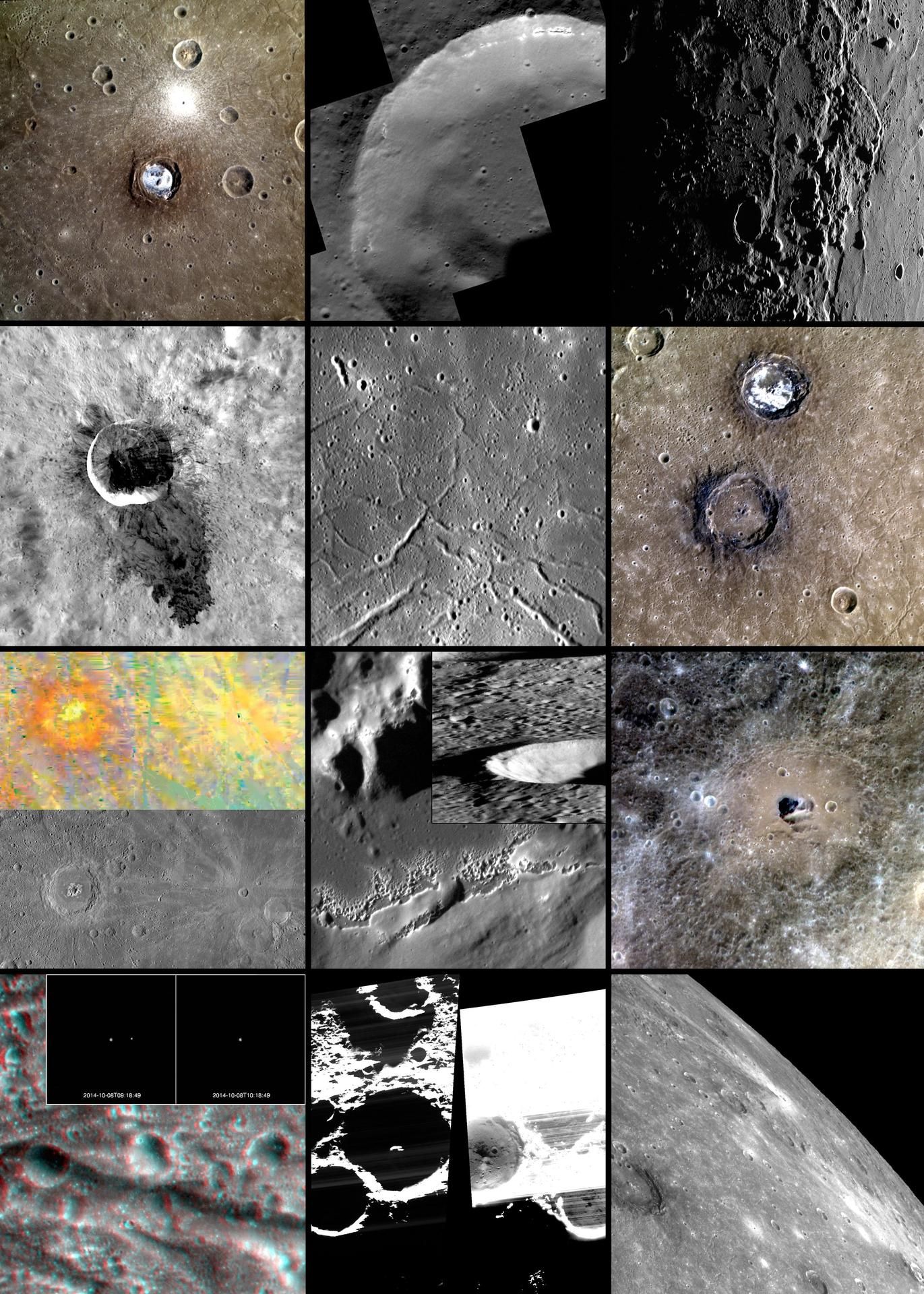
Observations from NASA's MESSENGER spacecraft (examples shown here) helped the team build new maps of the planet's shrinkage. (Image credit: NASA/Johns Hopkins University Applied Physics Laboratory/Carnegie Institution of Washington)
Mercury and the rest of the solar system planets formed due to the gradual collisions and aggregations of rock and gas upon asteroids and comets. Some of those impacts that created the planets also released a lot of heat. Mercury has been slowly cooling from those ancient impacts, and its interior has been shrinking along the way.
While this kind of cooling affects the entire planet's landscape, impact craters can mask the effects because each crash into the surface generates its own surface changes, including debris and new divots. The craters build up over time, making it difficult to spot more ancient geology underneath.
Nishiyama's team compared two sets of maps from Mercury, using data from NASA's MESSENGER mission, which orbited Mercury between 2011 and 2015. One set of maps charted geological features showing contraction, and the other set estimated the roughness of the planet's surface. Their work covered the entire surface and demonstrated that the most rugged spots on the planet have fewer wrinkles from shrinking. In other words, according to Nishiyama, the debris from more recent impacts is covering up the evidence of shrinking.
Nishiyama said more information will help to confirm the estimate. Such data could come from the European Space Agency's BepiColombo spacecraft, which began its arrival sequence at Mercury earlier this month after nearly eight years of space travel. Once the mission settles in, the spacecraft will take higher-resolution imagery of the surface than MESSENGER did. Nishiyama's team expects BepiColombo to pick up smaller impact craters, as well as scarps and ridges, that could further refine the measurements.
"Stay tuned for future topography measurements by BepiColombo," Nishiyama said. "Future data from laser altimetry on BepiColombo will collect more information on planetary contraction by measuring topography more precisely."
Yevgeny Khrunov was born Sept. 10, 1933, in Prudy, Russia. A Soviet Air Force pilot, he was selected as one of the first cosmonauts on Feb. 25, 1960, along with 19 others including Yuri Gagarin, Aleksei Leonov, and Andriyan Nikolayev. Though not part of the Vanguard Six, Khrunov would make history on the Soyuz 4/SoyuzContinue reading "Sept. 10, 1933: The birth of Yevgeny Khrunov"
Astronomers have taken one of the deepest looks yet at Cloud-9, a candidate "dark galaxy," and found no trace of stars. The paper outlining this discovery was posted to the arXiv preprint server on Aug. 21.
Though their origins may be shrouded in mystery, fast radio bursts (FRBs) could be used to probe some of the universe's biggest puzzles. This includes probing the nature of dark matter, the invisible sort of matter that somehow dominates the universe, and dark energy, the mysterious force causing the expansion of our universe to accelerate. They could even shed light on the mysteries of neutrinos, or "ghost particles." Let's dive into how.
FRBs are brief but intense blasts of radio waves currently thought to erupt from rapidly rotating dead stars with the universe's strongest magnetic fields, called magnetars. As FRBs travel billions of light-years to reach Earth, they pass through dense clouds of gas and dust in galaxies. This "cosmic fog" changes the original FRB signal. What this means is these blasts of radio waves carry the fingerprints of how matter in the universe is distributed.
Mapping the distribution and "clumpiness" of ordinary matter in galaxies can then help trace the distribution of dark matter, the effect of dark energy and the mass of neutrinos.
"We've established that FRBs are a leading probe of the distribution of matter in the universe," team leader Kritti Sharma, a graduate student working with Vikram Ravi, a professor of astronomy at the California Institute of Technology (Caltech) and also part of the team, said in a statement. "These FRB data can be used to enhance cosmology experiments that are trying to answer questions about dark matter, dark energy, and the mass of neutrinos."
For this research, Ravi and Sharma analyzed a sample of about 100 FRBs. This represents the first time scientists have used FRBs to directly measure the impact of so-called "feedback" from galaxies on the clumpiness of matter in the large-scale regions between galaxies.
Cosmic ghosts and the dark universe
Ordinary matter, composed of atoms made up of electrons, protons and neutrons, accounts for just around 5% of the universe's energy/matter budget despite comprising stars, planets, moons, our bodies, next door's cat and everything we see around us on a day-to-day basis.
Of this budget, the other 95% is composed of dark energy (68%) and dark matter (27%). It's little wonder that scientists are very keen to better understand these two aspects of the cosmos, sometimes collectively referred to as the "dark universe."
Things get even more murky when considering how, of that 5%, the second most abundant particles in the universe, aside from particles of light or photons, are neutrinos. These get their nickname of "ghost particles" because they interact with other matter particles so infrequently that approximately 100 trillion neutrinos pass through your body every second without leaving any trace. This is possible because neutrinos are virtually massless, and scientists are keen to accurately measure the mass of these cosmic ghosts.
These three mysterious elements of the cosmos have played a vital role in the evolution of large-scale cosmic structures like galaxies and galaxy clusters. That means, in turn, that measuring the clustering of matter can reveal details about the aspects of the universe that influenced that clustering.
An illustration of a supermassive black hole pumping energy into its surroundings, a type of cosmic feedback that can smooth out clumpy cosmic matter. (Image credit: Robert Lea (created with Canva))
However, to do that, scientists also have to understand how other factors smooth out cosmic clumpiness. That includes the energy pumped out from the hearts of galaxies by feeding supermassive black holes, a type of cosmic feedback that smooths out clumpy cosmic matter lying outside galaxies.
"The feedback process thins the gas around the galaxies, redistributing matter across vast distances. It smooths out clumps of matter in a way that looks astonishingly similar to what massive neutrinos do, or what dark energy or dark matter theories predict," Ravi said. "Unless scientists can independently measure this contribution from feedback, they can't tell these effects apart."
That's where FRBs come in.
An animation shows the random appearance of fast radio bursts (FRBs) across the sky. Astronomers have discovered about 85 since 2007. (Image credit: NRAO Outreach/T. Jarrett (IPAC/Caltech); B. Saxton, NRAO/AUI/NSF))
The researchers found that, while galactic feedback does indeed smooth surrounding material, making it less clumpy, the effect is weaker than has previously been measured.
"Our analysis of FRBs reveals how gas ejected by astrophysical feedback suppresses cosmic structure," team member Elisabeth Krause of the University of Arizona said in the statement. "This is amazing considering we only had about 100 FRBs in our sample. It's only the beginning."
The investigation of the universe with FRBs could get a major boost in 2029 when Caltech's Deep Synoptic Array (DSA) begins operating in Nevada. This powerful radio telescope is expected to find tens of thousands of FRBs, a major boon for cosmology.
The team's research was published on Tuesday (Sept. 8) in the journal Nature Astronomy.
Look up at the night sky and it is easy to imagine a few bright worlds hanging in an empty blackness. But what are we really looking at when we say “the Solar System”? It is a family shaped by one star’s gravity, built from the same ancient disk of gas and dust, and still […]
A "forbidden" merger between two massive black holes may not have been quite as impossible as previously thought. That's according to new research that suggests the black holes involved were smaller than expected.
On Nov. 23, 2023, the gravitational wave detector LIGO (Laser Interferometer Gravitational-Wave Observatory) detected tiny ripples in spacetime caused by the merger of two black holes. What was incredible about this signal, designated GW231123, was that it seemed to be the result of a black hole with 140 times the mass of the sun colliding with another that holds 100 solar masses.
This raised eyebrows among researchers because usual models of stellar evolution struggle to account for such massive black holes, especially ones that seemed to be spinning as fast as these two. While scientists have been attempting to explain how such an odd black hole binary could form. The team behind this new research suggests it doesn't need to be explained at all. They think that the masses of these black holes were an illusion.
The key to this illusion is a phenomenon called gravitational lensing, first predicted by Albert Einstein's 1915 theory of gravity, general relativity, which also first predicted the existence of gravitational waves. This theory says objects with mass cause the curvature of space and time, united as a four-dimensional entity called "spacetime." The more mass an object possesses, the greater the curvature, and because gravity arises from this curvature, the greater the gravitational influence.
Gravitational lensing occurs when light from a background object passes a massive foreground object. The foreground object can warp the fabric of spacetime in such a way that the light's path is curved. This means light from the same background source can reach Earth at different times, depending on how much that light was diverted.
This difference in travel time can magnify a background source, and it has been used to great effect to observe distant and ancient galaxies ordinarily too faint to be seen.
This research team thinks the effect also applies to gravitational waves, suggesting the signal GW231123 is an example of gravitationally lensed ripples in spacetime that made the black holes appear larger than they actually are.
"Like light, gravitational waves can also be deflected, magnified and split into multiple signals by massive objects," team member Miguel Zumalacárregui, group leader in the Astrophysical and Cosmological Relativity Department at the Albert Einstein Institute (AEI), said in a statement. "For gravitational waves, diffraction and interference effects give us an additional way to identify and study lensed signals."
A diagram (not to scale) of how gravitational lensing works. (Image credit: NASA, ESA & L. Calçada)
To investigate this possibility, the team developed a mathematical model of gravitational lensing and created software powerful and fast enough to analyze it.
"If we assume that GW231123 was deflected and distorted by a compact object of about 190 to 850 solar masses — or by an extended structure such as a globular cluster — we can understand the observed high masses," said team member Srashti Goyal, who was based at the AEI when conducting the research. "Moreover, the lensing interpretation does not require unusually high spins."
When the team modeled the event with that consideration factored in, they found the merger involved a system with a mass of 140 solar masses, rather than the 240-solar-mass system initially theorized.
A simulation of a black hole merger. (Image credit: NASA's Goddard Space Flight Center)
The team doesn't quite know what massive object is responsible for lensing the gravitational wave signal GW231123. But no matter what it is, if the team is correct, the lens could be something quite special.
"The nature of the lens remains a major mystery in our analysis, as individual compact lenses with 100 to 1,000 solar masses should be exceedingly rare," Zumalacárregui said. "Future work will need to establish whether such lenses can form, or whether an ensemble of lighter objects, including stars, can explain this event."
The team can't yet conclusively say if GW231123 is the first gravitationally lensed gravitational wave signal. Finding future signals of the sort will require upgrades to the sensitivity of detectors like LIGO.
Though even before that happens, the research does point to the utility of gravitational wave astronomy to study some of the universe's most violent events.
Using the ALMA (Atacama Large Millimeter/submillimeter Array) radio telescope, astronomers have watched as two stars come together to form a massive stellar binary. The observations revealed that these stars didn't form from the same collapsing cloud of gas and dust, as most binary stars are assumed to form, but instead came together later in their infancy.
Here on Earth, we are slightly prejudiced by our single sun to view stars as somewhat solitary bodies. However, around half of sun-sized stars in the Milky Way have a companion star. This percentage of stellar partnership rises to around 90% of massive stars. Eventually, these massive stars go supernova and shape their cosmic surroundings. Thus, understanding these binary systems is vital to our understanding of stars and of galaxies in general.
The team behind this research initially observed the still-growing massive stars, or protostars, in the binary system IRAS 07299−1651, located around 5,300 light-years away in 2019. At first, the researchers didn't see anything that suggested these stars didn't form from the same disk-shaped cloud of gas and dust that later fragmented. However, one thing really stood out: the disks of material surrounding and feeding these protostars are oddly misaligned.
Over the course of eight years, the team mapped subtle shifts in the position of the stars using ALMA in addition to the Very Large Array (VLA), as well as infrared images from the James Webb Space Telescope (JWST) and the Very Large Telescope (VLT).
"For the first time, we were able to watch two massive stars move around one another while they were still being born," team leader Yichen Zhang of Shanghai Jiao Tong University, China, said in a statement.
The team was able to reconstruct the full 3-dimensional structure of IRAS 07299−1651 for the first time, obtaining details about how the stars orbit each other, the way their disks are aligned, and the angle at which they blast jets into space.
"Each telescope revealed a different piece of the puzzle," team member Rubén Fedriani, of the Instituto de Astrofísica de Andalucía (IAA) in Granada, Spain, said. "The combination of radio and infrared observations provides the most exquisite detail on the formation of this massive protobinary system."
Unexpected chaos
The team's observations took them by surprise. They were expecting these stars to orbit each other in neat, near-circular orbits. Instead, the orbits were found to be highly flattened or "eccentric," almost parabolic.
If the stars had formed from the same disk of material, then even after it fragmented, the individual disks surrounding the stars would be aligned. However, that wasn't the case; the disks are tilted at a sharp angle to each other and to the orbits of the stars.
"It felt like solving a three-dimensional puzzle," team member Yao Wang of Shanghai Jiao Tong University said. "Each new observation added another piece, and eventually the orbit, disks, and jets all came together into a single, coherent picture."
An artist’s impression of the formation of a close massive binary system, showing misaligned disks around two young stars. (Image credit: Y. Zhang)
The chaotic structure of IRAS 07299−1651, as observed by the team, is difficult to explain if the two stars emerged from the same disk of material.
Instead, the researchers theorize that the two stars were born in individual clouds of gas and dust, before a chance encounter brought the two infant stars and their respective natal cocoons together.
Tracing back the orbits of the stars, the researchers found that this encounter likely occurred around 60 years ago. Considering stars live for billions of years, that is an instant on a cosmic timescale. The disk-shaped pockets of material around the stars have thus far survived the encounter, retaining their well-defined structures.
"This study demonstrates that the early lives of stars can be quite chaotic, with a chance encounter leading to this gravitational dance and stellar coupling," team member Jonathan C. Tan of the University of Technology and the University of Virginia said.
A binary star system, is IRAS 07299−1651 destined to settle to form such a system? (Image credit: NASA)
What the team can't yet establish is whether these stars are destined to stick together or if they will eventually move apart. Indeed, this fate may not have been sealed yet; interactions with the surrounding gas could determine what shape this system takes in the future.
The team hopes that further observations of IRAS 07299−1651 will help to better understand what the future holds for these stars.
In the meantime, the long-term monitoring approach adopted by the researchers could provide scientists with a powerful new way of investigating other young massive binary systems. This could reveal how common encounters like this are and if more binary systems are composed of stars brought together by chance encounters.
The team's research was published on Tuesday (Sept. 8) in the journal Nature Astronomy.
A brand new observatory began its tenure on Aug. 30 — it's called the Nancy Grace Roman Space Telescope, and it's equipped with a high-tech tool that can directly photograph planets beyond our solar system.
The tool is called a coronagraph; in simple terms, a coronagraph is a device that can be affixed to a telescope and block out the light of a star the telescope is looking at to study features around that star. Without such a device, starlight can be so overpowering that it outshines details nearby. You can think of a coronagraph as a way to recreate a total solar eclipse, except instead of the moon blocking out the sun it's a humanmade mask of sorts that does that trick.
But while coronagraphs have been used many times before, the one that just launched toward the stars is unprecedented. "The Roman Space Telescope is carrying the most advanced coronagraph that humanity has ever put into space," Dominic Benford, the telescope's program scientist, told Space.com.
If you can remember the striking "Pale Blue Dot" image of Earth that NASA's Voyager 1 spacecraft captured while floating about 3.7 billion miles (6 billion kilometers) from the sun, this is the kind of thing scientists expect to see with Roman's coronagraph. A menagerie of Pale Brown Dots should soon make us feel the weight of our existence.
"I love the feeling of smallness that comes from understanding you're not alone in the universe," Vanessa Bailey, Roman's coronagraph instrument scientist, told Space.com.
Earth as a "pale blue dot" seen by Voyager 1 in 1990. (Image credit: NASA/JPL-Caltech)
How does it work?
Coronagraphs aren't really a new thing. Often, they're even used to study our own sun.
For example, NASA's PUNCH mission — which stands for Polarimeter to Unify the Corona and Heliosphere — launched in 2025 and consists of four spacecraft, one of which holds a coronagraph. This coronagraph blocks out the light of our sun in order to reveal the wispy tendrils of the sun's outer atmosphere, or corona.
"In fact, more than 100 years ago, astronomers used coronagraphs to create an artificial eclipse to study the sun's corona," Bailey said during a press briefing on Aug. 29, a day before Roman launched to space. "That's the reason for the name."
But when it comes to other stars, coronagraphs hold another purpose. They can block out a star's light in such a way that planets actually orbiting that star come into view.
"We can block that starlight until we have only a few parts per billion of the light of the star remaining," Benford said of Roman's coronagraph. As a result, he explained, "we can directly see the light bouncing off something like a Jupiter around another star, which we've never been able to do before."
NASA's Solar and Heliospheric Observatory, or SOHO, constantly observes the outer regions of the sun's corona using a coronagraph, which blocks the bright solar disk. (Image credit: ESA/NASA/SOHO)
This process will surely give us our Pale Brown Dots — but to take things a step further, scientists will also be able to dissect the light bouncing off the theoretical Jupiter to reveal what the atmosphere of the world is like, too.
To be clear, Roman isn't the only astronomy tool we have that utilizes a coronagraph while looking beyond our solar system. Even the James Webb Space Telescope and Hubble Space Telescope have their own, for that matter. However, Roman's is far more complex.
For one, the Roman's coronagraph doesn't exactly "block" out starlight like a standard coronagraph does. For the "moon" in its artificial eclipses, it uses a combination of patterned disks and special filters to create destructive interference with the light of a target star. Destructive interference means competing waves of light cancel one another out, leading to a zeroed amplitude. In effect, this blocks out the starlight as necessary and only allows light reflected off the planets of interest to pull through and reflect off the coronagraph's mirrors.
A diagram showing what the disk's pattern might look like. (Image credit: NASA's Goddard Space Flight Center)
The first active coronagraph
Which brings us to the next special part about Roman's coronagraph: It's the first "active" coronagraph to fly in space.
What this means is it can adjust those mirrors in real-time to make sure its exoplanet observations are as clear as possible. This is important because as light reflects off the coronagraph's mirrors, it can create small distortions that mess up the delicate destructive interference dance. You'd need to adjust to bring the balance back, and these adjustments are possible because Roman's coronagraph has hundreds of tiny pistons built into its mirrors. This makes them deformable so they can change shape to account for distortions.
If it all works out, this coronagraph should be capable of detecting exoplanets that are about 100 million times fainter than their stars.
"These deformable mirrors are a real engineering feat," Bailey said during the press briefing. "They can be commanded with the precision approaching the size of an atom, and this is what really allows us to make this transformative performance."
The Roman Space Telescope's coronagraph as scientists were working on it. (Image credit: NASA/JPL-Caltech)
As for what the specific hope is for Roman's coronagraph, Bailey explained there are a few nearby star systems the team is particularly interested in peering into because we have hints of Jupiter-like planets orbiting in those systems that still haven't been imaged. "Or," she said, "there may be really interesting remnants of dust and debris from the process of planet formation." Perhaps that dust could exist in the habitable zones of the stars Roman looks toward, and perhaps this could tell us more about the birth of planet Earth.
"That is interesting in its own regard but also interesting as a precursor to the Habitable Worlds Observatory," Bailey said, in reference to NASA's next great project that will be equipped with a more advanced version of Roman's coronagraph. "We can study how dusty these nearby systems are and understand whether any of them might have too much dust for us to be able to observe an Earth-like planet in the future."
An animation shows what Roman looks like deploying in space. (Image credit: NASA’s Goddard Space Flight Center Conceptual Image Lab)
While Roman will pretty much be focusing on Jupiter-like worlds because they're big enough to be detected with its current capabilities, HWO could certainly find another Earth someday.
From 6,000 exoplanets to 100,000
And before we wrap up, we must briefly mention this newly christened exoplanet hunter's partner tool, the majorly impressive Wide Field Instrument (WFI) that can survey huge swaths of sky in one go. It is because of the partnership between the WFI and its coronagraph that Roman will immensely expand our exoplanet gallery, says associate administrator for NASA's Science Mission Directorate Nicky Fox. The coronagraph won't be finding new exoplanets alone, but rather will be diving deeper into exoplanets the WFI finds first.
The Roman Space Telescope's WFI. (Image credit: NASA/Chris Gunn)
WFI will use two different techniques to contribute to our gallery. The first one is called the transit technique, and it's the same method big names like Kepler and TESS tapped into. It involves noticing dips in starlight that happen when a possible planet transits the face of a star from the telescope's vantage point. "If you see that happen multiple times," Fox said, "you can infer that it's a planet, and you can get the radius and the size of the planet from that observation."
The second technique has to do with gravitational lensing, which refers to how objects with mass in space (and therefore gravitational influence) can warp the very fabric of spacetime and alter the path of light traveling through the affected region. What comes to mind might be a mighty galaxy cluster twisting spacetime like a sheet of satin, but little things like stars and planets can do it, too. The so-called "microlensing" effect of smaller objects warping spacetime leads to the brightening of background objects.
Fox sums up WFI's two techniques in a nutshell: "If you see a little dip, that can suggest there's a transiting planet. You see a little brightening, that can suggest there's a microlensing planet."
For WFI, the microlensing technique will be sensitive to Earth-size planets in the habitable zones of their stars, while the transiting technique will be more sensitive to planets closer to their stars. And as Bailey reminds us, there are absolute heaps of planets to test Roman out on: "When you look up at the night sky, most of those stars have planets."
Right now, we only know of about 6,000 of those worlds. Fox believes this new space telescope could unveil 100,000 more.
Astronomers just dropped a video 27 years in the making: the highest-definition animation of a gargantuan black hole jet blasting out of a distant galaxy and twisting off into space.
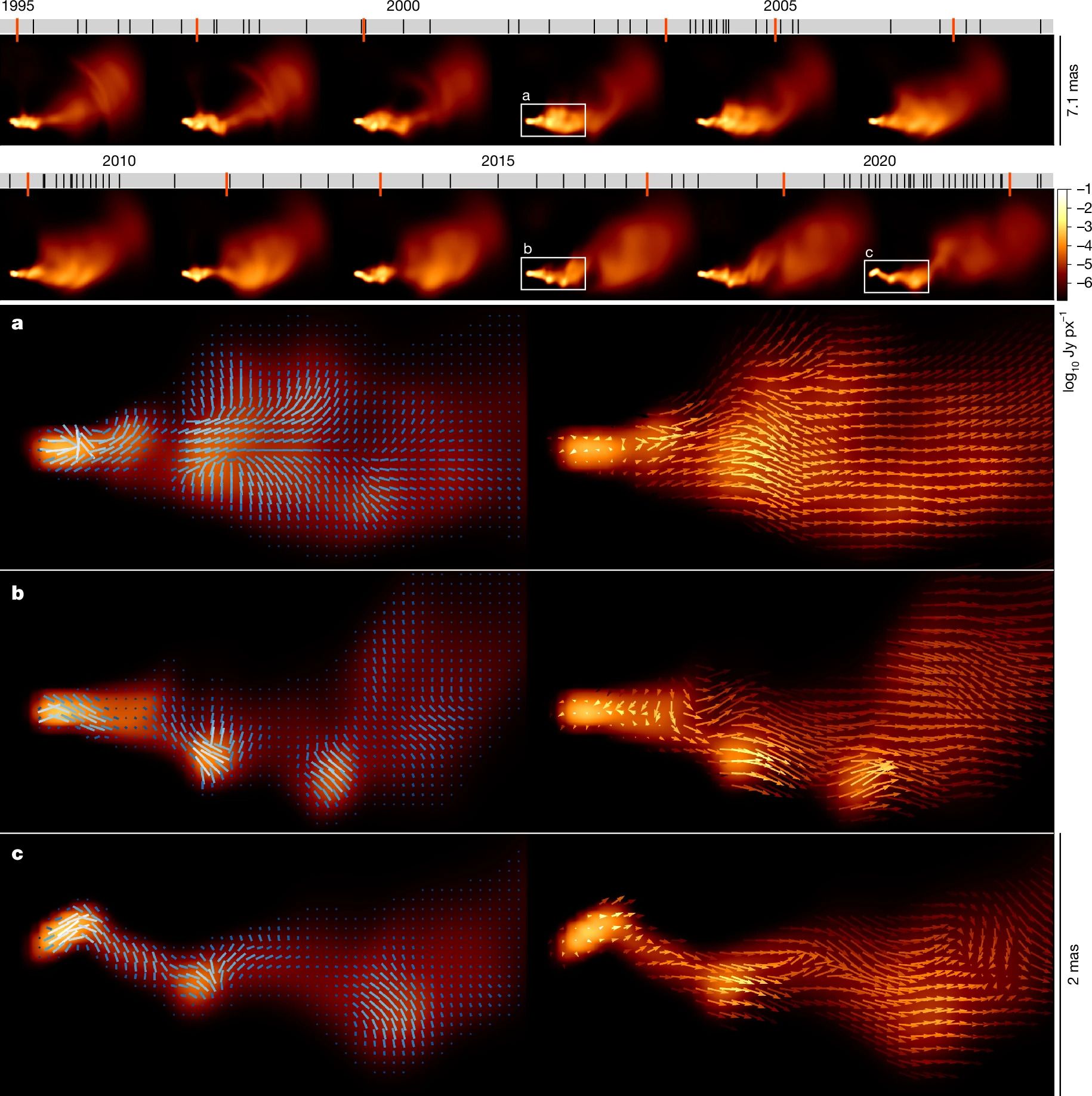
The video, made from 116 images taken between 1995 and 2022, captured a blazar known as 3C 345, in the constellation Hercules. A blazar is a sort of quasar — a bright, feeding supermassive black hole embedded in the center of a faraway galaxy — that emits huge jets of gas into its environment. The jets blaze at nearly the speed of light and are charged with highly concentrated X-rays and gamma rays.
As described in an Aug. 26 study in the journal Nature, scientists gathered the images of 3C 345 using decades of observations by the Very Long Baseline Array (VLBA), a network of 10 telescopes spread across the U.S. (VLBA had two programs that caught views of the jet, called BEAM-ME and MOJAVE, which collectively followed hundreds of blazar sources.)
To turn those hundred-or-so images into an animated movie, the team used an AI neural network named Kine, achieving a resolution four times higher than that of any individual image. By doing so, the researchers mapped the speed of the black hole jet to the highest precision yet. (Several study co-authors had previous experience boosting the resolution of distant black hole images while working at the Event Horizon Telescope Collaboration, the team behind the first image of a black hole.)
"The higher quality of our video reconstruction enabled a detailed measurement of the plasma velocity in the jet," study first author Marianna Foschi, a postdoctoral researcher at Caltech, told Live Science in an email.
A big, bright surprise
The researchers were surprised to see that the mighty jet's brightest components were flying at 10 to 13 times the speed of light while the gas surrounding it was zooming at about nine to 12 times the speed of light.
Still images of the black hole jet taken over 27 years. The bottom images (a-c) show the direction of polarization in the plasma jet. (Image credit: Foschi et al / Nature)
"This is unexpected because the general consensus is that these bright components are shock perturbations moving through the plasma, and as such they should have a higher velocity compared to the surrounding fluid," Foschi said. "Our work does not invalidate the shock model in general, but it puts it into question, at least in the case of this specific source."
VLBA uses radio antennae across the continental U.S. to map the sky, providing a wide view of the universe. But while VLBA has a comprehensive view of the sky, it lacks very fine details. The array is designed to generate a two-dimensional image with elements based on a measurement between two of the array's telescopes. Because the array has only 10 telescopes to do those measurements, however, its pixel resolution is limited.
That's where the Kine AI model makes a difference. The goal of Kine's work, Foschi said, is to develop an imaging algorithm that can create videos of observations at different times, focused on astronomical sources with variable brightness.
Kine is a neural network — a type of machine learning model that uses layers of "neurons" (computing nodes) to learn from a dataset, similar to the way a human brain learns. Kine can "process observations at different times, while learning and leveraging the spatio-temporal correlations present in the data," the research team wrote in the paper, referring to time and the three dimensions of space.
Foschi said the team is eager to apply Kine to other astronomical observations. "We believe this method will drastically change the way jet dynamics is studied from observations," she said. "In fact, our method enables a precise measurement of the projected velocity at any point in the jet."
See how much you know about black holes with our black hole quiz!
For the first time, astronomers combined Hubble and Webb space telescopes to hunt down some of the smallest, faintest objects ever spotted in the outer Solar System.
Solar system simulations starting from varied initial conditions suggest that Earth-like planets can emerge naturally from planet formation. Computer simulations of planetary systems can now begin from thousands of different starting conditions, allowing researchers to explore how worlds might emerge without assuming the final outcome. Over the past three decades, these models have advanced from [...]
A few hundred million years after the Big Bang, the first stars ignited—literally the "let there be light" moment for the universe. Now known to astronomers as Population III, or Pop III, stars, these giants were very different from the stars we know today. They formed from pristine hydrogen and helium, with almost no "metal" (i.e., other elements) holding them back. They were also huge, growing to tens to hundreds of times larger than the sun. And they died young, in many cases collapsing into the universe's earliest black holes.
A new image of the Helix Nebula reveals how dying stars return material to the galaxy. The Helix Nebula offers a rare look at what happens after a dying star releases its outer layers into space. New observations show fragments of that material colliding with surrounding gas, breaking apart, and beginning their return to the [...]

 Login