Nintendo of America got its tariff refund and is using the money to hold a sale, rather than returning it to customers who paid higher-than-expected prices for the Nintendo Switch 2 and accessories. The rare promotion, dubbed the "Customer Appreciation Sale," will run from September 13 to 26 and will offer 30% off digital Switch games, bundles, and "select physical games, downloadable content, accessories, amiibo, and apparel." Discounts will be available in Nintendo Stores and the Nintendo eShop, as well as other participating retailers.
"The Customer Appreciation Sale is our way of saying thank you to Nintendo players for their continued support and is made possible in part by tariff-related refunds," a brief blog post on Nintendo's U.S. website reads. "While Nintendo absorbed most tariff-related costs, the refunds helped make promotions like this one possible."
In a 2026 earnings document, the company stated that it got $300 million in tariff refunds.
Nintendo of America is facing a proposed class action lawsuit from customers who believe the company will be made whole twice: once through raised prices and a second time through the refunds. Sony is facing a similar suit, and in September, Nintendo of America filed a motion to dismiss its suit.
Nintendo was hit hard by the Trump administration's tariffs. Soon after the Switch 2's initial announcement, the company delayed U.S. pre-orders for the console, though the system launched on time. In May, Nintendo raised the price of the Switch 2 by $50 to $499, though that also priced in component shortages and included hikes in Europe and Japan.
In March, Nintendo of America sued the U.S. government in the U.S. Court of International Trade seeking refunds, joining Costco, FedEx, Revlon, and more than 1,000 others. The Supreme Court ruled that large swaths of the tariffs were unlawful, with over $166 billion due back to American businesses. By the end of July, the government had paid $100 billion in refunds.
Most companies seem to be pocketing the refunds, even though costs were typically passed on to American consumers. In August, Panic, which makes the handheld Playdate focused on indie games, refunded tariffs to customers.
The Black Panther villain’s hairstyle has become a default for Black video game characters because it’s easy to code. Danielle Udogaranya is changing that.
Today is September 9, and the significance of the date for Australian consumers is that, by law, buying online apps and games now requires an over-18 age verification step. The local law isn't specific about the exact type of verification, only that it offers "appropriate age assurance measures." Valve is complying by asking for a bank card rather than government ID or a biometric check. The problem in the land down under is that while credit cards seemingly all work, debit card support is spotty and conditional.
This situation isn't unique, as it's basically a repeat of the same existing scenario in the United Kingdom. Valve's privacy-minded approach is laudable, as a bank card only links a payment method to a name and address. Meanwhile, a government ID is a more dangerous document if it gets leaked; face scans are quite fallible and revealing, and biometrics are intrinsic to the person and not replaceable if exposed — unlike bank cards, which can be canceled and swapped in minutes.
However, having a card check as the only verification option is causing problems, and many users are already asking for other means of verification, even if they're more invasive, citing Xbox and Sony's services as more accommodating.
Since credit cards in Australia (and the UK) can only be issued to adults, they work fine for Steam verification. Debit cards, on the other hand, can be carried by minors, and they're only valid for age checks under specific conditions. For now, that seems to be those (a) belonging to the Mastercard network, which introduced its own global automatic age verification check on June 2, 2026, and (b) for which the issuing bank flagged the card product as adults-only. The transaction firm only passes the answer to "is the buyer an adult?" back to the merchant (in this case, Steam), without exposing an actual date of birth.
A quick harnessing of user reports, mainly from Reddit posts, seems to indicate that debit Mastercards from Commonwealth, Westpac, and Macquarie appear to work, while those from Bendigo, St. George, Revolut, ANZ, and most Visa cards seem to fail the check. Note that this is an evolving situation, so the situation may have changed by the time you're reading this.
The demographics of credit card ownership definitely don't help matters. Unlike the U.S., where credit cards are the default method of purchase, only about 45% of Australian buyers and 65% of UK punters own one. Perhaps most importantly, within the 18-24 age demographic, only 25% to 30% own a credit card — precisely the people who buy the most games and are the most affected. For both user satisfaction and business reasons, it's seemingly desirable that Steam add verification alternatives.
Preorders for the Nintendo Switch 2 The Legend of Zelda 40th Anniversary Edition went live shortly after yesterday's Nintendo Direct and sold out instantly. Walmart has listed the handheld gaming console but has enabled preorders. Meanwhile, you can preorder it on Amazon for $519.99, so you may still have a chance to get one at MSRP before the scalpers.
Major U.S. retailers, including Target, Best Buy, and GameStop, were the first to enable preorders for the Switch 2 The Legend of Zelda 40th Anniversary Edition, which instantly sold out. It did not take long for scalpers to hit eBay to resell preorders for as much as $1,000, almost 2X over Nintendo's MSRP. Zelda-exclusive consoles have always been prime targets for scalpers.
The Switch 2 The Legend of Zelda 40th Anniversary Edition, the first limited edition of the Switch 2 and a The Legend of Zelda-themed edition celebrating the franchise's 40 years, makes the handheld console even more desirable to hardcore fans and scalpers looking to make a quick profit. Plus, the console's $519.99 price tag, which is only $20 over the vanilla Switch 2, gives gamers extra incentive to purchase one. The problem is finding one in stock.
Along with the console, Nintendo also gave the Switch 2 Pro controller and carrying case with an included screen protector the same The Legend of Zelda 40th Anniversary Edition treatment. Best Buy currently has both up for preorder at $99.99 and $39.99, respectively.
The Switch 2 The Legend of Zelda 40th Anniversary Edition officially launches on October 29. Historically, The Legend of Zelda-themedconsoles are available for purchase on launch day. However, stock will likely be extremely limited, which is why many fans like to lock in their preorders early.
It remains to be seen whether Nintendo will produce many units of the Switch 2 The Legend of Zelda 40th Anniversary Edition. At least for the previous limited-edition consoles, like the Nintendo Switch OLED: Tears of the Kingdom Edition or Nintendo Switch Lite: Hyrule Edition, stock was not a problem since you can still buy them today despite being last-generation consoles.
If you play hard to get, you could get Xbox Game Pass for cheaper; at least that is what numerous users are reporting on a Reddit thread. One Xbox Game Pass subscriber shared a screenshot of Microsoft offering them the Ultimate plan for $16.09 for a month, 30% lower than the standard $22.99. Their secret? Cancel Xbox Game Pass almost every month.
Dynamic win-back discounts are perhaps the oldest trick in the book, but they remain widely used because of their effectiveness in re-engaging customers who have stopped buying a product or, in Microsoft's case, canceled their Xbox Game Pass subscription. These targeted offers, often disguised as "We Miss You" or "Welcome back" deals, aim to win back lost customers with exclusive or time-limited discounts.
According to the Redditor, they have used Xbox Game Pass on and off for about two years. However, instead of committing to an annual plan, the user frequently paused and resubscribed. In the Redditor's words, they were "not doing any sort of tricks lol...just got the offer randomly because I cancel gamepass almost every month, so maybe this was their way of keeping me."
This kind of customer behavior is not uncommon among subscription services, since buyers seek to maximize value and avoid unnecessary spending. Apparently, Microsoft seemingly noticed this user and proactively offered a 30% discount, dropping the Xbox Game Pass Ultimate price from $22.99 to $16.09 for a year. And it worked. The Redditor confirmed that they took the offer and locked in for the entire year.
At least one other Redditor confirmed they also received the same $16.09 offer. The thread quickly filled with additional posts as users shared their experiences with Xbox Game Pass discounts. For example, one Reddit user said that when they logged in with a secondary account on their Xbox console, they saw an $18 offer for 12 months of Xbox Game Pass Ultimate. Their main account allegedly never receives offers like this. Meanwhile, other users chimed in to report receiving $ 20-per-month offers.
It is unclear what criteria Microsoft uses to distribute these win-back discounts. Many speculate that the company may be considering activity, subscription history, or even multiple accounts. The discounts do not seem limited to the U.S., where the Redditor lives. Users in the thread have reported similar discounts in regions like México.
Despite Microsoft slashing Xbox Game Pass pricing earlier this year, many gamers still resort to digital key marketplaces such as Eneba, G2A, or Loaded, where one month of Xbox Game Pass Ultimate can cost as little as $9.28. By running targeted annual promotions, Microsoft can encourage subscribers to stick with Xbox Game Pass, secure long-term revenue, and avoid the risks of month-to-month cancellation.
However, these targeted discounts raise an important question: should Microsoft not reward loyal Xbox Game Pass subscribers with similar exclusive discounts? Win-back promotions are great for bringing back former subscribers, but long-time users will feel overlooked and see no reason to commit, since the generous deals go to those who cancel and return.
Nintendo just aired one of the most important Directs of the Switch 2 generation, showcasing the upcoming Ocarina of Time remake in all its glory. The presentation also brought along the announcement of the first special edition Switch 2 hardware: The Legend of Zelda 40th Anniversary Edition. The console costs $519.99, but there's also an identically themed Pro Controller for $99.99 that you can pre-order right now — either item ships later this year on October 29.
The company's first handheld to be adorned in special edition Zelda makeup was the Game Boy Advance SP released in 2004 alongside The Legend of Zelda: The Minish Cap. The first home console to receive the same treatment was The Wind WakerHD edition of the Wii U in 2013. Most recently, we got a Tears of the Kingdom-themed Switch OLED in 2023, followed by the Hyrule Edition of the Switch Lite next year.
Across every handled and home console released, The Legend of Zelda 40th Anniversary special edition Switch 2 will be the 12th piece of Zelda-themed hardware Nintendo has put out. Moreover, it took the original Switch just a few months to get its first limited-edition hardware (Monster Hunter XX Special Pack), but the Switch 2 has clearly taken its time with this design, and it's sure to be a collector's item.
The tablet itself is mostly the same boring black except for a few golden triangles at the back. However, the Joy-Cons feature a beautiful green design with a Tri-Force symbol on the left. The dock is a gorgeous, two-tone golden and black color with a very bold Tri-Force theme across the front and some easter eggs on the back. Even the packaging is supposed to have textured foil cover art. The console will retail for $520 and does not come with any game.
NintendoNintendoNintendo
Alongside the console, there's a Switch 2 Pro Controller that looks very similar to the Joy-Cons, with a green and gold theme that combines elements of the Triforce with a crest emblem. It comes as is for $100, but you can also get it with a subtly themed display stand for $110. Finally, there's also a $40 carrying case adorned with Zelda illustrations. You even get a custom, green-colored microfiber cloth inside and a screen protector.
Keep in mind that all of this hardware celebrates the 40th anniversary of the Zelda franchise, which already passed earlier this year. It has nothing to do with the upcoming Ocarina of Time remake and, as such, the game is not included in the $520 limited edition Switch 2. Pre-orders for all the items discussed above are open, and they will be released on October 29, 2026. The Ocarina of Time remake drops next month, on November 19, 2026, and will be sold separately for $60.
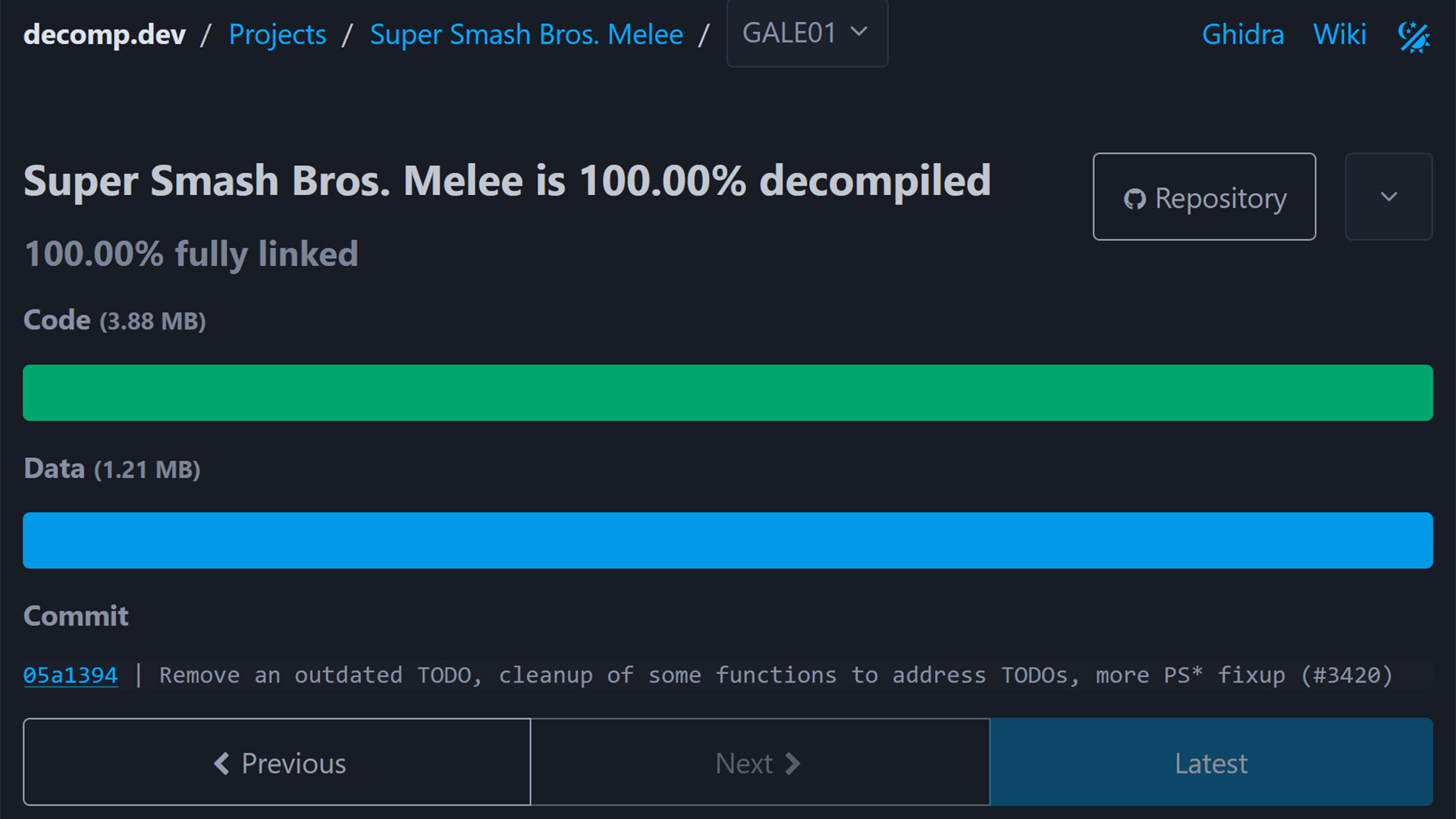
A Super Smash Bros Melee decompilation project hit its key long-standing goal a few hours ago. Nintendo’s legendary platform fighting game, which launched on the GameCube in 2001, has now been 100% decompiled by a team of developers. This is a complex game to convert to C code, but the project code can now be compiled into a binary byte‑for‑byte identical to Nintendo’s original main.dol. The effort has taken the team six years or more to get to this stage, with OpenAI's Astra part of the effort to get it over the line. Gamers may already be excitedly anticipating Super Smash Bros Melee ports and modding tools, but these too will take time and effort.
Decompilation projects seem like the latest trend to grasp the retro gaming and development communities, but some, like this, have been in progress for a very long time. Enthusiasts are spurred on by old console hardware becoming scarce, expensive, or uneconomical to repair. Thus, they want to preserve the original game code in a manner that can be ported to modern supported systems. Demanding 100% accuracy with a complex game like this was ambitious, but now that milestone has been reached.
Preservation isn’t the only goal, or result of projects like this. Seasoned developers will now be able to pore over the game’s C code and gain insights into Melee’s engine, physics, game mechanics, and more. Armed with this knowledge, we should eventually see the modding potential of this game blossom. This has happened in the wake of previous successful decompilation projects.
If you drop in on the doldecomp/melee GitHub page, linked above, you can check over the code for yourself. There are instructions for compiling this Super Smash Bros Melee C code on various platforms, including Windows. However, please remember these aren’t ports; you will just be recreating the v1.02 US release main.dol file from the GameCube, which weighs in at 3.88MB. You'll also need the original assets (textures, audio, etc.) from the GameCube disc that you own, in order to run the game.
Some highlight that the project was finalized with thanks in part to the latest AI tech, including GPT-6 Astra. Similar tech might also be used to rapidly develop the ports and mods that the crowds are looking forward to.
Sony Japan has officially implemented a new customer harassment policy to address ongoing customer backlash, following the company’s controversial announcement to phase out physical PlayStation game discs by January 2028. In an official publication on September 1, the company outlined prohibited customer behaviors to protect the dignity and safety of its employees and threatened to suspend customer service if the behaviors continued.
“The dignity and safety of our employees must not be threatened by customer harassment, such as words or demands from customers that exceed what is considered reasonable according to social norms,” the publication read. “If any behavior constituting customer harassment is confirmed, we may restrict or suspend customer service in order to protect the safety of our employees.”
Some of the examples of customer harassment detailed in the publication include “persistent and repeated, or prolonged, demands; excessive or unreasonable demands for compensation; abusive language, threats, slander, and other similar behaviors; requests unrelated to products or services; intimidating attitude; discriminatory or sexual conduct; and attacks and demands against individual employees.
The company also listed “forcing someone to prostrate themselves,” visiting company grounds without permission, and excessively asking for apologies as customer harassment, expressing willingness to use legal force if necessary. “We will take a firm stance against such actions and aim to build healthy and sustainable relationships while respecting both our customers and employees,” it said. “If we deem it necessary, we will cooperate with the police, lawyers, etc., and consider taking action, including legal measures and criminal proceedings.”
The new policies appear to be in response to the intense backlash over Sony's decision to end physical disc production by 2028. The decision was met with immediate, widespread backlash from the gaming community, which argued — among other things — that ending physical discs was equivalent to eliminating true ownership. Critics also argued that digital purchases were rentals and placed too much power in the company's hands, which could restrict access at will. Just 6 days after the July 1st announcement, a Change.org petition to stop the move had amassed 200,000 signatures and is now approaching 400,000.
The company doesn't appear to be backing down. After a class action lawsuit related to Sony’s decision to kill physical discs, the company moved to force the case into out-of-court arbitration, arguing that “reasonable consumers would not be misled into believing they own digital games.” The plaintiffs allege that Sony misleads consumers by using "Buy" buttons for digital PlayStation games without clearly disclosing that buyers are only purchasing a temporary, revocable license rather than actual, permanent ownership of the game.
Several other related lawsuits are ongoing. Regardless, Sony has said it will "cautiously move forward" with its decision despite “strong views” from players. The company hopes its new customer harassment policy will curb some of the backlash individual employees are currently facing. The policies also align with Japan's recent law that mandates companies to take measures to prevent customer harassment towards their workers.
Musicians and synth-heads in the audience, rejoice. A new vintage synthesizer plugin has arrived that has the potential to blow many commercial offerings out of the water — and it's completely free, to boot. Audio software maker Autodafe has released the Vintage Emulator Studio (VES), a fresh new plugin that integrates a fair number of the open-source MAME emulator's synthesizer cores in one neat package.
The entire list of emulated synths is below, but it includes iconic entries like the Akai MPC3000, LinnDrum, Oberheim DMX, and Roland TR-707 — used by names like Dr. Dre, New Order, The Police, INXS, and Prince, among many other high-level acts. There are a total of 44 machines, all with component-level emulation.
What makes VES different from most other synth plugins is that instead of presenting a facsimile of the final output or a hybrid mix of component- and output-stage emulation, it employs — by way of MAME — full component-level emulation. Each processor, tone generator, envelope generator, filter chip, and converter should be faithfully reproduced, potentially resulting in a "perfect" emulation of the gear in question, more or less depending on the status of each driver core.
Notably, on machines whose MAME emulation is farther along, analog and/or digital output stages are faithfully recreated, meaning you won't need additional low-pass filters or any other trickery to make the synth sound like the actual hardware. Additionally, the skeuomorphic, HiDPI-ready UI replicates the units' control panels, dials, buttons, and LCD displays, making them easy to interact with if you're familiar with the real hardware — and probably a nightmare if you're not, as "ease of use" wasn't high on the list of priorities back then. Floppy disk, CD-ROM, and peripheral emulation ought to be included too.
If by now you're thinking this is all too good to be true, there are indeed a couple or three catches. First and foremost, as with any emulator, you'll need to provide your own ROM/firmware, and depending on the synthesizer, any associated sample packs. Although obtaining those is not too difficult, having a copy of that data is a legal gray area if you don't own the original hardware. Although we haven't tested it ourselves, the CPU usage of the plug-in ought to be somewhat high, considering all the work it's doing simulating every single component.
Additionally, while MAME's emulation cores aim for full component-level emulation, not every synth driver has had the same amount of work put into it. For example, the Akai MPC-3000 driver is nearly complete, while the Prophet-5's has only been introduced to MAME fairly recently — so your mileage may vary. We'd expect this VST to be updated somewhat frequently as work on its MAME core moves forward.
For the sake of argument, though, if only a handful of synths are fully emulated, that's still an impressive showing out of a list of 44, given that in theory you'll get output that tracks exceedingly close to that of the original hardware, all from one plugin. You can download the Vintage Emulator Studio right here, in VST3 or AU format, for every major OS: Windows, macOS Intel/M-series, and Linux. It's also available as a handy standalone application.
Grand Theft Auto: Vice City has cemented itself as one of the most legendary games of all time. It originally came out in 2002 on the PS2 before making its way to the Xbox and PC a year later. Fast forward to 2026, and now the game is entirely playable in a browser window. It was actually already playable last year on DOS Zone but was quickly shut down following a DMCA strike from Take-Two. However, a different website called "Quenq" has taken up the mantle now, and it also hosts GTA III there.
The project is still the same because it quite literally says DOS Zone in the pause menu. Anyhow, for a change of pace, we tried the game on a OnePlus 12; it loaded immediately and ran without any issues. Beyond keyboard/mouse and controller, the game is also compatible with touchscreen controls. We were able to seamlessly move around the world and control Tommy in both landscape and portrait orientations.
You get a save game and mod manager, allowing you to upload your own files right into the browser. You can type cheats using an external keyboard as well. There's an FPS limit option before the game begins because GTA Vice City was intended to run at 30 FPS, so playing it at unlocked framerates (which this port supports) can sometimes cause bugs and physics to break. We were able to easily play the game past 100 FPS on desktop, though.
FutureFuture
The project likely uses reVC — a community project that decompiles the original source code of GTA: Vice City into clean, readable C++ code. Then, WebAssembly helps translate C++ code into JavaScript that the browser can natively understand. The port should be running on WebGL 2, a JavaScript API that bypasses your browser's typical layout engine and talks directly to your GPU to execute graphics-intensive tasks.
The same goes for GTA III — it's also available on Quenq, features the same controls and options (except for the mod manager), and is likely built using re3, which is the decompiled source code of GTA III. This project doesn't seem to be ripped off from DOS Zone, as there is no indication of such in the pause menu. It also runs just as well as the Vice City port, and we had no issues playing it across a bunch of devices.
Just out of curiosity, we checked DOS Zone and actually found both Vice City and GTA III listed there, but they require uploading the game assets. You can also just download the data through a torrent after you click a button, but the platform leaves that choice to you with clear disclaimers that they won't be responsible for piracy. It's clear that the DMCA takedown has shifted the way the platform distributes these projects, but it's still impressive that they're up, nonetheless.
Getting a retro game console to look right on a modern TV can be a challenge, as legacy video signals need to be scaled or de-interlaced, while latency and aspect-ratio issues can further make retro games look or feel different from the original experience. In an attempt to recreate the nostalgic experience, retro gaming hardware manufacturer Unico has introduced the Traveller ULW10, a CRT-inspired 10-inch TV.
According to the company, the ULW10 is a PVM (Professional Video Monitor) with a vibrant 4:3 panel that “combines the character of a classic display format with the reliability of modern technology.” In terms of connectivity, the monitor comes with RGB, VGA, and HDMI video inputs, offering support for a wide variety of consoles. There is also a USB Type-A port, while the rear compartment provides storage for compatible consoles that can be tucked behind the display. It also includes knobs and physical buttons for various settings, similar to those found on old-school televisions.
UnicoUnicoUnico
Unfortunately, the ULW10 does not include a composite video input, and Unico says the decision ultimately came down to the limited space inside its compact chassis. With room needed for the signal board and other components, the company had to choose which video inputs to include. HDMI and VGA were retained for modern devices, PCs, and video converters, while RGB SCART was selected as the analog option because it offered the best balance between compatibility and image quality. It is also worth mentioning that the ULW10 is not a CRT monitor, but it can simulate the CRT or pixel-art style of old games.
The monitor will be offered in three color options: red and white, cream white, and studio gray. The casing includes built-in carrying handles as well as speaker vents, although the monitor itself does not include any speakers. The Traveller ULW10 will be available via Kickstarter, and while pricing information has not yet been confirmed, you can reserve a ‘Founder Spot’ for $5 and receive $30 back when you back the monitor on Kickstarter.
The developers of the Sony PlayStation 3 emulator RPCS3 have told their social media followers that it is now possible to play games straight from discs. As announced on Twitter/X, the emulator’s latest refinement works only with certain internal and external Blu-ray drives. Happily for retro gamers, there’s a lengthy compatibility list of drives featuring many models and brands, and the same drives are also compatible with dumping your media to fixed storage.
You can now play your PS3 games on PC... DIRECTLY FROM THE DISC DRIVE!💿 PLUG AND PLAY! Owning your games as physical media allows you to play games released as far back as 20 years ago without relying on any servers!See compatible disc drive models at https://t.co/nSzG5S954L pic.twitter.com/d1uKE7BpyrSeptember 6, 2026
Above you can see the RPCS3 devs are pretty happy with the slick new “plug and play” refinements that are available to users of the latest version of the emulator. “You can now play your PS3 games on PC... DIRECTLY FROM THE DISC DRIVE!” boast the open source emulator programmers. “PLUG AND PLAY! Owning your games as physical media allows you to play games released as far back as 20 years ago without relying on any servers!” The RPCS3 team thanks digant73 and Megamouse, specifically, for contributions making this feat possible.
Indeed, this is another step forward in making a slick emulator that works in a surprisingly frictionless fashion. Though the Tweet mentions PC, specifically, extended disc drive play support is also available on Linux, FreeBSD, and macOS. You just need to check that drive compatibility list. Moreover, all users can enjoy “optimized install times for package installations from the disc drive.” It has also been confirmed that PS4 and PS5 console users with Linux installs can launch PS3 games directly from disc using RPCS3.
Here’s a quick tip for folks who have an obscure Blu-ray drive that isn’t in the list. If you want to confirm compatibility with the drive, just put a PS3 disc in it. If you can browse its files, it's compatible; if nothing shows up, then it's not.
With pricing for the best SSDs now sky-high, being able to test-run new (old) games before dumping them to fixed storage could be a boon. It might also be good for auditioning a batch of discs you have recently bought, to see which ones are keepers.
The campaign to recruit video gamers into Air Traffic Control (ATC) jobs has been a resounding success, according to U.S. Department of Transport head Secretary Sean P. Duffy. This groundbreaking campaign was launched by the USDOT and FAA back in April, hoping to net a bumper intake of skilled operatives with transferable gaming‑related skills such as spatial awareness, multitasking, strategic thinking, and rapid problem‑solving. By the U.S. politician’s account, “the results are HISTORIC” with the campaign the fastest ever to hit its target, and 2,000+ hired.
🚨 GAME CHANGERIn April, we launched a NEW CAMPAIGN to recruit video gamers as air traffic controllers — and supercharged the entire hiring process to get the BEST & BRIGHTEST in faster. The results are HISTORIC ✈️✅ 94% of hiring goal met — fastest time ever to reach target… pic.twitter.com/gN3OGmEIBBAugust 9, 2026
The recruitment ploy of appealing to young adults who love video gaming seems to have been a smart idea. Duffy highlights three metrics to backup his claims that the campaign was a “game changer.”
Firstly, the Secretary of the USDOT says that this recruitment drive for skilled ATC staff achieved a 94% hiring goal, and has seen the “fastest time ever to reach target.” Secondly, they’ve hired the most candidates in a single year – that’s over 2,000 ATC operators. There’s also another 2,000+ recruits in the pipeline, boasted Duffy.
The Secretary of the USDOT went on to claim that, with the gamer recruitment drive now well underway, “we’re building the strongest, sharpest workforce in aviation history.”
In the Tweet from the politician, it is interesting to see the news presenter's tone regarding ‘gamers’ shift from questioning to appreciation, mirroring what might be expected of their audience. We see various games being played in the video reel, but probably the best fit for ATC roles are those who get their kicks from flight simulation games. The video ends with an unnamed exec, standing next to Secretary Duffy, gushing that “we’ve never had a group perform that well.”
The original video that helped this ATC recruitment drive hit the headlines back in April is embedded above, for context. “You’ve been training for this,” states the USDOT video. “Become an Air Traffic Controller.” The message goes on to inform those already interested that the average salary in this role is $155,000 after just three years. Not only that, a successful applicant will “keep millions of people safe every day.”
Some announcements arrive with fireworks, while others show up as a single easily missed tweet during a flurry of QuakeCon announcements to quietly close one of the longest-running oddities in PC gaming. After roughly 25 years, Return to Castle Wolfenstein (RTCW) is finally available in Germany in its original, uncut form. Bethesda Deutschland dropped the news amidst its QuakeCon announcements, bringing an end to a censorship saga regarding Nazi symbolism that stretches all the way back to the game's original 2001 release.
The game's environments are surprisingly varied despite the relatively primitive technology in use. This level is set in Norway. (Image credit: Bethesda Softworks)
If you weren't around for PC gaming in 2001, it's hard to overstate how different the landscape looked.NVIDIA's GeForce 3 had only recently introduced programmable shaders to consumer graphics cards, theATI Radeon 8500 was fresh competition, Windows XP was brand new, and legendary pioneers 3dfx had just disappearedafter being acquired by NVIDIA. Broadband internet was becoming more common, but plenty of multiplayer sessions still happened over LANs, and a Pentium III or Athlon paired with 256 MB of RAM was enough to run one of the latest engine technology showcases.
Built on id Tech 3, perhaps better known as the tech that powered the incredible Quake III Arena, Grey Matter's Return to Castle Wolfensteinlooked fantastic for its day, and it also inherited the series' unmistakable identity. See, ever since Castle Wolfenstein in 1981, and even more so after Wolfenstein 3D essentially invented the first-person shooter as we know it a decade later, the games have been about one thing above all else: shooting Nazis.
That identity created a problem in Germany. For decades, games depicting Nazi symbolism faced legal and regulatory hurdles that films did not, resulting in a heavily modified German version. In RTCW, swastikas disappeared, Nazi organizations were renamed, Heinrich Himmler became the fictional "Heinrich Höller," and references to the Third Reich gave way to the equally fictional "Wolf Clan."
At first glance, that sounds like the sort of censorship that simply strips away context, yet RTCW was already a strange game. The opening hours suggest a relatively grounded World War II action title. You wake up in a prison with a knife, you fight Nazis in a castle, and things seem normal for about a whole hour before rapidly veering into supernatural pulp. Within a few missions, you're fighting zombies, exploring haunted crypts, and watching the SS dabble in increasinglyimplausible occult experiments.
The final boss Heinrich is barely mentioned before the end of the game, making him quite a surprise if you aren't paying close attention to the story. (Image credit: Alan Chan/MobyGames)
By the end, the final boss isn't Hitler (mech suit or no) or a secret superweapon, but Heinrich I, historically known as Henry the Fowler. He was a real 10th-century German king, supposedly resurrected in the game through dark ritual. He's also somewhat infamously a surprisingly manageable final boss, making for a finish both absurd and anticlimactic after the game's escalating parade of undead knights and bizarre experiments.
Seen through that lens, the censored version accidentally became a different story. Instead of Nazis attempting to exploit medieval occult power, it played more like an ancient secret society preserving itself across the centuries before trying to resurrect its long-dead founder. It's arguably a cleaner fantasy premise. The "Wolf Clan" makes more narrative sense once the game fully commits to gothic horror. However, it does make the opening chapters, where an OSS Ranger is somehow investigating a shadowy organization seemingly unrelated to the wider war, a bit awkward.
The catch, of course, is that it stops feeling much like Wolfenstein. The series' DNA isinseparable from infiltrating Nazi strongholds and sabotaging increasingly desperate attempts to turn the tide of World War II. Remove that element, and the title itself starts to feel like an artifact from another game series altogether.
These surprisingly detailed mission briefings had to be fully reworked for the German version of the game. (Image credit: Bethesda Softworks)
It's a curious example of something that occasionally happens with censorship across entertainment. More often than not, edits simply leave a work feeling diminished. Every so often, though, these constraints produce something unexpectedly memorable. The Texas Chain Saw Massacre owes much of its enduring reputation to how much horror it leaves to implication rather than explicit gore, and that decision was made due to the ratings board. Similarly, action film edits for TV often cut gory death scenes, which can ironically improve the pacing of the film.
Return to Castle Wolfenstein belongs in that same conversation, albeit for different reasons. The German version wasn't a better version of the game in any objective sense, but it accidentally shifted the genre. Instead of occult Nazis, it became a story about an ancient cult whose descendants had survived into the modern era. That's a premise that I personally find more appealing and even internally consistent, even if it comes at the expense of the series' defining theme.
The RealRTCW mod offers widescreen support and improved texturing and lighting over the base game. (Image credit: RealRTCW Team)
So, after a quarter of a century, German players can finally buy the same uncensored game that much of the rest of the world has had since 2001. It's ironic, and it's about time, too. While Germany relaxed its gaming rules in 2018, allowing modern entries like The New Order to go uncut in 2019, Grey Matter's 2001 classic remained stuck in censorship limbo until now.For game preservation, historical authenticity, and simple consumer choice, that's unquestionably the right outcome. Yet it also marks the quiet retirement of one of gaming's strangest alternate versions; a release that, through a combination of legal necessity and narrative coincidence, accidentally stumbled into telling a very different and potentially more compelling story.
Folks in Germany should now be able to pick up the uncensored version of the classic game on sale for just two dollarsat Steamand GOG, or you can get a bundle that includes the original Wolfenstein 3D for just a dollar more. If you grab it, make sure to check out theRealRTCW overhaul mod that radically improves the game with modern features like proper widescreen support and cleaner OpenAL audio.
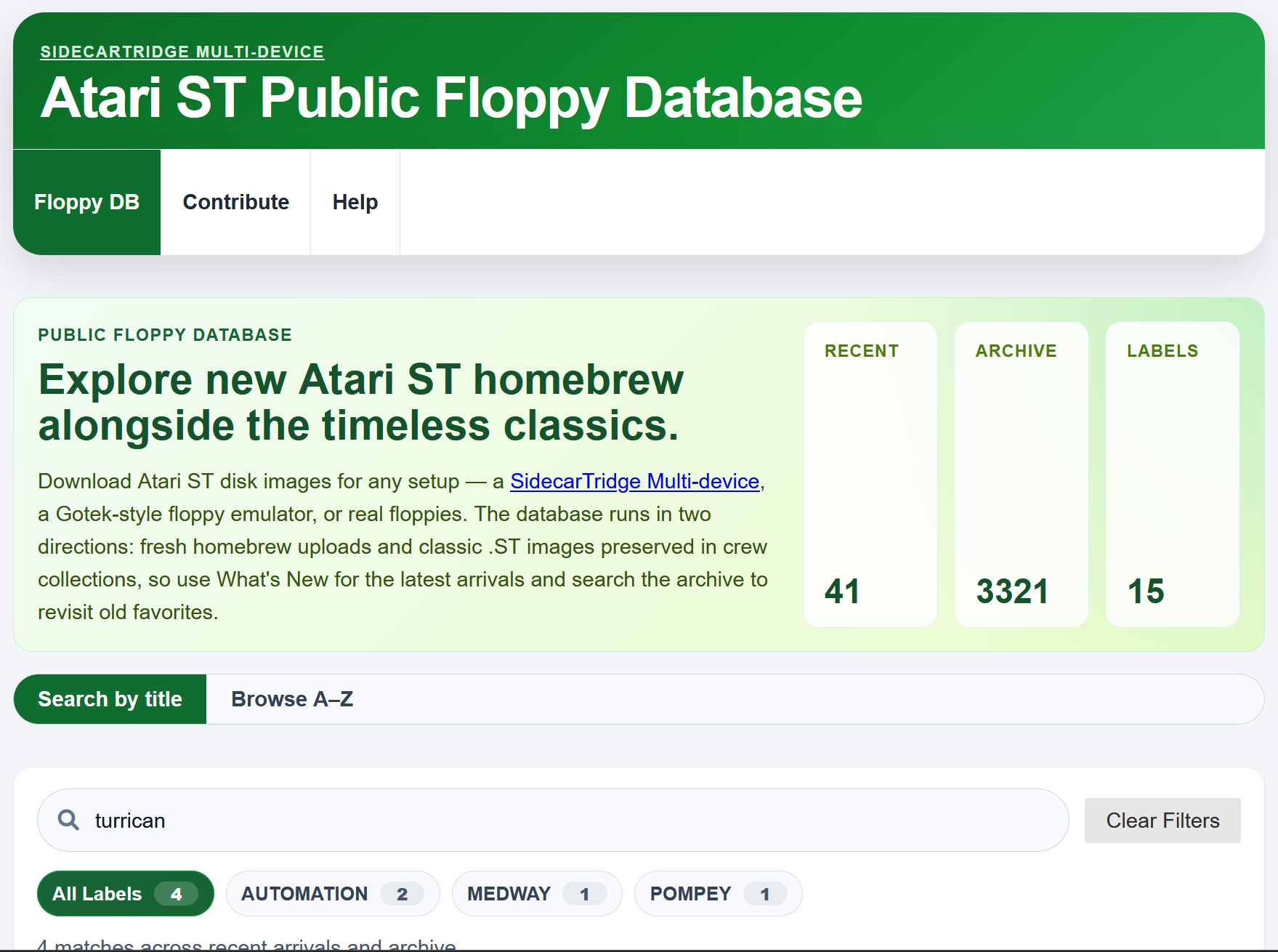
An extensive Atari ST floppy disk database can now easily be accessed by all netizens. Originally created to serve floppy images to the owners of the SidecarTridge multi‑function hardware add‑on for the Atari ST family (ST, STE, Mega ST, TT, Falcon), anyone can now browse, search, and download the .ST files to use with other hardware, emulators, or even to rewrite the disk images to actual floppies.
The Atari ST Public Floppy Database browser from the SidecarTridge Multi-device is now open on the web to everyone.Until now, searching that community-curated archive of floppy images meant firing up your Atari ST with a SidecarTridge Multi-device. The search lived inside the…July 21, 2026
After reading the announcement, I decided to check out the online repository. My favorite old platformer series was there, with more than one disk featuring the legendary Turrican and Turrican II releases. I also checked and confirmed public domain/shareware favorites like Gravity Force were available, as was Llamatron, and the mono high-resolution Bolo. Some things I looked for, like the Stupendous Demo, seemed to be missing, as were serious art and DTP tools I used to dabble with in the 90s.
(Image credit: Tom's Hardware)
The database is pleasingly new and regularly maintained, though. For example, it has 41 Atari ST disks flagged as recent arrivals. These are a mix of old releases being added, and some extremely new titles like new homebrew games, and a collection of demos released at Sommerhack 2026 just last month.
Another day another Doom port, but the new DoomPaint stands out from the crowd for a few reasons. Firstly, it has been developed by Mark Russinovich, the Microsoft Azure CTO. Secondly, DoomPaint runs the actual original shareware Doom release using MS Paint as the monitor or viewport for in-game action. That’s different, and it is remarkable to read that the OLE clipboard hack behind this latest Doom escapade allows the game to run at a fair pace, up to 35 FPS, but might also sometimes be “spreadsheet-tier,” according to the author.
“The actual Doom engine (ViZDoom) runs the real shareware DOOM1.WAD — with the BSD-licensed Freedoom WADs covering the episodes shareware doesn't ship — and renders headlessly,” explains Russinovich on the project GitHub page. “Every frame is placed on the Windows clipboard and pasted into Paint's canvas as a genuine document edit.” The Microsoft CTO adds that the relatively low frame rate “is part of the charm” of DoomPaint, but 35 FPS isn’t bad, if you can make it, especially in 1990s PC gaming terms.
There are files, resources and instructions on how to run DoomPaint on the GitHub site. Depending on your machine you may be able to run this version of Doom at a full 35 FPS at 320 x 200, or even 640 x 400 pixels. It even includes sound and music.
Towards the end of the README file, Russinovich says that “Paint renders the game but does not compute it. Paint computes nothing. Paint has never computed anything. That's the joke.” DoomPaint is distributed under the MIT license.
Russinovich started at Microsoft in 2006, where he’s transformed SysInternals into the backbone of Windows diagnostics. More recently he’s shaped Azure’s architecture, security, and reliability. Over the past year he has, accidentally or by design, become well known as a leading voice behind addressing the many shortcomings of Windows 11.
It's therefore kind of surprising that this busy CTO has time to fiddle with projects like DoomPaint. However, the most dedicated coding and computer enthusiasts will also code and compute in their spare time.
GameStop has listed a Doom Floppy Disk Limited Edition Imitation Gold Plated Replica at $29.99. Let’s unpick that for a moment. These are imitation floppy disks coated in imitation gold, delivered in a commemorative box. There’s a display stand included, too. However, these are non-functioning 'floppy disks' inspired by the Doom v1.2 shareware release and don’t contain any game data. Doom's single-level ‘Knee‑Deep in the Dead’ shareware release is still free to download, though, as it has been for many years.
GameStop and FanattikGameStop and FanattikGameStop and Fanattik
“What's more retro than obsolete technology?” asks Fanattik, the collectibles maker behind this useless physical media. “Celebrating the humble 3½-inch, 1.44 MB floppy disk that the game was originally released on back in 1993, this limited edition Doom Floppy Disk Replica plated with imitation gold comes in a box displaying the original game artwork, has a display stand included, and is individually numbered as one of 5,000 worldwide.” Pre-orders are now open at GameStop in the US for $29.99 or directly from Fanattik in the UK at £19.99.
The 89 x 89 mm dimensions of the golden-but-not-gold and 3.5-inch-but-not-floppies make them at least the correct size. However, if I were buying fake floppies, I think I would appreciate a movable protective sliding mechanism and the write-protect cutout toggle to move, so I could fidget with them from time to time.
Also, in some ways, it is ironic that game media is now being licensed and hawked to fans, at non-trivial prices, without any game data contained on them. This seems to be a growing trend as the games industry moves inexorably to a digital-only future. People still covet the physical media so much that they are now willing to pay for it, even without any game data or download code being associated with it.
The original Doom v1.2 shareware edition was released on two floppy disks in Feb 1994, and it is famous for adding modem support to this seminal game. If you paid and registered Doom v1.2, you would get four floppy disks from id Software containing the full three-episode campaign. The registered release disk set stayed on four floppies until the CD-ROM era.

 Login