The commander and pilot of NASA's Artemis II mission have gained a new distinction five months after splashing down from the Moon: They're not fully retiring from the space agency.
Reid Wiseman and Victor Glover are the first astronauts to join NASA's emeritus program, enabling them to continue to support the work being done at Johnson Space Center in Houston. They will remain available to train and mentor the current workforce while still being able to pursue employment and opportunities outside of NASA.
"I have asked NASA ... to not use the term 'retire' as much, but technically emeritus is a retirement program," Glover told collectSPACE.com on Wednesday. "It's something we have typically done for scientists when they have groundbreaking research, and they want to go back to academia to teach or to research and publish."
Sixty years after television audiences first tuned in to see the voyages of the Starship Enterprise, an astronaut on board the International Space Station has paid tribute to Star Trek by flying the badge of the franchise's latest fictional captain.
Expedition 75 flight engineer Sophie Adenot with European Space Agency (ESA) donned the Delta badge originally worn by actor Anson Mount for a video recorded from aboard the space station. Mount portrays Christoper Pike in the Paramount+ streaming series Star Trek: Strange New Worlds. Paramount and ESA both released the clip on their Instagram feeds.
"For 60 years, Star Trek has brought us stories of friendship and exploration. I'm wearing Captain Pike's badge aboard the ISS in celebration of continuing the real world work of science and exploration," said Adenot. "For me, exploration and science are about curiosity and cooperation daring to go a little farther together, learning from what we discover and build, and turning that knowledge into a better future for everyone."
Many things change in space, including how the intestines function. Constipation is a known side effect of space travel, but until now, little has been known about why it happens. Constipation is a familiar problem for astronauts, but the biological reason it develops during spaceflight has remained uncertain. Researchers from the University of Copenhagen working [...]
However, the three Russian cosmonauts living on the ISS will have to clock in as usual.
NASA astronaut Jessica Meir (left) and the European Space Agency's Sophie Adenot work together inside the International Space Station’s Quest airlock during spacesuit fit and leak checks. (Image credit: NASA)
The trio — Pyotr Dubrov, Andrey Fedyaev and Anna Kikina — "will be busy monitoring the Progress 94 resupply spacecraft when it undocks on Monday, packed with trash and obsolete gear, from the Poisk module," NASA officials said in an update on Friday.
"It will be replaced by the Progress 96 resupply spacecraft after it launches from Kazakhstan's Baikonur Cosmodrome on Sept. 9 for an automated docking two days later to Poisk’s vacated port," they added.
Adenot, Feyaev, Hathaway and Meir arrived at the ISS in mid-February on SpaceX's Crew-12 mission. Dubrov, Kikina and Menon are relative newcomers, reaching the station aboard a Russian Soyuz spacecraft on July 14.
NASA astronauts on long-duration missions to the ISS generally work a relatively normal schedule, getting weekends and major holidays off. Such downtime is crucial to mission success, as it helps the spaceflyers stay happy, healthy and productive.
They may not be able to mark the holidays in exactly the same ways we do here on Earth, however. For example, the astronauts won't be grilling any hamburgers or hot dogs today, as open flames are verboten on the ISS.
As today's schedule shows, international crewmates do not always have the same days off in orbit. But they try to celebrate major holidays like Christmas together, both to cement the bonds that exist between them and to take the sting out of being so far away from family and friends.
Two NASA astronauts installed the seventh and final set of mounting hardware for new sets of solar arrays during a successful 6.5-hour spacewalk outside of the International Space Station.
Jessica Meir and Anil Menon on Thursday (Aug. 6), assembled the modification kit for one of the space station's eight power channels, which will allow for the future addition of a new ISS Rolll-Out Solar Array (iROSA). Since 2021, astronauts on prior spacewalks have deployed six of the iROSA assemblies, leaving now just two awaiting delivery to the station later this year.
Like building a giant erector set, Meir and Menon worked to assemble and bolt together the triangular brackets on the 3B power channel, located on the far right, or starboard (S6) segment of the station's backbone truss. Menon was positioned on an articulating portable foot restraint (APFR) atop a worksite interface (WIFEX), providing a stable angle to work from the truss.
NASA graphic showing the augmentation plan for the ISS Roll-Out Solar Arrays (iROSAs), including where work has been completed and where work is still needed prior to a spacewalk that installed the mounting hardware on power channel 3B on Thursday, Aug. 6, 2026. (Image credit: NASA)
Once the modification kit structure was built and secured to the 3B mast canister, the two spacewalkers routed cabling that will carry the electricity from the future iROSA into the 3B power channel and then covered the struts with multi-layer insulation to protect them from micrometeoroid strikes.
The iROSA wings sit forward of the legacy solar arrays, augmenting their electricity generation rather than replacing it. The station's eight original arrays began showing degraded power output as they exceeded their 15-year design life. When used in tandem with the new iROSA wings, the upgraded system will increase the station's electricity supply by 20% to 30%.
The other power channel currently without an iROSA deployed is 2A on the left, or port side, of the station.
NASA astronauts Jessica Meir (at left) and Anil Menon (with feet to camera) installed solar array mounting hardware during a spacewalk outside of the International Space Station on Thursday, Aug. 6, 2026. (Image credit: NASA)
"Anil, you can see the moon to the — well, I am not sure what way you're facing, but…," said Meir, taking a short break during the spacewalk to notice NASA's next destination for astronauts under its Artemis program.
"To my right. Yeah, I see it — thanks for the heads-up," said Menon. "I can see a future moon base there."
"I can see it, too!" Meir said.
Meir later turned her attention to Mars with her closing words of the day.
"On this day in 2012, NASA's robotic rover Curiosity successfully landed on the surface of Mars with the goal of understanding if the planet could have fostered life. Curiosity achieved that goal within a year," she said. "One day, humans will visit Curiosity, propelled by the groundbreaking science, technology demonstrations and operations conducted here on the International Space Station for almost 26 years now."
"Today, we made one more step toward expanding the ISS power system, further sustaining our human presence in low Earth orbit, as we prepare to take those next steps," said Meir.
A camera mounted on NASA astronaut Anil Menon's spacesuit helmet captured this view of NASA astronaut Jessica Meir (at left) and the worksite where they assembled and installed mounting hardware for a new solar array outside of the International Space Station on Thursday, Aug. 6, 2026. (Image credit: NASA)
Thursday's spacewalk began at 8:33 a.m. EDT (1233 GMT) when Meir and Menon switched their spacesuits to internal battery power. After collecting their tools and reentering the Quest airlock, the spacewalk, or extravehicular activity (EVA), concluded at 3:00 p.m. EDT (1900 GMT), 6 hours and 27 minutes after it began.
This was the 96th U.S. EVA and 281st spacewalk overall in support of the International Space Station's assembly, maintenance and enhancement. It was the first career spacewalk for Menon and the sixth for Meir, bringing her total time on EVA to 42 hours and 33 minutes.
This was the first spacewalk for the space station's Expedition 75 crew. There are two more U.S. outings scheduled for this month: EVA 97 will work to replace a space-to-ground antenna on Aug. 13, and EVA 98 will connect power channel cables and data relay systems as part of ongoing maintenance, including preparations for the station's future deorbit, as well as replace a navigational aid used for spacecraft docking on Aug. 25.
The next crew, spacecraft and rocket to fly to the International Space Station are on schedule to meet their mid-September launch date, mission managers and the astronauts told reporters on Monday (Aug. 3).
SpaceX's Crew-13 astronauts — commander Jessica Watkins and pilot Luke Delaney of NASA, mission specialist Josh Kutryk with the Canadian Space Agency and mission specialist Sergey Teteryatnikov of Russia's federal space corporation Roscosmos — will become only the second crew to fly aboard the Dragon spacecraft "Grace" when they lift off no earlier than Sept. 12 from Space Launch Complex-40 at Cape Canaveral Space Force Station in Florida.
They will then dock with the space station the following day to begin a seven-month stay on the orbiting outpost, as part of the Expedition 75/76 crew.
"We expect a very busy mission with lots of station maintenance, both internal and external, with a few EVAs [extravehicular activities, or spacewalks] on the docket," said Watkins, who is the only member of Crew-13 to have flown into space before and will become the first active NASA astronaut to fly on Dragon twice. "[We also expect] visiting vehicle capture and stowage operations, lots of science — very interesting science experiments that will be flying with us as well — and plenty of outreach."
Kutryk will be the fourth Canadian to serve on an ISS crew and the second from his country to fly this year, after Jeremy Hansen launched around the moon on the Artemis II crew in April.
"Personally, myself, I grew up on a cattle farm in Canada. It's a long way from being here with this mission in front of us, but the one thing that has resonated at every twist and turn in that journey has been the complexity of these missions and the enormity of the teams that go into pulling missions like this off," said Kutryk. "So, we need to say thank you to everyone."
Cybertrucks, spacesuits and mudflats
"Every time we do a human spaceflight mission, it gives us an opportunity to strengthen our understanding of low Earth orbit. It gives us an opportunity to broaden our international relationships and an opportunity to showcase to the world what we can do in low Earth orbit for human spaceflight," said Joel Montalbano, NASA's deputy associate administrator for human spaceflight.
Crew-13 mission managers take part in a pre-flight press conference on Monday, Aug. 3, 2026 at NASA's Johnson Space Center in Houston. From left to right: Joel Montalbano, deputy associate administrator, Human Spaceflight Mission Directorate, NASA Headquarters; Dana Weigel, manager, Low Earth Orbit Program, NASA Johnson; Richard Jones, deputy director, NASA's Commercial Crew Program; Mathieu Caron, director, Astronauts, Life Sciences, and Space Medicine, CSA; and Julianna Scheiman, director, NASA Science and Dragon Programs, SpaceX. (Image credit: NASA)
During the mission, Watkins, Delaney, Kutryk and Teteryatnikov will take part in research to combat heart disease and Parkinson's disease by studying human stem cell-derived tissues. They will also explore crop production that's important for longer-duration spaceflight missions, and help improve scientists' understanding of blood flow abnormalities that are seen on long missions. The crew will also test new diagnostic medical equipment for keeping an eye on their overall health.
First, though, they must get to space.
"Final integration of the Dragon is complete. The capsule was stacked on the trunk just last week and mission preparations are proceeding well for a mid-September launch," said Dana Weigel, NASA's manager for its low Earth orbit program. "Falcon 9 booster maintenance will kick off this month. That same booster was flown on Crew-12. We are not tracking any major issues for this mission campaign."
This Friday (Aug. 7), the crew will don their SpaceX suits — the first "Rev. 3" models with improved donning and doffing capabilities, as well as adjustments to account for spinal growth on orbit — and get their first chance to board "Grace," their ride into orbit and back. This "test drive" will help them gain some muscle memory — some familiarity within the the vehicle mission — and provide them a very big psychological boost, managers said.
"Grace" will also sport new metal "mud flaps" for its Draco abort thrusters, replacing earlier carbon fiber models. In addition, should the crew encounter an emergency before launch, they will be evacuated from the launch pad area for the first time by Tesla Cybertrucks operated by SpaceX, reducing conflicts when SpaceX and NASA want to launch crewed flights at the near or same time.
"There was a lot of certification that had to go into making sure those Cybertrucks would start up with a gloved hand. There were a lot of tests in terms of making sure you could egress the vehicle with a bulky suit on," Richard Jones, deputy program manager of NASA's commercial crew program, said in a response to a question from collectSPACE and Space.com. "All of those things were proven to be already intact, and they're going to configure those Cybertrucks to be ready."
Departures and arrivals
The four members of Crew-13 will be sharing their time on the space station with outgoing and incoming Russian Soyuz crews, who will launch and land with members of Delaney's astronaut candidate class, "The Flies," selected in 2021.
"It's really exciting to see the class fly," said Delaney. "We're going to be meeting Anil [Menon] up there. He's part of our class. Deniz [Burnham] will come up right behind to replace him. Working closely with both of those two throughout astronaut training, it's really just satisfying."
"I'm slightly hoping we get delayed a little bit, so we have some overlaps, so that way we can have three Flies back to back, he said.
The central golden dragon on NASA’s SpaceX Crew-13 patch harkens back to Apollo 13, embodying resilience and gazing upward to the dawn of a new era of discovery. (Image credit: NASA)
For Kutryk, some timing just cannot be controlled.
"It's about midway through — pretty much perfect timing. That's sarcasm," said Kutryk, referring to the upcoming birth of his third child, who is expected to come into the world while he is on the space station.
"It's been done a couple times before," he said, referring to NASA astronaut Mike Fincke and Randy Bresnik, who both had children born while on the ISS. "I think that my family is ready. I have a wonderful, huge support network, from my wife outwards, around us, and we're looking forward to that challenge and to the uniqueness of this experience."
When we last checked in on Boeing's Starliner spacecraft in February, NASA was announcing that it had formally classified the 2024 crewed flight of the Starliner spacecraft as a “Type A” mishap, an acknowledgement that the test flight was a serious failure.
At the time, NASA Administrator Jared Isaacman said the space agency was working with Boeing to "fully understand the risks associated" with the Starliner spacecraft, and to remediate them. Starliner would not fly its next mission, a cargo flight to the International Space Station, until those problems were identified and remediated. He declined to put a date on the test flight.
However, it now appears this work is proceeding apace.
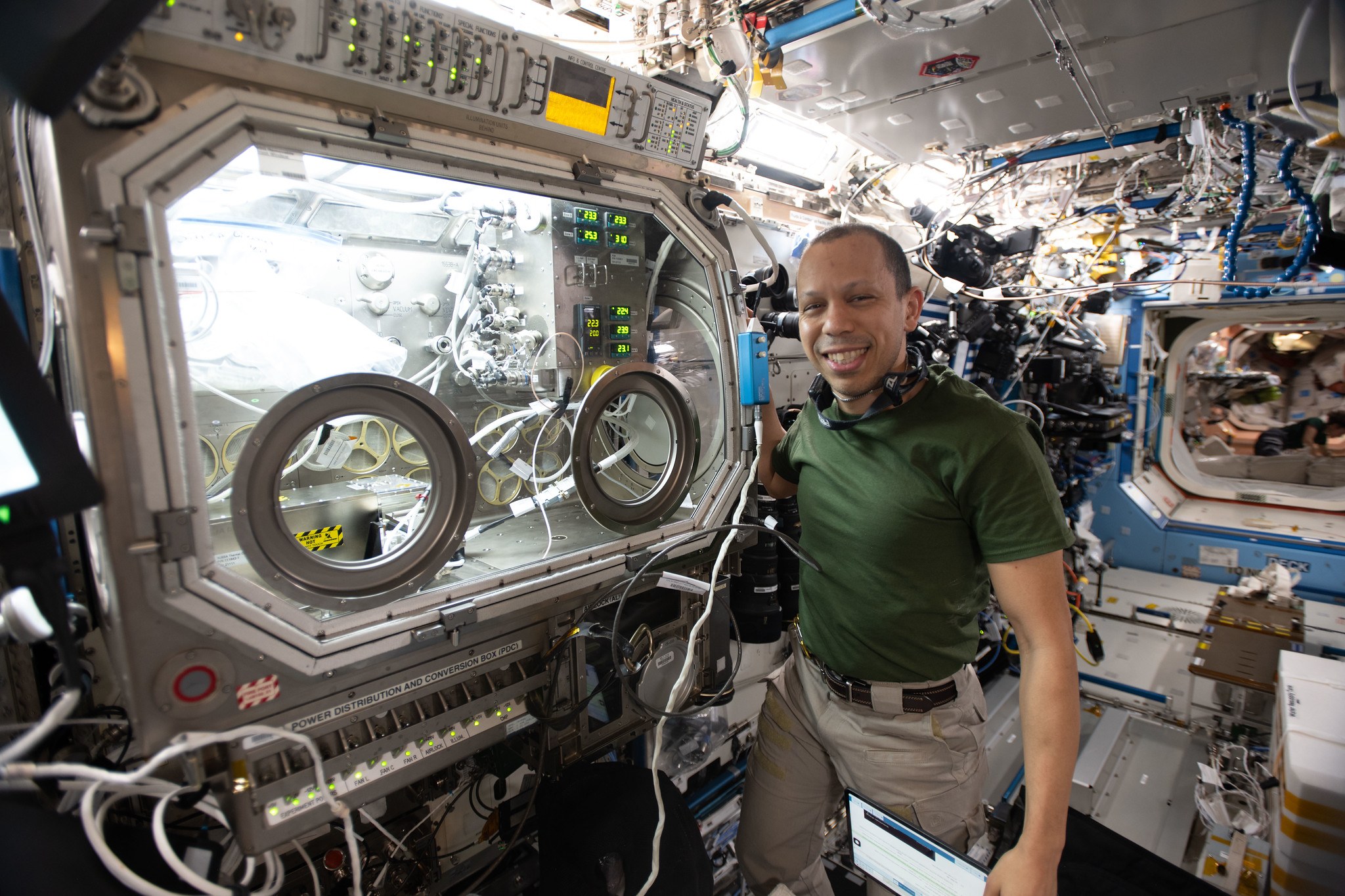
NASA astronaut and Expedition 74 flight engineer Chris Williams shows off the Destiny laboratory module’s Microgravity Science Glovebox aboard the International Space Station. Williams was supporting semiconductor crystal research to help advance the commercial space economy and promote Earth-based industries.
NASA/Chris Williams
NASA astronaut Chris Williams will recap his recent eight-month mission aboard the International Space Station during a news conference at 2:45 p.m. EDT Tuesday, Aug. 4, from the agency’s Johnson Space Center in Houston.
NASA will stream this event live through a variety of platforms. Learn where to watch online:
United States-based media interested in attending in person must contact the NASA Johnson newsroom no later than 5 p.m., Friday, July 31, at jsccommu@mail.nasa.gov.
Media wishing to participate by phone must contact the Johnson newsroom no later than two hours before the start of the event. To ask a question by phone, media must dial into the news conference no later than 15 minutes prior to the start of the call. NASA’s media accreditation policy is available online.
Williams returned to Earth on July 26, after logging 241 days as an Expedition 73/74 flight engineer during his first spaceflight. He returned along with Roscosmos cosmonauts Sergey Kud-Sverchkov and Sergei Mikaev, completing 3,856 orbits of the Earth over the course of their more than 102-million-mile journey. They also saw the arrival of six visiting spacecraft and the departure of eight.
During his mission, Williams supported a wide range of scientific investigations and technology demonstrations. He helped advance research for new cancer treatments and improved in-space manufacturing of materials used in high-performance computers and electronics. Williams also completed two spacewalks to prep for space station power system upgrades and to replace a faulty joint on the Canadarm2 robotic arm. The crew’s work aboard the space station helps improve life on Earth and prepare for future human missions to the Moon and Mars.
To learn more about International Space Station research, operations, and its crews, visit:
NASA's plan to deorbit the International Space Station in coming years has fallen under the scrutiny of a government watchdog group and stirred up a wave of reaction by a leading ocean conservation organization.
As presently blueprinted by NASA, the International Space Station will be de-orbited via a series of actions. Firstly, in early to mid-2028, the ISS will start to be lowered through a combination of Earth's natural atmospheric drag and the execution of re-entry maneuvers by the ISS's Russian segment. Then, in mid-2029, NASA plans to launch a SpaceX-supplied, government paid for, U.S. Deorbit Vehicle (USDV) and attach that craft to the ISS, which will fire its 46 Draco thrusters and push the station down to a watery grave.
But there's one issue that has ecology experts concerned. The Ocean Foundation, a Washington, D.C.-headquartered group with a mission to improve global ocean health and the human relationship with the sea via carefully chosen strategies and projects, says the planned deorbit of the International Space Station "raises serious concerns for ocean health that the space community has not adequately grappled with," according to Mark Spalding, president of the foundation.
A troubling gap
A just-issued U.S. Government Accountability Office (GAO) report has focused on issues related to NASA's plan to bring down the International Space Station (ISS) and transition from the ISS to commercial space stations, namely NASA's concern about having a "gap" in continuous human presence in low Earth orbit.
The GAO report explains that, at the end of 2030 or early 2031, the USDV is to perform a re-entry burn. That would push the ISS through the Earth's atmosphere and into a pre-determined spot – an ocean zone called Point Nemo.
"As part of the reentry process, NASA expects portions of the ISS and deorbit vehicle to break up and fall into the remote part of the ocean to minimize the risk to populated areas," states the GAO report.
SpaceX rendering of its U.S. Deorbit Vehicle (USDV), a Dragon-derived spacecraft with 46 Draco engines designed to propel the International Space Station into a controlled reentry. (Image credit: SpaceX)
But as for using Point Nemo or any part of the ocean as a convenient dumping ground, Spalding told Space.com that "there is a troubling structural gap in international law that the ISS de-orbit throws into sharp relief."
Under the Space Liability Convention of 1972, if space debris falls on another nation's territory or damages property, Spalding said, the launching nation owes compensation - absolutely and without needing to prove fault. "But no equivalent protection exists for the ocean," he said.
"As a result, when space agencies have control over where debris falls, they aim for the high seas, and in doing so, they incur no legal obligation to pay for cleanup or environmental remediation," said Spalding.
The Ocean Foundation leader said he understood the legitimate safety rationale for targeting Point Nemo, the point on Earth farthest from any populated area. "But the ocean's remoteness from human infrastructure should not be mistaken for a lack of value or vulnerability," Spalding said. "The ocean and its creatures deserve the same protection that international law affords to national territories."
Concerning the ocean's ecosystems, Spalding asks what happens to the marine ecosystems and creatures on the seafloor where the ISS leftovers land?
"The honest answer is, we don't fully know. That is deeply troubling for a structure the size of a football field. We do know that not everything burns up on reentry. Denser components will survive and reach the seafloor," Spalding added.
Point Nemo (marked in red) in the south Pacific Ocean is farther from land than any other point on Earth. It is also home to the world's largest "Spacecraft Cemetery." (Image credit: PGC/NASA IBCAO Landsat/USGS/Google)
The problem: uncertainty
What denser, specific materials from the ISS re-entry will be, and what harm they may cause to marine life, Spalding said, "has not been adequately studied or disclosed. That uncertainty is itself the problem."
Additionally, what environmental harm may begin before the debris hits the water is worrisome. As the largest reentry in history, the cumulative atmospheric impact of down-falling ISS hardware deserves serious study, he said.
For one, Spalding flagged a newly negotiated High Seas Treaty (BBNJ Agreement) that is relevant to downing the ISS. It requires parties to conduct environmental impact assessments for activities that may affect the marine environment beyond national jurisdiction when effects are unknown or poorly understood.
"It is fair to ask whether the ISS deorbit — the largest such reentry in history, targeting the high seas — should trigger that obligation," Spalding said.
The International Space Station. (Image credit: NASA/ESA–T. Pesquet)
Position statement
As for the Ocean Foundation's position on the ISS deliberate crashing into the Pacific Ocean, the group believes that discussion points prior to the ISS downing include:
A full environmental impact assessment of the anticipated seafloor debris field and atmospheric effects;
Public disclosure of all materials that will survive reentry and reach the ocean floor;
A rigorous legal analysis of obligations under the UN Convention on the Law of the Sea (UNCLOS,) the London Protocol of 1996 that provides an international standard and framework for countries to individually and collectively protect and preserve our oceans from pollution caused by the dumping of wastes and other matter into the ocean, along with the BBNJ Agreement.
The high seas have no sovereign who can demand accountability, concluded Spalding. "We believe this gap in international law needs to be closed, and the ISS de-orbit is a vivid illustration of why."
SpaceX's Dragon capsule leaves after dropping off some supplies and science at the ISS. (Image credit: NASA/Jessica Meir)
SpaceX's Cargo Dragon capsule shines in the sunlight over Earth as it departs from the International Space Station in a new image snapped from onboard the station.
With sunbeams gleaming downward, reflecting off of the spacecraft's hull, the Dragon can be seen backing away from the station mere moments after undocking from the port on the station's Harmony module. The undocking is so recent that you can clearly see both the docking port and the hatch of the Dragon where the two connected.
The space station has been in orbit since 1998 and continuously occupied since November, 2000. With decades of work in orbit, it can be easy to take for granted the incredible transport system that supports cutting-edge research hundreds of miles above Earth's surface.
The work done on the station is impressive, but this system is just as mind-boggling. In addition to launching and returning astronauts who perform critical maintenance and repair work on the station on top of their research duties, cargo missions keep the station stocked.
From food and clothing to medical equipment and intricate science experiments, these missions are essential for both keeping astronauts safe and healthy on station as well as continuing the progression of science in-orbit. This back-and-forth between Earth and the space station is an impressive feat, and this photo shows the system fully in-motion.
Russian cosmonaut Aleksandr Samokutyaev, who served twice as a crew member aboard the International Space Station (ISS), including during the final US space shuttle mission in 2011, has died at the age of 56.
With Samokutyaev's death on Wednesday, he becomes the first former ISS long-duration resident to die in the 26 years that the space station has been a home to 155 other cosmonauts and astronauts as expedition crew members. The cause of his death is unknown.
Portrait of cosmonaut Aleksandr Samokutyaev.
Credit:
Roscosmos
"The leadership and staff of the Roscosmos State Corporation extend their sincere condolences to the family and loved ones of Aleksandr Mikhailovich," officials with Russia's space agency said in a statement.
A part of Canadarm2 robotic arm on the ISS broke in May, requiring repairs by spacewalking astronauts no earlier than June 30. A spare is already on the station.
The southern lights, also known as the aurora australis, were captured by the NASA astronaut Jessica Meir from the International Space Station on Saturday.
NASA's Artemis II crew are the fastest people alive, and now they have the patch to prove it.
Mission Commander Reid Wiseman, pilot Victor Glover, and mission specialists Christina Koch and Jeremy Hansen (the latter with the Canadian Space Agency) spent 10 days in early April flying by the Moon. Their journey took them farther away from Earth than any humans have gone (52,756 miles [406,771 km]) and then, on the way back on board their Orion spacecraft Integrity, they sped up to about 24,664 miles per hour (39,693 k/ph) reentering the atmosphere.
Only three other people in history have traveled faster. NASA's Apollo 10 astronauts Thomas Stafford, John Young, and Eugene Cernan set the record for the highest speed attained by a crewed vehicle relative to the Earth's surface: 24,791 mph (39,897 kph) on May 26, 1969.
NASA has released a new update on a long-running air leak aboard the International Space Station, detailing recent developments involving a troubled section of the orbiting laboratory and precautionary measures taken to protect the crew. The issue involves the PrK transfer tunnel inside Russia’s Zvezda service module, where cracks have been causing small atmosphere leaks [...]

 Login