Dell Technologies Inc. is set to raise $5 billion from an investment-grade bond sale that saw booming investor demand as the company rides a surge in revenue from AI servers.
Amazon and Best Buy today have big discounts on the M5 Pro and M5 Max MacBook Pro, with up to $600 off select models. A handful of models have better discounts when compared to the last time we tracked these deals, coming in as much as $100 off previous price points.
Note: MacRumors is an affiliate partner with Amazon. When you click a link and make a purchase, we may receive a small payment, which helps us keep the site running.
New massive discounts have hit the 14-inch models, with $500 off the 18-Core/24GB/2TB M5 Pro MacBook Pro, now priced at $2,699.00, and a giant $600 off the 36GB/2TB M5 Max model, now priced at $3,499.00. These are both the best prices we've tracked on the MacBook Pro in the wake of the summertime price hikes.
In terms of the larger display models, we're tracking discounts on all four models on Amazon. These start at $2,759.00 for the 24GB/1TB M5 Pro configuration ($240 off), and reach up to $4,499.00 for the 48GB/2TB M5 Max device ($500 off).
If you're on the hunt for more discounts, be sure to visit our Apple Deals roundup where we recap the best Apple-related bargains of the past week.
Deals Newsletter
Interested in hearing more about the best deals you can find in 2026? Sign up for our Deals Newsletter and we'll keep you updated so you don't miss the biggest deals of the season!
TM184C—an ancient G-protein-coupled receptor-like superdark protein involved in regulation of autophagy, intercellular connectivity and material exchange—underscores the promise of exploring the understudied human proteome and beyond.
As artificial-intelligence tools become crucial collaborators in science, universities must teach students to challenge such systems and assess their ability to do so.
China's solar power capacity has overtaken coal for the first time, marking a major milestone in the country's rapid expansion of renewable energy.
China had about 1,288 gigawatts (GW) of installed solar capacity at the end of July, compared with 1,285 GW of coal-fired capacity, according to figures from the country's energy administration reported by the South China Morning Post.
"China reaching around 1,288 GW of installed solar capacity, marginally overtaking coal, is a major milestone," Matthew Davies, UNESCO chair in sustainable energy technologies and a professor of chemical engineering at Swansea University in the U.K., told Live Science.
However, installed capacity doesn't necessarily equate to actual electricity generation. "Solar only generates when sunlight is available, whereas coal plants can run for much longer periods, so solar still supplies a much smaller share of China's electricity than coal," Davies said.
In other words, China has more solar capacity than coal capacity, but coal remains far more important when it comes to the amount of electricity actually delivered to the grid.
Between January and July this year, Chinese solar power output rose 15.5% compared to the same time period in 2025. Over those seven months, it reached 802.4 TWh, which is around 13% of the country's total electricity consumption.
"I would see this as a structural turning point, not the point at which solar has replaced coal," Davies said. "The key question is whether renewable generation can grow fast enough not only to meet rising electricity demand but to push coal generation down in absolute terms. Given the scale of China's power system, sustained reductions in coal use could have a major impact on global CO₂ emissions."
To do that, China will need to do more than build solar farms. One of the biggest challenges will be integrating all of the new renewable power into the electricity system.
"Installing solar is only part of the transition; grids, transmission, storage and demand flexibility all need to keep pace so that renewable electricity can actually be used," Davies said.
This transition toward solar panels will also make renewable energy more accessible around the world, as China's enormous manufacturing capacity will help drive down the global cost of solar panels. However, Davies said the next phase of the transition is to ensure the whole solar production process is sustainable. "We need to think about where technologies are made, where materials come from, how long they last, and how they are reused or recycled," he said.
Solar panel manufacturing involves raw material extraction, processing, manufacture, transport and installation, so it has an initial carbon footprint. High energy requirement for polysilicon production is a considerable factor as it uses coal-fired power plants. But, this is offset by the electricity they generate.
There is also a case for expanding local and regional manufacturing, Davies noted. Doing so could strengthen supply chains, create local skills and economic value, and make the global energy transition more resilient and equitable. That could be particularly important for expanding access to electricity in parts of the world where reliable power remains limited.
"The global energy transition is not only about replacing fossil fuels in existing electricity systems; it is also about enabling people who still lack reliable electricity to gain access to clean, affordable power," Davies said. "Ultimately, success is not simply about installing more solar panels. It is about building a clean-energy system that is affordable, sustainable, resilient and accessible globally."
Thami carried out preliminary research on the results of extreme heat on European cities this summer. The study looked into how many buildings have adequate shade from trees. The results were striking.
In London, Paris and Madrid over 90% of buildings did not have enough shade around them to prevent urban heat island effects. These were among the worst results in cities we studied, but even the best performers had a majority of residents without adequate heat protection – cities like Hamburg (56% unprotected) and Barcelona (70% unprotected).
This builds on past research that shows how major cities around the world – including in Europe – tend to struggle to reach useful levels of tree canopies to create shade close to homes and workplaces. It suggests that that homes should have a view of three trees and be within a 300 m walk of a park.
Early results for my research suggests that huge portions of European cities are exposed to avoidable heat island effects.
How urban heat islands work
On many days during summer 2026 it didn’t get much cooler in the evening. This is because of what is known as the urban heat island effect. Cities typically lack shade, due to high rates of tree removal, sparse planting, and poor tree health and there are vast amounts of asphalt, clay and concrete. These are almost the perfect materials to soak up and hold heat from all that direct sunshine. Unshaded asphalt can reach over 70°C on heatwave days.
Even after sunset, cities stay hot because roads, buildings and footpaths begin to radiate their absorbed heat back at us as they cool. The urban heat island effect can add significantly to ambient temperatures, making a day that is already very hot (perhaps 35°C) even more dangerous in high-asphalt, low shade locations (over 40°C).
What could help?
Tree shading is an effective strategy to address this urban heat, with a range of other mental and physical health benefits to local residents. Trees prevent solar radiation reaching heat-absorbing materials such as asphalt, and also keep the sun off our bodies. Tree shade has been shown to reduce the heat absorbed by pedestrians by up to 18°C.
Healthy trees also push water out of their leaves as they photosynthesise, which soaks up heat as it evaporates. This evaporative cooling effect adds an extra few degrees of cooling, in addition to shading people and preventing heat island effects, even during heatwavesas long as trees still have access to water.
Where trees are needed
Planting more trees in cities in the wake of this summer’s heatwaves is going to help cool urban areas down. The thinktank, the Create Streets Foundation, found the temperature on an exposed paved area in London during one heatwave was 55°C but was 25-30°C in a shaded area metres away.
Looking at a city such as London, you might argue that it already has plenty of trees: around 8 million.
But trees are only effective tools against urban heat when they’re close to homes. A lush shady park 800m away isn’t going to prevent dangerous localised heat island effects for you and your neighbours.
The other crucial factor is that there are thresholds of shade cover that have to be reached for trees to actually offer substantial cooling. A few isolated trees creating small islands of shade aren’t enough. Adding more tree canopy has been shown to be effective at preventing urban heat islands when it reaches 30-40% overall shade cover, within 60m of homes and workplaces.
It will also be important to plant trees that are best able to cope with increasingly hot temperatures in Europe.
Adding just a few degrees to an already hot day sharply ramps up the danger that heat poses. In locations where heat islands bump up the ambient air temperature from 33°C to 37°C, or 35°C to 41°C, there’s an increase in patients attending hospital admissions’ rooms due to heat related illness. When air temperature increases above 35°C the human body’s ability to manage the heat is greatly reduced; cardiovascular strain, dehydration, potentially leading to heatstroke and the need for medical intervention.
When it makes nights hotter there are other ramifications. It is during the cooler night hours that the body loses heat to reset for the following day. If the body is still trying to cope with warm temperatures, 24°C and above, this impacts recovery and impairs sleep quality. This means we start the next day in deficit, both physiologically and cognitively, to cope with another hot day. Repeated exposure to days of high heat mean that the deficit builds over time.
Adding more trees works
Medellin in Colombia is an example of what happens when more plants are added to urban streets.
There are signs that Paris and London are aware they need to make changes. The recently announced Heat Ready London plan includes a focus on urban greening.
Paris is already starting to add more green space. The city’s school streets programme not only creates safe, car-free areas close to local schools, but also has added more trees. Evidence already suggests that surfaces in school streets are 5°C cooler than their traffic-heavy counterparts, with fewer trees.
As Europe prepares for more hot summers, planting trees close to homes needs to be high on the agenda to help people cope.
Thami Croeser has previously recieved funding from The Australian Research Council, Greenlife Australia, and the European Union's Horizon 2020 program. He is a Director of the Australasian Green Infrastructure Network, a not-for-profit peak body. He occasionally provides urban forest advisory and analytics services in a private consulting capacity.
Simon Hodder has previously received funding from the European Union's Horizon 2020 program and UKRI, Engineering and Physical Sciences Research Council (EPSRC).
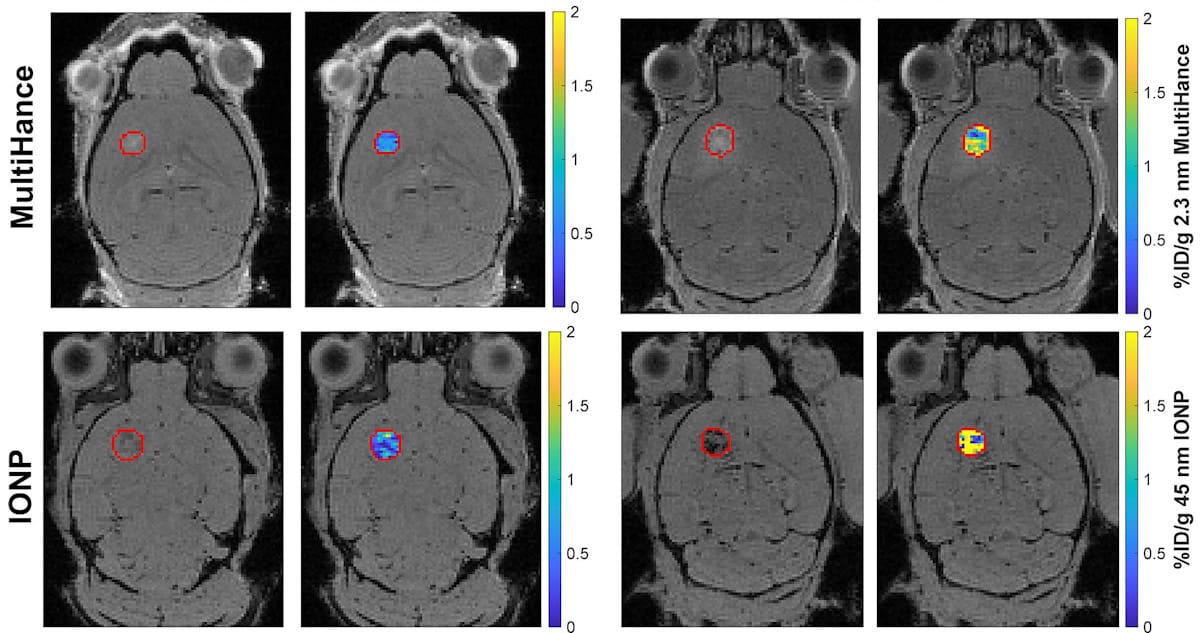
Brain tumour images Representative MR images of baseline (left panels) and FUS-treated (right panels) mouse brains. The top row shows administration of a 2.3 nm contrast agent (MultiHance), the bottom row shows administered iron oxide nanoparticles, 45 nm in size. Each pair of panels shows the anatomic image with the tumour outlined in red on the left, and the corresponding image superimposed with a concentration map showing the amount of nanoparticle retained within the tumour (as a percentage of the injected dose per gram) on the right. (Courtesy: CC BY 4.0/Radiology 10.1148/radiol.251005)
Drug delivery to the brain has been a longstanding challenge in medicine. One option is focused ultrasound (FUS), which can safely disrupt the blood–brain barrier for drug delivery. But how much of a drug gets into the brain depends heavily on its size. A long-standing assumption is that delivery decreases as drug size increases. But by using a clever spin on MRI physics, researcher Matthew Hoch and colleagues from the University of Virginia have shown that “the smaller the better” might not be entirely correct.
The blood–brain barrier is one of biology’s toughest engineering problems. Composed of a dense, tightly sealed layer of cells lining every blood vessel in the brain, the blood–brain barrier only lets nutrients and oxygen through and protects the central nervous system by blocking bloodborne pathogens. In doing so, however, it also blocks the delivery of drugs to the brain. Brain tumours compound this with their own blood–tumour barrier, further hindering drug delivery. For years, researchers have pondered how therapeutics could be delivered past these checkpoints; the answer may simply lie in the use of sound.
The process begins with the injection of gas-filled microbubbles into the bloodstream, where they circulate freely. Exposure to FUS then expands and contracts the volume of these microbubbles, creating a temporary, localized gap that pries the barrier open just long enough for drugs to slip through. Although the technique works, it is unclear how much of a drug actually comes through. In this new study, the team investigate how the size of the drug influences FUS-mediated drug delivery and introduce a novel technique to measure precisely how much drug is delivered.
The measurement problem
Many neurotherapies, with a range of sizes, could benefit from this drug delivery method. But measuring how much of the drug gets past the blood–brain barrier is challenging with current imaging methods. For example, fluorescence imaging is limited by its semi-quantitative nature, while PET scanning suffers from poor spatial resolution.
Standard MRI methods are not only time-consuming, but, in the form of T1-mapping, are typically limited by the size of commercially available contrast agents, which are small in comparison to larger neurotherapeutics used for immunotherapy and gene delivery. Other standard MRI methods sensitive to the presence of iron (T2-mapping) provide an alternative avenue to measure larger agents, but can again be limited by scan time for 3D visualization. Both approaches also have potential to suffer from low sensitivity at low concentrations.
Hoch and his team solve this measurement problem by introducing quantitative susceptibility mapping (QSM), an MRI technique with diverse applications in neuroimaging including evaluation of haemorrhage, iron deposition and calcification. QSM works by exploiting the distortion of local magnetic fields by different materials, a property called magnetic susceptibility. By injecting iron-based nanoparticles that induce measurable, spatially localized shifts in the MRI signal’s phase, QSM can generate a 3D map of magnetic susceptibility. This can then be used to calculate the actual concentration of iron-based nanoparticles within tissues.
By transforming an MRI scanner into a sensitive nanoparticle detector, the researchers present a novel way to quantify drug delivery down to fractions of a percent of the injected dose.
What did they find?
The team tested this approach using four different particles, with a 20-fold range in size. The first was a small gadolinium-based contrast agent, MultiHance (a proxy for small molecule therapeutics), at around 2.3 nm; the other three were iron oxide nanoparticles (IONPs) of 15, 23 and 45 nm, sizes that mirror the dimensions of therapeutic candidates used for immunotherapy and gene therapy.
Using healthy and glioma brain tumour-carrying mice, the researchers used FUS treatment to open the blood–brain barrier and deliver particles of varying sizes. They recorded MRI scans before and after delivery and used QSM to generate a precise measurement of how much of each particle made it into brain tissue.
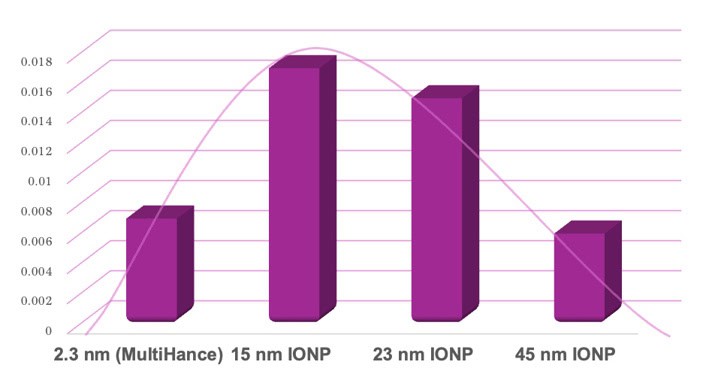
Brain delivery by particle size The amount of drug delivered, as a percentage of the initial injected dose, that has successfully travelled to the brain. (Courtesy: Adapted from Radiology 10.1148/radiol.251005/CC BY 4.0)
The results were unexpected. Drug delivery followed a bell-shaped curve in healthy mice. From the smallest (2.3 nm) particle to the 15 nm IONP, delivery increased 2.6-fold, then at 23 nm, remained steady. Interestingly, at 45 nm, delivery dropped by 2.5-fold compared with the 23 nm nanoparticle, comparable to that of the smallest agent.
This sweet spot, ranging from 15 to 23 nm, demonstrates that smaller isn’t always better. The researchers suspect that this trend in drug delivery is due to a balance between how easily a particle can squeeze through the barrier (so favouring smaller particles) and how long a particle stays in circulation, giving it more time to travel across the barrier (favouring larger particles).
In the mice with brain tumours, where there is an addition of the tumour’s own leaky, disorganized vasculature, the blood–tumour barrier, drug delivery can differ from that to healthy brain. Specifically, this barrier is thought to make drug delivery more difficult than in healthy tissue due to higher tissue pressures and inconsistent blood flow. But the researchers unexpectedly found that FUS boosted delivery of both small and large agents into tumours, with no real difference to the drug delivery levels seen in healthy brain tissue, despite the added presence of the blood–tumour barrier.
“The outcome is exciting because it means that focused ultrasound delivery performance is not expected to diminish in brain tumours,” says senior author Richard J Price in a press statement. “In fact, it may even be enhanced for some types of therapeutics.”
FUS-mediated barrier opening is currently in clinical trials for use in Alzheimer’s disease and glioblastoma, and this research has implications in both drug engineering and treatment planning. By introducing QSM, Hoch and his colleagues have provided a universal, precision technique to quantify contrast agent delivery. Taking existing tools, used for a specific physics measurement problem, and developing them to answer a completely different biological question is no small feat. Here, the researchers present an ingenious intersection of physics and biology, and its potential application in medicine.
The researchers report their findings in Radiology.
Upgrades the virtualization software with support for macOS 27 Golden Gate and adds OpenGL 4.3 graphics driver support. ($99.99 Standard Edition subscription, free update, 5.4 MB, macOS 14+)
Document and information manager updated with AI assistant and Markdown enhancements. ($99 new for standard and $199 for Pro, free update, 94.9 MB, macOS 13+)
Three Rogue Amoeba audio apps add initial compatibility with macOS 27 Golden Gate. ($69/$49/$29 new, free updates, various sizes, multiple system requirements)
A thousand years ago, feasts in what’s now northern Georgia state included cacao from Central America.
Potsherds discarded after an 11th-century feast at Etowah—an Indigenous city just north of what’s now Atlanta—contained traces of cacao, a raw ingredient of chocolate. The chemical residue and ancient DNA reveal that not only did the Mississippian people who built the city have excellent taste, they also had trade connections that reached at least 3,000 kilometers to Central America. And in a sense, chocolate may have helped build the Mississippian mounds.
Ancient dirty dishes
University of South Carolina archaeologist Adam King and his colleagues found fragments of ancient DNA from Theobroma cacao in the inner surfaces of potsherds from long-ago feasts at Etowah. Fruit from the cacao tree contains beans that, when dried and roasted, produce chocolate in all its glorious forms. Cacao only grows in the tropics, which means the nearest actual cacao trees would have been at least a 3,000-kilometer trek away from the woodlands of the eastern US. And that means the Mississippian people who lived in Etowah must have had continent-spanning trade connections.

 Login

 Note: MacRumors is an affiliate partner with Amazon. When you click a link and make a purchase, we may receive a small payment, which helps us keep the site running.