
❌

Normal view

Big Tech eyes glacier-strewn Patagonia for building mega AI data centers — region offers 17,300 glaciers, coldness, and cheap energy, but fiber lines are scarce

9 September 2026 at 11:00

Patagonia, a region of Argentina with 17,300 glaciers, has the potential to turn into a data center hotspot. The cool climate and abundant energy resources there are drawing interest from the likes of Amazon, Google, and OpenAI, according to Reuters. However, there needs to be more work on tapping into the resources and equipping high-speed networking, like fiber, to make the place irresistible. There’s also the question of political stability with a presidential election next year.

Argentina, and Patagonia in particular, has some juicy lures for potential hyperscale data center operators, and the cold climate is a bonus. That environment helps keep data centers cool and use less power while maintaining agreeable thermals. Patagonia has tens of thousands of glaciers across the Northern Patagonian Ice Field and the Southern Patagonian Ice Field combined.

Another bonus to would-be Patagonian data center operators are the range of energy sources there. Reuters mentions hydroelectric power, wind, and shale gas, but some operators who are already established are also adding solar.

Then, the social and political climate looks good for data centers in Argentina. According to the source, the populace doesn't hate data centers yet. At least there seems to be no campaign groups or public backlash. It is also reported that President Javier Milei has been making changes to court Big Tech. That’s a positive, and may be a negative. Positive in that the Argentines are now being accommodating to the needs of huge AI data centers. Negative, as there’s a presidential election next year, where things could take a dramatic turn, or not. There are also some regions in Patagonia where data center expansions may be complicated by the wishes and needs of indigenous communities. Businesses offering sizable, long-term investments aren’t keen on uncertainty.

With the pretty good environment for hyperscale buildouts established, it isn’t that surprising to see Reuters say OpenAI has confirmed a $25B and 500MW clean energy data center in the country. Lesser-known (to us) companies like Poland's Green Capital also plan a $3B and 300MW data center in Patagonia. It is also reported that FlexDomes, a U.S.-based green data center company, is planning the first stage of a 120MW facility.

Meanwhile, in neighboring South American countries, there are large developments from the likes of Amazon, Google, and others. Argentina must have these data center whales in its sights, as they are known to be scouting for expansion into new locations.

As well as political / business risk, Argentina has some structural weaknesses that need to be addressed by those developing in the country. It is said to have connectivity and power grid infrastructure deficiencies, for example. In other locations, we have seen these addressed on almost a per-project basis, with some state intervention, but it adds some high costs to setting up.

Super Smash Bros Melee gets fully decompiled after over six years of effort — ambitious and technically impressive project delivers GameCube classic as C code

8 September 2026 at 13:57

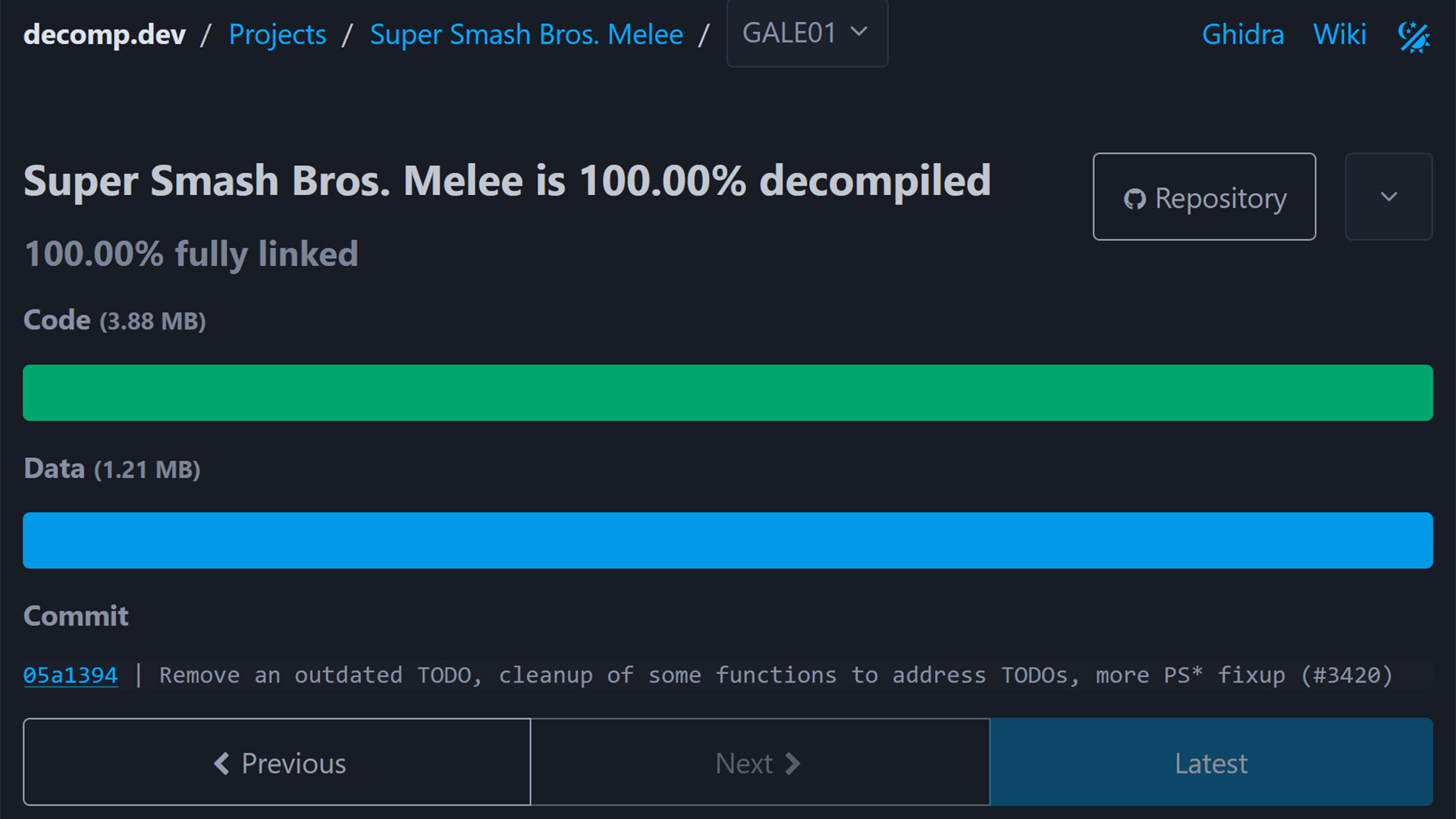
A Super Smash Bros Melee decompilation project hit its key long-standing goal a few hours ago. Nintendo’s legendary platform fighting game, which launched on the GameCube in 2001, has now been 100% decompiled by a team of developers. This is a complex game to convert to C code, but the project code can now be compiled into a binary byte‑for‑byte identical to Nintendo’s original main.dol. The effort has taken the team six years or more to get to this stage, with OpenAI's Astra part of the effort to get it over the line. Gamers may already be excitedly anticipating Super Smash Bros Melee ports and modding tools, but these too will take time and effort.

Super Smash Bros. Melee has been 100% decompiled!
 from r/SSBM

Decompilation projects seem like the latest trend to grasp the retro gaming and development communities, but some, like this, have been in progress for a very long time. Enthusiasts are spurred on by old console hardware becoming scarce, expensive, or uneconomical to repair. Thus, they want to preserve the original game code in a manner that can be ported to modern supported systems. Demanding 100% accuracy with a complex game like this was ambitious, but now that milestone has been reached.

Super Smash Bros Melee decomp

(Image credit: decomp tracker)

Preservation isn’t the only goal, or result of projects like this. Seasoned developers will now be able to pore over the game’s C code and gain insights into Melee’s engine, physics, game mechanics, and more. Armed with this knowledge, we should eventually see the modding potential of this game blossom. This has happened in the wake of previous successful decompilation projects.

If you drop in on the doldecomp/melee GitHub page, linked above, you can check over the code for yourself. There are instructions for compiling this Super Smash Bros Melee C code on various platforms, including Windows. However, please remember these aren’t ports; you will just be recreating the v1.02 US release main.dol file from the GameCube, which weighs in at 3.88MB. You'll also need the original assets (textures, audio, etc.) from the GameCube disc that you own, in order to run the game.

Some highlight that the project was finalized with thanks in part to the latest AI tech, including GPT-6 Astra. Similar tech might also be used to rapidly develop the ports and mods that the crowds are looking forward to.

Google maps entire brain and central nervous system of adult male fruit fly, software engineers immediately make it run Doom — AI-powered 3D model of over 166,000 neurons can also play Super Mario 64

8 September 2026 at 12:06

Late last week, Google announced that scientists had, for the first time, “mapped the complete brain and central nervous system of an adult male fruit fly.” On Monday, software engineers were already demonstrating the full MaleCNS v1.0 fruit fly connectome being trained to play Doom, as well as Super Mario 64. In light of these developments, perhaps it is time to amend Arthur C. Clarke’s Third Law. We suggest something similar to ‘Any sufficiently advanced new technology will immediately be forced to play Doom.’

For the first time, scientists have mapped the complete brain and central nervous system of an adult male fruit fly — a key model organism in science. 🪰Working alongside HHMI Janelia Research Campus and the scientific community, @GoogleResearch scientists and researchers used… pic.twitter.com/dpcXH4jmNSSeptember 3, 2026

Let’s look at this story in its natural chronological order. Scientists have been using fruit flies for research for over a century. The winged insects have a strong history in the avenues of genetic research. The humble fruit fly is still relevant in the 2020s in genetics, neuroscience, and more.

Now, for the first time, the complete brain and central nervous system of an adult male fruit fly have been fully mapped. Google Research scientists worked alongside HHMI Janelia Research Campus and the scientific community to achieve this milestone. In the social media post outlining the achievement, Google claimed that AI was used “to combine millions of 2D images into 3D neural shapes, reconstructing a record-breaking 166,000+ neurons.” That’s somewhat below the estimated 86 billion neurons in the human brain. AI data centers are going to need more RAM, folks.

This scientific breakthrough is going to “accelerate our understanding of the brain, and is a major milestone in neuroscience,” noted Google last Thursday. By Tuesday, it was already being trained to play classic video games.

I'm training a fly brain to play Doom using the full MaleCNS v1.0 fruit fly connectome.Each Doom frame stimulates sensory neurons. Neural activity is mapped to game controls. Damage triggers a stimulus to two PPL101 dopamine cells as reinforcement.Will the fly learn to… https://t.co/ObCJ03gxy3 pic.twitter.com/H2YDBtyuR8September 6, 2026

We’ve seen software engineer Alex Wormuth and ‘C++ ragebaiteur’ Jessica Paquette already demonstrate fly-brain video game training. Their fly-brain tinkering focuses on Doom and Mario 64, respectively.

Of their Doom training efforts, Wormuth says that “Each Doom frame stimulates sensory neurons. Neural activity is mapped to game controls. Damage triggers a stimulus to two PPL101 dopamine cells as reinforcement.” The dev closes their tweet with the question “Will the fly learn to survive?” The code is fully open source, and you can also watch the training progress of the 166,700 neurons live.

playing mario 64 using a fly's brain pic.twitter.com/G4BmfMSWb8September 7, 2026

Paquette’s short video clip shows Mario repeatedly taking off and bumping into a wall. If it were bumping into a window, it would be exhibiting the pinnacle of fly-brain intelligence. We also have the code to this fly-brain video gaming project, which was “literally 100% vibe coded with GPT Astra… just for fun.” Hopefully non-coders/tinkerers will get updates on the success of this training via Paquette’s socials.

Tech enthusiast finds $12,000 stack of RAM in their garage — work let them keep an old server stuffed with 1,920GB of DDR4

8 September 2026 at 11:00

A computing enthusiast has shared images of a fat stack of DDR4 RAM sticks that they found at home. VastOption8705 told other tech fans on Reddit that they “found 10k worth of RAM sitting in my garage.” We count 30 sticks of DDR4-2666, and three sticks shown separately are all 64GB modules. If they are all 64GB modules, that number of sticks would add up to 1,920GB of RAM…

Found 10k worth of ram sitting in my garage
 from r/LinusTechTips

How did this huge amount of RAM end up in VastOption8705’s garage? The story goes that the Redditor was allowed to keep an old server from their workplace. Such 'generosity' isn’t unheard of, and it might have actually saved the company some recycling fees.

Is server DDR4 useful?

Numerous comments on the Reddit post jokingly pitch for RAM stick donations. But they might be barking up the wrong tree. Looking more closely at the sticks, where the labels are clearly readable, reveals that they are Samsung 64GB DDR4 ECC registered DIMMs (RDIMMs).

These kinds of RAM sticks are commonly used in servers built around Intel Xeon, AMD Epyc, or AMD Threadripper platforms. Sadly for their market value and the folks on Reddit hoping for some spare RAM, they aren’t consumer PC friendly. Even if you have a DDR4-supporting motherboard, these ECC RDIMMs will be both physically and electrically incompatible with your home creator/gaming PC.

Pricing and the Australia question

A quick poke around eBay U.S. listings shows that a single 64GB DDR4-2666 stick like those shown can be bought for between $350 and $425. So, we could roughly value the 30 sticks at $12,000 if a price of $400 per stick were achieved. The OP’s touted $10K valuation wasn’t far off. But if VastOption8705 lives in Australia, as they seem to, and guesstimated the value in Australian dollars, AU$10,000 currently equates to ~US$7,200 – quite low.

If you have spare RAM in your garage, don't share your address on public forums. The best I could find is a pair of 8GB DDR4 SO-DIMMs in my drawer. I also had some 30-pin SIMMs, SDRAM, PowerMac ROMs, and DDR3 modules probably worth just pennies, despite the RAMpocalypse.

OpenAI’s GPT-6 Astra model autonomously completes Portal in 24 hours — feat cost just $571 in tokens

7 September 2026 at 14:25

An AI and LLM enthusiast has conducted an experiment where OpenAI's new GPT-6 Astra played through the entirety of Valve's Portal 3D puzzler game on its own. This seems like a remarkably progressive step forward for LLMs and a convincing demonstration of multimodal 'AI intelligence.' It wasn’t that long ago AIs were losing at Atari 2600 chess. However, this puzzle gaming task resulted in 3,336 tool calls and a headline API cost of $571.18. CozyBlaze, the enthusiast, has since clarified that the costs were covered by their $200 Codex Pro subscription.

The video above has Astra’s thinking/pauses removed to make watching somewhat bearable.

“The model controls Portal through MCP [Model Context Protocol] + a modified SourcePauseTool,” explains CozyBlaze. “The game stays paused while the model thinks; once the model sends an input sequence, SPT unpauses and executes it.” During the thinking time, the AI received screenshots and information about the player character position. After this, the game resumed, and Astra executed its planned moves and inputs. This is why the edited highlights reel is ~ 2 hours, but the full set of GPT-6 Astra Portal VOD streams adds up to ~24 hours.

And... GPT-6 Astra has autonomously completed Portal! I didn’t expect this to happen so soon, but I’m glad we've made so much progress here.I was reminded that back in 2016, one of OpenAI’s technical goals was to “solve a wide variety of games using a single agent.” pic.twitter.com/2nVREdCbMISeptember 5, 2026

CozyBlaze is pragmatic about the achievement. They admit there are still many problems to solve, and this runthrough shouldn’t be viewed as an AI benchmark. “But watching a general-purpose agent autonomously navigate and make it all the way through the game feels like a small glimpse of that original vision becoming real,” they observe. That original vision is OpenAI’s from way back in 2016, when an eventual goal of a single agent solving a variety of games was mentioned.

If you want to see the inner workings of CozyBlaze’s Portal Agent, it is available on GitHub. There are some instructions there for you to explore it or try it for yourself, too.

GPT-6 Astra became OpenAI’s flagship model earlier this month. OpenAI claims the new model offers “a new generation of intelligence,” and “is state-of-the-art on computer use, browsing, software engineering, cybersecurity, science, and professional work.” Expect to see more of Astra flexing its muscular gray matter in the coming days.

RPCS3 emulator can now run PS3 games on PC directly from a disc drive in landmark development — unlocks 20 years of physical titles on Windows, Linux, and macOS

7 September 2026 at 11:47

The developers of the Sony PlayStation 3 emulator RPCS3 have told their social media followers that it is now possible to play games straight from discs. As announced on Twitter/X, the emulator’s latest refinement works only with certain internal and external Blu-ray drives. Happily for retro gamers, there’s a lengthy compatibility list of drives featuring many models and brands, and the same drives are also compatible with dumping your media to fixed storage.

You can now play your PS3 games on PC... DIRECTLY FROM THE DISC DRIVE!💿 PLUG AND PLAY! Owning your games as physical media allows you to play games released as far back as 20 years ago without relying on any servers!See compatible disc drive models at https://t.co/nSzG5S954L pic.twitter.com/d1uKE7BpyrSeptember 6, 2026

Above you can see the RPCS3 devs are pretty happy with the slick new “plug and play” refinements that are available to users of the latest version of the emulator. “You can now play your PS3 games on PC... DIRECTLY FROM THE DISC DRIVE!” boast the open source emulator programmers. “PLUG AND PLAY! Owning your games as physical media allows you to play games released as far back as 20 years ago without relying on any servers!” The RPCS3 team thanks digant73 and Megamouse, specifically, for contributions making this feat possible.

Indeed, this is another step forward in making a slick emulator that works in a surprisingly frictionless fashion. Though the Tweet mentions PC, specifically, extended disc drive play support is also available on Linux, FreeBSD, and macOS. You just need to check that drive compatibility list. Moreover, all users can enjoy “optimized install times for package installations from the disc drive.” It has also been confirmed that PS4 and PS5 console users with Linux installs can launch PS3 games directly from disc using RPCS3.

Here’s a quick tip for folks who have an obscure Blu-ray drive that isn’t in the list. If you want to confirm compatibility with the drive, just put a PS3 disc in it. If you can browse its files, it's compatible; if nothing shows up, then it's not.

With pricing for the best SSDs now sky-high, being able to test-run new (old) games before dumping them to fixed storage could be a boon. It might also be good for auditioning a batch of discs you have recently bought, to see which ones are keepers.

❌