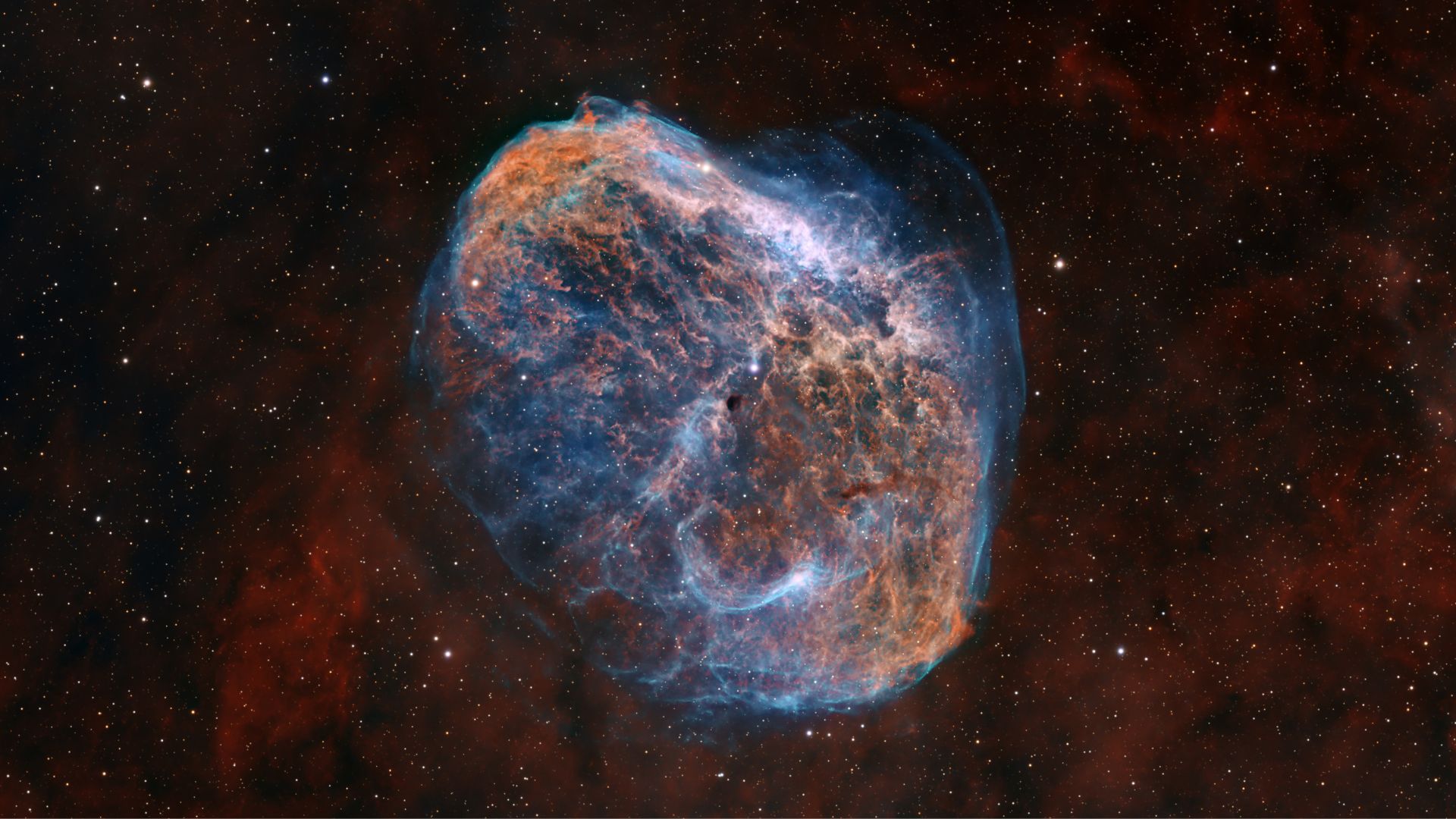
The Crescent Nebula shines in the constellation Cygnus. (Image credit: Kevin Boardman)
Astrophotographer Kevin Boardman captured this spectacular view of the Crescent Nebula, revealing intricate filaments of gas surrounding a massive star nearing the end of its life some 4,700 light-years from Earth in the constellation Cygnus.
Boardman's image represents a turbulent chapter in the life of the colossal Wolf-Rayet star WR 136 (HD 192163), which, visible as a blue point of light at the center of the image, is expected to end its life in a dramatic supernova explosion in about 100,000 years.
The 25-light-year-wide bubble is formed from stellar material cast off by WR 136 during its transformation into a red giant star, according to NASA. Repeated impacts by fast-moving stellar winds later send shockwaves through the outer shell, creating the complex filaments we see today.
ZWO ASI533MC Pro
(Image credit: Amazon)
The ZWO ASI533MC Pro camera is the best dedicated astro camera out there, in our opinion. It features zero amp glow, 80% quantum efficiency and a 20FPS frame rate. It also features a 9MP sensor and you can check out our ZWO ASI533MC Pro review for a more in-depth look.
Catalogued as NGC 6888, or Caldwell 27, the Crescent Nebula, gets its nickname from its crescent-moon like appearance when observed in certain wavelengths of light. Boardman revealed spectacular detail in the nebula by imaging it with a set of narrowband filters over 16 hours and 18 minutes spread across five nights in late July.
"In the image, orange-red H-alpha reveals the tangled filaments while blue-cyan [O III] outlines emission from doubly ionized oxygen around the shell," Boardman told Space.com in an email. Each filter isolates specific wavelengths of light emitted by ionized gases, allowing different structures within the nebula to stand out.
Boardman collected roughly 12 hours of narrowband data from the nebula itself, along with four hours and 20 minutes of data capturing the surrounding stars, before combining exposures using the astronomy software PixInsight during post-processing.
The Crescent Nebula is too faint to be spotted with the naked eye, but can be seen with a moderate-to-large telescope equipped with a light pollution filter throughout September.
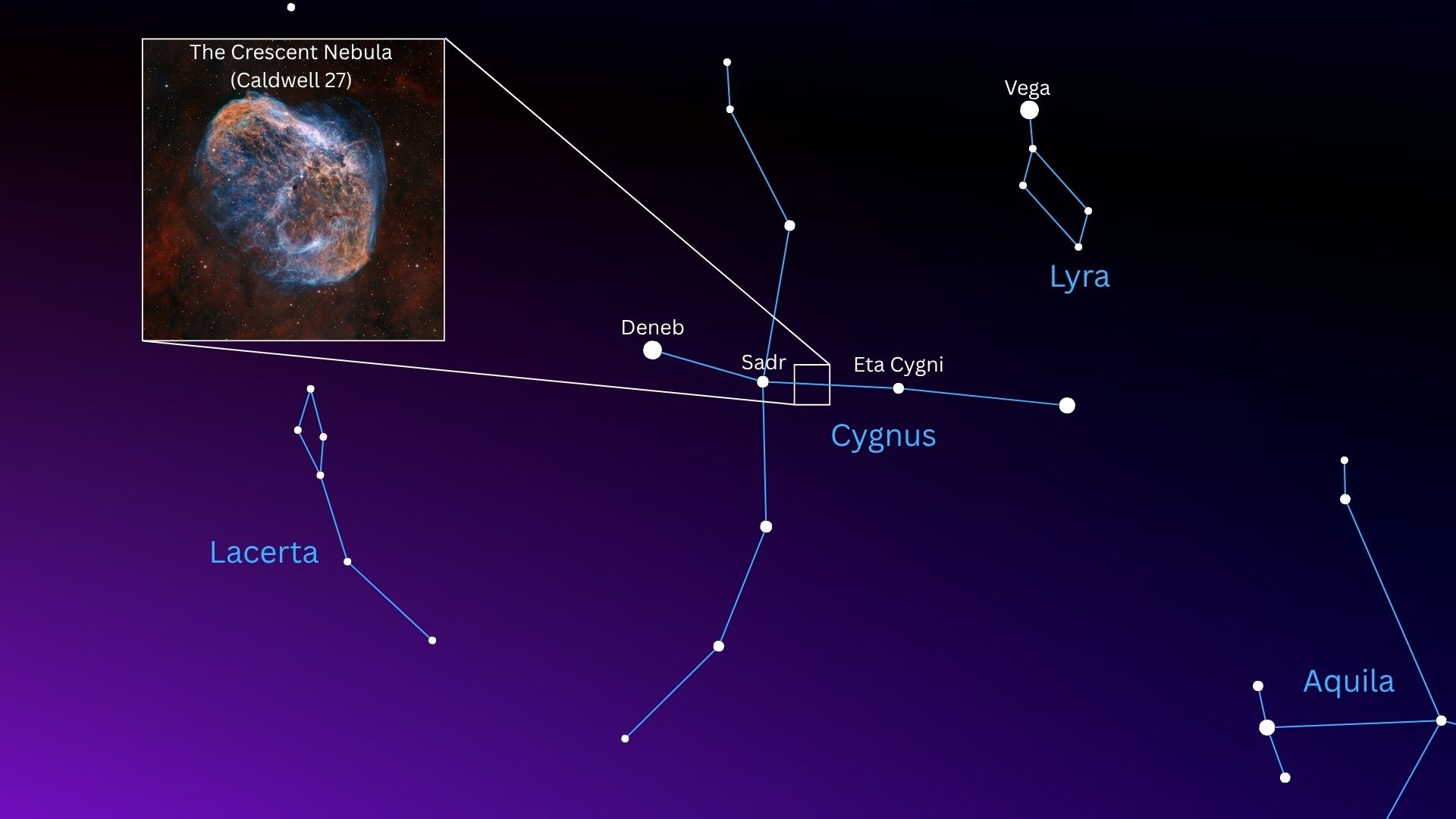
How to find the Crescent Nebula among the stars of the constellation Cygnus. (Image credit: Inset image: Kevin Boardman, created by Anthony Wood in Canva.)
First, locate the magnitude +2.34 star Sadr at the center of the cross-shaped constellation Cygnus, which appears high overhead for Northern Hemisphere observers in late summer.
Next, locate the dimmer magnitude +4.03 star Eta Cygni using the simplified star chart above, or with the aid of a smartphone astronomy app. The Crescent Nebula lies directly between these two bright stars and is best seen on the dark nights surrounding this month's new moon phase on Sept. 10-11.
Editor's Note: If you would like to share your astrophotography with Space.com's readers, then please send your photo(s), comments, and your name and location to spacephotos@space.com.
This MacVoices Briefing compares the Insta360 Snap Selfie Screen with Light and SmallRig Phone Vlog Selfie Monitor, two solutions for framing shots while using an iPhone’s best camera. Factors in choosing include MagSafe mounting, wired versus Wi-Fi connections, screen size, touch controls, lighting, battery life, compatibility, portability, pricing, and flexibility. Chuck talks about how to determine help which monitor is best for your different shooting needs, and how he solved the choice question.
Macbook Pro, 15", 2017
Mac OS Monterey, Version 12.6
iPhone 13 Pro Max
IOS 16.0
For managing Pictures in the Photo Application between my MacBook and iPhone - I want to be able to delete pictures from the iPhone but they always come back from the MacBook Pro?
How can I keep pictures from always coming back?
Apologies for not using correct nomenclature / terms - I am not much of a chiphead.
Is there a good resource for using Photo Application for both the Laptop and...
Galaxies are separated into three main categories—spirals, ellipticals, and irregulars. Spirals are like our own Milky Way and appear to spin around a central focus. Ellipticals are older galaxies and likely the results of mergers. Irregulars that can encompass a wide range of galactic phenomena.
Spirals, ellipticals, and irregulars are all represented in this new collection. Each image hasX-ray data from Chandra, combined with data from other telescopes such as the James Webb Space Telescope (JWST), Hubble, IXPE, Swift, and NuSTAR, and others both in space and on the ground. Gaze into the galaxies in the gallery below. (Click to expand images to full screen.)
NGC 16-72
A barred spiral galaxy featuring a prominent central bar or bridge of stars that channels gas toward its core. Chandra X-rays (purple) highlight growing black holes along the bar and core, merged with Hubble optical light (white, yellow and soft blue) and JWST infrared dust filaments (red). Studying barred spirals in action can help reveal how gas in our own Milky Way, which is also a barred spiral, feeds its central black hole and forms new stars. Image X-ray: NASA/CXC/SAO; Optical: NASA/ESA/STScI/Hubble Heritage Team; Infrared: NASA/ESA/CSA/STScI/J. Lee and T. Williams; Image Processing: NASA/CXC/SAO/L. Frattare, J. Major, K. Arcand.
II Zw 096
A chaotic, dust-shrouded system of merging galaxies forming stars at a furious rate. Chandra X-ray data (magenta) pinpoint powerful black hole activity and hot gas, while Hubble optical (blue and white) and Webb infrared (red and grey) data illuminate vast stellar nurseries hidden behind interstellar dust. Systems like II Zw 096 show us how powerful galaxy collisions shaped the early universe. Image: X-ray: NASA/CXC/SAO; Optical: NASA/ESA/STScI; Infrared: NASA/ESA/CSA/STScI; Image Processing: NASA/CXC/SAO/L. Frattare and J. Major.
M33
A nearby, face-on spiral galaxy whose clear spiral arms offer an unhindered view of its stellar engine. X-ray data from Chandra (purple) highlights point sources like neutron stars and stellar-mass black holes pulling material off companion stars (systems called X-ray binaries), while optical data from the Very Large Telescope’s MUSE instrument (pink and grey) maps glowing pockets of hydrogen gas. Ultraviolet data from NASA’s Swift telescope (blue) reveals populations of young, massive stars sizzling across the spiral arms. M33’s proximity to us allows astronomers to audit individual high-energy objects and map how stellar feedback affects a galaxy’s ecosystem. Image: X-ray: NASA/CXC/SAO; Optical: ESO/VLT; UV: NASA/Swift; Image Processing: NASA/CXC/SAO/L. Frattare.
NGC 4258
A spiral galaxy famous for having two extra, “anomalous” spiral arms composed of hot gas. Chandra’s X-rays (royal blue) show superheated shockwaves created by central black hole jets, combined with optical light from Hubble (red, yellow and pale blue) and infrared dust filaments from Webb (bright orange). M106 helps show how supermassive black holes can create structural features that mimic star-bearing spiral arms, influencing a galaxy’s evolution. Image: X-ray: NASA/CXC/SAO; Optical: NASA/ESA/STScI; Infrared: NASA/ESA/CSA/STScI; Image Processing: NASA/CXC/SAO/L. Frattare.
NGC 1569
A compact dwarf irregular galaxy undergoing a violent, compact burst of star formation. Chandra and XMM-Newton observations (blue and purple) reveal massive bubbles of million-degree gas inflated by stellar winds, set against a backdrop of optical light (magenta, orange and white) imaged by Adam Block. Dwarf starburst galaxies can serve as local laboratories for studying the conditions of the early universe, where small, primitive galaxies formed stars at frantic rates. Image: X-ray: (XMM):ESA/XMM-Newton, (Chandra): NASA/CXC/SAO; Optical: Univ.of Arizona/Mt Lemmon SkyCenter/Adam Block/Josep Drudis; Image Processing: NASA?CXC/SAO/L. Frattare.
M90
A large spiral galaxy that is being stripped of its gas as it plunges at high speed through hot gas in the Virgo Cluster of galaxies. Chandra’s X-ray data (magenta) pinpoints high-energy point sources—such as X-ray binaries and supernova remnants—and diffuse hot gas nestled within the spiral disk imaged by Hubble (blue, brown and gold). A ground-based optical light image taken from New Mexico by Timothy Martin reveals red filaments of hydrogen gas streaming over 300,000 light-years behind the galaxy as it falls into the Virgo Cluster. Image: Accidental Astronomers. X-ray: NASA/CXC/SAO; Optical: NASA/ESA/D. Thilker/J. Lee/PHANGS-HST Team; Full-field: Tim Martin; Image Processing: NASA/CXC/SAO/L. Frattare.
Centaurus A
A giant elliptical galaxy undergoing a dusty merger, featuring a powerful jet of particles blasting tens of thousands of light-years into space. Chandra’s X-rays (blue) showcase the high-energy jet, with additional X-rays from IXPE (orange), while Webb infrared (magenta) and optical light (amber and white) from the European Southern Observatory expose a dark, churning dust lane. As one of the closest active galaxies to Earth, Cen A allows astronomers to study the effects of supermassive black hole jets in extraordinary detail. Image: X-ray: (Chandra) NASA/CXC/SAO, X-ray (IXPE): NASA/MSFC; Optical: ESO; Infrared: NASA/ESA/CSA/STScI; Image Processing: NASA/CXC/SAO/L. Frattare, K. Arcand, and J. Major.
M104
Famous for its broad central bulge and dark outer dust ring, this galaxy sits at a nearly edge-on tilt to Earth. Chandra X-rays (cyan and orange) isolate compact point sources and hot gas in the galaxy’s sprawling halo, merged with Hubble optical light (warm white) and Webb infrared vision (purple-red dust lane). Studying M104 may help bridge the gap between spirals and ellipticals, helping astronomers better understand how a galaxy’s giant outer cloud of stars grows and ages alongside its inner disk. Image: X-ray: NASA/CXC/SAO; Optical:NASA/Hubble Heritage Team/AURA/STScI; Infrared: NASA/ESA/CSA/STScI; Image Processing: NASA/CXC/SAO/L. Frattare.
Arp 143
This ring galaxy system formed when a smaller companion galaxy punched straight through its center like a bullseye, creating a powerful cosmic shockwave. Chandra X-rays (purple) uncover bright X-ray binary systems scattered along the collision shock wave, laid over Hubble’s optical image (blue and white) of expanding stellar rings. Such head-on collisions can trigger vast ripple effects, sparking huge waves of star birth across entire galaxies. Image: X-ray: NASA/CXC/SAO; Optical: NASA/ESA/STScI/J. Dalcanton; Image Processing: NASA/CXC/SAO/L. Frattare.
NGC 4725
A “one-armed” barred spiral galaxy surrounded by a prominent star-forming ring. Chandra’s X-ray data (magenta) pinpoints several bright X-ray sources, likely caused by growing black holes, embedded within the sweeping optical disk (soft blue and white) captured with the Mt. Lemmon Observatory. Galaxies with unusual single arms can offer a window into how the gravity from a passing galaxy can trigger bursts of star formation. Image: X-ray: NASA/CXC/SAO; Optical: NASA/ESA/STScI/NAOJ/R. Gendler; Image Processing: NASA/CXC/SAO/L. Frattare.
NGC 1385
A barred spiral galaxy packed with regions where stars are actively forming. Chandra X-ray data (magenta) highlights stellar nurseries and X-ray binaries scattered along dusty spiral structures brought to life by Hubble optical (white and grey) and Webb infrared (orange and red) observations. Comparing multiwavelength data of barred spirals containing active star formation helps scientists map how local starbursts build up galactic mass over time. Image: X-ray: NASA/CXC/SAO; Optical: NASA/ESA/STScI; Infrared: NASA/ESA/CSA/STScI; Image Processing: NASA/CXC/SAO/L. Frattare.
NGC 660
A rare “polar ring” galaxy where a tilted outer ring of stars and dust rotates over the galaxy’s poles, an unusual structure likely caused by a collision with another galaxy about a billion years ago. Chandra’s X-rays (purple) reveal a possible growing supermassive black hole in the center of the galaxy, plus X-ray binaries nestled within the stars and dust captured by the Gemini Observatory in optical light (gold, blue and white). Studying polar rings teaches us about the diverse effects of stellar collisions on the shapes of galaxies. Image: X-ray: NASA/CXC/SAO; Optical:NSF/International Gemini Observatory/AURA; Image Processing: NASA/CXC/SAO/L. Frattare.
M82
An irregular galaxy undergoing intense star formation because of a gravitational interaction with a neighboring galaxy hundreds of millions of years ago. Chandra X-rays (blue), supplemented by NuSTAR data, show towering superwinds of million-degree gas blowing thousands of light-years out of the galactic disk, with Hubble optical light (yellow, orange and white) showing the galaxy shape, and Webb and Spitzer detailing infrared dust emission (red). M82 was nicknamed the Cigar Galaxy mostly because of its edge-on angle to Earth, which makes its central disk look like an elongated, cigar-shaped oval with small optical telescopes. The galaxy illustrates how violent galactic “exhaust systems” can regulate a galaxy’s growth by venting gas outwards. Image: X-ray: NASA/CXC/SAO; Optical: NASA/ESA/STScI; Infrared: NASA/ESA/CSA/STScI; Image Processing: NASA/CXC/SAO/L. Frattare, J. Major, and K. Arcand.
NGC 3256
A pair of colliding, gas-rich spiral galaxies merging into a single massive system. Chandra’s X-ray data (pink) isolates point sources and shock-heated gas, Hubble’s optical light (blue and white) captures tidal tails of stars, and Webb’s infrared vision (red and orange) cuts through the dust to show hidden star formation. Galaxy collisions like this offer a preview of our far future, showing what might happen if our own Milky Way collides and merges with the nearby Andromeda Galaxy. Image: X-ray: NASA/CXC/SAO; Optical: NASA/ESA/STScI; Infrared: NASA/ESA/CSA/STScI; Image Processing: NASA/CXC/SAO/L. Frattare.
NGC 3938
A face-on spiral galaxy whose orientation gives us an unobstructed view of its disk. X-ray emissions from Chandra (magenta) detail energetic X-ray binaries and supernova remnants scattered across dust lanes in an optical image (white, blue and gold) from Adam Block with Mt. Lemmon Observatory. Face-on orientations are important for galactic studies because they provide the most unobstructed views of a galaxy’s stars and gas. Image: X-ray: NASA/CXC/SAO; Optical: Adam Block/Mount Lemmon SkyCenter/University of Arizona; Image Processing: NASA/CXC/SAO/L. Frattare.
I have to send from photos to a friend. I took these photos on my iPhone 5C (about 6 or 7 pics) and I'd like to transfer them to my Mac laptop (OSX 10.7.5) and then send them as attachments to an email to my friend. But I don't know how to do any of this. Sorry, I'm not really a power user and I don't usually take many photos. Of course, I do know how to send an attachment to an email but I don't know how to get the photos from my iPhone to my Mac. I have the latest version of iTunes...
It’s a bird’s world, and we’re just living in it. Today, the National Audubon Society officially announced the winners of the 2026 Audubon Photography Awards. The contest is now in its 17th year and celebrates stunning photos (and even a few videos) that showcase the beauty of birds and the challenges they face. For the second year, the judges awarded prizes to residents of Chile and Colombia, as well as the United States and Canada, highlighting how avians connect us across geographies and ecosystems.
This year’s Grand Prize winners each received $5,000 and a voyage to Antarctica with HX Expeditions—an expedition cruise company and Audubon’s exclusive cruise partner.
Take a peek at the winners in the gallery below. (Click to expand images to full screen.)
Prizes for United States and Canada Residents
Grand Prize: Jacqueline Burke, roseate spoonbill
A roseate spoonbill (Platalea ajaja) at the St. Augustine Alligator Farm Zoological Park, in St. Augustine, Florida. Image: Jacqueline Burke.
Youth Prize: Ian Shultz, rock pigeon
A rock pigeon (Columba livia) in Golden Gardens Park in Seattle, Washington. Image: Ian Shultz.
Video Prize: Piper VanOrd, great blue heron
A great blue heron (Ardea herodias) at Allegheny Islands Wilderness, National Wild & Scenic Allegheny River, in Warren, Pennsylvania. Credit: Piper VanOrd.
Female Bird Prize: Gail Bisson, common merganser
A common merganser (Mergus merganser) in East Bay Sandbar, Nova Scotia, Canada. Image: Gail Bisson.
Plants for Birds Prize: Mike Henry, Gila woodpecker and saguaro cactus
A Gila woodpecker (Melanerpes uropygialis) and saguaro cactus (Carnegiea gigantea) in Tucson, Arizona. Image: Mike Henry.
Birds Without Borders Prize: Nick Parayko, Tennessee warbler
A Tennessee warbler (Leiothlypis peregrina) in photographer Nick Parayko’s backyard in St. Albert, Alberta, Canada. Image: Nick Parayko.
Birds in Landscapes Prize: Liron Gertsman, white-tailed tropicbird
A white-tailed tropicbird (Phaethon lepturus) in Hawai’i Volcanoes National Park in Hawai’i. Image: Liron Gertsman.
Northern gannets (Morus bassanus) on the Isle of Noss in the Shetland Islands, United Kingdom. Image: Josh Galicki.
Prizes for Chile and Colombia Residents
Grand Prize: Francisco Castro Escobar, lesser horned owl
A lesser horned owl (Bubo magellanicus) in Antofagasta, Chile. Image: Castro Escobar.
Youth Prize: Juan David Camacho Márquez, Canada warbler
A Canada warbler (Cardellina canadensis) in Doña Dora Birding, El Queremal, Valle del Cauca, Colombia. Image: Juan David Camacho Márquez.
Video Prize: Nicolás Muñoz García, black-browed albatross
A black-browed albatross (Thalassarche melanophris) is on Isla Chañaral Marine Reserve, Huasco Province, Chile. The nearest town is Caleta Chañaral de Aceituno. Credit: Nicolás Muñoz García.
Birds Without Borders Prize: Rodrigo González Pairoa, black-browed albatross
A black-browed albatross (Thalassarche melanophris) in Almirantazgo Fjord, Chile. Image: Rodrigo González Pairoa.
Conservation Prize: Santiago Pérez Rincón, yellow-eared parrot
A yellow-eared parrot (Ognorhynchus icterotis) in Anaime River Canyon, Rural District of the Municipality of Cajamarca, Department of Tolima, Colombia. Image: Santiago Pérez Rincón.
Plants for Birds Prize, Colombia: Santiago Giraldo, yellow-eared parrot and Quindio wax palm
A yellow-eared parrot (Ognorhynchus icterotis) and Quindio wax palm (Ceroxylon quindiuense) in Anaime, Cajamarca, Tolima, Colombia. Image: Santiago Giraldo.
Birds in Landscapes Prize, Colombia: Faber Mosquera Álvarez, oilbird
Oilbird (Steatornis caripensis) in the Cañón de los Guácharos, Pijao, Quindío, Colombia. Image: Faber Mosquera Álvarez.
Birds in Landscapes Prize, Chile: Timothy Dhalleine, crested caracara
A crested caracara (Caracara plancus) in Torres del Paine National Park, Magallanes and Chilean Antarctic region, Chile. Image: Timothy Dhalleine.
A gentoo penguin (Pygoscelis papua) in Fildes Bay, Antarctica, in the vicinity of the Chilean bases. Image: Gonzalo Bertolotto Quintana. Gonzalo Bertolotto Q
The winners and honorable mentions are published online in Audubon magazine, and winners will be in the Fall 2026 print issue. The annual Top 100 photos will also be announced on September 23, 2026, and additional selections will be featured in digital galleries on Audubon’s website.
The 2027 Audubon Photography Awards will open for entries on January 13, 2027.
In the CYME booth at NAB in Las Vegas, Matthieu Kopp, Chief Technology Officer, previews the next Peakto release, highlighting support for much larger media libraries, expanded collaboration, guest sharing, and secure on-premise access without cloud uploads. He also discusses other features such as new culling tools, improved ingest control, subclips for video workflows, and […]
At NAB 2026, Russell Pompea, Account Executive from Topaz Labs, discusses major advances in Topaz Video, including Starlight Precise 2.5 for restoring low-quality footage, SDR-to-HDR conversion, and Apple Silicon optimization. The conversation also covers Topaz’s photography tools, model customization, subscription pricing, local vs. cloud processing, and shared responsibility for cloud security.
Life in space is hard. Most orbiting observatories retire well before their 20th birthday. Yet the Hubble Space Telescope has survived and continues to thrive well into its 30s. Astronomers celebrated the observatory’s 36th birthday in April by releasing a new image of the Trifid Nebula (M20). This stellar nursery lies about 5,000 light-years fromContinue reading "Hubble captures a corner of M20"
A new Google Earth tool allowed the creation of A.I. deepfake maps. The tech giant quickly pulled it back after a backlash and concerns about disinformation risks.
Astrophotography tends to blur the boundary between science and art. The incredible images from Hubble and JWST, for example, captivate us as much for their aesthetic beauty as for their data. Recently, a photography student blurred those lines even further, taking the concept of capturing the cosmos quite literally by creating images from film’s interactionContinue reading "How one student captured the universe without light"
Two dormant volcanoes in the Andes are shown “connected” by the glowing ribbon of a distant cosmic feature stretching across the sky between them, in a rare cosmic alignment echoing ancient legends about these neighboring peaks—and all of it was captured in one of the most breathtaking astronomy images in recent memory.
The photo (seen below) was captured by astrophotographer Gonzalo Laserna Vargas and showcased by the American space agency this week. In it, we see Parinacota and Pomerape, a pair of ancient stratovolcanoes that form an unmistakable part of the landscape along the border between Bolivia and Chile.
In local folklore, these two prominences represent a prince and princess whose forbidden romance forever linked them in myth. Although no geological evidence exists for any physical links between them, astronomy recently helped fulfil that mythic connection in an unprecedented night sky display. The unique conditions that made this image possible, as well as the planning and preparation that went into it, were described by Vargas in a recent post on his Instagram account.
In the new imagery, recently featured as NASA’s Astronomy Picture of the Day, Barnard’s Loop—a vast arc of glowing hydrogen gas surrounding part of the constellation Orion—is showcased in a long-exposure photograph as it appears behind the two volcanoes.
The image was captured coinciding with the appearance of the nebula directly behind the volcanoes, and from an angle that causes the visible portion of the celestial object to appear as though it is rising from the mouths of the ancient volcanic peaks, uniting them through what resembles a colorful, luminous aerial display.
Despite the awe-inspiring appearance of the imagery, as part of the larger Orion Molecular Cloud, Barnard’s Loop remains at a distance of around 440 parsecs from these dormant volcanic peaks—in other words, close to 1,400 light-years away.
a Cosmic Convergence
Capturing a cosmic convergence at this scale required careful planning by Vargas, who took a sequence of exposures from the same location in Bolivia in mid-April, at a time when the nebula appeared perfectly in between the two mountain summits.
One thing that helped with this is the fact that Barnard’s Loop is one of the largest emission nebulae visible from Earth. Although it is far too faint to be seen easily with the naked eye, the nebula’s vibrant pink and orange colors appear in long-exposure photography, revealing its eerie halo fueled by the presence of hydrogen gas.
Along with Barnard’s Loop, several of the night sky’s most recognizable objects also make an appearance in Vargas’s photo. Near the center of the image is the Orion Nebula, which happens to be one of the nearest stellar nurseries to Earth. Such areas of the cosmos are places where new star formation occurs within vast clouds of cosmic dust and gas.
Higher in the image, another striking feature—the Rosette Nebula—can also be seen, revealed as a massive cloud of glowing gas around a small group of young stars.
A Cosmic Neighborhood United in Imagery
Although each of these features is separated by hundreds or even thousands of light-years from Vargas’s imagery, they all appear in a singular frame, producing a dramatic cosmic backdrop for the ancient volcanic landscape they appear above.
Hence, for reasons that are easy to see, Vargas’s photo was named NASA’s Astronomy Picture of the Day for July 28, 2026, revealing another artful view of the cosmos that relies on far more than just advanced equipment—it also showcases the necessity for astronomical knowledge, careful preparation, and, of course, impeccable timing.
The result in this case is a moment captured in time, where mythology, an ancient volcanic landscape, and the cosmos all converge within a single frame.
Micah Hanks is the Editor-in-Chief and Co-Founder of The Debrief. A longtime reporter on science, defense, and technology with a focus on space and astronomy, he can be reached atmicah@thedebrief.org. Follow him on X @MicahHanks, and at micahhanks.com.
I am using an Epson v850 Perfection scanner with my iMac on MacOS 15.7.7. Occasionally the connection fails and does not reconnect after starting and restarting the scanner and scanning utility. All cabling seems to be okay. I try again later or next day and it works fine.
The scanner is about 3M [10'] away so is the distance an issue?
In my work, my absolute favorite days are the ones where I just get to take pictures. I’m testing a new camera or a new film stock, and so I’ve got nothing on the agenda other than heading to some locations that are beautiful or interesting (or, ideally, both) and capturing images of them. At the end of the day I’m normally tired, sweaty, have new blisters on my feet — and feel fantastic.
But those days are quite rare. Often I’m consumed with other things, the nitty-gritty of writing, work, life-admin and everything else. Trying to be more efficient, for money and time reasons, means that I tend to do my photography in big infrequent chunks — and some research I’ve seen is making me reconsider that approach.
The benefits of a regular photography habit for mental health are well-documented. British photo retailer MPB, in announcing its partnership with mental-health charity Mind, points to a study in the peer-reviewed journal Health which finds that taking a photo every day provides tangible benefits in terms of mental well-being.
British photographer, broadcaster and passionate nature advocate Chris Packham is a huge believer in the power of photography to effect a positive mental change. ‘Photography has always been a conscious way of addressing chronic or specific mental health issues in my life,’ he says.
‘When I'm peering down the lens, I'm so engrossed in the objective, so intensely involved with the technical and creative process, that the rest of the world vanishes. It's just me and the photo. The exterior anxieties are relegated to oblivion, and I get maximal relief.’
‘For me, photography is a key part of a portfolio of tried and tested therapies which consistently enhance positive mental health outcomes.’
And it’s not just taking photos! Even the simple act of viewing them can have a positive effect. MPB also cites a 2024 survey undertaken by Fujifilm, in which 80% of respondents reported that viewing old photos brought them feelings of happiness and calm, and helped to reduce anxiety.
(Image credit: Future)
Building a daily habit
I'm grateful to MPB and Mind for making me think more mindfully about how I engage with photography. It's also worth noting that the retailer is putting its money where its mouth is, and donating £1 to Mind for every item bought or sold on its marketplace this August, working towards its goal of £50,000 a year for the charity.
The campaign has got me thinking that I’m missing out on the mindful benefits of a daily (or near-daily) picture-taking habit. When I’m using my camera, I’m not looking at my phone. I’m not even thinking about the cursed thing; it’s normally in my backpack. I think this could be of much greater mental benefit if I were doing it regularly for shorter sessions.
Our cameras editor Tim Coleman tried screen-free photography for a week and found it made him feel more immersed and connected with his shooting. Even when using a digital camera, it felt like a digital detox — something that people frequently say they want more of!
So if you, like me, tend to plan your photo-taking around long days that you only get to enjoy every so often — it might be worth thinking about ways you can incorporate a more frequent habit, too.
Bringing the camera on a walk to the station to capture details of your local community. Building a twenty-minute walk into your lunch break to see what sights unfold around you. It won’t just benefit your photography, but could also have a real, positive, tangible impact on your mental well-being.
In a rare first for me, I actually used autofocus for this entire astrophotography shoot. If I'm being honest? I prefer it when shooting astro with a mirrorless camera. Why? Because it is quicker and that means more time capturing the stars and less time setting up. I can get a star in sharp focus using autofocus in half the time that it would take me to do it manually and it's way easier to focus with the shutter or back button than play about with the focus ring, especially with cold fingers.
The Canon EOS R6 III makes shooting astro much quicker with its rapid low-light autofocus. (Image credit: Harry Bennett / Future)
I only managed to get out under one clear sky to test the new R6 III but it was a wonderful session at my usual dark hill spot surrounded by a sea of stars and celestial shapes. After setting up my tripod, I was ready to start shooting, armed with the Canon 14mm f/1.4 and 45mm f/1.2 lenses.
Pairing the R6 III with the RF 14mm f/1.4 lens is a perfect set up for astrophotography.Harry Bennett / FutureI also tried it with the Canon RF 45mm f/1.2 lens, which delivered exceptional aperture performance, albeit with a few spots of chromatic aberration.Harry Bennett / Future
If you are a seasoned astrophotographer, you will undoubtedly have started your craft by learning how to manually focus on stars to get them crisp and sharp in the frame. Everyone does. Whilst the manual focus (MF) versus autofocus (AF) debate continues within the community, the technology for low-light autofocusing capability has come a long way since mirrorless cameras were first introduced and the R6 III is physical proof of that.
The astrophotography
Mizar and Alcor in the panhandle of the Big Dipper. Shot with Canon EOS R6 III and RF 45mm f/1.2 lens, Aperture: f/1.2, Shutter speed: 2 sec, ISO 500 | Bortle class 4. (Image credit: Harry Bennett / Future)
You only get the luxury of being able to do this if your camera is actually good at autofocusing in low light and for starry nightscapes. All three versions of the Canon EOS R6 feature a low-light autofocus range of -6.5 exposure value (EV), so they already have a strong baseline for shooting under dark skies. The Canon EOS R6 III features a higher resolution and advanced autofocus algorithms, so the AF system actually has more data to use and is better at using it.
I was able to capture bright objects easily and start shooting without having to spend ages using manual focus for each new shot. The autofocus was powerful enough to capture at least one star in each of my frames. I simply used autofocus on the brighter points of light in my composition, waited for the green box and then switched to manual to avoid any refocusing if I decided to recompose the shot.
Pollux and Castor above Jupiter. Shot with Canon EOS R6 III and RF 45mm f/1.2 lens, Aperture: f/1.2, Shutter speed: 2 sec, ISO 500 | Bortle class 4. (Image credit: Harry Bennett / Future)
Bright objects were the easiest to capture, with Jupiter, Pollux and Castor easily captured in the western sky. Light pollution washed out the contrast in this shot but it was the quickest autofocus because of the brightness of the objects.
The autofocus helped me capture a range of other constellations too. With the R6 III focusing on the bright starArcturus, along with the rest of Boötes and Coma Berenices next to the Coma Star Cluster (Melotte 111).
Arcturus, Boötes, Coma Berenices and the Coma Star cluster (Melotte 111). Shot with Canon EOS R6 III and RF 14mm f/1.4 lens, Aperture: f/1.4, Shutter speed: 8 sec, ISO 800 | Bortle class 4. (Image credit: Harry Bennett / Future)
The shape of Leo is recognisable and the autofocus captured the brightest star, Regulus, to bring the rest of the stars in the constellation into focus. You can even spot the Beehive Cluster (M44) in Cancer, to the right of the frame and it is fairly sharp in focus. Barring some minor star trailing from my lack of a star tracker, the stars are nicely in focus, including on minor objects like star clusters.
Regulus in Leo, with the Beehive Cluster (M44) in the bottom right. Shot with Canon EOS R6 III and RF 14mm f/1.4 lens, Aperture: f/1.4, Shutter speed: 6 sec, ISO 640 | Bortle class 4. (Image credit: Harry Bennett / Future)
Using the 45mm lens, I got some close-ups of some quadrilateral shapes in the sky. Hercules' prominent trapezoidal keystone is visible and one of the corners, Zeta Herculis, was picked up by the autofocus. It is not exactly a bright star, with a magnitude of 2.88, but the R6 III picked it up easily and brought the rest of the corners into focus. Whilst barely a smudge along one of the sides of Hercules, I even managed to capture the Hercules globular cluster (M13) with the R6 III and the Canon RF 45mm wide open at f/1.2.
The keystone of Hercules. Shot with Canon EOS R6 III and RF 45mm f/1.2 lens, Aperture: f/1.2, Shutter speed: 2 sec, ISO 2500 | Bortle class 4.Harry Bennett / FutureA cropped view of the Hercules Globular cluster (M13). Shot with Canon EOS R6 III and RF 45mm f/1.2 lens, Aperture: f/1.2, Shutter speed: 2 sec, ISO 2500 | Bortle class 4.Harry Bennett / FutureThe 'head of the dragon' in Draco, with Iota Herculis to the right. Shot with Canon EOS R6 III and RF 45mm f/1.2 lens, Aperture: f/1.2, Shutter speed: 2 sec, ISO 2500 | Bortle class 4.Harry Bennett / Future
The polygonal head of the dragon in Draco was easily captured in the centre of the frame, with bright stars Eltanin (2.23), Rastaban (2.79) and even Iota Herculis (3.8) showing prominently. The autofocus capabilities of the EOS R6 III are maximised when used alongside a lens with a very fast aperture like f/1.4 and f/1.2. Without these types of lenses, you would be much less likely to be able to autofocus on such dim stars.
The upgrades
The big question when looking at the third iteration of a camera model is to figure out if the upgrades are actually worth it. First, you have to think about your budget and also what you are using the camera for. For astrophotography, there are a few upgrades in the EOS R6 III that can be considered to see whether they are worth it.
The most noticeable upgrade on the R6 III is the resolution, which has been upgraded from the R6 II's 24.2MP sensor to a 32.5 MP sensor. On top of improved resolution for general and astrophotography, the boosted number of pixels allows the Dual Pixel CMOS AF II to collect even more data points because there are more pixels. Dual Pixel architecture splits each pixel into two separate photodiodes and allows each photodiode to read the light from the star at two different positions and allows the lens motor to bring those points together into perfect focus.
(Image credit: Harry Bennett / Future)
The upgraded sensor resolution combined with upgraded tracking algorithms from the flagship Canon EOS R5 II make the R6 III better at locking onto low-light points and make autofocus for astrophotography much more reliable than in previous models.
I initially expected the higher resolution to translate into more image noise on photographs but this was not the case. The R6 III utilizes dual-gate gain architecture, which means that every pixel has a switchable path at the hardware level depending on the ISO level used and allows images with higher ISOs to have a heavily reduced base amount of noise and thus makes them less grainy.
A cropped view of the orange star Pi Herculis in the keystone of Hercules. Shot with Canon EOS R6 III and RF 45mm f/1.2 lens. Aperture: f/1.2, Shutter speed: 2 sec, ISO 2500 | Bortle class 4.Harry Bennett / FutureJupiter beneath Pollux and Castor, with Venus and Auriga to the right. Shot with Canon EOS R6 III and RF 14mm f/1.4 lens, Aperture: f/1.4, Shutter speed: 2 sec, ISO 800 | Bortle class 4.Harry Bennett / Future
Photos at lower ISOs on the R6 III have an incredibly high dynamic range (HDR) thanks to the low conversion gate (LCG) circuit. This allows the natural color of the stars to be preserved instead of coming across as indeterminate white blobs, as well as the subtle hues of the dark surrounding sky in the photograph.
A cloudy blue sky. Shot with Canon EOS R6 III and RF 7-14mm f/2.8-3.5 fisheye lens, Aperture: f/8, Shutter speed: 1/125 second, ISO 125. (Image credit: Harry Bennett / Future)
Aside from the technical aspects of how the resolution improves the autofocus, the detail in images from the R6 III is noticeable and is great for picking up finer stellar structures such as star clusters and smaller stars. When paired with a distorted lens like the Canon RF 7-14mm f/2.8-3.5 fisheye lens, extra resolution really helps details pop. I didn't get to use the fisheye lens for astro but general daytime shooting delivered some high-quality photographs.
The addition of CFexpress card slot will please professional photographers who need the fastest read and write speeds for their workflow. (Image credit: Harry Bennett / Future)
The final important upgrade on the R6 III is the inclusion of a CFexpress card slot, which allows faster writing and reading speeds both in camera and during media downloads. A UHS-II SD card has an average read speed of 300MB/s and an average write speed of 260MB/s.
This may seem fast but the most advanced CFexpress cards have a read and write speed of over 3000MB/s, which makes huge workloads so much easier to process. This may only be of benefit to professional photographers who shoot a lot of video or need to do a huge amount of burst photography in RAW format, but it does vastly improve the performance of this camera. Bear in mind that CFexpress cards are much more expensive than SD cards and require an additional CFexpress reader to transfer data to a computer.
Is it worth it?
The controls on the EOS R6 III are essentially the same as the EOS R6 II. (Image credit: Harry Bennett / Future)
The price difference between the R6 Mark II and the Mark III is just under $1000 and for that amount of money, justifying the move up to the latest model comes down to a few factors that you will have to consider. The power of the low-light autofocus is tempting but you should think about the camera as a whole to see whether it is worth making the investment.
We gave the Canon EOS R6 II a huge five stars. (Image credit: James Abbott)
If you are looking to boost resolution in your night-time scenes and have been shooting astrophotography for a long time, the R6 III could be worth the extra investment thanks to the 32.5MP sensor, which retains the powerful dual-gain architecture for getting high dynamic range images at lower ISOs and delivering high ISO images with significantly less grain.
If you have a heavy workflow, you are likely to be frustrated with the lack of a CFexpress card slot on the earlier R6 models and would benefit from the advanced functionality the new slot will give you, especially if you shoot a lot of RAW imagery and video.
Wide aperture lenses, like an f/1.4 lens, can deliver exceptional low-light performance but they are also extremely expensive, so buyers should consider how they want to invest in their camera gear. (Image credit: Harry Bennett / Future)
Stick with an earlier model or a different mirrorless camera if you are a very casual astrophotographer who does most of your shooting in the daytime. I just can't justify the massive jump in price for basic shooting, where a beginner or intermediate photographer's money might be better spent on getting a fast f/1.4 lens for superior astro. I used the Canon RF 14mm f/1.4 lens for astrophotography testing and I don't think the images would have looked half as good if I had used a lens with a smaller aperture. If you already own the R6 II, the only reason you might upgrade is if you need to do more heavy cropping into your images or need better hybrid video functionality from a camera.
With Spatial Reframing, users can improve the composition of a photo after it’s been taken. Spatial Reframing builds on Apple’s deep understanding of spatial models thanks to Apple Vision Pro, so users can touch and drag a photo and preview in real time how the perspective shifts — as if they’d repositioned the camera in the original scene. Using powerful image models, Spatial Reframing will only generate new content where the perspective has been shifted, ensuring the reframed photo stays consistent with the original scene.
Users can also expand images with the Extend tool to give their subjects more breathing room. For example, they can straighten a crooked horizon without cropping out anything important, or adjust the aspect ratio, and Extend will fill in the missing pieces. Additionally, the popular Clean Up tool gets a major upgrade, so users can remove distractions with better quality and more realistic infill, even when the scene is complex.
These seem like useful features. I think it’s fine for Apple to offer them, but they do seem somewhat at odds with its previous preening about how they believe in the sanctity of photos that actually happened.
“Reframing photos with AI” - I don’t like this at all 👎
Kind of the crosses the line to cheating about reality too much for me… it’s one thing to lighten or darken or colorize pixels, but another thing to reposition them against each other.
Generative AI is a technology that photographers are distancing themselves from (or should be), thanks to all the AI slop being produced everywhere. And yes, that includes creations from Apple’s Image Playground app, the image generator that the company also showed off during the WWDC keynote.
But generative AI doesn’t need to mean full images created from text prompts. When applied to selective areas, like erasing a piece of trash next to a subject’s feet, generative AI can do some of the menial work of replacing pixels that photographers would otherwise spend time retouching in an app like Photoshop. Google’s Pixel phones include a similar Magic Eraser tool.
Spatial Reframing is a great example of how the technology can be used to enhance real photos you capture.
This is a bit hyperbolic and unkind, so I hope you can forgive me for venting. And, hey, who knows? Maybe the fancy new AI-powered reframing feature will actually get broad use. (But I doubt it…)
In the two weeks since, my view has been very much reinforced. The Clean Up tool is now significantly more powerful, while the Reframe and Extend tools address similar real-life needs …
In 1839, the president of Harvard University invited William Bond to move into a house on campus and, by virtue of bringing along his own astronomical equipment, become the university’s first astronomer in residence. With public interest spurred by the 1835 passage of Halley’s Comet and the Comet of 1843, Harvard soon had enough moneyContinue reading "July 16, 1850: Bond and Whipple photograph Vega"
On my way to Tash Rabat from Son-Kul, both in Kyrgyzstan, sitting on the comfortable seats of a minibus, I had to pinch myself just to realize that it wasn’t a dream. I could see green valleys on one side of the road and the rugged brown Pamir Plateau on the other. As someone whoContinue reading "Capturing the night sky in Kyrgyzstan"

 Login