Login
Your backyard telescope is just the beginning
15 September 2026 at 17:40
Telescope Live gives astrophotographers access to world-class imaging data.
The post Your backyard telescope is just the beginning appeared first on Astronomy Magazine.

Telescope Live gives astrophotographers access to world-class imaging data.
The post Your backyard telescope is just the beginning appeared first on Astronomy Magazine.
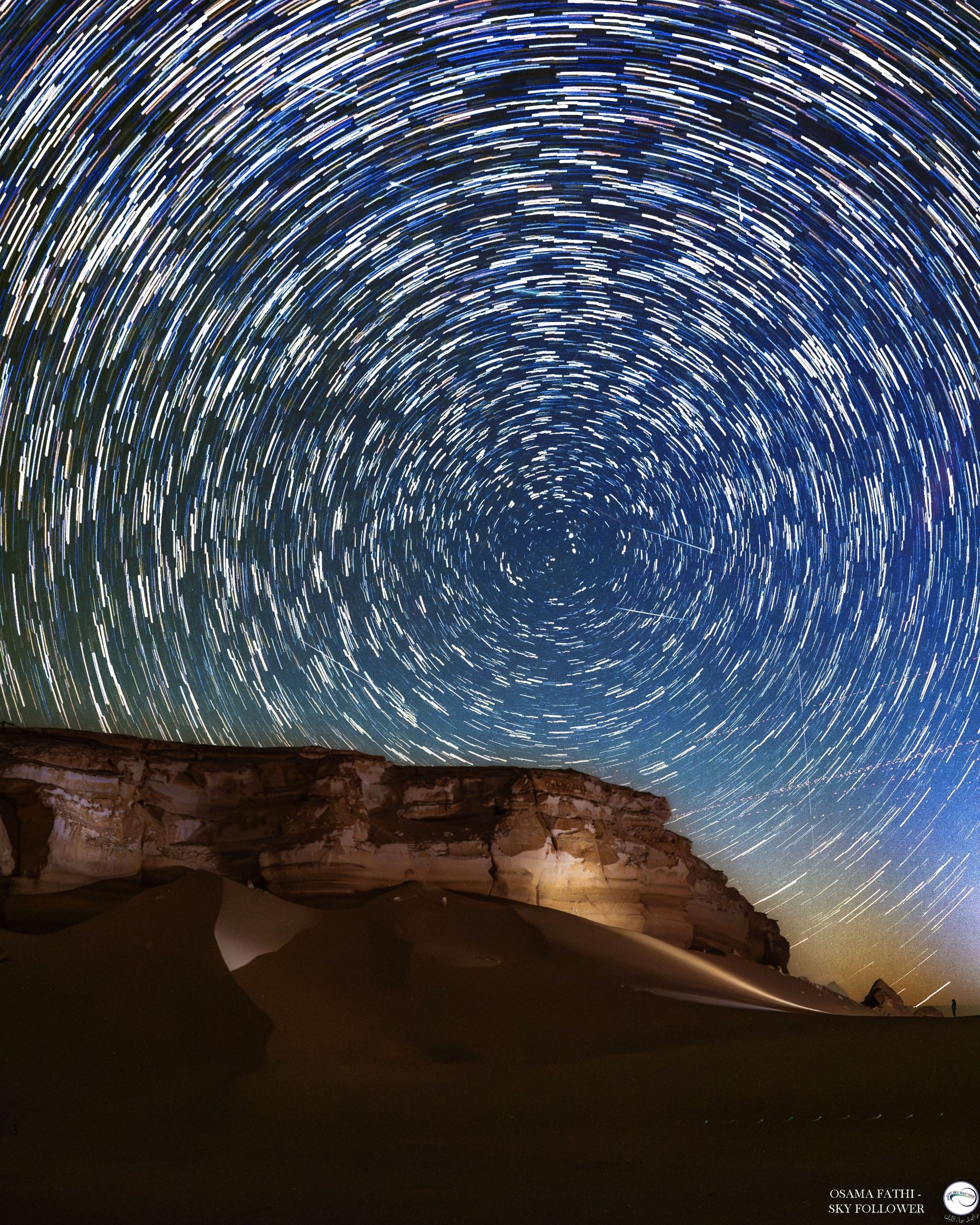
Astrophotographer Osama Fathi created this incredible view of Perseid meteors streaking through circling star trails above Egypt's Western Desert on Aug. 13-14, the night following the shower's peak under dark new-moon skies.
Fathi imaged the star trails in 240 consecutive 25-second exposures, which captured the apparent motion of the stars in Earth's sky as they seemed to circle the celestial north pole and the North Star Polaris. The length of each trail reveals how far the stars appeared to move as Fathi captured their ancient light with his Sony A7 III camera and a 16-35 mm lens during the 100-minute shoot.
But Fathi wasn't alone beneath the desert skies as he captured the scene.
"Capturing this photo in Egypt's Western Desert during the Perseids was an unforgettable experience," Fathi told Space.com in an email. "The night was exceptionally clear and I was surrounded by around 200 fellow astronomy enthusiasts sharing stories, stargazing and photographing the sky."
Perseid meteors appear as unbroken streaks of light, captured in a single exposure as tiny particles — often no larger than a grain of sand — burn up in Earth's atmosphere in the blink of an eye.
Dotted trails closer to the horizon depict the trajectories of satellites as they passed silently through the skies over Egypt's Western Desert. Fathi captured the landscape and starscape separately before combining, or stacking, the images into a mesmerizing image.
The result is a gorgeous nightscape that highlights the beauty of the natural landscape, the rotation of Earth and the natural light show of the Perseid meteor shower that we experience as Earth passes through the trail of debris shed by comet 109P/Swift-Tuttle.
Want to capture beautiful images of the night sky for yourself? Then be sure to read our guide to photographing star trails, along with our picks of the best cameras and lenses for astrophotography available in 2026.
Editor's Note: If you would like to share your photos of the night sky with Space.com's readers, then please send your photo(s), comments, name and location to spacephotos@space.com.

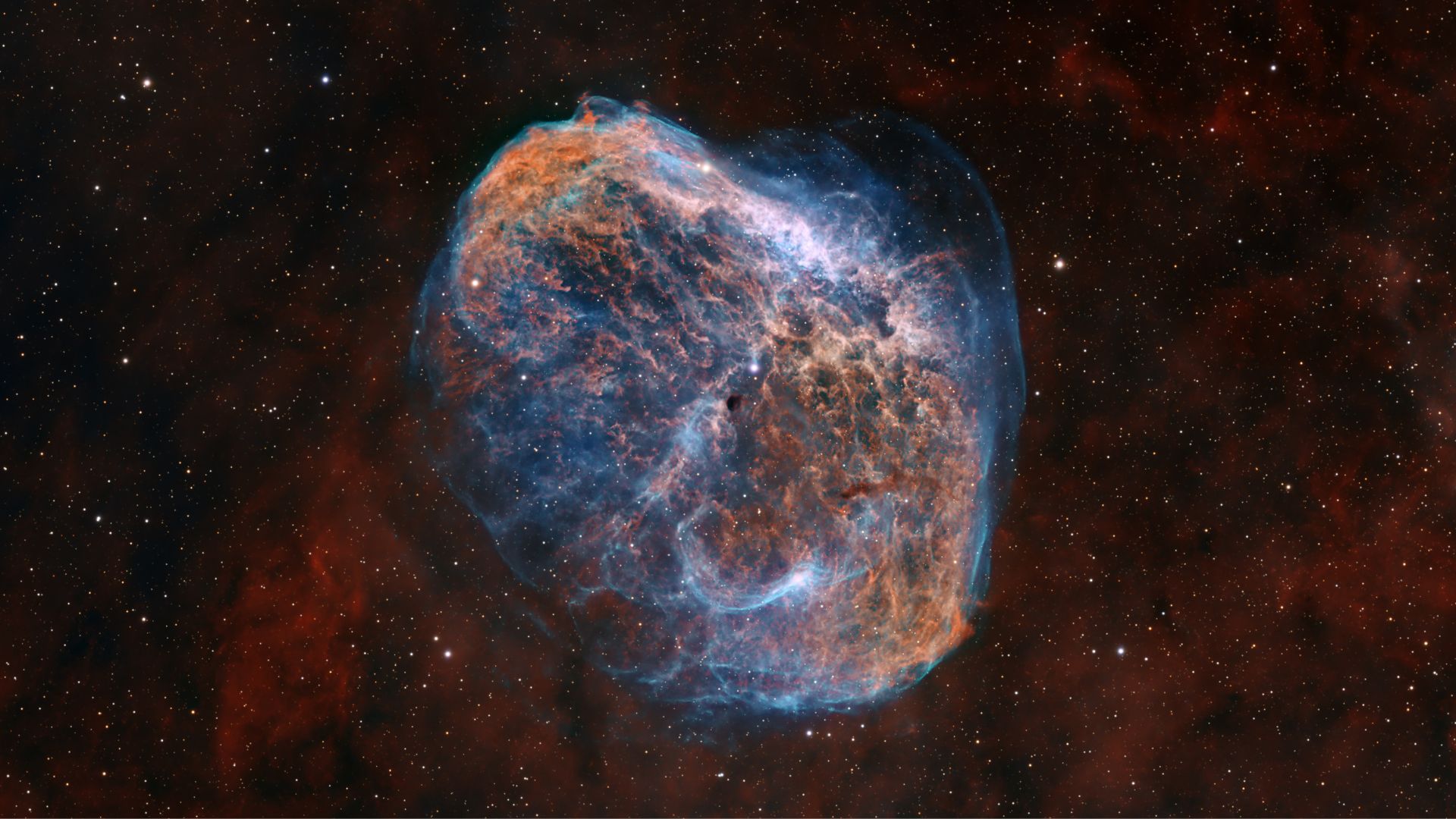
Astrophotographer Kevin Boardman captured this spectacular view of the Crescent Nebula, revealing intricate filaments of gas surrounding a massive star nearing the end of its life some 4,700 light-years from Earth in the constellation Cygnus.
Boardman's image represents a turbulent chapter in the life of the colossal Wolf-Rayet star WR 136 (HD 192163), which, visible as a blue point of light at the center of the image, is expected to end its life in a dramatic supernova explosion in about 100,000 years.
The 25-light-year-wide bubble is formed from stellar material cast off by WR 136 during its transformation into a red giant star, according to NASA. Repeated impacts by fast-moving stellar winds later send shockwaves through the outer shell, creating the complex filaments we see today.
The ZWO ASI533MC Pro camera is the best dedicated astro camera out there, in our opinion. It features zero amp glow, 80% quantum efficiency and a 20FPS frame rate. It also features a 9MP sensor and you can check out our ZWO ASI533MC Pro review for a more in-depth look.
Catalogued as NGC 6888, or Caldwell 27, the Crescent Nebula, gets its nickname from its crescent-moon like appearance when observed in certain wavelengths of light. Boardman revealed spectacular detail in the nebula by imaging it with a set of narrowband filters over 16 hours and 18 minutes spread across five nights in late July.
"In the image, orange-red H-alpha reveals the tangled filaments while blue-cyan [O III] outlines emission from doubly ionized oxygen around the shell," Boardman told Space.com in an email. Each filter isolates specific wavelengths of light emitted by ionized gases, allowing different structures within the nebula to stand out.
Boardman collected roughly 12 hours of narrowband data from the nebula itself, along with four hours and 20 minutes of data capturing the surrounding stars, before combining exposures using the astronomy software PixInsight during post-processing.
The Crescent Nebula is too faint to be spotted with the naked eye, but can be seen with a moderate-to-large telescope equipped with a light pollution filter throughout September.
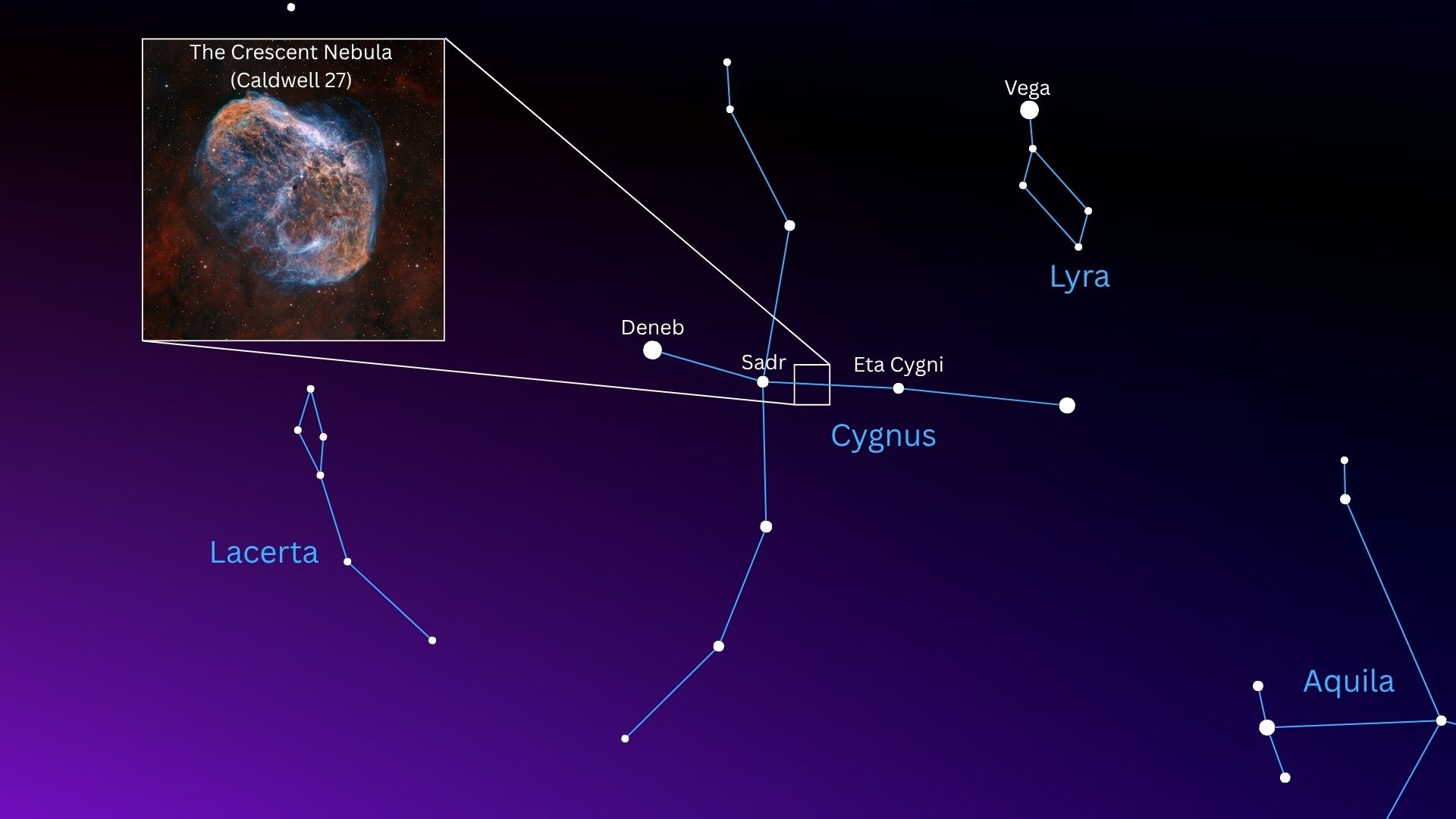
First, locate the magnitude +2.34 star Sadr at the center of the cross-shaped constellation Cygnus, which appears high overhead for Northern Hemisphere observers in late summer.
Next, locate the dimmer magnitude +4.03 star Eta Cygni using the simplified star chart above, or with the aid of a smartphone astronomy app. The Crescent Nebula lies directly between these two bright stars and is best seen on the dark nights surrounding this month's new moon phase on Sept. 10-11.
Be sure to check out our roundups of the best cameras and lenses for astrophotography if you're looking to upgrade your equipment, along with our picks of the top telescopes for observing the night sky.
Editor's Note: If you would like to share your astrophotography with Space.com's readers, then please send your photo(s), comments, and your name and location to spacephotos@space.com.
Life in space is hard. Most orbiting observatories retire well before their 20th birthday. Yet the Hubble Space Telescope has survived and continues to thrive well into its 30s. Astronomers celebrated the observatory’s 36th birthday in April by releasing a new image of the Trifid Nebula (M20). This stellar nursery lies about 5,000 light-years fromContinue reading "Hubble captures a corner of M20"
The post Hubble captures a corner of M20 appeared first on Astronomy Magazine.
Astrophotography tends to blur the boundary between science and art. The incredible images from Hubble and JWST, for example, captivate us as much for their aesthetic beauty as for their data. Recently, a photography student blurred those lines even further, taking the concept of capturing the cosmos quite literally by creating images from film’s interactionContinue reading "How one student captured the universe without light"
The post How one student captured the universe without light appeared first on Astronomy Magazine.

Two dormant volcanoes in the Andes are shown “connected” by the glowing ribbon of a distant cosmic feature stretching across the sky between them, in a rare cosmic alignment echoing ancient legends about these neighboring peaks—and all of it was captured in one of the most breathtaking astronomy images in recent memory.
The photo (seen below) was captured by astrophotographer Gonzalo Laserna Vargas and showcased by the American space agency this week. In it, we see Parinacota and Pomerape, a pair of ancient stratovolcanoes that form an unmistakable part of the landscape along the border between Bolivia and Chile.
In local folklore, these two prominences represent a prince and princess whose forbidden romance forever linked them in myth. Although no geological evidence exists for any physical links between them, astronomy recently helped fulfil that mythic connection in an unprecedented night sky display. The unique conditions that made this image possible, as well as the planning and preparation that went into it, were described by Vargas in a recent post on his Instagram account.
In the new imagery, recently featured as NASA’s Astronomy Picture of the Day, Barnard’s Loop—a vast arc of glowing hydrogen gas surrounding part of the constellation Orion—is showcased in a long-exposure photograph as it appears behind the two volcanoes.
The image was captured coinciding with the appearance of the nebula directly behind the volcanoes, and from an angle that causes the visible portion of the celestial object to appear as though it is rising from the mouths of the ancient volcanic peaks, uniting them through what resembles a colorful, luminous aerial display.
Despite the awe-inspiring appearance of the imagery, as part of the larger Orion Molecular Cloud, Barnard’s Loop remains at a distance of around 440 parsecs from these dormant volcanic peaks—in other words, close to 1,400 light-years away.
Capturing a cosmic convergence at this scale required careful planning by Vargas, who took a sequence of exposures from the same location in Bolivia in mid-April, at a time when the nebula appeared perfectly in between the two mountain summits.
One thing that helped with this is the fact that Barnard’s Loop is one of the largest emission nebulae visible from Earth. Although it is far too faint to be seen easily with the naked eye, the nebula’s vibrant pink and orange colors appear in long-exposure photography, revealing its eerie halo fueled by the presence of hydrogen gas.
Along with Barnard’s Loop, several of the night sky’s most recognizable objects also make an appearance in Vargas’s photo. Near the center of the image is the Orion Nebula, which happens to be one of the nearest stellar nurseries to Earth. Such areas of the cosmos are places where new star formation occurs within vast clouds of cosmic dust and gas.
To the nebula’s right, Betelgeuse is also visible, the reddish supergiant which was recently confirmed to have a stellar companion after more than a century of speculation about what might cause unusual variances in its brightness.
Higher in the image, another striking feature—the Rosette Nebula—can also be seen, revealed as a massive cloud of glowing gas around a small group of young stars.
Although each of these features is separated by hundreds or even thousands of light-years from Vargas’s imagery, they all appear in a singular frame, producing a dramatic cosmic backdrop for the ancient volcanic landscape they appear above.
Hence, for reasons that are easy to see, Vargas’s photo was named NASA’s Astronomy Picture of the Day for July 28, 2026, revealing another artful view of the cosmos that relies on far more than just advanced equipment—it also showcases the necessity for astronomical knowledge, careful preparation, and, of course, impeccable timing.
The result in this case is a moment captured in time, where mythology, an ancient volcanic landscape, and the cosmos all converge within a single frame.
You can learn more about this image at NASA’s website, and follow Vargas and his cosmic photography on Instagram.
Micah Hanks is the Editor-in-Chief and Co-Founder of The Debrief. A longtime reporter on science, defense, and technology with a focus on space and astronomy, he can be reached at micah@thedebrief.org. Follow him on X @MicahHanks, and at micahhanks.com.
In a rare first for me, I actually used autofocus for this entire astrophotography shoot. If I'm being honest? I prefer it when shooting astro with a mirrorless camera. Why? Because it is quicker and that means more time capturing the stars and less time setting up. I can get a star in sharp focus using autofocus in half the time that it would take me to do it manually and it's way easier to focus with the shutter or back button than play about with the focus ring, especially with cold fingers.
I only managed to get out under one clear sky to test the new R6 III but it was a wonderful session at my usual dark hill spot surrounded by a sea of stars and celestial shapes. After setting up my tripod, I was ready to start shooting, armed with the Canon 14mm f/1.4 and 45mm f/1.2 lenses.
If you are a seasoned astrophotographer, you will undoubtedly have started your craft by learning how to manually focus on stars to get them crisp and sharp in the frame. Everyone does. Whilst the manual focus (MF) versus autofocus (AF) debate continues within the community, the technology for low-light autofocusing capability has come a long way since mirrorless cameras were first introduced and the R6 III is physical proof of that.
You only get the luxury of being able to do this if your camera is actually good at autofocusing in low light and for starry nightscapes. All three versions of the Canon EOS R6 feature a low-light autofocus range of -6.5 exposure value (EV), so they already have a strong baseline for shooting under dark skies. The Canon EOS R6 III features a higher resolution and advanced autofocus algorithms, so the AF system actually has more data to use and is better at using it.
I was able to capture bright objects easily and start shooting without having to spend ages using manual focus for each new shot. The autofocus was powerful enough to capture at least one star in each of my frames. I simply used autofocus on the brighter points of light in my composition, waited for the green box and then switched to manual to avoid any refocusing if I decided to recompose the shot.
Bright objects were the easiest to capture, with Jupiter, Pollux and Castor easily captured in the western sky. Light pollution washed out the contrast in this shot but it was the quickest autofocus because of the brightness of the objects.
The autofocus helped me capture a range of other constellations too. With the R6 III focusing on the bright star Arcturus, along with the rest of Boötes and Coma Berenices next to the Coma Star Cluster (Melotte 111).
The shape of Leo is recognisable and the autofocus captured the brightest star, Regulus, to bring the rest of the stars in the constellation into focus. You can even spot the Beehive Cluster (M44) in Cancer, to the right of the frame and it is fairly sharp in focus. Barring some minor star trailing from my lack of a star tracker, the stars are nicely in focus, including on minor objects like star clusters.
Using the 45mm lens, I got some close-ups of some quadrilateral shapes in the sky. Hercules' prominent trapezoidal keystone is visible and one of the corners, Zeta Herculis, was picked up by the autofocus. It is not exactly a bright star, with a magnitude of 2.88, but the R6 III picked it up easily and brought the rest of the corners into focus. Whilst barely a smudge along one of the sides of Hercules, I even managed to capture the Hercules globular cluster (M13) with the R6 III and the Canon RF 45mm wide open at f/1.2.
The polygonal head of the dragon in Draco was easily captured in the centre of the frame, with bright stars Eltanin (2.23), Rastaban (2.79) and even Iota Herculis (3.8) showing prominently. The autofocus capabilities of the EOS R6 III are maximised when used alongside a lens with a very fast aperture like f/1.4 and f/1.2. Without these types of lenses, you would be much less likely to be able to autofocus on such dim stars.
The big question when looking at the third iteration of a camera model is to figure out if the upgrades are actually worth it. First, you have to think about your budget and also what you are using the camera for. For astrophotography, there are a few upgrades in the EOS R6 III that can be considered to see whether they are worth it.
The most noticeable upgrade on the R6 III is the resolution, which has been upgraded from the R6 II's 24.2MP sensor to a 32.5 MP sensor. On top of improved resolution for general and astrophotography, the boosted number of pixels allows the Dual Pixel CMOS AF II to collect even more data points because there are more pixels. Dual Pixel architecture splits each pixel into two separate photodiodes and allows each photodiode to read the light from the star at two different positions and allows the lens motor to bring those points together into perfect focus.
The upgraded sensor resolution combined with upgraded tracking algorithms from the flagship Canon EOS R5 II make the R6 III better at locking onto low-light points and make autofocus for astrophotography much more reliable than in previous models.
I initially expected the higher resolution to translate into more image noise on photographs but this was not the case. The R6 III utilizes dual-gate gain architecture, which means that every pixel has a switchable path at the hardware level depending on the ISO level used and allows images with higher ISOs to have a heavily reduced base amount of noise and thus makes them less grainy.
Photos at lower ISOs on the R6 III have an incredibly high dynamic range (HDR) thanks to the low conversion gate (LCG) circuit. This allows the natural color of the stars to be preserved instead of coming across as indeterminate white blobs, as well as the subtle hues of the dark surrounding sky in the photograph.
Aside from the technical aspects of how the resolution improves the autofocus, the detail in images from the R6 III is noticeable and is great for picking up finer stellar structures such as star clusters and smaller stars. When paired with a distorted lens like the Canon RF 7-14mm f/2.8-3.5 fisheye lens, extra resolution really helps details pop. I didn't get to use the fisheye lens for astro but general daytime shooting delivered some high-quality photographs.
The final important upgrade on the R6 III is the inclusion of a CFexpress card slot, which allows faster writing and reading speeds both in camera and during media downloads. A UHS-II SD card has an average read speed of 300MB/s and an average write speed of 260MB/s.
This may seem fast but the most advanced CFexpress cards have a read and write speed of over 3000MB/s, which makes huge workloads so much easier to process. This may only be of benefit to professional photographers who shoot a lot of video or need to do a huge amount of burst photography in RAW format, but it does vastly improve the performance of this camera. Bear in mind that CFexpress cards are much more expensive than SD cards and require an additional CFexpress reader to transfer data to a computer.
The price difference between the R6 Mark II and the Mark III is just under $1000 and for that amount of money, justifying the move up to the latest model comes down to a few factors that you will have to consider. The power of the low-light autofocus is tempting but you should think about the camera as a whole to see whether it is worth making the investment.
If you are looking to boost resolution in your night-time scenes and have been shooting astrophotography for a long time, the R6 III could be worth the extra investment thanks to the 32.5MP sensor, which retains the powerful dual-gain architecture for getting high dynamic range images at lower ISOs and delivering high ISO images with significantly less grain.
If you have a heavy workflow, you are likely to be frustrated with the lack of a CFexpress card slot on the earlier R6 models and would benefit from the advanced functionality the new slot will give you, especially if you shoot a lot of RAW imagery and video.
Stick with an earlier model or a different mirrorless camera if you are a very casual astrophotographer who does most of your shooting in the daytime. I just can't justify the massive jump in price for basic shooting, where a beginner or intermediate photographer's money might be better spent on getting a fast f/1.4 lens for superior astro. I used the Canon RF 14mm f/1.4 lens for astrophotography testing and I don't think the images would have looked half as good if I had used a lens with a smaller aperture. If you already own the R6 II, the only reason you might upgrade is if you need to do more heavy cropping into your images or need better hybrid video functionality from a camera.
In 1839, the president of Harvard University invited William Bond to move into a house on campus and, by virtue of bringing along his own astronomical equipment, become the university’s first astronomer in residence. With public interest spurred by the 1835 passage of Halley’s Comet and the Comet of 1843, Harvard soon had enough moneyContinue reading "July 16, 1850: Bond and Whipple photograph Vega"
The post July 16, 1850: Bond and Whipple photograph Vega appeared first on Astronomy Magazine.
On my way to Tash Rabat from Son-Kul, both in Kyrgyzstan, sitting on the comfortable seats of a minibus, I had to pinch myself just to realize that it wasn’t a dream. I could see green valleys on one side of the road and the rugged brown Pamir Plateau on the other. As someone whoContinue reading "Capturing the night sky in Kyrgyzstan"
The post Capturing the night sky in Kyrgyzstan appeared first on Astronomy Magazine.