❌

Normal view

Tokenization Of H2O: Is O2 Next?

Water is the foundation of life itself. The UN says we are entering an age of “Global Water Bankruptcy” and therefore we should be subjected to “bankruptcy management,” where “conservators” are appointed by the court to manage the sale of remaining assets. Hence, tokenization enters stage right: sell the scarcity to the world in a price auction. The whole scheme is indisputably evil! ⁃ Patrick Wood, Editor.

The Elites are Claiming the World’s Water Supply and Plan to Trade It on the Stock Market.

Yep, you heard me right. This is not a joke or exaggeration. The facts are out there for all to see. I wrote about the tokenization of nature in my article “From Blockchain to Ball and Chain: Are We Being Borged?” [1] This article will deal primarily with the tokenization of the world’s water supply.

Tokenization: Turning Life Itself into a Tradeable Chip

For those who do not understand tokenization, here is a short and simple explanation: Tokenization means turning something real, like a share of water rights, a measured volume of water from a river or aquifer, or even credits for water that was “saved” or recycled, into a digital token (a unique digital certificate) that lives on a blockchain.

A blockchain is simply a shared digital notebook that many computers keep identical copies of at the same time, so the records of who owns what cannot be secretly changed by any one person or company.

That token can then be bought, sold, or traded on markets the same way people trade stocks or other assets. Instead of water simply belonging to the land, the local community, or the people who rely on it, it becomes a financial product that large investors, corporations, and institutions can own fractions of and exchange for profit. The right to use, claim, offset, or trade that water becomes the commodity.

Offset means making up for the water you use by helping save or restore the same amount somewhere else. A farmer switches to drip irrigation, a project restores a wetland, or a company reuses treated wastewater. That saved or restored water is measured and turned into credit. You buy or claim the credit. On paper your water use is balanced.

How Dare They Profit from Stealing Our Water

How dare they make money off this corrupt plan to steal, control, measure and meter the world’s water supply. Yes, I sound like Greta. The irony is thick: the same girl who made “How dare you” famous has been thoroughly programmed to cheer for Agenda 2030 and the very control grid she should be screaming against. Since she refuses to use her catchphrase where it actually belongs, then I will.

Water is the foundation of life itself. Every human, every animal, every plant depends on it. Yet the same elites who lecture the public about scarcity and climate are building the machinery to turn every last drop into a tradable asset they can profit from while ordinary people face rationing and surveillance.

This is exactly the process already described and promoted in official reports. Goldman Sachs itself published “Securing and Financing the Future of Water” in 2026, openly stating that tokenization can turn water rights into traceable tokens that track use across markets and deliver credits for companies that conserve or recycle water through connections to flow meters. Read it yourself: https://www.goldmansachs.com/insights/articles/securing-and-financing-the-future-of-water

The United Nations has declared the world has entered an era of “Global Water Bankruptcy.” Their report argues that the old system of local rights is finished and that new enforceable limits, transparent accounting, and centralized management are required. See the official collection: https://unu.edu/inweh/collection/global-water-bankruptcy

The Mapping Machines Are Already Flying Over Your Head

Look at how they are already doing it. Across the United States, helicopters now fly low over farms and aquifers towing giant electromagnetic loops that map the groundwater beneath our feet like an MRI of the earth. California’s Department of Water Resources runs statewide Airborne Electromagnetic Surveys for exactly this purpose. Click here to read how the water mapping technology works: https://water.ca.gov/programs/sgma/aem

hese surveys create detailed maps of every major water source so that usage can later be tracked and limited.

The All-Seeing Eye of Oracle Returns: Now It Watches Every Drop You Use

Oracle Utilities already processes data from more than 100 million meters worldwide with AI systems that detect irrigation, leaks, and individual household use in real time. Their customer platform is designed for exactly this level of precise control: https://www.oracle.com/utilities/customer-platform/

Larry Ellison didn’t just dream of a panopticon. He said the quiet part out loud: “Citizens will be on their best behavior because we are constantly recording and reporting everything that’s going on.” That wasn’t a warning. That was a sales pitch from the man who still owns roughly 40% of Oracle, the company now quietly embedding itself into the pipes that deliver the most basic resource on Earth: water.

Once you own the real-time ledger of every drop that enters every home, every farm, every factory, you don’t need jackboots. You just need a dashboard. Throttle the water, and compliance follows. The same technocratic elite that spent decades consolidating data, finance, and surveillance is now moving on the last ungoverned commons, water itself, under the soothing branding of “customer platforms” and “smart utilities.”

And Ellison isn’t some lone eccentric billionaire operating in a vacuum. He’s a Trump donor who poured roughly $45 million into supporting the 2024 campaign and has since enjoyed the kind of access that turns political proximity into regulatory profit. The same circle that lectures about freedom while building the tools to score, monitor, and ration everyday life now has one of its most unapologetic surveillance advocates sitting in their inner circle.

The water meters are just the latest sensor in a system that already knows when you open the fridge, when and where you drive, when you yawn, drink, text or speak and soon, how long you shower and how many times you flush your toilet.

This is not innovation. This is the elite’s operating system for managed scarcity and behavioral compliance, dressed up as progress and sold by a man who openly celebrated the idea that constant recording would keep the public “on their best behavior.” Oracle isn’t managing utilities. It’s helping construct the choke points. What’s next Larry? Are you going to regulate and tokenize oxygen?

The infrastructure for control is already being paired with the financial machinery. Chainlink, a decentralized oracle network that feeds real-world data such as meter readings and conservation verification into blockchain systems, has published detailed guides on digitizing water rights and conservation credits into tokens so companies can buy offsets just like carbon credits: https://chain.link/article/tokenized-water-rights-credits

In Dubai, the DMCC (Dubai Multi Commodities Centre), a government-backed free zone and major international trading hub, has signed agreements to launch the world’s first digital token backed by verified freshwater reserves, positioning water itself as a tradable commodity on global markets: https://mediaoffice.ae/en/news/2025/june/17-06/dmcc-signs-strategic-mou

They Already Seized the Food and Are Playing God with the Weather

The elites have been systematically taking control of the world’s food supply for years. Bill Gates, through Cascade Investment, has become the largest private owner of U.S. farmland, holding hundreds of thousands of acres across nearly twenty states. At the same time, major asset managers like BlackRock hold massive stakes in the dominant agribusiness corporations that control seeds, fertilizers, processing, and distribution.

Simultaneously, cloud seeding programs and solar geoengineering research, backed by Silicon Valley money and governments, are rapidly expanding. These efforts claim to manage rainfall and cool the planet, yet they place the power to influence weather patterns in the hands of the very institutions already pushing centralized control over water and food.

In other words, they are running the classic Hegelian dialectic to consolidate power:

  1. Create the droughts through weather geoengineering/modification
  2. Declare an emergency and frighten the public.
  3. Arrive with the “solution,” water tokenization that will supposedly save the planet but in reality just make them richer.

The pattern is unmistakable. Connect the dots. First, they buy the land that grows the food. Then they experiment with altering the weather that waters the crops. Now they are mapping, metering, and tokenizing the water itself so that every drop can be tracked, rationed, and sold.

This Is Not Theory. This Is the Takeover in Progress. Technocracy 101

They tell us water is too important to leave in local hands. They declare bankruptcy on systems that have sustained communities for generations. Then they create the digital and physical infrastructure to measure every use, enforce every limit, and profit from every token. The shared nature of water is being rewritten into a system of permission slips owned by the elite few who say that they, the experts, the financiers, the scientists, know best how to manage nature and humanity. It is all part and parcel of the plan of Technocracy Inc.

And make no mistake, this entire scheme sits squarely inside the United Nations Agenda 2030 and its Sustainable Development Goals. SDG 6 pretends to be about “clean water and sanitation for all,” yet the real machinery being built is the global accounting, metering, and financialization of every drop. The same institutions that wrote the goals now promote water “bankruptcy,” enforceable limits, transparent tracking, and market-based solutions that turn a basic necessity of life into a tradable asset class. What is sold to the public as sustainability and equity is in practice the transfer of control from communities and nations to the very financial and bureaucratic elites who drafted the blueprint. Agenda 2030 is the framework being used to justify seizing, measuring, and selling the world’s water under the banner of saving it.

This is the plan. It is already in motion. And the people pushing it expect the public to accept it as inevitable.

It is NOT inevitable.

Resistance is NOT futile.

Expose the plan. Shout if from the rooftops, news sites, podcasts and council meetings.

Don’t let the elites complete their takeover plan. They have the money but we have the numbers.

Read full story here…

EAGLE

31 July 2026 at 23:02

EAGLE

Explorer for Artemis Geology, Lunar, and Earth — a NASA satellite program to study surface biology and geology on Earth, with technologies that could support future missions to the Moon and Mars.

Future Mission

NASA’s EAGLE program — Explorer for Artemis Geology, Lunar, and Earth — will be a series of satellite missions studying surface properties using technologies for Earth observation that will also benefit future missions to the Moon and Mars, where they could identify critical resources and safe landing sites.

The satellites making up the first two EAGLE missions will study biology and geology on Earth’s surface to support agriculture, disaster response, and other needs. Each mission will carry a different instrument with capabilities that complement each other. The first mission (EAGLE-VSWIR) is scheduled to take flight in 2028.

Mission Type

Orbiter

Target

Earth, Moon, Mars

Launch

No earlier than 2028

Objective

Study surface composition and changes

  • EAGLE-VSWIR

    EAGLE-VSWIR (Visible to Shortwave Infrared) will observe the Earth’s surface every 16 days with a high-resolution imaging spectrometer, which measures light reflected from the planet’s surface, separating wavelengths across the visual and into the infrared spectrum. The patterns created by light being reflected or absorbed across this spectral range act like fingerprints, letting scientists identify the composition of the surface. 

    A similar instrument, NASA’s EMIT (Earth Surface Mineral Dust Source Investigation), has been monitoring Earth from the International Space Station since July 2022, characterizing the surface mineral composition of Earth’s arid lands, monitoring ecosystem status, and tracking health and safety hazards — such as methane leaks and acid mine drainage — among other applications.

    EAGLE-VSWIR will have 25 times more capability than EMIT has today. This technological leap will allow scientists to map surface deposits of critical and rare-earth minerals, strengthen food security, and aid wildfire prevention and recovery. It can also highlight environmental hazards such as oil spills or landslide risks, and monitor water quality and availability.

    Region of Nevada as observed by NASA's EMIT with spectrum on right edge
    The front of this image cube shows a region in Nevada observed by NASA’s EMIT imaging spectrometer; the cube’s sides show the spectral fingerprint for every point in the image and can be used to discover mineral resources. EAGLE-VSWIR will have 25 times greater performance beyond NASA’s current state-of-the-art EMIT.
    NASA/JPL-Caltech
  • EAGLE-TIR

    The EAGLE-TIR mission will provide Thermal InfraRed (TIR) imagery when it launches two to three years after EAGLE-VSWIR, measuring energy emitted from the surface and producing data that scientists can use to map temperature, composition, and critical mineral deposits. On Earth that would let researchers monitor wildfires and volcanic activity, track drought and water use by crops, study urban heat islands, observe the rates that snow or ice accumulates or melts, and better understand Earth’s resilient ecosystems.

    EAGLE-TIR follows on from ECOSTRESS (ECOsystem Spaceborne Thermal Radiometer Experiment on Space Station), which has been observing Earth from the International Space Station since 2018. ECOSTRESS was designed to study how different ecosystems respond to drought and water stress, and the data has provided a vital understanding of how plants’ water use changes throughout the day. Since ECOSTRESS also measures emitted energy in the thermal infrared, its surface-temperature products have also been used for urban planning and wildfire monitoring. 

    Further innovation and lessons learned from ECOSTRESS has led to EAGLE-TIR, which will carry a multi-band thermal radiometer. EAGLE-TIR’s great strength compared to existing missions is that it provides detailed imagery of the entire globe every two days, day and night, at multiple wavelengths not available from other instruments.

    Aerial view of Namib desert in Infrared captured by ECOSTRESS
    This image shows the minerals contained in Namibian dunes using ECOSTRESS data. EAGLE-TIR will have more spectral channels to enable even better mineral discrimination.
    NASA/JPL-Caltech
  • EAGLE Program

    By advancing vital techniques for measuring our planet’s surface composition, resources, and hazards, the EAGLE program addresses critical needs in Earth observation, with technologies that can also transfer to planetary exploration, where they’ll serve as pathfinders for future missions to the Moon and Mars.

    015B0489.NEF
    As the Artemis II crew came close to passing behind the Moon and experiencing a planned loss of signal, they captured this image of a crescent Earth setting on the Moon’s limb on April 6, 2026.
    NASA
Featured Video

EAGLE

NASA unveiled the EAGLE program as one part of its “Ignition” event on March 24, 2026, when it announced a wide-ranging series of transformative agencywide initiatives. With EAGLE (the Explorer for Artemis Geology, Lunar, and Earth missions), NASA will deploy breakthrough hyperspectral images across Earth with later missions anticipated for the Moon and Mars in rapid succession. On Earth they’ll identify critical minerals for national security, enable precision agriculture, and support disaster response. On Earth and at Mars they will locate critical minerals and resources such as ice for propellants, rare-earth elements for technology, and construction materials for habitats.

EMIT

EMIT (Earth Surface Mineral Dust Source Investigation) measures the mineral composition of Earth’s dust source regions, to help scientists understand how they heat or cool our planet.

Learn More About EMIT

ECOSTRESS

ECOSTRESS (ECOsystem Spaceborne Thermal Radiometer Experiment on Space Station) is accurately measuring the temperature of plants on Earth.

Learn More About ECOSTRESS

The post EAGLE appeared first on NASA Science.

💾

Join us for continuing coverage as our leaders discuss the agency's implementation of the National Space Policy and our plans to advance science and discover...

Queensland and NT reject Labor’s push to ensure that power-hungry AI datacentres use renewable energy

29 July 2026 at 04:19

Federal-state stoush comes as rating agency warns that electricity bills could skyrocket

Queensland and the Northern Territory have rejected the federal government’s plans to mandate that AI datacentres use renewable power, rubbishing Anthony Albanese’s proposals to regulate the booming technology as “underdeveloped ideas that hand increased power to Canberra”.

The latest federal-state stoush on energy comes as S&P Global, the economic rating agency, warns that power use from datacentres could rise five-fold by 2035 to 10% of Australia’s total consumption, and that a mismatch between delivery timelines for datacentres and renewable projects could lead to energy bills skyrocketing.

Continue reading...

© Photograph: Bloomberg/Getty Images

© Photograph: Bloomberg/Getty Images

© Photograph: Bloomberg/Getty Images

Solar-thermal desalination process operates at near 100% efficiency

9 June 2026 at 09:30

Constant access to a supply of freshwater is critical for life on this planet, as well as for the growth of industry, agriculture and modern-day economies. But natural water supplies are depleting in many parts of the world, with around 2.2 billion people lacking safely managed drinking water, according to United Nations estimates.

Many countries rely on converting ocean water into freshwater using desalination plants. But the reverse osmosis and thermal distillation techniques currently used are energy intensive and leave behind brine that raises the salt level of the water (and reduces oxygen levels), which can harm sea life.

Researchers from the University of Rochester have taken a new approach by developing a solar-thermal desalination process that’s less energy intensive, doesn’t generate brine and doesn’t require chemical additives to pre-treat the water.

“Today, about one quarter of the global population lacks safely managed drinking water; but at the same time the oceans contain an enormous resource of both water and valuable minerals,” explains lead researcher Chunlei Guo. “We wanted to develop a technology that could address these challenges together, producing freshwater sustainably while turning what is traditionally considered waste into a resource.”

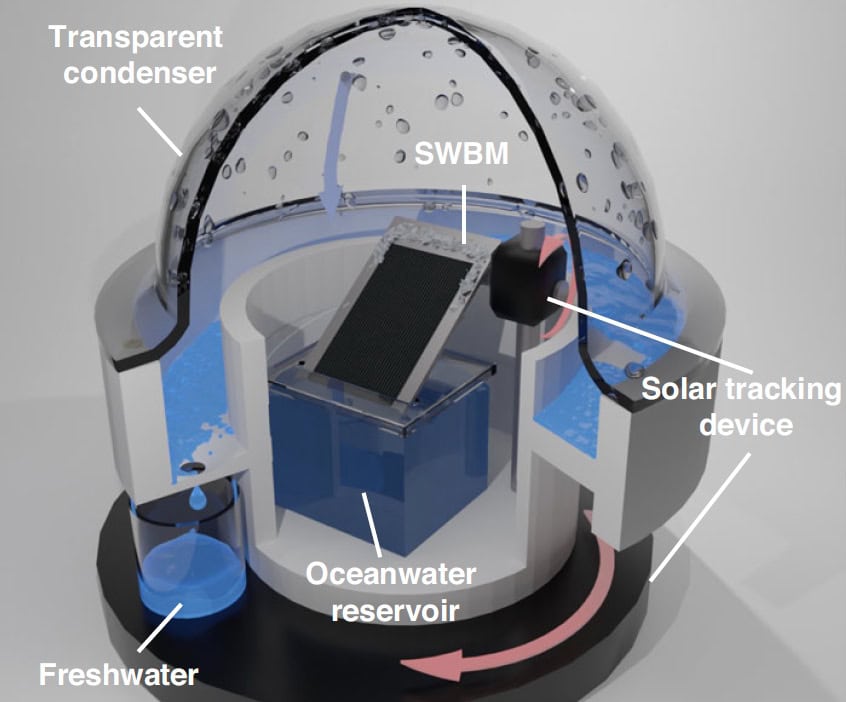
The novel desalination technology, described in Light: Science & Applications, is based on a multi-functional superwicking black metal (SWBM) panel created via femtosecond laser processing. Desalination involves evaporating and distilling the water, removing the salt in the process. To do this, materials that absorb sunlight and heat up, while wicking water, are required. The SWBM panel proved effective at both.

The SWBM panel is highly attractive to water and can pull a thin film of water upwards across its surface, while absorbing almost all solar energy. This uphill pulling of water against gravity means that the panel can be placed in any orientation, enabling effective solar tracking.

The evaporated and distilled water can be extracted from the panel and the remaining salts are directed away from the panel’s active region and deposited in its passive (untreated) regions. This not only self-cleans the active region of the panel, but enables continuous desalination to produce distilled drinking water.

Harvesting valuable minerals

This approach means that concentrated brines are not deposited back into the ocean, and the solid salt can be collected and used to produce common table salt. The process also extracts other precious minerals such as lithium, which could be used in battery manufacturing. As traditional land-based mining becomes more expensive, extracting lithium directly from ocean water could prove a lower-cost, more sustainable option.

“The most important advance is that our system can desalinate real ocean water continuously using sunlight alone, without generating waste, with little to no maintenance and while recovering valuable minerals such as lithium,” says Guo. “By using a superwicking, self‑cleaning surface invented in my lab to move salts away from the evaporation region, we overcame the clogging bottleneck that has limited solar desalination until now. This is the first time we have achieved stable, low‑maintenance, high‑efficiency and nearly 100% salt-recovery performance with actual seawater.”

Solar-tracking desalination system
Solar-tracking desalination system Sunlight is incident on the SWBM panel through a transparent hemispherical dome, generating water vapour that condenses on the dome’s interior hydrophobic surface and is collected by the walls. (Courtesy: CC BY 4.0/Light Sci Appl 10.1038/s41377-026-02315-4)

The self-cleaning mechanism is vital for use in real-world scenarios. Many desalination technologies work in the lab where the only mineral component is sodium chloride. Ocean water, however, contains many other materials, such as magnesium and calcium salts, that could crystallize on the panel and clog it. The self-cleaning process is driven by etched grooves that stop these minerals from staying on the panel. If oceans contain too high a mineral content, wider and deeper grooves can be etched into the panel by applying a higher laser power during fabrication.

The team tested the solar-thermal desalination panel using water samples from Pacific, Atlantic and Indian Oceans. When tracking the sun over a week to purify the ocean water, the panel demonstrated an average evaporation rate of 1.76±0.04 kg/m2/h and a salt harvesting rate of 61.74 ± 2.46  kg/m2/h under one sun illumination, corresponding to 74% solar-to-vapour conversion efficiency and near-100% salt extraction.

The researchers are now working to scale up the technology and integrate it with other mature platforms, such as solar cells. “We have made significant progress by demonstrating that the desalination process can be used to cool the solar cells, improving electrical output while simultaneously producing freshwater. This approach could lead to a synergistic water-energy system that operates sustainably,” Guo tells Physics World.

The post Solar-thermal desalination process operates at near 100% efficiency appeared first on Physics World.

In One of Africa’s Deepest Lakes, Scientists Have Found a Species No One Expected Swimming at Incredible Depths

25 July 2026 at 13:00

A remarkable discovery has been made in East Africa’s Lake Malawi, one of the deepest bodies of water on the African continent.

Africa’s impressive lakes have long remained a focus of speculation for naturalists, involving folklore about strange creatures—including supposed holdovers from prehistoric times—alleged to inhabit some of their waters.

However, a much smaller discovery made by a team of researchers with the Department of Zoology at the University of British Columbia (UBC) at Vancouver, Canada, is nonetheless challenging our past thinking on what kinds of life forms can be found lurking in the depths of some of Africa’s storied lakes.

In a remarkable discovery, a variety of lake fly larvae have been found descending into the very oxygen-deprived depths of Lake Malawi, where they hide more than 650 feet below the surface to avoid predators.

After spending their days in this deep-water “dead zone,” the larvae reemerge at night and feed—or at least some of them do, if they are lucky enough to escape the fish searching for a dinner of their own, while these tiny insects are commuting back to the surface.

A Surprising Discovery Deep in Lake Malawi

To chart the unusual daily cycle of these larvae, UBC researchers Dr. Philip Matthews and Dr. Evan McKenzie used sonar technologies, which were positioned deep within the lake.

While this provided an idea about where these tiny insects were going, it was dissecting the larvae that revealed how these remarkable little creatures have somehow evolved a respiratory system that contains two pairs of small air sacs, which function like ballast tanks, allowing the larvae to control their buoyancy.

insect submariners
Chaoborus edulis larva (Image Credit: Philip Matthews)

Within these sacs, they discovered the presence of resilin, a material that can either expand or contract in proportion to changes in the pH of the sac’s walls. As a result, the larvae can change the volume of these unique air sacs, thereby controlling their buoyancy.

It is an unusual capability these creatures display, to say the least. Curious about how deep they might be able to go, the researchers placed several of the larvae within small pressure chambers to simulate the depths they might travel to before the sacs imploded.

Much to the team’s surprise, these natural buoyancy systems held out under conditions that would match depths of 400 meters (1,312 feet), which is much deeper than what the sonar data reveals about the larvae’s daily descents into Lake Malawi.

While it has long been assumed that insects, which often thrive in freshwater environments, do not live in open oceans due to such pressures associated with the depths of the world’s largest bodies of water, these African insect larvae reveal that such creatures can survive under such conditions.

Based on their findings, the UBC researchers hope to work on finding ways of simulating such capabilities, perhaps by creating pH-powered resilin smart materials, or even artificial systems that emulate the way muscles operate.

The team’s findings appeared in the new study, “Crush-resistant air sacs allow insect larvae to exploit aquatic habitats at extreme depth,” published in the journal Science.

Micah Hanks is the Editor-in-Chief and Co-Founder of The Debrief. A longtime reporter on science, defense, and technology with a focus on space and astronomy, he can be reached at micah@thedebrief.org. Follow him on X @MicahHanks, and at micahhanks.com.

There’s One Very Stinky Reason Why Labour’s Housebuilding Targets Are Doomed to Fail

24 July 2026 at 17:38

There's one very stinky reason why Labour's ambitious housebuilding targets are doomed to fail, says Mike Wells: Britain's creaking sewers and drainage systems simply can't cope with all the demands of new homes.

The post There’s One Very Stinky Reason Why Labour’s Housebuilding Targets Are Doomed to Fail appeared first on The Daily Sceptic.

Common Diet Advice About Water and Spicy Food May Be Completely Wrong

23 July 2026 at 20:20
Man Hot Chili Pepper ForkWater and spice influenced eating in opposite and unexpected ways during controlled meal experiments. A glass of water beside a meal is often treated as an easy way to eat less. The usual explanation is that the water stretches the stomach and creates a sense of fullness before too much food is consumed. A Cornell [...]

Key Factors Driving Sustainable Stormwater Management Success

18 July 2026 at 22:18

A new study in npj Urban Sustainability points to the practical levers that determine whether stormwater systems actually deliver long-term sustainability. As cities expand and rainfall extremes intensify, green and nature-based infrastructure has been promoted to capture runoff, reduce flooding, and protect water quality. But the research warns that success is not automatic: design decisions and operational realities can make or break performance.

The authors, Sun, Randrup, Blecken and colleagues, analyze what they call “decisive factors” governing sustainable stormwater management. Their central message is that the most visible features—such as bioswales, permeable surfaces, or detention basins—only work when supported by the right planning assumptions and measurable hydrological outcomes.

A key technical theme is how stormwater must be matched to system capacity under changing conditions. The study emphasizes that system sizing, soil or media properties, and infiltration or storage behavior strongly influence whether the infrastructure can handle typical storms and rare, high-intensity events. When these factors are misestimated, treatment efficiency can collapse during peak flows.

Equally important are maintenance and lifecycle considerations. Sustainable stormwater is sensitive to clogging, sediment accumulation, vegetation health, and changes in catchment behavior. The research highlights the need for maintenance regimes that reflect likely failure modes, rather than generic schedules that ignore local hydrology and traffic or land-use impacts.

The paper also stresses the value of monitoring and model-informed decision-making. Reliable data on rainfall patterns, runoff routing, and pollutant loads allow managers to validate performance and adjust operations. This feedback loop helps prevent long-term degradation that otherwise remains invisible until issues become costly.

For cities seeking viral, widely transferable “what works” guidance, the authors’ findings offer a shortlist of priorities: realistic capacity planning, robust material characterization, design for multi-storm performance, and maintenance strategies tied to specific mechanisms. Together, these elements translate sustainability goals into systems that function under real weather and real urban change.

The study’s DOI is 10.1038/s42949-026-00448-4.

Subject of Research: Sustainable stormwater management / urban sustainability
Article Title: Decisive factors in sustainable stormwater management
Article References: Sun, Z., Randrup, T.B., Blecken, GT. et al. Decisive factors in sustainable stormwater management. npj Urban Sustain 6, 104 (2026). https://doi.org/10.1038/s42949-026-00448-4
Image Credits: AI Generated
DOI: https://doi.org/10.1038/s42949-026-00448-4

Apple TV’s beloved kids series ‘Stillwater’ set to premiere all-new fifth season August 21st

16 July 2026 at 18:00
Apple TV has announced season five of the award-winning animated kids and family series “Stillwater,” premiering with five new episodes on August 21, 2026.

Apple TV on Thursday announced an all-new season five of the beloved, award-winning animated kids and family series “Stillwater,” premiering with five episodes on Friday, August 21, 2026. Based on the bestselling Scholastic “Zen” book series by Jon J Muth, “Stillwater” follows a wise panda who teaches three young siblings about the world and each other. The series centers on siblings Karl (Judah Mackey), Addy (Eva Ariel Binder) and Michael (Tucker Chandler), who encounter everyday challenges — big and small — which sometimes feel insurmountable. Fortunately for these three, they have Stillwater (James Sie), a wise panda, as their next-door neighbor. Through his example, stories and gentle humor, Stillwater teaches the children the concept of mindfulness, while offering them a deeper understanding of their feelings as well as tools that help them face their own day-to-day challenges. “Stillwater” is produced for Apple TV by Gaumont and Scholastic Entertainment.

Take a deep breath and embrace your inner peace by embarking on a fun adventure with the first four seasons of “Stillwater” available on Apple TV. Through breathing exercises, mindful moments and simple everyday practices, this uplifting, Peabody and Daytime Emmy Award-winning series invites you and your family to discover your own zen through each episode. “Stillwater” was produced through Apple TV’s changemakers initiative in collaboration with awareness and intention expert Mallika Chopra, author of “Buddha and the Rose” and the “Just Be” series for kids.

Apple TV has announced season five of the award-winning animated kids and family series “Stillwater,” premiering with five new episodes on August 21, 2026.

Gaumont and Scholastic Entertainment produce, with Sidonie Dumas, Nicolas Atlan, Terry Kalagian, Iole Lucchese, Caitlin Friedman, Jef Kaminsky, Jun Falkenstein and Rob Hoegee serving as executive producers. In addition, the series features the voice talents of Sie, Binder, Chandler and Mackey.

The exciting slate of recent offerings for kids and families on Apple TV also features “My Brother the Minotaur,” from Academy Award-nominated animation studio Cartoon Saloon and award-winning children’s media company Dog Ears; “Wonder Pets: In the City,” from Emmy Award winner Jennifer Oxley and produced by Nickelodeon Animation; animated adventure trilogy “WondLa,” based on the New York Times bestselling book series “The Search for WondLa” by Tony DiTerlizzi; highly anticipated kids and family series “Yo Gabba GabbaLand!” inspired by the hit, Emmy Award-nominated cultural phenomenon “Yo Gabba Gabba!”; season two of Emmy Award-winning “Shape Island,” based on the internationally bestselling picture books from Mac Barnett and Jon Klassen; animated fantasy adventure series “The Sisters Grimm,” based on Michael Buckley’s New York Times bestselling book series; the music-driven animated comedy series “BE@RBRICK” from DreamWorks Animation; “Goldie,” inspired by Emily Brundige’s award-winning 2019 short film of the same name, and many more.

Award-winning all-ages offerings now streaming globally on Apple TV also include the BAFTA Award and Emmy Award-winning live-action animated hybrid special “The Velveteen Rabbit,” BAFTA Award and Humanitas Prize-winning “El Deafo,” BAFTA Award-winning “Lovely Little Farm,” “Duck & Goose,” “Get Rolling With Otis,” Spin Master Entertainment’s “Sago Mini Friends,” Emmy Award-winning “Frog and Toad,” based on the Caldecott and Newbery Honor-winning books, Annie Award-nominated “Not a Box,” GLAAD Media Award-nominated “Pinecone & Pony,” The Jim Henson Company’s Emmy Award-winning “Fraggle Rock: Back to the Rock,” “Harriet the Spy” and “Slumberkins,” Sesame Workshop’s “Helpsters,” Joseph Gordon-Levitt, HITRECORD and Bento Box Entertainment’s “Wolfboy and the Everything Factory,” Jack McBrayer and Angela C. Santomero’s and Emmy Award-nominated “Hello, Jack! The Kindness Show.” Live-action offerings include “Me,” an elevated cinematic coming-of-age story from Barry L. Levy, Bonnie Hunt’s DGA Award and WGA Award-nominated “Amber Brown,” DGA Award-winning “Best Foot Forward,” “Surfside Girls,” WGA Award-winning “Life By Ella,” Sesame Workshop and Sinking Ship’s Emmy Award-winning “Ghostwriter,” Emmy Award and Environmental Media Association Award-winning “Jane,” and Scholastic’s “Puppy Place.” “Here We Are: Notes for Living on Planet Earth,” the Emmy Award-winning television event based on the New York Times bestselling book and TIME Best Book of the Year by Oliver Jeffers, is also featured.

Apple TV offers premium, compelling drama and comedy series, feature films, groundbreaking documentaries, and kids and family entertainment, and is available to watch across all of a user’s favorite screens. After its launch on November 1, 2019, Apple TV became the first all-original streaming service to launch around the world, and has premiered more original hits and received more award recognitions faster than any other streaming service in its debut. To date, Apple Original films, documentaries and series have been honored with 850 wins and 3,737 award nominations and counting including multi-Emmy Award-winning and history-making comedies “The Studio” and “Ted Lasso,” global cultural phenomenon “Severance,” Apple’s most-viewed drama “Pluribus,” Academy Award Best Picture winner “CODA” and Academy Award winner “F1,” the highest-grossing sports feature of all time.

MacDailyNews Note: Apple TV is available on the Apple TV app in over 100 countries and regions, on over 1 billion screens, including iPhone, iPad, Apple TV 4K, Apple Vision Pro, Mac, popular smart TVs from Samsung, LG, Sony, VIZIO, TCL and others, Roku and Amazon Fire TV devices, Chromecast with Google TV, PlayStation and Xbox gaming consoles, and at tv.apple.com, for $12.99 per month with a seven-day free trial for new subscribers. For a limited time, customers who purchase and activate a new iPhone, iPad, Apple TV 4K or Mac can enjoy three months of Apple TV for free.

Watch on Apple TV


‎
Please help support MacDailyNews — and enjoy subscriber-only articles, comments, chat, and more — by subscribing to our Substack: macdailynews.substack.com. Thank you!

Support MacDailyNews at no extra cost to you by using this link to shop at Amazon.

The post Apple TV’s beloved kids series ‘Stillwater’ set to premiere all-new fifth season August 21st appeared first on MacDailyNews.

AI Identifies the Most Effective Ways to Measure Water’s Hidden Structure

13 July 2026 at 13:21

The properties of water are unusual among liquids—it expands when it freezes, reaches its highest density just above freezing, and does not behave like the simple liquids chemists often use to understand matter.

Now, a new study in Communications Chemistry uses artificial intelligence to compare competing methods for measuring water’s hidden molecular order and determine which are truly effective.

Researchers at the University of Osaka developed a neural network to test 16 different ‘structural descriptors,’ which are mathematical tools for measuring how ordered or disordered water molecules are at the microscopic scale. Over the past 30 years, scientists have independently developed these descriptors, each with its own approach and scale, all aimed at explaining the same underlying puzzle.

Until now, researchers lacked a standard method for comparing them directly—a gap this study fills.

Water’s Split Personality

Scientists call water supercooled when it cools below its usual freezing point but remains liquid. In this state, water’s unusual traits become even more noticeable. Molecules require something like a scratch or impurity to start freezing into ice. Without these, water can stay liquid even when it is much colder than 32°F.
Many physicists believe that supercooled water is made up of two different structures: a loosely packed, highly ordered, low-density liquid (LDL) and a tightly packed, disordered, high-density liquid (HDL). The balance between these forms is thought to drive water’s unusual properties. Scientists use structural descriptors to measure how a molecule sits between these two extremes by tracking features such as the angles between neighboring atoms, distances to nearby molecules, or the formation of hydrogen bonds. However, these tools were never meant to be compared directly.

Distinguishing Hot From Cold

To establish a common standard, the Osaka team trained a neural network using molecular dynamics simulations of water at temperatures from 200 to 300 Kelvin. Using only the values from a single structural descriptor, it had to predict the temperature at which each molecular configuration was generated. If a descriptor captured meaningful structural information, the network could easily distinguish hot from cold.

“Past studies have shown that using machine learning to classify and understand structural data is effective,” says corresponding author Kang Kim. “We specifically wanted to incorporate a neural network model into this study to evaluate how accurate the descriptors were at capturing key structural information, in a way that is like human cognition.”

The network assessed each descriptor using a standard classification measure. To deepen their analysis, the team used an explainable AI technique called LIME. This method looks at how the model makes its decisions and checks whether its reasoning matches established physical principles, instead of relying only on statistical patterns.

Two Descriptors Pull Ahead

Out of the 16 descriptors tested, two stood out. The Local Structure Index (LSI) and another, referred to as zeta (ζ), both of which measure the distance between the first and second layers of neighboring molecules, achieved nearly perfect accuracy across the tested temperatures. Another group, based on how hydrogen bonds connect, also scored well but was not as accurate as the others. Older descriptors that rely on tetrahedral angles or interaction energies became less accurate at higher temperatures, where molecules move more, and the differences blur.

“The network used what it had learned to compare how 16 descriptors differentiated between LDL and HDL structures at different temperatures,” says senior author Nobuyuki Matubayasi. “In this way, we determined the most efficient descriptors.”

The LIME analysis backed up the network’s results with evidence consistent with scientists’ expectations. Molecules with high Local Structure Index and zeta values led the model to predict lower temperatures, which is consistent with the idea that more ordered, LDL-like structures appear as water cools. This suggests that the network captured more than just statistical correlations.

With a common framework for comparing descriptors in place, researchers could attempt to develop descriptors that directly identify HDL and LDL environments rather than infer them indirectly. Whether these new tools will finally solve one of water’s biggest mysteries, the point where its two proposed liquid forms fully separate, is something scientists are just starting to investigate.

Austin Burgess is a writer and researcher with a background in sales, marketing, and data analytics. He holds an MBA, a Bachelor of Science in Business Administration, and a data analytics certification. His work focuses on breaking scientific developments, with an emphasis on emerging biology, cognitive neuroscience, and archaeological discoveries.

❌