❌

Normal view

Europe's mountain summits are warming—vegetation is responding in surprisingly different ways

14 August 2026 at 23:00
Decades of climate change have not left Europe's mountain vegetation unscathed. However, the changes observed do not always match expectations. As a new international study by a research team led by researchers from the University of Vienna, the Austrian Academy of Sciences and the BOKU University shows, alpine vegetation has shifted significantly towards warmth-associated species. However, the direct link between this so-called thermophilization and local warming is surprisingly weak. The study has recently been published in the journal Nature Ecology & Evolution.

Water Found in Stellar Envelope Near the Milky Way’s Central Black Hole

11 August 2026 at 20:24

Astronomers using NASA’s James Webb Space Telescope have discovered water molecules inside the enormous envelope of gas and dust surrounding IRS 3, an aging star located remarkably close to the supermassive black hole at the centre of the Milky Way. The finding challenges the long-held assumption that the intense radiation and gravitational turbulence around Sagittarius A, commonly known as Sgr A, would prevent molecules from surviving in such a hostile environment.

IRS 3 lies about 0.6 light-years from Sgr A*, a distance equivalent to roughly 42,000 times the separation between Earth and the Sun. In everyday terms, that is an immense distance. On the scale of the Galactic Centre, however, it places the star in the immediate neighbourhood of a black hole containing approximately four million times the mass of the Sun. The region is crowded with stars, powerful magnetic fields, energetic particles and rapidly changing radiation, making IRS 3 an exceptional natural laboratory for studying how stars evolve under extreme conditions.

The observations were conducted with the Mid-Infrared Instrument, or MIRI, aboard the James Webb Space Telescope. Mid-infrared light is particularly useful for investigating cool dust and molecules that absorb and re-emit radiation at characteristic wavelengths. By analysing the infrared spectrum of IRS 3, researchers led by PD Dr Florian Peißker of the University of Cologne identified the chemical and physical properties of the material surrounding the star with far greater detail than previous observations allowed.

What makes IRS 3 especially striking is the scale of its circumstellar envelope. The structure extends to a radius of approximately 10,000 astronomical units, where one astronomical unit is the average distance between Earth and the Sun. Such envelopes are common around mature, evolved stars, but IRS 3 appears to be unusually isolated in the immediate vicinity of Sgr A*. Its enormous shell of material therefore stands out against a dense background containing millions of other stars.

The new observations indicate that IRS 3 is undergoing a phase known as a superwind. This is a brief but dramatic stage in the late evolution of certain stars, particularly asymptotic giant branch stars. During this phase, powerful stellar winds carry gas and newly formed dust away from the star at extremely high rates. Over periods of only a few centuries, the star can lose a substantial fraction of its outer layers, transforming its surroundings into a thick, expanding envelope that will eventually disperse into interstellar space.

According to the research team, IRS 3 is losing material at a rate equivalent to the mass of Earth every 18 days. Although the comparison makes the scale easier to imagine, the total outflow is far more significant when considered over astronomical timescales. The steady loss of gas and dust explains why the envelope is both unusually large and dense. It also provides the raw material in which molecules can form, shielded within cooler regions of the expanding stellar outflow.

The detection of water is the most surprising aspect of the study. Near Sgr A*, ultraviolet radiation, X-rays and high-energy particles are expected to break apart fragile molecules. Water molecules can be destroyed when energetic photons dissociate them into their constituent atoms, particularly in exposed regions close to powerful sources of radiation. Yet the MIRI observations show that water exists within the envelope of IRS 3, suggesting that the dense outflow from the star creates protected pockets where molecular chemistry can proceed.

This discovery does not mean that the Galactic Centre is a calm or hospitable environment. Instead, it demonstrates that stellar mass loss can temporarily create its own chemical refuge. The material expelled by IRS 3 increases the density of gas and dust around the star, allowing some regions of the envelope to absorb damaging radiation. Within these shielded zones, atoms can combine on dust grains or in the gas phase, producing molecules that would otherwise be rapidly destroyed. The finding offers a new view of how evolved stars may enrich even the most violent regions of a galaxy.

The researchers say that IRS 3 may be actively supplying the area around Sgr A* with elements and molecules that later become part of the broader interstellar medium. Water itself is not evidence of life, but it is a crucial ingredient in planetary formation and a central component of the chemistry that precedes biology. As the envelope expands, some of its contents will eventually mix with surrounding gas, potentially influencing the composition of future stars, planets and smaller bodies formed in the Galactic Centre.

The study, published in Astronomy & Astrophysics, also highlights the scientific value of observing the Milky Way’s centre at infrared wavelengths. Visible light is heavily obscured by dust along the line of sight, while infrared radiation can pass through much of that material and reveal otherwise hidden structures. Future observations with METIS, a next-generation mid-infrared instrument being developed for the Extremely Large Telescope in Chile, could provide sharper views of IRS 3’s envelope, measure its winds in greater detail and determine how its molecular content changes over time. For now, the star’s unexpected water-rich cocoon is offering astronomers a rare glimpse of stellar chemistry unfolding beside one of the most extreme objects in the universe.

Subject of Research: Not applicable

Article Title: Dust production in the harsh environment of Sgr A* – MIRI/JWST observation of the O-rich asymptotic giant branch star IRS 3

News Publication Date: 11-Aug-2026

Web References: https://doi.org/10.1051/0004-6361/202660243

References: Astronomy & Astrophysics

Image Credits: ESO/F. Peissker

Keywords

James Webb Space Telescope, JWST, MIRI, IRS 3, Sagittarius A, Sgr A, Milky Way, Galactic Centre, water molecules, superwind, asymptotic giant branch star, stellar evolution, circumstellar envelope, dust production, black hole, infrared astronomy, Extremely Large Telescope

Neanderthals passed on a gene that helps modern humans pack on more muscle — but only a few people have it

11 August 2026 at 20:04

Tens of thousands of years ago, Neanderthals mated with modern humans and passed along a gene variant that enables us to pack on more muscle, a new study finds.

Researchers found that this specific Neanderthal gene, a variant of the growth hormone receptor gene, causes cells to respond strongly to growth hormone. The Neanderthal version of the gene creates a growth hormone receptor with two amino acid changes and one deletion, compared with the typical receptor in most modern humans. The researchers think it entered the modern human gene pool through interbreeding, probably about 47,000 years ago.

"The most noticeable characteristic would likely be greater muscle mass, around 270 grams [9.5 ounces] per copy of the variant," study co-author Hugo Zeberg, a geneticist at the Karolinska Institute in Sweden, told Live Science in an email. "A person who inherited two copies, one from each parent, could therefore have more than half a kilogram [1.2 pounds] of additional muscle mass."

The study, published Aug. 5 in the journal Cell, found that almost all Neanderthals had this gene variant, but only about 10% of modern humans do. Certain modern human groups were more likely to have it, with the variant showing up in about 1% of modern people with European ancestry, and up to 25% of those with Southern Asian or Southeast Asian ancestry. It does not seem to appear in people of African ancestry, possibly because the interbreeding happened in Eurasia.

Growing cells

Human growth hormone is produced naturally by most people in the brain's pituitary gland, and it stimulates growth in children and adolescents. Some people have too much or too little human growth hormone, but most of these cases can be medically treated for it. The pituitary gland is also essential in adults for producing hormones that have several roles, including regulating metabolism, stimulating ovulation in ovaries, and stimulating testosterone production in testicles.

In the study, the researchers studied 10 samples of Neanderthal DNA and two samples of Denisovan DNA from archaeological sites in Europe, the Balkans, Siberia and Asia. (The Denisovans were closely related to the Neanderthals.)

They compared their results to modern biobanks that store more than 1.1 million human genomes and related physical data, to understand the effects of the gene variant.

The researchers next tweaked cells in the laboratory to express the regular and Neanderthal variants of the gene, and found that the Neanderthal cells multiplied about 40% more often than regular cells when flushed with growth hormone. Despite this, the Neanderthal gene variant doesn't always make people look bulkier, the researchers found. Instead, the differences are more subtle: for example, people who have this gene variant would have higher levels of a key signaling protein in response to growth hormone, the researchers wrote.

The team also found that people with the gene variant might have slightly shorter tooth roots and small differences in their jaw shape — features that are seen in Neanderthals, who went extinct around 40,000 years ago.

a recreation of a Neanderthal hunting in the forest

Neanderthals went extinct around 40,000 years ago, but passed along key genetic features to modern humans. (Image credit: gorodenkoff via Getty Images)

Growing Neanderthals

Neanderthals were, in general, stockier than modern humans. But Zeberg thinks their enhanced response to growth hormone does not fully explain why Neanderthals were generally more robust and "thick-set" than modern humans.

"It cannot explain the Neanderthal body type on its own," he said. "Neanderthal robustness was almost certainly shaped by many genes, as well as by development, lifestyle, and environmental factors. Our results provide one possible piece of a much larger puzzle."

The placenta produces a particular form of growth hormone for a fetus, which differs from the form of growth hormone produced by the pituitary gland. However, it seems the Neanderthal variant doesn't respond to growth hormone from the placenta. As a result, Neanderthal babies were the same size at birth as modern human babies but grew faster after that, Zeberg said.

In the study's sample of modern humans, the team noticed that children aged 11 or younger with the gene variant didn't show the effect; rather, only older individuals did. This suggests that the gene variant's differences might not emerge until puberty, strengthening the idea that it responds only to growth hormone produced by the pituitary gland and not by the placenta, the researchers said.

"Growth hormone is also particularly important during puberty, when its levels rise substantially," Zeberg said. "The effect of the variant is therefore likely to be especially important during puberty and later development, rather than before birth."

Kornelius Kupczik, a paleoanthropologist at the University of Chile in Santiago who was not involved in the study, told Live Science that it was notable to see such a high prevalence of the Neanderthal gene variant in people of South Asian and Southeast Asian ancestry, when it was relatively rare among Europeans.

This suggests that early human migrations may have been more complicated than had been assumed — a "curious" challenge that required further investigation. "I guess that's something we still have to find out," he said.

How much do you know about our closest relatives? Find out with our Neanderthal quiz!

Did Sugar Help Build the Human Brain? New Research Challenges the Meat-Driven Evolution Theory

11 August 2026 at 12:36

Scientists have theorized for decades about how the human brain evolved and grew dramatically in size. Now, new research points to one common ingredient that may have played a crucial role in the brain’s evolution over time: sugar.

A research team at the University of Sydney and the University of Glasgow created a model comparing modern nutrition with that of our ancestors over a span of four million years. The findings suggest that our ancestors relied on naturally occurring carbohydrate-rich foods, which could have played an important role in not only their overall dietary nutrition but also the evolution of the human brain.

These new findings challenge an older scientific model that emphasizes meat as a primary driving force behind human evolution.

“Raw starch does not release glucose, meaning early humans likely relied on naturally sweet foods long before grains became a regular part of the diet,” said lead author Professor Jennie Brand-Miller, Professor of Human Nutrition at the University of Sydney Charles Perkins Center and School of Life and Environmental Sciences, in a statement. 

While meat played a role in our ancestors’ diets, the new research suggests that the amount of energy required by a growing brain also needs to be considered. Throughout human evolution, brain size increased from roughly 300 grams in early hominins to approximately 1,500 grams in modern humans. Glucose is the brain’s primary energy source, creating increasing nutritional demands as brain size grew over time.

“While animal foods were important, the brain’s need for glucose has largely received little attention from anthropologists,” Professor Brand-Miller said.  

The Research

To better understand this hypothesis, the team created a model encompassing six evolutionary stages. Researchers estimated the “obligatory glucose demand” of the brain and other glucose-dependent tissues, including red blood cells, kidneys, and reproductive tissues. They then compared these glucose requirements with the carbohydrate sources that would have been readily available to humans during different stages of evolution.

“The human brain is unusually large for our body size and requires substantial amounts of energy,” Professor Brand-Miller said.  “Glucose is the brain’s primary energy source, and for much of human evolution, would have come from carbohydrates found in foods such as fruit and honey.” 

The model incorporated evidence from numerous fields, including metabolism, food composition, fossil isotope studies, dental morphology, archaeology, primate diets, and genetics.

Overall, the research suggests that early hominins, including Australopithecus, Homo habilis, and Homo erectus, were highly dependent on carbohydrate-rich foods, with fruit representing an important source. Later, as humans began using fire to cook food, starch-rich plants could also provide significant amounts of glucose. Grains, meanwhile, appear to have entered the human diet much later. The researchers point to archaeological evidence of seed grinding dating to around 65,000 years ago.

“People often think of carbohydrates as breads and cereals, but for most of human evolution carbohydrates came from fruits, honey and underground plant foods,” said Professor Brand-Miller. “The earliest evidence of seed grinding is 65,000 years ago, when we see the first evidence of grinding stones to make flour.” 

The study also examined the role of glucose in reproduction and pregnancy. Pregnancy and lactation significantly increase glucose demands, since energy is required not only by the mother but also by the developing fetus and placenta, as well as for milk production.

The new findings may also help explain humans’ longstanding attraction to sweet foods. For much of human evolution, naturally sweet foods such as fruit and honey provided concentrated sources of energy while also supplying fiber, vitamins, minerals, and other nutrients.

That doesn’t mean people should start making a run for the candy aisle. The findings do not suggest that modern humans should consume more refined sugar. Instead, the researchers distinguish between naturally occurring sugars found in whole foods and highly processed foods containing large quantities of added sugar.

Sugar was also not the human brain’s only source of fuel, nor were carbohydrates the sole dietary factor influencing human evolution. Rather, the researchers argue that glucose requirements have often received less attention than other dietary factors, including meat, fat, and protein. Our ancient appetite for naturally sweet, carbohydrate-rich foods, however, may have helped fuel the extraordinary expansion of the human brain.

Chrissy Newton is a PR professional and the founder of VOCAB Communications. She currently appears on The Discovery Channel and Max and hosts the Rebelliously Curious podcast, which can be found on YouTube and on all audio podcast streaming platforms. Follow her on X: @ChrissyNewton, Instagram: @BeingChrissyNewton, and chrissynewton.com. To contact Chrissy with a story, please email chrissy @ thedebrief.org.

Why Were There No Tiny Non-Avian Dinosaurs? Mammals May Have Been to Blame

10 August 2026 at 19:06
Torvosaurus gurneyi. Image credit: © Sergey Krasovskiy.

Dinosaurs evolved into some of the largest animals ever to walk the Earth, but a new mathematical model suggests that early mammals may have crowded them out of the ecological niches reserved for the smallest creatures.

The post Why Were There No Tiny Non-Avian Dinosaurs? Mammals May Have Been to Blame appeared first on Sci.News: Breaking Science News.

This Fossil Upends a Decades-Old Debate About Snake Evolution

10 August 2026 at 15:11
Early Snake Tametara mirimExceptionally preserved Brazilian fossil reveals early snakes explored several habitats. More than 4,000 snake species live today, yet the evolutionary path that produced their elongated, limbless bodies remains difficult to reconstruct. Snakes are highly modified lizards, but their limited fossil record has left one of evolutionary biology’s central questions unresolved. Scientists have long debated whether [...]

Exploring the Foundations of the Scientific Revolution

9 August 2026 at 08:06
The Scientific Revolution was significantly influenced by Christian philosophers and scientists, particularly Francis Bacon, who emphasized empirical methods and a rational Creator. The integration of faith and reason laid the foundational principles of modern science. The laws of the physical universe never change and are discoverable using the scientific method.

Finishing Off an Asteroid

7 August 2026 at 17:00

A rendering of a small star surrounded by a ring of gas and some larger asteroids.

Only one white dwarf star has ever been caught eating an asteroid. Recently, however, astronomers may have found another that just finished its meal.

Eating Asteroids

Although stars like our Sun don’t explode in violent supernovae like their massive counterparts, they don’t slink quietly into a peaceful old age either. When a solar-mass star reaches the end of its main sequence life, it first swells dramatically (the Sun may eventually grow so large that it consumes Earth and the device you’re reading this on), then shrinks down to a tiny but incredibly hot ember known as a white dwarf.

A rendering of an asteroid with large cracks and a tail of dust.

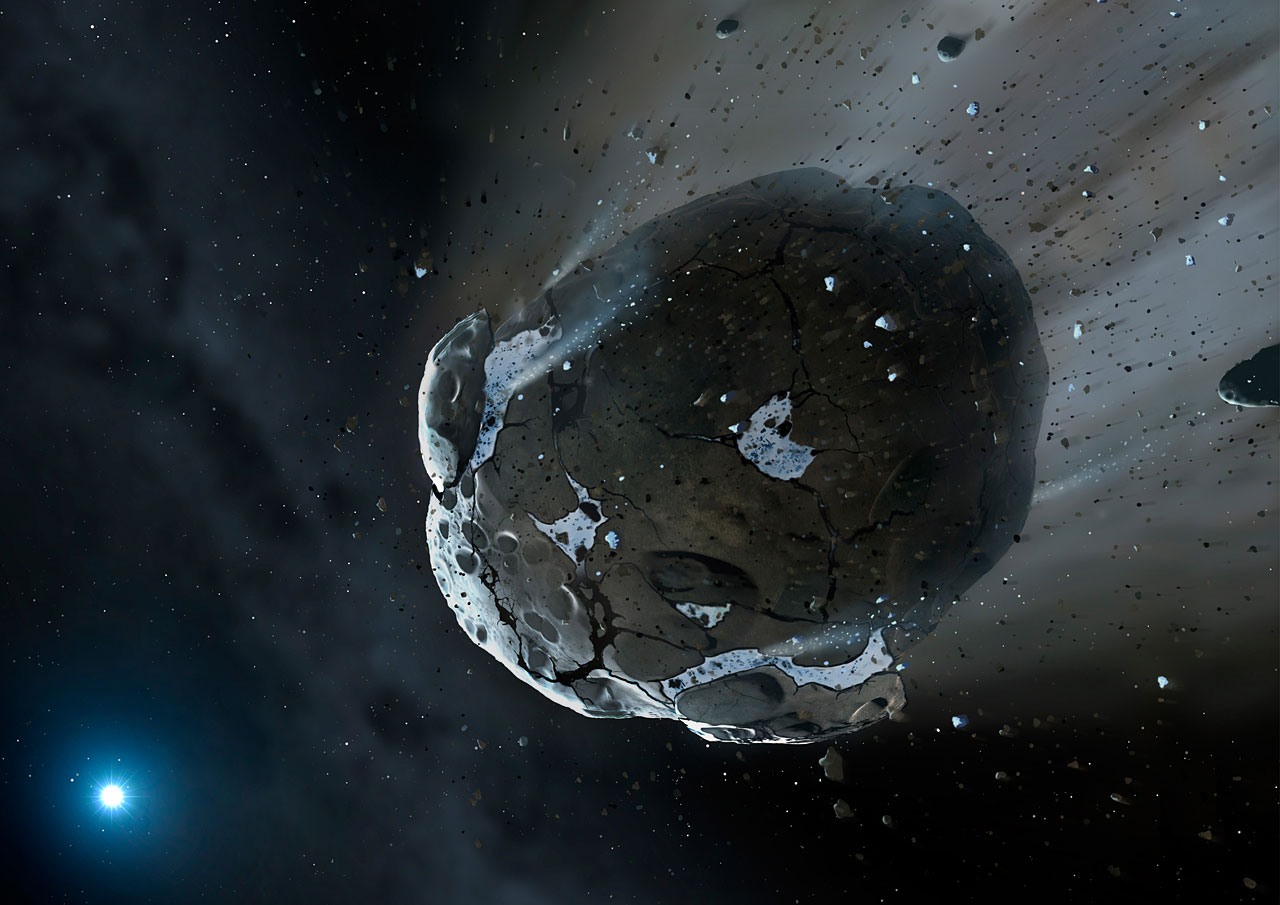
An artist’s impression of an asteroid breaking up near a white dwarf star. [NASA, ESA, M.A. Garlick (space-art.co.uk), University of Warwick, and University of Cambridge]

As one might imagine, this process is not kind to any planets or asteroids that were previously circling the star. While some might survive, others are sent spiraling inwards where they break apart and are accreted onto their hosts. Due to the extreme temperatures and surface gravity of white dwarfs, whatever falls on their surfaces is vaporized, sorted by weight, and quickly dragged out of sight. Since heavy elements cannot last long in a white dwarf’s atmosphere, whenever astronomers see their stains in the star’s spectrum, they know that the star must have recently consumed the rocky remains of their former asteroids and planets.

However, although researchers have found these stains in over a quarter of white dwarfs and consequently have reasoned that asteroid snacking must be common, they’ve only ever caught one star mid-meal. Recently, Ben Zuckerman (University of California, Los Angeles) and a team of collaborators may have found another, though it may have just finished dining.

Leftover Crumbs

A time vs. flux plot showing a flat trend.

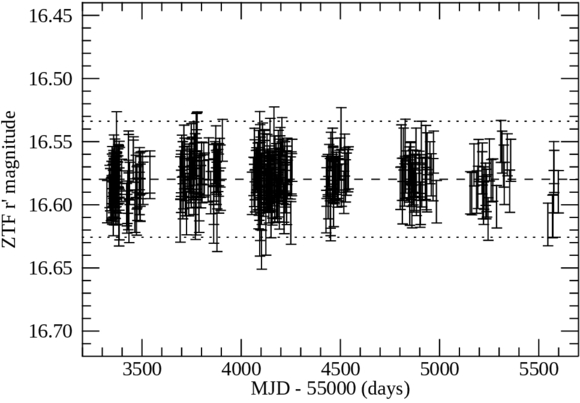
The light curve of WD J0234-0406 measured by the Zwicky Transient Facility. Unlike WD 1145+017, which frequently changes brightness, this white dwarf appears remarkably steady despite the high-velocity gas surrounding it. [B. Zuckerman et al. 2026]

This new star, called WD J0234-0406, shares some characteristics with the “iconic” WD 1145+017 that was first spotted mid-meal, but it also differs in an interesting way. High-resolution spectroscopy reveals that both stars have gaseous material orbiting around them along highly non-circular paths. These have been interpreted as “precessing rings of high velocity gas” that previously belonged to parent asteroids. However, while WD 1145+017 appears to flicker as bits of disintegrating asteroids pass between it and our line of sight, WD J0234-0406 is rock steady. Neither TESS nor the Zwicky Transient Facility have detected any dips in light from the star despite the evidence that solid material must have recently drizzled into the star’s atmosphere.

The researchers suggest that this relative quiet is a matter of timing. While asteroids are actively breaking up around WD 1145+017, the parent bodies that supplied the gas and dust around WD J0234-0406 may have shattered long ago and have already been either vaporized or ground down into smaller particles. All that is left over are the crumbs slowly spiraling toward the star.

Although WD J0234-0406’s meal may not be as dramatic as WD 1145+017’s feast, it’s still exciting to expand the sample of known white dwarf-asteroid interactions. And, with the upcoming release of data from the DESI survey poised to reveal the spectra of tens of thousands of white dwarfs, the sample is likely to grow again soon.

Citation

“High-velocity Circumstellar Gas Orbiting a White Dwarf Star,” B. Zuckerman et al 2026 ApJ 1004 254. doi:10.3847/1538-4357/ae23c4

The post Finishing Off an Asteroid appeared first on AAS Nova.

“One Origin of the Genetic Code, but Two Origins of Life”: Scientists Reveal the Ancient Evolutionary Split That Gave Rise to All Life on Earth

7 August 2026 at 14:11

An international research team has uncovered how LUCA, the last common ancestor of all life on Earth, split into the first two branches of organisms—bacteria and archaea—allowinglife to thrive innew conditions and spread to other biomes.

Scientists from the Institute of Molecular Evolution at Heinrich Heine University Düsseldorf (HHU) led the research, revealing their findings in a recent paper published in Science Advances, investigating these early cells’ metabolisms.

The team discovered that the chemical reactions and energy sources behind these two types of cells told unique stories of separate evolutions, in new work that sheds light on the primordial processes that gave rise to some of Earth’s first free-living cells.

Life on Earth Begins

Roughly four billion years ago, life on Earth emerged as the first cells formed, most likely at hydrothermal vents, before evolving to explore new biomes. 

“We would see two very different kinds of cells emerging, pioneer bacteria and pioneer archaea, making their first attempts at life outside the confines of a hydrothermal vent,” said lead author Natalia Mrnjavac, a biologist at the University of Düsseldorf.

The new study investigated protein structures, chemical reactions, and genomes involved in the evolution of these early free-living cells.

“These comparisons are giving us unprecedented insights into the phase of evolution when metabolism catalysed by enzymes was arising from spontaneous reactions catalysed by metals in the Earth’s crust,” said senior author William Martin, a Düsseldorf biologist.

Metabolism and Evolution

Among the new work’s major findings is a consideration of the entire set of 420 chemical reactions involved in metabolism that produce amino acids, RNA bases, and vitamins from the raw materials of hydrogen, ammonia, and carbon dioxide. 

These reactions are preserved for modern researchers inside the genetic code, allowing the team to make a surprising discovery: about half of LUCA’s reactions were catalyzed by environmental metals instead of enzymes produced by the organism itself.

“Metals that naturally occur in hydrothermal vents can replace a surprisingly large number of enzymes in metabolism,” said co-author Harun Tüysüz, an inorganic chemist from the Max-Planck-Institut für Kohlenforschung and the IMDEA Materials Institute in Madrid.

In this study, the team reconstructed catalysis evolution from metal-only to a metal-enzyme hybrid present in LUCA, and finally to the divergence of the bacterial and archaeal lineages. This evolution helped life move on from the hydrothermal vents inhabited by the first cells by replacing the inorganic catalysts provided by that environment with new enzymes. 

“We can see cases where the ancestors of bacteria and archaea independently evolved structurally distinct enzymes to catalyse the same essential metabolic reaction,” Mrnjavac explained, adding that “such parallel inventions could have paved the way to the independent emergence of free-living bacteria and archaea.”

The Energy for Life on Earth

A primary question involves what supplied the energy driving metabolic reactions in early life on Earth. A compound named ATP is the primary metabolic driver in most organisms today, but it comes from enzymes and is not present in hydrothermal vents. The researchers identified a new energy source in palladium, a natural catalyst used by chemists and also plentiful in hydrothermal vents.

“When we react phosphite, a form of phosphorus that naturally occurs in hydrothermal vents, with organic compounds, we get metabolic phosphorylation reactions overnight in water. Phosphite and palladium replace ATP and enzymes; it’s amazing, and it makes early evolution a lot easier to grasp,” Schlikker said.

Understanding the interconnection between so many reactions presents a significant mathematical challenge. For this reason, the team included not just biologists, but network scientists tasked with ordering the reactions by their complexity, which the researchers hoped would indicate the sequence in which they evolved. Using a machine learning algorithm, the team discovered that a clear order did appear to exist.

“The new data leave only one conclusion,” Martin concluded. “The bacteria and archaeal lineages made the transition to the free-living state independently. Only free-living cells are alive.”

“Let’s call it by name,” Martin added. “We are looking at one origin of the genetic code, but two origins of life.”

The paper, “Intermediate Stages in the Origin of Metabolism at a Phosphorylating Hydrothermal Vent,” appeared in Science Advances on August 5, 2026.

Ryan Whalen covers science and technology for The Debrief. He holds an MA in History and a Master of Library and Information Science with a certificate in Data Science. He can be contacted at ryan@thedebrief.org.

Scientists Discover that the Increase in Visual Information Was What Allowed the Development of Ape and Human Brains

The research, published in the journal Science, was led by Richard F. Kay, emeritus professor of Evolutionary Anthropology at the Trinity College of Arts & Sciences and at the Nicholas School of the Environment at Duke University. The work, which used a unique collection of skulls mostly from the Natural History Museum of the Duke […]

❌