Moon dust looks soft in photographs, but it is a difficult material for machines and people. The grains are sharp, abrasive and electrically clingy. NASA engineers at Johnson Space Center are using a dedicated test facility to find out how tools, joints and spacesuits will cope with it before Artemis astronauts return to the lunar […]
The Chicxulub impact not only plunged Earth into an impact winter but also produced a dust blanket that later overheated the planet, according to new research from Purdue University and the University of Colorado, Boulder.
New analysis of dust deposits left after the massive asteroid hit Earth around 66 million years ago suggests the event created a thick, worldwide dust blanket that drove heat down toward the planet’s surface, resulting in global wildfires.
The researchers behind the new study said the evidence for a post-impact dust blanket and resulting heat wave adds new fuel to the debate about what role, if any, the Chicxulub asteroid played in their extinction, by suggesting most unsheltered animals would have died instantly.
Scientists Debate Connection Between Asteroid Impact and Dinosaur Extinction
While scientists agree that a massive chunk of space rock slammed into Mexico’s Yucatan Peninsula 66 million years ago, they have continued to debate the event’s impact on the end of the dinosaurs‘ reign. Still, the timing of the two events, and the evidence for a mass extinction of animals incapable of seeking the necessary shelter to survive the asteroid’s impact, has led most to connect the two events to some degree.
Further studies of the impact have shown that the event’s immense heat and pressure vaporized a massive amount of rock, resulting in a huge cloud of dust and rock vapor high into the Earth’s atmosphere. As some of that dust condensed into tiny rock ‘spherules’ and slammed back into the surface, the friction between them and the air generated a corresponding heat pulse.
According to the authors of the new study, many theories suggested that this heat pulse acted like a planetary-wide broiler, including “radiating enough heat to sizzle thin-skinned animals without shelter,” but not enough for plants to suddenly burst into flames. The team said that this result temporarily caused researchers to move away from the idea that the immediate impact event caused the dinosaur’s extinction rather than a longer, more drawn-out event.
Now, after years of new ideas, the team said that a 2023 discovery once again changed the debate, leading to their new proposal.
Atmospheric Layer of ‘Post-Impact’ Dust Would Have Magnified Heat Wave 3.5 Times
According to the team’s statement, the 2023 discovery involved a layer of “extremely fine post-impact dust” that could have formed from rock vapor that did not condense into spherules.
“It reinvigorated my interest in what happened to the leftover vapor,” explained Brandon Johnson, a planetary scientist at Purdue University and lead author of the study detailing the new theory, “that’s where this work started.”
To determine what effect such a post-impact dust layer might have had on dinosaurs and other terrestrial animals, the team plugged the new data into previous simulations of the Chicxulub event. Johnson and colleagues especially wanted to know how the dust layer would boost Earth’s retention and release of heat energy generated by the falling rock spherules.
After running several simulations, the team determined that the dust layer would have increased the surface heat by 3.5 times compared to an event that only included the falling spherules. Unlike earlier models, this new version with the dust layer included showed that the heat pulse would have been enough to “kill animals and start spontaneous forest fires.”
“We’re in the realm where we might be essentially killing off everything within that first hour or two,” Johnson explained.
Notably, the researcher said his team’s concept is not unlike alternative extinction theories that credit a global post-impact winter for the eventual mass extinction of dinosaurs and other lifeforms.
“It seems counterintuitive,” Johnson said, “but actually it’s the same effect.”
The research compared the idea to how an insulated mug can keep hot coffee hot and iced coffee cold.
“Once the spherules finished falling and the fires petered out, massive dust clouds could have blocked warmth from the Sun for years to decades and caused a global winter,” the authors explained.
Results Could Help Unravel Why Some Animals Survived, and Others Didn’t
When discussing how the team’s findings might affect the ongoing debate about dinosaur extinction, Johnson said the work seems to offer strong support to the impact extinction theory.
“This work of ours supports this idea that it really is the impact that was devastating to terrestrial life and caused the mass extinction,” the researcher explained.
Although the team suspects that the global fires caused by the dust amplified the heat wave, they point out that a more complete geological record would likely be needed to provide confirmation. Alfio Alessandro Chiarenza, a paleontologist at University College London who was not involved with this study, said researchers could find a record of global wildfires, but “we just don’t have it so far.”
“It would be great to figure out which animals survived right at the impact and what their biological features were,” Chiarenza added. “This could finally tell us why some animals made it when others, like the dinosaurs, didn’t.”
Christopher Plain is a Science Fiction and Fantasy novelist and has spent the last six years as Associate News Editor and Head Science Writer at The Debrief. Follow and connect with him on X, learn about his books at plainfiction.com, or email him at christopher@thedebrief.org
Every year, more than 5,000 tons of material with cosmic origins lands on Earth’s surface, with as much as 15,000 tons of this “space dust” making its way into the atmosphere but vaporizing during reentry.
The resulting rain of micrometeorites that reaches our planet consists mostly of tiny objects anywhere from 30 to 200 micrometers in size, based on past studies. But what are the origins of these large volumes of material that accumulate over time as they shower the Earth throughout the year?
According to new research, evidence for one potential source of this cosmic debris has now been found: it could be coming from unidentified near-Earth objects.
Space Dust with Unknown Origins
The problem with tracing the origins of space dust is that most of it that makes its way into Earth’s atmosphere doesn’t survive the intense conditions of atmospheric entry, and those tiny bits that do—known as cosmic spherules—are reshaped as they melt from the friction they encounter while falling.
Although their original mineral structure is compromised as well as their shape, there are a few isotopes—namely oxygen—that these spherules maintain that scientists can use to help trace their origins. Based on their chemical “fingerprints,” cosmic spherules are placed into different groups by planetary scientists, with many being able to be traced back to known varieties of meteorites and other sources.
Image obtained using an electron microscope of space dust possibly originating from a comet (Image Credit: NASA)
Among these groups, around ten percent fall into a category possessing unusually small quantities of the isotope oxygen-16. This category, known as Group 4, doesn’t appear to match any known meteorite group—the implication, therefore, is that some of this cosmic debris may originate from an unidentified variety of near-Earth objects.
New Clues to the Origins of Uncorrelated Space Dust
Now, according to new research by Matthias Van Ginneken and colleagues, there are at least some ways that the origins of these spherules can be determined, one of which involves their orbital parameters.
In one case, the team writes in a recent study published in Science Advances, “the mineralogical and textural properties of a subset of cosmic spherules do provide information on the orbital parameters of their precursors, including eccentricity and encounter velocity.”
This group of materials, which is dubbed “CumPo” based on its material consistency of cumulate olivine porphyritic, is “characterized by clustered olivine phenocrysts that increase in size from one side of the spherule to the other,” the team writes.
In short, this unique class of spherules points to equally unique orbital characteristics that may be associated with what the research team surmises could be atypical types of near-Earth objects, or NEOs, that could be near enough to our planet to provide a likely source.
A particular clue offered by these objects is that some of them may have undergone unusually high entry speeds, as evidenced by their surface texture. One factor that could potentially account for this is that they may have entered Earth’s atmosphere at angles consistent with objects possessing high orbital eccentricity.
More Clues from Antarctica
As with past studies, researchers were able to retrieve several samples of these CumPo cosmic spherules from Antarctica, which provides a pristine environment that helps to facilitate their discovery and collection. However, another source location had been far less remote: urban rooftops, where a large amount of cosmic dust lands every year.
With the aid of electron microscopy and microprobe chemistry studies, Ginneken and colleagues examined the mineralogy, chemistry, and textures of these spherules, as well as the oxygen isotopes they contained.
What they found indicated an entirely new subset of spherules, which possess significant amounts of cumulate olivine rich in sulfur, garnering the name “SCumPo.” This unique new class of samples has links to the “Group 4” class and their minimal inclusion of oxygen-16. Other unusual similarities they possess are an overall absence of magnetite and a low presence of nickel in their olivine crystals, paired with an abundance of iron-nickel sulfur and a significant amount of sulfur present within glasses produced from vitrification.
Intriguingly, some spherules appeared to show a combination of signatures that were both poor in oxygen-16 in some areas, while rich in the isotope in others. This suggests that these cosmic materials had likely been mixed from two separate original sources, since such conditions could not be otherwise explained through natural processes.
“We interpret this as strong evidence that the SCumPo precursors were composite materials containing at least two different components,” the team writes in their study. Then, by running numerical simulations of crystal settling to help determine the likely entry speeds of these materials, and thereby their eccentricities while in orbit, the team determined that the settling of olivine is most consistent with entry speeds of as much as 17 kilometers per second, and likely no more than 14 kilometers per second—speeds that would be consistent with NEOs, as opposed to asteroids originating from the main-belt.
Evidence for an Unknown Class of Space Objects
Based on their findings, the team believes that unsampled meteorites from the CM, CO, and CY classifications of carbonaceous chondrites—a group of primitive, carbon-rich meteorites containing some of the oldest materials in our Solar System—are the likely sources for these cosmic materials.
“Given that we have linked their composition to the CM-CO-CY clan of carbonaceous chondrites, it is plausible that their parent body was a primitive carbonaceous asteroid that migrated onto an Earth-crossing orbit—attaining comet-like orbital parameters,” the team writes.
“For instance, one might consider the disrupted fragments of a thermally altered but water-bearing asteroid (like the CY group) that evolved into near-Earth space,” they add.
Although still only inferred from their studies, the team suggests the existence of a hypothetical new variety of NEOs based on the samples they studied, which are unlike any variety of meteorites currently known on Earth.
“These findings point to a previously unsampled, primitive, sulfide-rich CY-like near-Earth asteroid, which represents a ‘missing’ meteorite parent body that contributes distinctive 16O-poor cosmic dust to Earth,” the team writes, noting that any future confirmation of the existence of this unknown class of meteorites would represent “a pivotal discovery.”
The team’s new paper, “16O poor cosmic spherules from near-Earth CY chondrite asteroids,” appeared in Science Advances.
Micah Hanks is the Editor-in-Chief and Co-Founder of The Debrief. A longtime reporter on science, defense, and technology with a focus on space and astronomy, he can be reached atmicah@thedebrief.org. Follow him on X @MicahHanks, and at micahhanks.com.
Our search for technosignatures – clear signs of advanced civilizations beyond Earth – takes many forms. Many are driven by the famous Drake equation, which attempts to estimate how many technological civilizations there are in the Milky Way. However, there’s a big fat question mark at the end of that equation in the form of […]
How do massive galaxies form and evolve? A recent study traces the stellar and dust distributions across evolutionary phases of massive galaxies to better understand how massive dusty star-forming galaxies fit into the picture.
Dusty Massive Galaxies
Massive galaxies, like the Milky Way or even larger, undergo phases of active star formation and quiescent phases of inactivity, but exactly how these galaxies evolve through these stages is not yet fully understood. Dusty star-forming galaxies, which are undergoing a period of intense star formation and shrouded in dust, might be the missing evolutionary step between star-forming and quiescent phases of massive galaxy evolution.
Currently, the leading explanation for massive galaxy formation and evolution is inside-out growth — star formation and quenching start in the inner regions of a galaxy and progress outward. However, it’s not clear whether dusty star-forming galaxies also follow the favored inside-out pathway, or if they instead proceed outside-in, first growing their disks and then assembling a central bulge.
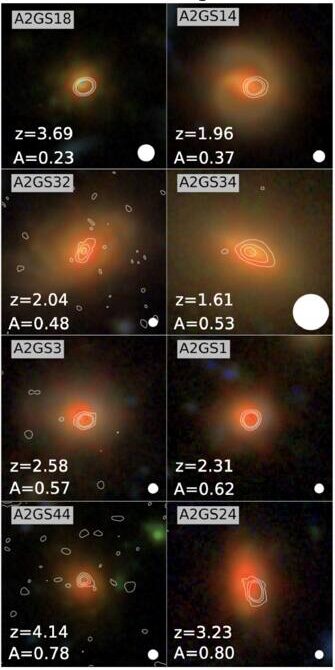
Example of JWST NIRCam images with ALMA contour lines overlaid for select dusty star-forming galaxies in the sample. [Modified from Bodansky et al 2026]
The spatial distribution (or morphology) of the stars and dust within dusty massive galaxies can help us trace their evolution. Thanks to high-resolution observations from JWST and the Atacama Large Millimeter/submillimeter Array (ALMA), researchers can now directly compare the morphologies of distant star-forming, quiescent, and dusty galaxies during the height of our universe’s star formation. Filling this gap will reveal how dusty star-forming galaxies may connect star-forming and quiescent galaxies in massive galaxy evolution.
Multiwavelength Morphological Comparisons
To directly compare the star and dust morphologies across massive galaxies, Sarah Bodansky (University of Massachusetts, Amherst) and collaborators selected a sample of 33 dusty star-forming galaxies from the GOODS-ALMA 2.0 survey that searched the sky for 1.1-mm dust emission as well as star-forming and quiescent comparison samples drawn from JWST observations. Combining the ALMA survey data with JWST imaging, the authors studied the rest-frame optical (stars) and rest-frame near-infrared (dust) morphologies of dusty, star-forming, and quiescent galaxies at redshifts around cosmic noon (a few billion years after the Big Bang).
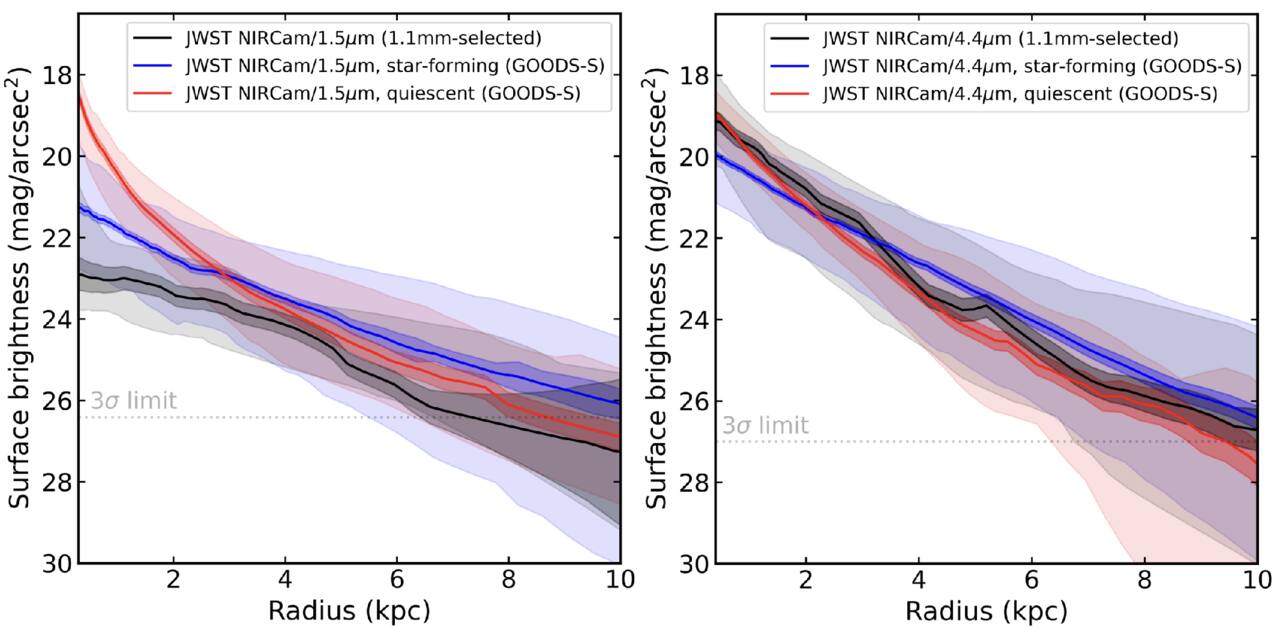
When comparing optical morphologies, the authors found that dusty star-forming galaxies and typical star-forming galaxies had similar distributions, but their near-infrared morphologies showed clear differences. Dusty galaxies tended to show more compact near-infrared emission, with dust tracing their stellar populations and more concentrated in the galaxies’ central regions. Though clearly different from star-forming galaxies, the authors noted striking similarities between the near-infrared morphologies of the dusty star-forming and quiescent galaxies, especially within their centers.
Average surface brightness profiles for the rest-optical (left) and rest-near-infrared (right) for the dusty (black), star-forming (blue), and quiescent (red) galaxies. In the near-infrared, the dusty star-forming galaxy profile appears very similar to the quiescent galaxy profile. [Bodansky et al 2026]
All of these properties suggest that dusty star-forming galaxies have built up stellar mass and dust in their cores, potentially forming a central bulge first and supporting an inside-out model of massive galaxy growth. This points to dusty star-forming galaxies as possible direct progenitors of early massive quiescent galaxies, hanging onto their last bit of star formation before becoming quiet as well. While this study morphologically distinguishes dusty galaxies from their star-forming and quiescent counterparts, future spectroscopic studies comparing the kinematics of these populations and investigations of molecular gas distributions are necessary to better pin down the evolutionary connection between star-forming, dusty, and quiescent massive galaxies.
Citation
“JWST+ALMA Reveal the Buildup of Stellar Mass in the Cores of Dusty Star-forming Galaxies at Cosmic Noon,” Sarah Bodansky et al 2026 ApJ 1001 235. doi:10.3847/1538-4357/ae4f64
Editor’s Note:Astrobites is a graduate-student-run organization that digests astrophysical literature for undergraduate students. As part of the partnership between the AAS and astrobites, we occasionally repost astrobites content here at AAS Nova. We hope you enjoy this post from astrobites; the original can be viewed at astrobites.org.
Imagine a galaxy from 13 billion years ago, long before the Milky Way took its current form. Now picture trying to uncover the secrets of that ancient galaxy. How quickly did it create stars and evolve? Here’s the tricky part: its light has journeyed across an unimaginable distance to get here. On its journey, cosmic dust — tiny grains of carbon and silicates — has scattered and dimmed the light, making the task harder.
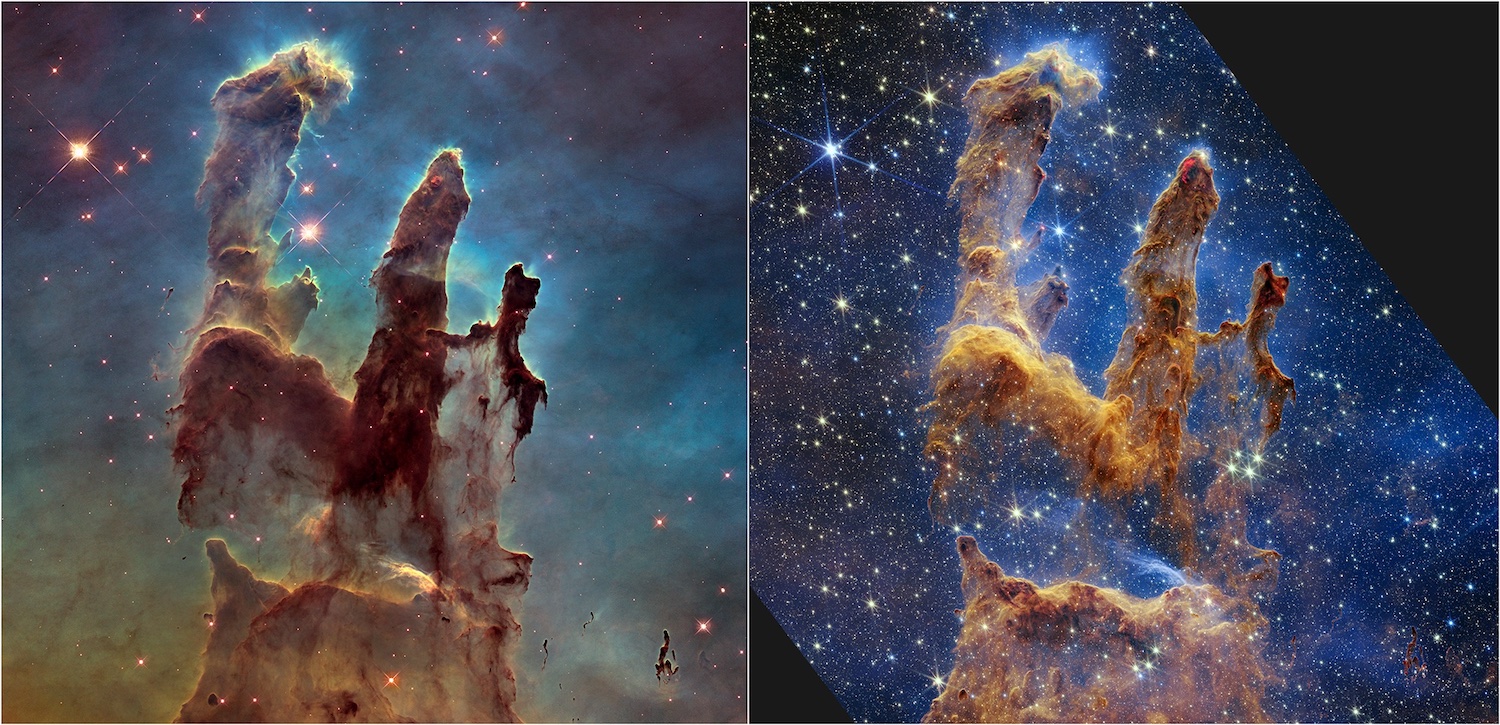
Dust doesn’t just block light — it changes it. Ultraviolet (UV) light gets scattered much more than light at longer wavelengths, which is why galaxies seem redder and dimmer than they truly are. This dual nature can be seen in the “Pillars of Creation,” in Figure 1. A new near-infrared image from NASA’s JWST, shown in the right panel below, helps us peer through more of the dust in this star-forming region. The thick, dusty brown pillars are no longer as opaque, and many more red stars that are still forming come into view.
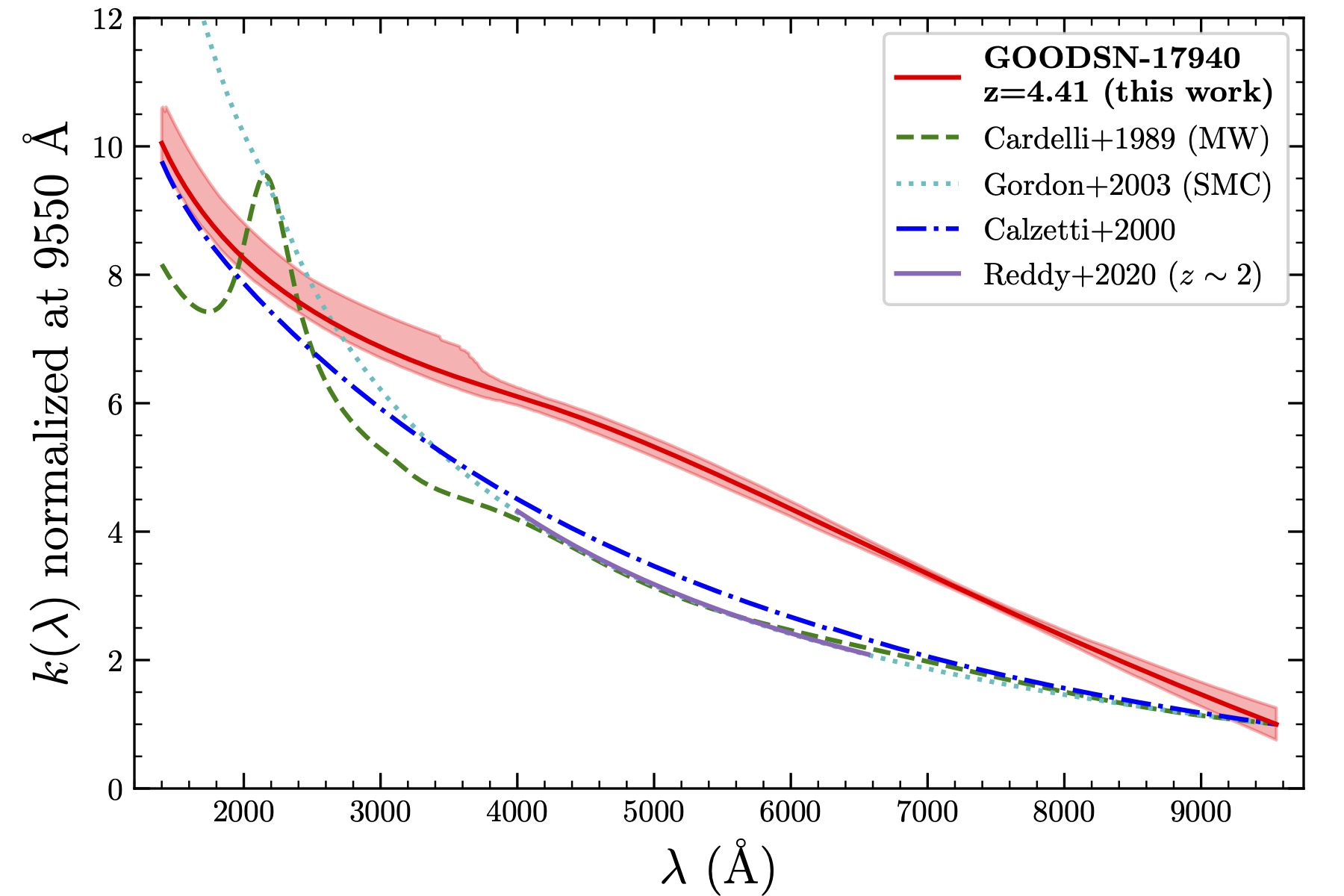
To quantify how dust affects light at different wavelengths, astronomers use dust curves — tools that reveal how much light is blocked or scattered, helping them correct for dust-induced distortions. For instance, the Milky Way’s curve stands out with a distinct “bump” around 2175 Å, which comes from tiny carbon-based particles in the dust. But the Small Magellanic Cloud (SMC) tells a different story. Its curve is steeper in the UV and doesn’t have that bump at all. These differences aren’t just random — they give us clues about the size, makeup, and distribution of dust grains in each galaxy. (See Figure 3 below for a visualization of these dust curves.)
But here’s the catch: most of the dust curves we have were designed for galaxies much closer to us, like the Milky Way or the SMC, so they may not apply in the exact same way to distant galaxies. Whether those same curves work for the much younger, chaotic galaxies of the early universe is an open question. The dust in nearby galaxies is well studied and relatively predictable, but does dust behave the same way in galaxies billions of years in the past?
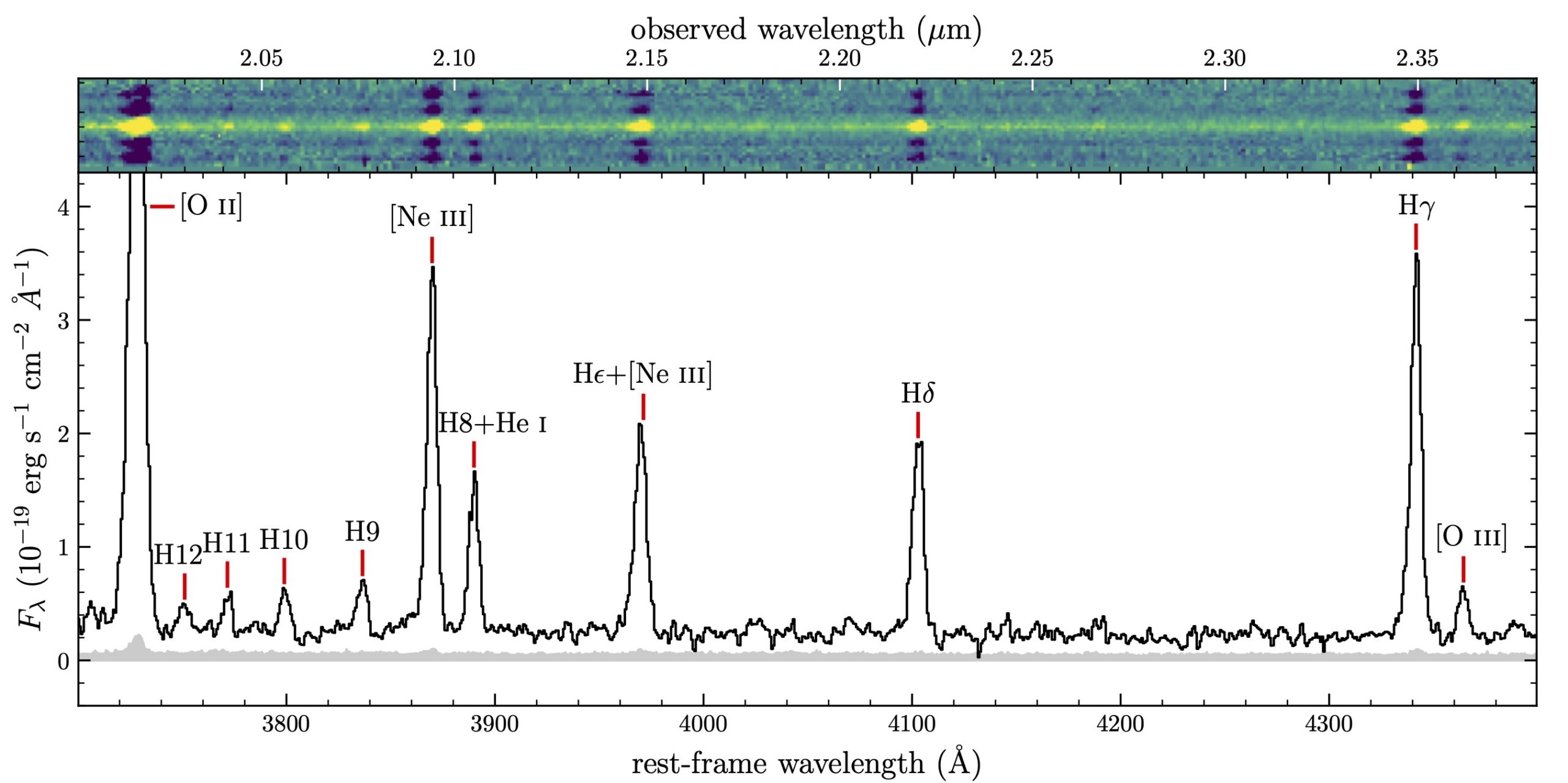
This question drove Ryan Sanders and collaborators to study GOODSN-17940, a starburst galaxy located at a redshift of z = 4.41, when the universe was just 1.36 billion years old. Observed as part of the Assembly of Ultradeep Rest-optical Observations Revealing Astrophysics (AURORA) survey using JWST, this galaxy provided an unprecedented opportunity to investigate how dust behaved in the distant past. Using JWST’s NIRSpec instrument, the team constructed a unique dust curve by studying 11 hydrogen emission lines from Hα to H12 (the twelfth line in the rest-frame optical Balmer series), shown in Figure 2. These lines act like lighthouses, their brightness giving away how much light is being absorbed by dust at each wavelength. By comparing the observed brightnesses of these lines, the researchers created a detailed dust curve tailored to GOODSN-17940.
Figure 2: Spectrum of GOODSN-17940 from the AURORA survey, showing hydrogen Balmer lines. These features help estimate the galaxy’s dust and ionization conditions. The top panel presents the 2D spectrum, showing spatially resolved emission that traces the galaxy’s structure, while the bottom panel shows the corresponding 1D spectrum. [Adapted from Sanders et al. 2025]
GOODSN-17940’s dust curve is shown in Figure 3. The y-axis represents the factor by which light is blocked/scattered by dust compared to this amount at 9550 Å. For example, a value of 2 means that light at that wavelength is attenuated two times more than light at 9550 Å.
Figure 3: The dust curve of GOODSN-17940 (solid red line) at z = 4.41, derived in this work, compared to established curves for the Milky Way (green dashed), Small Magellanic Cloud (SMC, dotted cyan), Calzetti et al. (blue dot-dashed), and Reddy et al. z ~ 2 galaxies (purple solid). This curve is steeper in the near-infrared and flatter in the UV, highlighting unique dust properties in this galaxy. [Sanders et al. 2025]
This dust curve is surprising. In the near-infrared, it is much steeper than the curves of the Milky Way or SMC. This suggests the galaxy’s dust grains might be smaller or distributed differently. But in the UV, the curve flattens out, showing less absorption than classical models predict. And unlike the Milky Way’s dust, there’s no 2175 Å bump at all. These findings hint at a galaxy with truly unique dust properties, shaped by its extreme youth and chaotic star-forming environment. But here’s the twist — GOODSN-17940 isn’t just any galaxy. Its star formation rate is 40 times higher than typical galaxies at its redshift. While rare at redshifts of z ∼ 2–4, galaxies like this are more common in the epoch of reionization, suggesting that what we’ve learned from GOODSN-17940 could apply to reionization-era galaxies — the ones that played a key role in shaping the early universe.
So, why does this even matter? If you used the Milky Way’s dust curve to adjust for the dust in a galaxy like GOODSN-17940, you’d be way off. In fact, you’d underestimate its star formation rate by up to 50%! This isn’t just a minor detail — it could explain why star formation rates derived from Hα don’t always match those derived from UV luminosity. Such details can completely change how we interpret a galaxy. It’s the difference between a galaxy steadily forming stars and one caught in a dramatic starburst phase. That’s why astronomers focus on creating dust curves tailored to individual galaxies. This study isn’t just about one galaxy — it’s about rethinking how we interpret dust, star formation, and galaxy evolution in the early universe. Before JWST, isolating individual emission lines from distant galaxies was challenging, but it has become much more efficient now. As more galaxies like GOODSN-17940 are studied, we might find that many early galaxies had dust curves breaking the mold, forcing us to refine how we measure star formation and understand cosmic history.
Original astrobite edited by Hilary Diane Andales and Delaney Dunne.
About the author, Niloofar Sharei:
I’m a third-year Astronomy PhD student at University of California, Riverside, where I study bursty star formation histories and how galaxies take shape. When I’m not busy exploring the universe, you can usually find me curled up with a good book, hiking somewhere peaceful, trying astrophotography, or getting lost in Bach’s music and art.
Through detailed simulations of gas and dust, a recent study revealed that the behavior of dust within protoplanetary disks is a bit more complex than previously assumed.
Dust Traps in Protoplanetary Disks
As a planet forms within a protoplanetary disk — dust and gas orbiting a new star — tidal interactions between the budding body and the dusty material surrounding it can create pressure bumps where dust builds up. These dust traps appear as rings in observations of protoplanetary disks.
Dust traps are thought to play a critical role in the disk’s evolution and the early stages of planet formation. Dust traps may prevent solid material from migrating inward, starving the inner disk and impeding planet growth interior to the trap. These reservoirs may also serve as a chemical barrier, keeping volatile materials like water from moving to the inner regions of a disk.
While a perfect dust trap completely isolates material from the rest of the disk, recent observations and 2D simulations have shown that dust traps may be a bit more permeable — leaking smaller sized grains, mixing material, and changing the disk’s appearance. However, these results only account for two dimensions of the complex three-dimensional environment in which dust traps reside. Thus, 3D hydrodynamical simulations are necessary to provide more realistic details of dust dynamics within planet-hosting protoplanetary disks.
Dusty Simulations
Z-axis averaged dust–gas density ratios (top) and dust–gas surface density ratios for the 3D simulations after 1,500 orbits. For the simulations with higher diffusion and lower planet mass, there is clear leaking of dust beyond the dust trap ring (edges marked with dotted red lines). Click to enlarge. [Huang et al 2025]
In a recent study, Pinghui Huang (Chinese Academy of Sciences; University of Victoria) and collaborators performed multiple 2D and 3D numerical simulations of gas and dust within a protoplanetary disk with a forming planet. The simulations varied the mass of the planet and the level of turbulent diffusion — how well material and energy flow and mix within the gas. These variations allowed the authors to explore how dust traps behave within different types of systems.
The simulations showed that the embedded planet will perturb the gas and dust, producing density shocks that create gaps and, subsequently, pressure bumps where dust traps coalesce. From their analysis, the authors found that dust traps become leakier at higher levels of diffusion and when the embedded planet is lower in mass. Essentially, if the gas flows and mixes more efficiently, the perturbations of the planet are erased more quickly, and if the planet is sufficiently small, its ability to disrupt the disk is much weaker. Dust remains coupled to the gas, flowing through these weak traps without becoming stuck. Additionally, the 3D simulations show higher amounts of leakage compared to the 2D simulations, which the authors attributed to the asymmetric and complex vertical geometry of the disk.
Flux-trapping ratio (left) and mass-trapping ratio (right) as a function of time for the 2D (top) and 3D (bottom) simulations. The higher-mass planet in Model A causes more flux and mass-trapping than the lower-mass planets and more turbulent systems. Additionally, the 3D simulations show significantly lower flux and mass-trapping than the 2D simulations. Click to enlarge. [Huang et al 2025]
Implications and Comparison to Observations
What then are the consequences of leaky dust traps? In planet formation theory, dust traps determine the mass at which a planet creates a sufficient pressure bump that isolates small pebbles and dust exterior to its orbit. For perfect dust traps, this isolation of material from the planet and inner disk creates a clear chemical distinction between the inner and outer disk. However, as shown by the 3D simulations, dust traps are imperfect, allowing small particles to filter through; the authors suggest this may mean that the growing planet slows but does not stop the migration of solid materials in a disk.
Recent observations of protoplanetary disks reveal the presence of larger volatiles within the inner disk. Specifically, the disk PDS 70 shows water emission in its inner disk despite having two confirmed giant planets orbiting in the outer disk. Without leaky dust traps, volatiles like water would be trapped in the pressure bumps created by these planets. However, as the authors have shown, the complex reality of dust dynamics within protoplanetary disks allows heavier elements to leak through, enriching the inner disk. Further observations and detailed 3D simulations will allow astronomers to understand the extent of leaky dust traps and reveal the realistic conditions driving early planet formation.
Citation
“Leaky Dust Traps in Planet-Embedded Protoplanetary Disks,” Pinghui Huang et al 2025 ApJ 988 94. doi:10.3847/1538-4357/addd1f
Earth Oddities • Strange Weather Phenomena • Global Dust Transport • Go back to Strange Sounds A massive Saharan dust plume has drifted across parts of Europe, hazing alpine views and coloring sunsets across the continent. But the most surprising part of the story is how the dust gets into the sky in the first […]

 Login