Air travel may one day get a little greener thanks to an unlikely fuel source: coconuts. Researchers at Osaka Metropolitan University have developed a biofuel made from coconut oil that can be blended with conventional jet fuel and used in existing turbine engines without significantly reducing engine efficiency. The fuel may also help lower some […]
A tiny microscope weighing just five grams could give neuroscientists an unprecedented view of how individual brain cells control behavior while animals move naturally. Researchers at the University of Colorado Anschutz Medical Campus and the University of Colorado Boulder have developed a head-mounted device that can both record neural activity and selectively activate individual neurons during movement. The technology could help scientists investigate how brain circuits generate behavior and how those circuits become disrupted in conditions such as Alzheimer’s disease, Parkinson’s disease and epilepsy.
The device, called Opto2P-FCM, combines two powerful techniques that have traditionally been difficult to use together in a freely moving animal. Two-photon microscopy provides detailed images of living brain tissue at cellular resolution, while optogenetics uses light-sensitive proteins to control selected neurons. By integrating both capabilities into a miniature instrument, the researchers can observe specific cells as they become active and then stimulate chosen neurons to test how they influence the surrounding network.
“These miniature microscopes have been increasingly used to study the neural basis of behavior in freely moving animals,” said Emily Gibson, PhD, associate professor of biomedical engineering at CU Anschutz and the study’s senior author. “This new microscope allows deeper penetration and higher resolution images in the brain. Importantly, it can also excite select neurons using optogenetics.”
For decades, conventional two-photon microscopes have been regarded as the gold standard for imaging neurons in living brains. These systems use infrared laser light to produce high-resolution images deep within tissue, allowing researchers to track calcium signals and other indicators of neural activity. However, conventional microscopes are generally large, stationary instruments. Animals must often remain immobilized beneath the objective, making it difficult to study brain activity during walking, exploration, social interaction or other natural behaviors.
Miniature microscopes have helped overcome that limitation by moving the imaging system onto the animal’s head. Yet reducing the size and weight of the equipment has often required compromises. Some compact systems provide lower-resolution images, while others can record neural activity but cannot stimulate precisely selected cells. The Colorado team designed Opto2P-FCM to address both problems through a dual-path optical architecture that separates imaging from stimulation.
In the imaging pathway, infrared light is directed through the brain to generate two-photon signals from fluorescent markers inside neurons. These markers can report changes in calcium concentration, which occur when neurons fire. The resulting signals are collected to create detailed images of neural activity at the level of individual cells. A separate optical pathway delivers patterned light for optogenetic stimulation, allowing researchers to activate specific neurons without disrupting the imaging beam or overwhelming the detectors.
This separation is technically important because imaging and stimulation place different demands on an optical system. High-resolution imaging requires precise focusing, efficient light collection and minimal optical distortion. Optogenetic activation, by contrast, requires intense, accurately positioned light capable of reaching the light-sensitive proteins expressed by selected neurons. Designing both functions into a device small enough to be carried by an animal required careful control of the alignment, geometry and weight of every optical component.
“This microscope is a game changer,” said Juliet Gopinath, PhD, professor of electrical, computer and energy engineering and physics at CU Boulder and a study co-author. “Being able to demonstrate a state-of-the-art instrument for both read-out and photo-stimulation of neurons is amazing.” The research team included engineers, physicists and neuroscientists who worked together to solve problems involving miniature lenses, mechanical tolerances, optical alignment and three-dimensional fabrication.
The device weighs approximately five grams, but its small size made construction unusually demanding. Mo Zohrabi, PhD, a senior research scientist at CU Boulder and co-first author, said the team initially thought such an instrument might be impossible to build because of the tight tolerances required by the optics and available 3D-printing technology. Gregory Futia, PhD, a senior research associate at CU Anschutz and co-first author, said that every component had to be designed and accounted for with extreme precision. Even slight misalignment could reduce image quality or prevent the stimulation beam from reaching the intended cells.
The researchers believe the platform could transform experiments designed to distinguish correlation from causation in the brain. Recording a neuron’s activity can show that it is associated with a behavior, but it does not prove that the cell helps produce that behavior. With optogenetic stimulation, scientists can activate a selected population and observe whether movement, decision-making or other actions change. At the same time, the microscope can record how neighboring neurons respond, providing a view of how local circuits coordinate activity.
The current Opto2P-FCM system is a prototype, and the researchers are working on future versions that could be smaller, lighter and faster. They also hope to expand the field of view so that more neurons can be monitored at once. Such improvements could make it possible to track larger networks over longer periods while animals engage in increasingly complex behaviors. By combining cellular-resolution observation with targeted manipulation in a freely moving subject, the technology may help reveal how healthy neural circuits operate and how neurological disease changes the communication between them.
Subject of Research: Miniature two-photon microscopy, optogenetics, neural circuits and brain activity during natural movement
Article Title: New Miniature Microscope Allows Scientists to Watch and Control Brain Cells During Natural Movement
References: Optica, “New Miniature Microscope Allows Scientists to Watch and Control Brain Cells During Natural Movement,” article publication date: Aug. 7, 2026
For more than seven decades, phosphorus has represented one of the great paradoxes in the study of the origin of life. This element, indispensable for the existence of living beings as we know them, forms the structural backbone of DNA and RNA, allows cells to store and transfer energy through the molecule adenosine triphosphate (ATP), […]
Scientists have developed a new 3D printing technique that can create soft materials programmed to either stretch or shrink when heated. The advance could eventually lead to more capable soft robots, artificial muscles, wearable devices and medical tools that change shape inside the body. The research was led by Professor Suk-kyun Ahn of Pusan National […]
Researchers from the Manchester Institute of Biotechnology, including Dr. Zachary Birch-Price and professor Anthony Green, have developed a new family of engineered enzymes that can create several different types of chemical bonds used to build complex molecules. This work demonstrates how artificial enzymes can be adapted to carry out a broad range of carbon-carbon (C-C) and carbon-nitrogen (C-N) bond-forming reactions with high selectivity, offering new possibilities for biocatalysis.
Researchers from the Manchester Institute of Biotechnology, including Dr. Zachary Birch-Price and professor Anthony Green, have developed a new family of engineered enzymes that can create several different types of chemical bonds used to build complex molecules. This work demonstrates how artificial enzymes can be adapted to carry out a broad range of carbon-carbon (C-C) and carbon-nitrogen (C-N) bond-forming reactions with high selectivity, offering new possibilities for biocatalysis.
It makes sense to think that the T3SS didn’t evolve into the bacterial flagellum, but that the bacterial flagellum shed some protein parts to become a T3SS.
Carbon dioxide is best known as a greenhouse gas that contributes to climate change, but scientists are increasingly exploring ways to turn it into something useful. A new study shows how sunlight and an unusual material called black silicon could help convert carbon dioxide into methane, the main component of natural gas. Researchers at National […]
Long before chemistry was a formal science, humans were experimenting with substances to solve problems, cure illnesses and make money. In his book "The Age of Alchemy: How Early Innovators Shaped Modern Chemistry" (Profile Books, 2026), author Kit Chapman, a science journalist and honorary researcher at Falmouth University in the U.K., traces how this ancient, protoscientific tradition shaped the world.
From our ancestors' early use of fire to some accidental — and disastrous — pyrotechnics in the 14th-century French court of Charles VI, Chapman reveals how early innovations across the world paved the way for modern science.
Hannah Osborne: The book is full of brilliant historical anecdotes that bring all of these alchemy breakthroughs into context. What was your favorite one and why?
Kit Chapman: I mean, you can't go wrong with a man trying to turn his own urine into gold, I think. Hennig Brand [who accidentally discovered phosphorus in the 17th century] was one of my early touchstones. I've known about this story for a while. I've always thought, "How can I get this into a book? What's the link?" Obviously alchemy provides this fantastic base. He bankrupted two wives to try and fund his 1,500-gallon [5,700 liters] urine habit — and then he gets something [phosphorous], against the odds.
This is the first element we can actually put a name to. This is the first person we can say actually discovered a chemical element, and it's an alchemist in the purest sense of the word. Then, of course, he tries to keep it secret. He sells it, eventually, to a friend, and his urine goes on tour around Europe, showing the kings and queens this glowing pee, before suddenly, [chemist and philosopher] Robert Boyle actually works out exactly what's going on.
That, to me, sort of encompassed everything I was hoping for in the book. There's a fantastic story there that's about human connection. There's the unraveling of mythology, and theology and belief, and starting to look at science. But there's also real practical stuff going on there. He didn't know what he was doing. He just didn't know why he was doing it, and that I found fascinating.
HO: You make the point that these people weren't thinking, "Oh, I'm going to do chemistry." How important is that for understanding how these early innovations shaped modern knowledge of how things work?
KC: I think that's essential. We often look at science as something separate from the real world, and one of the things that I really wanted to do with this book was to illustrate that science is going on in every profession. It's going on in every home, continuously; it's going on in our bodies continuously. It's everywhere.
Science is a way to understand what's going on in the world. It is not a separate thing from culture, from belief, from trade, from globalization, from discovery, from just getting on with life. I wanted to bring in the potters, the weavers, the bakers, the urine salesmen — which was an entire thing that I didn't really know I had to go down. I found it fascinating.
And, of course, [there are] artisans. When we start looking at the first actual chemistry that's being done, it is people trying to create beautiful works of art, perfumes, things like that. It moves away from survival and into this ecstatic beauty, and that, to me, encompasses what I love about the history of science. It's bringing all of these threads together and making discoveries not necessarily where we think we're going to find them.
HO: You mentioned the beauty of it all, and the perfume. One of the chapters I really enjoyed was the first chemist who was a female perfume maker in ancient Assyria.
KC: Tappūtī Bēlet-ekallim. The fascinating thing is that the only reason we know her name is that she put it down in cuneiform. She wrote it down. She may well have been a slave; perfume makers were often slaves. She was certainly a woman who was working in the palace. She was working with another woman whose name, unfortunately, we've lost to time.
What I find fascinating is that we now have this person who was one of the working class, one of the underdogs, slaving for a week to make this potion that she wrote down because the recipe is incredibly detailed. And we remember her name, but we have no recollection of the lord or lady that she was actually making it for. It's kind of class warfare throughout the centuries.
HO: I found the extreme sort of secrecy really striking — that so many of these ancient texts were lost because they were being hidden. But then you also have the fall of civilizations, so we've lost all this knowledge.
KC: It's this combination of, as you mentioned, hiding the recipes because they are trade secrets. If you look at the first alchemy book that we actually know of — "Physika Kai Mystika" — it literally translates as "natural and secret questions" or trade secrets. These were craftsmen, and, of course, they didn't want to share it with rival craftsmen. If you've got a really good recipe for making something look like gold, you want to keep that to yourself.
They use these code words — and that went all the way through into what we think of as alchemy, that sort of Renaissance period where they're talking about taking the fiery sword from the belly of the dragon, which is just wonderful and descriptive.
But you also have things like Emperor Diocletian destroying the texts in Alexandria in 300 A.D. Why did he do it? Because it was a matter of survival for him. Twenty-five of his predecessors were murdered by their own guards or died of plague and things like that — horrible fates. He wanted to avoid that, and the idea that [someone] could turn something into gold terrified him. It would debase his currency, so it always brings in that politics. It brings in human nature and human curiosity.
HO: Do you think there are still things we're yet to discover from alchemy from the past?
KC: Yeah, without question. Whether or not we're going to discover some kind of new, groundbreaking technology that's going to change the world, I can't see that happening. But the one thing we could see is the use of natural products in a way that we hadn't necessarily thought [of].
A great example of that is [Nobel Prize-winning chemist] Tu Youyou and the discovery of artemisinin compounds [from the] qinghao [plant], which comes from a Chinese alchemist's herbal remedies book, essentially 1,700 years ago. The fact that the best defense we have against malaria, the best antimalarials possible, comes from this ancient alchemical source indicates that there's probably more to find.
Nobel Prize winner Tu Youyou (Image credit: STR / Stringer via Getty Images)
There is almost certainly more to find in terms of how they [ancient alchemists] used recipes, how they would try and make gold. Their understanding of the world is something that we don't necessarily have a full grasp of, and we're still piecing it together. There's some wonderful work being done by Matteo Martinelli and others looking at the history of, particularly of Western alchemy emerging in Egypt.
We also have things like Greek fire. We have a pretty good idea how they did it, but if you're looking for what the exact recipe [is], we're still not 100% sure.
HO: It's interesting now, watching modern equivalents taking place. We still, to an extent, try to guard our own knowledge.
KC: Yeah, we do, and I think it's actually a pernicious thing in science. We have this publish-or -perish mentality, which is that if we don't get the paper out first, obviously we lose the patent, but wider than that, we lose the kudos. There's this kind of necessity to kind of hide things. You hear about all kinds of shenanigans — a reviewer delaying a paper until their paper comes out, things like that, all this kind of naughtiness going on.
We've got to recognize that science has moved on certainly from the "Great Man" idea. We're now working collaboratively in teams. That is the only way that modern science gets done. The second, if there is one lesson from the book, it's that if you try and hide science, you delay progress.
If you look at the traditional story of science, we talk about Europe. Occasionally, we might bring in China. But India, Africa, Mesoamerica, South America, North America — every single continent was having scientific discoveries and developments.
The moment you actually start spreading ideas, the real ignition for me for the Renaissance and for what becomes chemistry, is the printing press. It's the fact that ideas can then be shared and accessed by everybody. The moment we start realizing that science is a global endeavor, that everyone can do it — man, woman, child, it doesn't matter your nationality, [it] doesn't matter your ethnic ethnicity, it's for everybody — the sooner we're going to start seeing some major progress that we otherwise wouldn't make.
HO: We see loads of the advances in chemistry and alchemy within civilizational melting pots. What were some of the biggest surprises to you when you were researching the book?
KC: One thing that really annoyed me was, looking through textbooks, you can look at who made zinc, and you come up with a name that came from the 1700s, or how platinum was discovered — that's a fantastic example. Platinum was discovered by a conquistador who noticed that some natives were wearing platinum. But, of course, he didn't discover it; it was discovered by the Indigenous populations.
The amount of science that came out of Mesoamerica, Central America, and the way that science was also being developed in India, it's just kind of completely overlooked. If you look at the traditional story of science, we talk about Europe. Occasionally, we might bring in China. But India, Africa, Mesoamerica, South America, North America — every single continent was having scientific discoveries and developments.
They weren't necessarily developments that we think of in terms of leading to chemistry, but they were dealing with social problems that they had at the time. They were tackling what was in front of them, and we always need to remember when we're looking at history to look at the context of the discoveries.
HO: Which breakthrough did you think was most impressive in terms of the materials or facilities that were available?
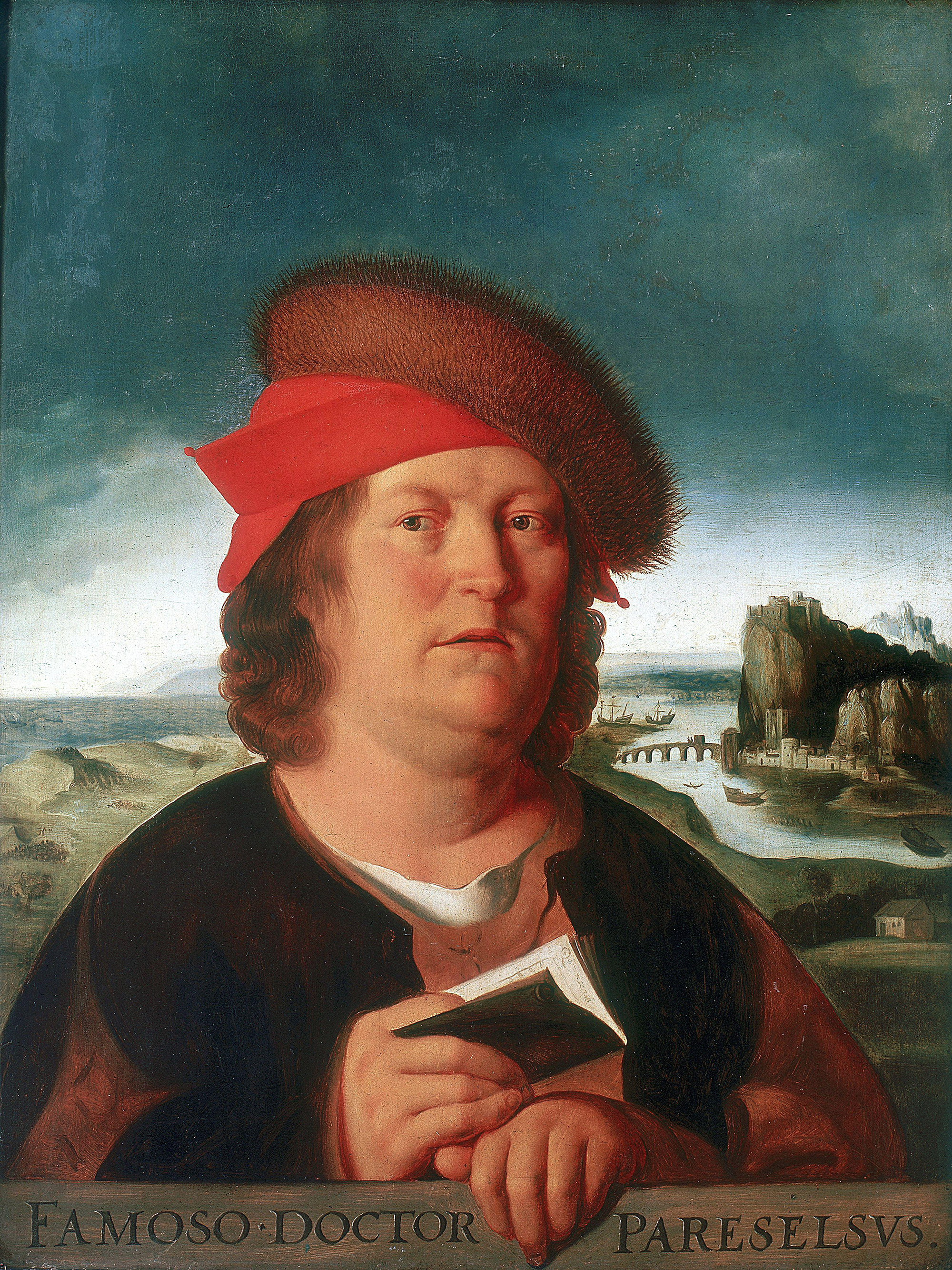
KC: One thing that I found sort of striking was, there's a chap called Paracelsus who is absolutely fascinating, absolutely bonkers. Paracelsus is, for me, the archetypical alchemist because he was certainly trying to revitalize medicine and get rid of humor theory and come up with all these ideas. [Editor's note: Humor theory is the idea that human health and temperament were related to four fluids in the body — black and yellow bile, blood and phlegm.] But he also believed that mermaids were real and that they were just out to steal men's souls.
A painting of Paracelsus. (Image credit: GL Archive via Alamy)
He was a drunk, he had a broadsword, and yet he's the guy that was able to combine what we think of as the traditional herbalist role and the doctors. At that point, doctors weren't even touching patients. They believed that the true skill of a medical man was that you didn't even need to examine a patient; you could just sort of look at them and you'd know what was wrong. He [Paracelsus] was able to say, "No, that's not right; you need to actually test things, and you need to try things." The moment we actually combine those two different threads together is when we actually started to get what becomes of modern medicine. The number of lives that saves is incalculable, so I think that that's one of the great moments.
The other one that always comes to me is Antoine Lavoisier in the French Revolution. He made several great discoveries — the fact that matter can only be changed; it can't be destroyed [at least at low energies]. The idea that if you take something, then obviously there's got to be components to that; you're not making it out of thin air. And coming up with a list of elements in the French Revolution or just before the French Revolution, unfortunately dies, from the guillotine [when Lavoisier was executed].
That, for me, was when we started to get true chemistry. That's when all of the magic is dispelled. I think he [Lavoisier] is, for me, the French equivalent of Isaac Newton. He's incredible.
HO: For you personally, throughout researching and writing the book, what was your biggest takeaway and what was the biggest surprise?
KC: My biggest takeaway is that science happens everywhere continuously through everyone. I traveled around the world for this book; I went to pretty much all of the continents. I didn't go down to Australia; that's about it. Wherever you go, there are discoveries being made. There are people who are trying to make their worlds better.
Science is not for this elite group; it's for everyone. One of the things I try to do with this book is to show people that even if you think that science isn't for you, it absolutely is; you're doing science continuously.
There've been so many [surprises]. One of the things — this is purely because of the way that I was taught and these inherent biases that we have — but it's so easy to overlook the role of women. When you start delving into the role of women in science … You've mentioned Tappūtī; we also have Mary the Jewess. Throughout the Renaissance, we have people like Caterina Sforza and [the] very famous Queen Christina of Sweden, which I didn't mention in the book because I just didn't have space.
The one shocker for me is this book "The Secrets of Isabella Cortese," which was a man pretending to be a woman to sell his science book. For me, [it] just kind of unravels this whole idea that science isn't for everyone.
This interview has been condensed and edited lightly for clarity.
profilebooks
The Age of Alchemy (Hardback)
"Age of Alchemy" is a fascinating and funny dive into chemistry long before chemistry existed. It captures the ingenuity of humans across cultures and time, revealing how ultimately the work of these early innovators would eventually meld into modern science.
About 2,500 years ago, people in what is now India and Sri Lanka were manufacturing an exceptionally high-quality type of steel. Wootz steel was extraordinarily strong and sharp, and they exported it globally — in the Middle East, it was used to forge the legendary Damascus blades. But around A.D. 1100, it vanished, and the knowledge of how these ancient people forged such high-carbon steel was lost.
In this excerpt from the book "The Age of Alchemy: How Early Innovators Shaped Modern Chemistry" (Profile Books, 2026), author Kit Chapman, a science journalist and honorary researcher at Falmouth University in the U.K., reveals the extraordinary story of Wootz steel and the experiments that finally showed how it was created using furnaces powered by monsoons.
During the Industrial Revolution, it became clear that something far stronger [than iron] — steel — was needed. Victorian engineers had started to build larger projects than anyone had ever seen, and were using cast iron for their structures, such as the first metal bridge, at Ironbridge in Shropshire. But cast iron was too weak. In 1847, a cast-iron railway bridge over the River Dee collapsed less than a year after it was opened.
If the world was going to modernise, it had to come up with a better material. Steel was the obvious answer, but how did you get rid of just the right amount of carbon in pig iron? The answer was found by an inventor called Henry Bessemer, who was hired by the British government to try to make cheap steel for use in guns. Bessemer's great innovation was to suggest that, once you've got your molten-hot pig iron, you blow air — a lot of air, between 85,000 and 550,000 litres per minute — up from beneath it.
This results in the iron undergoing oxidation, both increasing the temperature of your molten steel and reacting with the impurities. The impurities form a scum at the top of the furnace called slag. This is a mix of metal oxides and other unwanted byproducts such as silicon dioxide, which then needs to be removed, decarbonising the pig iron into the exact ratio you need for steel. With the steel already molten, it can then be poured out into whatever shape you need.
Bessemer became one of the leading figures of the "Second Industrial Revolution" at the tail end of the nineteenth century. He was knighted by Queen Victoria; his steelworks in Sheffield led to it becoming synonymous with steel; and in the US, eight towns were named after him. Without Bessemer, the world would never have known steel's true potential, and our skylines wouldn't be dominated by modern structures that rely on them, such as skyscrapers, railroad tracks and suspension bridges.
Except there's a big problem. "The story you've been told about metallurgy is from a western viewpoint," explains Gill Juleff, an archaeologist from the University of Exeter, and the reason I've come out to Sri Lanka. "It comes from colonialism, and the dominance of Europe. In Asia, there were technologies that were making very good-quality steel. The makers of iron understood it. All of the evidence suggests that India was very familiar with it. They were producing hardened chisels that carved granite even in the Iron Age. You can only do that with steel."
A Damascus blade forged from Wootz steel. (Image credit: HDesert via Getty Images)
As early as 500 BCE, steel began to originate from the Indian subcontinent that was far greater in quality than any other. The blades were forged with intricate, elaborate patterns and banding, like the marbling of the finest cut of steak. These were harder than any other blades, cut sharper and cost more.
Arabian, Greek, Roman and Chinese writers all described this wonder-material, which became so legendary that a Persian euphemism for cutting someone with a sword was an "Indian answer." It was known as Wootz steel. Just like pepper or other commodities from southern India that moved west along the Silk Road, the steel's rarity made it a luxury item.
"It's not a material that your everyday blacksmith would necessarily want," Juleff says. "High-carbon steel is an awful lot harder to work. It's not for arrowheads or kitchen knives. It became used by specialist swordsmiths." Then, around 1100 CE, the mysterious, intricately patterned blades simply vanished. Subsequent versions emerged (the most famous is Damascus steel), but Wootz steel had disappeared completely. It left a gaping hole in the history of chemistry.
No one could figure out how the Sri Lankans produced steel of such fine quality, and with such intricate patterning, well over a thousand years before it should have been possible. That is, until Juleff discovered the answer. She realised that archaeologists had been looking at the question based on how Europeans worked with iron.
"We discovered that the furnaces were all placed at the top of hills," Juleff explains. "Hundreds of them, of a type we'd never seen before; we only knew they were furnaces because there was slag everywhere. For some reason, the early Sri Lankans had their villages at the bottom of a hill, and then dragged all their iron to the top to smelt it." Initially, the strange furnaces were a puzzle. Typically, a furnace is tall and erect, like a chimney; this creates a natural draught that feeds oxygen to the fire, drawing air in and pushing out the exhaust gases. The Sri Lankan furnaces were totally different. They were flat, half a metre high and 2 metres long, with hundreds of holes bored into the front and back. They looked like oversized harmonicas.
Ancient people forged Wootz steel near Sri Lanka's central highlands at the tops of hills to utilize the monsoon winds. (Image credit: Jakub Specjalski via Getty Images)
"The answer wasn't immediately obvious why," Juleff says. "And then we realised they were all facing into the wind." What if the Sri Lankans weren't using bellows at all? This is why Juleff asked me to come to Colombo in the off-season. Every year, Sri Lanka is buffeted by two wet seasons: the south-west monsoons from May to September, and the north-west monsoons from December to February. It's a kind of weather you have to experience yourself to truly appreciate.
"A monsoon wind blows up to 90km an hour [56 mph]," says Juleff. "When you're at the top of a hill, you get an aerodynamic effect, where all the wind's rushing up and cresting. You're battered by it. Everyone told me you couldn't run a furnace just using the wind, because it's not strong or reliable enough. So, I decided to experiment. I built one." Juleff's furnace was identical to the Sri Lankan ruins she had found. She fed it using charcoal and iron sourced locally from surface deposits — exactly as would have been available to the villagers who built them.
Then, she waited for the monsoon. "So, we ran this furnace," Juleff says. "And, to begin with, I thought it wasn't working. We had this line of fire behind the front wall, and nothing at the back. I thought everything needed to be burning." It looked like the experts had been right: the monsoon winds weren't regular or consistent enough to blow into the furnace's holes to create the temperatures required.
But then Juleff's mood changed. "It was like a Transformers toy, everything rearranged in my mind. I had a eureka moment! It wasn't wrong at all; it was how it was designed to work. The wind was blowing up the hill — it wasn't blowing into the tubes at all, it was blowing over the top of the furnace. It's like an aeroplane wing: by blowing over the furnace, you're creating this incredible pocket of low pressure." The Sri Lankan furnace wasn't a harmonica, with air puffed through it; instead, it was played like a flute.
This is the Bernoulli effect, the same principle that sticks a race car to the road, or keeps water moving through your plumbing. The change in pressure and the smooth, ordered air flow was creating a furnace beyond anything western science had considered possible. The team continued putting in ore and charcoal throughout the day, then allowed things to cool. The next day, they returned to see what they had produced. At the top was a knotted lump of pure iron — a bloom, as expected. "But then below that, stuck to the bottom of our slag, was another layer of metal," Juleff says. "High-carbon steel. The wind did it. We couldn't stop the wind doing it. We had created a furnace that could make the best steel anywhere in the world."
Juleff had solved the mystery of Wootz steel. Not only did we now know how it was made, we understood why the technology hadn't spread around the world: the technology was anchored in the unique geography of Sri Lanka, and the people who visited weren't scholars, but traders who didn't appreciate the small miracle they were witnessing.
"The metal-makers weren't moving," Juleff says. "They were here, sat in the interior of Sri Lanka, season after season, running these incredible furnaces." Why did Wootz steel vanish? In the twelfth century CE, Sri Lanka was invaded by the Pandya dynasty of southern India. It triggered a societal collapse, as Sri Lankans were forced to pay tribute to their conquerors. The most likely explanation is that, during the chaos of the invasion and its messy aftermath, the traders and middlemen who brought the Wootz steel to the coast, and the ships that transported it around the world, had stopped coming.
It wouldn't have occurred, or mattered, to a Sri Lankan metallurgist that their goods were ending up in the hands of kings and emperors in some distant land they'd never heard of; they'd have only seen that they couldn't sell to local traders any more. The villagers stopped making goods that didn't sell, and moved on to other, more profitable, careers.
Excerpted from "The Age of Alchemy: How Early Innovators Shaped Modern Chemistry," Profile Books, 2026.
Profile Books
The Age of Alchemy: How Early Innovators Shaped Modern Chemistry
"Age of Alchemy" is a fascinating and funny dive into chemistry long before chemistry existed. It captures the ingenuity of humans across cultures and time, revealing how ultimately the work of these early innovators would eventually meld into modern science.
Researchers used quartz from fossilized wood to trace how Europe developed. A polished piece of fossilized wood may look like little more than a decorative stone, yet the quartz inside it can preserve the history of an entire region for hundreds of millions of years. Geologist Dr. Steffen Trümper of the University of Münster and [...]
Oxygen provides the driving force for many vital chemical reactions. Two well-known examples include respiration, the process that allows living things to break down food to release its energy, and combustion, reactions that produce heat and light. But oxygen has an unusual electronic configuration that tends to slow reactions with organic matter, so reactions often need help to get started. In nature, specialized proteins called enzymes can activate oxygen on demand by first rearranging its electrons.
Oxygen provides the driving force for many vital chemical reactions. Two well-known examples include respiration, the process that allows living things to break down food to release its energy, and combustion, reactions that produce heat and light. But oxygen has an unusual electronic configuration that tends to slow reactions with organic matter, so reactions often need help to get started. In nature, specialized proteins called enzymes can activate oxygen on demand by first rearranging its electrons.
A worker at a US government lab got bitten by a monkey carrying a deadly virus, and it turned out nobody knew what to do about it. Around the same time, someone from the same lab tried to smuggle outbreak samples into the country. All of this while everyone's worried about AI making bioweapons. Let's take a look.
Your favorite stretchy workout clothes may be much easier to recycle one day, thanks to a new type of elastic yarn that is as strong and stretchy as today's spandex-containing fabrics.
The yarn, described in a July 25 study in the journal ACS Materials Letters, is built entirely from polyethylene, the plastic used in milk jugs and single-use grocery bags. By contrast, most of today's stretchy fabrics blend spandex, a bouncy-but-weak polyurethane fiber, with a tougher fiber like polyester or nylon.
That combination gives clothes their stretch and durability. But because the fibers are chemically different, it's difficult and costly to separate them for recycling, and chemicals used to break down the fabrics are toxic. The result is that almost none of this material is recycled. An estimated 80% of textiles sold in the U.S. contain spandex, and most end up incinerated or in a landfill, study co-author Svetlana Boriskina, a research scientist in the Department of Mechanical Engineering at MIT, said in a statement.
To solve that problem, the MIT team turned to polyethylene, one of the world's most widely recycled plastics. For the yarn's stretchy core, the researchers created a soft, springy version of polyethylene akin to a rubber band. Around that core, they wound a second, stiffer polyethylene fiber, more like a fishing line, coiling it tightly the way a spring or a twisted phone cord is coiled. Because both materials come from the same plastic family, they don't need to be separated before they're recycled.
In laboratory tests, the researchers melted a spool of the yarn and respun it into new yarn 10 separate times. Each time, they tested its strength, and the recycled yarn performed just as well as the original in every case. In head-to-head tests, the new yarn even outperformed commercial spandex-polyester yarn in maximum load, meaning it could bear more force before breaking, according to the study.
The team has already shown that these lightweight polyethylene fibers can be engineered for other perks, too — like cooling, moisture wicking and stain resistance — building on their earlier work spinning polyethylene into wearable fabric. Even buttons, zippers and buckles could eventually be made from compatible plastics, so a whole garment could be melted down and remade without being taken apart first.
Scientists trained artificial intelligence on libraries of DNA and then asked the model to create recipes for viral genomes. Sixteen of them were viable, yielding new viruses.
Google’s notorious AI Overview just handed would-be Flock vandals a perfect excuse to carve into the company’s controversial AI-integrated license plate readers (ALPRs).
ALRPs are wildly unpopular, especially online, where privacy-minded communities trade memes and videos cheering on destruction of the surveillance equipment. One of the more popular bits in this space centers on the idea that Flock’s ALPR’s are supposedly packed with valuable metals like gold, copper, and zinc — so, the tongue-in-cheek riffing goes, why not crack one open and cash in at the nearest scrapyard?
Clever or not, the meme hinges on a spurious claim. ALPRs do contain trace amounts of gold and other metals, just not enough to be worth the trouble. Unless you’re well versed in breaking down circuit boards, you’d be hard pressed to earn enough to buy a Big Mac, let alone recoup your labor costs.
Search “how much gold does a Flock camera have” and Google’s AI Overview doesn’t even push back a little bit. Instead, it flatly asserts that a “Flock safety camera contains about 1 to 5 grams of gold used in its internal circuit boards and wiring.” (At today’s gold prices, that would mean each Flock camera contained up to $650 of gold.)
Google goes on to claim that Flock’s ALPRs hold anywhere from two to 23 pounds of copper, which would be an engineering marvel considering the whole device only weighs three pounds.
Google’s AI Overview cites two sources to back up its summary, and neither holds up.
The first is an anonymous Substack post from an account called do.not.obey.do.not.comply, claiming the “rough scrap value of these metals per camera is estimated to be $150 to $500.” Google’s summary skips the fine print, however: that figure comes from “estimates based on scrap-value discussions” — vibes, in other words, as opposed to actual reporting or financial information.
The second is an AI-generated Instagram post riffing on the same meme, egging vandals on to gut the camera to access their supposedly precious innards. The account behind that post seems to belong to a weed grower, with most other posts about plant cloning, hydroponics, and fully grown cannabis flower.
There’s a real irony buried in all this AI slop: one AI-surveillance company’s search engine is quietly manufacturing an excuse to destroy another AI-surveillance company’s product. If that doesn’t sum up the current state of the AI-obsessed tech industry, nothing will.

 Login