❌

Normal view

'Like a jail door slamming': Male sperm whales' mysterious rhythmic clanging is the loudest communication sound of any animal

11 August 2026 at 16:09

Sperm whales make the loudest communication sound of any animal on Earth, researchers find — but they aren't sure why.

In a new study, researchers investigated the mysterious, low-frequency clangs made by male sperm whales and found that they were louder than any known sperm whale communication signal, with the potential to be heard by other whales around 43 miles (70 kilometers) away.

They are very loud and metallic sounds that almost sound "like a jail door slamming," which is "why they are also called clangs," study first author Simone Videsen and co-author Peter Teglberg Madsen, biologists at the Center for Active Sensing with Sound at Aarhus University in Denmark, told Live Science in an email. "You feel small as a human when you hear them, as they are clearly made by something bigger than you," they said.

Sperm whales (Physeter macrocephalus) are the largest toothed predators, growing up to around 59 feet (18 meters) long. They dive deep into the ocean to hunt giant squid (Architeuthis dux) and other prey that dwell as low as 1.9 miles (3 km) below the ocean surface.

The distinctive clangs, first reported in the 1980s, are the loudest communication signal that sperm whales make, although they can produce even louder echolocation clicks to locate prey during hunts. The clangs are unusual because they are made only by males and represent an extreme form of communication that scientists still can't fully explain.

In the latest study, the researchers used hydrophones (underwater microphones) off the Seychelles to measure the sound level of the clangs. They also studied the rhythm of the signals in recordings collected in other locations, including off Sri Lanka, Norway and Scotland.

The recordings revealed that the whales kept up a slow, low-frequency rhythm, unlike the short, rhythmic clicks that both males and females make for typical social communication or the clicks used in echolocation. In fact, the rhythm was so slow that males left a gap of 5 to 10 seconds between each clang. That might not sound that impressive ‪—‬ but as far as we know, whales can't count to 10, so they are using another means to keep up this rhythm. According to the study, the whales might be relying on the echoes of the clangs bouncing off the seafloor.

Sperm whales can produce these record-breaking acoustics thanks to their ginormous noses — the largest of any animal — that dominate their massive heads, which make up about one-third of their body length. To make the clangs, male whales use their "phonic lips" ‪—‬ structures in their noses that snap together.

"They make [these noises] by forcing pressurized air through so-called phonic lips in their giant sound producing nose," Videsen and Madsen said.

The researchers proposed a few possible explanations for why the whales might be making the long-range clangs. For example, the males might be using the sounds to attract mates or scare off other males.

However, the communication may exist for another, unknown reason. In future studies, the researchers hope to learn more about this mysterious form of communication by playing recordings of the clangs underwater and seeing how nearby sperm whales respond.

'It's incredibly rare to see a moment like this in the ocean': Camera drone captures moment humpback whale gives birth off Australian coast

A camera drone operator captured footage of a humpback whale giving birth off the north coast of New South Wales in what is thought to be a world first.

Alexander Forrest, a commercial drone pilot for the Organisation for the Rescue and Research of Cetaceans in Australia (ORRCA), was conducting aerial observations of migrating humpback whales (Megaptera novaeangliae) on July 28. ORRCA is a nonprofit organization focused on the rescue, conservation and welfare of marine mammals.

During the survey, Forrest noticed a whale swimming slightly behind her pod and going unusually slowly. Then, he saw her give birth.

"It's incredibly rare to see a moment like this in the ocean. It's a very rarely documented encounter," Forrest told Live Science. "It's the first drone video as far as we know of a full humpback whale live birth. It gives critical inside moments in the first moments of a calf's life, and also discovers the behaviour of a new humpback whale mother and her freshly newborn calf."

An ORRCA spokesperson said that this is only the fourth time the phenomenon of a humpback whale giving birth had been filmed, in general. Scientists also have footage of other whale births, including a gray whale (Eschrichtius robustus) birth filmed off the coast of California and a sperm whale (Physeter macrocephalus) recorded giving birth in the Caribbean.

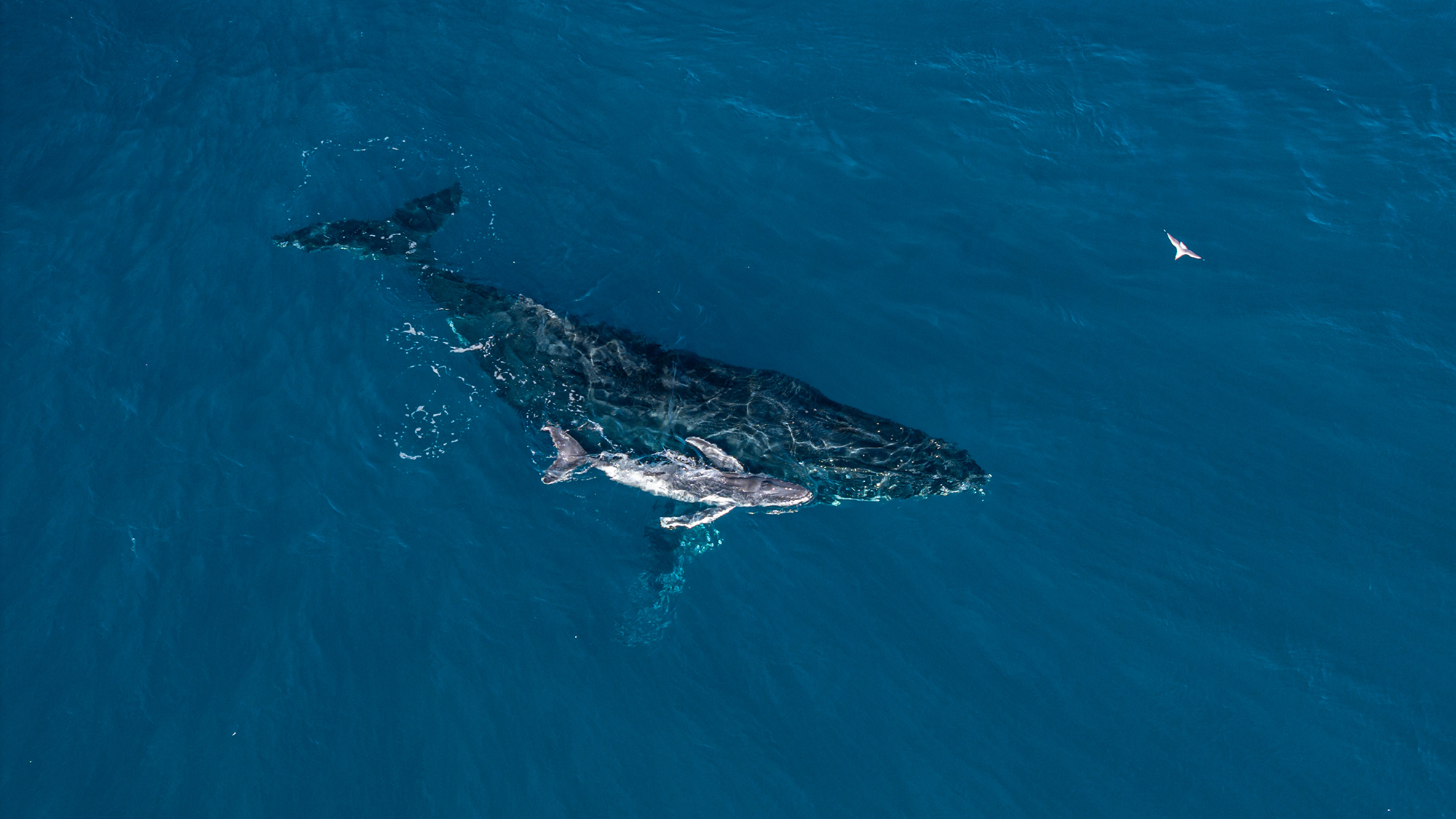
Large whales swim in the blue ocean

The expectant humpback whale mother swam behind her pod, eventually giving birth by herself. (Image credit: Alexander Forrest/ORRCA (@forrestfov))

The drone video shows the newborn whale surface from blood-reddened water for its first breath. The mother then turns back to reunite with it. The scene was filmed around 0.4 miles (700 meters) from the shore at Kingscliff in northeastern New South Wales.

The birth is "a symbol of one of the strongest conservation efforts in history, returning humpback whales from near extinction to nearly 50,000 on the New South Wales coast," Forrest said. Gathering data on this humpback whale population is critical to "discovering more about where they birth, what happens when they birth, and what those early moments look like."

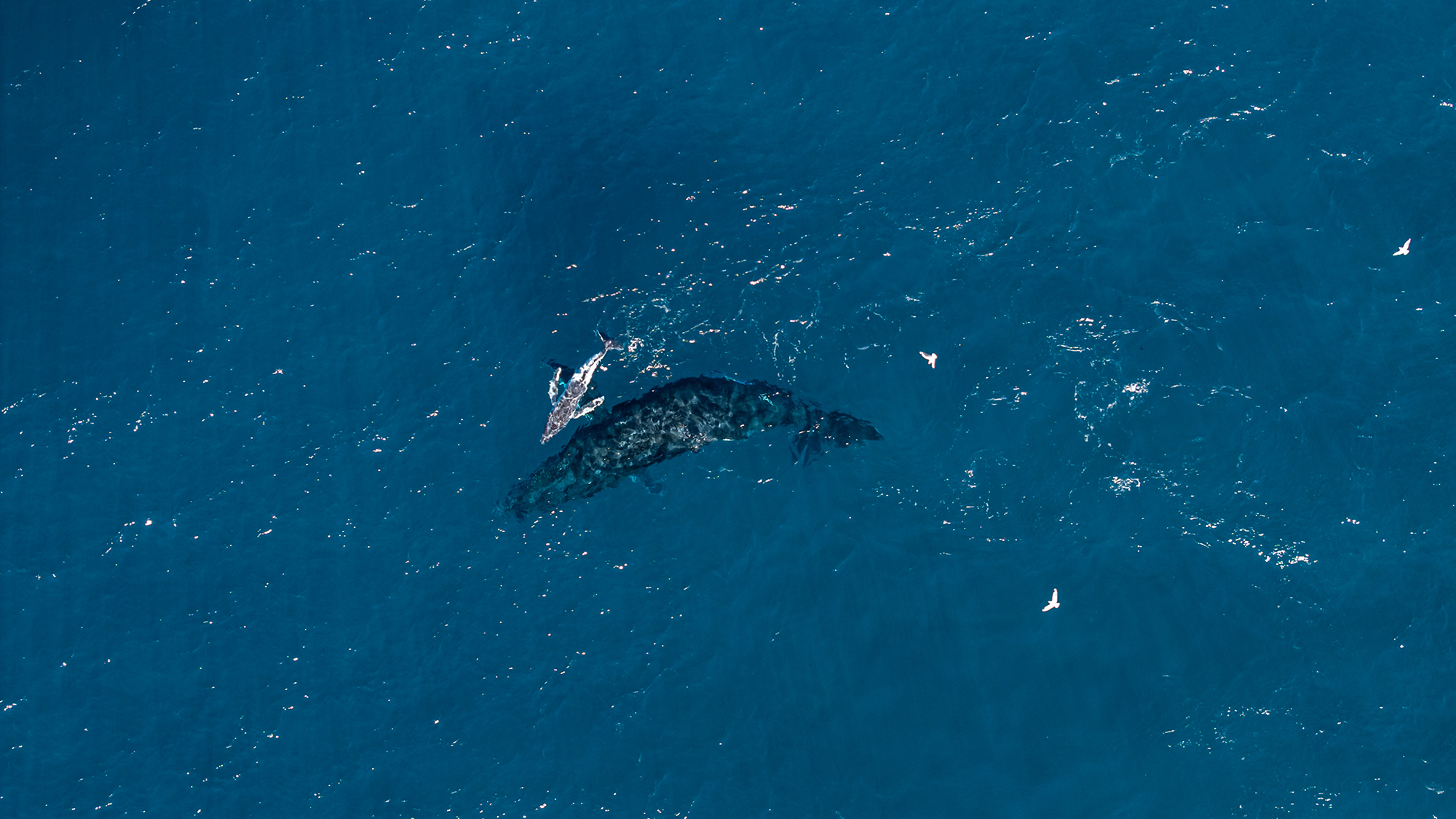
Large whales swim in the blue ocean

Humpback whale calves stay with their mothers for their first 11 months. (Image credit: Alexander Forrest/ORRCA (@forrestfov))

The footage will now be analyzed so that a report on the observation can be peer-reviewed and published in a scientific journal. Notably, the mother whale was trailing behind her pod when she gave birth, a detail biologists will compare with observations of other birthing whales that were accompanied by members of their pod. For instance, the 2023 drone footage of the sperm whale giving birth showed that she had 10 adult females near her that formed a protective circle and took turns lifting the calf up so it could breathe at the water's surface.

Throughout their first weeks, calves stay close to their mothers and learn critical behaviors, such as breathing at the surface.

"Humpback whales seem to have an incredible maternal bond with their offspring," Forrest said. "There is an 11-month period where this calf will be raised and feeding on very nutrient-rich milk until it is a yearling and can fend for itself."

A newborn humpback whale calf weighs 1 to 1.5 tons (900 to 1,360 kilograms) and measures roughly 10 to 16 feet (3 to 5 meters) in length. While feeding on its mother's milk, the calf will gain 100 pounds (45 kg) a day and develop the strength and food storage it needs for its first migration. Humpback whales undertake one of the longest migrations of any mammal, travelling up to 5,000 miles (8,000 kilometers) each way between the cold waters of the poles to warm tropical breeding grounds.

Stalking Silence in Svalbard: Norse Scientists Unveil New Method for Tracking Silently Moving Objects in the Water

15 July 2026 at 13:07

Scientists from the Norwegian University of Science and Technology have unveiled a method for tracking silently moving underwater and surface objects by using existing fiber-optic cables to measure water displacement.

The scientists behind the novel detection approach, which was designed to detect whales even when they aren’t vocalizing, also demonstrated the method’s ability to track surface ships and potentially underwater vessels, such as submarines, that traditionally rely on silence for stealth.

Tracking Silently Moving Whales and Other Objects

In the research team’s study, the authors explain that it is already possible to record and reconstruct marine mammal vocalizations, including those of whales, using seabed fiber-optic cables. They note that the current method, called distributed acoustic sensing (DAS), allows scientists to passively monitor whale behavior, “enabling both the detection of vocalizations and the simultaneous tracking of multiple individuals.”

However, they add, although this data can prove valuable in tracking these increasingly endangered animals, “it has not been possible to track marine mammals when they are silent.”

“A fundamental limitation of passive acoustic monitoring is that most methods rely on acoustic data, which is only available when whales vocalize,” the study authors explain, adding that this limitation “clearly demonstrates the need for new sensing methods that can detect silent whales.”

Although the researchers propose several methods, including combining DAS data with satellite and observational data to paint a more complete picture, they also note a “second path” that involves exploring current datasets to discover new, valuable acoustic signatures even when the animals are silent.

Detecting Hydrodynamic Pressure Changes Caused by Ships and Animals

When exploring new ways to interpret DAS data collected by seabed fiber-optic cables, the team explained how low-frequency strain variations may arise from “a range of physical mechanisms.” These include hydrodynamic processes “associated with moving objects.”

For example, the authors explain, when a ship moves across the ocean surface, it pushes water ahead of it and draws water along in its wake. This motion through the water medium generates a strain on the surrounding water described as a hydrodynamic pressure field. According to the team, this motion-induced pressure field  “extends downward through the water column.”

“The displacement of water generated by moving whales and ships induces a moving hydrodynamic pressure field that extends through the water column, dynamically loading and unloading the seafloor,” they explain.

Changes in this pressure field caused by moving objects cause sediments on the ocean floor to deform laterally and vertically. In areas of the seafloor with fiberoptic cables buried underneath, the DAS system records this “lateral deformation” of the sediments, which “translates into strain that can be observed in the DAS data.”

“This means that no acoustic signal is involved, and we can ‘listen’ to silent whales,” they write.

Tests Demonstrate Tracking Surface Ships and Submerged Whales

To calibrate their approach, the team used surface ships as “proxies” in a series of field experiments. According to their study, the four interrogator units (IU) were installed “during the DAS experiment on Svalbard in 2022.” Then, another unit was installed in Longyearbyen in March 2025. Although the study focuses on the newer IUs, the team notes that all the experimental data “was used to analyze how coupling affects the detectability of hydrodynamic pressure field signatures and how the signal characteristics change with increasing source-receiver distance.”

In those experiments, the team investigated four ships of different sizes. Notably, all ships were observed at a depth of 70 to 80 meters and were traveling at roughly the same speed. Critically, ship size, speed, and route data can be verified externally, providing a check on the study’s results.

“Ships are observed in the DAS data year-round, and the AIS is available to confirm which ship is sailing above the fiber and at what time,” they explain.

As expected, they found that the DAS signal amplitude “scales with the size of the ship.” For example, the smallest ship they observed barely registered above the background noise, making it the hardest to track. Conversely, the largest vessel tracked by the team, an icebreaker, left the clearest signal.

The researchers also demonstrated the ability to observe hydrodynamic pressure and velocity signals from a cruise ship at a water depth of 413 m, “and up to 550 m from the fiber cable.” However, when the team searched for whales, the range was much more limited.

“The smaller blue whales can be observed when diving within 40 m of the fiber-optical cable,” they explain.

During a dedicated test segment, the team monitored what they interpreted as several silently moving whales traversing through the detection zone. Although they were unable to independently confirm they were whales in the same way they could confirm the ships, the team notes that “multiple lines of analysis support the interpretation that whales are responsible for the observed signals.”

The team also notes that AIS data confirmed that no acoustic ship signatures were present “in the time window studied.” They add that this result “reduces the likelihood that the observed low-frequency signals originate from vessels.”

The Signal Amplitude Decreases with Increasing Distance From the Fiber

When discussing the implications of their findings, the team said their data shows that the observed low-frequency response captured by the fiber-optic cables “is consistent with translating hydrodynamic pressure fields generated by the displacement of water by moving ships and other large bodies such as whales.”

“This sensing method enables an approach to monitoring one of the world’s most endangered species,” they explain, adding that it is even more effective at detecting submerged objects than at detecting surface ships.

“A fully submerged object generates a more symmetric pressure field, while a surface-bound ship produces a truncated field due to the air–water interface, which limits the downward extent of the pressure field,” the study authors write.

When discussing the limitations of their innovative, silent, object-tracking approach, the team notes that it is only effective for tracking smaller ships and whales at close range.

“Kvitungen is the smallest ship investigated in this work and is barely observed above the noise floor for a water depth of ∼75 m,” they write. “Blue whales are even smaller and are unlikely to be detected at distances greater than approximately 30 to 40 m from the fiber.”

The team also notes that although larger ships generate stronger signals than smaller ones, “the signal amplitude decreases with increasing distance from the fiber.”

Other limitations involved data returns suggesting whales that were either “abnormally long or surprisingly small.” The team said this seemingly impossible result “underlines that our simple model needs further development to obtain more precise results.”

The study “Detecting silent whales using seabed fiber-optic cables” was published in the Proceedings of the National Academy of Sciences (PNAS). 

Christopher Plain is a Science Fiction and Fantasy novelist and Head Science Writer at The Debrief. Follow and connect with him on X, learn about his books at plainfiction.com, or email him directly at christopher@thedebrief.org.

Scientists Discover a 5-Million-Year-Old Whale Graveyard Deep Beneath the Indian Ocean

14 July 2026 at 23:31
Whale Skeleton Dark Lava RockA deep ocean whale graveyard is revealing new clues about whale evolution and the ecosystems that form around their remains. When a whale dies, its body can become the beginning of an entire deep ocean ecosystem. For a time, the carcass may drift at the surface, drawing sharks and other predators. Eventually, after weathering and [...]

New pipeline in Canada to proceed after C$150bn pledged to ease BC and First Nations concerns

Port expansion and protections for whales part of BC and Alberta plan to expand country’s presence overseas

The governments of Canada and the province of Alberta will move forward on a major new oil pipeline after the pair announced a plan to ease concerns of British Columbia and First Nations on the Pacific coast.

Canada’s prime minister, Mark Carney, shuttled between British Columbia and Alberta on Thursday to announce more than C$150bn in new investments in both provinces, part of a broader project of reducing trade with the United States and expanding his country’s presence in overseas markets.

Continue reading...

© Photograph: Canadian Press/Shutterstock

© Photograph: Canadian Press/Shutterstock

© Photograph: Canadian Press/Shutterstock

'Weirdos of the sperm whale world' appear to be evolving 2 different dialects, audio recordings suggest

24 June 2026 at 15:01

An isolated population of sperm whales in the Mediterranean Sea are splitting into two distinct groups with different dialects, a new study reveals. This shift has likely been happening for thousands of years, as two groups split from an initial single population.

The findings, published Tuesday (June 23) in the journal Proceedings of the Royal Society B: Biological Sciences, are providing a rare insight into the process of different dialects emerging among non-human species.

The sperm whales (Physeter macrocephalus) live in small social units of females and young, and they associate with other groups in the same area. They use social vocalizations called codas ‪—‬ shortpatterns of clicks ‪—‬ to communicate. The particular codas they use identify them as being part of the same cultural group.

Taylor Hersh, a researcher in the School of Biological Sciences at the University of Bristol in the U.K. and first author of the research, and her colleagues have analyzed codas recorded over almost 20 years in the Mediterranean, where there is a unique population of a few thousand sperm whales, to see if they all use the same dialect.

Sperm whales entered the Mediterranean via the Strait of Gibraltar about 20,000 years ago, and they have spread throughout the area. The whales rarely leave the sea ‪—‬ even males, which normally migrate. Other sperm whales don't seem to enter often, either, so the Mediterranean ones are effectively isolated from other populations and are considered an endangered subpopulation.

"The sperm whales in the Mediterranean are really cool," Hersh told Live Science. "I've always thought of them as the weirdos of the sperm whale world in that they don't leave through the Strait of Gibraltar even though they could. They are unique, and for a long time, they were also thought to be acoustically unique."

The thinking was that all the sperm whales in the Mediterranean belonged to the same clan, identified by their use of a single coda 90% of the time. This coda consists of three clicks and then a pause before the fourth and final click ‪—‬ a pattern called the three-plus-one type.

But the analysis by Hersh's team of 5,291 codas recorded between 2003 and 2021 revealed that sperm whales living in the eastern Mediterranean around the Hellenic Trench, off Greece, have a slightly different dialect from that used by animals in the western basin around Spain's Balearic Islands.

The eastern whales produce a distinct form of the three-plus-one coda. "It's a very similar pattern of clicks, but it's much, much faster," Hersh said.

four sperm whales in the sea

Researchers found distinct dialects between the two populations, with the eastern population producing slower codas. (Image credit: Asociación Tursiops)

In some recordings, whales in the eastern Mediterranean produced the slower coda, showing they were familiar with both dialects.

"The western sperm whales religiously stick to their dialect, but there were four instances of eastern whales using the western dialect," Hersh said. "The question of why is still an open one. Their dialect seems to be a lot more diverse than we expected. They do occasionally make those slow three-plus-one codas, but they make a lot of other coda types, too."

Hersh hopes further recordings alongside records that tie individual whales to sounds and events might help elucidate why the whales switch between dialects.

"It's exciting to see this study showing different populations behaving closely, but also differently," said Gašper Beguš, linguistics lead at Project CETI, a nonprofit organization that aims to translate the communication of sperm whales.

The study paints a picture of sperm whales progressively occupying the Mediterranean from west to east, with the dialect of one group gradually changing. "The groups in the east clearly remember the western dialect because they have these 'throwback' days," Hersh said.

It's still a mystery how and why these dialects evolved.

"Every speech is a dialect; the question is how did they arise and why?" said Beguš, who wasn't involved in the new study. He said the historical change in habitat does help to show which dialect came first. "In the Mediterranean, maybe they're forming different groups, so that's why they're trying to distinguish themselves," he told Live Science, giving the parallel of young people who distinguish themselves from previous generations by coming up with new slang.

"It's possible that these two groups with repertoires that are very similar but still distinctive could represent a sort of midway phase,” Ellen Jacobs, a marine biologist at Aarhus University in Denmark who wasn't involved in the research, told Live Science via email.

"Changes in the rhythm might be a very feasible and meaningful way for coda signals to start to diverge," she said, like the way the English words "How do you do?" got mashed together until they morphed into "howdy."

The timescale on which a sperm whale dialect develops is uncertain, but it's likely a slow process, according to Hersh. "It's probably happening on the scale of hundreds and thousands of years, because sperm whales can live into their 60s and 70s. And this study is looking over 19 years of data, and that's just a snapshot of one animal's life," Hersh said.

This means the eastern whale dialect was conceivably emerging in the Mediterranean Sea as famous human civilizations were speaking different languages on the surrounding lands, including when the ancient Greeks and Romans were rising and then falling.

"Maybe if we could leave them for another 10,000 years, we would come back to find the completely separated dialects of clans," Jacobs said.

Humpback Whale Stuns Scientists With 15,000 Kilometer Journey Across Oceans

9 June 2026 at 02:45
Humpback Whale Head Close UpTwo humpback whales crossed entire oceans between Australia and Brazil, setting migration records and surprising scientists. Scientists have documented an extraordinary feat of long-distance travel by humpback whales, confirming for the first time that individual animals have moved between breeding areas off eastern Australia and Brazil. The discovery reveals ocean crossings of more than 14,000 [...]
❌