Samsung just uploaded a One UI 9 Watch test firmware (L500XXU2ZZH2) for the Galaxy Watch 8 Classic to its servers.
The new firmware specifically targets the Watch 8 Classic, making it one of the first older models (outside the new Watch 9 series) to get public beta access.
This build runs on a newer bootloader version. Once you install it, rolling back to the previous software won't be possible.
Samsung is moving closer to bringing One UI 9 Watch to older Galaxy smartwatches, and the Galaxy Watch 8 Classic seems to be among the first to receive it. A new test build has appeared on Samsung’s test servers, which could be a sign that a public beta could be launched soon.
As per the screenshots shared by Tarun Vats on X, Samsung has uploaded the firmware with build number L500XXU2ZZH2/L500OXM2ZZH2 for the Galaxy Watch 8 Classic. Just because the software is ready doesn’t mean the beta will be available quite yet, but it’s a strong indication that Samsung is preparing to get things started soon.
Breaking news!Galaxy Watch8 Classic: The first One UI 9 watch beta build has been spotted on the test server.Build: L500XXU2ZZH2/L500OXM2ZZH2We can expect the beta program in the coming weeks. pic.twitter.com/FLzpdHihYQAugust 11, 2026
Samsung's smartwatch software usually goes through a few internal builds before it makes it to users. The test-server listing also suggests that downgrade might not be possible after the update is installed, and the new firmware seems to be built on a newer bootloader version.
This is important for anyone looking to get into the beta early. The software is still in testing, so expect unfinished features, bugs, and compatibility issues. If you rely on your smartwatch for notifications, exercise, or health monitoring, it might not be the best idea to put it on your everyday watch.
While Samsung hasn’t made an official statement regarding the beta program, the leaked build suggests that the Galaxy Watch 8 Classic could be one of the first devices, apart from the Galaxy Watch 9 series, to get access.
There is a bigger reason to follow this rollout. Samsung's Galaxy Watch 9 and Galaxy Watch Ultra 2 already ship with One UI 9 Watch based on Wear OS 7, so there's little reason for Samsung to now withhold the update from older models. If Samsung holds to its usual rollout pattern, the beta could be here in the next few weeks.
Samsung's newest smartwatches finally hit store shelves last week, but if you weren't being vigilant, you could've completely missed that one of the best Galaxy Watch 9 deals is still going strong at T-Mobile.
That's a whopping $430 in savings on the 40mm version of the watch. Need something bigger? You can apply the same discount to the 44mm version or even the Galaxy Watch Ultra 2 if you need a bit more power. The choice is yours.
The Samsung Galaxy Watch 9 is here, and T-Mobile will already give you the flagship wearable for free when you add a line with Watch Plan Plus 2.0 on the carrier's website. You'll still have to pay the $35 activation fee, but you're looking at $430 in savings on a device that's sure to rank among the best Android smartwatches released this year. No trade-in required. View Deal
The Samsung Galaxy Watch 9 takes the foundation of its excellent predecessor and adds a new Snapdragon processor and a larger battery without increasing the size or weight. The result is a sleek, lightweight smartwatch that doesn't skimp on premium specs and innovative Galaxy AI software features.
Just like the Galaxy Watch 8, the new model still features a vibrant AMOLED display with 32GB of onboard storage, plus you get dual-band GPS tracking, IP68 with 5ATM water resistance, and a powerful BioActive sensor with ultra-accurate health and fitness tracking capabilities.
So what's the catch? Well, as I mentioned above, you'll need to pay the $35 activation fee and sign up for the Watch Plan Plus 2.0 plan to enjoy the $430 discount. This plan costs just $15 per month and gives you unlimited talk, text, and data directly from your smartwatch, in addition to unlimited texting and 5GB of data in over 215 countries worldwide (15GB of data in Mexico and Canada).
"Hold on, hold on. What's going on here?" my coach asked as he noticed me wearing four watches before I went out running. I often wear two watches to the gym because I'm constantly comparing them, but I've never worn four before, and that was clearly enough to raise eyebrows.
After explaining the article you're currently reading, in which I wear four smartwatches through a series of tests, he laughed and told me I must have a fun job. Indeed, I do! But the results of the test should be a real help to anyone looking to buy a smartwatch this year (and help save some money in the process).
So stick with me as I run through my past week, in which I wore four smartwatches to sleep, every time I ran during my half-marathon Spartan training, and during a full 5K Spartan race over the weekend.
Starting off with a good night's sleep
(Image credit: Nicholas Sutrich / Android Central)
I would never recommend sleeping with four smartwatches on, but I will say that it wasn't nearly as uncomfortable as I had been dreading. Most smartwatches collect the same sleep data, but every so often you'll find a watch that does something different. The Galaxy Watch Ultra 2, for example, included a skin temperature measurement, measured against a baseline it had determined in the past 2 weeks since I started wearing it.
Sleep stats
Metric
Samsung Galaxy Watch Ultra 2
Honor Watch 6
Amazfit T-Rex 3 Pro
OnePlus Watch 3 43mm
Sleep time
6h 33m
6h 38m
6h 43m
6h 31m
Sleep score
72
77
54
70
Deep sleep
1h 3m
2h 24m
1h 17m
1h 2m
Light sleep
2h 36m
2h 48m
3h 8m
3h 47m
REM sleep
2h 2m
1h 26m
1h 22m
1h 42m
Times awake
18 (52m)
2
9 (38 min)
2 (7m)
Breathing quality
12.9 times/min (high rate)
63 (low score)
14 BRPM
N/A
Heart rate range
45-84 (51 avg)
30-122ms HRV
47-73
46-64 bpm (52 avg)
Blood Oxygen
93%
N/A
94%
N/A
Skin temperature
+1.3F
N/A
N/A
N/A
Of all the watches I wore, the Honor Watch 6 showed the least data. Most of it is holed up in a sleep analysis section that gives you percentages and glanceable "normal," "high," and "low" ranges so you don't have to dive deep. That's good because I couldn't figure out how to dive deep into this data.
The OnePlus Watch 3 43mm offered a better look at the data, but it didn't include as many data points (like SpO2 or breathing quality). The Galaxy Watch Ultra 2 did a great overall job, but it seems like it's a bit more sensitive to my restless sleep than the other watches.
Overall, I felt like the Amazfit T-Rex 3 Pro's data was the most accurate. I know I woke up more than 2 times (which the Honor and OnePlus watches say), but there's no chance I was up 18 times as Samsung suggests. The T-Rex 3 Pro has a temperature sensor onboard, but apparently, it doesn't include this data for sleep. Weird choice, but that terrible 54 sleep score lines up with how I felt when I woke up, not the 72 Samsung gave me.
Time for a run (or four)
(Image credit: Android Central)
I began training for a Spartan Beast a few weeks ago using Amazfit's incredible running coach feature because I already felt confident in the watch's ability to accurately measure everything. Since I had already been comparing the Amazfit T-Rex 3 Pro to every other watch I've worn over the past few years, it made sense to keep it on for this comparison.
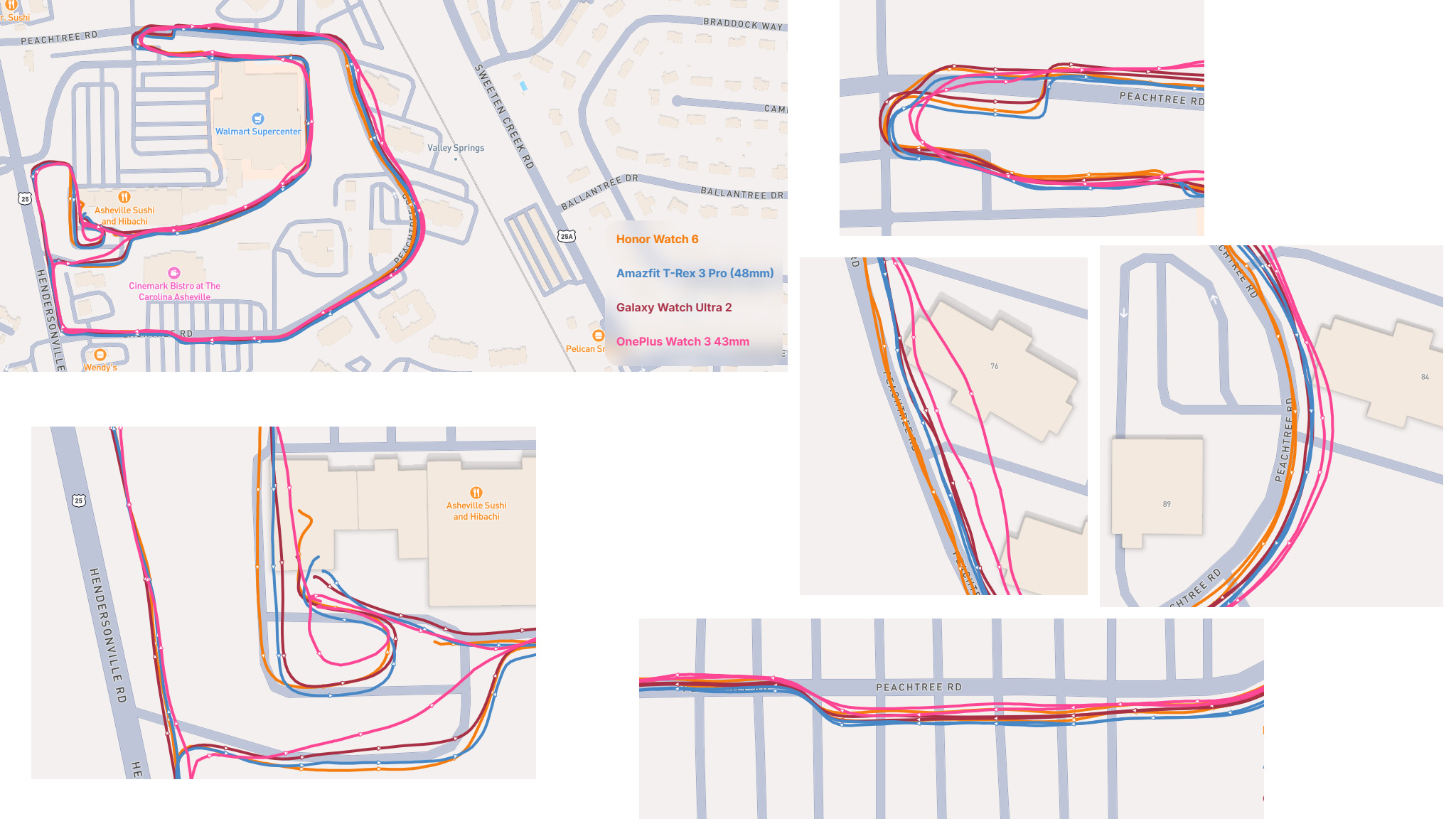
My intuition wasn't wrong. Looking at the map data above, where I ran 2.5 miles over two loops around this Walmart and the surrounding business park, things look pretty even until you zoom in. I broke off sections of the track so you can see the GPS tracking discrepancies between the watches.
Overall, the OnePlus Watch 3 43mm was the least accurate (genuinely a surprise to me), while the Galaxy Watch Ultra 2 and Amazfit T-Rex 3 Pro tied for first. The Honor Watch 6 also did an excellent job, but there were two points on the map with notable tree cover that showed me running in the road instead of on the sidewalk, while the other two kept me on the side of the road.
(Image credit: Android Central)
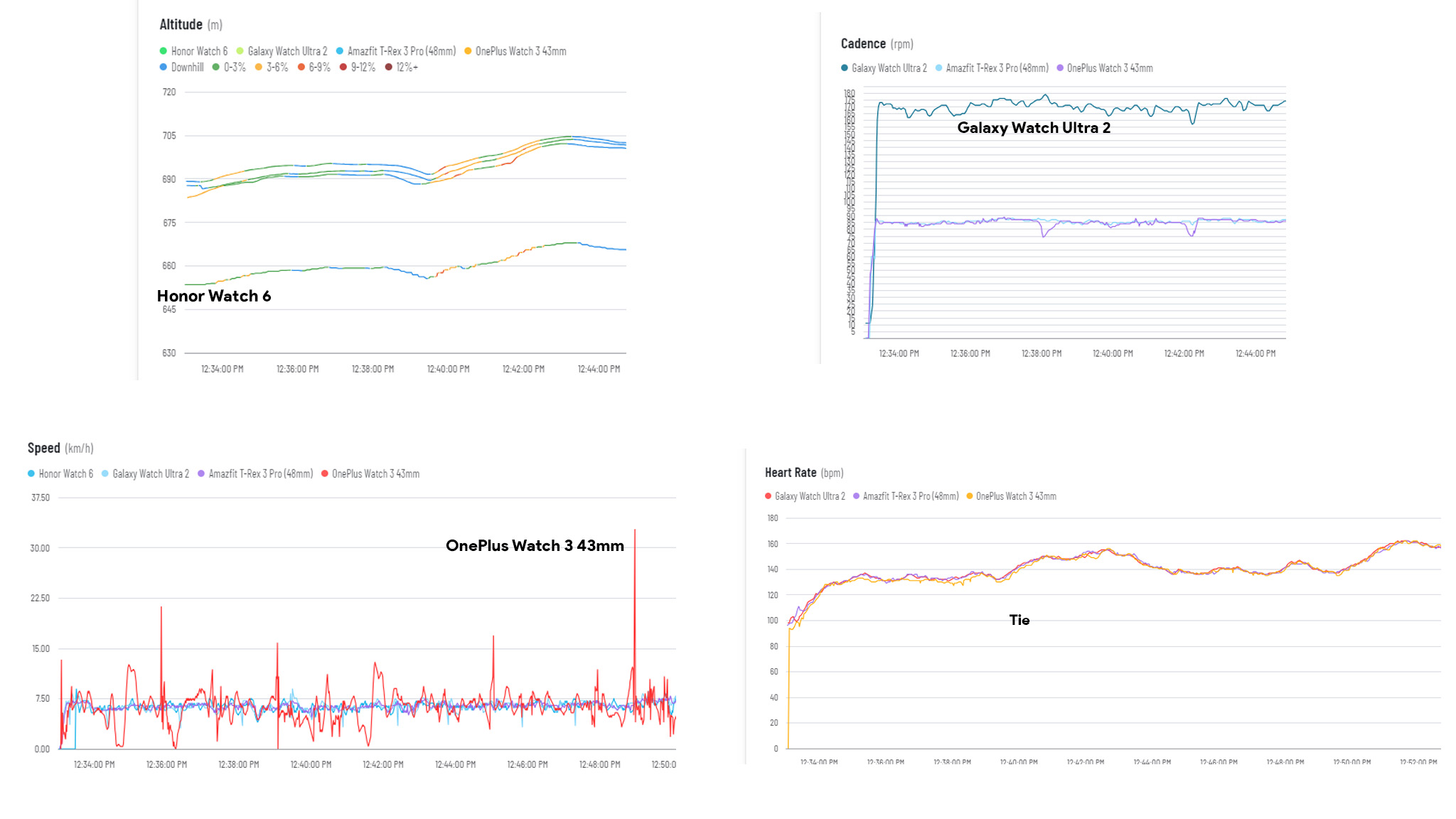
As I dove deeper into the rest of the data, I found a consistent pattern among all four watches. In each data point, there was a clear outlier. The Honor Watch 6, for example, got the altitude all wrong, while the Galaxy Watch Ultra 2 completely fumbled the cadence measurement.
The OnePlus Watch 3 43mm had some very strange spikes and dips in speed, almost assuredly owing to the GPS tracking issues I mentioned earlier, while all four watches tied for heart rate accuracy. Notably, the Amazfit T-Rex 3 Pro didn't show up as an outlier on any of the data points, owing to its excellent overall accuracy.
One Spartan Race to finish it off
(Image credit: Android Central)
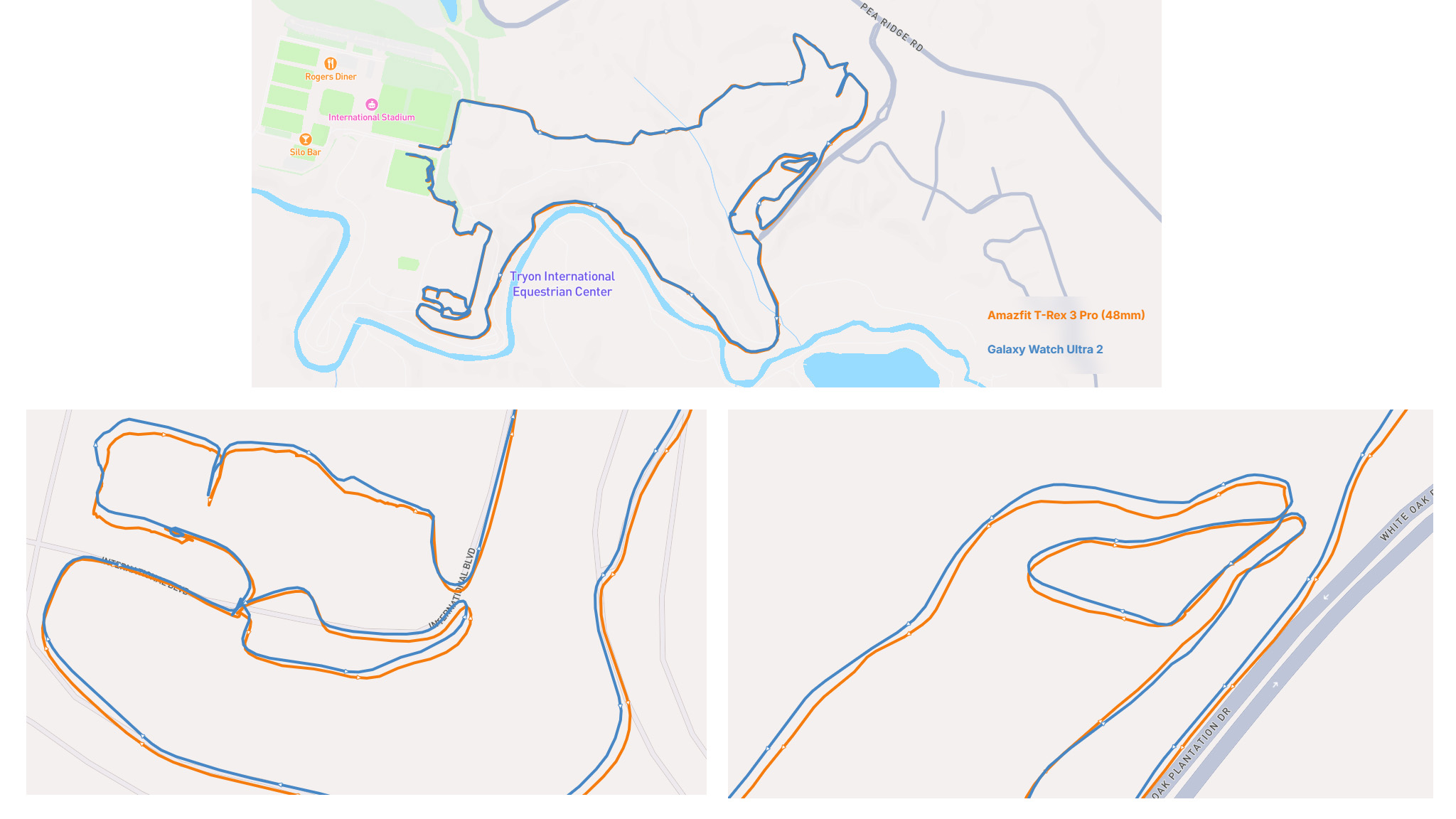
As I approached the Spartan Race, it was clear that Amazfit and Samsung were leading the pack here. Since I had to wear an RFID bracelet and a separate time bracelet for the race, I only had room for two smartwatches, so this was going to be between the winners.
I don't see any obvious discrepancies in the GPS data between the two watches. Clearly, each is slightly different from the other, but it's impossible to tell which one is right since this is a trail course. I'll give this section a tie.
(Image credit: Android Central)
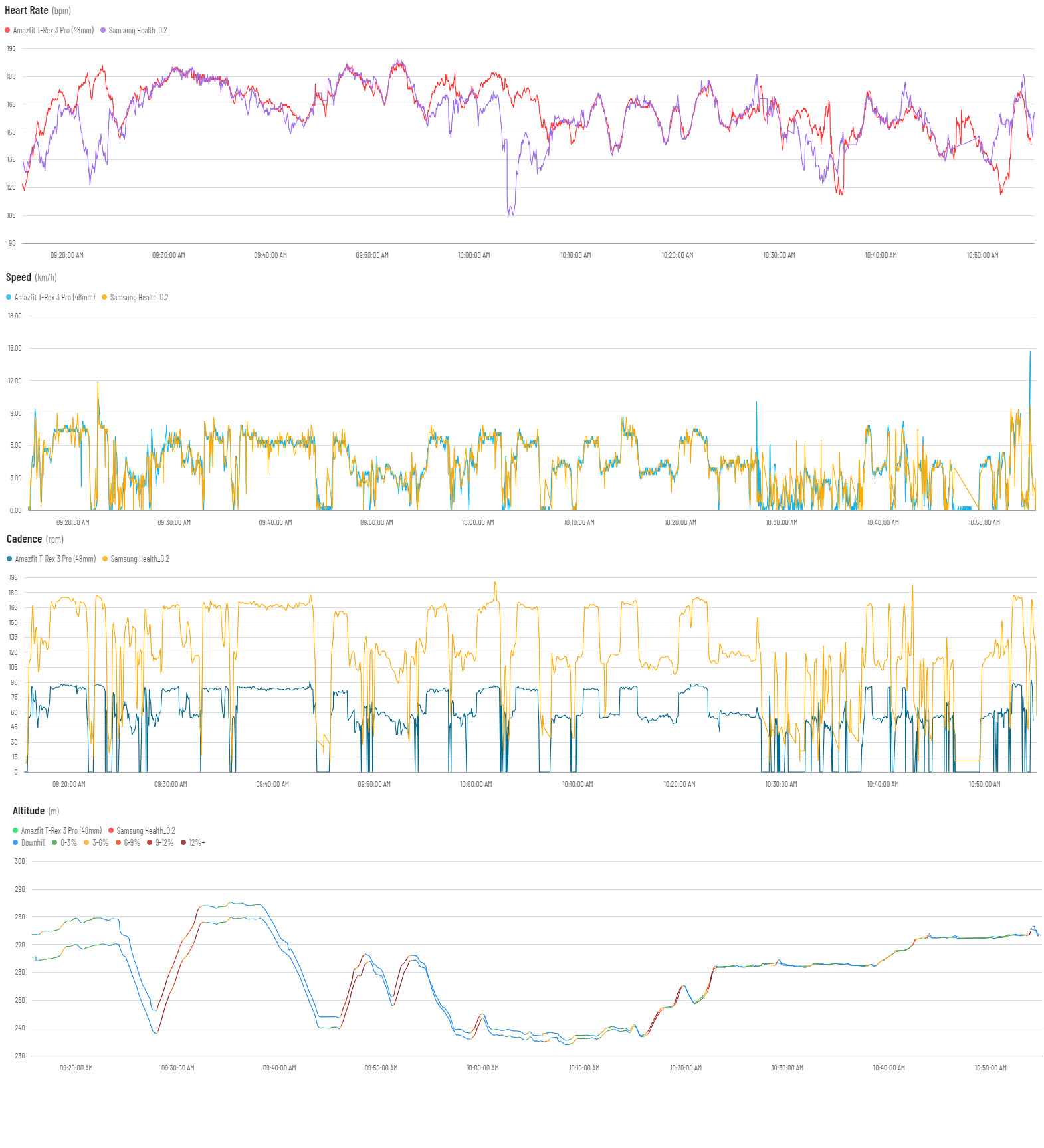
You'll need to click the expand button on the image above and zoom in to see all the details, but once you do, you'll understand why Amazfit did a better job of tracking this race. In the heart rate data, you'll see three points where the Galaxy Watch Ultra 2 did something weird. Just after 9:20 and around 10:05, it registered a far lower heart rate than I actually had.
Then, around 10:46-10:50, it seems to have failed to get a heart rate at all. Strangely enough, that same lapse in data also appears in the speed and cadence graphs. While both watches were dead-on with speed data and mostly similar with altitude, the Galaxy Watch Ultra 2 wildly messed up my running cadence, which happened during other runs I've gone on with this watch, too.
This particular Spartan Race was both very busy and extremely muddy, causing quite a bit of backup at each obstacle. On the cadence graph, you can see where the Amazefit T-Rex 3 Pro properly measured me not moving while waiting in line, yet the Galaxy Watch Ultra 2 seems to think these moments didn't happen. Trust me, I was frustrated enough to remember them, and that's enough to give the T-Rex 3 Pro the win.
Truly amaze
(Image credit: Nicholas Sutrich / Android Central)
The Amazefit T-Rex 3 Pro has been my go-to smartwatch for the past two years, and it's no wonder, with the results I've seen over the past week. While several watches have caught my attention since then, this one is consistently the most reliable and one of the most feature-rich.
Aside from being a great watch, the Zepp app that powers the experience is second to none. The UI is excellent; it's got a ton of amazing features (like this AI-powered food logging feature), and the subscription is only necessary if you want additional AI-powered insights, which I haven't typically used in the past. All in all, it's easily my favorite workout companion and an experience I think fitness fans will love.
Em sua tradicional newsletter “Power On”, o jornalista Mark Gurman (da Bloomberg) tratou dos planos da Maçã para futuro do Apple Watch. A linha poderá passar por reformulações em seu formato, expandindo a variedade de modelos ofertados — mas essa mudança não estaria no horizonte de curto prazo.
Ainda que o bem-estar seja um pilar basilar do segmento de vestíveis (tanto por parte da Apple quanto na concorrência), a equipe de design industrial da empresa trabalha em novos produtos que funcionem como a resposta da Maçã à expansão da gama de dispositivos vestíveis disponíveis no mercado, sejam os anéis inteligentes ou as pulseiras sem tela.
Gurman salientou, no entanto, que essas mudanças poderão “levar tempo” para chegar ao consumidor final, e que atualizações modestas deverão definir o tom da linha durante pelo menos os próximos dois anos; ele reiterou ainda que a Apple planeja reintroduzir o acabamento em cerâmica — ou agora em setembro, com o “Apple Watch Series 12” e o “Ultra 4”, ou com os modelos que deverão ser apresentados no ano que vem —, além de apresentar melhorias significativas de performance.
Quem lidera a frente de ampliação dos vestíveis da Apple é Eddy Cue, que assumiu o comando do setor de saúde no ano passado. O executivo parece estar atento às iniciativas de empresas como a WHOOP ou a Oura, que redefiniram a relação dos wearables com a integração de recursos de inteligência artificial (IA) — o que, dada a expansão da IA no ecossistema da Maçã, poderá ser um caminho para os diferenciais em termos de software.
Os planos para o futuro, de acordo com o jornalista, envolvem variações de wearables sem telas, que deverão ser ainda mais acessíveis do que o Apple Watch SE, além de variantes que extrapolam a linha Ultra e Hermès. Gurman mencionou que, embora acredite que a hipótese nunca se transformará em um lançamento real, a Apple cogitou ainda a implementação de telas redondas.
Ao fazer um breve passeio pela trajetória do Apple Watch, ele destacou que as suas evoluções, assim como as do iPhone, partiram (e seguem partindo) de mudanças incrementais, sem romper com o formato do relógio apresentado por Tim Cook em 2014. Ao traçar um paralelo com a trajetória dos iPhones, a ampliação dos formatos do Apple Watch lembra a expectativa de que o “iPhone Ultra” redefina o paradigma de formato dos celulares da Maçã.
Apple Watch Ultra 3
Cores: natural ou preto Pulseiras: loop Alpina, loop Trail, Oceano ou estilo milanês de titânio
Material: alumínio ou titânio Cores: cinza-espacial, prateado, ouro rosa, preto brilhante, natural, dourado ou ardósia Tamanho: 42mm ou 46mm Conectividade: GPS ou GPS + Cellular Pulseiras: esportiva ou estilo milanês
NOTA DE TRANSPARÊNCIA: O MacMagazine recebe uma pequena comissão sobre vendas concluídas por meio de links deste post, mas você, como consumidor, não paga nada mais pelos produtos/serviços usando os nossos links de afiliado.
Igeekphone News: August 2, 2026 – Samsung is reportedly preparing to introduce the Galaxy SmartTag 3, the next generation of its Bluetooth tracking accessory, with a redesigned appearance that aligns more closely with the company’s current hardware and software design language.
According to recent leaks, the upcoming smart tracker will feature an all-new rounded-square design, marking a significant departure from its predecessor while maintaining familiar functionality.
A Return to Samsung’s Family Design Language
Based on the leaked information, the Galaxy SmartTag 3 adopts a shape that sits between a square and a circle, featuring gently rounded corners that mirror the aesthetic of One UI app icons and Samsung’s latest wearable devices, including the Galaxy Watch 9.
The redesign represents another evolution in the SmartTag series’ appearance:
Galaxy SmartTag 2: Capsule-inspired shape with an integrated keyring opening
Galaxy SmartTag 3: Refined rounded-square design that emphasizes visual consistency across Samsung’s ecosystem
The updated design appears intended to create a more cohesive look alongside Samsung’s expanding portfolio of Galaxy devices.
Lanyard Hole May No Longer Be Built In
One notable change suggested by the leak is the apparent removal of the integrated lanyard or keyring hole found on the previous generation.
If accurate, users who want to attach the tracker to keys, backpacks, luggage, or other personal belongings may need to purchase a dedicated protective case or accessory with a built-in attachment point.
While this approach could improve the overall aesthetics of the device, it may reduce convenience for users who prefer attaching the tracker directly without additional accessories.
Physical Button Returns for Quick Controls
The leaked design also shows the return of a central physical button, continuing a feature introduced in earlier SmartTag models.
The button is expected to support multiple shortcuts, including:
Single press: Ring a connected Galaxy smartphone to help locate it nearby.
Double press: Trigger user-defined automation routines through Samsung’s Modes and Routines feature (formerly known as Bixby Routines).
This functionality allows the tracker to serve not only as a location device but also as a convenient smart home or productivity shortcut.
Expected Features
Although Samsung has yet to announce official specifications, the Galaxy SmartTag 3 is expected to retain the core technologies that power previous models, including:
Bluetooth connectivity
Ultra-Wideband (UWB) support for precise directional tracking (on compatible Galaxy devices)
Compatibility with Samsung’s SmartThings Find network
Dust and water resistance rated at IP67 or possibly IP68
Some reports also suggest the new tracker could adopt Bluetooth 6.0, potentially improving location accuracy, connection stability, and power efficiency. However, it remains unclear whether battery life will improve over the previous generation.
Expected Launch Timeline
Samsung has not officially confirmed the Galaxy SmartTag 3, but current reports suggest the accessory could debut before the end of 2026.
Industry observers expect it may launch alongside other upcoming Galaxy devices, including the rumored Galaxy S26 FE smartphone and the Galaxy Tab S12 tablet series, as part of Samsung’s year-end product lineup.
Final Thoughts
The leaked Galaxy SmartTag 3 appears to focus on refining Samsung’s existing smart tracking platform rather than introducing major functional changes. A redesigned rounded-square form factor, continued support for Bluetooth and UWB tracking, SmartThings Find integration, and programmable physical controls suggest Samsung is prioritizing design consistency and everyday usability.
If the reported specifications prove accurate, the Galaxy SmartTag 3 could become a compelling option for Galaxy users seeking a reliable item tracker that integrates seamlessly with Samsung’s broader ecosystem. More details, including pricing, battery performance, and regional availability, are expected to emerge closer to the product’s official launch.
Igeekphone News August 8, 2026 – XR hardware company Unseen Reality has officially unveiled the URXR One, a lightweight head-mounted display designed to serve as a portable replacement for traditional monitors rather than a conventional virtual reality headset. The device is set to launch on Kickstarter on August 4, with an early-bird price of $800, while the expected retail price is $900. Shipments are scheduled to begin in mid-October 2026.
Designed as a Personal Display Instead of a VR Headset
Unlike most VR headsets that focus on immersive gaming or virtual environments, the URXR One is positioned as a wearable display for productivity, entertainment, and extended everyday use. The headset is optimized for displaying traditional 2D content, making it suitable for users who want a large virtual screen for work, media consumption, or multitasking.
According to Unseen Reality, the headset has been engineered for comfortable long-term wear and supports both 3 Degrees of Freedom (3DOF) and 6 Degrees of Freedom (6DOF) operating modes. Spatial tracking in 6DOF mode is enabled by a dual-camera SLAM (Simultaneous Localization and Mapping) system, allowing the virtual display to remain anchored in physical space as users move around.
Lightweight Design with Pancake Optics
One of the URXR One’s standout features is its remarkably lightweight construction. Weighing just 93 grams, the headset is significantly lighter than most standalone VR and mixed reality devices currently on the market.
The display system incorporates a Mini Pancake optical design, which helps reduce both size and weight while maintaining image clarity. The headset is equipped with:
Dual 1.03-inch Micro OLED displays
2448 × 2064 resolution per eye
90Hz refresh rate
These specifications are intended to deliver crisp visuals suitable for productivity applications, video streaming, and general computing.
Virtual Display Expands Up to 200 Inches
The URXR One enables users to create a virtual display that can scale from the approximate size of a laptop screen to as large as 200 inches, providing a flexible workspace without requiring a physical monitor.
This approach makes the device particularly attractive for mobile professionals, travelers, and users working in limited spaces who want a large-screen experience while maintaining portability.
External Device Required
Unlike standalone XR headsets equipped with onboard processors, the URXR One does not include an independent computing platform. Instead, it functions as an external display by connecting directly to compatible devices through a USB-C DisplayPort connection.
Users can pair the headset with laptops, PCs, tablets, or supported smartphones capable of video output over USB-C.
However, Unseen Reality notes that certain smartphones may not provide sufficient power or DisplayPort output through a single USB-C connection. For these devices, the company offers an optional URXR Power Hub, priced at $69, which supplies additional power and expands compatibility.
Pricing and Availability
The URXR One will be available through a Kickstarter crowdfunding campaign, offering:
Early-bird price:$800
Expected retail price:$900
Optional URXR Power Hub:$69
The company expects to begin shipping the headset to backers in mid-October 2026.
Final Thoughts
Rather than competing directly with immersive VR headsets, the Unseen Reality URXR One targets users looking for a lightweight, wearable personal display for productivity and media consumption. Its 93-gram design, Mini Pancake optics, dual Micro OLED displays, 90Hz refresh rate, and 6DOF spatial tracking distinguish it from traditional smart glasses while avoiding the bulk of many standalone XR devices.
If Unseen Reality delivers on its promises of comfort, display quality, and reliable spatial tracking, the URXR One could become an appealing option for professionals and enthusiasts seeking a portable large-screen experience without carrying a physical monitor.
Smart wearables continue to evolve, and DT NO.1 E08 Smart Cycling Glasses are a perfect example of how artificial intelligence, photography, and audio technology can be integrated into a lightweight pair of sports glasses. Designed for cyclists, outdoor enthusiasts, and tech lovers, the E08 combines AI recognition, hands-free photography, video recording, music playback, and voice interaction into a single wearable device.
Designed for Active Lifestyles
The DT NO.1 E08 features a sporty cycling-glasses design that prioritizes comfort and stability during outdoor activities. Whether you’re riding a bike, hiking, running, or traveling, the lightweight frame provides a secure fit while offering protection from sunlight and wind.
Its modern aerodynamic appearance makes it suitable for both athletic and casual use, allowing users to capture experiences without carrying additional devices.
AI-Powered Smart Assistance
One of the biggest highlights of the E08 is its built-in AI functionality. The glasses support OpenAI-powered recognition technology, enabling users to interact with intelligent voice features while on the move.
AI capabilities include:
Object recognition
Voice assistant functions
Smart information retrieval
Voice interaction
Real-time AI-assisted experiences
These features transform the glasses from a simple recording device into a wearable AI companion.
13MP Camera with 32MP Photo Capture
The integrated 13MP camera allows users to capture moments directly from their point of view. Unlike traditional action cameras, the E08 records exactly what the wearer sees, making it ideal for cycling adventures, scenic rides, and outdoor exploration.
Photo resolution reaches up to 32MP, delivering detailed images suitable for sharing on social media or preserving memorable experiences. The hands-free design means users can focus on the activity rather than holding a smartphone.
1080P Video Recording with EIS Stabilization
For video creators and outdoor sports enthusiasts, the E08 supports 1080P HD video recording. Electronic Image Stabilization (EIS) helps reduce vibrations and shaking, producing smoother footage during movement.
Whether cycling through city streets or mountain trails, the stabilization technology improves recording quality and makes videos more enjoyable to watch.
Fast Wi-Fi 6 Connectivity
The inclusion of Wi-Fi 6 technology enables faster wireless transfers and improved connectivity. Users can quickly synchronize photos and videos with their smartphone, reducing the need for cables and simplifying content sharing.
Wi-Fi 6 also enhances communication between the glasses and companion applications, ensuring responsive performance for AI features and media management.
Open-Ear Audio Experience
The E08 functions as more than just smart glasses. Built-in speakers provide an open-ear listening experience, allowing users to enjoy music, navigation prompts, and voice responses while remaining aware of their surroundings.
This design is especially beneficial for cyclists and runners who need to hear traffic, pedestrians, and environmental sounds for safety. The device supports up to 10 hours of music playback, making it suitable for long rides and outdoor adventures.
Smart Features for Everyday Use
Beyond photography and audio, the DT NO.1 E08 offers a range of intelligent functions:
Voice control
AI recognition
Hands-free operation
Music playback
HD video recording
Wireless file transfer
Outdoor sports support
Smart assistant integration
These features make the glasses useful not only for sports but also for travel, commuting, sightseeing, and daily activities.
For cyclists and outdoor enthusiasts, the E08 provides a practical combination of safety and convenience. Users can listen to music, receive AI assistance, capture photos, and record videos without reaching for a smartphone.
The first-person perspective recording capability makes the glasses particularly appealing for adventure content creators, while the open-ear audio design helps maintain environmental awareness during activities. Smart-glasses users often view camera, audio, AI assistance, and battery life as the most important features in everyday wearable devices.
Final Verdict
DT NO.1 E08 Smart Cycling Glasses successfully blend AI technology, hands-free photography, HD video recording, and open-ear audio into a versatile wearable device. With its 13MP camera, 32MP photo capability, Wi-Fi 6 connectivity, OpenAI recognition features, and 10-hour battery life, the E08 offers an impressive package for cyclists, travelers, and outdoor adventurers.
For users seeking a smart wearable that can capture experiences, provide AI assistance, and deliver entertainment without sacrificing comfort or awareness, the DT NO.1 E08 stands out as a compelling option in the growing smart glasses market.
OpenAI family of devices plans are no longer limited to an experimental gadget hidden inside a design studio. OpenAI President Greg Brockman has confirmed that the company’s first consumer device will begin a broader series intended to reconsider how people interact with artificial intelligence.
The confirmation gives OpenAI’s hardware strategy a clearer shape without revealing the first product itself. Brockman said the company is not ready to discuss the device in detail, but described it as the first in a series that will rethink what devices should be when AI can understand language, observe context and complete tasks.
That ambition extends well beyond placing the ChatGPT app on another piece of hardware. OpenAI wants to reduce the menus, buttons, model selectors and separate applications that currently stand between a person and an AI assistant.
For Apple, Google and other established platform owners, the implication is significant. ChatGPT currently reaches consumers through devices and operating systems controlled by other companies. An OpenAI-designed product would give the company direct control over the microphones, cameras, sensors, interface and account experience through which its models interact with people. 56000
OpenAI Family of Devices Begins With io
OpenAI’s move into consumer hardware accelerated in 2025 when it acquired io Products in a transaction valued at approximately $6.5 billion.
The startup had been founded by former Apple design chief Jony Ive alongside Scott Cannon, Evans Hankey and Tang Tan. Its team included hardware engineers, designers, manufacturing specialists and product developers, many of whom had spent years working together at Apple.
OpenAI and Ive had already been collaborating before the acquisition. Their early ideas developed into physical designs, convincing the partners that they needed a dedicated company capable of engineering and manufacturing complete products rather than another software prototype.
The io team officially merged with OpenAI in July 2025. Ive and his design collective LoveFrom remained independent while assuming extensive design and creative responsibilities across OpenAI.
The structure combines OpenAI’s models and software research with a group experienced in turning new interface concepts into mass-produced consumer products. Ive’s previous work helped shape the iMac, iPod, iPhone, iPad, Apple Watch and other devices that established Apple’s modern design identity.
OpenAI has continued recruiting hardware expertise from Apple. Paul Meade, who led hardware development for Apple Vision Pro and worked on the company’s smart-glasses efforts, reportedly joined OpenAI’s hardware organization in 2026.
OpenAI also placed product-development veteran Peter Welinder in a leadership role connected to the io division. The resulting organization is not structured like a small accessory project. It is being assembled to develop products, create manufacturing relationships and support more than one form factor.
Image Credit: Google
The First Device Remains Unannounced
OpenAI has not publicly confirmed the name, appearance, price or specifications of its first device. It has also not presented the product as a smartphone, pair of glasses, wearable pin or conventional smart speaker.
Recent reporting describes a portable, screen-free device designed primarily for use inside the home. The reported product resembles a compact speaker but includes a rechargeable battery, allowing it to move between rooms rather than remain attached to one location.
A camera and additional sensors would help the device understand its surroundings. Mechanical elements could allow parts of it to move, creating a more expressive physical presence than a stationary speaker waiting for a wake word.
The reported design would rely heavily on OpenAI’s latest voice technology. Instead of requiring a person to wait for the assistant to finish speaking, the system could listen and respond more naturally during overlapping conversation. Access to personal information, including messages or email when authorized, could give it enough context to handle requests rather than merely answer questions.
These details remain reported plans rather than announced specifications. OpenAI could change the hardware, features or release schedule before introducing the product.
The company is reportedly targeting a presentation during 2026 and a commercial release in 2027. Fortune separately reported that the initial design has been finalized, although development of the larger product family continues.
Why OpenAI Wants Hardware of Its Own
ChatGPT already operates across iPhone, iPad, Mac, Android and Windows devices. That wide distribution gives OpenAI access to an enormous audience without requiring it to manufacture screens, batteries or processors.
It also leaves crucial parts of the experience under the control of Apple, Google and Microsoft.
An operating system determines when ChatGPT can use a microphone, whether it can run continuously, how notifications appear and which applications it can control. Platform owners can limit background access, change default-assistant rules or promote their own AI systems more prominently.
Those restrictions matter more as ChatGPT develops from a chatbot into an agent. Answering a question inside an app requires relatively little control over the device. Completing a task across messages, calendars, files, cameras and connected appliances requires deeper access.
OpenAI hardware could be designed around those capabilities from the beginning. The assistant would not need to behave like one application among dozens because it could become the primary interface.
Brockman has described the current ChatGPT interface as too complicated, particularly as new models and tools add more controls. OpenAI’s objective is to make much of that interface disappear.
A successful device could allow someone to describe an outcome instead of opening several applications and completing each step manually. The user might ask the assistant to reorganize a day after a delayed flight, contact the relevant people and adjust reservations. The interface would be the request and the resulting confirmation rather than a sequence of taps.
A Family Creates More Context Than One Gadget
Calling the project a family of devices changes the strategy. One experimental product would need to prove its value independently. A coordinated group could distribute different sensors and functions across the places where people already live and work.
A home device could provide shared access in kitchens and living spaces. A personal wearable could preserve private conversations while moving outside. A future mobile product could handle visual information, navigation and communication without reproducing the application grid of a smartphone.
OpenAI is reportedly developing approximately five hardware concepts, with the screen-free home companion receiving priority. The company has also explored wearables and home robotics, although none of those later products has been announced.
The devices would become more useful if they shared the same ChatGPT identity, memory controls and task history. A request started at home could continue through another product without requiring the user to repeat the people involved, the desired result or the decisions already made.
That continuity is one of the strongest advantages Apple currently receives from controlling a complete ecosystem. An iPhone, Mac, Apple Watch, AirPods and HomePod can exchange information because Apple designs the devices, operating systems and cloud services together.
OpenAI appears to be pursuing a different center of gravity. Instead of making the operating system coordinate applications, it could make the AI assistant coordinate specialized devices.
Image Credit: Dado Ruvic/Reuters
ChatGPT Will Also Expand Through Other Companies’ Hardware
OpenAI’s hardware work does not mean the company intends to reserve ChatGPT for its own products.
Brockman has said OpenAI is interested in deeper integrations with smart glasses, wearables and other devices through its application programming interfaces. The company wants ChatGPT to become an interface available across hardware categories, including products manufactured by third parties.
That creates a two-track strategy. OpenAI can use its own devices to demonstrate the experience it considers ideal while allowing other manufacturers to connect their cameras, microphones and sensors to ChatGPT.
Third-party distribution would help OpenAI reach consumers who do not want another dedicated device. It would also reduce the risk of depending entirely on the success of one hardware launch.
The difficult part will be keeping those experiences consistent. A wearable may have limited battery capacity, a camera may require visible privacy controls, and a speaker may depend on cloud processing when a connection is available. OpenAI will need to define what its assistant can do reliably across products with very different technical limits.
Early AI Hardware Changed the Expectations
The first generation of dedicated AI gadgets established a warning for every company entering this market.
Humane’s AI Pin and the Rabbit R1 attracted attention by promising an alternative to application-based computing. Their launches also exposed problems involving response delays, battery life, incomplete features and tasks that remained easier on a smartphone.
Those products demonstrated that access to a language model does not automatically justify a new object. Consumers need to understand why they should carry, charge and maintain another device when ChatGPT, Gemini and other assistants already operate on phones.
OpenAI has several advantages those earlier companies lacked. It controls one of the most widely used AI services, operates the models behind the interface and has the resources to improve the software after launch. The io acquisition gives it experienced design and manufacturing leadership rather than requiring it to assemble a hardware organization gradually.
The standard will consequently be higher. A well-designed enclosure and natural voice will not be enough if the device cannot complete dependable tasks more efficiently than an iPhone or Android phone.
Apple’s Lawsuit Could Affect the Schedule
OpenAI’s expansion beyond Apple devices has also produced a direct legal confrontation with Apple.
Apple filed a federal lawsuit in July 2026 accusing OpenAI, io and former Apple employees of misappropriating confidential hardware information. The complaint alleges that trade secrets connected to unreleased products, engineering processes and suppliers were taken for the benefit of OpenAI’s hardware business.
OpenAI has denied having any interest in Apple’s trade secrets and said it was unaware of evidence giving the complaint merit. The allegations have not been decided by a court.
Apple is seeking restrictions on the use of its confidential information, along with the return of materials and financial damages. The case could require OpenAI to separate employees from parts of the project, replace suppliers or repeat engineering work if disputed information is found inside the development process.
It does not automatically establish that OpenAI’s reported product copies an Apple device. The first OpenAI design is described as substantially different from Apple’s current hardware, but the legal dispute could still affect when it can be manufactured or sold.
The First Product Will Define the Rules for the Rest
The most important details at OpenAI’s eventual hardware presentation may have little to do with the object’s shape.
A camera-equipped device that learns from activity inside a home will need unmistakable recording indicators, understandable data-retention controls and a simple method for temporarily disabling its sensors. Owners will need to know which information remains on the device, what reaches OpenAI’s servers and which memories can be reviewed or deleted.
OpenAI will also have to explain whether the product requires a paid ChatGPT subscription, how much it can do without an internet connection and whether multiple members of a household receive separate identities. Those choices will determine whether it behaves like a personal assistant, a shared appliance or a new subscription terminal.
Support for messages, calendars, music and connected appliances will require cooperation from outside companies. A device cannot replace frequent phone interactions if it remains unable to enter the services where those interactions occur.
The first model will therefore establish more than OpenAI’s industrial-design language. It will set the privacy, account, subscription and developer rules that every later member of the OpenAI family of devices inherits.
A lista de exceções para os aparelhos com baterias removíveis inclui seis novas categorias, entre as quais estão os smartwatches e rastreadores de fitness.
A Xiaomi lançou os novos REDMI Buds 8, com altifalante de 11 mm, sistema de cancelamento de ruído ativo híbrido capaz de atingir é 50 dB, e autonomia que pode durar até 44 horas de autonomia. Estes auriculares já estão disponíveis em Portugal em três cores a partir de 54,99 euros.
 Login