Empty space is not completely empty in the equations of quantum physics. Under an ordinary magnetic field, that distinction is impossible to notice. Near a magnetar—a neutron star with a magnetic field trillions of times stronger than Earth’s—space itself can alter the way light travels. NASA’s Imaging X-ray Polarimetry Explorer (IXPE) has measured unusually strong […]
Which naked-eye star is richest in metals and what is the estimated mass of the metal contained therein? ThomasMineral, Virginia In astronomer-speak, metals refer to elements heavier than helium. The first stars that lit up the universe were very metal-poor, since hydrogen and helium were just about the only materials around after the Big Bang. TheseContinue reading "Which naked-eye star is richest in metals?"
Stars do not actually switch their lights on and off when they twinkle. The flicker happens between the star and your eyes, as its light passes through Earth’s moving atmosphere. Planets are affected by the same air, but they usually look steadier because their light arrives from a small disk rather than a single point. […]
A pioneer mission in astrometry – the measurement of the position, distance, motion, brightness, and color of stars – the European Space Agency’s (ESA) High Precision Parallax Collecting Satellite, or Hipparcos, launched on Aug. 8, 1989. There were immediately problems when a rocket-engine failure kept Hipparcos from reaching its planned orbit. However, the satellite wasContinue reading "Aug. 8, 1989: The Hipparcos satellite launches"
Astronomers have captured the death of a massive star from its first faint flash of X-rays, revealing an unusual explosion that may bridge the gap between ordinary supernovas and more extreme, gamma-ray-burst-producing stellar explosions
The event began in March 2026, when China's Einstein Probe spacecraft detected a brief X-ray flash from a galaxy about 500 million light-years away. Follow-up observations identified the source, initially designated EP260321a and later named supernova SN 2026gzf, as a broad-lined Type Ic supernova.
Such explosions occur when massive stars that have lost their outer layers of hydrogen and helium collapse. They are often associated with narrow, powerful jets traveling near the speed of light and, in some cases, brilliant gamma-ray bursts. But SN 2026gzf produced neither.
An image of a galaxy 500 million light-years away captured by the Dark Energy Camera (DECam), mounted on the NSF Víctor M. Blanco 4-meter Telescope in Chile taken on March 9, 2026 (left); and an image of the galaxy now containing supernova SN 2026gzf taken by the same camera on April 3, 2026. (Image credit: CTIO/NOIRLab/DOE/NSF/AURA Image Processing: D. de Martin & M. Zamani (NSF NOIRLab))
Instead, the initial X-ray signal appears to have been a "shock breakout" — the moment the blast wave generated by a collapsing star reaches its surface and releases its first burst of radiation. The flash was the faintest shock breakout yet linked to a broad-lined Type Ic supernova, according to the research team.
Because shock breakouts generally last only seconds to hours, astronomers rarely detect them. In this case, rapid observations by a network of space- and ground-based telescopes, including a number of NSF NOIRLab observatories, allowed researchers to follow the supernova across multiple wavelengths throughout its early life.
"Our observations allowed us to study the physics of three pieces of this explosion: the X-ray shock breakout, the accompanying supernova, and the interaction of the supernova with material previously cast out by the dying star," Jillian Rastinejad, who led one study on the event, said in a statement. "With this information we were able to map out the structure of the material surrounding the star and understand the star's violent lifestyle before it collapsed."
A close up of the area of space that contains the the galaxy home to supernova SN 2026gz, taken by the LSST Camera at the Vera C. Rubin Observatory. (Image credit: CTIO/NOIRLab/DOE/NSF/AURA Image Processing: D. de Martin & M. Zamani (NSF NOIRLab))
The observations suggest that the progenitor was a Wolf-Rayet star born with about 20 times the mass of the sun. Before exploding, it had shed its hydrogen and helium, leaving behind a core composed largely of carbon and oxygen.
Researchers also found evidence of multiple shells of material surrounding the star. Those shells were likely expelled during turbulent bouts of mass loss shortly before the explosion, giving astronomers an unusually detailed view of the star's final stages.
The discovery suggests that energetic, broad-lined Type Ic supernovas do not always produce gamma-ray bursts or relativistic jets. Instead, massive stars may reach similar-looking explosions through a wider variety of pathways than astronomers previously recognized.
"Going forward, I'm excited to observe more shock breakout events in similar detail to test if all stripped stars have a similar 'lifestyle' prior to collapse and what, if any, differences we see," said Gokul Srinivasaragavan, a member of Rastinejad's team.
Star formation in the nearby Andromeda Galaxy (M31) has been slowing down over the last 500 million years, according to a new study using Hubble Space Telescope data. The study was published July 27, 2026, in The Astrophysical Journal. Lead author Tobin Wainer, an astronomer at the University of Washington, and his team used dataContinue reading "Andromeda’s star formation is slowing down"
An unusual clump of gas 450 million years after the Big Bang may contain stars hailing from the universe’s elusive first generation of stars. New research examines an alternative explanation involving an accreting black hole.
Meet Hebe
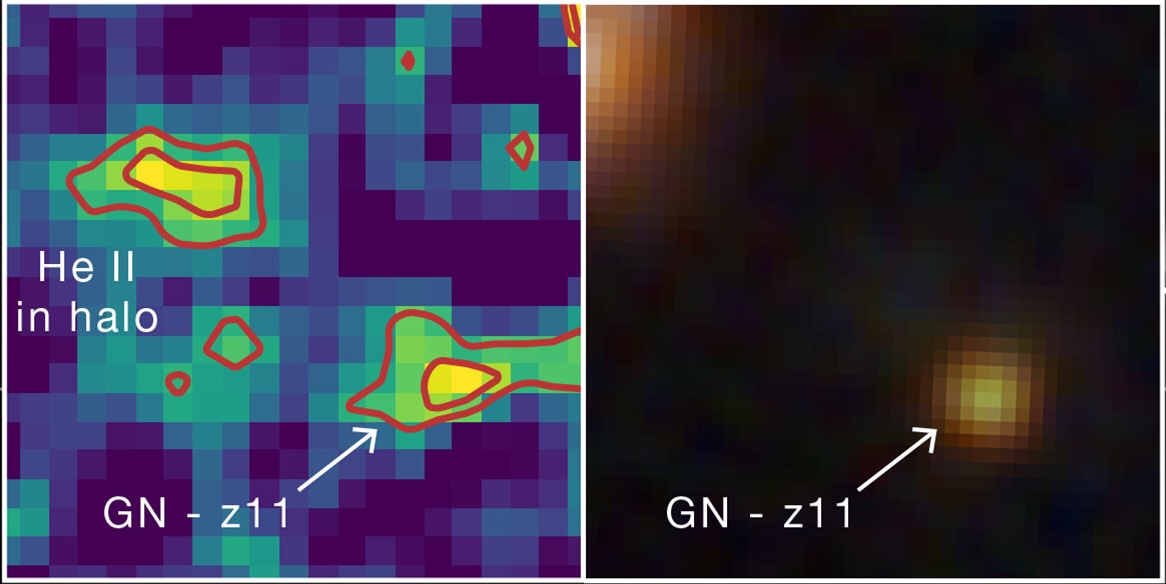
Hebe is visible in the image on the left as a prominent blob of helium emission up and to the left from GN-z11, a luminous galaxy hosting an accreting supermassive black hole. On the right is an infrared image of the same region, in which Hebe is not visible. Click to enlarge. [Adapted from NASA, ESA, CSA, Ralf Crawford (STScI)]
Initially spotted in 2024, an early-universe gas clump nicknamed Hebe has now been identified as a possible hiding place of Population III (Pop III) stars — the universe’s first generation of stars. Pop III stars are thought to be massive and chemically pristine, containing only hydrogen, helium, and a whisper of lithium. This exciting hypothesis was prompted by the detection of recombination lines from helium, which could be ionized by the high-energy radiation of the first stars.
Before the community settles on this exciting explanation, however, the hypothesis must withstand all the tests astronomers can throw at it. In a recent research article, Junehyoung Jeon, Tae Bong Jeong, and Saiyang Zhang (The University of Texas at Austin) along with Volker Bromm (The University of Texas at Austin) attempted to explain Hebe’s properties in another way.
Considering Alternatives
Hebe glows with distinctive helium emission that requires a source of high-energy radiation. This radiation could be provided by a cluster of Pop III stars, but it could also, in theory, arise from an accreting supermassive black hole embedded within the gas clump.
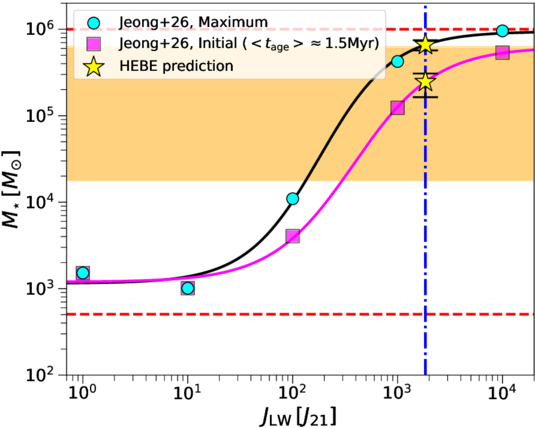
Predicted total mass of Hebe’s Pop III stars as a function of the Lyman–Werner flux from the nearby galaxy GN-z11. Click to enlarge. [Jeon et al. 2026]
The authors used models to explore both possibilities. For the first scenario, in which the telltale helium emission is driven by a cluster of Pop III stars, the team calculated the maximum possible mass of the cluster, which sets how much high-energy radiation is produced. The cluster mass is moderated by high-energy radiation from another source: GN-z11, a starburst galaxy situated about 10,000 light-years from Hebe. For the second scenario, the team modeled the spectral energy distribution arising from a supermassive black hole — either a direct-collapse black hole or a primordial black hole — accreting pristine gas from the surrounding cloud.
Still a Leading Explanation
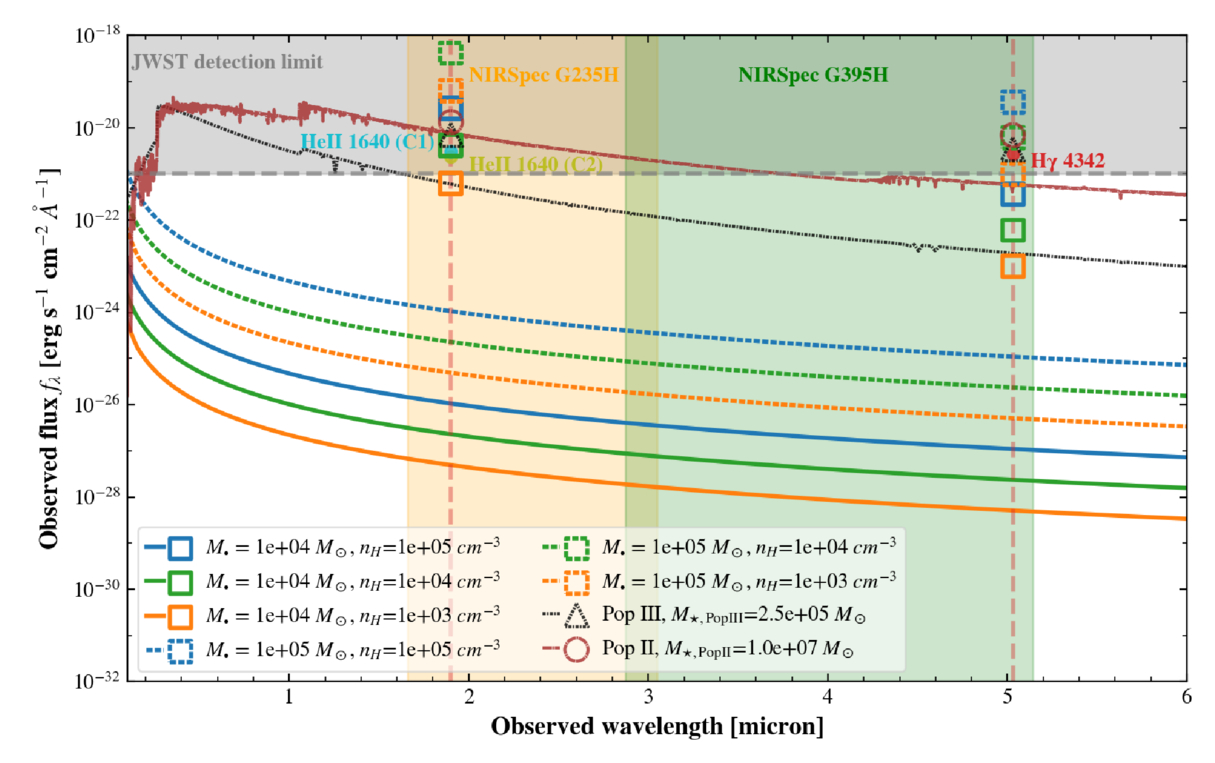
While the black hole scenario could, with reasonable black hole masses, gas densities, and accretion rates, reproduce individual flux measurements drawn from JWST observations, this hypothesis struggled to simultaneously match multiple measurements. The Pop III star cluster scenario, with a cluster mass of a few hundred thousand solar masses, provided the best fit to the JWST data.
Modeled spectral energy distributions (lines) and predicted line flux densities (open symbols) for the accreting black hole, Pop III star, and Pop II (second-generation) star hypotheses. The observed JWST line fluxes are shown as filled circles. Click to enlarge. [Jeon et al. 2026]
As a final test, the team introduced a third possibility involving a population of second-generation stars, which are more chemically enriched than Pop III stars. While this model fit well, the number of stars necessary to match the data — roughly 10 million — would produce a stellar continuum detectable (but so far not seen) by JWST.
While a cluster of Pop III stars is still the leading explanation for Hebe’s properties, the team noted that the Pop III star and black hole hypotheses aren’t mutually exclusive; Hebe could very well harbor a primordial black hole and a smattering of Pop III stars. Regardless of what powers its characteristic helium emission, Hebe offers an enticing glimpse into the early universe, and more work is needed to understand this intriguing object.
Citation
“What Is Powering the Enigmatic He II Emitter Hebe: The First Stars or Black Holes?” Junehyoung Jeon et al 2026 ApJ1006 27. doi:10.3847/1538-4357/ae7bea
This artist’s concept depicts a tidal disruption event, which occurs when a star passes fatally close to a supermassive black hole. Crumbs of the splintering star heat up as they swirl around the black hole, creating a glow astronomers can see from far across the cosmos, and the black hole launches a relativistic jet into space.
NRAO/AUI/NSF/NASA
NASA’s Neil Gehrels Swift Observatory captured an “orphan” black hole lighting up as it devoured a star on the outskirts of a faraway galaxy. These phenomena are rare to begin with, and none had ever before been seen so far outside of a galaxy’s core.
“We were looking for these star-shredding events as a way to find otherwise invisible supermassive black holes wandering away from the galactic cores where they usually reside,” said Robert Stein, a research fellow at The University of Maryland, College Park and NASA’s Goddard Space Flight Center in Greenbelt, Maryland. “With this discovery, which is one of just a couple that have been confirmed so far, we’ve validated a new technique and can use it to hunt for more.”
A paper describing the results, led by Stein, was published Monday in The Astrophysical Journal Letters.
Researchers saw an ultrabright flare unleashed by a star being torn apart by extreme gravitational forces after drifting too close to a monster black hole — a phenomenon called a tidal disruption event. The black hole behind the blast weighs in at about a million times the Sun’s mass. Its existence was first flagged in November 2025 as an unusual brightening in a galaxy about 750 million light-years away by ZTF (Zwicky Transient Facility), a survey conducted by the Palomar Observatory in Southern California.
“Out of the half million flashes ZTF detects each night, our new artificial intelligence algorithm automatically recognized a flare that looked a lot like a tidal disruption event, despite its unusual location in the outskirts of a galaxy,” Stein said. For a few months, the tidal disruption event outshone its entire host galaxy in ultraviolet wavelengths, temporarily radiating with the light of about 10 billion suns.
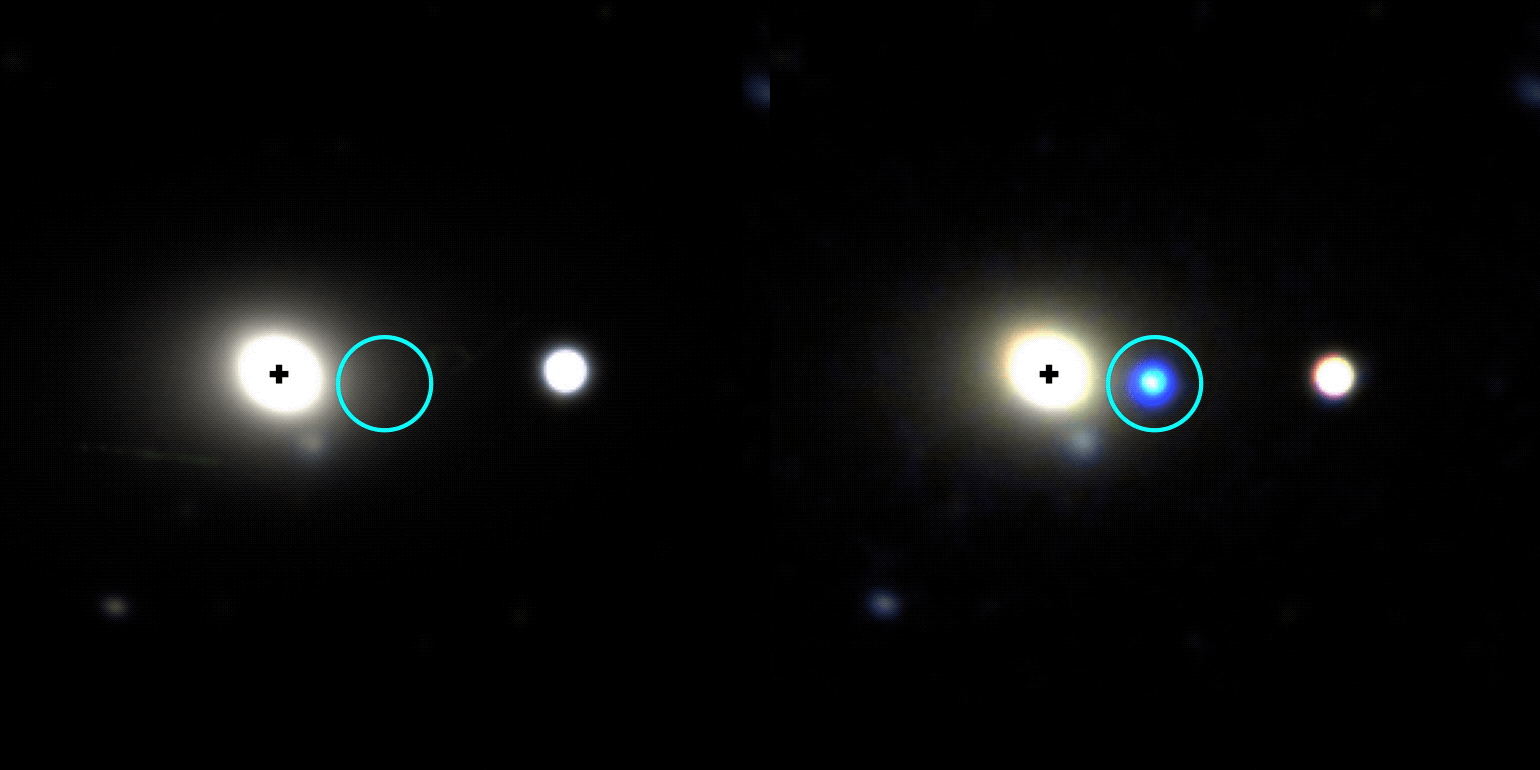
This gif shows the galaxy WISEA J014656.04-152214.7, located about 750 million light-years away in the constellation Cetus, before and after a tidal disruption event was spotted on its outer edge in November 2025. The image at left was taken by the DESI (Dark Energy Spectroscopic Instrument) Legacy Survey and the one at right is from the Lowell Discovery Telescope.
Other telescopes, including the SOAR (Southern Astrophysical Research) telescope in Chile, followed up on the ZTF source to look at the event’s spectrum, which revealed features supporting that it was likely a tidal disruption event. Astronomers then used NASA’s Swift to look at wavelengths they can’t detect with ground-based telescopes to uncover new information. For example, Swift’s UVOT (Ultraviolet/Optical Telescope) took the blip’s temperature and found that it had quite a fever at about 54,000 degrees Fahrenheit (30,000 degrees Celsius).
“The combination of all this data helped us rule out other explanations and confidently say it’s a tidal disruption event, despite its strange location,” said Jonathan Carney, a doctoral student at the University of North Carolina at Chapel Hill, who took the first spectra that supported the flare’s interpretation as a tidal disruption event.
Hidden heavyweights
Nearly every galaxy in the universe is anchored by a supermassive black hole sitting right in the center. About once every 100,000 years, a star will drift too close to this invisible heavyweight and trigger a tidal disruption event.
While they’re rather rare in any given galaxy, scientists scour millions of galaxies for them. Each year, astronomical surveys typically spot about 30 tidal disruption events occurring somewhere in the universe.
Prior to 2024, they’d only been seen in galaxy cores. That’s partly because astronomers mainly looked for them there; after all, it’s where all the known supermassive black holes were, and you can’t get a tidal disruption event without one (the gravitational pull of lighter black holes isn’t strong enough).
Then scientists saw the telltale signs of a star being shredded 2,600 light-years from the center of its host galaxy. That inspired more astronomers to look beyond galaxy cores for similar events, and now a team has identified one more than 30,000 light-years away from a galaxy’s center.
This video visualizes a star approaching a supermassive black hole so closely that it’s stretched to a breaking point by the black hole’s strong gravity. Intense tidal forces crack the star open and hurl its gaseous guts outward. Stellar debris forms a spinning accretion disk as it continues to spiral into the black hole.
NASA, ESA, STScI, Ralf Crawford (STScI)
Oddball origin story
So how did the newfound black hole become so off-kilter?
“It must have originated in a galaxy’s center, but not the one it’s in the outskirts of now,” Stein said. “We think the host galaxy’s supermassive black hole is still at its core, but the one eating the star could have started off in a small galaxy that merged with the big one we see today.”
The researchers have outlined two possibilities. Three or more galaxies may have merged together, and the gravitational tug-of-war between their central supermassive black holes may have flung the lightest black hole out to the galaxy’s edge.
Or a dwarf galaxy could be midway through a merger. As the dwarf’s stars fell into the larger galaxy, one may have passed too close to the dwarf’s supermassive black hole.
“Further discoveries could reveal the origin of this apparent ‘orphan’ black hole,” Stein said. “The key science question we want to answer is: How common are wandering black holes?”
The answer may soon be within reach. “Pointed science observations with Swift’s UVOT and XRT (X-Ray Telescope) instruments are temporarily suspended as the mission awaits an orbit boost, which is planned for this summer,” said co-author S. Bradley Cenko, Swift’s principal investigator at NASA Goddard. The spacecraft, whose primary mission ran from 2004 to 2006, is slowly sinking toward Earth due to atmospheric drag after more than 20 years of observations of the changing universe. Nudging it to a higher orbit could extend its lifetime even longer. “Once it resumes normal operations, Swift could continue searching for more examples of out-of-place black holes.”
In the coming years, scientists will use the new technique to search for disintegrating stars in observations from the newly operational Vera C. Rubin Observatory, jointly funded by the U.S. Department of Energy and National Science Foundation, in Chile and NASA’s upcoming Nancy Grace Roman Space Telescope.
“Rubin’s wide, deep surveys will reveal a much larger sample of tidal disruption events than current observatories are capable of collecting, including ones that are off-center,” Carney said. “And Roman’s space-based surveys will extend the current search zone by seeing ones that are farther away, looking back through 9 billion years of cosmic history.” Adding their observations to Swift’s and those from ground-based observatories will bring astronomers closer than ever before to completing a census of the universe’s behemoth black holes.
The second law of thermodynamics states that entropy, or disorder, in an isolated system always increases over time. Einstein famously said that “the second law of thermodynamics occupies a unique position among the laws of Nature,” reflecting how fundamental he believed the principle to be.
In its early days, the universe was smooth and uniform, with low entropy. As it expanded, gravity pulled gas into stars, stars into galaxies, and eventually made life possible. Each step seems to create order in one place, even though the universe as a whole became more disordered. Cosmologists have usually explained this by pointing to the universe’s growing volume.
Gravity as a Ledger, Not a Force
Mathematician Ginestra Bianconi at Queen Mary University of London addressed this problem with a framework called Gravity from Entropy. Rather than treating gravity as a fundamental force, the Gravity from Entropy framework proposes that it emerges from an information-based difference between two descriptions of spacetime geometry. One metric describes the actual shape of spacetime, while the other describes the geometry that matter and curvature would create. When these two match, gravity disappears. When they differ, gravity arises from the difference.
In the low-energy, weak-curvature limit, the framework reduces to general relativity. In the new study, Bianconi adds a thermodynamic perspective. She applies Gravity from Entropy to the standard model of an expanding universe and shows that the local geometric degrees of freedom follow the first law of thermodynamics, with their own temperature and pressure emerging from the equations.
Falling Density, Rising Total
One of the study’s central findings is the distinction between total entropy and entropy per unit volume. As the universe grows, the total entropy increases, just as the second law demands. However, the study found that entropy per unit volume decreases over time even as the universe’s total entropy continues to increase. Within the Gravity from Entropy framework, Bianconi proposes that this declining local entropy density may help explain how galaxies and other cosmic structures emerge.
The study also shows that these geometric temperatures change depending on what dominates the universe. In a universe dominated by matter or radiation, the temperature decreases over time. In a universe dominated by dark energy, like our own, they remain nearly constant. The framework even assigns a temperature and pressure to empty spacetime.
A Theory Still Waiting to Be Tested
“This work reveals how the Gravity from Entropy theory can tackle the challenging question of reconciling the second law of thermodynamics with the emergence of complexity in our universe,” stated Bianconi. “These results may open new avenues for investigating the long-standing problem of reconciling the foundations of cosmological irreversibility, the emergence of complex structures, and ultimately life with fundamental gravitational dynamics.”
So far, Gravity from Entropy has not been confirmed by observations. The theory makes predictions that future observations of large-scale cosmic structures and other gravitational phenomena could test. While it remains unproven, Bianconi believes it could offer a new way to link gravity, thermodynamics, quantum mechanics, and the rise of complexity in the universe.
Austin Burgess is a writer and researcher with a background in sales, marketing, and data analytics. He holds an MBA, a Bachelor of Science in Business Administration, and a data analytics certification. His work focuses on breaking scientific developments, with an emphasis on emerging biology, cognitive neuroscience, and archaeological discoveries.
Around 4.6 billion years ago, an immense cloud of gas and dust in space collapsed in on itself. As it collapsed, gravity pulled most of the material toward several small points, one of which would eventually become our Sun. The other points formed other stars in what scientists call an open cluster.
During this early stage of the Sun’s life, it was surrounded by a swirling disk of leftover material aligned with its equator, known as a protoplanetary disk. Eventually, this disk condensed to form the planets that make up our solar system. This process normally results in a system with a star at its center, and the planets orbiting the plane of the star’s equator.
However, scientists have found that this scenario doesn’t quite hold for our solar system. The planets in our solar system orbit the Sun in a single plane offset from the Sun’s equator by approximately 6°. The fact that the planets are in the same orbital plane suggests that the protoplanetary disk model of solar system formation is correct, since the odds of the Sun capturing 8 rogue planets in this arrangement are astronomically low. So, what threw the planets in our solar system off-kilter?
The plane in which the solar system’s planets orbit the Sun is offset from the Sun’s equator by approximately 6°. Li simulated how the solar system tilted based on its 4 largest planets, from left to right: Neptune, Saturn, Jupiter, and Uranus. Illustration by Andrew Bizal.
To determine what caused the solar system to tilt, Daohai Li at Queen Mary University of London recently used the computer program NBODY6++ to model different versions of the open cluster from which the Sun came. In these simulations, he varied the number of stars in the cluster, from 500 to 2,000 to 8,000. He also varied the radius of the cluster, from 0.25 to 1 to 4 parsecs (8 to 30 to 100 trillion kilometers or 5 to 20 to 70 trillion miles). Finally, he varied the percentage of stars with a binary companion from 10% to 50% to 90%. Li assigned each star a randomly generated initial mass, starting position, and velocity, and simulated their interactions for 400 million years.
First, Li examined the simulations to identify stars with masses approximately equal to the Sun’s. From this group of solar-massed stars, Li found ones that left the cluster after 400 million years as a single star, after either forming alone or having lost a former companion star. He proposed that these stars were the most similar to the Sun and could thus host a simulated solar system.
Li then simulated the planets and their orbits as they would have formed on these potential host stars. To simplify this process, Li only simulated the 4 giant planets, Jupiter, Saturn, Uranus, and Neptune, which dominate planetary behavior in our solar system. He modeled these solar systems independently for 200 million years to ensure they would remain intact and used those that did for statistical analysis of the solar system’s past.
Overall, Li discovered 2 scenarios that could explain the solar system’s tilt. In the first, the primordial solar system was jostled by many distant neighboring stars in its cluster. This jostling tilts the planets’ orbits, but it does so randomly. Therefore, this scenario would make it unlikely for the planets to remain in the same orbital plane. It would also cause them to orbit the Sun faster and more chaotically than in our solar system.
In the second scenario, the Sun had a temporary companion star that it either formed with or briefly encountered before separating. When this occurred, the simulated planets’ orbits all tilted together. Stars that formed with a binary companion had a 10% chance of tilting their planets’ orbits by 6° or more, while stars that formed alone had a less than 0.1% chance.
Li concluded that the solar system could have tilted as a result of interactions between the Sun and a temporary companion star within its parent cluster. However, he acknowledged that the model strongly depends on how closely a star passes by the Sun, since the closer a star passes, the more it disturbs the solar system. Despite this uncertainty, it’s possible that somewhere in space is the Sun’s twin or former neighbor that we haven’t seen in eons, and that’s what made our solar system crooked!
For the first time, scientists may have discovered a binary system—like the twin suns of the fictional planet Tatooine in "Star Wars"—where both stars exploded as supernovas, a new study finds.
Although Earth may orbit around a single star, more than half of all stars are in systems where two or more suns orbit each other. "When it comes to massive stars, the percentage in multiple systems are even higher," study lead author Miltiadis Michailidis, a postdoctoral fellow at Stanford University in California, told Space.com.
When massive stars burn all their fuel, they can die in giant explosions known as supernovas. These outbursts can briefly outshine all of the other suns in these stars' galaxies. They often leave behind expanding super-hot clouds of debris known as supernova remnants. Astronomers have detected about 300 such remnants in our galaxy to date.
Given how often massive stars are found in binary systems, "one can expect many pairs of massive stars where both will explode as supernovas," Michailidis noted. "However, this has never been observed, until now."
One reason supernova pairs may have escaped attention is that "if the stars are too close together when they exploded, the resulting supernova remnants may look like that from a single explosion," Michailidis explained. Another is that one star going supernova may propel its partner far enough away to hide the fact they were ever a duo, he added.
In the new study, Michailidis and his colleagues investigated a supernova remnant known as IC 443, located about 6,000 light-years from Earth in the constellation Gemini. IC 443 is also known as the Jellyfish Nebula for how it resembles a jellyfish.
IC 443 is one of the most extensively studied supernova remnants in the galaxy because of how shock waves from the supernova have collided with surrounding clouds of gas and dust to create a set of concentric bubble shells, "much like how a drop of water falling on a lake creates circular waves," Michailidis said. "It is very isolated from its surroundings, without many other objects nearby to complicate its very bright emissions."
The scientists analyzed one of IC 443's much dimmer, long-hidden neighbors, dubbed G189.6+3.3. The German-led ROSAT (Roentgen Satellite) mission first discovered G189.6+3.3 in 1994 via its faint X-ray emissions, and the Russian-German Spektrum Roentgen Gamma (SRG) space observatory later clearly detected shell-like structures within G189.6+3.3, suggesting that it was a supernova remnant.
A composite multiwavelength view of the IC 443 region (with the X-ray emission from IC 443 removed) overlaid with gamma-ray emission above 1 GeV detected by the Fermi Large Area Telescope. (Image credit: NASA Goddard Space Flight Center and M. Michailidis et al. 2026; orange, brown: radio, ESA/Planck and MWISP; yellow: optical, DSS; red: infrared, NASA/WISE; violet: ultraviolet, NASA/Swift; teal: X-rays, SRG/eROSITA; magenta: gamma rays, NASA/DOE/Fermi LAT Collaboration)
In the new study, the researchers analyzed more than 16 years of data from NASA's Fermi Gamma-ray Space Telescope along with earlier X-ray, optical and radio measurements. They discovered signs that both IC 443 and G189.6+3.3 were both smashing into the same interstellar cloud of hydrogen, revealing they were close together in space, with the centers of their explosions about 30 to 50 light-years apart.
The researchers calculated that the chances of randomly encountering two unrelated supernova remnants at this distance from one another "was about one in 1,000," Michailidis said. "This suggests that our discovery is in fact the first known binary-system supernova pair."
The scientists estimated that G189.6+3.3 was older than IC 443, with the parent star of G189.6+3.3 exploding between 20,000 to 110,000 years ago, while IC 443 was created about 8,000 to 9,000 years ago. The original stars may have been 20 or more times the sun's mass.
These new findings can help shed light on how massive binary stars evolve, interact and die. For instance, further analysis of G189.6+3.3 and IC 443 can reveal how much of a kick the former gave the latter when it died, Michailidis said.
The scientists detailed their findings July 21 in the journal Nature Communications.
O Apple TV adquiriu antecipadamente os direitos de produção de “Peculiar Stars”, o vindouro (e bastante disputado) romance de Rebecca Yarros, autora conhecida pela série de livros “Empyrean”.
A aquisição foi confirmada pelo serviço no X. A série será produzida pelo Apple Studios e contará com Yarros como produtora executiva, por meio da sua empresa Full Measures Productions.
A new tale of survival and romance from bestselling author Rebecca Yarros.
Apple Studios will develop Peculiar Stars, and Yarros will serve as executive producer through her banner Full Measures Productions. pic.twitter.com/g2KTQ6ZnSL
Uma nova história de sobrevivência e romance da autora best-seller Rebecca Yarros.
O Apple Studios desenvolverá “Peculiar Stars”, e Yarros será produtora executiva por meio da sua produtora, a Full Measures Productions.
“Peculiar Stars” será publicado em novembro e acompanhará uma jovem que fica presa em uma ilha deserta com um membro da família do seu noivo — o que transformará sua visão sobre o amor.
Quando eles são finalmente resgatados e retornam aos seus mundos repletos de privilégios, expectativas e segredos, esse retorno se mostra muito mais perigoso do que a ilha onde estavam.
De acordo com o Deadline, a Apple ainda está à procura de um roteirista para escrever a adaptação. No livro, a história terá um ritmo lento, se desenrolando por 543 dias na ilha supracitada.
O Apple TV está disponível no aplicativo Apple TV em mais de 100 países e regiões, seja em iPhones, iPads, Apple TVs, Macs, dispositivos Android, smart TVs ou online — além de também estar em aparelhos como Roku, Amazon Fire TV, Chromecast com Google TV, consoles PlayStation e Xbox. O serviço custa R$29,90 por mês, com um período de teste gratuito de 7 dias. Por tempo limitado, quem comprar e ativar um novo iPhone, iPad, Apple TV ou Mac ganha 3 meses do Apple TV. Ele também faz parte do pacote de assinaturas da empresa, o Apple One.
NOTA DE TRANSPARÊNCIA: O MacMagazine recebe uma pequena comissão sobre vendas concluídas por meio de links deste post, mas você, como consumidor, não paga nada mais pelos produtos/serviços usando os nossos links de afiliado.
Reboots and remakes may be all the rage in Hollywood with mixed degrees of success (we don't talk about the Nightmare on Elm Street reboot ... ever), but they aren't so popular in other forms of art such as painting. However, a recent cosmic rework of one of art's most well-regarded pieces could be just as breathtaking as its original counterpart.
That's all thanks to the Dark Energy Camera (DECam), which has captured a vibrant view of the Corona Australis molecular cloud, that shows the star-forming region resembling a cosmic take on Vincent Van Gogh's iconic painting The Starry Night.
The Corona Australis Molecular Cloud measures around 16 light-years in diameter is located around 430 light-years from Earth, making it one of the closest star-birthing regions to our solar system. The molecular cloud and its dark lanes of gas and dust, the raw materials for star construction, are at the left of the DECam image.
A vibrant view of the Corona Australis Molecular Cloud as seen by the DECam painting a scene reminiscent of Van Gogh’s The Starry Night. (Image credit: Dark Energy Survey/DOE/FNAL/DECam/ CTIO/NOIRLab/NSF/AURA)
Also prominent on the left of the image is the shining nebulaNGC 6729, which is a reflection nebula of the Corona Australis Molecular Cloud. That means that it is a cloud of interstellar dust that is reflecting the light of the newborn stars embedded within this molecular cloud.
NGC 6729 is composed of different elements that can be seen on the left side of the image. This includes an orange cloud that is actually the binary star system R Coronae Australis. This binary consists of a pre-main-sequence star that has gathered mass but hasn't yet triggered the fusion of hydrogen to helium in its core, and its companion, a red dwarf star. These stars orbit each other every 43 to 47 years and are incredibly bright, with their light also reflecting from nearby reflection nebulas. This light also ionizes nearby gas, creating glowing regions called emission nebulae, also part of NGC 6729.
At left, the young binary system R Coronae Australis illuminates surrounding gas and dust, while the glittering globular cluster NGC 6723 shines at upper right, far beyond the nearby stellar nursery. (Image credit: Dark Energy Survey/ DOE/ FNAL/ DECam/ CTIO/NOIRLab/NSF/AURA)
To the top-right of the image is the globular clusterNGC 6723, nicknamed the Chandelier Cluster. Located around 29,000 light-years from Earth, NGC 6723 is thought to contain some of the oldest stars in the Milky Way.
The Chandelier Cluster contains tens of thousands to millions of stars, which aren't all ancient; within the spherically shaped globular cluster are more than a smattering of younger stars.
Astronomers and astrophotographers of all levels will be more than familiar with the Corona Australis Molecular Cloud and the Chandelier Cluster and this region as a whole.
But just as it took the artistic vision of Van Gogh to transform the night sky into a stunning painting, it has taken the observing power of the DECam, mounted on the Víctor M. Blanco 4-meter Telescopeat Cerro Tololo Inter-American Observatory (CTIO) in Chile, to bring out the stunning beauty of this slice of the night sky.
In 1839, the president of Harvard University invited William Bond to move into a house on campus and, by virtue of bringing along his own astronomical equipment, become the university’s first astronomer in residence. With public interest spurred by the 1835 passage of Halley’s Comet and the Comet of 1843, Harvard soon had enough moneyContinue reading "July 16, 1850: Bond and Whipple photograph Vega"
Astronomers have spotted four dead star white dwarf stars playing a game of cosmic hide-and-seek, all four of which were hiding in the glares of red dwarf companion stars.
This marks the first detection of white dwarfs existing in double star systems in our cosmic backyard. The white dwarfsare all located within around 65 light-years of Earth, and one of them is number nine in the top 10 closest white dwarfs to the solar system.
White dwarfs are the type of stellar remnants left behind when stars around the size of the sun run out of fuel needed for nuclear fusion. This leads to their cores collapsing. The lack of fusion also means these stellar remnants cool and become dim. Thus, the light of much larger and brighter red dwarf stars is incredibly effective at hiding white dwarfs.
"Nearby isolated white dwarfs are usually easy to find, but we couldn't see these four stars directly in visible wavelengths because their red dwarf companions were drowning out their light," team leader Mairi O'Brien of the University of Warwick in the UK said in a statement."It's a reminder that even in our own cosmic neighborhood, we can still find surprises if we look in the right way, at the right wavelengths."
Wobbles gave them away
Though astronomers have been diligently surveying our cosmic backyard for decades, white dwarfs are extremely good at remaining unseen. In fact, the only thing that gave these four hidden dead stars away? Curious "wobbles" caused in the motion of the stars they were hiding behind, like a hiding child causing a curtain to ripple.
The team followed up on these telltale clues by taking a closer look at these systems with NASA's long-serving Hubble Space Telescope. This investigation was conducted in ultraviolet light and using custom calibration to prevent flaring from the red dwarf companions from mimicking white dwarf signals.
This investigation not only revealed the four lurking white dwarfs, but also demonstrated that one of these systems, G 203-47, located just 25 light-years away, has some curious characteristics. Twenty-seven years elapsed between the initial radial wobble and the detection of this hidden dead star.
That isn't the weird thing, though. What is strange is that the red dwarf companion of this white dwarf only rotates once every 100 Earth days or so, yet it only takes about 15 days to orbit its dead star companion. This means that gravitational forces have failed to lock the red dwarf and white dwarf together, which is what happens in similar systems.
"What's fascinating is that G 203-47 shouldn't be rotating this slowly if it formed the same way as similar systems. This suggests that these binaries have had very different evolutionary histories," team member David Wilson, of the University of Colorado Boulder, said. "Some underwent violent, prolonged interactions early on that locked them tidally. Others, like G 203-47, experienced gentler, briefer encounters that left them in this unusual state."
An illustration of a red dwarf star orbiting a white dwarf dead star companion. (Image credit: Robert Lea (created with Canva))
The discovery of these white dwarfs helps researchers better understand the population numbers of the dead stars throughout the Milky Way. In fact, predictions would have suggested finding roughly four to five closely orbiting white dwarf-red dwarf pairs within around 65 light-years of our solar system, so finding four should instill a lot of confidence in our current theoretical models.
"Only about 30% of red dwarfs within 20 parsecs[65 light-years] have been systematically surveyed for hidden white dwarf companions," team member and University of Warwick researcher Pier-Emmanuel Tremblay said in the statement. "We think there could be as many as nine or 10 additional binary systemsin our local stellar environment that we haven’t found yet.
"If we put more targeted effort into observing red dwarfs, perhaps we will find more surprises like this."
Astronomers have, for the first time, directly mapped the magnetic field surrounding an unusual "lighthouse" pulsar, revealing an invisible cosmic highway that channels particles blasted from the rapidly spinning stellar remnant.
Using NASA's Imaging X-ray Polarimetry Explorer (IXPE) mission, researchers measured the magnetic field around the pulsar PSR J1101−6101 — nicknamed the "Lighthouse" — and confirmed a long-standing prediction that its high-energy particles stream along magnetic field lines extending through the Milky Way. This discovery offers a rare look at how some of the universe's most extreme objects accelerate particles to nearly the speed of light, according to a statement from the space agency.
Pulsars are rapidly rotating neutron stars — the ultra-dense remnants left behind when massive stars explode as supernovas. Their powerful magnetic fields channel beams of radiation from their magnetic poles that sweep across space as the stars spin, much like the beam of a lighthouse.
PSR J1101−6101, which is located at the center of the Lighthouse Nebula, spins about 16 times every second and is traveling at supersonic speeds after receiving a powerful kick from the supernova that created it. As it tears through interstellar gas, it leaves behind a bright X-ray tail while producing a narrow filament that juts out almost perpendicular to its direction of travel. Astronomers had long suspected this unusual structure traced energetic electrons escaping along the Milky Way's magnetic field.
"We wanted to test that theory,"Jack Dinsmore, lead author of the study and undergraduate student at Stanford University, said in the statement. "The 'smoking gun' would come by measuring the polarization of the light, which indicates the magnetic field direction. If the magnetic field points along the filament, that confirms that the filament's particles are flowing along the field."
Unlike conventional X-ray telescopes, IXPE measures the polarization of X-rays — the preferred orientation of their electric fields — allowing scientists to reconstruct the geometry of otherwise invisible magnetic fields. Because the Lighthouse Nebula is relatively faint in X-rays, the researchers developed new analysis techniques to extract as much information as possible from the observations.
Using IXPE, astronomers measured the nebula's magnetic field for the first time, confirming that high-energy particles escape the pulsar by traveling along the Milky Way's magnetic field lines. (Image credit: X-ray: Chandra: NASA/CXC/Stanford Univ./J.T. Dinsmore et al.; IXPE: NASA/MSFC/J.T. Dinsmore et al., Radio: CSIRO/ATNF/ATCA; Optical: 2MASS/UMass/IPAC-Caltech/NASA/NSF; Image processing: NASA/CXC/SAO/L. Frattare)
The team found that the magnetic field runs parallel to a remarkably long filament extending away from the pulsar, confirming that high-energy particles are streaming along magnetic field lines. But the observations also uncovered an unexpected twist: the field is far more orderly than scientists anticipated. The unusually strong polarization signal suggests the filament contains much less magnetic turbulence than current models predict, offering new insight into how fast-moving pulsars inject energetic particles into the surrounding galaxy.
"The striking divergence in magnetic field orientations observed between radio and X-ray wavelengths provides compelling evidence for the highly structured nature of these objects," Niccolò Bucciantini, co-author of the study from the Italian National Institute for Astrophysics, said in the statement. "This marks the first clear indication that particles of different energies occupy distinct regions within the system, hinting at the presence of multiple, and potentially very different, acceleration mechanisms at work."
Their findings were published July 9 in The Astrophysical Journal.
The universe is haunted by "cosmic ghosts" called neutrinos, and new research suggests they may be the "whispers" of stars that died in supernova explosions over the course of billions of years.
The discovery is an important step forward in our understanding of the life and death of stars and how they enrich their environments with metals, elements heavier than hydrogen and helium. It could also help better understand how black holes and neutron stars are born when massive stars die.
The second most common particles in the universe, neutrinos get their spooky nickname because they are chargeless and near-massless, so phantom-like that around 100 trillion neutrinos pass through you at nearly the speed of light every second, but over your entire life only one will interact with the atoms of your body, if you're lucky.
The newly suggested connection between neutrinos and a history of supernova blasts has emerged from the first detection of a flux of neutrinos called the Diffuse Supernova Neutrino Background (DSNB). It was detected by one of the world's largest neutrino detectors, the Super-Kamiokande, located 3,280 feet (1,000 meters) underground in Gifu Prefecture, Japan.
"Observing the world's first indication of the Diffuse Supernova Neutrino Background is a deeply meaningful achievement and has been a long-cherished goal since the beginning of the Super-Kamiokande project," Hiroyuki Sekiya of the University of Tokyo said in a statement.
Stars go out with a bang but continue with a whisper
Supernovas come in a range of types, but the ones this research concerns are so-called "core-collapse supernovas." These occur when stars much more massive than the sun reach the end of nucleosynthesis in their cores. When they are no longer able to fuse elements to create metals heavier than iron, the stars become unable to produce the outward energy that for millions of years has balanced them against the inward push of gravity.
Thus, with gravity the ultimate winner of this cosmic tug of war, the star's core collapses, sending violent shockwaves rippling outward into the outer stellar layers, which are ripped away. This leaves the core as a stellar remnant, either a neutron star or a black hole, initially surrounded by an expanding shell of supernova debris.
The energy from these events is carried away by particles of light (photons) spread across the electromagnetic spectrum, but also by neutrinos. Yet, despite the fact that supernovas have been erupting every second over the course of 13 billion years or so to produce the neutrinos that accumulate as the DSNB, this ghostly signal is still faint, a whisper rather than a shout.
The Crab Nebula as seen by the Hubble Space Telescope and ground-based telescopes in a composite view The nebula is the aftermath of a core-collapse supernova. (Image credit: NASA, ESA, NRAO/AUI/NSF and G. Dubner (University of Buenos Aires))
To "hear" these cosmic whispers, the team behind this research analysed almost 14 years of data from Super-Kamiokande in the form of Cherenkov light generated when neutrinos interact with 50,000 tons of ultrapure water.
This revealed a signal of neutrinos in line with what would be expected from the DSNB. This signal still needs to be confirmed, but it is a strong indicator of the DSNB, the first humanity has ever had.
Across the universe, supernova explosions occur several times per second. Since the birth of the universe, neutrinos emitted by these supernovae have diffused through space and accumulated over cosmic time. (Image credit: Kamioka Observatory, Institute for Cosmic Ray Research, The University of Tokyo)
"We are already planning on incorporating ongoing observations at Super-Kamiokande together with its successor detector, Hyper-Kamiokande, to further improve sensitivity in future collaborative studies," said team member Yosuke Ashida,of Tohoku University.
The team's results were presented on June 25, 2026, at Neutrino 2026: XXXII International Conference on Neutrino Physics and Astrophysics, held at the University of California, Irvine, USA.
The only three measurables in galactic astronomy are the position, luminosity and spectrum of the source light received in our telescopes. There is no distance information without unprovable assumptions, hence no direct measurement of size or age of the universe. Thus we may conclude it is young in agreement with the Bible.
A huge, shining bauble of stars called Terzan 5 could be a clump of our galaxy's central bulge that hasn't been smoothed out into the mix, and has instead survived as a fossil relic leftover from the birth of the Milky Way galaxy.
"Terzan 5 may provide direct evidence that can help explain how bulges formed in galaxies throughout the universe," said Barbara Lanzoni of the University of Bologna in a statement. Lanzoni is a member of a team of astronomers, led by Bologna colleagues Giorgia Zullo and Francesco Ferraro, who tackled Terzan 5 with the James Webb Space Telescope (JWST).
Terzan 5 is a globular cluster — a huge sphere of stars with a total mass two million times greater than our sun's and a total luminosity 800,000 times greater. The problem is, Terzan 5 lies about 18,800 light-years away in the bulge of the Milky Way galaxy. This means dense lanes of intervening galactic dust block our view, significantly dimming Terzan 5's apparent brightness. That's why it wasn't discovered until 1968 by the Turkish–French–Armenian astronomer Agop Terzan.
Globular clusters tend to be ancient. They also tend to have formed all their stars in one giant burst. As such, all their stars should be the same age, 12 to 13 billion years old. Yet, a select few globular clusters show evidence of having more than one generation of stars. These include Omega Centauri, NGC 2808 and NGC 1783 in the Milky Way galaxy, as well as NGC 411 in the Small Magellanic Cloud and NGC 1696 in the Large Magellanic Cloud. Several explanations have been put forward, including the possibility that they are the core remnants of dwarf galaxies that have been stripped of most of their stars by gravitational tidal forces emanating from the Milky Way. Or perhaps these clusters were simply massive enough to retain some molecular gas for future stellar generations.
When the Hubble Space Telescope took a look at Terzan 5 in 2009 and then again in 2016, it found that it too was among the ranks of weird globular clusters with two generations of stars, dating back 12.5 and 4.7 billion years. However, because it is behind so much galactic dust, not even Hubble has the clearest of views.
The JWST, however, does. Its near-infrared vision can see through the dust.
"Webb's new near-infrared observations, cross-referenced with Hubble's archival observations, have given us a much clearer picture of the history of Terzan 5," said study leader Giorgia Zullo, who is a Ph.D. student at Bologna.
The JWST detected two further generations of stars, one generation born 3.8 billion years ago and another 2.5 billion years ago. Four generations of stars is hard to explain for any globular cluster, which is why the team think that Terzan 5 could be something more primordial: a leftover building block of the Milky Way's bulge that was never quite assimilated by our galaxy.
"For some reason, this peculiar clump of stars formed separately from the bulge and was not destroyed as the bulge itself formed," said Ferraro. "Terzan 5 is what we now call a bulge fossil fragment because it resembles the primordial clumps that contributed to the formation of the bulge."
Disk galaxies sport two main components: a relatively narrow disk formed from spiral arms, and a bulbous core called the bulge. Galactic bulges tend to be the oldest parts of galaxies, forming billions of years before the disks, at least in the Milky Way's case. The JWST is seeing this process occurring in the early universe, revealing clumpy, young galaxies, but given the great expanse of space and time that JWST is looking across, the observations of the building blocks that go into making these galaxies are still not totally clear. With Terzan 5, we could be looking at one of the building blocks of the Milky Way's bulge relatively close-up, and it could provide new insights into the birth of our galaxy.
An artist's impression of the James Webb Space Telescope. (Image credit: NASA, ESA, CSA, Northrop Grumman)
Terzan 5 is probably not the only bulge fossil fragment either. As well as those other aforementioned globular clusters, some of which might be fossil fragments and others might be the cores of dwarf galaxies, the globular cluster Liller 1 close to the center of our galaxy shares many of Terzan 5's properties, including its high abundance of heavy elements produced by multiple generations of stars that have died either in supernova explosions.
The team are now looking to chase up another 40 or 50 globular clusters in the bulge to see if they could also be bulge fossil fragments, or whether they are just regular globular clusters.
The findings were presented at the 248th meeting of the American Astronomical Society in Pasadena, California which took place between June 14 and June 18. A paper describing the JWST observations has also been published in the journal Astronomy & Astrophysics.
Scientists have discovered that dying stars don't go down without a fight. New research suggests that when stars like the sun enter their red giant phase, they spit out blobs of plasma and receive a corresponding "kick" in the opposite direction.
Stars become red giants when the hydrogen in their cores is exhausted, and that core collapses. This results in the outer layers of the star where nuclear fusion is still occurring, puffing out and expanding the star's radius to as much as 100 times its original size. Those outer layers are eventually lost altogether, leaving behind a dense stellar remnant known as a white dwarf.The sun itself will undergo this transformation in around 5 billion years, swelling out to around the orbit of Mars and engulfing the inner rocky planets, including Earth.
California Institute of Technology researcher Jim Fuller calculated that before a star becomes a white dwarf, it will receive around 10,000 little kicks over the course of hundreds of thousands of years. The cause of these kicks is the ejection of blobs of plasma from the red giant stars.
"In this model, blobs of matter are chaotically being ejected from the surface of the bloated stars in an asymmetric fashion," Fuller said in a statement. "And every time that happens, the star gets a little kick in the opposite direction. Like Newton said, for every action there is an equal and opposite reaction."
The blobs of plasma will be chaotically ejected in random directions, but this will still result in an overall net push on the red giant, a phenomenon mathematicians call a "random walk." This is akin to randomly flipping a coin to decide whether to move north or south and still eventually finding yourself moved from your starting position.
Fuller determined that for a red giant, this random walk would see a movement in a random direction at a speed of around 2,200 mph (3,540 km/h). This may seem like a lot, but it pales in comparison to the kicks received by massive stars that explode as supernovas.
An illustration shows a red giant ejecting plasma and receiving a kick in the opposite direction (Image credit: Jim Fuller/Caltech)
The lack of an explosion in the transformation of an average-sized star into a white dwarf makes these events less dramatic, but we have still seen evidence of this happening.
Caltech researcher Kareem El-Badry has previously discovered that widely separated binaries are less common in cases when one star has undergone the transformation into a white dwarf. One possible explanation is that repeated kicks during the red giant phase eventually break apart these loosely bound stellar pairs.
"If the orbital speed of the binaries is less than the kick speed, the wide binaries will become gravitationally unbound," Fuller said. Fuller's model also suggests something that astronomers are yet to see. He predicts that in some cases the kicks received by a red giant could send it pinballing toward a stellar companion, causing a massive explosion when the two collide.
Astronomers could now search the cosmos for such events, the discovery of which would help verify Fuller's model.
Fuller's results were presented at the 248th meeting of the American Astronomical Society in Pasadena. The study has been submitted to the Proceedings of the Astronomical Society of the Pacific.

 Login