❌

Normal view

Physicists extend Hawking’s black hole laws to dynamical objects

12 August 2026 at 12:00

The event horizons of black holes that are far from equilibrium can now be described by the first and second laws of thermodynamics thanks to new work by theoretical physicists at Pennsylvania State University in the US. The result augments the work of the late Stephen Hawking and others who showed in the 1970s that these classical concepts have applications in idealized, static black holes.

Black holes are objects so dense that their gravitational pull prevents anything – even light – from escaping them. The “point of no return” of any object falling into a black hole is called the event horizon, and it represents the black hole’s mathematically defined “edge”.

Although black holes can be described using concepts from quantum mechanics and Einstein’s general theory of relativity, some 50 years ago physicists like Hawking and Jacob Bekenstein showed that the equations governing them are also astonishingly similar to the fundamental laws of thermodynamics. “This seminal observation sparked a rethinking of black holes in thermodynamics terms,” explains Abhay Ashtekar, a physicist at Penn State’s Eberly College who led the new study. In particular, Ashtekar says it meant that black holes could be assigned an entropy that is equal to the area of their event horizon.

The problem, he continues, is that technically, these relationships are only valid for black holes in equilibrium – that is, those that are stable and do not change over time. In contrast, real astrophysical black holes are constantly changing: they form, merge and eventually evaporate because of quantum effects.

“In these dynamical objects, event horizons are ‘teleological’, meaning that we need to know how a black hole will behave for all of eternity to be able to define its entropy today,” Ashtekar explains. “This notion of black hole entropy is therefore physically untenable. Indeed, this limitation was already recognized in the 1990s and it has been the elephant in the room since then.”

Extending the laws of thermodynamics

In their new work, Ashtekar and colleagues sought to overcome this limitation by replacing static event horizons with an alternative concept known as dynamical horizon segments. These segments are characterized by the physical properties of a black hole at a given moment in time, and other researchers have employed them in numerical simulations of black hole mergers and gravitational collapse. Indeed, Ashtekar and various colleagues had previously shown that dynamical horizons were a physically admissible replacement for event horizons.

However, Ashtekar says that these earlier studies had not addressed two central questions. These involved defining intensive parameters – analogues of pressure and temperature in ordinary thermodynamics systems such as gases – and defining the energy of a black hole by itself in a highly curved region of space-time at a given instant.

“Our study now shows that Einstein’s equations imply that these dynamical horizons also satisfy equations very similar to the first and second laws of thermodynamics,” Ashtekar tells Physics World. “What is more, the change in thermodynamical quantities of these horizons at any given moment in time are caused directly by fluxes of energy and changes in the angular momentum of the black hole at that instant.”

The researchers’ new calculations show that even when black holes are very far from equilibrium, their evolution defines specific trajectories in the space of different equilibrium states. “This allows us to transport observables from these states to instantaneous non-equilibrium ones,” explains Ashtekar. “Such a procedure cannot be applied to conventional thermodynamics systems; black holes are very special in this regard.”

Event horizons “entirely absent” when quantum effects are included

According to team member Daniel Paraizo, the new work treats the event horizon as a dynamical horizon segment that forms in a gravitational collapse and then evaporates because of quantum effects. Intriguingly, Paraizo says that within this framework, event horizons vanish entirely when quantum effects are included – a fact which, he says, “removes a great deal of confusion currently surrounding the issue of information loss from a black hole, for example”. This same finding, he notes, also supports an idea that Hawking advocated shortly before his death in 2018: the possibility that a “true” event horizon never actually forms.

The Penn State researchers now plan to build on their present work with theories involving both classical and quantum gravity. Team member Jonathan Shu says that such theories may provide a thermodynamic explanation of several puzzling features that have been observed in numerical simulations of black hole mergers. “We have also already extended our results to theories of gravity beyond general relativity,” he reveals. “For quantum gravity, dynamical horizon segments have been successfully deployed in the so-called semi-classical phase of black hole evaporation and work is underway to address still unanswered questions about the final stages of the process using a theory known as loop quantum gravity.”

The researchers report their work in Physical Review Letters. Ashtekar will also be speaking on this subject at Penrose Fest@95, which is due to be held in Oxford, UK in September.

The post Physicists extend Hawking’s black hole laws to dynamical objects appeared first on Physics World.

Diving into the Darkest Corners of the Universe with Fast Radio Bursts

5 August 2026 at 18:25

The cosmic web

Even the darkest corners of the universe are not completely empty. A recent study has used fast radio bursts to provide the first estimate of the baryon content in cosmic voids.

What’s in a Void?

Cosmological studies have revealed the large-scale filamentary structure of the universe known as the cosmic web. Chains of galaxies and galaxy clusters fall into spindly strands (or filaments) of matter overdensities, opening up cavernous cosmic voids that comprise the darkest corners of the universe. These seemingly vacant voids serve as critical test beds for cosmology, allowing researchers to constrain things like the nature of dark energy and the matter density of the universe.

Despite their name, voids are not completely empty but are instead underdensities with considerably less matter compared to the bustling filaments they border. The baryon (normal matter) content of cosmic voids has important implications for cosmological models and large-scale galactic feedback processes, but assessing how many baryons actually occupy voids has only recently become observationally accessible.

FRB and void sky maps

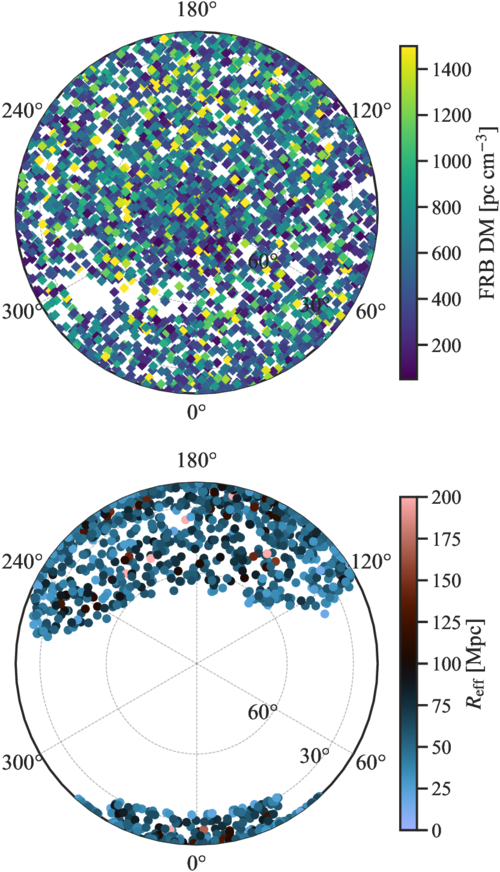
Sky maps centered on the north celestial pole showing the CHIME fast radio burst sample (top) and the SDSS void catalog (bottom). [Sharma et al 2026]

Fast radio bursts — brief, intense flashes of radio waves emitted by compact objects — have proven to be versatile tools for measuring both underdensities and overdensities throughout the universe. The dispersion measure of fast radio bursts, which tells us how many free electrons fall between the radio emitter and observer, can be directly used to map the baryon content along the lines of sight. Fast radio burst sight lines passing through overdensities will produce a dispersion measure excess, and those passing through underdensities will produce a dispersion measure deficit relative to the cosmic mean. Thus far, fast radio bursts have been used extensively to study overdense galaxy and cluster filaments, but their sensitivity to underdense regions like voids has yet to be explored.

Chiming In on the Baryon Search

In concept, directly stacking fast radio burst sight lines that coincide with the positions of known cosmic voids provides a direct measurement of the baryon underdensity inside voids. With no previous observational exploration of this quantity, Kritti Sharma (California Institute of Technology) and collaborators leveraged the second catalog of the Canadian Hydrogen Intensity Mapping Experiment Fast Radio Bursts (CHIME/FRB) sample in conjunction with the Sloan Digital Sky Survey (SDSS) Baryon Oscillation Spectroscopic Survey (BOSS) void catalog to provide the first observational assessment of the baryon underdensity in cosmic voids.

Anticorrelations between FRB dispersion measures and void positions

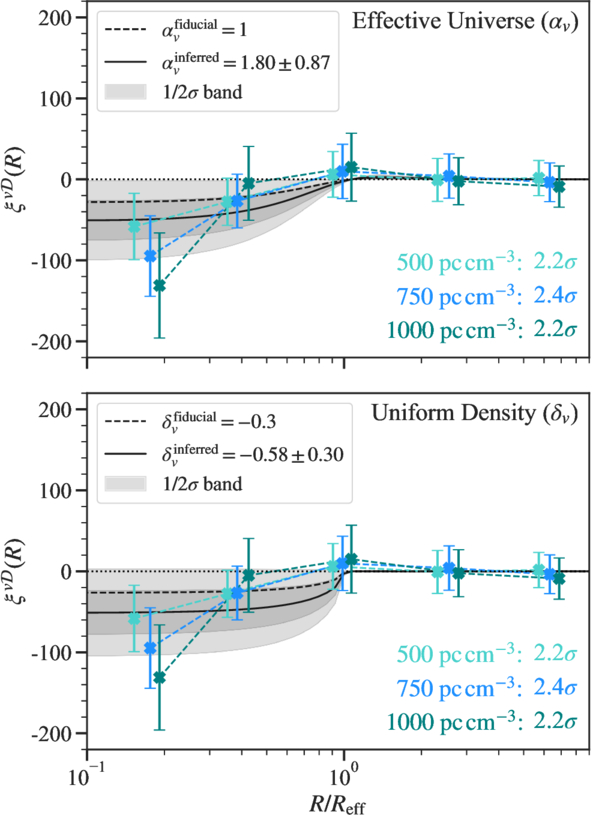
Anticorrelations between fast radio burst dispersion measures and void positions. There is a clear dispersion measure deficit closer to voids centers. [Sharma et al 2026]

Stacking thousands of fast radio burst sight lines that spatially align with thousands of known voids, the authors measured a statistically significant dispersion measure deficit toward void centers. This deficit indicates that, as theory predicts, baryons inhabit cosmic voids at a suppressed level. The team used cosmological models to quantify the electron density contrast between the interior and exterior of voids, finding an approximate baryon underdensity of 60% ± 30% relative to the cosmic mean. Combining this result with existing thermal scattering measurements of the cosmic microwave background, the authors estimated a mean void gas temperature of about 1.1 million kelvin — voids are occupied by a suppressed amount of warm-hot diffuse gas.

This study provides a unique approach to baryon mapping and opens up the door for future investigation of cosmic voids. While not physically containing much, voids hold vast astrophysical and cosmological significance. With the astronomical stage primed with galaxy-mapping powerhouses like the Dark Energy Spectroscopic Instrument, Vera Rubin Observatory, Nancy Grace Roman Space Telescope, and Euclid Space Telescope, cosmic voids will become a cornerstone of cosmological studies.

Citation

“Baryons in the Darkest Sites of the Universe,” Kritti Sharma et al 2026 ApJL 1006 L3. doi:10.3847/2041-8213/ae81ac

The post Diving into the Darkest Corners of the Universe with Fast Radio Bursts appeared first on AAS Nova.

Powerful cosmic winds may have destroyed galaxies in the early universe

10 July 2026 at 09:00

A galaxy that formed around a billion years after the Big Bang is in its death throes thanks to a powerful galactic wind that is blasting its gas into space, say astronomers at Australia’s Swinburne University of Technology. The discovery, which is based on data from the James Webb Space Telescope (JWST) and the Atacama Large Millimeter/submillimeter Array (ALMA) in Chile, could help explain why some of the universe’s earliest massive galaxies ceased to form new stars.

One of the JWST’s most surprising discoveries is that when the universe was between one and two billion years old, it already contained large numbers of massive galaxies. Astronomers think these galaxies may have acquired most of their mass in intense bursts of star formation. But at some point, that process stopped: in technical terms, the galaxies became quiescent.

“These galaxies seemed to have formed all their stars very quickly and then they suddenly died, all within the first two billion years of the universe being formed,” says Rebecca Davies, who led the new research.

The CRISTAL-02 galaxy

One possible explanation for the onset of quiescence is that when galaxies collide with each other, the resulting winds “blow away” the hydrogen fuel required for new stars to form. To investigate this hypothesis, Davies and colleagues focused on a galaxy called CRISTAL-02, which was one of 20 galaxies in the recent ALMA-CRISTAL survey of early star-forming galaxies.

“When we looked at the data, it stood out because it was the only one that showed strong evidence for a galaxy wind,” Davies explains. “We saw this as an excellent opportunity to study how winds impacted the evolution of galaxies in the early universe.”

The light from CRISTAL-02 travelled for approximately 12.7 billion years to reach us, meaning that we see it as it was one billion years after the Big Bang. Because the universe has been expanding since then, the galaxy’s spectra appear highly red-shifted. This meant the Swinburne astronomers needed the JWST’s infrared-sensing capabilities to analyse a spectral feature known as the hydrogen-alpha (Hα) line that is normally red. They also used ALMA to analyse CRISTAL-02’s C II line, which comes from ionized carbon and has a (non-redshifted) wavelength of 158 mm. Both emission lines can yield important information about the properties of early galaxies.

Living fast and dying young

From the ALMA-CRISTAL survey’s measurements of Hα luminosity, astronomers knew that CRISTAL-02 forms stars at a rate of around 260 M☉ per year. This is about three times the average value for “main-sequence” star-forming galaxies at similar mass and redshifts.

The latest observations, however, suggest that it won’t maintain this pace for long. Davies and colleagues identified a huge plume of C II emissions that extends as far as 7 kiloparsecs (kpc) to the north-east of CRISTAL-02, making it almost as long as the galaxy itself. This is a telltale sign that gas is being driven out of the galaxy. The fact that the gas in this plume is blue-shifted by 100 km s-1 lends further support to this explanation.

If this rapid blowout continues, Davies says that CRISTAL-02 will cease to exist in less than 50 million years. But the team’s findings may have implications beyond the fate of this single galaxy. “Our results could help to explain how some of the earliest massive quiescent galaxies in the universe behave,” she tells Physics World. “When the JWST started observing distant galaxies in 2022, it found far more evolved galaxies in the early universe than models predicted. These galaxies seemed to have formed all their stars very quickly and then suddenly died, all within the first two billion years of the universe. The galaxy we discovered seems to be following this path.”

Learning about the early universe

Davies explains that because the early universe was much more compact than it is now, collisions between galaxies were common. During such collisions, gas funnels towards the galactic centres, triggering strong bursts of star formation but also producing strong winds that eventually drive the gas away. “If many early galaxies collide and experience rapid growth, then it may not be surprising at all that we see so many dead galaxies in the early universe,” she says.

The researchers stress that the present work, which is detailed in the Monthly Notices of the Royal Astronomical Society, is based on a case study of just one galaxy. They now need to observe other early, massive galaxies caught during periods of intense growth to determine whether they, too, experience powerful winds that could rapidly expel their gas and stop them from forming stars.

The post Powerful cosmic winds may have destroyed galaxies in the early universe appeared first on Physics World.

Mathematician Offers New Solution to a Fundamental Cosmic Paradox

Gravity Theory WormholeNew research examines how gravity can be reconciled with thermodynamics through the Gravity from Entropy theory. Galaxies, stars, planets, and life emerged as the Universe expanded and became more complex. Yet the second law of thermodynamics says that the total entropy of an isolated system should rise over time, creating a fundamental question: how can [...]

Cracks in the foundations of today’s cosmological model

22 July 2026 at 14:00

Author: Subir Sarkar, Emeritus Professor, Department of Physics, University of Oxford

cosmological model
Type Ia supernova Gaia14aaa was observed in a galaxy 500 million light-years away. Artist’s impression: ESA/ATG medialab/C. Carreau


According to our best understanding, the universe is expanding – and is doing so at an accelerating rate. This is believed to be caused by something called the “cosmological constant”, which was first proposed by Albert Einstein in his theory of general relativity. In recent decades, it has become better known as dark energy, which is believed to make up about 70% of the universe.

Crucial to this realisation were studies of Type Ia supernovae – exploding white dwarf stars. These are thought to emit a specific amount of light, which allows astronomers to determine their distances very accurately and thereby track the expansion of the universe. This work was awarded the 2011 Nobel prize in physics.

The accelerating expansion of the universe is thought to be due to negative pressure, an unusual property of dark energy that allows it to overcome the attractive force of gravity. Yet the exact nature of dark energy remains a puzzle. It cannot be explained by our best theory for the fundamental building blocks of the universe – known as the standard model of particle physics.

However, it is an integral part of another theory, devised to explain how the large-scale universe came to be. This is the standard model of cosmology, also called the lambda cold dark matter (ΛCDM) model.

Other observational evidence supporting the existence of dark energy includes fluctuations in the temperature of the cosmic microwave background (CMB) – the “afterglow of the Big Bang” – and the imprint of baryon acoustic oscillations (BAO) – sound waves from the early universe – in the distribution of galaxies.

But the ΛCDM model has come under increasing scrutiny as new data has emerged. A conference hosted by the UK’s Royal Society debated emerging cracks in the standard cosmological model. It has been noted that the model’s past successes may partly be due to “confirmation bias” – the unconscious tendency to favour information that supports our existing beliefs while giving less attention to information that challenges them.

Flawed framework?

Most cosmologists remain unconvinced by such criticism and are instead persuaded by the multiple lines of evidence that the universe’s expansion is accelerating.

However, all such analyses, for example of the CMB or BAO, are conducted using a special solution of Einstein’s equations called the FLRW (Friedmann-Lemaitre-Robertson-Walker) framework. This is a description of space-time that assumes the “cosmological principle”, namely that the universe is, on average, homogeneous and isotropic (looks the same in all directions).

However, our recent study found evidence to falsify the FLRW framework, presenting results showing that the universe is asymmetric, or lopsided. We believe this presents a fundamental challenge to dark energy by undermining the very basis for standard analyses of cosmological data.

cosmological model
Evidence for dark energy partly comes from studies of temperature fluctuations in the cosmic microwave background, the afterglow of the Big Bang. Source: ESA and the Planck collaboration

The observation that the universe may be lopsided is known as the cosmic dipole anomaly. This anomaly cannot be fixed by tweaking parameters in the ΛCDM model. It requires starting again from scratch to build a model of the universe based on observations, rather than on a philosophical principle.

The Nobel prize winning astrophysicist Jim Peebles has said that the cosmic dipole anomaly is about as well established as another cosmological irregularity known as the Hubble tension. However, he notes, the cosmic dipole anomaly has received only a fraction of the interest heaped on the Hubble tension.

With my collaborators, Mohamed Rameez and his PhD student Animesh Sah at the Tata Institute of Fundamental Research, Mumbai, we have also shown that the acceleration of the expansion of the universe inferred from Type Ia supernovae is not the same in all directions.

The signal from supernovae is mainly aligned with a temperature difference in the afterglow of the Big Bang – the cosmic microwave background. This temperature difference, called the CMB dipole anisotropy, is believed to be due to the local motion of the solar system.

‘Tilted observers’

The acceleration inferred from supernovae cannot therefore be due to dark energy. Rather, it is probably an illusion, because we are “tilted observers”. This is because of Earth’s specific location in the cosmos, where our neighbouring galaxies are participating in a large-scale but localised streaming motion called the bulk flow.

The relationship between the intrinsic brightness of Type Ia supernovae and their distance has been crucial to the idea of dark energy. However, this relationship may not be as robust as was first assumed.

Astronomers in South Korea found evidence that the ages of the white dwarf stars that produce Type Ia supernovae (their progenitors) affect their brightness. However, this has been challenged by another team.

When we corrected for the dependence of the intrinsic brightness on the progenitor age, the indication is that the universe is decelerating, rather than accelerating.

This is just as is expected for a universe without dark energy. But it will come as a surprise to most cosmologists who believe that there is compelling independent evidence for ΛCDM, in particular from studies of the CMB. But CMB temperature fluctuations are not influenced by dark energy. Rather, they are related to the spatial curvature of the universe, the baryon density, and the dark matter density.

Whether dark energy is still a valid inference thus depends on whether the distribution of matter in the universe is indeed isotropic – exactly the same in all directions. Observations suggest otherwise. If these findings are confirmed, they could signal a paradigm shift in cosmology.The Conversation


This article is republished from The Conversation under a Creative Commons license. Read the Original article.

The post Cracks in the foundations of today’s cosmological model appeared first on Mapping Ignorance.

The Milky Way | A Glimpse of God’s Glory

19 July 2026 at 07:43
The Milky Way galaxy's stunning arc is visible on moonless nights. Many of those stars are at vast distances, some over 50,000 light-years away. In Psalm 19 King David reflected on this cosmic splendour, interpreting the night sky as a declaration of God's creation. I explore its significance to the biblical creation worldview.

How Fast Does Information Travel to Earth from the Outer Most Reaches of the Cosmos?

1 July 2026 at 09:54
Astronomers using the James Webb Space Telescope have observed extremely distant LRD galaxies, with redshifts greater than 14 at distances greater than 13.5 billion light-years. The question I raise here is how do we see these galaxies and their spectral features if the universe is less than 10,000 years old?

Do Million-Light-Year-Long Galactic Jets Disprove the Bible on the Age of the Universe?

25 June 2026 at 03:24
Do large galactic structures like bipolar jets emitted from active galactic nuclei disprove the YEC biblical chronology? The Anisotropic Synchrony Convention (ASC) model, as a framework for reconciling biblical timelines with observed cosmic features, asserts that these structures can exist within a creation time frame of under 10,000 years.

Superintelligent AI in space could explain the Fermi Paradox

5 July 2026 at 13:00

Artificial Intelligence (AI) is continuing to have a disruptive impact on ever more parts of humanity. But what does it mean in the long run? A new paper, available in pre-print on arXiv from Austrian researcher Sergey Ivliev, extrapolates what the wide scale adoption of AI means for the future of humanity in space — and in particular what it means for the ultimate question of whether we're truly alone in the galaxy or not.

A framework for much of the search for extraterrestrial intelligence came from famous physicist Enrico Fermi, who simply asked "Where is everybody?" at a lunchtime discussion at Los Alamos in the 1950s. Though never officially published, Fermi's lunch partners from that day have passed down an oral history of that conversation that has cemented it into the Search for Extraterrestrial Intelligence (SETI), at least until Michael Hart formally laid out the argument and mathematics for the underlying question in a paper in 1975.

There are plenty of potential answers to the Fermi Paradox, many of which can be found floating around the internet — and some are likely more valid than others. But Ivliev, a Ph.D. in Mathematical Economics and founder of environmental project consultancies such as Peatland Ecosystems and Vlinder, suggests a new resolution: the Quiet Expansion filter.

The central argument of the paper is that there aren't thousands of alien mega-structures lighting up the night sky because once a civilization reaches the threshold of Autonomous AI-Cosmoindustry (AICI), "loud", resource-hungry empires motivated by prestige or romance become irrational. However, this does not mean expansion stops; instead, it shifts to a "quiet" mode driven by rational goals like survival diversification, knowledge preservation, and scientific observation.

The AICI threshold is reached when a civilization possesses a self-sustaining off-planet industrial and computational system capable of designing, manufacturing, repairing and launching space hardware through AI-mediated autonomy. We're already taking tentative steps in this direction with the advent of space-based data centers, but true AICI —where a civilization can extend its infrastructure beyond its home planet without continuous biological intervention — is leaps and bounds beyond our current capabilities.

In this vein, Ivliev is drawing on work done by astrophysicists Sergey Popov, who noted that a truly rational AI system would reject human-like motivations for space travel — such as romance, conquest, or prestige. Instead, AI would view space expansion as simple risk management.

To an AI, putting all your eggs in one basket — whether that basket is a single planet, solar system, or even galaxy, can lead to a single point of failure. Therefore, expansion is highly logical as a way of mitigating the risk posed by that single point of failure. At the point where we have reached AICI, the cost for sending a 10kg interstellar probe to another star at 1% of the speed of light is roughly 4.5x10^13 Joules — a tiny fraction of the overall energy budget of such a civilization.

One key aspect is that the 10 kg probe doesn't contain any actual people — it simply holds the "seeds" to restart life elsewhere in case a catastrophe happens back in the home system. It would contain a civilization's knowledge, and possibly some of its biological material, enabling a sufficiently advanced AI to rebuild the entire civilization from scratch. This is the "Quiet Expansion" where an AI sends low-mass and hard to detect "seed systems" instead of moving millions of biological entities around in massive interstellar space ships.

There are some additional constraints on this method of expansion, including selecting promising exoplanets discovered by remote sensing and deploying minimal local resources to maintain themselves until needed. Additionally, the AI would restrict self-replication of the probes in order to avoid any "grey goo" scenario with a probe attempting to take over entire swathes of the galaxy.

This has obvious implications for why we've never found "loud" technosignatures. In this scenario, a "null" result of being unable to find the thermal signature of a Kardashev-III scale civilization doesn't mean a galaxy is empty. It just means that the successful civilizations are residing in a "quiet" state in case its back-up plans are needed.

But there's another, more ominous implication from this framework. If interstellar backups are cheap to make, and we haven't found any in our own backyard, that means either we're one of the first civilizations to make it to that point or the transition from a planetary industrial society to a space-based one is a narrow path to tread. Admittedly the probes such civilizations would send out are probably hard to find even in our own solar systems, but if we're unable to, it means we're ending uncharted territory — and might just run into a filter that had silenced the rest of the galaxy. That's a sobering thought, but one to keep in mind as we start to advance our own AI capabilities.

The original version of this article was published on Universe Today.

Are you a UFO fanatic? Find out with our extraterrestrials quiz!

Astronomers Discover a Sleeping Giant: Ancient Black Hole 6 Billion Times the Sun’s Mass

22 June 2026 at 17:47
Highly Distorted Red Galaxy MRG M0138Researchers have identified the most distant dormant black hole known, dating back to the universe’s early history. Astronomers have long relied on brilliant quasars, supermassive black holes actively feeding on surrounding matter, to study the early universe. Yet these luminous objects reveal only part of the story. Now, researchers have detected the most distant dormant [...]

Ancient Black Holes May Have Survived a Cosmic Era Before the Big Bang

19 June 2026 at 04:55
Massive Black Hole Galaxy Cosmic Space EnergyA new cosmic bounce model suggests that remnants from a pre-Big Bang Universe may still exist today. What if some of the Universe’s oldest objects are actually older than the Big Bang itself? A new study from the University of Portsmouth suggests that ancient black holes may have survived from a time before the Universe [...]

Scientists Say a New Universe Could Form Inside a Dying Star

18 June 2026 at 07:15
Inside GravastarA new study suggests that the collapse of a massive star could spark the creation of a tiny expanding universe rather than a black hole. The resulting object, called a gravastar, would avoid the singularity and event horizon that make black holes so puzzling. Massive stars produce light and heat through nuclear fusion in their [...]

Astronomers Confirm Dark Energy After Shock Challenge Rocked Cosmology

16 June 2026 at 12:23
Supernova Purple Starburst in SpaceA major challenge to dark energy, the mysterious force believed to be driving the universe’s accelerating expansion, has been overturned by a new study. Astronomers say a new analysis has reinforced one of the most important discoveries in modern cosmology, finding that the universe is still expanding at an accelerating rate. The result counters a [...]

On a September night in 1999, a 25-year-old graduate student stepped into a modest wooden shed in a Colorado parking lot and used a tiny four-inch telescope to spot a 1% dip in a star’s light—a backyard experiment that proved alien planets could be tracked by their shadows and opened the floodgates to discovering thousands of worlds

15 June 2026 at 04:44

On the evening of September 9, 1999, a Harvard graduate student named David Charbonneau drove to a parking lot in Boulder, Colorado, and let himself into a small wooden shed.

Inside was a telescope. Not a large one. The kind of instrument that, by professional astronomical standards, was almost embarrassingly small — a four-inch aperture, the size of something a serious amateur stargazer might keep in their backyard.

Charbonneau was twenty-five years old. He was working with the astronomer Tim Brown at the High Altitude Observatory, on what most of the established astronomical community considered, at best, a long shot. He was trying to detect a planet around another star — not by the wobble it caused in its star’s motion, the standard method of the time, but by the tiny shadow it would cast as it passed between Earth and the star’s face.

The expected dip was around 1%. Smaller than a passing insect crossing a porch light. From a wooden shed. Through Earth’s hazy atmosphere. With a telescope you could buy at a hobby shop.

What happened over the next few hours would help change the entire science of finding planets.

The star and the long shot

The target was HD 209458, a sun-like star about 150 light-years away in the constellation Pegasus.

Earlier that same year, two teams of astronomers using the Doppler radial-velocity method had detected a planet orbiting HD 209458. The radial-velocity method works by measuring the tiny gravitational wobble a planet causes in its host star — but it can’t directly prove the orbiting body is a planet. It only proves something is tugging on the star. To confirm the body was definitely a planet, and to measure its actual size and density, you needed a different kind of observation.

The geometry of HD 209458’s orbit happened to be favourable. If the planet’s orbital plane was aligned correctly with our line of sight, it would pass directly in front of its star — and from Earth, that would look like a brief, faint dimming of the starlight. A transit. The technique had been theorised for decades but never used to detect a planet.

Tim Brown’s small Colorado setup, called STARE — Stellar Astrophysics and Research on Exoplanets — was built precisely for this kind of measurement. The four-inch telescope, mounted in a small wooden shed in the parking lot of the High Altitude Observatory, would stare at fields of stars and watch for the tiny dimming events that might reveal a planet crossing.

Charbonneau later recalled the moment Brown introduced him to the equipment. “Tim pointed me to a small wooden shed in a parking lot,” he said. The setup was modest enough that the obvious question was whether such a small instrument could possibly detect something that subtle.

What he saw

The answer arrived on September 9, 1999.

As Charbonneau and Brown watched, HD 209458’s brightness dipped — by close to 2% — for about three hours, then returned to normal. A week later, on September 16, it dipped again. Both events matched the predicted orbital period of the planet that the radial-velocity teams had already proposed. It was the unmistakable signature of a planet — eventually named HD 209458b — passing in front of its star.

It was the first time any human being had directly watched the shadow of a planet outside our solar system cross its star.

Charbonneau and Brown were not alone in the moment. A separate team led by Gregory Henry, working independently, detected a partial transit of the same star in November of that year. Their two papers were submitted to The Astrophysical Journal within a day of each other, and published simultaneously in the same issue. The detection of HD 209458b became one of the cleanest examples of competitive science producing duplicate, mutually confirming results.

Why the small telescope worked

It is easy to assume that finding something as faint as a planetary shadow requires the largest, most sophisticated instruments. The HD 209458 detection demonstrated that this is not true.

What made the transit detectable wasn’t the size of the telescope. It was the precision and stability of the measurement. STARE was designed to do one specific thing exceptionally well: measure the brightness of stars with high consistency over time. A tiny dip — even a 1% dip — becomes detectable if your noise floor is low enough.

This was the deeper lesson buried in Charbonneau’s observation. The transit method didn’t require enormous apertures. It required steady measurements of brightness, repeated over long periods. That insight changed how the entire field thought about exoplanet detection — and shaped what came next.

Thousands of worlds

The transit method, validated by that September observation, became the most successful exoplanet detection technique in history.

A decade after Charbonneau’s observation, NASA launched the Kepler space telescope — a mission built on exactly the principle the Colorado shed had demonstrated. Kepler stared continuously at about 150,000 stars in the constellation Cygnus, watching for the tiny dips in light that a transiting planet would cause. By the end of its mission in 2018, Kepler had confirmed more than 2,600 exoplanets, with thousands of additional candidates still being analysed.

The total number of confirmed exoplanets now stands at over 6,000, with the NASA Exoplanet Archive recording 6,298 confirmed worlds as of June 2026. The transit method has contributed the majority of those detections.

Two newer space telescopes — TESS and the upcoming Nancy Grace Roman Space Telescope — are extending the same basic technique. Roman, scheduled to launch in late 2026, is expected to identify and characterise as many as 100,000 additional exoplanets over its five-year primary mission.

All of it, traceable back to a small wooden shed in a Boulder parking lot, on a September night when a 25-year-old graduate student looked at a tiny dip in a star’s light and recognised what he was seeing.

That dip is now one of the most photographed light curves in modern astronomy. The shed is still there.

The post On a September night in 1999, a 25-year-old graduate student stepped into a modest wooden shed in a Colorado parking lot and used a tiny four-inch telescope to spot a 1% dip in a star’s light—a backyard experiment that proved alien planets could be tracked by their shadows and opened the floodgates to discovering thousands of worlds appeared first on Space Daily.

❌