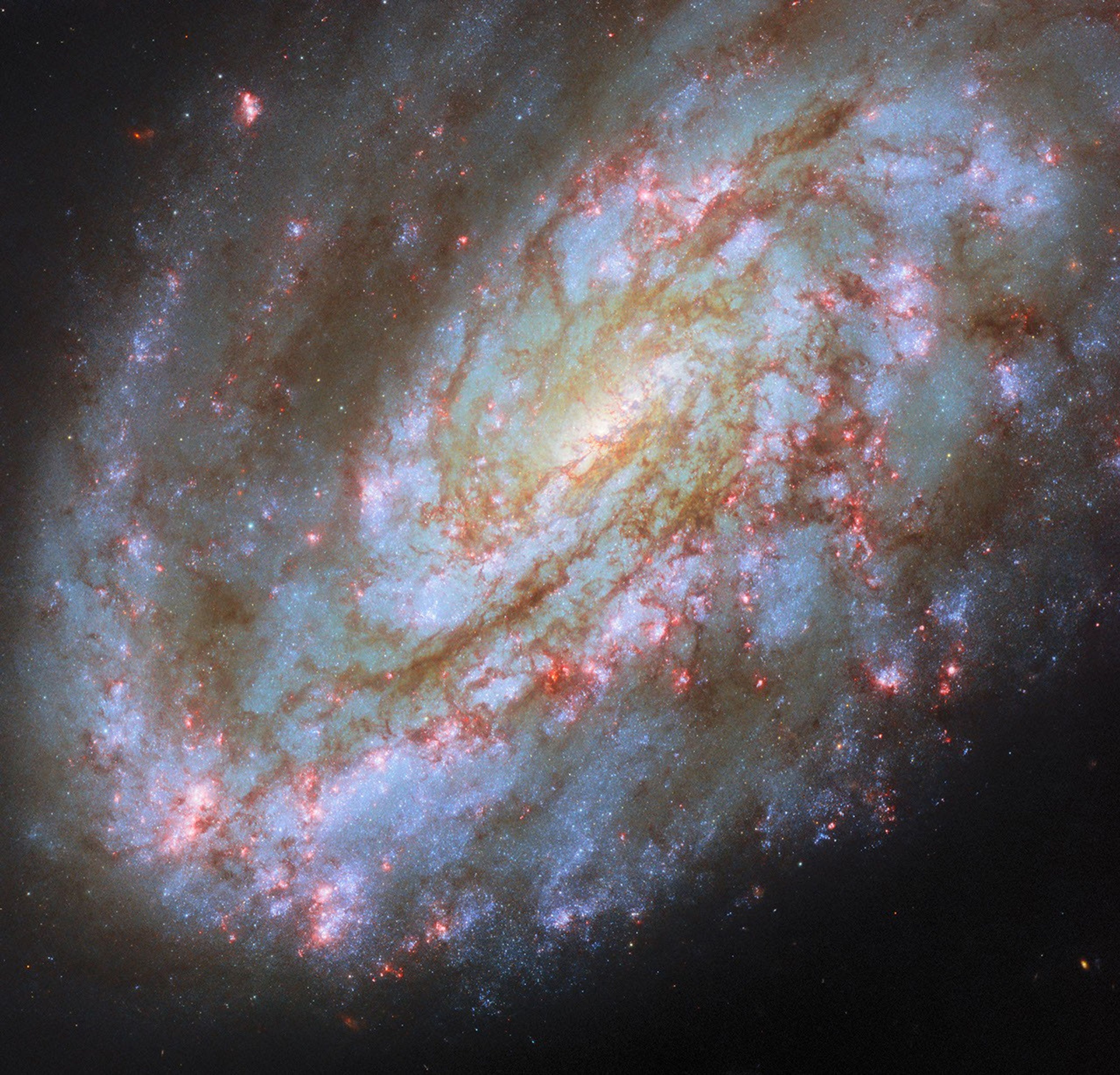
Life in space is hard. Most orbiting observatories retire well before their 20th birthday. Yet the Hubble Space Telescope has survived and continues to thrive well into its 30s. Astronomers celebrated the observatory’s 36th birthday in April by releasing a new image of the Trifid Nebula (M20). This stellar nursery lies about 5,000 light-years fromContinue reading "Hubble captures a corner of M20"
Stunning new imagery of the distant celestial object NGC 2392, better known as the “Lion Nebula,” has been obtained by NASA’s James Webb Space Telescope.
The cosmic vista captured by Webb reveals a colorful view of the ancient nebula, whose characteristic appearance resembles one of nature’s most respected apex predators, complete with a bushy-looking “mane” composed of hazy stellar gases and objects similar to comets.
The new high-resolution imagery offers one of the clearest and most detailed views of the Lion Nebula ever seen. Previous images captured by Webb’s predecessor, the Hubble Space Telescope, were obtained in 2000, featuring the same celestial feature in visible light.
With the added spectral ranges Webb’s Near Infrared Camera (NIRCam) and Mid-Infrared Instrument (MIRI) can capture, the Lion Nebula now appears in colorful pinks and indigo hues, surrounded by distant galaxies blazing in brilliant orange from across vast cosmic distances, whose light has traveled billions of years to reach our Solar System.
A Lion Roars Across the Cosmos
A particularly striking feature about the new imagery is the way cosmic dust and regions of ionized gas are showcased in the new Webb imagery.
“It’s taken several thousand years for this collection of gas and dust to reach its current shape, and the nebula’s components continue to be altered,” read a portion of a statement released by the European Space Agency (ESA) that accompanied the new images.
The Lion Nebula, as seen with the MIRI instrument on board the James Webb Space Telescope (Image Credit: NASA, ESA, CSA, STScI; Image Processing: Alyssa Pagan (STScI)).
One reason that helps account for the changing appearance of the Lion Nebula over time can be found at its center, where the remnants of a slowly dying white dwarf star (which effectively forms the nose in the lion’s face after which the nebula is named) continues to supercharge the surrounding cosmic structures made visible in the new Webb imagery.
The rest of the lion’s face is composed of an expanding bubble of ionized gas, the nature of which remains somewhat mysterious. Presently, astronomers are uncertain about what exact mechanisms give rise to the complex appearance of this gassy bubble and its internal structures, which are a recurring element in ancient nebulae such as this.
NGC 2392 isn’t the only celestial feature known as the “Lion Nebula.” An entirely separate diffuse nebula located in the Cepheus constellation, known as Sharpless 2-132, also shares this nickname due to its shape, which resembles a lion’s body seen from the side.
A Cosmic Visage Frozen in Time
For now, the Lion Nebula is captured in the Webb imagery, which, despite its almost serene beauty, represents a highly active area of the cosmos, undergoing constant change as material is continually ripped away from the stellar central core.
Sometime in the next 10,000 years or so, this striking celestial feature will eventually be destroyed, once the white dwarf powering the nebula completely dies and the remnants of stellar material are completely dispersed into the surrounding space.
Until then, this remarkable cosmic feature will remain a target of study by astronomers, whose inquiries are helped significantly by the unprecedented clarity offered in the latest Webb images.
Micah Hanks is the Editor-in-Chief and Co-Founder of The Debrief. A longtime reporter on science, defense, and technology with a focus on space and astronomy, he can be reached atmicah@thedebrief.org. Follow him on X @MicahHanks, and at micahhanks.com.
Astronomers have found a third giant planet around Beta Pictoris, one of the best-known young planetary systems near Earth. The discovery is striking because the planet was not first picked out as a bright dot in a telescope image. NASA’s James Webb Space Telescope found it in the spectrum of light coming from the system: […]
NASA is currently targeting August 30 for the launch of the Nancy Grace Roman Space Telescope from Florida. The date can move, as launch dates do, but the mission is close enough to the pad that its central idea deserves a clear look: Roman will survey huge stretches of the universe in one exposure, gathering […]
New evidence has come to light showing that the mysterious 'little red dots' discovered in the early universe by the James Webb Space Telescope could evolve into the active centers of fully formed galaxies.
"Everything created in the early universe must evolve into something around us," said George Rieke of the University of Arizona in a statement. "We have had little idea of what little red dots become, but these results finally show us how to find their progeny."
Discovered by the James Webb Space Telescope (JWST) almost as soon as it became operational in 2022, little red dots have been a perplexing cosmological mystery. As their name suggests, they appear small, red and surprisingly bright. They are mostly found at redshift values suggesting they existed between 13.2 and 12.2 billion years ago. To shine so brightly at such great distances would usually imply these objects are quasars — which are luminous nuclei of galaxies powered by active supermassive black holes — but the light coming from little red dots is more like that of bloated stars. It looks to be mostly in infrared with some ultraviolet, and none of the X-rays that one would expect from an active black hole chomping down on material.
As such, researchers have come up with the hypothesis that little red dots are "black hole stars," or vast clouds of gas heated from within by a concealed but growing supermassive black hole.
However, the population of little red dots drops off a cliff at redshifts equating to less than 12 billion years ago. Where did they all go? There are two options. Either they all died off, or they developed into objects more familiar to us.
A team led by Pierluigi Rinaldi, who was at the University of Arizona's Steward Observatory when conducting this research but is now at the Space Telescope Science Institute (STScI) in Baltimore, think it has identified a descendent of a little red dot. It appears to be in the form of a distant galaxy, catalogued as WISEA J123635.56+621424.2, which is found at a redshift of 2, meaning that we see it as it was 10.5 billion years ago.
The galaxy displays neat spiral arms around a red core. Rinaldi's team have nicknamed it the Saguaro, after a species of cactus native to the Sonoran desert in the United States' south-west, thanks to the galaxy's arms and how its core resembles the red fruit produced by the cactus.
A field of galaxies in Ursa Major, with the Saguaro galaxy inset. (Image credit: NASA/ESA/CSA/STScI/Pierluigi Rinaldi (Steward Observatory); Image Processing: Alyssa Pagan (STScI))
Saguaro's core has all the hallmarks of a little red dot. It shines bright in infrared as seen by JWST, and also emits in ultraviolet as detected by the Hubble Space Telescope. Yet, NASA's Chandra X-ray Observatory has also detected faint X-rays originating from Saguaro.
"What the X-ray observations show is that this galaxy has an active galactic nucleus, and a very obscured one at that," Carys Gilbert of the University of Cape Town in South Africa, who participated in the study alongside Rinaldi, said in the statement. "It's not only obscured but also X-ray weak. That kind of combination could explain the lack of X-ray emission that we see from all other little red dots. It fits the puzzle of little red dots nicely."
This is not the first time X-rays have been seen coming from a little red dot. Earlier this year it was reported that scattered X-rays were seen breaking through from a little red dot called 3DHST-AEGIS-12014, given credence to the hypothesis that little red dots are black hole stars, where the black hole gradually consumes the "star" from the inside out, eventually carving holes through which X-rays can escape. We see 3DHST-AEGIS-12014 as it was 11.8 billion years ago, meaning that Saguaro, which existed 1.3 billion years later, is a little bit further on in its development.
A comparison to how the Saguaro galaxy appears to us now, and how it would appear as a little red dot if it existed at a higher redshift. (Image credit: Alyssa Pagan (STScI); Illustration: Leah Hustak (STScI))
"Because the Saguaro is at lower redshift, we can see the very beautiful and bright host galaxy in high resolution and detail with Webb and Hubble," said Harvard's Zihao Wu, who was also part of Rinaldi's team.
Intrigued, Rinaldi's team simulated how Saguaro would appear to us if it existed a billion years after the big bang. Much of its galactic structure would either be less developed or simply just too faint to be seen at such distance. All that would be visible would be the nucleus, looking very much like all the other little red dots.
This implies that little red dots are not a unique population of their own, but are simply a phase in the development of galaxies with supermassive black holes. Our own Milky Way could have been a little red dot once upon a time.
Saguaro is a crucial link in the story of little red dots and how they connect with modern galaxies. While there is still much to learn, such as the beginning of their story and how they form, the middle and end of their story is now beginning to take shape.
The Carina Nebula's "Treasure Chest" stuns in this new image captured by the James Webb Space Telescope. (Image credit: ESA/Webb, NASA & CSA, M. Reiter)
In a nebula far, far away, colossal clouds of dust and gas tower amongst the stars.
What is it?
This spectacular new image from the James Webb Space Telescope showcases the brilliant majesty of the Carina Nebula, a giant cloud of dust and gas found 7,500 light-years away in the constellation Carina.
In this new image, captured by JWST's Near-Infrared Camera (NIRCam), you can see the nebula in a whole new light. This snapshot captures a specific feature that is being dubbed the "Treasure Chest," as it vaguely resembles a glowing coffer overflowing with stellar jewels.
This "Treasure Chest" contains a cluster of young stars, approximately 70 stars in total. While these might be young, growing stars, the most massive of the bunch is a whopping 19 times more massive than our sun.
Why is it incredible?
While JWST has looked at the Carina Nebula before, new observations can reveal completely new details and help scientists uncover new information about the nebula and the strange ways in which the universe works.
Right now, scientists think that the star cluster in the "Treasure Chest" is about 1.3 million years old. However, previous estimates thought the grouping could be just 100,000 years old. So, new observations by powerful telescopes like JWST can significantly change our understanding of the cosmos.
With each new observation or data point, the history and context of the universe around us could completely transform. And, as this star cluster grows over time, its stars will become more brilliant. They may therefore illuminate more of this star cluster, potentially revealing details and secrets of this "treasure" that scientists might never have predicted.
For 35 years, the Hubble Space Telescope has looked out into the Universe. Now, Lego is inviting builders to look inward with its latest model of the orbiting observatory.
The new Lego Icons Hubble Space Telescope (set no. 11382) was released on August 1 for $140 at the toy company's stores and its online shop. The 1,252-piece kit builds a 15-inch-long (38-cm) desktop model that is about twice as large as the previously released Lego Hubble models.
The Icons Hubble is the first to be sized in comparison to a Lego minifigure, such that the included astronaut provides a sense of scale for the telescope.
Certaines des caractéristiques du Système solaire, à commencer par l'origine de la Lune, s'expliquent par des événements et des scénarios violents. Que faut-il en penser dans le cas de certaines des lunes de Neptune depuis que le télescope James-Webb a pris le relais de Hubble ?
A £3 million investment could help secure a leading UK role in NASA’s future search for life on nearby planets. An Earth-like planet orbiting a nearby star would appear as little more than a dim point beside a light source 10 billion times brighter. British astronomers are preparing technology that could help NASA separate that [...]
A giant planet spent more than a decade concealed inside one of astronomy’s most closely watched star systems. Astronomers have discovered a planet named Beta Pictoris d orbiting a young star just 63 light-years from Earth. The gas giant is about 100 times fainter than Beta Pictoris b, the first planet found in the system, [...]
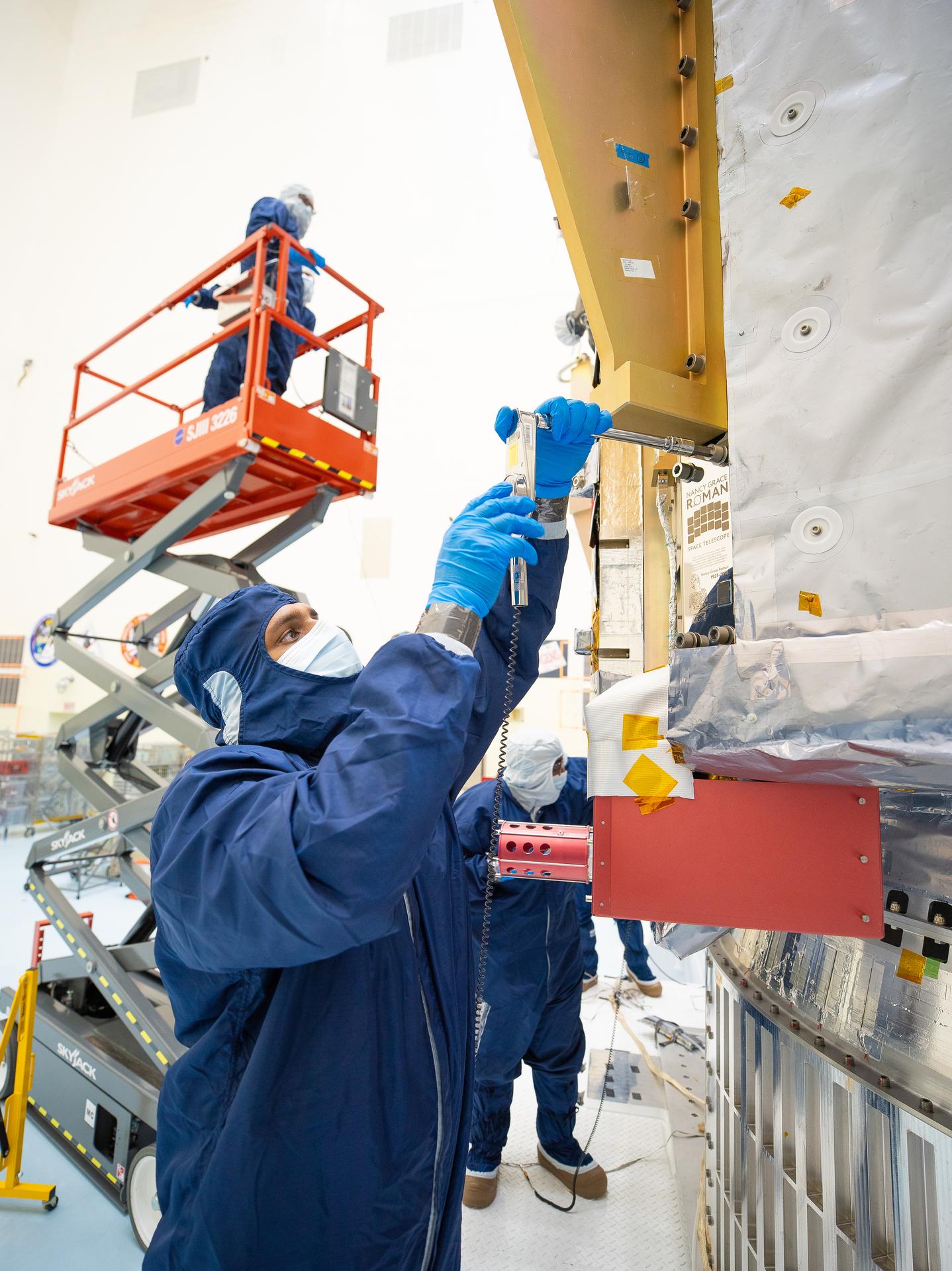
On July 27, technicians at NASA’s Kennedy Space Center in Florida installed a memory card containing 1,350,144 names as part of a commemorative plaque on the Nancy Grace Roman Space Telescope. The names were submitted by people globally, including astronauts from Artemis II and Artemis III. The memory card will travel with the Roman observatory to the Sun-Earth Lagrange point 2, or L2, about one million miles from Earth, where the Sun’s and Earth’s gravity balance out.
Roman is named after Dr. Nancy Grace Roman, NASA’s first chief astronomer and one of the architects of the agency’s modern science program. Roman championed space-based observatories that could study the universe from above Earth’s hazy atmosphere while making their data broadly available to the scientific community.
NASA and SpaceX are targeting launch for no earlier than 7:26 a.m. EDT Sunday, Aug. 30 aboard a SpaceX Falcon Heavy from Launch Complex 39A at Kennedy.
NASA’s Hubble Shows Star Formation in Andromeda Galaxy Winding Down
NASA Hubble’s view of part of the Andromeda galaxy.
Credits: Image: NASA, ESA, Benjamin Williams (UWashington), Zhuo Chen (UWashington), L. Clifton Johnson (Northwestern); Image Processing: Joseph DePasquale (STScI)
A new study using data from NASA’s Hubble Space Telescope finds that star formation in the nearby Andromeda galaxy has undergone a 500-million-year decline, with an even steeper drop in the last 40 million years. Andromeda, a spiral galaxy comparable in size to our Milky Way, is close enough to be seen with the unaided eye from areas with dark skies. Located about 2.5 million light-years from Earth, practically our cosmic backyard, Andromeda offers an opportunity for astronomers to examine its stellar populations in detail, leading to better understanding of the past of galaxies like our own.
To reach this conclusion, the researchers combined data from two Hubble surveys: the Panchromatic Hubble Andromeda Treasury and the Panchromatic Hubble Andromeda Southern Treasury. Together, these two surveys mapped two-thirds of the disk of Andromeda in ultra-sharp detail. In total, the team measured about 200 million individual stars across the galaxy, giving them a detailed picture of Andromeda’s past activity.
“We need to measure the individual stars because they are the fossil record of the galaxy’s formation. Hubble is the only telescope that can give you high enough spatial resolution over a large enough area to be able to do that in Andromeda,” said Ben Williams, astronomer at the University of Washington and a co-author on the study.
Massive stars are bluer and short-lived, while less massive stars are redder and longer-lived. As a result, areas that have experienced recent star formation tend to have a larger fraction of blue stars, while areas with less recent star formation typically have a redder population. The team divided the Andromeda images into thousands of squares, spanning 300 light-years on each side of the square, and determined the history of star formation within each parcel to gain a comprehensive view of the galaxy’s past.
NASA’s Hubble Space Telescope has provided a detailed view of millions of stars in the Andromeda galaxy. Regions that have experienced recent star formation (1) appear significantly bluer than regions with less recent star formation (2).
NASA, ESA, Benjamin Williams (UWashington), Zhuo Chen (UWashington), L. Clifton Johnson (Northwestern); Image Processing: Joseph DePasquale (STScI)
Steady decline
Previous research showed the Andromeda galaxy experienced a dramatic burst of star formation about 2 billion years ago, likely due to a past interaction or merger with another galaxy. Since that time, star formation has been steadily declining.
Astronomers measure the rate of star formation in terms of the mass, or amount of gas and dust, converted into stars per year. The researchers calculated that, 500 million years ago, Andromeda formed stars at a rate of about one solar mass per year. However, the formation rate dropped to about half that by 40 million years ago. The current rate has plummeted even farther, to about one-fifth the mass of our Sun per year.
The team also examined whether that decline was consistent across the galaxy or concentrated in certain areas. They found that much of the recent star formation has occurred in a star-forming ring located about 32,000 light-years from the galaxy’s center. As a result, much of the decline they measure is driven by decreasing activity within that ring.
Rather than being the result of reduced material from which new stars can form, the decline is more likely to be a natural winding down from its previous, more active state.
“It’s just like after running a marathon, sometimes you’ve got to take a bit of a breather,” said Tobin Wainer, lead author, University of Washington.
Likely suspect
The team also investigated whether there was any connection between the decrease of activity in Andromeda and its proximity to satellite galaxy M32 (Messier 32). The M32 galaxy is separated from Andromeda by about 16,000 light-years in the plane of the sky; however, its 3D location in space is uncertain. As a result, astronomers are unsure if or when it might have interacted with Andromeda in the past.
“One of the major motivations for this program was to probe potential interactions between M32 and Andromeda’s disk,” said Zhuo Chen, co-author, University of Washington.
Survey data from the Panchromatic Hubble Andromeda Southern Treasury allowed the team to study the history of star formation in Andromeda near M32. They found that this area showed signs of decreased star formation compared with other regions. The timing of this decrease, which this study finds began roughly 60 million years ago, could help constrain when the M32 galaxy interacted with Andromeda’s disk.
“We can’t explicitly say that we are seeing a decrease in star formation because of M32. But it’s right there, and it’s definitely the most likely suspect,” said Wainer.
This movie, created from an analysis of data from NASA’s Hubble Space Telescope, demonstrates how the rate of star formation in the Andromeda galaxy has declined over the past 500 million years. Brighter colors indicate where star formation was highest during a given time.
Visualization: Tobin Wainer (UWashington); Image Processing: Joseph DePasquale (STScI); Video: NASA, ESA, STScI, Gregory Bacon (STScI)
The team plans to continue analyzing the Hubble data and combine it with data from ground-based observatories to gain additional insights into the history of Andromeda.
“There’s a strong scientific value to this archival data. Andromeda is important because it’s a neighbor that is close enough that we can see it in great detail while also getting a global perspective,” said Raja GuhaThakurta, co-author, University of California Santa Cruz.
An even greater global perspective is likely to come from NASA’s Nancy Grace Roman Space Telescope after it launches as early as Sunday, Aug. 30. Roman’s gigantic field of view can cover at least 100 times as much area as Hubble at near-infrared wavelengths in a single observation. A newly approved Roman observing program will image the entirety of Andromeda’s disk and areas of its surrounding halo, allowing astronomers to measure hundreds of millions of stars and enabling groundbreaking new science.
The Hubble Space Telescope has been operating for more than three decades and continues to make ground-breaking discoveries that shape our fundamental understanding of the universe. Hubble is a project of international cooperation between NASA and ESA (European Space Agency). NASA’s Goddard Space Flight Center in Greenbelt, Maryland, manages the telescope and mission operations. Lockheed Martin Space also supports mission operations at Goddard. The Space Telescope Science Institute in Baltimore, which is operated by the Association of Universities for Research in Astronomy, conducts Hubble science operations for NASA.
NASA’s Hubble Space Telescope has provided a detailed view of millions of stars in the Andromeda galaxy.
Star Formation Rate in Andromeda Over Time
This movie, created from an analysis of data from NASA’s Hubble Space Telescope, demonstrates how the rate of star formation in the Andromeda galaxy has declined over the past 500 million years.
This NASA/ESA Hubble Space Telescope image features the spiral galaxy NGC 4654, located 72 million light-years away in the constellation Virgo (the Maiden).
NASA, ESA/Hubble, D. Thilker, J. Lee, and the PHANGS-HST Team
The subject of this NASA/ESA Hubble Space Telescope image is a spiral galaxy struggling against titanic forces that appear on galactic scales in space. This is NGC 4654, an intermediate spiral galaxy in the constellation Virgo (the Maiden). It is classified as an “intermediate” because its overall shape lies between spiral galaxies that have a bar across their centers and those that don’t. NGC 4654 has a weak bar structure at its center and is located 72 million light-years from Earth in the Virgo Cluster, a particularly massive and populous galaxy cluster.
NGC 4654 is particularly asymmetric, with a rounded and clearly-defined edge on one side and a long tail of gas stretching out from the opposite side — outside the field of view captured in this image. This gaseous tail is the result of ram pressure stripping, a force that galaxies can experience as they plow through space. NGC 4654 moves with such high velocity that it sweeps up and rams through the hot, rarefied gas filling the space between the Virgo Cluster’s galaxies. This intracluster medium in turn exerts a “ram pressure” on the galaxy, compressing the galaxy’s leading edge and dragging its gas behind the galaxy, creating the elongated tail.
It’s not just the galaxy’s gas that is unevenly distributed: its stars are too, and this is more unusual for a spiral galaxy. While the spiral arm on its leading edge is rich with stars and gas, the opposite arm noticeably lacks stars, influencing the galaxy’s lopsided spiral shape. Astronomers think that ram pressure alone is unlikely to cause this effect. Rather, NGC 4654 was also subjected to the gravitational force of fellow Virgo Cluster galaxy NGC 4639. While the two galaxies are far apart now, it’s thought that a fly-by interaction between them around 500 million years ago ripped away NGC 4654’s gas along one side, limiting star formation there and creating the asymmetry in its shape.
Many galaxies that undergo ram pressure stripping suffer reduced star formation rates as the cold gas that collapses to form their stars is pulled away and lost. NGC 4654, however, is still forming nearly two Suns’ worth of stars every year, a rate comparable to other galaxies of similar size. The active star formation is visible in the latest Hubble data included in this image. The data picks up on a wavelength of red light emitted by the clouds of energized gas where newborn stars lurk. The bright pink bubbles that appear across NGC 4654 — from its forward spiral arm, to around its weak bar, and out to the edge of its disk — are areas where these newborn stars shine.
The data used in this image came from two observing programs (#15654, #17502) that aim to link the gas in galaxies with star formation. By observing many prominent galaxies in the vicinity of our own, researchers hope to better understand how gas moves in galaxies, where and when it collapses to form stars and star clusters, and what effect those new stars have on the gas around them.
Webb found a hidden giant planet by detecting its atmospheric chemistry through a bright debris disk. For years, a third giant planet remained concealed within the bright dust surrounding Beta Pictoris, one of the most closely observed planetary systems in the Milky Way. NASA’s James Webb Space Telescope has now exposed the hidden world by [...]
Using NASA's long-serving Hubble Space Telescope, astronomers have discovered that a stellar explosion in the Milky Way is blasting out cosmic bullets travelling at 20 million miles per hour.
The cosmic explosion in question is V445 Puppis, which erupted in 2000 and is the only known "helium nova" in our galaxy. Though astronomers have been studying V445 Puppis for two decades, much of the phenomena associated with it were shrouded in mystery due to a vast cloud of dusty debris that surrounded this nova.
When this debris finally cleared, a team of researchers was able to peer into V445 Puppis using Hubble, NASA's exoplanet-hunting spacecraft TESS (Transiting Exoplanet Survey Satellite), and the Earth-based Very Large Telescope (VLT), along with an array of other instruments. This allowed them to discover not only the "bullets", clumps of potentially oxygen-rich gas it is firing, but also the true nature of this system. This revealed that V445 Puppis consists of a dead star hungrily feeding on a companion star that is, by itself, a rare find. Thus, this system offers scientists a rare chance to study one of the rarest types of binary systems and one of the rarest cosmic explosions.
"The origin of these 'bullets' is a mystery. We suspect that these originated post-outburst, but 'bullets' of this kind have not been observed in any other nova," team member John Mills, a researcher at the University of Warwick in the UK, said in a statement.
What is a helium nova?
Helium novas like V445 Puppis occur when a white dwarf dead star cannibalistically strips helium-rich but hydrogen-poor matter from a star that has already lost its outer layer of hydrogen, exposing inner layers of helium; forming a rare "helium star." By contrast, "ordinary" novas are explosions triggered by the buildup of stolen stellar matter rich in hydrogen, not helium.
As the material accumulates on the surface of the white dwarf (a type of stellar remnant left behind when stars around the mass of the sun die) it creates runaway pressures and temperatures that eventually trigger a thermonuclear explosion.
When V445 Puppis went nova back in late 2000, it launched vast, twin plumes of debris that resemble butterfly wings. Stretching out for more than a trillion miles, astronomers initially spotted this bipolar outflow in infrared. The nova also spawned a thick disc of dust that completely obscured the binary star system. That cloud persisted for over two decades, preventing astronomers who were investigating the expanding debris from determining what kind of stars the blast originated from.
Once the debris cleared, this team determined that the system contained a helium star, one of only a few thousand of these stripped stellar bodies to be discovered among the billions of stars that populate the Milky Way.
"The culprits behind this galactic eruption have been an enduring mystery over the past 25 years, which is why it is very exciting to confirm that this helium nova was the result of a helium star accreting onto a white dwarf," Mills said.
The findings also revealed cosmic "bullets" that are even more remarkable, as they have never been seen around any other novas. Intriguingly, the team also found that V445 Puppis may be about to go nova again, and this could lead to an entirely different type of cosmic explosion.
Is V445 Puppis about to blow its top again?
Mills found that the white dwarf in V445 Puppis has overcome its stellar indigestion and is once again feeding on its companion helium star.
This is the process that led to the initial helium nova, and could mean that another episode of this rare type of cosmic explosion is soon to occur.
That has implications for our understanding of another type of cosmic eruption, this time a type of supernova called a Type Ia supernova. These occur when white dwarfs overfeed on companions and are completely destroyed by the resultant explosion.
Scientists have long suspected that repeated helium nova eruptions could lead to final Type Ia supernovas.
An illustration of a white dwarf star feeding on a stellar companion prior to the eruption of a type Ia supernova (Image credit: Robert Lea (created with Canva))
A new Type Ia supernova would be exciting because these events are so regular in terms of their light emission that they can be used as so-called "standard candles" to measure cosmic distances and gauge the age of the universe.
This means that they can also be employed in the quest to understand how fast the universe's expansion is proceeding, and the influence of the mysterious force called dark energy on this process.
"I look forward to seeing how this result may help us uncover what powers other similar hydrogen-poor astronomical explosions, such as the famous Type Ia supernovas," Mills said.
Il existe plusieurs objets et phénomènes exotiques en astrophysique qui sont des serpents de mer, comme on dit. Des signes de leur existence apparaissent parfois et à répétition dans les observations, sans que l'on puisse aboutir vraiment à une conclusion. C'est le cas avec une nouvelle...
Paleontologists now know that many of the dinosaurs didn't disappear but instead evolved into modern birds, and new research suggests that "cosmic dinosaurs" observed by the James Webb Space Telescope (JWST) didn't go extinct either. Rather, they may have evolved into familiar sights in the modern universe: vast conglomerations of densely packed stars called "globular clusters."
Little Red Dots became quite the puzzle for astronomers in 2022, when the JWST began to routinely spot them in abundance around 600 million years after the Big Bang. That is because these objects seemingly disappear before the cosmos gets to around 2 billion years old.
Astronomers have proposed many different explanations for Little Red Dots, including the suggestion that they could be "black hole stars," or black holes wrapped in vast shrouds of dense gas and dust. This team theorizes that a forming globular cluster with a supermassive star, a hypothetical short-lived stellar body with between 1,000 and 10,000 times the mass of the sun, would also look a lot like a Little Red Dot at its heart.
"These may not be just a strange new JWST population with no connection to the universe around us today," team leader John Chisholm of the University of Texas Austin said in a statement. "Instead, Little Red Dots may persist past the early universe, evolving into something relatively familiar.
"Little Red Dots could be galaxies, they could involve black holes, or they could be something even more unexpected. Our work shows that forming globular clusters with supermassive stars should be part of that conversation."
An unfamiliar side to a familar sight
Globular clusters are generally seen in large galaxies and are densely packed with up to many millions of ancient stars. Our galaxy, the Milky Way, is host to at least 150 globular clusters, and though familiar, astronomers still aren't quite sure how they form.
"We usually see them [globular clusters] after billions of years of evolution, at a time when their massive stars are gone, their gas has been cleared out, and dynamical processes have changed their masses and structures," team member Danielle Berg of UT Austin said in the statement. "That makes it very hard to reconstruct the original conditions they formed in."
It is thought that the stars in globular clusters all formed at the same time in the early universe. However, at this time the cosmos should only have had hydrogen, helium and a smattering of heavier elements (which astronomers call "metals") available for star construction. Yet, many stars in globular clusters are strangely abundant in helium and metals like nitrogen, sodium and aluminum, while lacking the expected levels of carbon, oxygen and magnesium.
"This specific pattern indicates nuclear fusion at very high temperatures, much higher than in the cores of even massive normal stars," team member Mike Boylan-Kolchin of UT Austin said in the statement. "A supermassive star is precisely the kind of environment that could produce this combination."
Globular cluster NGC 6638, as seen by the Hubble Space Telescope. (Image credit: ESA/Hubble & NASA, R. Cohen)
Supermassive stars capable of generating this kind of heat would form in the dense environments of early globular clusters in which stellar collisions and mergers would be expected to occur over and over again. The resultant supermassive stars would be short-lived, lasting just around 1 million years (remember the sun is middle-aged at 4.6 billion years old) — but this would be sufficient time to forge the elements needed to explain the peculiar chemistry of globular clusters.
When these supermassive stars die in supernova explosions, the elements they forged would be blasted out to become the building blocks of the next generation of stars. This would provide the stars of modern globular clusters with their unusual chemical fingerprints.
"In our model, the supermassive star that helps make the object look like a Little Red Dot would live for only a short time," Chisholm continued. "Once that star dies, the object may no longer look like a Little Red Dot, even if the cluster itself survives billions of years."
Just some of the "little red dot" galaxies discovered by the JWST. (Image credit: NASA, ESA, CSA, STScI, Dale Kocevski (Colby College))
Strange chemistry isn't the only thing linking early globular clusters with Little Red Dots, however. Not only does the team propose that the distribution of Little Red Dots in the early universe matches the distribution of modern globular clusters, but they also say models of Little Red Dot evolution show that their estimated masses could easily lead to the masses of globular clusters seen in the recent universe.
There is also the issue of timing. Little Red Dots appear around 600 million years after the Big Bang, and that is also the time that scientists estimate that globular clusters would have begun to form.
"There's no single smoking gun at this point that says Little Red Dots are globular clusters, but it would explain a lot of diverse and surprising observations," said Boylan-Kolchin.
This study is currently available to view as a pre-print on the paper repository arXiv.

 Login