❌

Normal view

Never-Before-Seen Vortices Are Swirling Across the Sun

Tiny Vortices on the SunThe world’s largest solar telescope and advanced computer simulations revealed vortices that are reshaping our understanding of the Sun. Across the Sun’s visible surface, hot plasma is constantly rising, cooling, and sinking. At the edges of these churning regions, researchers have now resolved tiny swirling structures that may help explain how the Sun twists, stores, [...]

NASA’s PUNCH Mission Cut Solar-Storm Arrival Uncertainty to 30 Minutes

10 August 2026 at 20:00

Forecasting a solar storm is a little like watching a wave leave a distant coast and trying to guess when it will reach the beach. Scientists can see a coronal mass ejection (CME) leave the Sun, but its speed and shape can change as it crosses space. By the time it reaches Earth, the warning […]

The post NASA’s PUNCH Mission Cut Solar-Storm Arrival Uncertainty to 30 Minutes appeared first on Curiosmos.

Starlink Satellites Reveal a Hidden Atmosphere 300 Miles Above Earth

9 August 2026 at 19:38
Modern Space Telecommunications Satellite Orbiting EarthSatellites designed to provide internet service are now serving an unexpected second purpose: helping scientists map the nearly invisible atmosphere at the edge of space. Researchers at Kyoto University have used orbital changes from about 1,200 Starlink satellites to map Earth’s thermosphere, a thin and difficult-to-observe region of the upper atmosphere. Their analysis produced the [...]

NASA’s PUNCH Mission Predicted a Solar Storm Arrival Within 30 Minutes

8 August 2026 at 18:00

NASA says a new four-spacecraft mission has completed an early test that could make one of the hardest parts of space-weather forecasting much more precise: estimating when a solar eruption will reach Earth. In a proof-of-concept exercise announced on August 4, NASA’s PUNCH mission used continuous images of a coronal mass ejection, or CME, to […]

The post NASA’s PUNCH Mission Predicted a Solar Storm Arrival Within 30 Minutes appeared first on Curiosmos.

Britain’s Power Grid Has a Blind Spot for Extreme Solar Storms, New Research Reveals

30 July 2026 at 19:13

In May 2024, the strongest geomagnetic storm in two decades pushed the Northern Lights far enough south to become visible across much of the UK and beyond. Now, a study that appeared in Royal Society Open Science reveals that the incident also exposed important gaps in how the UK monitors and prepares its power grid, satellites, and aviation for future extreme space weather.

The storm reached a G5 rating, which is the highest level on the geomagnetic storm scale used by NOAA, as a result of five coronal mass ejections reaching Earth within a period of two days. Researchers with the Space Environment Impacts Expert Group (SEIEG) stated that although the storm caused only relatively minor disruption, it revealed shortcomings in the UK’s capacity to monitor and prepare for more severe space weather events.

The SEIEG then made 14 recommendations to the UK government addressing matters such as grid monitoring, satellite operations, and space weather forecasting. Richard Horne, chair of SEIEG and head of space weather at the British Antarctic Survey, recently gave a presentation on the findings at the Royal Astronomical Society’s National Astronomy Meeting in Birmingham.

A Storm That Tested the Limits

Researchers estimate that the May 2024 storm was a one-in-13-year event. By contrast, a Carrington-class storm, like the 1859 event that defines the standard for extreme space weather, has about a 1% chance of occurring in any given year. This means that a much more disruptive storm is still possible. The SEIEG report uses the 2024 storm as a practical example to assess how prepared the UK is for a more severe event.

“The Northern Lights were the most visible sign of the May 2024 storm, but they were only one part of a much broader space weather event that tested the UK’s critical infrastructure. The storm highlighted where we need better monitoring, better forecasting and more research so we’re prepared for a more severe event in the future,” Horne said.

The Blind Spot in Britain’s Power Grid

Geomagnetic storms create electric fields at Earth’s surface that can drive geomagnetically induced currents (GICs) through long conductive systems, including power transmission networks. High levels of GICs can overheat transformers, disrupt their normal function, and in severe cases cause damage that may lead to failures across parts of the power grid.

Currently, there are no GIC monitors in operation in England or Wales. The SEIEG report recommends establishing a network of monitors to assess how much current various transformer designs can tolerate before sustaining damage.

New Zealand as the Model

The report cites New Zealand as an example of effective monitoring. Since it is at a similar geomagnetic latitude, the country faces similar space weather risks, and its grid operators monitor around 93 transformers across 28 substations. Unlike in England and Wales, where monitoring is absent, these operators have verified their models using actual measurements and implemented operational mitigation procedures during the May 2024 storm.

Crowded Skies, Rising Risk

The storm also affected satellites in orbit. Almost 5,000 satellites adjusted their orbits during the storm. Satellites licensed in the UK saw their number of collision warnings rise by 35%. Since there are now so many objects in low-Earth orbit, a serious storm could raise the risk of collisions, possibly resulting in debris and causing additional incidents.

Preparing for Future Storms

SEIEG also recommends improving forecasts of coronal mass ejections and solar energetic particle events to provide two to three hours of warning before severe geomagnetic storms reach Earth. Improved forecasts could allow grid operators, satellite controllers, and airlines to take protective measures before severe geomagnetic storms arrive. 

“One of the biggest lessons from the May 2024 storm is that we still have important gaps in our monitoring and understanding of how severe space weather could affect UK infrastructure,” said Horne. “We were fortunate that this was not a one-in-100-year event. We now have an opportunity to strengthen our monitoring, improve our forecasts and make sure the UK is better prepared before a much larger storm occurs.”

The 14 recommendations are now under review by the UK government. Whether these steps will be taken before a Carrington-scale storm occurs remains uncertain. With this extreme class of storms remaining a realistic possibility, the researchers argue that improving monitoring and forecasting now could reduce the impact of a future extreme event.

Austin Burgess is a writer and researcher with a background in sales, marketing, and data analytics. He holds an MBA, a Bachelor of Science in Business Administration, and a data analytics certification. His work focuses on breaking scientific developments, with an emphasis on emerging biology, cognitive neuroscience, and archaeological discoveries.

How space weather could bust the AI boom

24 June 2026 at 14:00
A coronal mass ejection from August, 2012. Credit: NASA/GSFC/SDO

America’s electric grid is entering a period of unprecedented strain. Utilities across the country are scrambling to keep up as power-hungry AI data centers expand at a staggering pace, often […]

The post How space weather could bust the AI boom appeared first on SpaceNews.

NASA Mission to Study Space Weather Impacts of Earth’s Atmosphere

18 June 2026 at 22:33
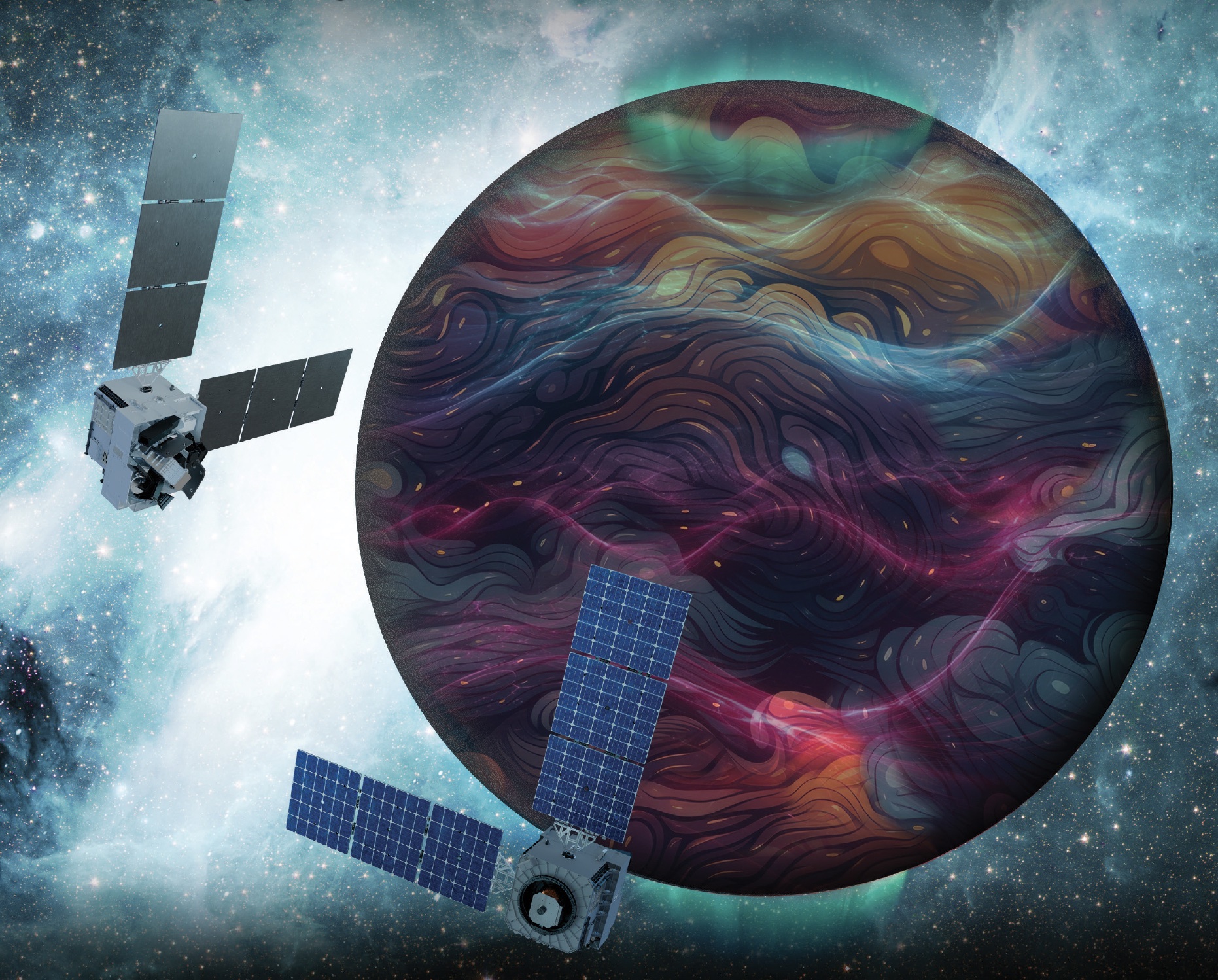
Artist’s rendition of the DAPHNE (Dynamic Atmosphere-Ionosphere Explorer) mission concept.
Artist’s rendition of the DAPHNE (Dynamic Atmosphere-Ionosphere Explorer) mission concept. The coloring represents auroras and atmospheric waves in Earth’s atmosphere.
Credit: Laboratory for Atmospheric and Space Physics/Mary Tostanoski

NASA selected a mission concept to research how space weather and dynamics within Earth’s atmosphere influence the space environment and help improve prediction capabilities for impacts on crucial technology, such as GPS and low Earth orbit satellites, as well as astronauts in space.

The DAPHNE (Dynamic Atmosphere-Ionosphere Explorer) mission will enter Phase B of development, which includes planning and design for flight and mission operations. It will use identical twin satellites to study how changes in Earth’s lower atmosphere influence our planet’s upper atmosphere, where space weather is manifested.

“NASA is advancing the United States’ leadership as a space weather-ready nation, and by providing new insights into Earth’s atmosphere we can better predict and prepare for impacts in our daily lives on Earth and in space,” said Nicky Fox, associate administrator, Science Mission Directorate, NASA Headquarters in Washington. “As NASA sends astronauts beyond Earth’s magnetic protection to the Moon, Mars, and beyond, DAPHNE will join the NASA science fleet strategically located across the solar system to provide data that will help mission planners predict and mitigate the effects of space weather for the benefit of all.”

The DAPHNE mission’s low-risk high-return concept will provide coordinated, multi-point measurements of neutral winds, temperature, and composition in the thermosphere. The ionosphere and thermosphere regions are where Earth’s neutral atmosphere transitions into the ionized plasma of space. In this thin shell that surrounds the planet, the atmosphere is in constant motion, shaped by the influence of solar activity and changes in the lower atmosphere and in near-Earth space.

Fundamental observations and physical insights from the DAPHNE mission will incorporate lower-atmospheric energy data to advance space weather predictive capabilities. The mission is led by Aimee Merkel from the Laboratory for Atmospheric and Space Physics at the University of Colorado, Boulder.

The mission will be subject to a confirmation review in 2027, which will assess the progress of the mission and the availability of funds. If confirmed, the total estimated cost of the mission, excluding launch, will not exceed $250 million in fiscal year 2023 dollars, with a mission launch date of no earlier than 2029.

The DAPHNE mission was proposed as a concept study in response to the DYNAMIC (Dynamical Neutral Atmosphere-Ionosphere Coupling) mission announcement of opportunity. Funding and management oversight for this mission is provided by the Solar Terrestrial Probes program at NASA’s Goddard Space Flight Center in Greenbelt, Maryland.

For more information on NASA’s heliophysics missions, visit:

https://science.nasa.gov/heliophysics

-end-

Abbey Interrante / Karen Fox
Headquarters, Washington
202-358-1600
abbey.a.interrante@nasa.gov / karen.c.fox@nasa.gov

Share

Details

Last Updated
Jun 18, 2026

The post NASA Mission to Study Space Weather Impacts of Earth’s Atmosphere appeared first on NASA Science.

NASA Mission to Study Space Weather Impacts of Earth’s Atmosphere

18 June 2026 at 22:33
Artist’s rendition of the DAPHNE (Dynamic Atmosphere-Ionosphere Explorer) mission concept.
Artist’s rendition of the DAPHNE (Dynamic Atmosphere-Ionosphere Explorer) mission concept. The coloring represents auroras and atmospheric waves in Earth’s atmosphere.
Credit: Laboratory for Atmospheric and Space Physics/Mary Tostanoski

NASA selected a mission concept to research how space weather and dynamics within Earth’s atmosphere influence the space environment and help improve prediction capabilities for impacts on crucial technology, such as GPS and low Earth orbit satellites, as well as astronauts in space.

The DAPHNE (Dynamic Atmosphere-Ionosphere Explorer) mission will enter Phase B of development, which includes planning and design for flight and mission operations. It will use identical twin satellites to study how changes in Earth’s lower atmosphere influence our planet’s upper atmosphere, where space weather is manifested.

“NASA is advancing the United States’ leadership as a space weather-ready nation, and by providing new insights into Earth’s atmosphere we can better predict and prepare for impacts in our daily lives on Earth and in space,” said Nicky Fox, associate administrator, Science Mission Directorate, NASA Headquarters in Washington. “As NASA sends astronauts beyond Earth’s magnetic protection to the Moon, Mars, and beyond, DAPHNE will join the NASA science fleet strategically located across the solar system to provide data that will help mission planners predict and mitigate the effects of space weather for the benefit of all.”

The DAPHNE mission’s low-risk high-return concept will provide coordinated, multi-point measurements of neutral winds, temperature, and composition in the thermosphere. The ionosphere and thermosphere regions are where Earth’s neutral atmosphere transitions into the ionized plasma of space. In this thin shell that surrounds the planet, the atmosphere is in constant motion, shaped by the influence of solar activity and changes in the lower atmosphere and in near-Earth space.

Fundamental observations and physical insights from the DAPHNE mission will incorporate lower-atmospheric energy data to advance space weather predictive capabilities. The mission is led by Aimee Merkel from the Laboratory for Atmospheric and Space Physics at the University of Colorado, Boulder.

The mission will be subject to a confirmation review in 2027, which will assess the progress of the mission and the availability of funds. If confirmed, the total estimated cost of the mission, excluding launch, will not exceed $250 million in fiscal year 2023 dollars, with a mission launch date of no earlier than 2029.

The DAPHNE mission was proposed as a concept study in response to the DYNAMIC (Dynamical Neutral Atmosphere-Ionosphere Coupling) mission announcement of opportunity. Funding and management oversight for this mission is provided by the Solar Terrestrial Probes program at NASA’s Goddard Space Flight Center in Greenbelt, Maryland.

For more information on NASA’s heliophysics missions, visit:

https://science.nasa.gov/heliophysics

-end-

Abbey Interrante / Karen Fox
Headquarters, Washington
202-358-1600
abbey.a.interrante@nasa.gov / karen.c.fox@nasa.gov

Share

Details

Last Updated
Jun 18, 2026

Hidden Solar Storms May Be Lighting Japan’s Skies With Massive Red Auroras

9 June 2026 at 14:14
Low Latitude AuroraUnusually tall red auroras over Japan may be revealing that some solar storms are stronger than scientists realize. A study published in the Journal of Space Weather and Space Climate reports that red auroras observed over Japan extended to altitudes of roughly 500-800 kilometers above Earth. The discovery was made by researchers from Hokkaido University [...]
❌