Latin squares are arrangements of symbols in a grid in which every symbol appears exactly once in each row and column. These symbol arrangements, which were first studied more than three centuries ago, are now widely used to optimize experimental designs and develop secure cryptographic systems, puzzles or other complex combinatorial structures.
At the quantum scale, tiny particles behave in bizarre ways. One reason for this is the uncertainty principle, which says that the more you know about where a quantum particle is, the less you can know about how fast it’s moving, and vice versa. Recently, this rule got a rare upgrade. The new uncertainty principle relates to fractals, shapes that remain equally complex no matter how much you…
In his 1927 paper, "A law of comparative judgment," the American psychologist L. L. Thurstone proposed that when people select one option among multiple alternatives, they are picking the one that has the highest value to them, even though they cannot assign a particular number to that choice.
In his 1927 paper, "A law of comparative judgment," the American psychologist L. L. Thurstone proposed that when people select one option among multiple alternatives, they are picking the one that has the highest value to them, even though they cannot assign a particular number to that choice.
A river has my heart. It’s not the austere, black Thames winding through London, where I was born, but a lazy green one 5,000 miles away, where I spent my adolescence: the Blanco River in Texas. My maternal ancestors have dipped into its waters for generations, as I have on countless summer days. The Blanco is a tributary of the San Marcos, which flows into the Guadalupe, and on into the Gulf of…
A little over a week ago, artificial intelligence company OpenAI announced 10 advances in mathematics and computer science made with its as-yet-unreleased model Astra. The discoveries cover a wide range of mathematical fields, including geometry, cryptography and coding theory.
Mathematics shows that every electoral system must compromise among proportionality, local representation, and parliament size. Denmark’s 2022 national election came down to a single seat, even though its proportional voting system was designed to make party representation closely match the vote. That outcome points to a deeper mathematical problem: no electoral system can always preserve [...]
As consumers, we are constantly making choices about things like what to eat at a restaurant, what clothing to buy at a store and the type of car we'd like to purchase, and so much more. Savvy producers of such goods look to economists to help estimate what products people want and how demand might shift when factors like price and availability change.
Physicists have built a crystal out of an "einstein" tile — an elusive shape mathematicians spent years searching for — and found that it bends light in a way no ordinary crystal can.
In the new study, published July 29 in the journal Nature Communications, researchers arranged this never-repeating tile shape into a pattern of nanoscale holes. This structure, known as a photonic crystal, is designed to control the way light moves through it. When the team shined a laser at it, the crystal produced a swirling, pinwheel-shaped scattering pattern that responded differently depending on which direction the incoming light was spinning.
The tile solves what mathematicians call the "einstein problem," a decades-old puzzle asking whether a single shape could cover a flat surface endlessly without ever repeating its pattern. (The name is a pun on "ein stein," German for "one stone," not a reference to Albert Einstein).
In the 1970s, mathematician Roger Penrose showed that two different shapes, used together like floor tiles, could cover a surface without the pattern ever repeating. Then, in 2023, geometry enthusiast David Smith and collaborators finally found one: a 13-sided shape that they nicknamed the "Smith hat"
Yuto Moritake, an experimental physicist at the University of Tokyo, first came across the hat tile in a popular science book in 2024. Moritake specializes in photonic crystals — materials patterned with repeating structures (often much thinner than a human hair) that bend and steer light for uses like lasers and optical sensors. Almost all photonic crystals rely on patterns that repeat in a regular grid. Moritake wondered what would happen if he swapped that repetition for the hat tile's never-repeating arrangement.
"I decided to include it in our photonic crystal structure," Moritake told Live Science, describing it as the starting point for the project.
To build the structure, Moritake and his colleagues used two precision manufacturing techniques, called electron beam lithography and etching, to punch hundreds of thousands of tiny holes — each just 100 nanometers in radius, or roughly 500 times thinner than a human hair — into a thin film of silicon nitride. This ceramic material is commonly used in computer chips. The holes were arranged according to the hat tile's pattern, covering a chip roughly half a millimeter across — about the width of a pencil tip.
When the team shined a laser at the finished chip, the light scattered, or diffracted, into a pinwheel-shaped pattern that appeared on a screen. Moritake first photographed the colorful pattern using his iPhone's long-exposure mode. The setting captured faint light over several seconds. Then, he switched to specialized cameras for more precise measurements.
The pattern was made up of well-defined bright spots, called Bragg peaks, that stayed in the same positions no matter where on the chip the laser hit. That consistency confirmed that the structure had the kind of long-range, predictable order found in a quasicrystal — a class of material whose atoms (or, in this case, holes) follow an orderly pattern that never repeats, unlike the repeating grids found in ordinary crystals such as table salt or diamonds.
Because the hat tile itself has no mirror symmetry — meaning it doesn't look the same as its own reflection, similar to how a left hand differs from a right hand — the scattering pattern it produced was also asymmetrical in this way. Scientists call this property chirality.
That chirality led to the study's biggest surprise. Light can be circularly polarized, meaning it spins either clockwise or counterclockwise as it travels, like a corkscrew. When Moritake tested the structure with both types of spinning light, he found a subtle difference in how each direction scattered off the crystal. Ordinary quasicrystals, which do have mirror symmetry, cannot produce this kind of effect.
"This structure can have some kind of circular polarization dependence," Moritake said, adding that the effect — made only possible by the tile’s asymmetry — was not something he initially expected to find .
Now, Moritake wants to apply this never-repeating pattern to control light traveling inside a photonic chip, rather than light that simply bounces off its surface. This could lead to future uses in optical communications and optical computing — technologies that use light instead of electricity to transmit or process information, Moritake said.
Researchers have designed a material that can "program" the way it releases heat, paving the way for more efficient energy systems and, potentially, devices that store information using heat instead of electricity.
The design, described in a June 25 study in the journal Laser & Photonics Reviews, sidesteps a nearly 160-year-old rule of physics linking how materials absorb and emit heat. Under ordinary conditions, a material that's good at absorbing heat from one direction is equally good at emitting heat in that direction. This rule of reciprocity, first described by physicist Gustav Kirchhoff in the 19th century, has limited engineers' ability to control incoming heat independently from and outgoing heat.
In the new study, the researchers designed a theoretical device that could direct heat radiation in different directions and remember that setting even after the power was switched off.
The new device pairs two materials that don't normally work together. Using a magnetic field, the team broke the natural symmetry in a layer of indium arsenide — a material that absorbs and emits infrared light — so that radiation traveling in one direction behaves differently than radiation traveling the other way.
On top of that layer sits a grating made of germanium-antimony-tellurium (GST) — a phase-changing substance that can switch between two distinct physical structures and stay in whichever structure it's set to until it's deliberately switched again. Once the GST is set into position, it locks the directional difference of radiation in place and holds it there without needing continuous power, which is what lets the device's heat-directing behavior be "programmed."
"I was impressed by the elegant combination of magneto-optical nonreciprocity with a nonvolatile phase-change material," Juejun Hu, a professor of materials science and engineering at MIT who wasn't involved in the study, told Live Science in an email.
That's significant because earlier attempts at this kind of directional control typically worked only at steep angles, which made them impractical. It's "particularly noteworthy" that this device functions when radiation arrives just 3 degrees off an otherwise-straight line, making it far easier to fit into real-world optical systems, Hu said.
The researchers compared their design to computer memory, since it holds onto its programmed state after the power is cut. However, the device stores a material state rather than heat itself, Hu told Live Science. GST simply keeps its amorphous or crystalline structure without power, which preserves the programmed response.
For now, the device exists only on paper; it hasn't been built or tested. Still, Hu thinks it's realistic, since it relies on well-established materials and manufacturing methods. However, the GST layer is thick enough that switching it back and forth repeatedly would be difficult, though other materials could fix this problem. Once that hurdle is surpassed, Hu expects the first real-world use to be infrared sensing, where compact, direction-selective heat absorption is most directly useful.
On May 20, 2026, OpenAI made an announcement that shook the mathematical world. An internal AI model — one not available to the public — had come up with a counterexample to the “unit distance” problem, a conjecture made in 1946 by Paul Erdős, the prolific, itinerant Hungarian mathematician. Erdős posed thousands of questions, but this one was special: It was both simple to explain and…
An AI-assisted counterexample disproves the Jacobian conjecture above two dimensions while leaving its original two-dimensional form open. A formula short enough to fit inside a single post on X has sent a surge of excitement through the mathematical community, just as millions of people were settling down after the FIFA World Cup Final. Levent Alpöge, [...]
Mathematicians have shown that completely fair elections are—in a sense—impossible. No electoral system can guarantee both that local votes translate directly into local seats and that total seat distribution matches overall vote shares—not without an indefinitely growing parliament.
Richard Feynman was a serious physicist who loved to answer unserious questions. Can math tell you how to order the optimal lunch? Can a human track scents like a bloodhound can by smelling his own footprints? Now, researchers have picked up one of Feynman's most curious unanswered questions by looking at the physics of "silly" sprinklers.
A typical lawn sprinkler with an S-shaped nozzle spins in a given direction as it spews water from its two openings. But if you throw that sprinkler into a swimming pool and hook it up to a vacuum so it sucks water in instead of spraying it out, which way will it spin — the same direction as before, or the opposite?
Feynman posed that question as a Princeton graduate student in the 1940s. According to Feynman's telling, he rigged a glass sprinkler in his university's lab. It gave a brief "tremor," then barely moved even as he raised the pressure. He repeated the process until the glass shattered, leaving the answer ambiguous. Since then, decades of follow-up experiments have turned up every possible answer — the sprinkler spinning one way, spinning the other way, jittering back and forth, or not moving at all — depending on how carefully the tests were built.
In 2024, a team at New York University led by applied mathematician and experimental physicist Leif Ristroph took a first crack at the question, finding that the reverse sprinkler rotates opposite to a forward sprinkler. But that explanation was tested only on ordinary S-shaped sprinklers, and it hadn't yet been pitted directly against two other leading theories.
One, which traces back to Austrian physicist Ernst Mach, holds that the total angular momentum of the swirling water inside the sprinkler's arms must be balanced by an opposite spin of the sprinkler itself. The other, associated with Feynman himself, focuses on pressure and suction effects right at the outer nozzles.
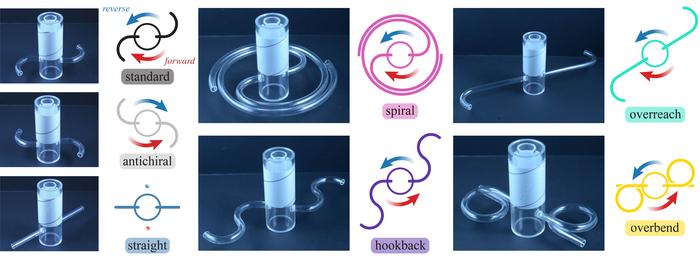
So Ristroph's team asked, what if the sprinkler weren't shaped like a sprinkler at all? What if its arms spiraled, bent the wrong way or curled back on themselves?
In a new study published July 13 in the journal PNASs, the researchers built seven deliberately "silly" sprinklers with unusual arm geometries to pit the leading theories against each other. That includes one sprinkler with arms that spiraled several times to maximize the water's angular momentum, and another with a counter-bend at the nozzle.
The sprinkler designs studied, with the observed rotation direction in the forward (red arrow) and reverse (blue) modes. (Image credit: NYU's Applied Mathematics Laboratory)
In the process, they tore down both ideas. If Mach were right, the spiral design should have spun dramatically differently. If Feynman were right, reversing the nozzle bend should have flipped the sprinkler's direction. Neither happened.
"We were forced to say, 'Feynman and followers, you guys are off,'" Ristroph told Live Science.
The spiral-armed sprinkler, meant to test Mach's theory, was just as unyielding. Even though the fluid inside carried substantially more angular momentum, "the solid barely cared," Ristroph said.
All three measurements across the seven designs pointed instead to the sprinkler's central hub, where the arms meet. There, incoming water collides and swirls, generating a flux of angular momentum inside the device that the solid structure pushes back against. The finding suggests that the reverse sprinkler is not much more than an inside-out version of a forward sprinkler governed by the same physics playing out at the opposite ends of the arms.
Ristroph emphasized that this result was made possible because of Jesse Smith, who just completed his physics doctorate at NYU while working on the project, along with a small team of Ristroph’s own students, and Ristroph's longtime collaborator Brennan Sprinkle, a computational fluid dynamics expert at the Colorado School of Mines whose surname is a coincidence.
Now, the team is building computer simulations to test whether the momentum-flux model holds up beyond the flow conditions already studied, and they hope to eventually derive it from fundamental fluid dynamics equations.
Ristroph said this "silly" problem does have real-world applications: Understanding how curved channels convert fluid flow into rotational force could inform the design of turbines and other devices that harvest energy from wind and water currents.
"If we can do something that would help with engineers designing devices to better make use of all the huge amounts of wind and water energy we have all around us," he said, "that would be, of course, a fantastic thing."
Beyond familiar particles such as electrons and protons, scientists have discovered a zoo of "quasiparticles" with exotic names, such as magnons, angulons, dropletons and polaritons. But what are quasiparticles, exactly? And given the "quasi" in their name, are they considered real particles?
One way to understand quasiparticles is to explore what a particle is. The standard mental picture of a particle "is of a discrete object, like a ball," Douglas Natelson, a condensed matter physicist at Rice University in Houston, told Live Science. However, this classic image of particles changed with the advent of quantum physics, which revealed that the universe becomes fuzzy at its smallest levels. For example, in 1924, French physicist Louis de Broglie showed that particles such as electrons could also behave as waves — a discovery that earned him a Nobel Prize.
Modern physics suggests that particles are excitations in fields that permeate the entire universe, a bit like a ripple in a pond, Ross McKenzie, a theoretical condensed matter physicist and professor emeritus at the University of Queensland in Australia, told Live Science. Each type of particle has its own corresponding field. For instance, photons of light are ripples of the electromagnetic field, McKenzie noted.
The quantum nature of particles means they can not only fly through an empty vacuum but also ripple through matter. For instance, photons can zip through transparent and translucent materials, and electrons can flow inside wires.
If you can picture a standard particle, such as an electron, as a ripple traveling within a material, you can also envision other kinds of excitations within matter. These other types of ripples are quasiparticles.
For example, think of "the wave" done at a sporting event. "You can watch it propagate around a football stadium; it has a location and a speed," Natelson said. "It only exists within the stadium, though, and it's made up of the collective response of all the interacting fans."
In much the same way, "quasiparticles can only exist within some medium or material, because they are built up from the response of that material's constituents or building blocks," Natelson said; in contrast, particles such as electrons and protons "can exist in free space."
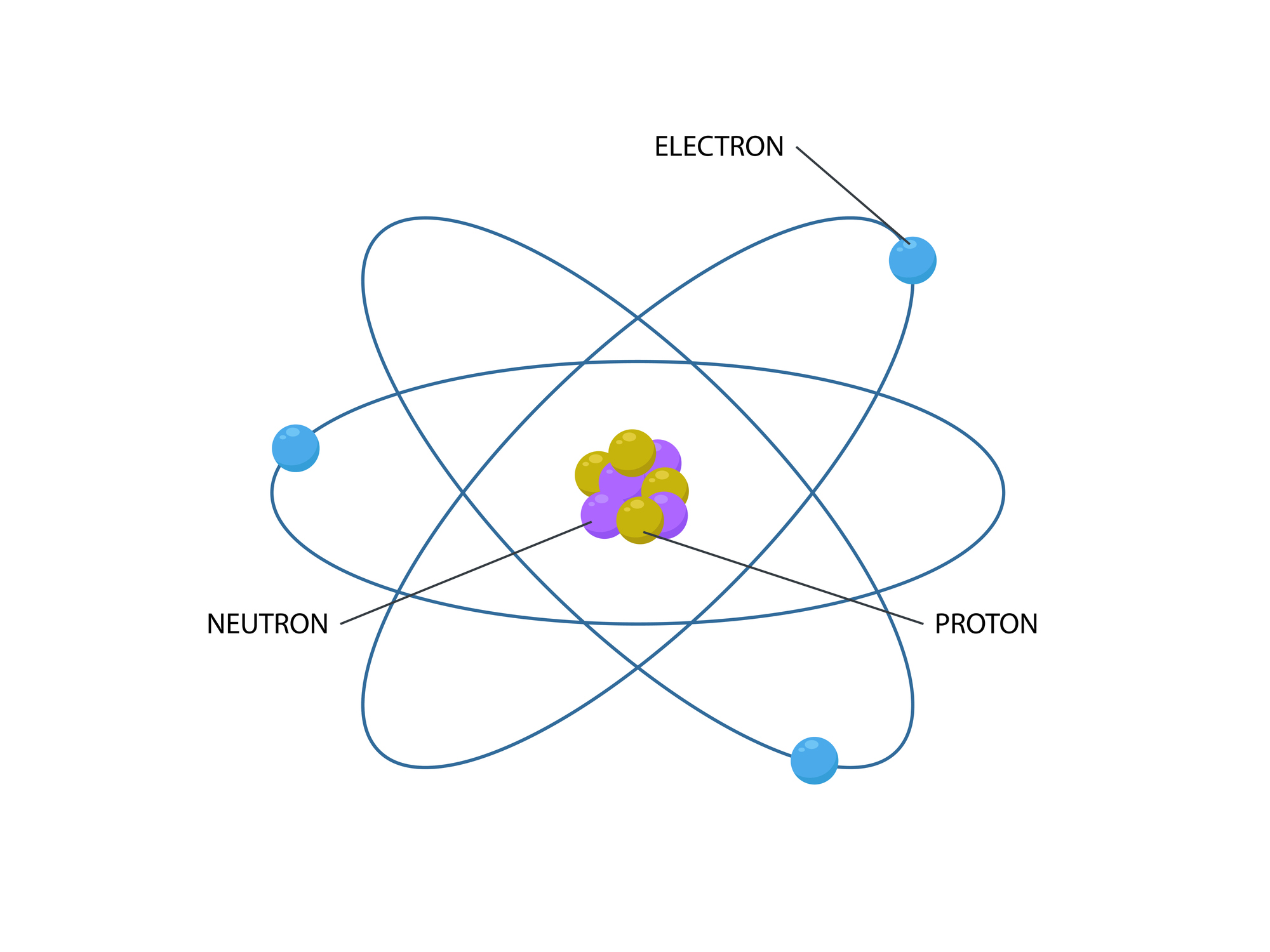
Electrons have a negative charge and orbit around the nucleus of an atom. (Image credit: agung fatria viaGetty Images)
In other words, quasiparticles can't exist in a vacuum and they can't exist on their own. They're reliant on particles acting together and being in a material where they can emerge, just as a wave carried out in a stadium can only exist when there is a group of people there who can perform it.
A philosophical question concerning quasiparticles is whether they are real, McKenzie noted. After all, "quasi" in Latin means "almost."
"Fundamental particles can exist in isolation in a vacuum, and quasiparticles need many interacting particles to exist," McKenzie said. "Still, I would say quasiparticles are, for all intents and purposes, just as real as particles, in how you can detect them and manipulate them."
A zoo of quasiparticles
The concept of quasiparticles originated with theoretical physicist Lev Landau in the 1950s, McKenzie said, and the idea ultimately helped Landau win the Nobel Prize in physics in 1962. Scientists have now proposed the existence of dozens of quasiparticle types, including the following:
The phonon, which is a quasiparticle of sound — it is the smallest packet of vibrational energy that makes up sound in matter, McKenzie said.
The electron hole, often simply called a hole, is the positively charged vacancy left behind once an electron has left its original place, McKenzie noted.
The electron quasiparticle, which essentially consists of an electron and its interactions with its surrounding environment. This combined package means the electron quasiparticle requires more force to move, so it effectively has more mass than a regular electron, McKenzie explained.
The exciton, a quasiparticle made of an electron and a hole orbiting each other.
The anyon, a kind of quasiparticle so far only seen in two-dimensional systems, which may carry only a fraction of an electric charge.
"How many kinds of quasiparticles are there?" McKenzie said. "Just like there are an infinite number of possible states of matter, I would say that, in principle, there are an infinite number of types of quasiparticles."
Scientists describe activity in material as quasiparticles "because it simplifies everything dramatically," McKenzie said. In the same vein, Natelson said that "very often the math behind physical phenomena in solids is described well by quasiparticles."
Quasiparticles are not simply useful for bookkeeping. For instance, researchers typically describe the behavior of electricity in electronic devices in forms of quasiparticles such as holes and excitons, Natelson said.
All in all, the answer to the question of whether quasiparticles are real is a matter of interpretation. If the question is whether or not a quasiparticle is an elementary particle such as an electron, the answer is no — they cannot exist on their own, and they depend on the materials in which they manifest.
However, if the question is whether or not quasiparticles are real phenomena, the answer is yes — they are things that scientists can measure that can behave like particles and effectively have many of the same properties that other particles do.
A Cambridge professor has transcribed a handwritten story that the famous mathematician wrote in the year before his death, presenting a different side of him.
Dr. Tsimerman won one of four Fields Medals, an award for top mathematicians under 40, for his work on the André-Oort conjecture, but is now changing his focus to artificial intelligence.
In May 2026, OpenAI released a new math result that sent shock waves throughout the world of mathematical research. A major unsolved problem called the "unit distance conjecture" had just been resolved by generative AI.
The 2026 Fields Medal, one of the world’s most prestigious mathematics prizes, has just been awarded to four pioneering young researchers — including mathematician Hong Wang, the third woman ever to win the prize in the 90 years since the award was established.
The Fields Medal is an award presented every four years to mathematicians under the age of 40 for their outstanding discoveries. The International Mathematical Unionannounced Thursday (July 23) that Wang, a professor at New York University, is among the four recipients of the 2026 medal for her work on a decades-old conjecture about how needles move in 3D spaces. .
The 2026 Fields Medal winners also include Yu Deng of the University of Chicago, who was recognized for connecting microscopic and macroscopic descriptions of gases; John Pardon of Stony Brook University, whose work solved major problems in topology and geometry; and Jacob Tsimerman of the University of Toronto, who developed powerful new techniques in algebraic geometry that have advanced progress on longstanding mathematical puzzles.
Wang joins an exceptionally small group of women to receive the Fields Medal. Iranian mathematician Maryam Mirzakhani was the first, in 2014, followed by Ukrainian mathematician Maryna Viazovska in 2022. No woman received the award at all in the nearly 80 years before Mirzakhani's win.
The four 2026 Fields Medal honorees. From left to right: Yu Deng, John Pardon, Jacob Tsimerman, and Hong Wang. (Image credit: ERIN BLEWETT via Getty Images)
Wang was recognized for her work on the Kakeya conjecture, a problem that asks how little space is needed to rotate a needle so that it points in every possible direction in three dimensions. Mathematicians had chased a solution for roughly 50 years.
Working with collaborator Joshua Zahl, Wang showed that if you track every direction the needle could point as a bundle of thin tubes, there's a precise trade-off between how thin those tubes are and how much total space they must occupy. Solving the puzzle required tools from harmonic analysis, a field that studies how complex shapes and signals can be broken down into simpler pieces.
The proof wasn't a triumphant moment for Wang, at least not right away. She and Zahl spent months checking their 127-page proof before making it public — and even then, Wang worried that their argument might be unclear. The paper nonetheless earned comparisons to a "once-in-a-century" result and set off a string of honors culminating in the Fields Medal, according to Quanta Magazine.
The 2026 Fields Medals were presented during the International Congress of Mathematicians in Philadelphia. The first Fields Medal was awarded in 1936. So far, 65 men have received the award.

 Login