❌

Normal view

Peacock raises prices by 18 percent after becoming profitable

18 August 2026 at 17:42

For the fourth time in four years, Peacock has raised its prices.

The Select plan, which has ads and doesn’t include sports, movies, or Peacock originals, went from $8/month to $9/month. The monthly fee for the standard ad plan (Premium) went from $11/month to $13/month, and the ad-free plan (Premium Plus) went from $17/month to $20/month. Annual pricing, as previously, offers 12 months for the price of 10 months.

Peacock’s previous price hike was in July 2025, when the middle tier (with ads) went from $8/month to $11/month, and the ad-free plan increased from $14 to $17. Peacock also raised prices in July 2024 and August 2023. NBCUniversal launched the service in 2020.

Read full article

Comments

© Jakub Porzycki/NurPhoto via Getty Images

Fairphone's latest repairable phone is finally available in the US for $650

18 August 2026 at 17:05

As smartphone designs have become more refined, they've also become less repairable. Fairphone bucks that trend, offering devices that can be fully disassembled and serviced using a single screwdriver. But its devices were a pain to get in the US until now.

The Dutch company has launched the Fairphone Gen 6+ in the US, offering not only the phone but a full line of accessories and replacement parts so you can keep your phone running for years. And yes, the battery is removable.

Don't expect the Fairphone Gen 6+ to blow you away in the spec department—it focuses on being repairable and paying workers a fair wage. Half of the phone is made from recycled materials, and it has a microSD card slot. How retro.

Read full article

Comments

© Fairphone

Tokenization Of H2O: Is O2 Next?

Water is the foundation of life itself. The UN says we are entering an age of “Global Water Bankruptcy” and therefore we should be subjected to “bankruptcy management,” where “conservators” are appointed by the court to manage the sale of remaining assets. Hence, tokenization enters stage right: sell the scarcity to the world in a price auction. The whole scheme is indisputably evil! ⁃ Patrick Wood, Editor.

The Elites are Claiming the World’s Water Supply and Plan to Trade It on the Stock Market.

Yep, you heard me right. This is not a joke or exaggeration. The facts are out there for all to see. I wrote about the tokenization of nature in my article “From Blockchain to Ball and Chain: Are We Being Borged?” [1] This article will deal primarily with the tokenization of the world’s water supply.

Tokenization: Turning Life Itself into a Tradeable Chip

For those who do not understand tokenization, here is a short and simple explanation: Tokenization means turning something real, like a share of water rights, a measured volume of water from a river or aquifer, or even credits for water that was “saved” or recycled, into a digital token (a unique digital certificate) that lives on a blockchain.

A blockchain is simply a shared digital notebook that many computers keep identical copies of at the same time, so the records of who owns what cannot be secretly changed by any one person or company.

That token can then be bought, sold, or traded on markets the same way people trade stocks or other assets. Instead of water simply belonging to the land, the local community, or the people who rely on it, it becomes a financial product that large investors, corporations, and institutions can own fractions of and exchange for profit. The right to use, claim, offset, or trade that water becomes the commodity.

Offset means making up for the water you use by helping save or restore the same amount somewhere else. A farmer switches to drip irrigation, a project restores a wetland, or a company reuses treated wastewater. That saved or restored water is measured and turned into credit. You buy or claim the credit. On paper your water use is balanced.

How Dare They Profit from Stealing Our Water

How dare they make money off this corrupt plan to steal, control, measure and meter the world’s water supply. Yes, I sound like Greta. The irony is thick: the same girl who made “How dare you” famous has been thoroughly programmed to cheer for Agenda 2030 and the very control grid she should be screaming against. Since she refuses to use her catchphrase where it actually belongs, then I will.

Water is the foundation of life itself. Every human, every animal, every plant depends on it. Yet the same elites who lecture the public about scarcity and climate are building the machinery to turn every last drop into a tradable asset they can profit from while ordinary people face rationing and surveillance.

This is exactly the process already described and promoted in official reports. Goldman Sachs itself published “Securing and Financing the Future of Water” in 2026, openly stating that tokenization can turn water rights into traceable tokens that track use across markets and deliver credits for companies that conserve or recycle water through connections to flow meters. Read it yourself: https://www.goldmansachs.com/insights/articles/securing-and-financing-the-future-of-water

The United Nations has declared the world has entered an era of “Global Water Bankruptcy.” Their report argues that the old system of local rights is finished and that new enforceable limits, transparent accounting, and centralized management are required. See the official collection: https://unu.edu/inweh/collection/global-water-bankruptcy

The Mapping Machines Are Already Flying Over Your Head

Look at how they are already doing it. Across the United States, helicopters now fly low over farms and aquifers towing giant electromagnetic loops that map the groundwater beneath our feet like an MRI of the earth. California’s Department of Water Resources runs statewide Airborne Electromagnetic Surveys for exactly this purpose. Click here to read how the water mapping technology works: https://water.ca.gov/programs/sgma/aem

hese surveys create detailed maps of every major water source so that usage can later be tracked and limited.

The All-Seeing Eye of Oracle Returns: Now It Watches Every Drop You Use

Oracle Utilities already processes data from more than 100 million meters worldwide with AI systems that detect irrigation, leaks, and individual household use in real time. Their customer platform is designed for exactly this level of precise control: https://www.oracle.com/utilities/customer-platform/

Larry Ellison didn’t just dream of a panopticon. He said the quiet part out loud: “Citizens will be on their best behavior because we are constantly recording and reporting everything that’s going on.” That wasn’t a warning. That was a sales pitch from the man who still owns roughly 40% of Oracle, the company now quietly embedding itself into the pipes that deliver the most basic resource on Earth: water.

Once you own the real-time ledger of every drop that enters every home, every farm, every factory, you don’t need jackboots. You just need a dashboard. Throttle the water, and compliance follows. The same technocratic elite that spent decades consolidating data, finance, and surveillance is now moving on the last ungoverned commons, water itself, under the soothing branding of “customer platforms” and “smart utilities.”

And Ellison isn’t some lone eccentric billionaire operating in a vacuum. He’s a Trump donor who poured roughly $45 million into supporting the 2024 campaign and has since enjoyed the kind of access that turns political proximity into regulatory profit. The same circle that lectures about freedom while building the tools to score, monitor, and ration everyday life now has one of its most unapologetic surveillance advocates sitting in their inner circle.

The water meters are just the latest sensor in a system that already knows when you open the fridge, when and where you drive, when you yawn, drink, text or speak and soon, how long you shower and how many times you flush your toilet.

This is not innovation. This is the elite’s operating system for managed scarcity and behavioral compliance, dressed up as progress and sold by a man who openly celebrated the idea that constant recording would keep the public “on their best behavior.” Oracle isn’t managing utilities. It’s helping construct the choke points. What’s next Larry? Are you going to regulate and tokenize oxygen?

The infrastructure for control is already being paired with the financial machinery. Chainlink, a decentralized oracle network that feeds real-world data such as meter readings and conservation verification into blockchain systems, has published detailed guides on digitizing water rights and conservation credits into tokens so companies can buy offsets just like carbon credits: https://chain.link/article/tokenized-water-rights-credits

In Dubai, the DMCC (Dubai Multi Commodities Centre), a government-backed free zone and major international trading hub, has signed agreements to launch the world’s first digital token backed by verified freshwater reserves, positioning water itself as a tradable commodity on global markets: https://mediaoffice.ae/en/news/2025/june/17-06/dmcc-signs-strategic-mou

They Already Seized the Food and Are Playing God with the Weather

The elites have been systematically taking control of the world’s food supply for years. Bill Gates, through Cascade Investment, has become the largest private owner of U.S. farmland, holding hundreds of thousands of acres across nearly twenty states. At the same time, major asset managers like BlackRock hold massive stakes in the dominant agribusiness corporations that control seeds, fertilizers, processing, and distribution.

Simultaneously, cloud seeding programs and solar geoengineering research, backed by Silicon Valley money and governments, are rapidly expanding. These efforts claim to manage rainfall and cool the planet, yet they place the power to influence weather patterns in the hands of the very institutions already pushing centralized control over water and food.

In other words, they are running the classic Hegelian dialectic to consolidate power:

  1. Create the droughts through weather geoengineering/modification
  2. Declare an emergency and frighten the public.
  3. Arrive with the “solution,” water tokenization that will supposedly save the planet but in reality just make them richer.

The pattern is unmistakable. Connect the dots. First, they buy the land that grows the food. Then they experiment with altering the weather that waters the crops. Now they are mapping, metering, and tokenizing the water itself so that every drop can be tracked, rationed, and sold.

This Is Not Theory. This Is the Takeover in Progress. Technocracy 101

They tell us water is too important to leave in local hands. They declare bankruptcy on systems that have sustained communities for generations. Then they create the digital and physical infrastructure to measure every use, enforce every limit, and profit from every token. The shared nature of water is being rewritten into a system of permission slips owned by the elite few who say that they, the experts, the financiers, the scientists, know best how to manage nature and humanity. It is all part and parcel of the plan of Technocracy Inc.

And make no mistake, this entire scheme sits squarely inside the United Nations Agenda 2030 and its Sustainable Development Goals. SDG 6 pretends to be about “clean water and sanitation for all,” yet the real machinery being built is the global accounting, metering, and financialization of every drop. The same institutions that wrote the goals now promote water “bankruptcy,” enforceable limits, transparent tracking, and market-based solutions that turn a basic necessity of life into a tradable asset class. What is sold to the public as sustainability and equity is in practice the transfer of control from communities and nations to the very financial and bureaucratic elites who drafted the blueprint. Agenda 2030 is the framework being used to justify seizing, measuring, and selling the world’s water under the banner of saving it.

This is the plan. It is already in motion. And the people pushing it expect the public to accept it as inevitable.

It is NOT inevitable.

Resistance is NOT futile.

Expose the plan. Shout if from the rooftops, news sites, podcasts and council meetings.

Don’t let the elites complete their takeover plan. They have the money but we have the numbers.

Read full story here…

Petlibro accused of “gaslighting” users over smart pet feeder outage

17 August 2026 at 19:43

Petlibro founder and CEO York Wu provided more information about an outage that left users unable to control their smart pet feeders through the companion app and, in some reported cases, left them with hungry pets.

Petlibro, a company owned by Shenzhen, China-headquartered firm Shenzhen Libro Technology Co., first acknowledged the outage on Tuesday at 5 am PT. At 7 pm PT on Wednesday, Petlibro said the outage was resolved. Notably, some people online reported different information at the time, and some claimed to still have problems as of August 13.

In a blog post on Saturday that included an apology and acknowledgement of the “frustration and concern” the outage caused, Wu confirmed that problems with Petlibro’s cloud server caused the outage:

Read full article

Comments

© Petlibro

How a 19th-century estate agent offered 3D property ‘walkthroughs’ before the dawn of the photography age

The Cosmoramic Room in P.T. Barnum’s American Museum, New York. Illustration from the museum’s official guidebook.

If you’re thinking about moving house or just feeling nosy about your neighbours, your first port of call may be an online property marketing site: Rightmove and Zoopla in the UK, Zillow in the US or Magic Bricks in India.

They offer 3D plans of their properties and a video walkthrough, sometimes with added interactive tools. It all seems very modern – yet it turns out, at least one pioneering London estate agent was offering its clients 3D visual walkthroughs long before the advent of commercial photography.

In the UK, estate agents came into being as a specialised profession in the mid-19th century, as rapid urbanisation and greater social and geographic mobility led to a dramatic increase in the demand for housing.

But in this pre-photography era, how did the Victorian era’s newly monied see what they could buy with their gains from trade or industry? One high-end London estate agent, Brooks & Green, came up with a novel answer.

Illustration of how the cosmorama worked.
How the cosmorama worked. From The Boy’s Own Book: A Complete Encyclopedia (1849)

In 1838, the year of Queen Victoria’s coronation, this Old Bond Street estate agent began advertising an early form of immersive visual technology called a “cosmorama”, to offer prospective buyers a virtual tour of the properties it was selling.

A cosmorama involved looking at paintings or artists’ prints through a large convex lens, which magnified the image and enhanced the perspectival depth, creating a basic 3D effect.

A blackened square frame between the lens and picture hid the edges – enhancing the viewer’s sense of looking at a large scene through an extended opening. Clever lighting effects further enhanced the depth and immersive effects.

To create this cosmoramic view, a skilled artist would have had to visit the estate to prepare the sketches. For 20 years, Brooks & Green promoted its “cosmoramic gallery” as a proto-version of a digital walkthrough. This was nearly 50 years before photography was widely used to advertise property.

Cutting of a Brooks & Green advert for its cosmorama device.
Brooks & Green advert for its cosmorama device. The Patriot newspaper, April 1842.

The estate agent advertised heavily in the London press. An 1842 advert claimed its office property gallery included “several hundred views of different estates”. Prospective buyers of one property were promised an “aerial perspective, the site and architectural elevation of a mansion, the local scenery and features of a park [and] ornamental grounds”.

The viewing experience of the cosmorama supposedly offered much more realism and detail than a written prospectus – without rich London buyers having to travel miles to inspect the property in question.

But this service was definitely not available to ordinary families. Only high-value mansions and estates were valuable enough to be visualised in this way. Entrance to the Brooks & Green gallery was supposedly free, but you needed an admission card – probably granted only to those who looked like they had suitably deep pockets.

Visual explanation of the cosmorama (November 1821). C. Blunt for La Belle Assemblée, nº155, vol. 24.

Exhibits around the world

For the first half of the 19th century, the cosmorama was one of the most common forms of visual show across Europe and the Americas. It was first revealed at a Paris exhibition in 1808 by the French showman Abbot Constant Gazzera. His success led to many more exhibitions throughout Europe during the 1820s and ‘30s.

In London, the Cosmorama Rooms opened in 1821 at 29 St James’s Street, moving to Regent Street in 1823. The gallery became one of the established London attractions for over 30 years. With Regent Street only a mile from Old Bond Street, it may have prompted an ambitious Brooks & Green employee to have the idea of using this innovation to market its property.

Also shown across Europe in pleasure gardens, popular science institutions, retail bazaars and fairgrounds, the cosmorama was successful because urbanisation and population growth had created a critical mass of middle-class audiences. It offered a new kind of immersive visual exhibition, reaching audiences who would never visit a fine-art gallery.

Cosmorama means “views of the world” in Greek. It was mainly used to display picturesque landscapes, renowned European sites and striking architectural interiors – such as the eruption of Mount Vesuvius, the canals of Venice or the interior of Saint Peter’s Basilica in Rome. The interest in this device reflected the public’s growing desire to be cultivated, and to learn about the wonders of the wider world.

Fascination with 3D worlds

But the cosmorama is just part of the story of immersive pictorial entertainment from the early 19th century. Other popular technologies included peepshows, panoramas and dioramas, all of which offered users a sense of virtual travel.

Panoramas were large circular paintings – the Imax cinema of the age – and dioramas were illusionistic spectacles created from 3D models. At the same time, itinerant exhibitors of peepshow boxes travelled the country’s fairgrounds displaying scenes of national events and sensational murders. Picturegoing had become part of everyday life.

I came across the Brooks & Green adverts for its cosmorama in my research for a historical project led by the Universidade Lusófona in Lisbon, which has mapped cosmorama exhibits across Europe and beyond. In all, Curiositas: Peeping Before Virtual Reality has catalogued more than 650 cosmoramas in Portugal, Spain and the UK.

Many more of these devices were exhibited in countries as far apart as North America, Brazil, Cuba and Australia. The famous US showman P.T. Barnum installed a cosmoramic gallery in his American Museum in New York.

The cosmorama was ultimately superseded by the stereoscope, which also created a 3D photographic experience by looking through lenses. Thus, the cosmorama was an early part of the story of our fascination with virtual worlds – of being taken outside and beyond ourselves, and immersed in another environment.

The Conversation

John Plunkett does not work for, consult, own shares in or receive funding from any company or organisation that would benefit from this article, and has disclosed no relevant affiliations beyond their academic appointment. He is the co-author of Popular Visual Shows 1800-1914: Picturegoing from Peep Shows to Film (Oxford University Press, 2025)

First test flight of largest all-electric aircraft used just $5 of electricity

14 August 2026 at 19:00

The first flight of the largest battery-electric aircraft to take to the skies lasted nearly half an hour while costing just $5 of electricity. That aviation feat comes at a time when jet fuel prices have skyrocketed because of the US war with Iran.

The test flight of Heart Aerospace’s X1 demonstrator aircraft took place at Plattsburgh International Airport in upstate New York on August 12. The X1 aircraft is comparable in size to a small regional airliner and can achieve a maximum takeoff weight exceeding 25,000 pounds with the help of four wing-mounted electric motors. The battery-electric propulsion system delivered more than one megawatt of power during the maiden flight.

All-electric aircraft can offer quieter and cleaner flight without the emissions that come from burning jet fuel. They may also prove more reliably cost-effective than conventional aircraft that come with jet fuel costs subject to geopolitical disruptions.

Read full article

Comments

© Heart Aerospace

Judge gives Google one week to fix "anticompetitive" app store download in Google Play

14 August 2026 at 16:46

Google began offering third-party app store downloads in the Play Store earlier this week, but US District Judge James Donato says the company isn't doing enough. After reviewing the process for accessing the first non-Google store, Donato ruled that Google has added unnecessary "anticompetitive friction," ordering the company to rectify the issues.

While Epic and Google are patching things up with a global partnership agreement, the two are still on opposite sides of the antitrust case in the US. Google lost the case in 2023, and the intervening years have been about determining how to implement remedies to address Google's anticompetitive behavior. One of the court's key elements is the requirement that Google include third-party app stores in the Play Store, giving users an easy way to get apps from non-Google sources. Aptoide Games became the first such app store recently.

However, Google worked hard to avoid this outcome, attempting to settle with Epic to keep third-party app stores out. When it was forced to admit the Aptoide store under the terms of the ruling, Google didn't exactly put up a banner welcoming third-party app stores. In fact, Judge Donato found in a Thursday hearing that Google's implementation was not good enough, according to The Verge.

Read full article

Comments

© Google

Samsung Galaxy Z Fold 8 Ultra review: The ultra foldable with an ultra price

14 August 2026 at 12:00

Samsung has largely defined the foldable phone category, but it's no longer alone in releasing flexible devices. Google, Motorola, and a raft of Chinese OEMs have their own take on this form factor. Is the new Galaxy Z Fold 8 Ultra really "ultra" enough to remain on top?

This phone doesn't have the wide frame of the new Z Fold 8, instead matching the approximate size and shape of the company’s last few tablet-style foldables. The Z Fold 8 Ultra is not a big leap, but it continues Samsung's pattern of iterative foldable improvements. At this point, there's very little left to improve. The compromises of going with a foldable over a regular flat phone have largely been erased with the Z Fold 8 Ultra. Well, except for the price.

Flatter and a little better

Foldables used to be real pocket-busters, almost like carrying two phones glued together. Samsung has successively shaved a few millimeters off every year, taking a leap last year with the Z Fold 7. The Z Fold 8 Ultra is even a bit slimmer than that phone, but the difference is basically imperceptible. It still has the same buttons in the same places, including a fingerprint sensor in the power button.

Read full article

Comments

© Ryan Whitwam

Ukrainian drones wipe out entire US tank brigade in live war game

13 August 2026 at 19:31

Ukrainian drone teams demolished a brigade of US Army tanks and armored vehicles during a live war game held this year—but the US soldiers were lucky enough to get “respawn” attempts while learning from the experience.

The semiannual military exercise, called Combined Resolve, gave the US military a firsthand taste of how modern drone warfare has evolved on the battlefields of Ukraine. The Ukrainian drone operators participating in the exercise were easily able to spot and destroy US armored vehicles by mimicking the actions of dropping bombs from above or moving close enough to simulate a kamikaze strike, according to US officials and a participant who spoke with The Wall Street Journal.

US armored vehicles were being destroyed so quickly that they were “respawned” and sent back into the simulated fray, a US official told The Wall Street Journal. The US troops who participated in the exercise—held in Germany from April 9 to May 10—were on rotational deployment from Fort Hood, Texas.

Read full article

Comments

© Sgt. Joseph Mcdonald | US Army

Pet owners say smart pet feeder outage led to furry ones going unfed

13 August 2026 at 18:53

Smart pet-feeder company Petlibro suffered an outage on Tuesday, giving users a harsh reminder of the risks of relying on smart devices.

Petlibro makes pet feeders that connect to Wi-Fi and, for setup with Petlibro’s mobile companion app, Bluetooth. Users can set the feeders to automatically dispense food at scheduled times, which is handy for pet care when the owner is out of the home.

In a statement to The Verge, Petlibro CEO York Wu said this week’s outage was “related to how the Petlibro app communicates with devices through its online servers.”

Read full article

Comments

© Petlibro

An astronomer on what it’s really like to stargaze for a living

metamorworks/Shutterstocl

Jodie Foster tearing up a dirt road, yelling stellar coordinates into a walkie-talkie à la the 1997 sci-fi film Contact. Control rooms alive with a cacophony of “enhance that signal”. Real-time discovery. That’s what I pictured when my PhD supervisor told me I’d be going observing at a telescope.

Cut to 2am on top of a mountain in La Palma last April, at an altitude that makes you forget you’re in the Canary Islands. It was utterly freezing, and I had dressed for the sunny archipelago in thin layers. I almost dropped my mug trying to close the telescope door against the wind.

Coffee and food waited two minutes away in the service building. In the darkness, the wind caught a loose scrap of fabric and scared the life out of me. I fell over within 30 seconds. Winds of 40km/h aren’t uncommon at the observatory; I was just entirely unprepared.

I sat on the road, mourning my dignity. And I looked up. For the first time in my life, I saw the Milky Way. It painted the sky, reminding me violently of my insignificance. Nothing in my life has ever compared to that. I allowed myself to bask in it for ten minutes. Then the work beckoned me: I needed coffee, and hadn’t told my colleague which star was next on the schedule.

How is an observing night prepared?

A night at a telescope begins in the afternoon. At around 4pm, my colleague, who was training me to use the telescope, and I drove up to the Nordic Optical Telescope. It’s a gorgeous piece of kit, with a diameter of 2.56 metres. It collects enough starlight for exquisitely precise measurements.

Every instrument and filter had to be carefully tested. On my side, this was a few lines of code. The telescope operator ensured everything worked properly and set up the telescope. While calibrations ran, I started scheduling the night’s observations.

Telescope time is limited, so having three nights at the helm meant I had to squeeze out every second I could. Hollywood did not prepare me for how many spreadsheets this involves. This sort of scheduling requires careful balancing of many factors. For example, observing stars close together on the night sky consecutively to avoid spending too much time repointing the telescope.

Once calibration and scheduling were complete, I watched the sun set. It was beautiful, but also a warning – working hours will soon begin. If you catch the right moment, you can see a small fleet of astronomers in cars headed to their respective telescopes.

The mountain came to life with domes opening, catching the first starlight of the night. There’s more than 20 telescopes in the observatory on the mountain, whose specialisms range from observing supernovae to exoplanets (any planet beyond our solar system).

The night itself

Around 8pm, the first light from a star – HD153557 in this case , a dwarf star around 59 light-years away – entered the telescope. This is always a bit special. The whir of the dome moving, the shutters opening, seeing the monitors show the first traces of data. I sipped my coffee, turned up the 80s hits, and was content in the knowledge that I’d still be in that chair in 12 hours.

This night started rather predictably. The weather was perfect, not a cloud in sight, and the telescope behaved beautifully. Before long we had a spreadsheet slowly getting filled in with completed observations. I knew the peace wouldn’t last. I’d done ten observing nights at two different telescopes by that point in my career, and not one of them without something disrupting my colour-coded plans. Typically, a cloud will move right in front of a star I’m trying to observe, or it’ll rain and that means we have to close the dome. But every few nights, there’s something a little more exciting.

An email just before midnight brought with it a Target of Opportunity alert. These are observations that need to be done immediately, a blink-and-you’ll-miss-it moment. This one was a gamma-ray burst. It’s one of the most violent events in the universe, over a trillion times brighter than our Sun. This was picked up by a space-based detector and emailed to us to request the observation.

Gamma-ray bursts aren’t in my area of expertise – I research stars like the Sun and their surrounding planets. Far less explosive. Between switching observing instruments, rotating the dome, checking calibrations, I was also digesting as much information as I could about what a gamma-ray burst is. This was probably the closest I’ll ever get to my Jodie Foster moment, and it was a rather anticlimactic, blurry image loading very slowly on a screen.

After the gamma-ray burst was observed, the control room became quiet again. Back to my spreadsheets and falling over trying to get coffee. To feeling slightly lonely but seeing another dome rotating under the moonlight when I stepped outside, and being reminded of the other tired astronomers all working beneath the same stars.

It was 8:30am when I finally got back to my room. Ready for a shower, and bed, and to wake up in five hours and do it all again.

The scientific end product

The reality is that scientific interpretation rarely happens in real time. The telescope measurements are first cleaned and calibrated by a computer programme, which turns them into usable spectra. I then apply my own analysis code to these spectra. For me, this comes much later, at my desk in Birmingham once my sleep schedule has recovered. These particular observations gave us stellar spectra: when a star’s light splits into a rainbow, imposed with patterns that reveal its temperature and chemical composition.

The most common observing nights involve balancing spreadsheets, a whole lot of coffee, and slowly surrendering to the delirium of sleep deprivation. Some of them have dramatic alerts. Some of them end up entirely clouded out and allow for an early bedtime.

There is no pivotal “enhance that signal” moment, but there is the quiet, consistent sense of joy that I’m cataloguing and understanding the stars that could one day be found to host another Earth. Hollywood didn’t prepare me for the scientific process. But it got the wonder spot on.

The Conversation

Alix Violet Freckelton receives funding from UKRI.

Twitch content has trained Amazon AI for years, but users can opt out now

12 August 2026 at 22:00

Twitch now lets users opt out of Amazon's use of content from their channels to train Amazon's "generative AI content models." The change, announced today, comes more than two years after a company executive confirmed that Amazon was using Twitch content for AI training.

In an updated support page, Twitch confirms that users must opt out if they don’t want their “streams, VODs, clips, stream chats, and pictures and text on your channel [to] be used in future training of a model developed by Amazon whose purpose is to generate or synthesize text, audio, images, or video.”

To opt out, users must go to the proper settings at www.twitch.tv/settings/security.

Read full article

Comments

© Omar Marques/SOPA Images/LightRocket via Getty Images

US boosts drone surveillance as flesh-eating screwworms spread in Texas

12 August 2026 at 20:40

Hundreds of US government drones have switched from border surveillance to a different surveillance mission this summer—looking for signs of screwworm infestations in wild animals and livestock herds.

The flesh-eating New World Screwworm is the parasitic larva that emerges from eggs laid by flies in the open wounds or body openings of warm-blooded animals and humans, with untreated cases potentially leading to severe injury or death. Since the first screwworm cases were detected in South Texas in June, the US Department of Agriculture and US Customs and Border Protection have been conducting “one of the most extensive animal-health surveillance operations in the country,” the USDA said on August 10 in social media posts on platforms like X and Facebook.

The effort involves at least 200 drones owned by the Department of Homeland Security, which includes the Customs and Border Protection (CBP) agency. But the actual number in use "varies depending on availability and need," a USDA spokesperson told Ars.

Read full article

Comments

© US Department of Agriculture

Google reveals 2026 hardware lineup: Pixel 11, Pixel Watch 5, and Pixel Tag

12 August 2026 at 15:00

Google has revealed its Pixel phone hardware for 2026, and you won't be surprised. The Pixel 11 series looks a lot like last year's lineup, featuring an evolution of the design Google adopted with the Pixel 9. There are some minor tweaks, a few new hardware goodies, and yes, even more Gemini-powered AI. The new phones are joined by an updated Pixel Watch 5 with much the same story, as well as Google's first in-house tracker device, the Pixel Tag. And you can place orders for all of Google's new hardware today.

The Pixel 11 series is clearly the star of the show. You might even call it the highlight—or HiLight. Just as the leaks predicted, Google's most notable hardware innovation for the 2026 Pixel phones is the return of the notification LED (sort of).

The new HiLight feature is available on the Pro phones, so the base model Pixel will remain unilluminated. HiLight consists of a ring of RGB LEDs inside the flash assembly on the back of the phone. It lights up when you're talking to Gemini, so you don't have to look at the screen of your phone to know you've been heard or that the AI is working. Thus, it makes the most sense when the phone is lying face down.

Read full article

Comments

© Google

Russian drones found near vital European offshore gas site, get blown up

11 August 2026 at 22:20

Romanian army divers used explosives to destroy two Russian-made drones found floating in the Black Sea near Romania’s largest natural gas project, according to the NATO member country’s defense minister.

Defense Minister Radu Miruță posted a Facebook video supposedly showing one of the drones being blown up in the water by explosive ordnance disposal divers of the Romanian army on August 11, as reported by Reuters and other news outlets. The drones were first spotted in the water by a ship working in the vicinity of the Neptun Deep—an offshore gas project under development in the Black Sea that will make Romania the largest gas producer in the European Union.

A Romanian Coast Guard ship that responded with army soldiers aboard found two drifting Gerbera-type drones of Russian design along with other debris. Miruță also disclosed that Romania had reached out to “Ukrainian partners who confirmed that the systems do not belong to them.”

Read full article

Comments

© Romanian Ministry of Defense

A Google insider spills the tea on how the company forsook its founding ideals

11 August 2026 at 17:07

In 2018, 20,000 Google employees worldwide made headlines when they staged a walkout to protest how the company had handled sexual misconduct allegations against key corporate executives, among other grievances. One of the organizers was Claire Stapleton, a communications specialist whose distinctive voice and ability to channel the corporate ethos had once earned her the internal moniker "Bard of Google."

Six months later, a disillusioned Stapleton resigned, claiming she had been demoted during the most recent restructuring as retaliation for helping to spearhead the walkout. The story of how she went from enthusiastic cheerleader to proactive dissident, and the many lessons she learned along the way, are featured in her new book, Don't Be Evil: Bad Bosses, Fake Promises, and My Escape from Big Tech—A Biting Memoir of Twelve Years Inside Google.

Stapleton didn't set out to be a rabble-rouser. When she joined Google out of college in 2007, it was like "getting the golden ticket in Willy Wonka," she told Ars. Awareness of her good fortune offset any initial uneasiness or skepticism, although Stapleton was sufficiently independent-minded not to move into what was then Google's new corporate housing development in Mountain View, California. Stapleton was very good at her job, and she quickly moved up the ranks, playing a key role in shaping the company's public image.

Read full article

Comments

© Alex Tai | SOPA Images | LightRocket | Getty Images

MacMagazine no Ar #695: preços dos iPhones, lançamento do “Ultra”, modelo comemorativo de vidro e mais!

14 August 2026 at 21:20

E hoje é dia de MacMagazine no Ar! 😃 Esta é a 695ª edição do nosso podcast.

Participantes do dia

A edição é obra do Eduardo Garcia [@edugarcya].

Pauta do episódio

Ouça pelo SoundCloud
Ouça pelo Apple Podcasts
Ouça pelo Spotify

Nosso podcast está disponível no Apple Podcasts, no Spotify, no YouTube, no Amazon Music, no Deezer, num perfil do SoundCloud ou diretamente num feed RSS.


Apoio: NordVPN

Logo - NordVPN

Proteja sua vida digital com a NordVPN, a VPN mais rápida e confiável do mercado. Navegue com segurança em redes Wi-Fi públicas, mantenha sua privacidade online e acesse conteúdos de qualquer lugar do mundo sem restrições. Assine agora a NordVPN e descubra por que milhões de usuários — incluindo nós, do MacMagazine — confiam nela para uma internet mais livre e segura. Aproveite a oferta exclusiva com mais de 70% de desconto e 4 meses grátis!

Links citados na introdução

Oferecimento: Patrões Platinum

Gravação ao vivo

Todas as nossas gravações do podcast são transmitidas ao vivo pelo YouTube, com interação via (Super) Chats.


Capa do podcast - MacMagazine no Ar
MacMagazine no Ar de MacMagazine Episódio: #695
Gravação: 13 de agosto de 2026
Duração: 1h11min15

💾

Version Tracker permite gerenciar quase 40 fontes de apps no macOS

14 August 2026 at 15:25

Quem conta com muitos aplicativos instalados no Mac geralmente pode enfrentar dificuldades para monitorar as versões de cada um deles e até mesmo atualizá-los.

Essa dificuldade aumenta ainda mais para quem conta com muitos softwares instalados fora da Mac App Store, e mais ainda caso você seja um desenvolvedor e faça o uso de vários gerenciadores de pacote. O Version Tracker é um novo aplicativo que atua em todos esses cenários.

Version Tracker

Ao estilo do velho MacUpdater (que foi descontinuado no início deste ano), o software faz uma varredura no macOS para monitorar 39 fontes diferentes de apps — desde aqueles disponíveis na Mac App Store, passando pelos que adotaram o framework Sparkle ou por vários gerenciadores de pacotes.

Version Tracker

Desenvolvedores, por exemplo, conseguirão verificar e atualizar (individualmente ou em lote) com facilidade as versões de dependências instaladas por gerenciadores como Homebrew, pip, npm, Docker — que por padrão são fragmentadas em vários mecanismos de atualizações.

O app conta com uma versão gratuita que permite verificar 48 fontes sem limite de tempo. Para mais fontes e atualização com um clique, é preciso assiná-lo (a assinatura custa a partir de 20€) ou comprá-lo por 50€ (essa compra inclui updates para todas as versões 1.x do software).

Subscribe to the TechInsights Newsletter

12 August 2026 at 14:05
Subscribe to the TechInsights Newsletter JWinters

Tech Insights. Smarter Decisions.

Stay Ahead of What’s Next in Semiconductors

Get the latest semiconductor news, in-depth analysis, teardowns, and market intelligence from TechInsights delivered straight to your inbox.

Sign Up for TechInsights Updates

Join thousands of industry professionals who rely on TechInsights for trusted semiconductor intelligence.

Inside the Innovation

Why Subscribe to TechInsights?

Independent. Objective. Trusted

Unbiased analysis based on primary research and real-world data.

Deep Technical Expertise

From silicon to systems, our engineers and analysts dive deep so you don’t have to.

Make Better Decisions, Faster

Get the intelligence you need to assess technology, benchmark competitors, and plan ahead.

TechInsights is our go-to source for semiconductor technology analysis and competitive intelligence."
- Senior Director, Market Intelligence

TechInsights

The Authoritative Information Platform to the Semiconductor Industry.

Discover why TechInsights stands as the semiconductor industry's most trusted source for actionable, in-depth intelligence.

LinkedIn
X
YouTube
App Store
Google Play Store
EcoVadis
ISO 27001 Certified
 

1-877-826-4447

1891 Robertson Rd #500, Nepean, ON K2H 5B7

Copyright © 2026 TechInsights Inc. All rights reserved.

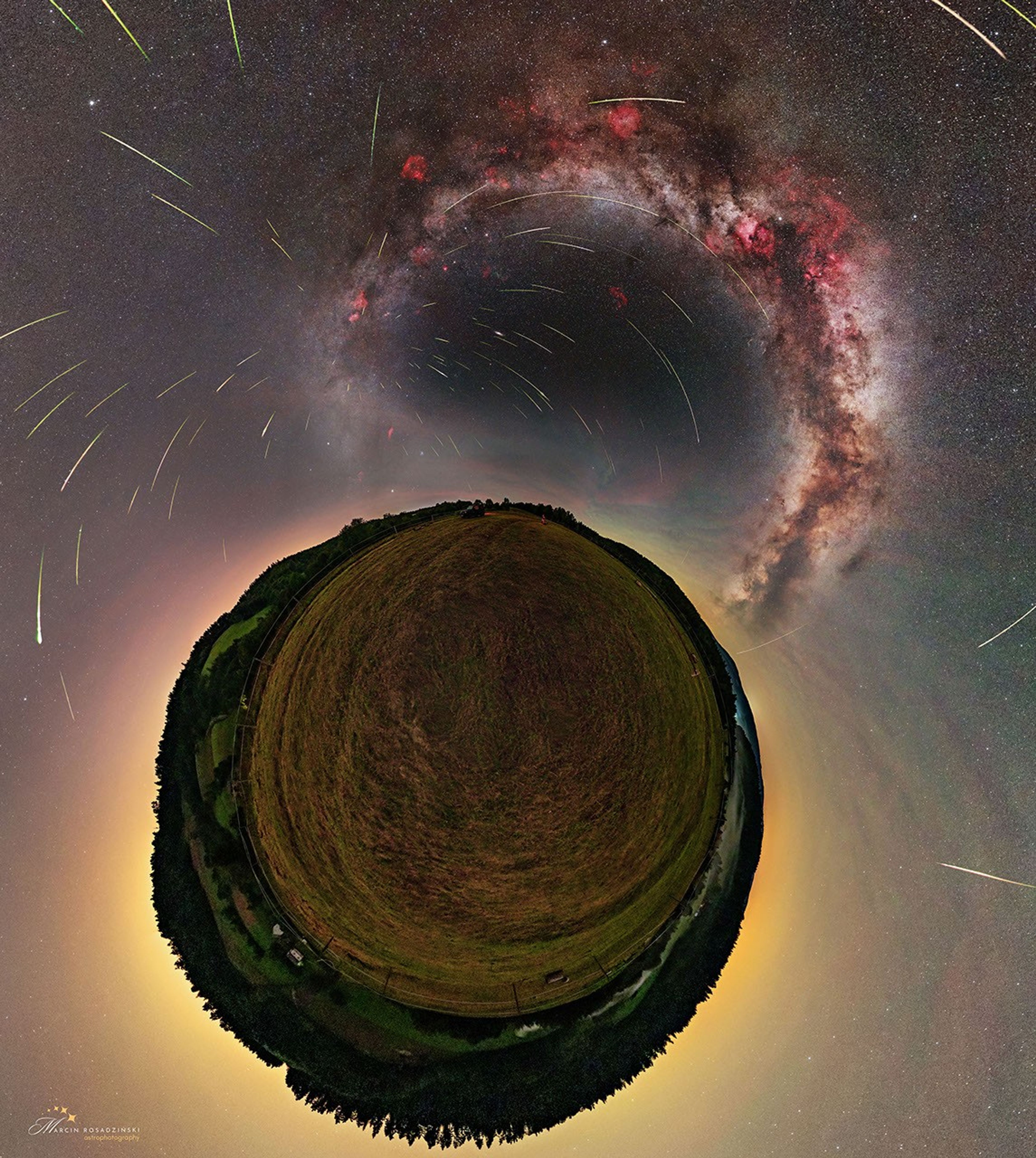
APOD: 2026 August 12 – Perseids over a Little Planet

12 August 2026 at 15:30

APOD

Astronomy Picture of the Day

Discover the cosmos! Each day a different image or photograph of our fascinating universe is featured, along with a brief explanation written by a professional astronomer.

The ground is shown in a little planet perspective, surrounded by the sky with a diffuse glow. The Milky Way is visible in the sky, as well as some nebulae in red and over a hundred meteors. Most of them appear to come from the same point.

Perseids over a Little Planet

Explanation: It looks like a view from the Little Prince‘s planet. The featured image is a throwback to the 2024 Perseid meteor shower, surrounded in this projection by the Bieszczady Mountains in Poland. Visible in the sky is the arch of the Milky Way, along with several nebulas in red and over a hundred meteors pointing to the radiant. The Perseids are easily visible and quite popular in the Northern Hemisphere summer. (Watching meteor showers in the winter is less convenient for a good reason). This year they are expected to offer an even more dazzling spectacle than usual, because the peak coincides with a new moon. The 2026 Perseid meteor shower will peak tonight with as many as 50-100 meteors per hour, when the Earth’s path crosses through debris left behind by Comet Swift-Tuttle. Typically, the best times for seeing the meteors are between midnight and pre-dawn. You won’t need binoculars to see the meteors, but a lawn chair and a dark sky location help.

NASA Stream: August 12 Total Solar Eclipse.
Tomorrow’s picture: pixels in space

Date August 12, 2026
Credit & Copyright: Marcin Rosadziński
Authors & editors: Cecilia Chirenti, Jerry Bonnell, Robert Nemiroff, Keighley Rockcliffe
A service of: ASD at NASA / GSFC,
NASA Science Activation & Michigan Tech. U.
❌