A Apple novamente não conseguiu obter a suspensão do processo de cálculo de taxas para compras a partir de links externos em sua disputa judicial contra a Epic Games. O caso, como já informamos, será analisado pela Suprema Corte dos Estados Unidos em algum momento a partir de outubro — e a Maçã havia solicitado ao Tribunal Distrital Norte da Califórnia que suspendesse os trâmites até lá, mas o tribunal negou o pedido.
As informações foram divulgadas no X por Tim Sweeney, fundador e CEO 1Chief executive officer, ou diretor executivo. da Epic.
Apple's stay was denied! Now they have 24 hours to file their proposed menu of junk fees with The Court, and Epic will have 60 days to file our legal analysis in advance of a court hearing on the topic.
O pedido de suspensão da Apple foi negado! Agora, a empresa tem 24 horas para apresentar ao tribunal sua proposta de lista de taxas abusivas, e a Epic terá 60 dias para protocolar sua análise jurídica antes da audiência sobre o assunto.
Como também apontado por Sweeney, a Apple tem agora 24 horas para apresentar ao tribunal um esboço das taxas que pretende cobrar dos desenvolvedores pelo uso de opções de pagamento alternativas e por links externos para compras realizadas na web. A Epic poderá, dentro de 60 dias, apresentar uma análise da proposta de taxas da Maçã — e o tribunal decidirá o que deverá valer.
Sweeney fez uma segunda publicação sobre o imbróglio, questionando se a Apple vai “documentar honestamente seus custos com o tempo de revisores humanos e tentar recuperá-los?”. Alternativamente, ele sugere que a Apple pode “inventar noções novas e absurdas de custo, até então desconhecidas pela humanidade”.
Will Apple honestly document their costs for human reviewer time and seek to recoup them? Or fabricate outlandish new notions of cost previously unknown to mankind? Tune in 24 hours from now to find out.
Será que a Apple documentará honestamente os custos com o tempo de revisores humanos e tentará recuperá-los? Ou inventará noções de custo absurdas e inéditas para a humanidade? Fique ligado: a resposta virá daqui a 24 horas.
A Apple recorreu à Suprema Corte contra a referida decisão, que concordou em analisar o caso. A Maçã, em seguida, solicitou à magistrada a suspensão do processo na instância inferior, argumentando que a (futura) decisão da Suprema Corte poderá afetar qualquer trabalho realizado nesse meio-tempo.
The campaign to recruit video gamers into Air Traffic Control (ATC) jobs has been a resounding success, according to U.S. Department of Transport head Secretary Sean P. Duffy. This groundbreaking campaign was launched by the USDOT and FAA back in April, hoping to net a bumper intake of skilled operatives with transferable gaming‑related skills such as spatial awareness, multitasking, strategic thinking, and rapid problem‑solving. By the U.S. politician’s account, “the results are HISTORIC” with the campaign the fastest ever to hit its target, and 2,000+ hired.
🚨 GAME CHANGERIn April, we launched a NEW CAMPAIGN to recruit video gamers as air traffic controllers — and supercharged the entire hiring process to get the BEST & BRIGHTEST in faster. The results are HISTORIC ✈️✅ 94% of hiring goal met — fastest time ever to reach target… pic.twitter.com/gN3OGmEIBBAugust 9, 2026
The recruitment ploy of appealing to young adults who love video gaming seems to have been a smart idea. Duffy highlights three metrics to backup his claims that the campaign was a “game changer.”
Firstly, the Secretary of the USDOT says that this recruitment drive for skilled ATC staff achieved a 94% hiring goal, and has seen the “fastest time ever to reach target.” Secondly, they’ve hired the most candidates in a single year – that’s over 2,000 ATC operators. There’s also another 2,000+ recruits in the pipeline, boasted Duffy.
The Secretary of the USDOT went on to claim that, with the gamer recruitment drive now well underway, “we’re building the strongest, sharpest workforce in aviation history.”
In the Tweet from the politician, it is interesting to see the news presenter's tone regarding ‘gamers’ shift from questioning to appreciation, mirroring what might be expected of their audience. We see various games being played in the video reel, but probably the best fit for ATC roles are those who get their kicks from flight simulation games. The video ends with an unnamed exec, standing next to Secretary Duffy, gushing that “we’ve never had a group perform that well.”
The original video that helped this ATC recruitment drive hit the headlines back in April is embedded above, for context. “You’ve been training for this,” states the USDOT video. “Become an Air Traffic Controller.” The message goes on to inform those already interested that the average salary in this role is $155,000 after just three years. Not only that, a successful applicant will “keep millions of people safe every day.”
What do you do when you return to your home town, with your dead mother in your car boot, to find the inhabitants have been turned into robots?
In the boot of her car, Pratelle carries the corpse of her mother and a giant sledgehammer. Her mission is simple: take the hammer to her home town. As you enter shops and homes through the door and leave them through the opposite wall, it becomes clear that the robots who either attack you or flee are all digital versions of your old neighbours.
Pratelle, with her close-cropped hair and dungarees, read to me as a queer woman, but interestingly, testers of the game often mistook her as a man. The team at developer Deconstructeam and longtime collaborator Selkie Harbour didn’t anticipate this confusion but found it fits the character perfectly, especially in this setting based on a small Spanish town like those in which the developers grew up.
A new day has dawned in the Play Store, and it's one that Google tried very hard to avoid. The first third-party app store has arrived in Google Play as a result of the long-running antitrust lawsuit with Epic. Those in the US can now head into Google Play and download Aptoide, a game-focused store that has been available as a sideloaded client since the early days of Android.
Forcing Google to distribute third-party app stores in Google Play was one of several remedies imposed by Judge James Donato after Epic emerged victorious in 2023. The remedies also included lowering developer fees, mirroring Google Play apps in other app stores, and allowing developers to use alternative payment systems. But it was the app store stipulation that seemed to irk Google the most.
Google almost avoided this outcome when it agreed to a settlement with Epic, which was announced early this year. Under the terms, Google would certify third-party app stores to allow users to install and use them with less friction, but it would not host them in Google Play. However, Google and Epic withdrew the settlement when it appeared the court would not approve it. This Registered App Store program is still slated to launch internationally, but in the US, Google is only doing what it must to comply with the judge's orders.
Game developer David Ashby and Aunty Donna’s Broden Kelly talk about their chaotic and silly sport game – involving meat pies with legs and Ford Falcons on the oval
Try explaining Australian rules football to anyone outside Australia and “it sounds like you’re making it up”, says David Ashby, the multi-hyphenate comedic mind behind deeply silly spoofs such as Italian Spider-Man and Danger 5. “Eighteen players a side, running around on a cricket oval with a rugby ball that has to be bounced every so often and gets kicked between posts – like, what the fuck is happening?”
Two years ago at a fantasy footy barbecue, Ashby had a brainwave: why not make a video game where Australia’s strange national sport becomes even stranger the more you play?
Sunset Visitor studio’s founder tells us about their new, unnerving Captcha-filled world which prompts players to ask what it means to have a ‘meat body’
Sunset Visitor is a studio that has long engaged with the idea that video games are an effective vehicle for ruminating on societal problems. Its Peabody award-winning project, 1000XResist, incorporated the development team’s complex feelings about the Covid pandemic. “We’re pretty used to absorbing the world into the work,” says studio founder Remy Siu. The outfit’s latest game, Prove You’re Human, continues this legacy of reflective game making, providing players with an AI-centric psychological horror experience where they must reason with a learning model convinced that it’s alive. “We’ve tried to situate ourselves in [the question]: what is the effectual feeling of being a person inside of all of this?” Siu says.
The story orbits around Santana, a living, breathing person who’s chosen to split herself in two for work, with her digital clone sent to test a corporate product, a computing system called Mesa. “A large part of [why Santana chooses to do this] is to allow her meat body a life that she doesn’t have, while the digital version of her gets to labour,” says Siu. As Santana’s copy wades into increasingly murky ethical waters, she becomes entangled with Mesa, completing surreal 2D and 3D Captchas to investigate the cyber-world and halt the hallucinations.
Some announcements arrive with fireworks, while others show up as a single easily missed tweet during a flurry of QuakeCon announcements to quietly close one of the longest-running oddities in PC gaming. After roughly 25 years, Return to Castle Wolfenstein (RTCW) is finally available in Germany in its original, uncut form. Bethesda Deutschland dropped the news amidst its QuakeCon announcements, bringing an end to a censorship saga regarding Nazi symbolism that stretches all the way back to the game's original 2001 release.
The game's environments are surprisingly varied despite the relatively primitive technology in use. This level is set in Norway. (Image credit: Bethesda Softworks)
If you weren't around for PC gaming in 2001, it's hard to overstate how different the landscape looked.NVIDIA's GeForce 3 had only recently introduced programmable shaders to consumer graphics cards, theATI Radeon 8500 was fresh competition, Windows XP was brand new, and legendary pioneers 3dfx had just disappearedafter being acquired by NVIDIA. Broadband internet was becoming more common, but plenty of multiplayer sessions still happened over LANs, and a Pentium III or Athlon paired with 256 MB of RAM was enough to run one of the latest engine technology showcases.
Built on id Tech 3, perhaps better known as the tech that powered the incredible Quake III Arena, Grey Matter's Return to Castle Wolfensteinlooked fantastic for its day, and it also inherited the series' unmistakable identity. See, ever since Castle Wolfenstein in 1981, and even more so after Wolfenstein 3D essentially invented the first-person shooter as we know it a decade later, the games have been about one thing above all else: shooting Nazis.
That identity created a problem in Germany. For decades, games depicting Nazi symbolism faced legal and regulatory hurdles that films did not, resulting in a heavily modified German version. In RTCW, swastikas disappeared, Nazi organizations were renamed, Heinrich Himmler became the fictional "Heinrich Höller," and references to the Third Reich gave way to the equally fictional "Wolf Clan."
At first glance, that sounds like the sort of censorship that simply strips away context, yet RTCW was already a strange game. The opening hours suggest a relatively grounded World War II action title. You wake up in a prison with a knife, you fight Nazis in a castle, and things seem normal for about a whole hour before rapidly veering into supernatural pulp. Within a few missions, you're fighting zombies, exploring haunted crypts, and watching the SS dabble in increasinglyimplausible occult experiments.
The final boss Heinrich is barely mentioned before the end of the game, making him quite a surprise if you aren't paying close attention to the story. (Image credit: Alan Chan/MobyGames)
By the end, the final boss isn't Hitler (mech suit or no) or a secret superweapon, but Heinrich I, historically known as Henry the Fowler. He was a real 10th-century German king, supposedly resurrected in the game through dark ritual. He's also somewhat infamously a surprisingly manageable final boss, making for a finish both absurd and anticlimactic after the game's escalating parade of undead knights and bizarre experiments.
Seen through that lens, the censored version accidentally became a different story. Instead of Nazis attempting to exploit medieval occult power, it played more like an ancient secret society preserving itself across the centuries before trying to resurrect its long-dead founder. It's arguably a cleaner fantasy premise. The "Wolf Clan" makes more narrative sense once the game fully commits to gothic horror. However, it does make the opening chapters, where an OSS Ranger is somehow investigating a shadowy organization seemingly unrelated to the wider war, a bit awkward.
The catch, of course, is that it stops feeling much like Wolfenstein. The series' DNA isinseparable from infiltrating Nazi strongholds and sabotaging increasingly desperate attempts to turn the tide of World War II. Remove that element, and the title itself starts to feel like an artifact from another game series altogether.
These surprisingly detailed mission briefings had to be fully reworked for the German version of the game. (Image credit: Bethesda Softworks)
It's a curious example of something that occasionally happens with censorship across entertainment. More often than not, edits simply leave a work feeling diminished. Every so often, though, these constraints produce something unexpectedly memorable. The Texas Chain Saw Massacre owes much of its enduring reputation to how much horror it leaves to implication rather than explicit gore, and that decision was made due to the ratings board. Similarly, action film edits for TV often cut gory death scenes, which can ironically improve the pacing of the film.
Return to Castle Wolfenstein belongs in that same conversation, albeit for different reasons. The German version wasn't a better version of the game in any objective sense, but it accidentally shifted the genre. Instead of occult Nazis, it became a story about an ancient cult whose descendants had survived into the modern era. That's a premise that I personally find more appealing and even internally consistent, even if it comes at the expense of the series' defining theme.
The RealRTCW mod offers widescreen support and improved texturing and lighting over the base game. (Image credit: RealRTCW Team)
So, after a quarter of a century, German players can finally buy the same uncensored game that much of the rest of the world has had since 2001. It's ironic, and it's about time, too. While Germany relaxed its gaming rules in 2018, allowing modern entries like The New Order to go uncut in 2019, Grey Matter's 2001 classic remained stuck in censorship limbo until now.For game preservation, historical authenticity, and simple consumer choice, that's unquestionably the right outcome. Yet it also marks the quiet retirement of one of gaming's strangest alternate versions; a release that, through a combination of legal necessity and narrative coincidence, accidentally stumbled into telling a very different and potentially more compelling story.
Folks in Germany should now be able to pick up the uncensored version of the classic game on sale for just two dollarsat Steamand GOG, or you can get a bundle that includes the original Wolfenstein 3D for just a dollar more. If you grab it, make sure to check out theRealRTCW overhaul mod that radically improves the game with modern features like proper widescreen support and cleaner OpenAL audio.
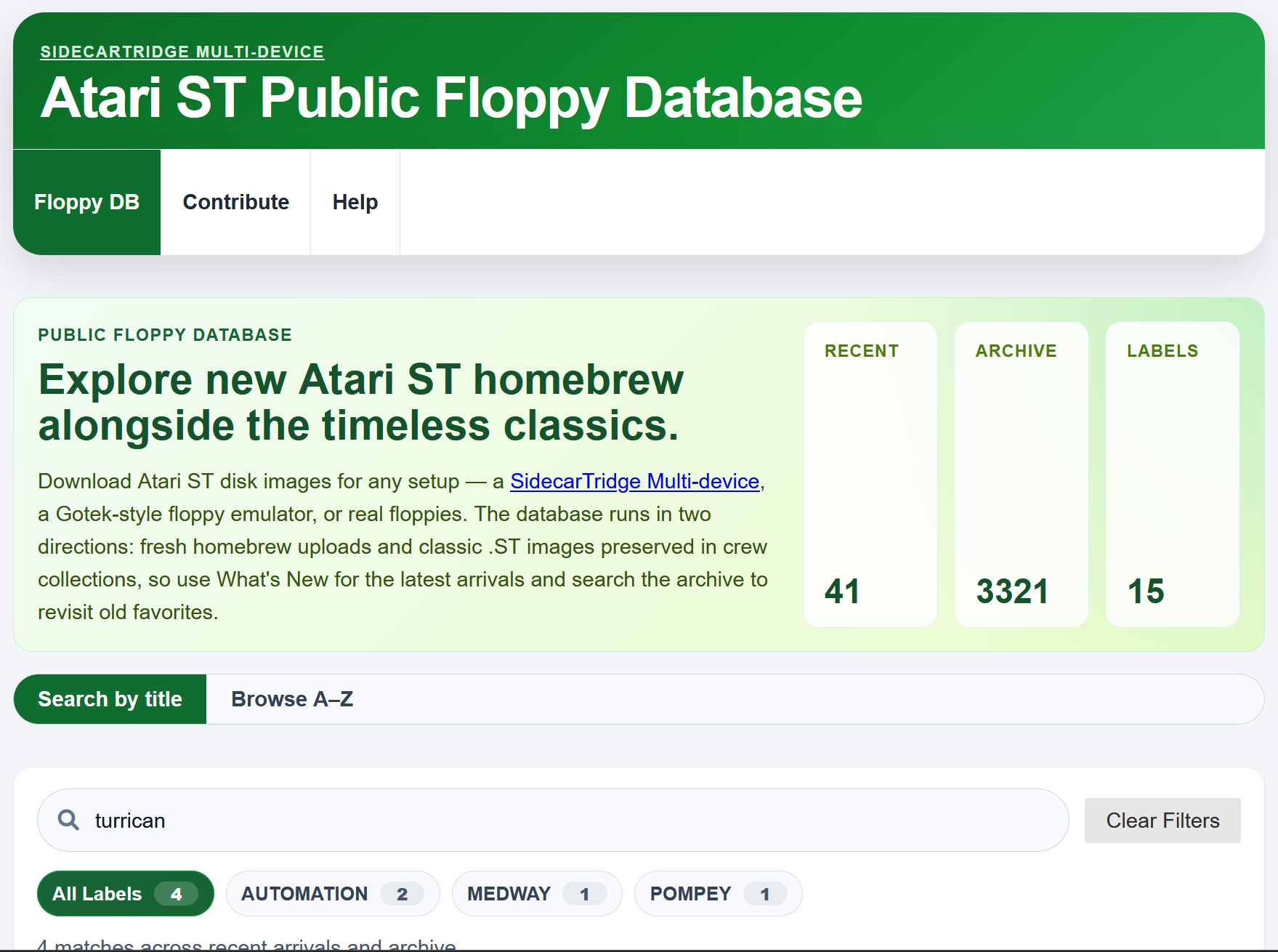
An extensive Atari ST floppy disk database can now easily be accessed by all netizens. Originally created to serve floppy images to the owners of the SidecarTridge multi‑function hardware add‑on for the Atari ST family (ST, STE, Mega ST, TT, Falcon), anyone can now browse, search, and download the .ST files to use with other hardware, emulators, or even to rewrite the disk images to actual floppies.
The Atari ST Public Floppy Database browser from the SidecarTridge Multi-device is now open on the web to everyone.Until now, searching that community-curated archive of floppy images meant firing up your Atari ST with a SidecarTridge Multi-device. The search lived inside the…July 21, 2026
After reading the announcement, I decided to check out the online repository. My favorite old platformer series was there, with more than one disk featuring the legendary Turrican and Turrican II releases. I also checked and confirmed public domain/shareware favorites like Gravity Force were available, as was Llamatron, and the mono high-resolution Bolo. Some things I looked for, like the Stupendous Demo, seemed to be missing, as were serious art and DTP tools I used to dabble with in the 90s.
(Image credit: Tom's Hardware)
The database is pleasingly new and regularly maintained, though. For example, it has 41 Atari ST disks flagged as recent arrivals. These are a mix of old releases being added, and some extremely new titles like new homebrew games, and a collection of demos released at Sommerhack 2026 just last month.
If you’ve been using computers for a long time, you might recall the Apple II and Apple IIgs, two of Apple’s early computers that were before they had fully committed to the Macintosh platform. While there were plenty of productivity apps and programming tools for Apple II and Apple IIgs, there were also a whole ... Read More
This year is the 30th anniversary of the launch of the original Quake by id Software, if you could believe it. To commemorate that, publisher Bethesda has released a new campaign chapter for the game, titled "Dawn of the Machine."
This is part of a series of new campaign chapters, all developed by MachineGames "in collaboration with id Software." MachineGames is best known for making the games in the relatively recent Wolfenstein reboot series, as well as Indiana Jones and the Great Circle. The Quake maps are made by a team dubbed "Quake Club," which includes several MachineGames employees who work on Quake maps in their spare time.
The ambition and scope of some of these maps is beyond what was typical for Quake maps back in the late '90s, thanks in part to the team's use of TrenchBroom, a newer map editor that works well on modern systems and is easier to work with and more capable than what folks were using in those days.
The all-conquering franchise’s revamps are technically impressive, its transfers more true to life – and its new grassroots social hub is surprising fun
As if the world wasn’t sufficiently football-obsessed, it’s time to prepare for the arrival of its biggest football video game. EA Sports FC 27 (the franchise that used to be Fifa – what better time to no longer be Fifa-branded?) is due to be released on 25 September. I just spent two intense days in Vancouver, where the EA FC games are made, playing FC 27 and talking to its developers.
With an annual franchise such as EA FC, it helps to have something fresh to entice regular fans, and FC 27 has a whole new element, entitled the Grounds. It’s a physical hub-type area, similar to the City as seen in 2K’s recent NBA 2K basketball games, but much more pleasant to frequent, split as it is into areas inspired by British, French and Argentinian street-football culture.
Daniel Mullins explains how he plans to follow up his quirky classic without losing what made it stand out in the first place
Glitchy aesthetics. Literally collapsing menu boxes. The game taunting you by “possessing” your Steam friends. Technical tricks of this nature may sound gimmicky in 2026, but they felt excitingly unorthodox a decade ago, when Pony Island came out to critical acclaim.
Fans of Daniel Mullins, the celebrated indie developer of Inscryption, will be forgiven for forgetting that Pony Island 2: Panda Circus is in active development. After all, it’s been almost three years since the announcement – and a full decade since it was first teased as an Easter egg in Pony Island’s ARG (Alternate Reality Game) – with only a single trailer and a bunch of tunes from the soundtrack released to the public.
EA Sports has released Madden NFL 27 Arcade Edition, a version of the popular football simulation franchise that Apple Arcade subscribers can play on the iPhone, iPad, Mac, and Apple TV. It’s a big release built specifically to take advantage of Apple hardware, allowing players to play the game on a wide variety of hardware.
I was struck by how easy it is to pick up and play the game whether you’re a diehard NFL fan or not. I don’t follow football closely, but I was able to get the hang of the game and have fun right away, knocking out a Quick Play match when I had a few minutes to spare.
Quick Play tightly limits the overall time it takes to complete a matchup, but it doesn’t sacrifice depth in the process. There are long lists of plays you can run, including suggested plays, play types, formations, and recents, as well as a wide variety of statistics. And after a big play, you can replay it with total control over the camera angle, too.
However, if you want to go really deep, the game’s Franchise Mode lets you play a full NFL season, managing your team all the way through the playoffs. You can also draft your dream team from the game’s huge catalog of real-world NFL stars. Plus, during the real-world NFL season, player attributes shift based on their actual performance.
Madden NFL 27 also looks terrific. The 120Hz playback is smooth on the iPhone, where I spent most of my time with the game, and even nicer on a bigger screen like my 14” M4 Max MacBook Pro, making for an immersive experience.
What impresses me most about Madden NFL 27, though, is how well it makes use of the Apple hardware and technologies at its disposal. Too often, those sorts of details get left behind when a big release is published on Apple platforms.
To its credit, EA has done an excellent job adapting Madden NFL 27 for Apple Arcade subscribers. You can play across every device mentioned above, leaving off on one device and picking up on another seamlessly because saves sync across devices. Every device supports game controllers and touch where applicable, and those devices with 120Hz displays support that, too.
Explore Antarctica as a flightless bird – and dodge some earthly monsters – in this surreal adaptation of HP Lovecraft
While watching the 2006 animated film Happy Feet with his daughter, Origame Digital founder Naphtali Faulkner noticed something interesting. “[In the movie], they see the digger fall into the ocean, and it has an almost eldritch quality,” he says. Over time, and with plenty of iteration, Faulkner’s inspirations coalesced, from HP Lovecraft to the 1982 version of The Thing and the works of David Lynch. “I’m a big fan of horror that sits in your head rather than in your stomach,” says Faulkner.
In Penguin Colony, players body-switch between species of flightless birds, piecing together cryptic cosmic clues as they tail a Nazi expedition to Antarctica. In the process, Origame Digital draws on Lovecraft’s novella At the Mountains of Madness. “I’d always wanted to do a creature that’s a manifestation of colonial thought, energy and power, and the idea of it resting and then regrowing,” says Faulkner. “I was looking through the history of Lovecraft and him being a gigantic racist, and this idea of the Nazis sort of came out,” he adds.

 Login