Login
Want the Public to Trust Science Again? In Four Lessons, Here’s How NOT to Do It
6 August 2026 at 16:29
Ethan Siegel’s approach to public discussion of science is common enough: the exalted scientist reaches down to the ignorant masses.


Labour's growing credibility crisis has deepened, with Angela Rayner facing fresh questions over whether she blurred the line between her time as a home care worker and her years as a union rep.
The post Rayner Accused of Misleading Public Over Career History appeared first on The Daily Sceptic.
Joe Rossignol (PDF):
The complaint alleges that Apple violated California’s Consumers Legal Remedies Act and other laws by failing to adequately review and monitor apps distributed through the App Store, despite marketing it as “a safe and trusted place to discover and download apps.” Due to these assurances in Apple’s marketing, the complaint said the plaintiffs trusted that a Sparrow Wallet app they downloaded from the App Store on iOS was legitimate, when in reality it was a fraudulent spoof designed to steal Bitcoin from users.
Sparrow Wallet is only available on Windows, macOS, and Linux. The popular Bitcoin wallet is not available on iOS, but scammers have released fake lookalike apps in the App Store that can trick users into giving up control of their funds.
[…]
Even when victims reported fraud, the lawsuit alleges that Apple often took little to no action, and it says other fake Sparrow apps remain in the App Store.
Sparrow Wallet developer Craig Raw has publicly addressed Apple’s slow response to multiple fake versions of his app appearing in the App Store. In a January 2024 social media post, for example, he said “there is still a scam ‘Sparrow Wallet’ app on the @Apple App Store, despite myself and others having reported it weeks ago.”
My attempt to protect users from scam apps on the @AppStore has gotten my Apple Developer account flagged for termination - ironically, for “dishonest activity”.
[…]
I’m the developer of the real Sparrow Wallet, a desktop app, and I hold the registered US trademarks for the name and logo. I have publicly warned @Apple and the community about these fake apps from early 2024, but they keep appearing.
The app @Apple flagged was a placeholder that was never published. Its only purpose was to warn users that Sparrow is desktop-only and that other “Sparrow” apps aren’t mine. This approach may have been misguided, but there was nothing dishonest about it.
In response to our request for comment, Apple said it has taken swift action to remove any apps impersonating Sparrow Wallet[…] Apple says it takes immediate action against apps that do not comply with its guidelines.
Previously:
Update (2026-07-28): Sarah Perez:
The complaint targets one of Apple’s longtime competitive arguments: that its tight control over its App Store makes its platform safer than those offered by its rivals. The company has used this claim to push back against deregulation of the app ecosystem, including third-party app stores and sideloading.
“As part of a sustained marketing campaign, Apple has positioned itself, its products and services, as offering a level of security and trustworthiness superior to any competing technology company,” the new filing states. “This includes assurances about the safety of applications distributed through its App Store. By retaining exclusive control over which apps are permitted on Apple devices, Apple has structured its platform to ensure that consumers depend entirely on its promise of safety and reliability,” it reads.
With third-party app stores, there would be an incentive to do better vetting than Apple, and with sideloading it would be clear that the app was not being downloaded from sparrowwallet.com.
Update (2026-07-29): Jeff Johnson:
What struck me about Apple’s response is that it places the burden of curating the App Store on developers and users rather than taking responsibility for it. After all, Apple reviews every version of every app before it can be published to the App Store. If Apple is curating the App Store, then why do scams have to be reported and removed? One wonders how the scams get past Apple review in the first place, and even if Apple review “is not perfect” (a gross euphemism), how the second line of defense, Apple employees patrolling the App Store for scams that the review team missed, also fails. The burden of App Store curation should not fall to me, a lone indie developer.
Apple’s response also ignores that the indie developer did report the scams, multiple times.
Previously:
Google was today fined €890 million ($1 billion) by the European Union for breaching antitrust rules with regard to its search and Google Play store services.
The European Commission found that Google had broken the Digital Markets Act (DMA) by using its dominant position in the search market to favour its own services, like shopping and hotel deals, over those of rivals.
The Commission also said that the company had abused its position by preventing developers from directing users to cheaper ways to buy apps and app subscriptions on websites and alternative app stores.
The Commission noted that Google has begun testing changes to how its own services are placed in search results and rolled out changes to its steering terms, which the EU’s main executive body described as substantial progress towards compliance.
“Google has fallen short of effective compliance with the Digital Markets Act, and today we have taken decisive yet balanced enforcement action sanctioning these breaches,” said Teresa Ribera, Executive Vice-President for Clean, Just and Competitive Transition.
“The best products should succeed because they’re better, not because they’re owned by the company running the search engine. And European consumers have a right to be told by app developers where to sign up to the best offers, even when the app store owner does not get a cut.”
With search, Google is required to share with competitors — search engines and AI chatbots alike — a massive amount of user data from Google Search user interactions. What terms people search for, what they click on in results, what languages and devices they use. It’s all ostensibly anonymized but that’s tricky when it comes to search terms. A lot of the terms people type into web search fields are to some degree personally identifying. The EC seems to be saying it’s Google’s problem to filter out things like passwords and usernames and omit them from the shared datasets. Google can charge money for this access, but only under “fair, reasonable, and non-discriminatory (FRAND)” prices, based on a Commission-defined methodology.
Previously:
Update (2026-07-27): John Gruber:
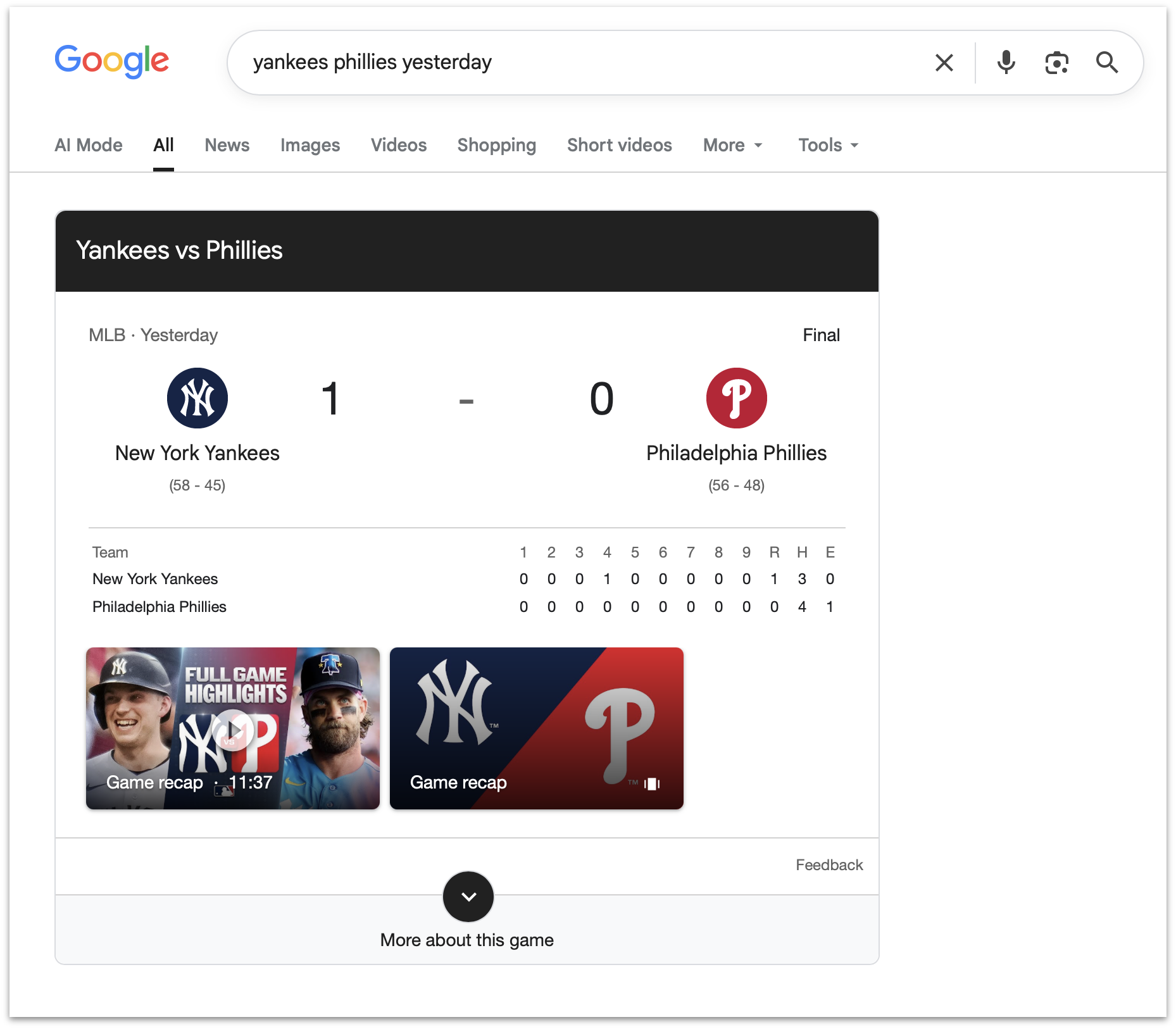
So if you search for the score of a sporting event, it’s illegal in the EU for Google to show you the score, like this search I just tried. What the EC is saying is that because Google Search is so popular, it’s no longer allowed to improve.
It drives me insane when in Europe the link between Google Search and Google Maps is broken and I often have to copy paste an address between the two. Thanks EU, what if I like Google’s integrations?
They could have simply added a selector when a user first clicks on the maps preview in the search result, and then remembered it on device or across that user’s account.
But of course, then the user could choose a competitor’s product and Google would have to honor it. That would be horrible, so instead they just made the user experience worse for everyone and elegantly made people blame the EU.
See also: Hacker News.
Ryan Whitwam (PDF, Reddit):
Back in 2018, Google was handed a record-setting 4.34 billion-euro ($4.9 billion) fine in Europe for abusing its monopoly on Android. The company has spent the intervening years challenging that decision, but the continent’s highest court has put a stop to that. The Court of Justice of the European Union has affirmed the penalty, meaning Google is out of options.
[…]
The EU took issue with Google search and Chrome being the default options on Android. Even devices made by other companies, such as Samsung and Xiaomi, include Google apps as the default per the Android licensing agreement, giving Google an unfair advantage, according to European antitrust regulators. This is not to be confused with a 2.95 billion euro ($3.45 billion) fine against Google’s advertising monopoly issued by the European Union last year.
In 2022, a lower EU court reduced the fine to the current 4.1 billion euros from 4.34 billion euros previously.
Google has argued that the Android operating system provides choice for users and supports developers and businesses across Europe.
Via John Gruber:
Google last year booked $132 billion in profit; this fine is about 3 percent of that..
[…]
There’s never a reason not to string the appeal process out, but it’s especially true when your profits are growing at an exceptional rate. By growing their profits around 5×, they’ve reduced the relative sting of this fine by 5×
Previously:
Apple’s challenge against the EU’s designation of its App Stores and iOS platform as “gatekeepers” was dismissed by Europe’s top court on Wednesday, reports Reuters.
[…]
The company also disputed the classification of iMessage as a number-independent interpersonal communications service, or NIICS, which would subject the app to EU telecoms rules. But the General Court said Apple’s actions regarding the iMessage service are inadmissible.
Back in 2023, Apple acknowledged that it qualified under the then-new definition of being what the EU called a gatekeeper service. But key to that is the size of the operation, and since 2024, Apple has been claiming it runs five smaller App Stores rather than one large one.
[…]
“Irrespective of the devices in question,” ruled the judges, “those stores have the same purpose, namely to connect app developers with end users in order to facilitate the distribution of software applications.”
Apple disagreed with the decision but didn’t say yet if it would appeal. “We firmly believe the DMA’s mandate goes beyond what is lawful and proportionate, threatening to erode decades of privacy and security protections we’ve built and leaving our users vulnerable to new risks,” an Apple spokesperson said in a statement to multiple outlets. “We will continue advocating for the innovation and privacy our European customers deserve.”
Apple still has two cases pending with EU courts. The first is a challenge to the EU Commission’s decision last year forcing Apple to open iOS to third-party developers, and the second is an appeal against the €500 million fine imposed in April last year for anti-steering violations.
Previously:
The EU required Apple to permit third-party app stores, while a US court ruled that developers have the right to direct iPhone users to third-party payment platforms for app purchases and subscriptions. Britain’s Competition and Markets Authority (CMA) is now proposing to apply this latter rule in the UK.
The U.K.’s competition regulator has proposed letting app developers direct users to payment options outside Apple’s App Store and Google’s Play Store, in a move aimed at increasing competition and reducing the fees charged by the two companies.
[…]
The regulator said any fees Apple and Google charge developers for enabling such “steering” must be fair and reasonable, remain below existing App Store and Play Store commissions, and allow developers to either pass savings on to consumers or reinvest them in innovation.
Requiring Apple to allow apps to steer users to the web to make payments is, I’ve long argued, sensible regulation. I’ve also long argued that Apple has been obstinate in disallowing it. If in-app payments — through Apple’s system — can’t compete with out-of-app payments on the web, something is wrong with IAP. But it’s wrong to assume that payments outside IAP will result in lower prices and better policies for users.
They may increase prices when costs grow but that does not mean they do the opposite. But who cares? Lower costs permit more flexibility on pricing and, even if that money ends up in the pockets of developers instead of Apple, is that supposed to be a bad thing? Is there a reason why someone should be upset that they might pay the same amount but an indie developer gets to keep more of it?
The proposed policies are pretty straightforward from what I can see. Among other obligations, Apple is not allowed to use or require scare tactics when users are routed to an external payment mechanism and, while it is allowed to charge a steering fee, it is not allowed to count services not used by developers offering third-payments nor double-count for services already accounted for by other developer fees. Also, the CMA calls bullshit on Apple’s claim that third-party payments are particularly risky[…]
Previously:
Update (2026-07-30): Juli Clover:
Apple said new UK App Store rules would give regulators a “highly intrusive” role dictating how it runs its business, reports Reuters. Apple submitted feedback to the UK’s Competition and Markets Authority as it considers forcing Apple to change its App Store rules around steering.
[…]
UK regulators said Apple can charge developers a fee, but it must be fair and reasonable, and below existing App Store commissions, so developers can pass savings to customers or reinvest them in innovation.
According to Apple, the CMA’s proposed rules would undermine innovation and investment, and would amount to price regulation because of the restriction on fees.
The issue before the commission currently is the built-in advantage for Gemini on Android. When you turn on any Google-powered Android phone, Gemini is already there and gets special treatment at the system level. The European Commission is taking aim at the lack of features available to third-party AI services. The commission believes that there are too many experiences on Android that only work with Google’s Gemini AI, and as a gatekeeper, Google must change that.
[…]
European regulators are proposing several broad changes to the way AI tools operate on Android phones. Some of this is straightforward, like allowing third-party AI tools to be invoked system-wide via hot words or button presses. This might also include allowing AI tools to view screen context when the user opens them.
[…]
Many of the Gemini AI features in Android, including Magic Cue, rely on running local models, and Google has been slow to allow third parties the system access to make that work effectively. So the EU is also suggesting a mandate that would ensure developers have the necessary hardware access to run local models “with high levels of performance, availability and responsiveness.”
Via John Gruber:
The difference between Google and Apple on this front is that Google just blazed ahead and shipped Gemini integrated into Android in the EU, and is now facing compliance problems after shipping. (Ask forgiveness.) Apple isn’t shipping Siri AI in the EU in iOS 27, knowing that it’s going to be deemed non-compliant. (Ask permission.)
Previously:
Update (2026-07-17): Juli Clover:
The European Commission today formally ordered Google to give third-party AI services the same access to Android device features that Gemini has.
[…]
The European Commission is giving Google a full year to implement changes that will meet the Digital Markets Act requirements, and that's before any legal appeals Google might make.
Google (via Ben Schoon):
This Android ruling threatens device security by granting external apps sensitive and powerful device permissions without these safeguards.
Update (2026-07-23): John Gruber (Mastodon):
They provide separate “Q&A” overviews of the guidance for Android AI interoperability and web search sharing, and the full guidance documents are PDFs (Case DMA.100220 for Android AI, Case DMA.100209 for web search).
[…]
The EC is demanding that Google create APIs that allow third-party AI assistants to do everything Google Gemini does now[…]
[…]
Also, in my reading, the EC is demanding that Google make available to third-party AI assistants all information in Google’s own apps (Gmail, Google Calendar, Google Docs, Google Maps, etc.) that Gemini has access to.
[…]
Apple unfortunately hasn’t shared any technical details describing its proposal for a “Trusted System Agent” that it shared with the EC last year. But whatever Apple’s vision for the Trusted System Agent is, I don’t see how the EC would deem it compliant with the DMA if they want from Apple anything close to what they are now demanding from Google.
I don’t know what will come of this, but I’m pleased to see it in the sense that it is logically coherent. The TSA seems like a way to give the appearance of doing something without actually solving the problem. Like Gruber, I don’t really see why Google would want to comply with this rather than taking their Gemini ball and going home. Unlike Gruber, I don’t find it scary to let users opt into sharing their data and background time with apps of their choosing. I don’t like software design by government committee, but it seems less bad than further entrenching an unfettered monopoly. Maybe this could have been avoided if Google had developed its own reasonable solution instead of shipping something that was obviously not compliant.
A group of 48 China-based iOS developers have filed an antitrust complaint against Apple with the country’s market regulator over the App Store’s commission rates, the South China Morning Post reports.
The developers sent an open letter to China’s State Administration for Market Regulation (SAMR), alleging that Apple failed to deliver on a promise to offer the lowest commission rate to the Chinese market. The group asked the SAMR to investigate and penalize Apple for allegedly abusing its market dominance to impose “unfair and excessively high” costs on local developers.
Apple lowered the fees in March but not as much as it did in Brazil and Japan.
Previously:
Unfortunately, due to the Digital Markets Act (DMA), Apple will not be able to ship Siri AI in the European Union with the release of iOS 27 and iPadOS 27. Over the past several months, EU regulators did not accept any of Apple’s proposed solutions to bring Siri AI to the EU while safely supporting other virtual assistants.
[…]
EU users will be able to access Siri AI on macOS 27 and visionOS 27. Developers located in the EU will not be able to test or use the new Siri AI features for their apps on iOS 27, iPadOS 27, and watchOS 27.
[…]
According to EU regulators, the DMA requires Apple to give any AI system nearly unlimited access to a user’s device, as well as the ability to act on that access autonomously without a user’s ongoing visibility and control.
[…]
Apple designed a solution called Trusted System Agent — an intermediary that would allow virtual assistants to safely access the same features and capabilities as Siri AI for devices in the EU. Apple also shared a plan to launch Siri AI in the EU while gradually rolling out this new solution over an 18-month period. The European Commission said no. In fact, the European Commission did not agree to any of Apple’s proposals.
This phrasing is not very clear, perhaps intentionally so. Apple is trying to give the impression that it did all this extra work to meet the DMA’s requirements, and yet the EC rejected its proposals, so it’s their fault Siri AI isn’t shipping in the EU. But it looks like the crux is that the Trusted System Agent is currently vaporware. What the EC rejected is that Apple wanted to be able to ship Siri AI now on the promise of future openness. The TSA would actually be built during this 18-month window of exclusivity. It’s not surprising that the EU would reject that proposal. The App Store doesn’t approve apps that flout the guidelines but promise to comply later. It doesn’t even entertain proposals of the form, “If I built this would it be approved?”
European Commission (via Steve Troughton-Smith, Update: John Gruber, Mastodon):
So first, the decision not to roll out Siri AI in the EU is Apple’s and Apple’s only.
Because absolutely nothing in the DMA prohibits Apple from introducing new products in the EU.
What Apple is however not allowed to do, just like any other gatekeeper, is to close the market.
[…]
Apple simply made a request to the European Commission to be exempted from their interoperability obligations under the DA.
And this for at least 18 months on top of it. Guess what? That’s not an option.
Apple said it detailed its plans for Siri AI to EU regulators six months ago, along with a technical proposal to allow secure third-party access to that data.
“In essence, a commission that’s asking us to conduct a very risky experiment on many, many, many tens of millions of users,” Greg Joswiak, Apple’s marketing chief, told reporters, “and we only want to ship these capabilities when we can do so safely.”
The EU said not to ship it without the TSA, yet Joswiak spins this as the EU asking Apple to be reckless? And if Apple wanted to ship them safely, why did it stop working on them?
Apple spoke of having spent hundreds of thousands of engineering hours on changes to comply with the EU. In the new report, though, Apple now says that it no longer knows what to work on.
So currently none of its engineers are working on adapting Siri AI to meet the EU’s demands.
It seems like Apple isn’t taking this very seriously. They’re more interested in trying to score PR points by blaming the delay on the EC rather than on building something compliant. So I guess the EC was prescient not to grant an exemption based on the promise that they’d follow through with the TSA.
However, do I think Apple should be made to open up that level of system access?
Honestly yes. They are worried about protecting my data. But it’s MINE. Me, the user.
Stick a big privacy prompt, maybe a system settings screen and reboot, but I want access to my data!
We can look to BrowserEngineKit to see how well it works out to introduce a trusted intermediate layer that Apple doesn’t itself rely on. And this seems like a much harder problem.
Yeah, that privacy layer is a stupid [non] starter. “Find the place my friend said we should go swimming and give me directions”
The only way that query can work with an intermediary layer is if the AI asks that layer to do the searching for them and only gets the response back.
Except that basically kills the advantage of LLM agents & instead delegate all the ‘smart’ parts to some dumb on device model Apple makes.
Previously:
Update (2026-06-11): Amy Worrall:
I keep seeing people (usually Americans) confused by where the EU is coming from with Apple and the DMA, eg “how can they care about privacy but also demand AI companies can access your data?”
My read is, the EU’s starting point is that a gatekeeper cannot treat itself as inherently more trustworthy than any other company. So if anyone’s AI can access your data, including Apple’s, it’s not up to the gatekeeper to say “we trust ourselves but don’t trust other companies” and force that on users.
The users should get to choose who they trust. And I think Apple is trying to draw a different line than it says. It worries that AI could be hijacked to steal your passwords and photos. But you can already install apps that manage and access that data. You can also install apps that access your calendar and mail data, and these apps can incorporate AI. Such apps actually get more access than what the EC wants because they must communicate with your servers directly. I would rather let an AI search my downloaded e-mails than read/write to my IMAP server, but Apple is blocking that option. The actual line it’s drawing isn’t that AI can’t access your data but that (aside from iMessage) it can only access it via additional engineering work and additional hoops for users to enter credentials. It seems like what Apple really wants is to make it hard for anyone to compete with Siri.
Update (2026-06-12): Cory Birdsong:
I’m skeptical that Siri AI is even capable of being meaningfully private or secure. As far as I know there is no mitigation for prompt injection, as Matthew Green describes here.
If it has access to private information, is exposed to external input and can access the Internet then how can they meaningfully claim it’s private or secure?
There’s a lot to unpack here, including more background information — and on-the-record statements — from a briefing Apple held Tuesday that I was invited to at Apple Park.
It’s frustrating that Apple has said so little on the record. They want to communicate that their “offers for compromise have been rejected,” but what exactly did they offer? Personally, I don’t think the TSA would be a very good solution because it would lock in both the limitations of Apple’s technology and their role as a gatekeeper. But Apple did not even say that the EC rejected the idea of the TSA, only that it rejected their proposal to violate the law for 18 months while building it.
But the bottom line is that Apple’s public statements regarding the DMA and the European Commission have never been this strident before.
[…]
Now, they’re a bit more on war footing. There’s a massive gulf between what Apple is willing to do with Siri AI in the EU and what the Commission is demanding from Apple for DMA compliance.
The European Commission isn’t demanding anything, the law is demanding it. The laws have been in place for several years now, Apple is currently in default of the law on several fronts, and is fighting its existing fines.
When the Chinese government wanted access to user data, Apple complied, but when the EU parliament voted for their citizens to be able to choose how to share their own data, that put Apple on a “war footing.”
There is some kind of irony in how Apple isn’t allowing Europe access to the new AI stuff; and meanwhile for the US, Apple is removing the setting for us to opt-out of it, effectively forcing it on us.
That’s how it is these days, huh? Either a government or a giant corporation makes our technology choices for us. We don’t get to choose for ourselves.
Previously:
Update (2026-06-17): John Gruber:
What exactly is the motivation for Apple and Google to engineer entirely separate systems for the EU to bring new features into compliance with the Commission’s broad interpretation of the DMA? Because if Apple doesn’t engineer a DMA-compliant version of Siri AI, iOS users in the EU will ... switch to Android, whose system-level AI was deemed noncompliant by the Commission a few months ago?
I briefly hoped that the DMA would lead to a sort of California effect for software, where products are designed for the stricter (more open, in this case) jurisdiction, and everyone else reaps the benefits, too, because that’s easier for companies than making separate versions of their products. But it turns out that Apple finds it well worth it to feature flag away the EU features it doesn’t want us to have, as well as the ones it doesn’t want to adapt for the DMA.
This doesn’t directly hurt Apple. It doesn’t force Apple to design, engineer, and ship a compliant EU-exclusive version of Siri AI that supports plug-and-play LLM back ends. It only hurts iPhone users who live in the EU, who are stuck with the old dumb version of Siri for the foreseeable future.
This demonstrates a market failure or legislative failure, depending on how you look at it. Both halves of the duopoly are in conflict with the law of the second largest economy in the word. Users will get a worse Siri, but this doesn’t bother Apple enough to do anything about it. Maybe the customers in the EU can be used as a bargaining chip. Neither Apple nor Google is worried that a competitor will come along with a compliant phone to challenge their dominance.
Here we are two years later and I think the answer is more clear than ever which side of the continental divide is more fun.
Gotta admit that as an EU citizen, I feel handicapped when it comes to brainstorming ideas to utilize Foundation Models.
Like, if I were to build a new app around them, it’s difficult to gauge if this is something Siri AI does out of the box when it isn’t available to me.
And unlike Apple, I intend to build software for the entire world.
Apple is acting out of greed and spite (see their hairbrained fee structures for alternative marketplaces as an example), but also yes, the DMA and enforcement thereof seems like a particularly difficult and capricious regulatory dynamic.
[…]
Those arguing that Apple is acting purely out of spite seem to suggest there is some obvious solution for iPhone Mirroring that would satisfy the interoperability mandate, but they never go into what that obvious solution is because they don’t know. They don’t know because I would guess no one does, not even Apple and certainly not the European Commission.
As far as I can tell, the European Commission doesn’t see it as their responsibility to help gatekeepers design features ahead of time in a way that should be compliant with the DMA. What they want instead is to decide whether or not a given feature runs afoul of the DMA after its released in the EU and presumably after they’ve gotten feedback from third parties.
If a developer emails Apple and asks if an app idea they have will be approved, they will get told to build it, submit it to the App Store, and see. The EU is the App Store here, and Siri AI is the app. I guess Apple don’t like their own policies.
I sympathize, even though Apple is in a better position than the developer, because it has more resources, because it would only potentially be blocked from shipping in one market, and because it can still sell its product in the EU, just with certain features disabled. Building something that might not be accepted is risky, but if you don’t submit anything that you think would be complaint with the rules, you don’t seem very serious. It’s still unclear to me exactly what Apple’s plan is. Its press release says it “will continue working” on bringing the features to the EU, but its SVP of marketing said in an interview that “none of its engineers are currently working on solutions.” Perhaps this implies that it’s banking on a legal or political solution rather than a technical one.
Update (2026-06-25): Jack Wellborn:
While the relationship between the European Commission and Google tells us nothing about playing ball, it tells us exactly how inconsequential support for alternative marketplaces is when it comes to regulatory scrutiny of integrated features. Apple hasn’t played ball with alternative marketplaces and now its new AI-based features are being withheld from the EU lest they get scrutinized for fines by the European Commission. Google hasn’t had to play ball with alternative marketplaces and now its new AI-based features are either being scrutinized for fines by the European Commission or being withheld lest they also get scrutinized. The European Commission is, rightly so in my opinion, regulating both operating systems equally and regardless of their support for alternative marketplaces.
It struck me today what a contrast this is with the rest of the AI world, increasingly connected via MCP. Imagine if Gmail was only accessible to AI on Android phones. If Teams was only accessible from a Windows Surface laptop. That is the kind of environment Apple’s policies create, with data locked into silos and monopolies free to leverage their existing strengths into dominance of new technologies too.
No thanks. Just as I should be able to sideload an app onto my own phone, I should be able to choose whether ChatGPT can access my iMessage history. The world is not going to come crashing down by giving users control of their own data.
Update (2026-07-02): Tim Hardwick:
Apple CEO Tim Cook held “constructive” talks with EU tech chief Henna Virkkunen on Tuesday about releasing Siri AI in the bloc while complying with the bloc’s digital rules, reports the Financial Times ($).
[…]
As for Apple’s proposed Trusted System Agent, a Commission official told the publication its contact with Apple on the idea was limited, and that it lacked a concrete proposal or details on how such an agent would work beyond the general concept. The official claimed Apple “focused on obtaining a green light to delay compliance.”
Update (2026-07-03): Nick Heer:
The DMA has been in effect for nearly four years and there is no reason why either party should be having so much difficulty with this proposal stage. Either the Commission is mischaracterizing Apple’s engagement, or Apple’s representatives need to be far better prepared.
It seems like Apple’s strategy is to encourage its customers to pressure the EU into changing the rules.
Previously:

A dried-out felt-tip marker and a snapped-off piece of molded black plastic sold for $857,600 at a Sotheby's auction on Wednesday.
What otherwise might have been worthless bits of trash commanded the highest bids due to where the two items were 57 years ago—lifting off aboard NASA's Apollo 11 spacecraft on humanity's first mission to land astronauts on the Moon. More than flown odds and ends, one was the problem that almost stranded Neil Armstrong and Buzz Aldrin on the lunar surface, and the other was the simple solution to saving the mission.
"Houston, Tranquility. Do you have a way of showing the configuration of the engine arm circuit breaker?" radioed Aldrin to Mission Control after realizing he or Armstrong had inadvertently broken off the top of the circuit breaker switch that would enable their ascent engine to ignite, beginning their trip back to Earth. "The reason I'm asking is because the end of it appears to be broken off. I think we can push it back in again. I'm not sure we could pull it out if we pushed it in, though."
© Sotheby's
Big changes are coming to Android apps, but they're not the changes Google wanted. The settlement between Google and Epic that aimed to put to rest the companies' long-running antitrust battle is being withdrawn, and that means third-party app stores are coming to the Play Store. Google has confirmed that it will begin distributing rival app stores next week, setting the stage for competing platforms to take a bite out of Google's Android revenue stream.
This case has the potential to upend software distribution on Android, and it's all because of V-Bucks. In 2020, Epic Games was frustrated that it had to pay a 30 percent cut to Apple and Google every time someone bought a bundle of V-Bucks in a mobile version of Fortnite. The publisher added a direct purchase option to the game in violation of both Apple's and Google's rules. Naturally, Fortnite was pulled from the App Store and Google Play, kicking off the antitrust lawsuit that is only now reaching its conclusion.
While Apple suffered little penalty in its Epic case, Google was tripped up by its anti-competitive management of the supposedly open Android ecosystem. Google used its market position to discourage device makers from promoting or pre-loading non-Google app stores and attempted to hide that conduct. The remedies set by Judge James Donato included lower fees, mirroring Google Play apps in other stores, and most vitally, placement of alternative app stores in Google Play.
© Getty Images | Kirill Kudryavtsev
In an age of AI hallucinations and collapsing trust, Jimmy Wales argues that Wikipedia’s human transparency may be exactly what makes it worth trusting.Changing weather patterns are forcing an early restoration of England’s medieval chalk giant.