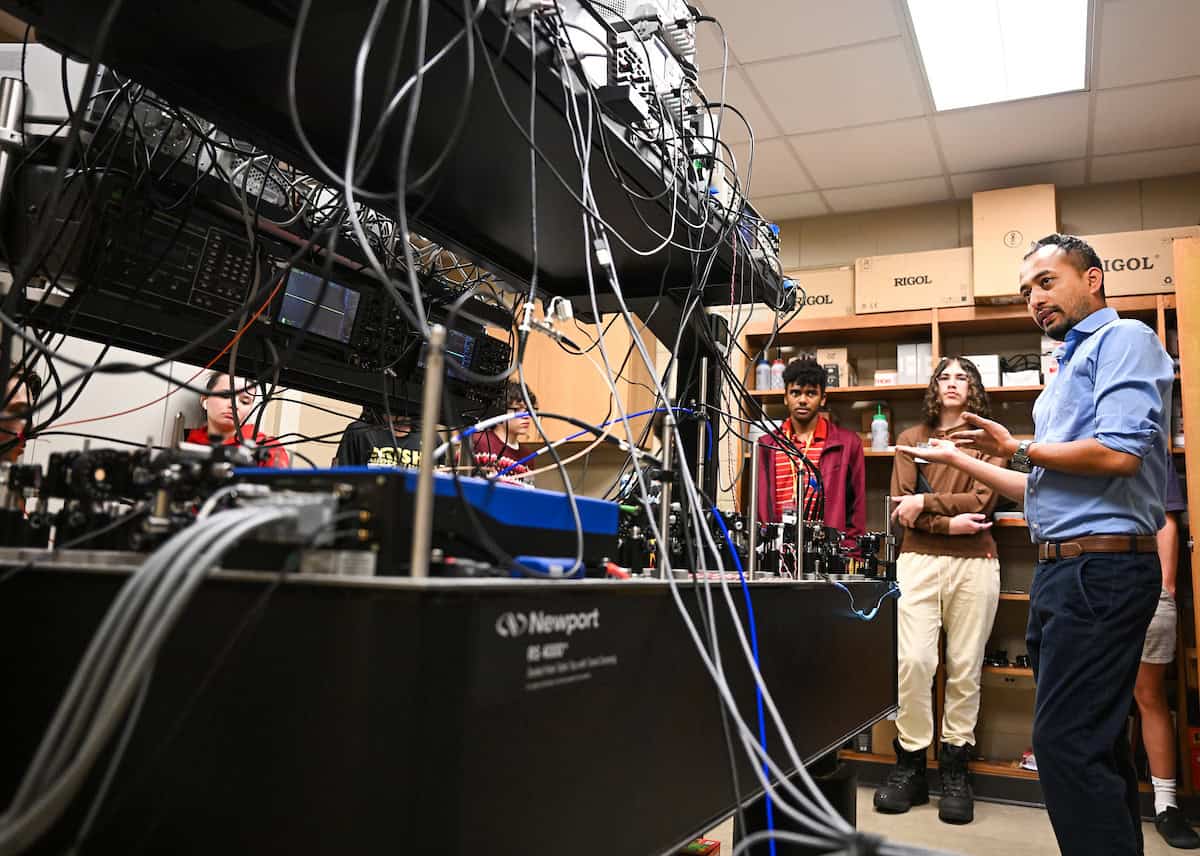
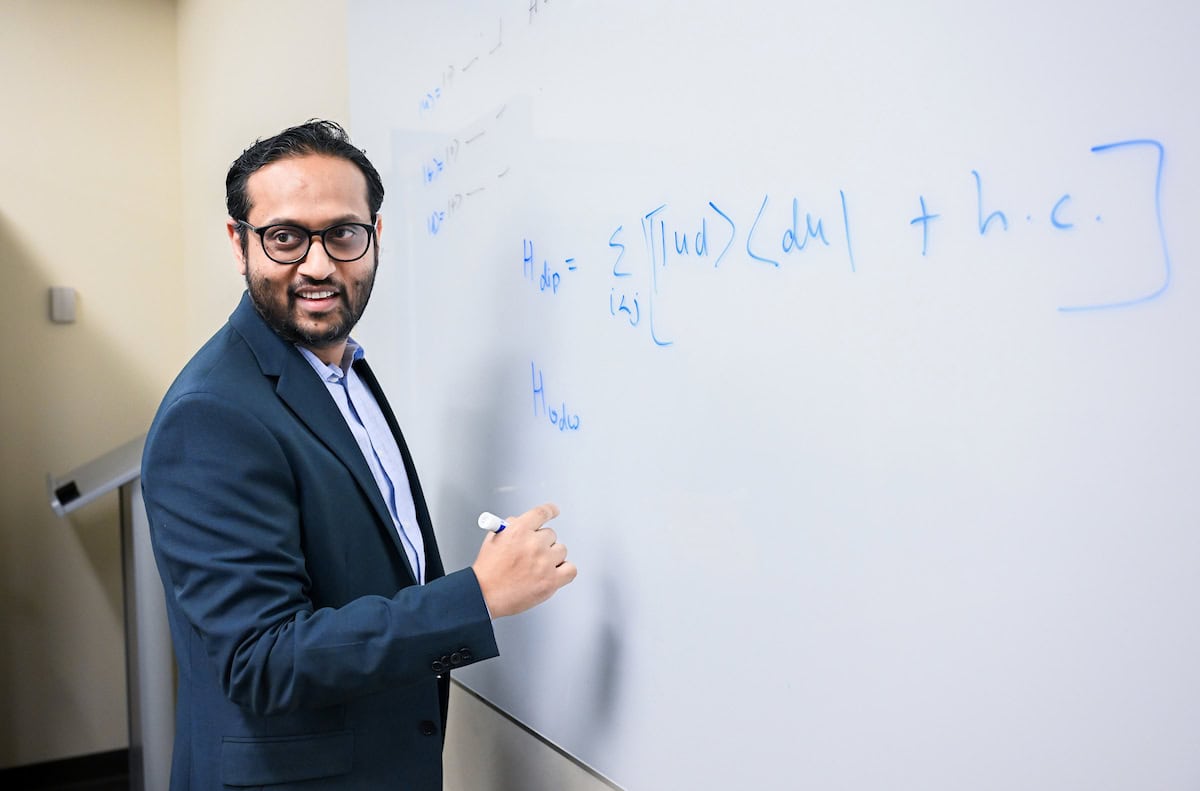
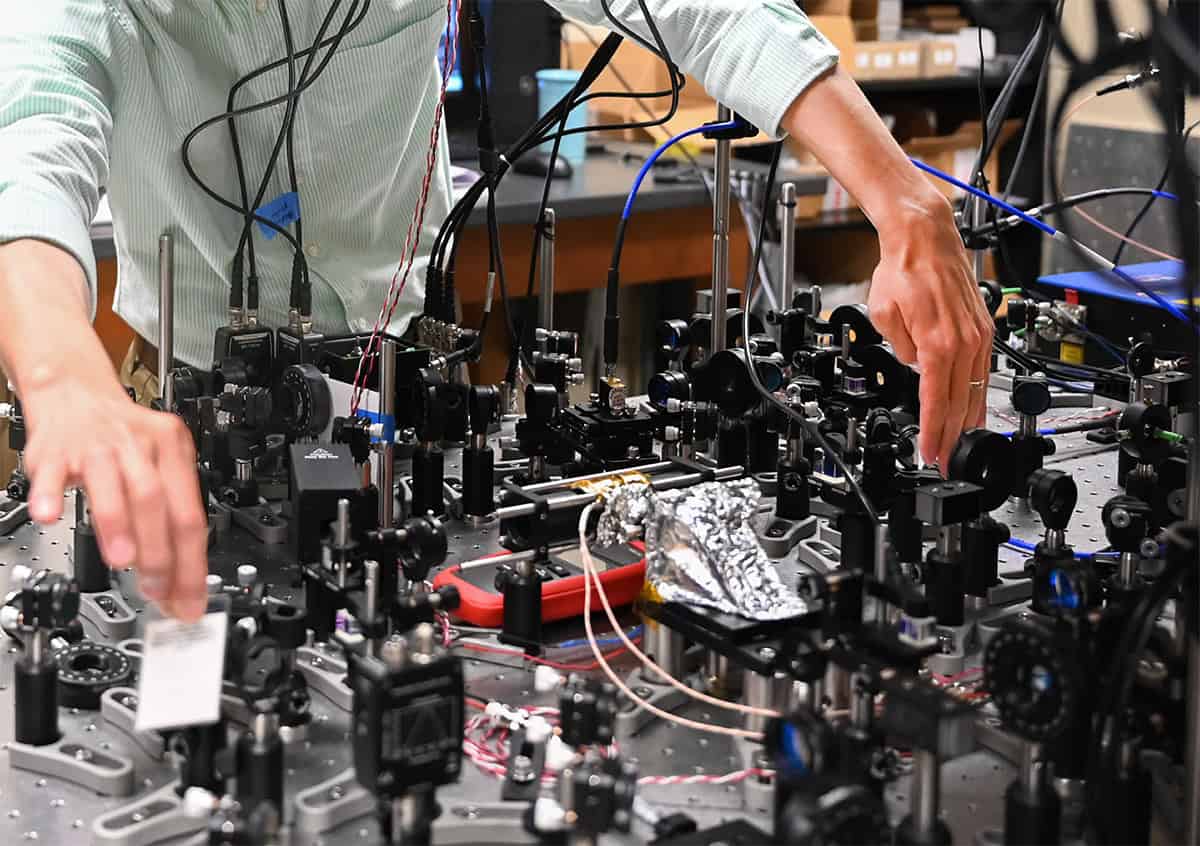
Kristian Dominek Barajas is head of quantum theory at the UK-based quantum computing company Oxford Ionics, which merged with the US firm IonQ in 2025. Barajas got his PhD – which was focused on developing analytic methods for high-accuracy models of driven quantum systems beyond the rotating-wave approximation – at the University of California Los Angeles, US, via the American Physical Society’s Bridge Program. The programme provides pathways into research for qualified students who might not otherwise continue their physics education. He now serves as chair of the APS Committee on Minorities (2025–2026), where he helps shape national initiatives that support physicists from historically marginalized backgrounds – particularly people of colour, LGBTQIA+ physicists, and physicists with disabilities.
What skills do you use every day in your job?
Because I’m relatively new to the field, I often have to break difficult questions down into simpler ideas before I can grapple with them. That has trained me to take a really complicated problem and give it my best guess, and that first-pass intuition often gets me surprisingly close to the full solution.
The other thing I’d highlight is leadership skills. I come from an untraditional background – it took me a long time to do my undergraduate degree, and afterwards I worked in a lot of different jobs, including working at a pet store, where I was training to become a team lead. When I went to grad school, I applied through the APS Bridge Program, which is great, and it gave me an opportunity to get into research. But again, my path wasn’t traditional: I did soft condensed matter physics for four years, and then my advisor passed away unexpectedly, so I switched fields to trapped ions because I needed to graduate. I had no background in quantum physics at that point, so it was quite a transition.
Experiences like this added up. By the time I joined Oxford Ionics right before the merger with IonQ, even though I was the “greenest” person in my team in terms of being new to the field, I had the most leadership experience. That meant I went from being an entry-level quantum theorist to a senior quantum theorist in two or three months. A month and a half later, I became the atomic, molecular and optical (AMO) theory manager. The experience I’d gained made it easy to set priorities and get people to go in the correct direction.
What do you like best and least about your job?
My least favourite part of the job is that I don’t get to read much new research. The job is so fast-paced and there’s so many things happening every day that getting the chance to sit down and read an article is quite rare. I use AI tools to help me find and keep up with new research. Part of my workflow involves asking AI to identify relevant papers and give me an initial sense of what I need to know. I still skim the papers themselves as much as I can, but I don’t get the chance as often as I’d like to pick up a manuscript and spend a whole day working through it like I did in academia.
We also don’t always have the time to write papers about what we’re doing. It’s not that we aren’t allowed to – in fact, we’re encouraged to pursue that if we want to do it – but finding time is challenging.
I’m constantly getting to do new and interesting physics, and I absolutely love that about my job
The upside is that the pace at which I get to do research far, far outweighs what I experienced in academia. What we accomplish on our team in four to six weeks is comparable to the amount we would do in six months in academia. It is absurd how fast we get to move. I’m constantly getting to do new and interesting physics, and I absolutely love that about my job.
What do you know now that you wish you’d known at the start of your career?
I wish I’d known that feelings of imposter syndrome don’t always have to be something to fear. For me, they can also be a reminder that there is still so much more to learn, and that can be exciting. That’s why I was so excited for the opportunity to earn my PhD in physics: it gave me the chance to keep learning. Now, whenever that old imposter feeling comes up, I try to see it as an opportunity to learn rather than a reason to hold myself back. I wish I had embraced that earlier in my career and not been so afraid to try things.
Quantum theory is one of humanity’s great intellectual achievements, radically transforming our understanding of nature at the deepest level while delivering unprecedented technological advances. We have thus always felt it a great pity that most young people never get the opportunity to engage with the theory at a substantive level.
The solid-state physicist David Mermin, who has studied the fundamentals of quantum mechanics, once memorably wrote of quantum theory: “We now know that the Moon is demonstrably not there when nobody looks”. It was a comment that certainly captures the imagination, but it is difficult to appreciate what he meant meant without engaging with the mathematics that lies behind it.
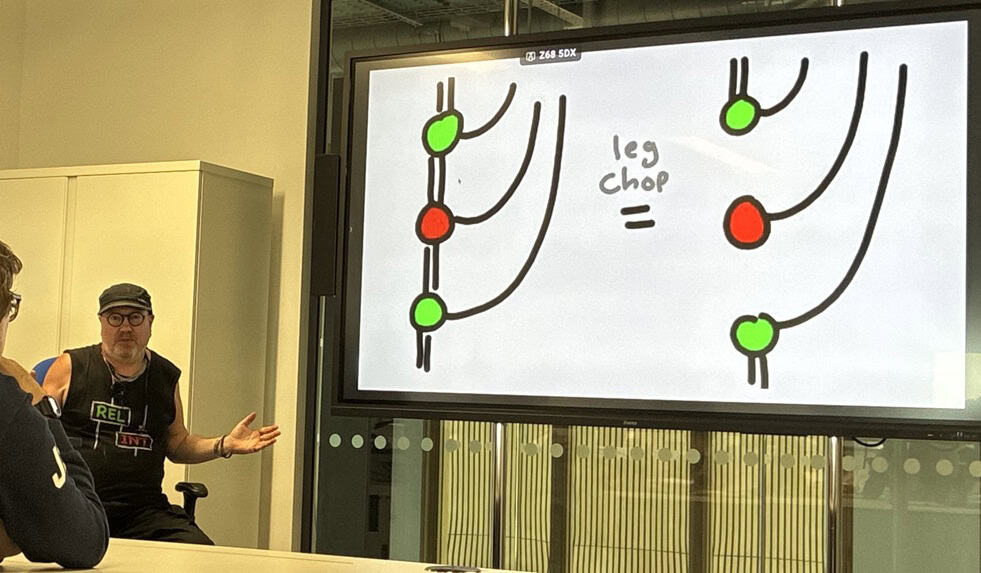
In an attempt to see if we could change that, we ran our first Quantum in Pictures programme at the University of Hertfordshire earlier this month. A five-day, in-person course, it was attended by about 45 students aged 16–18 and was built around Quantum Pictorialism – a diagrammatic approach to quantum theory pioneered by Bob Coecke from the University of Oxford and collaborators.
Seeing for real Bob Coecke using his pictorial approach to the subject (Courtesy: Shanti Pise and Leron Borsten)
The crucial point is that the pictures aren’t illustrations of some more fundamental mathematics hidden underneath. The pictures are the mathematics. A rigorous graphical calculus built from spider diagrams enables students to reason directly about quantum processes. Since this diagrammatic formulation is fully equivalent to the usual Hilbert space formalism, the students were doing quantum mechanics for real.
We felt truly privileged to share the mysteries of quantum mechanics with a fantastically friendly, interested and diverse cohort from schools across south-east England. What struck me was how readily they engaged with the material: asking excellent (and sometimes rather challenging) questions, debating ideas and working collaboratively through the problem-solving sessions.
The graphical problems proved particularly popular, with repeated cries for “more spider diagrams!”. The course was deliberately ambitious, but by the end, they were able to work through the complete quantum teleportation protocol. Indeed, one student was confident enough to get up and reason through it for the whole class (something we certainly would not have dared to do at their age).
As Maya, a year-12 student from Highams Park Sixth Form in London, put it: “I really enjoyed seeing how ideas in quantum physics could be explained through simple pictures and diagrams. I was surprised that concepts like quantum teleportation, which seemed very complicated at first, could become much easier to understand through this approach. The programme has made me even more interested in studying physics and exploring quantum theory in the future.”
The approach also worked for students without a traditional mathematics or physics background, such as Andrew, a year-12 student from Sir John Lawes School in Harpenden.
“The programme was captivating,” he said. “The concept of using diagrams was innovative and explained things in a logical manner to help me understand topics such as quantum teleportation. The programme showed the stark differences between classical and quantum physics through real-world examples, enriched by talks from industry experts and pioneers with different backgrounds.”
Muhammad Hamza Waseem, who helped develop the programme and joined us on the final day, captured the atmosphere perfectly. “I found the enthusiasm, curiosity, and irreverence of the students very inspiring,” he said, “and I hope that they take the same spirit into their university education and beyond.”
That sense of joy and excitement was, for me, the lesson of the week. We’ve been thoroughly convinced that quantum theory isn’t intrinsically beyond the reach of curious 16-year-olds. We just need to give them the right mathematical language. The next step is an optional graduate-level exam, which will put that claim to the test. Watch this space.
The authors would like to thank staff, researchers and students from the University of Hertfordshire who volunteered their time to make the programme possible. They are also grateful to Ian Loffler, Bob Coecke and Muhammad Hamza Waseem for their support and inspiring contributions.
Simulating quantum systems is something that classical computers struggle with. Not surprisingly, quantum computers are expected to do a much better job – particularly when a quantum-computer’s architecture is designed to solve a specific type of physics problem.
My guest in this episode of the Physics World Weekly podcast is Ross Jenkinson of the UK’s University of Manchester. He talks about the challenges and rewards of using quantum computers in particle physics – a field where classical supercomputers can struggle to simulate simple systems.
We also explore how quantum information theory is being combined with Einstein’s general theory of relativity to shed light on the nature of space and time.
This podcast is supported by American Elements, the world’s leading manufacturer of engineered and advanced materials. The company’s ability to scale laboratory breakthroughs to industrial production has contributed to many of the most significant technological advancements since 1990 – including LED lighting, smartphones, and electric vehicles.
As I was strolling through Belfast’s Titanic Quarter last summer, I discovered with delight a road called Bell’s Theorem Crescent. It’s named in honour of the Belfast-born physicist John Bell, best known for his eponymous theorem. Despite not being as embedded in popular culture as Schrödinger’s cat, his theorem will certainly ring a bell (forgive the pun) with most physicists.
The story goes back to 1935 when Albert Einstein, Boris Podolsky and Nathan Rosen (EPR) came up with their now-famous thought experiment, which was designed to show that quantum mechanics was, as a description of nature, incomplete. In the EPR scenario, non-local influences can affect the measurement outcomes performed on spatially separated particles.
Given how odd that seemed, some physicists invoked what are known as “hidden variables” to get rid of these non-local correlations and restore local realism. It was in 1964, while working at the CERN particle-physics lab, that Bell showed that no local hidden-variable theory can be compatible with the predictions of quantum mechanics.
This result – Bell’s theorem – is something I was familiar with but I had paid little attention to where it had originally appeared. As I discovered, it was published in a paper called “On the Einstein Podolsky Rosen paradox” in the journal Physics (3 195) in 1964. Also known as Physics Physique Физика, this little-known publication existed only from 1964 to 1968. In fact, Bell’s theorem is the most important result published in it.
The journal was set up by two physicists at Bell Laboratories in the US – Bernd Matthias and future Nobel laureate Philip Anderson. According to A Mind Over Matter– Andrew Zangwill’s 2021 biography of Anderson – they were not too happy with conventional physics journals. “The referees,” Anderson said, “often did a bad job, the editors took too long to make decisions, and too much wrong physics got published.”
Those are complaints you’ll still hear in coffee breaks at most physics conferences today, and they prompted Matthias to contact the media magnate Robert Maxwell, who’d founded Oxford-based publishing house Pergamon Press. Maxwell had figured out that scientific publishing could be a very lucrative business so he helped the two physicists to set up the journal.
A publishing experiment
In their first editorial, Anderson and Matthias called Physics an “experimental journal”, which they hoped would solve the problem of there being “far more good physics written than any physicist can read”. Their solution was to pick only those papers worth the attention of all physicists, which the editors did by reviewing – then accepting or rejecting – every submission themselves. They even paid authors 10 cents a word if their paper appeared in print.
Anderson and Matthias admitted that many physicists had already written to them, criticizing their proposed selection model. They’d been told that their “judgements will be fallible”, that they might be “overimpressed by showiness”, and that they’d end up rejecting excellent work. In response, the pair promised to try their best, accepting they would make mistakes and that their “criteria will be, not better, but different”.
The journal’s criteria clearly succeeded, in that Anderson and Matthias identified the merits of Bell’s paper, which was far from mainstream
These criteria clearly succeeded, in that they identified the merits of Bell’s paper, which was far from mainstream. Keen to find out more about the events surrounding its publication, I contacted Zangwill, who had interviewed Anderson several times for his book. Zangwill shared the following quote, published here for the first time.
“One day,” Anderson recalled, “a paper came in from a guy neither of us had heard of – John Bell. It was about hidden variables in quantum mechanics. Bernd had no clue, but I accepted it with the hope that its publication would spell the death of Bohmian trajectory quantum mechanics. It’s a very famous paper today.”
In 1967 the quantum physicist John Clauser found Bell’s paper after stumbling uponPhysics Physique Физика, attracted by its unusual title. Clauser, who shared the 2022 Nobel Prize in Physics, carried out the first Bell test in 1972 with Stuart Friedmann. Their work triggered a long series of experiments that would deepen our understanding of quantum mechanics and catalyse the development of quantum technologies.
Over its short life, Physics did publish work from other notable physicists including Murray Gell-Mann, Leonard Susskind and Leo Kadanoff. In fact, the journal was ahead of its time, with the model of in-house editorial selection for broad interest returning in the 2000s with the Nature series of journals. The inclusive, multi-language title was also well ahead of its day.
Sadly, Physics Physique Физика was discontinued in 1968 after just three volumes
Sadly, Physics Physique Физика was discontinued in 1968 after just three volumes. According to what Anderson told Zangwill, it stopped “not because it lacked submissions, but because they had promised contributors rapid publication and Maxwell kept increasing the time between the appearances of successive issues”. Maxwell’s aggressive pursuit of profit might also have played a role.
The journal has since been archived by the American Physical Society and is freely accessible online. One can only wonder what might have happened if Anderson and Matthias had picked a different name for their journal.
Science fiction has long embraced the idea of travelling backward in time, but the advent of Einstein’s general theory of relativity transformed these ideas from fantasies into potential – albeit contested – realities. In particular, solutions to the equations of general relativity known as closed time-like curves (CTCs) seem to allow a system’s trajectory to return to a previous point in time. Although the existence of CTCs has never been proven, their admissibility within general relativity has inspired many physicists to study their implications, which include increases in information processing speeds as well as retrograde time travel.
Inspired by the 2014 film Interstellar, in which a father sends messages to his daughter in the past, Kaiyuan Ji and Mark Wilde of Cornell University, together with Seth Lloyd at the Massachusetts Institute of Technology, have now investigated the potential advantages of a retrograde messaging channel based on a CTC. As well as deriving an exact expression for the information capacity of such a channel, they showed that this capacity exceeds that of regular channels that do not involve backward time travel.
Post-selected CTC models
To model their CTC, the researchers used an approach that Lloyd and his then-collaborators developed 15 years ago. This approach exploits the mathematical equivalence between a CTC and the combined operations of quantum teleportation and post selection, so it is often referred to as a post-selected CTC model. Previous analyses established that this model disallows time-travel paradoxes such as going back in time to kill your grandfather, while still preserving correlations between the system that travels backward in time and the environment.
The latter feature is important, Ji notes, because quantum CTC models without it have a distinct drawback: “If you travel through that closed time-like curve, you end up in the past, but basically you lost all the memory of what has happened before you do time travel,” he explains.
A further advantage of the team’s chosen model is that it does not prohibit causal loops in which correspondents in the past and future influence each other. To return to the Interstellar scenario, Ji explains that while the daughter is influenced by her father’s message, she also influences her father, because he witnessed how she decoded the message and therefore used that information to optimize his encoding protocols.
The existence of causal loops in the model allowed Ji and his colleagues to formulate an expression for the channel’s bit capacity. It also pointed towards the best way of maximizing that capacity. The optimal strategy, Ji explains, would involve the father using his memory from the past when encoding his message to the past, which makes sending messages to the past more efficient (and capable of a higher bit capacity) than sending messages to the future. “The causal loop is essential to the design of the optimal communication protocol in this retro causal communication setting,” he tells Physics World. “It is not possible in standard communication from the past to the future.”
Capacity for messages
The CTC can also be used to form a quantum channel capable of transmitting either regular classical data or quantum data back in time. Using their expression for the channel’s bit capacity, the researchers were able to show that its classical bit capacity is twice that of its quantum counterpart.
Nicole Yunger Halpern, a theoretical physicist at the University of Maryland who has studied some implications of CTCs for metrology but was not involved in the current work, describes the research as “creative and technically impressive”. She points out that while calculating a communication channel’s capacity is a common challenge in the field of information theory, obtaining straightforward answers can be difficult. “The authors combined this workaday task with a highly unusual (retrocausal) setting and, moreover, obtained a simple solution,” Halpern says.
Not everyone is sold on the mathematical format of post-selected CTC models, though. Scott Aaronson, a computer scientist at the University of Texas at Austin, US, who has previously studied the speed advantages of information processing using CTCs, believes that studies with this approach “attempt to model time travel but don’t fully succeed at it”. However, with respect to the question of channel capacity, Aaronson concedes it may be “interesting to prove things”.
While the current model considered the effects of distortion (“noise”) on messages in the channel, Ji suggests it might be interesting to broaden this to include noise in the memory of the process – like the father in Interstellar having a hazy recall of his daughter’s decoding protocol. Ji also notes that the post-selection CTC model has some mathematical equivalence with black hole final state projections, and he says it might be interesting to explore these connections, too.
Quantum connections UTC Quantum Center brings together a cross-disciplinary mix of departments and colleges to support targeted development efforts in research infrastructure, translational R&D and education. (Courtesy: Angela Foster/UTC)
Think big, win big. The University of Tennessee at Chattanooga (UTC) is ticking both boxes, it seems, with a programme of strategic investments spanning quantum research, education, workforce development and academic-industry partnerships. By 2030, the hope is that those investments will pay out, putting Chattanooga on the fast-track to becoming the “Quantum Capital of the South” – a destination where researchers, students, entrepreneurs, industry leaders, national laboratories and public-sector partners work together to accelerate quantum discovery and deployment.
“Success will be measured not only through research funding and scholarly output, but also through the strength of the quantum ecosystem and the opportunities it creates throughout the region,” says Mina Sartipi, UTC’s interim vice-chancellor for research. Equally important, early-career faculty and researchers will have the opportunity to make an outsized impact. “They are not entering an environment where every role has already been defined,” she adds. “They are helping to build the future of quantum science and engineering in Tennessee, delivering a long-term vision that extends well beyond the university.”
Quantum excellence
The UTC Quantum Initiative got under way in 2022 and, two years later, was followed by the establishment of UTC Quantum Center. The latter provides the engine-room for UTC’s quantum ambitions, bringing together a cross-disciplinary mix of departments and colleges across the university to support targeted development efforts in research infrastructure, translational R&D and education. “Ultimately, we want UTC Quantum Center to be recognized as a destination for top quantum talent,” says Sartipi. “A virtuous circle that will see us attracting outstanding faculty, students and research partners from across the country and internationally.”
Mina Sartipi “Ultimately, we want UTC Quantum Center to be recognized as a destination for top quantum talent.” (Courtesy: Angela Foster/UTC)
As the inaugural director of UTC Quantum Center, Rick Mukherjee is tasked with implementing and delivering UTC’s quantum growth plan. “The priority is to put Chattanooga on the map in terms of quantum science and technology innovation,” he notes. “We’re creating a quantum centre-of-excellence at UTC where interdisciplinarity underpins everything we do, engaging associated faculty and research students from core disciplines like physics, mathematics, electrical engineering and computer science.”
Entangled pathways
If that’s the back story, what of the detail? The research effort at UTC Quantum Center is organized around four headline themes: quantum networking; quantum imaging and sensing; quantum information theory; and quantum simulation of many-body phenomena (using one quantum system to emulate another).
The collaboration with EPB is pivotal in each case, with UTC Quantum Center providing one of the nodes on the utility’s metro-area quantum network (the first commercial quantum network of its kind in the US) and, by extension, gaining priority access to EPB’s in-house quantum computer (an IonQ trapped-ion system with 36 physical qubits).
The EPB network, which runs across a pre-installed fibre-optic base, is effectively a proof-of-principle testbed for national and international quantum connectivity. “This is one brick in the wall towards next-generation quantum networking applications – from quantum key distribution and quantum cryptography to distributed quantum computing and the quantum Internet,” notes Mukherjee.
A case in point: one of the first experiments that UTC Quantum Center performed in collaboration with ORNL involved the development of an automatic system that continuously corrects for distortions in fibre-optic cables and, in so doing, allows quantum information to transit reliably across a city-scale network. The system maintained high-quality quantum entanglement for more than 30 hours, demonstrating a key capability for future quantum communication networks.
Rick Mukherjee “We’re creating a quantum centre-of-excellence at UTC where interdisciplinarity underpins everything we do.” (Courtesy: Angela Foster/UTC)
“Currently, our researchers are transmitting pairs of entangled photons across EPB’s fibre network and characterizing multipartite entangled states,” explains Mukherjee. “This work represents the next step toward realizing the potential of quantum networks for advanced communication, sensing and distributed quantum computing applications.”
Alongside his leadership role, Mukherjee remains an active researcher and oversees a group of research faculty, postdocs and graduate/undergraduate students who specialize in theoretical quantum physics, quantum algorithms and quantum machine-learning applications. Crucially, the team’s algorithms are designed to be hardware-agnostic, allowing them to run across diverse quantum computing architectures – from superconducting and neutral-atom systems to photonic platforms – regardless of the vendor.
By avoiding dependence on any one technology, the research is positioned to adapt versus a rapidly changing quantum landscape. “Whatever modality ultimately wins the race to deliver at-scale quantum computing,” Mukherjee says, “we’ll be ready to deploy our algorithms and unlock quantum advantage on those machines.”
The quantum connector
Alignment with industry is a defining theme at UTC Quantum Center, evidenced by a twin-track approach that aims to engage both technology developers and future end-users. On the one hand, Mukherjee and colleagues are initiating traditional academic-industry partnerships with hardware and software companies at all levels of the quantum supply chain; on the other, they are positioning UTC as a “quantum connector” to help businesses and public-sector organizations de-risk the early-stage adoption of quantum technologies and applications.
“Universities have an important role to play here,” says Mukherjee. As such, he sees UTC Quantum Center as an “honest broker”, providing specialist information in an unbiased manner to help engineering and management teams understand the commercial upsides of quantum technologies across sectors as diverse as finance, healthcare, telecoms and energy.
“We are working with the future adopters of quantum on their early-stage orientation and upskilling,” he explains. “Our professional development programmes – ‘Quantum 101’ if you like – will ensure Tennessee has a ‘quantum-ready’ workforce.”
Proof-of-concept R&D studies represent a natural progression of such partnerships, with UTC researchers addressing real-world problems that could potentially be better solved using quantum methods and applications. Joint projects with utilities like the Tennessee Valley Authority, for example, are developing quantum algorithms for power grid optimization and load management. Elsewhere, UTC Quantum Center recently published work on the gate-assignment problem (another quantum optimization challenge) with Lufthansa Industry Solutions (the research arm of Germany’s Lufthansa Airlines). A similar research collaboration is underway with the consultancy Deloitte.
Network effects
That engagement with industry is matched by UTC Quantum Center’s efforts to build bridges with other academic institutions. Over the past two years, Mukherjee and his team have put in place a network of collaborations with quantum researchers at top-tier universities, among them Harvard, Purdue, Texas A&M and the University of Tennessee at Knoxville in the US as well as the University of Hamburg in Germany.
Quantum discovery UTC Quantum Center’s research programme covers four main themes: quantum networking; quantum imaging and sensing; quantum simulation of many-body phenomena; and quantum information theory. (Courtesy: Angela Foster/UTC)
The recently announced UTC/ORNL Governor’s Chair in Quantum Information Science and Engineering reflects the momentum of these efforts. This senior faculty position will further strengthen ties between UTC and ORNL, with the eventual post-holder overseeing a joint team across both institutions to create new opportunities for collaborative research, student engagement and workforce development.
So what does success look like for UTC Quantum Center in 2030? “Ultimately,” concludes Sartipi, “success means that when people think about the future of quantum technologies in the US, they think of Chattanooga as the Quantum Capital of the South – a place where talent is cultivated, partnerships flourish and discoveries translate out of the laboratory into societal and economic impact.”
Quantcore is a spin-out from the University of Glasgow and is based at the university’s Advanced Research Centre.
Quantcore builds the superconducting processors, resonators and sensors used in quantum computers and certain sensing systems. The firm uses niobium-based components, which can operate at higher temperatures than materials currently used in quantum computers. The firm recently received £2.5m in seed funding from several backers.
The qBIG award, now in its fourth year, is sponsored by the UK-based venture capital firm Quantum Exponential and includes a £10,000 cash prize as well as mentoring from Quantum Exponential and business support from the IOP. The award was presented yesterday in London at the Economist Commercialising Quantum 2026 event.
Accepting the prize on behalf of the company, Quantcore chief executive officer Jack Brennan says he is “delighted” to win the award.
“The previous winners are a great example of up-and-coming quantum companies, and it’s a privilege to be part of that list,” he says. “A huge thanks to the qBIG group for choosing Quantcore, and a huge thanks to my fantastic team for working so hard to build the company.”
Two runners up were commended by the IOP. One is Mater-AI, which develops thermoelectric materials for energy conversion and cooling. The other is Skydiamond, which produces lab-grown diamonds that can be used in quantum computing as a material for creating qubits.
“The UK quantum industry is going from strength to strength – and is becoming a major growth engine,” says Louis Barson, IOP’s director of science, business & education. “The qBIG prize is all about celebrating the strong pipeline of new physics-powered quantum innovators like Quantcore coming through – and giving them a platform to help accelerate that growth.”
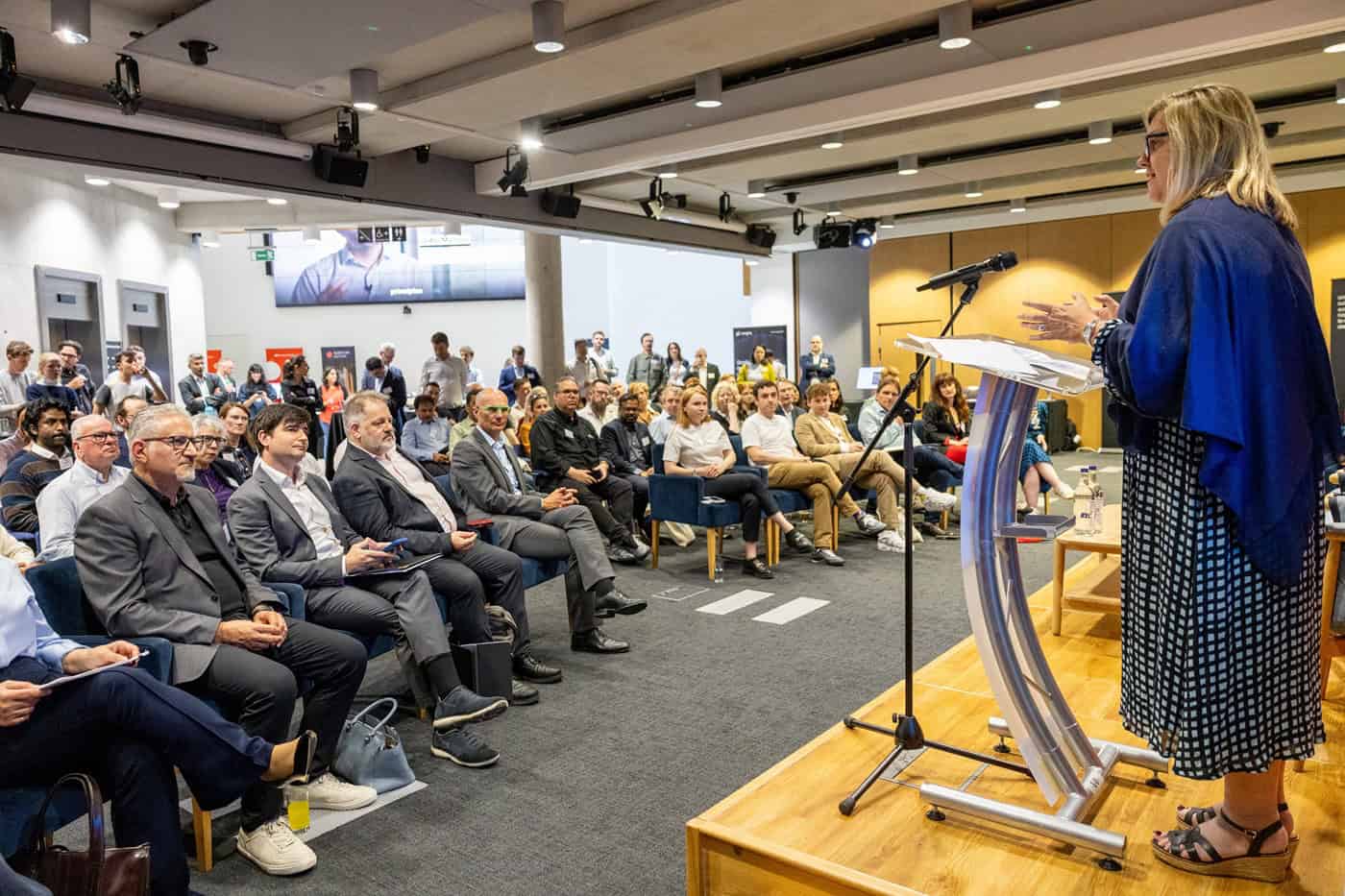
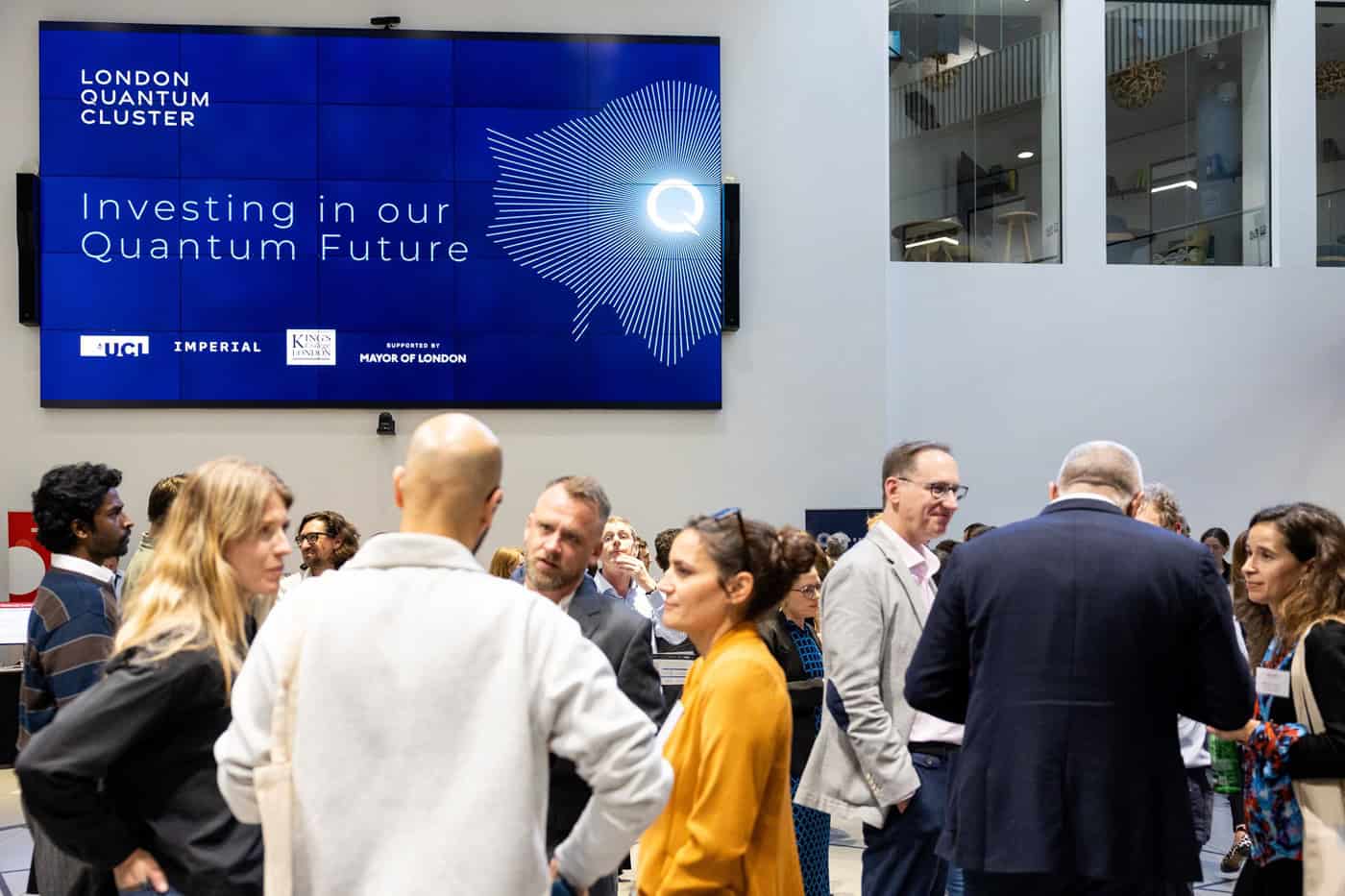
Capital connections Janet Coyle from London and Partners addressing delegates at a meeting at the Institute of Physics to mark the first anniversary of the London Quantum Cluster. (Courtesy: Carmen Vilano)
“There are two types of people when it comes to quantum,” joked Howard Dawber, deputy mayor of London for business and growth at a meeting at the Institute of Physics last night to celebrate the first anniversary of the London Quantum Cluster.
“There are those who understand quantum mechanics. There are those who don’t. And there are those who are in superposition of understanding and not understanding until they are observed.”
It was a light-hearted remark that matched the mood of what was essentially an evening of boosterism for quantum technology in London ahead of London Tech Week next week.
As chair of London and Partners – the growth agency for London – Dawber told the gathering of more than 100 “quantum influencers” that the organization was “100% behind the London Quantum Cluster”.
Founded in 2025 by University College London, King’s College London and Imperial College London, with support from the Mayor of London and the UK government, the cluster seeks to establish the capital as a powerhouse of quantum tech.
Georgia Siora from Warwick Economics and Development presented data to show that London is already doing well in the sector, being home to more than 160 quantum companies, with seven of the top 10 UK quantum firms based in the city. Small- and medium-sized quantum firms in the capital, she added, contribute an estimated £153m annually to the economy.
Happy anniversary The London Quantum Cluster is now one year old. (Courtesy: Carmen Vilano)
“Quantum and deep tech are at the heart of the capital’s 10-year growth plan,” added Janet Coyle, managing director of London and Partners.
Geraint Rees, vice-provost for research, innovation and global engagement at UCL, said his aim was “to make London the best place on the planet for serious quantum companies”. He pointed to UCL spin-out Quantum Motion, which has just won $160m of venture-capital funding, as an example of the kind of firm making a name in the city.
The evening ended with a panel debate chaired by Jess Wade from Imperial College London, featuring Maria Maragkou from Nu Quantum as well as Richard Murray, founder of ORCA Computing, who drew a distinction between universities being all about expanding the frontiers of knowledge, whereas for start-ups “the aim is to win”.
Also on the panel was physicist Alejandro Montblanch – head of quantum communication and networking at banking group HSBC – who made it clear that what he wanted to know was: “How can your quantum company help HSBC make more money?”
A welcome note of caution came from London-based venture-capital investor Eloisa Angeles, who pointed out that while the UK has a good track record of government-funded research, the UK is weak at “follow through”, with the government not focused on procurement and not having the end customer of the research in sight.
The experiment centered on the Aharonov–Bohm effect, a strangequantum phenomenon where electrons respond to a magnetic field even when they never actually pass through it. First predicted back in 1959, this effect has been notoriously difficult to confirm because the changes it causes in electronwaves are incredibly subtle.
In 1980, physicist Michael Berry showed that classical systems could model the Aharonov–Bohm effect. In this analogy, a vortex at the center of a water tank replaces the solenoid that creates a magnetic field in the quantum experiment. Water waves take the place of electrons. When these waves travel around the vortex, rather than through it, they acquire a measurable distortion. This appears as a pitchfork-shaped pattern in the wave fronts, showing that the vortex changes the phase of the waves without direct contact. The OIST team extended the approach by testing a new scenario.
“With waves traveling the opposite direction, you see a mirror image pattern,” says Jonas Rønning, co- author and former postdoc in the OIST unit. “The question for us was, what happens if you send waves from both directions at the same time? We thought that the patterns might cancel each other out, or both pitchfork-like patterns would be visible, but our intuition was completely wrong.”
Two Waves Walk Into a Vortex
The researchers constructed a custom tank, created a vortex at its center, and sent waves from opposite sides to meet in the middle. They used a high-speed camera to observe how the waves interacted on the water’s surface.
Without a vortex, the peaks and troughs remain in place. When the vortex is there, the standing wave breaks down. The vortex shifts the phase of the waves as they travel around it, altering the standing-wave interference pattern and creating rotating nodal lines. These are lines of momentarily flat water that spiral outward and turn in the opposite direction of the vortex.
“This was something new and unexpected,” says Aditya Singh, a PhD student in the Nonlinear and Non-equilibrium Physics Unit and co-first author of the study. “That’s what makes this fluid analogue system so valuable. It reveals topological effects — wave behaviors that occur across the whole system — that can’t be seen in quantum experiments.”
At first, the team suspected their equipment was causing the rotating lines. However, the same pattern also appeared in their computer simulations.
“When we first saw these lines, we thought they were an experimental artifact,” Singh says. “But when we also saw them in our simulations, we dropped everything and quickly worked out the mathematics underlying how they arise.”
More Speed, More Lines
As the strength of the vortex increased, more rotating nodal lines appeared, always moving in the direction opposite to the vortex. The study showed that the number of lines is quantized, meaning it is fixed to whole-number values determined by the vortex’s circulation. In other words, the topology of the vortex determines how many rotating nodal lines appear. This effect was observed across the entire wave field, not just near the vortex core as earlier models suggested.
This finding differs from Berry’s original experiment, which observed changes only near the vortex. In this case, the researchers discovered a non-local effect, a pattern that covers the entire system and depends on the overall setup. Instead of being limited to the area near the vortex, the rotating nodal lines appeared throughout the whole standing-wave pattern.
Although the practical uses of these newly discovered nodal patterns are not yet clear, the study shows that simple classical systems can reveal behaviors that are challenging to observe in quantum experiments. By making these effects visible, the researchers plan to explore more complex wave systems that could offer new insights into superconductivity and other quantum phenomena.
“One direction is to make the system more complex by introducing multiple vortices and arranging them into a lattice,” senior author Mahesh Bandi says. “That setup would mirror conditions in some superconducting materials, with the water waves behaving like a supercurrent. We don’t yet know what we’ll see — and that’s exactly what makes it worth doing.”
Austin Burgess is a writer and researcher with a background in sales, marketing, and data analytics. He holds an MBA, a Bachelor of Science in Business Administration, and a data analytics certification. His work focuses on breaking scientific developments, with an emphasis on emerging biology, cognitive neuroscience, and archaeological discoveries.
The White House has issued an executive order aiming to unify and accelerate U.S. development of quantum technologies, including space systems that could enable next-generation navigation, sensing and secure communications.
In her YouTube video Bell’s Theorem Experiments on Entangled Photons, Dr. Fugate shows how polarization-entangled photons violate Bell’s inequality. In this Insight, I will use quantum information theory to explain why such entangled photon-polarization qubits violate the version of Bell’s inequality due to John Clauser, Michael Horne, Abner Shimony, and Richard Holt known as the...
Towards the end of the first lecture for the Qiskit Global Summer School 2025, Foundations of Quantum Mechanics, Olivia Lanes (Global Lead, Content and Education IBM) stated: Before we end, let’s now briefly talk about the birth of quantum information science, a pivotal shift that began in the 1990s. This is the era when researchers...
Comment on PBS Space Time video PBS Space Time produces some very good videos on the foundations of quantum mechanics (QM), so let me comment on their video What If Physics IS NOT Describing Reality to provide (crucial) missing information. This comment pertains only to the first 9 min of the video, i.e., it has...
The concept of quantum superposition (or superposition for short) is very counterintuitive, as Schr##\ddot{\text{o}}##dinger noted in 1935 writing [1], “One can even set up quite ridiculous cases.” To make his point, he assumed a cat was closed out of sight in a box with a radioactive material that would decay with 50% probability within an...

 Login

 This podcast is supported by