The tech giant is investing in the natural-gas-burning power plant as part of a huge data center in Texas, even as it pledges to honor climate commitments.
NASA just made an interstellar tweak to the Voyager 2 spacecraft, known as the "Big Bang", to keep its remaining 50-year-old science instruments running a little longer.
Voyager 2 and its twin launched in 1977, called Voyager 1, rely on a form of nuclear battery known as a radioisotope thermoelectric generator that uses the heat produced by the decay of plutonium. But the supply of plutonium on each probe drops at about four watts a year on each spacecraft.
To keep the probe running on this dwindling power supply, engineers recently reduced Voyager 2's power requirements by turning off a few non-science devices and using "lower-power alternatives" that are still effective enough to keep the spacecraft warm while it's so far from the sun, NASA officials said in a statement. "The spacecraft power margins have grown razor thin, requiring the team to conserve energy by shutting off non-essential devices and systems," NASA officials wrote of the mission, which is managed by the agency's Jet Propulsion Laboratory.
The drop in power is having a measurable science impact on both spacecraft — each has turned off two of their science instruments since 2024 alone. While some of these instruments were shut off after the spacecraft finished their historic planetary flybys decades ago, others were turned off due to power requirements.
Each spacecraft initially launched with 10 instruments, and Voyager 2 is now down to only three instruments. At first it looked as though Voyager 2 would have to shut down another of these instruments later this year, but luckily, the new power shifts will allow all three to operate "for at least another year," NASA said.
Voyager 1 will be tasked to do the same "Big Bang" power change "in the coming months." A signal to each spacecraft takes nearly 24 hours (or one light-day) to make a one-way journey, and officials noted Voyager 1 is further from Earth than its twin. (Voyager 2 is at about 142 astronomical units or sun-Earth distances, while Voyager 1 is nearing 171 AU.)
The two spacecraft initially launched to take advantage of a rare alignment between the outer solar system gas giant planets, which in order of distance from the sun are Jupiter, Saturn, Uranus and Neptune. Each Voyager spacecraft first flew past Jupiter and Saturn, taking unprecedented imagery of the planets and their moons.
NASA's Voyager 2 probe captured this image of Europa, the smallest of Jupiter's four Galilean moons, on July 9, 1979. (Image credit: NASA/JPL)
Next, Voyager 1 was directed to fly above the plane of the solar system (also known as the ecliptic) while Voyager 2 continued flying past Uranus and Neptune, becoming the first spacecraft to see these worlds and their moons. Voyager 2's last planetary flyby was in 1989.
The two spacecraft continue to send scientific data from interstellar space; Voyager 1 passed into that region in 2012, while Voyager 2 did so in 2018. Voyager 1 is Earth's most distant spacecraft, currently around 15.9 billion miles (25.5 billion kilometers) away from us, according to NASA.
Apple Health data can now move between the Health app and Google Health on an iPhone. The connection lets Google Health import supported information recorded by an iPhone, Apple Watch, and compatible apps. The latest Google Health update can also send supported Fitbit information to Apple Health.
This two-way connection is useful for people who wear a Fitbit but prefer Apple’s Health app as the central place for viewing activity, sleep, steps, and other wellness information. It also reduces the need for third-party synchronization apps.
The feature requires a recent version of Google Health. Google began introducing support for sending data back to Apple Health with Google Health version 5.05. Because app updates can roll out gradually, the new sharing options may not appear until the latest version reaches your account.
Update Google Health Before Starting
The Fitbit app became Google Health in 2026. Existing Fitbit users should find that the installed app has changed its name and design after updating. Fitbit accounts must also be moved to an adult Google Account to use the redesigned service.
Google says the Apple Health connection requires iOS 16.4 or later. The iPhone must have internet access while the connection is being created.
To check the iOS version installed on your iPhone:
Settings > General > About > iOS Version
Install the latest compatible iOS update if the phone is running an older release.
To look for an available iPhone software update:
Settings > General > Software Update
Next, confirm that Google Health is current. Version 5.05 or later is required for the newer option that sends supported Google Health and Fitbit information to Apple Health.
To update Google Health from the App Store:
App Store > Profile Picture > Available Updates > Google Health > Update
If Google Health does not appear under Available Updates, search for the app manually. The App Store page may show an Update button if a newer release is available.
To find the app directly:
App Store > Search > Enter Google Health > Google Health (Fitbit)
People who previously used Fitbit should sign in with the Google Account connected to their Fitbit information. Creating a different account may produce an empty Google Health profile.
Image Credit: Google
Connect Apple Health Data to Google Health
Connecting the apps allows Google Health to read supported information from Apple Health. This can include data collected by the iPhone, Apple Watch, and other apps that already share information with Apple Health.
To start the Apple Health connection:
Google Health > Connections > Apps and Services > Apple Health > Get Started
Depending on the Google Health version and interface shown on the iPhone, Connections may appear behind the profile icon.
To find Apple Health through the alternative menu:
Google Health > Profile Icon > Partner Apps > Apple Health
Google Health will display a consent screen explaining the connection. Read the information before continuing.
To approve the initial connection:
Sync Google Health With Apple Health > Agree
The iPhone will then display Apple’s health permission screen. This screen lets you decide which information Google Health can read.
To give Google Health access to every supported category:
Apple Health Permission Screen > Turn All Categories On > Allow
You do not have to share every available category. Selecting individual permissions provides more control over sensitive health information.
To share only selected categories:
Apple Health Permission Screen > Select Each Health Category > Allow
Google Health can import supported information such as steps, distance, active energy, exercise records, routes, sleep sessions, sleep stages, heart rate, resting heart rate, heart rate variability, blood oxygen, respiratory rate, body temperature, weight, body fat percentage, water, nutrition information, and some cycle-tracking data.
Available categories depend on the devices and apps connected to Apple Health. An iPhone may provide steps and walking information, while an Apple Watch can contribute heart rate, workouts, sleep, and other measurements supported by the model.
After the permissions are approved, Google Health should confirm that the connection is complete.
To finish the connection:
Google Health Confirmation Screen > Done
New Apple Health information should begin appearing automatically in Google Health. Google has said that imported data can be used across relevant Google Health metrics, although not every external data type is used for every calculation.
To find imported health information:
Google Health > Health > Select a Metric
Google Health may display information from several connected sources together. Its value for a metric can differ slightly from the number shown by Apple Health because the apps may process available data differently.
Send Fitbit Data to Apple Health
Google Health version 5.05 adds the reverse direction that many iPhone and Fitbit users previously lacked. Supported information recorded through Fitbit can now be written into Apple Health.
Before enabling this option, make sure the Fitbit is properly connected to Google Health. Fitbit devices normally synchronize automatically throughout the day when Bluetooth is available and the wearable is near the iPhone.
To check the connected Fitbit:
Google Health > Profile Icon > Devices > Select Your Fitbit
The device page should show the wearable, its battery level, and its most recent synchronization time. Opening Google Health can also prompt a nearby Fitbit to transfer recently collected information.
Once the wearable is updating Google Health correctly, open the Apple Health connection settings.
To open the sharing controls for Apple Health:
Google Health > Profile Icon > Partner Apps > Apple Health
The interface may use Apps and Services instead of Partner Apps on some versions.
To reach the same connection through Apps and Services:
Google Health > Connections > Apps and Services > Apple Health
Follow the prompts for sharing Google Health information with Apple Health. The iPhone may display separate permissions for data that Google Health can read and data that it can write.
To allow supported Fitbit information to appear in Apple Health:
Apple Health Permission Screen > Allow Google Health to Write > Select Health Categories > Allow
Google says supported information can include exercise records, steps, sleep, vitals, and other health data. The exact selection can vary according to the Fitbit model, region, Google Health version, and information stored in the account.
Selecting every category is convenient, but it can create overlapping sources when an iPhone, Apple Watch, and Fitbit record the same type of activity. Choose only the categories you want Google Health to add.
A person who uses a Fitbit mainly for sleep, for example, can allow sleep information while leaving steps disabled. Someone who wears a Fitbit instead of an Apple Watch may prefer to enable steps, workouts, heart rate, sleep, and other supported categories.
Image Credit: AppleMagazine
Check Google Health Permissions
Apple Health keeps permission controls on the iPhone. You can change them after the first connection without deleting either app.
To review Google Health access from Apple Health:
Health > Profile Picture > Privacy > Apps > Google Health
The page shows the categories Google Health is permitted to read or update. Turn off any category you no longer want to share.
Some iOS versions provide the same controls through the Sharing tab.
To find Google Health through the Sharing tab:
Health > Sharing > Apps and Services > Google Health
Turning off a permission stops future sharing for that category. It does not necessarily remove information that has already been written to Google Health or Apple Health.
The Google Health app also provides controls for the connection.
To review Apple Health inside Google Health:
Google Health > Connections > Apps and Services > Connected > Apple Health
If Google Health displays a message that new data types are available, open the connection and approve the additional categories you want to use. Newly supported information is not automatically shared without permission.
Manage Duplicate Health Information
An iPhone, Apple Watch, and Fitbit can record similar information at the same time. Apple Health keeps each source attached to its data and uses a priority order when presenting combined measurements.
You can inspect the sources contributing to a category and choose which one Apple Health should prefer.
To review the sources used for step information:
Health > Search > Activity > Steps > Data Sources and Access
The screen shows the apps and devices that provide step records. If Google Health, an Apple Watch, and the iPhone all appear, you can adjust their priority.
To change the order of step sources:
Health > Search > Activity > Steps > Data Sources and Access > Edit > Drag Sources Into the Preferred Order > Done
Move the source you trust most toward the top. Apple Health generally gives higher priority to sources placed above others when similar records overlap.
Repeat the same process for other categories if their totals do not look right. Exercise, sleep, active energy, and distance can each have their own sources and permissions.
Image Credit: Google
Fix Missing or Delayed Data
Synchronization is not always immediate. A Fitbit first sends its information to Google Health, and Google Health then writes supported records to Apple Health. Bluetooth availability, Background App Refresh, internet access, and battery-saving behavior can affect this process.
Begin by opening Google Health with the Fitbit close to the iPhone. Wait for the device to complete its normal synchronization before checking Apple Health.
If Apple Health information is missing from Google Health, confirm that the connection remains active.
To check the connection status:
Google Health > Connections > Apps and Services > Apple Health
If Google Health displays an error or a request for new permissions, follow the message shown on the screen.
Background App Refresh can help Google Health update when the app is not open.
To allow Google Health to refresh in the background:
Settings > General > Background App Refresh > Google Health > On
Bluetooth must remain available for a Fitbit to communicate with the iPhone.
To confirm that Bluetooth is enabled:
Settings > Bluetooth > Bluetooth On
If the connection continues to fail, disconnecting and reconnecting Apple Health may restore the permission request.
To disconnect Apple Health from Google Health:
Google Health > Connections > Apps and Services > Apple Health > Disconnect > Confirm Disconnect
Disconnecting the service does not automatically remove every permission already stored by Apple Health. Review the Google Health entry in the Health app if you want to remove those permissions as well.
To remove the remaining Apple Health permissions:
Health > Profile Picture > Privacy > Apps > Google Health > Turn Off All
After reconnecting the apps, allow time for new records to appear. Previously stored information may not transfer in exactly the same way as activity recorded after the connection was enabled.
You can inspect an individual entry to confirm whether it came from Google Health, a Fitbit, an Apple Watch, or the iPhone.
To check the source and time of a synced record:
Health > Search > Select a Health Category > Show All Data > Select the Latest Entry
Two NASA astronauts installed the seventh and final set of mounting hardware for new sets of solar arrays during a successful 6.5-hour spacewalk outside of the International Space Station.
Jessica Meir and Anil Menon on Thursday (Aug. 6), assembled the modification kit for one of the space station's eight power channels, which will allow for the future addition of a new ISS Rolll-Out Solar Array (iROSA). Since 2021, astronauts on prior spacewalks have deployed six of the iROSA assemblies, leaving now just two awaiting delivery to the station later this year.
Like building a giant erector set, Meir and Menon worked to assemble and bolt together the triangular brackets on the 3B power channel, located on the far right, or starboard (S6) segment of the station's backbone truss. Menon was positioned on an articulating portable foot restraint (APFR) atop a worksite interface (WIFEX), providing a stable angle to work from the truss.
NASA graphic showing the augmentation plan for the ISS Roll-Out Solar Arrays (iROSAs), including where work has been completed and where work is still needed prior to a spacewalk that installed the mounting hardware on power channel 3B on Thursday, Aug. 6, 2026. (Image credit: NASA)
Once the modification kit structure was built and secured to the 3B mast canister, the two spacewalkers routed cabling that will carry the electricity from the future iROSA into the 3B power channel and then covered the struts with multi-layer insulation to protect them from micrometeoroid strikes.
The iROSA wings sit forward of the legacy solar arrays, augmenting their electricity generation rather than replacing it. The station's eight original arrays began showing degraded power output as they exceeded their 15-year design life. When used in tandem with the new iROSA wings, the upgraded system will increase the station's electricity supply by 20% to 30%.
The other power channel currently without an iROSA deployed is 2A on the left, or port side, of the station.
NASA astronauts Jessica Meir (at left) and Anil Menon (with feet to camera) installed solar array mounting hardware during a spacewalk outside of the International Space Station on Thursday, Aug. 6, 2026. (Image credit: NASA)
"Anil, you can see the moon to the — well, I am not sure what way you're facing, but…," said Meir, taking a short break during the spacewalk to notice NASA's next destination for astronauts under its Artemis program.
"To my right. Yeah, I see it — thanks for the heads-up," said Menon. "I can see a future moon base there."
"I can see it, too!" Meir said.
Meir later turned her attention to Mars with her closing words of the day.
"On this day in 2012, NASA's robotic rover Curiosity successfully landed on the surface of Mars with the goal of understanding if the planet could have fostered life. Curiosity achieved that goal within a year," she said. "One day, humans will visit Curiosity, propelled by the groundbreaking science, technology demonstrations and operations conducted here on the International Space Station for almost 26 years now."
"Today, we made one more step toward expanding the ISS power system, further sustaining our human presence in low Earth orbit, as we prepare to take those next steps," said Meir.
A camera mounted on NASA astronaut Anil Menon's spacesuit helmet captured this view of NASA astronaut Jessica Meir (at left) and the worksite where they assembled and installed mounting hardware for a new solar array outside of the International Space Station on Thursday, Aug. 6, 2026. (Image credit: NASA)
Thursday's spacewalk began at 8:33 a.m. EDT (1233 GMT) when Meir and Menon switched their spacesuits to internal battery power. After collecting their tools and reentering the Quest airlock, the spacewalk, or extravehicular activity (EVA), concluded at 3:00 p.m. EDT (1900 GMT), 6 hours and 27 minutes after it began.
This was the 96th U.S. EVA and 281st spacewalk overall in support of the International Space Station's assembly, maintenance and enhancement. It was the first career spacewalk for Menon and the sixth for Meir, bringing her total time on EVA to 42 hours and 33 minutes.
This was the first spacewalk for the space station's Expedition 75 crew. There are two more U.S. outings scheduled for this month: EVA 97 will work to replace a space-to-ground antenna on Aug. 13, and EVA 98 will connect power channel cables and data relay systems as part of ongoing maintenance, including preparations for the station's future deorbit, as well as replace a navigational aid used for spacecraft docking on Aug. 25.
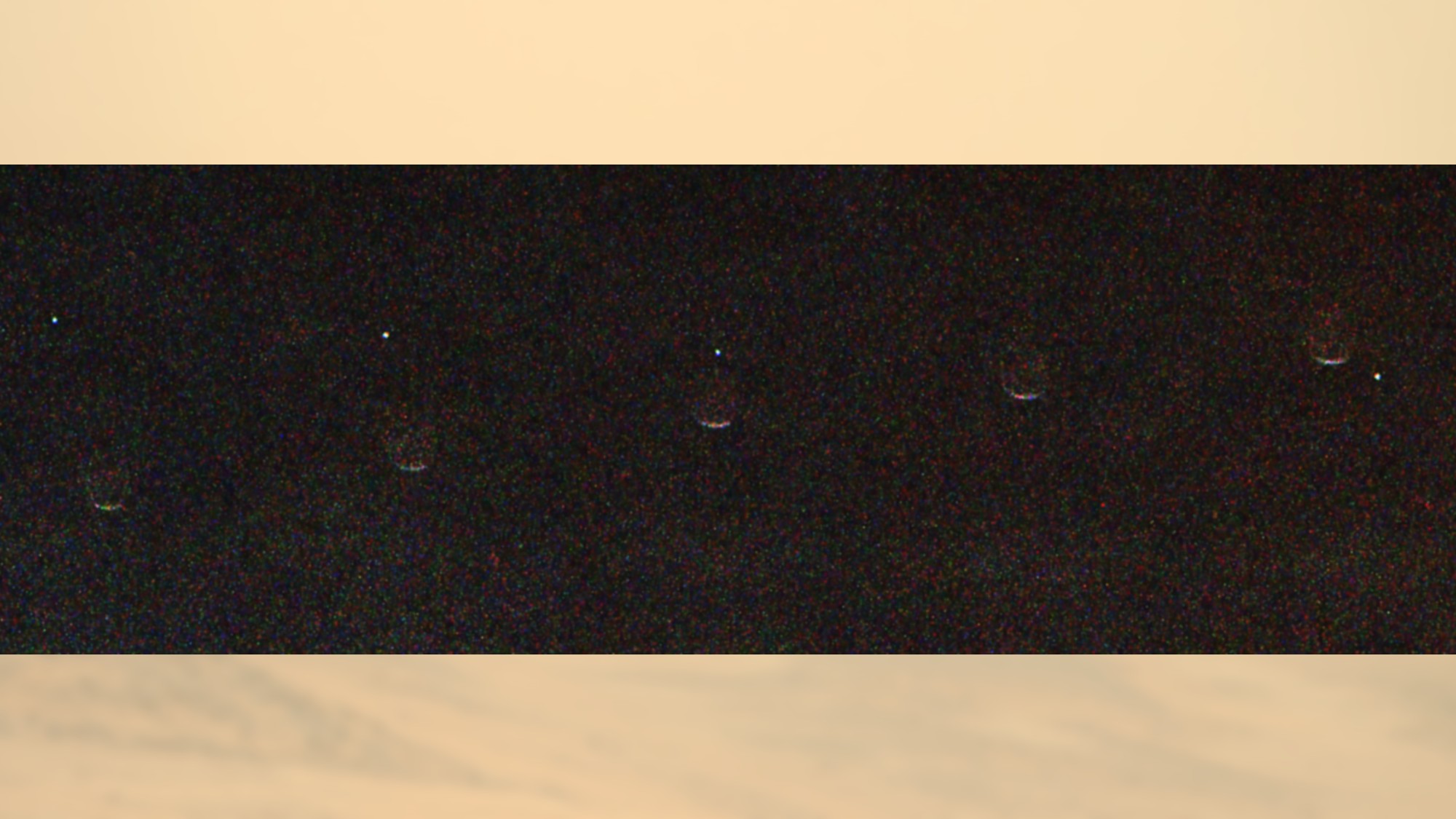
A composite image captured by NASA's Perseverance rover on July 2, 2026 showing Earth (the bright dot) passing behind Mars' moon Phobos in the Red Planet sky. (Image credit: NASA/JPL-Caltech/ASU/MSSS/SSI)
NASA's Perseverance rover witnessed a rare event recently, when Earth briefly disappeared behind Mars' moon Phobos in the Red Planet sky.
What is it?
These new composite images were released by NASA's Jet Propulsion Laboratory (JPL) and taken on July 2, 2026, the 1,907th Martian day of Perseverance's mission. They consist of nine different images taken by the rover's Mastcam-Z instrument as it pointed up into the hazy Martian sky, watching our planet, seen here as a pale dot, cross behind the Mars moon Phobos.
This type of event is known as an occultation, from the Latin word occultare, meaning "to hide." On Earth, the most common type of occultation occurs when our moon passes in front of background stars or when planets pass behind the moon.
Mars has two moons, Phobos and Deimos. Phobos is the larger and innermost moon. Both are lumpy and irregularly shaped, and astronomers aren't sure whether they came from the asteroid belt or were formed from an ancient impact near or on the Red Planet.
A composite of nine different images captured by NASA's Perseverance rover on July 2, 2026 showing Earth (the bright dot) passing behind Mars' moon Phobos in the Martian sky. (Image credit: NASA/JPL-Caltech/ASU/MSSS/SSI)
Why is it incredible?
The image took careful preparation and required Perseverance to be in the right place at the right time.
"Phobos crosses the Martian sky three times a day, and Earth is visible for months at a stretch, but catching one directly behind the other takes planning and a little luck," said Mark Lemmon, a Mastcam-Z co-investigator at the Space Science Institute.
The next crew, spacecraft and rocket to fly to the International Space Station are on schedule to meet their mid-September launch date, mission managers and the astronauts told reporters on Monday (Aug. 3).
SpaceX's Crew-13 astronauts — commander Jessica Watkins and pilot Luke Delaney of NASA, mission specialist Josh Kutryk with the Canadian Space Agency and mission specialist Sergey Teteryatnikov of Russia's federal space corporation Roscosmos — will become only the second crew to fly aboard the Dragon spacecraft "Grace" when they lift off no earlier than Sept. 12 from Space Launch Complex-40 at Cape Canaveral Space Force Station in Florida.
They will then dock with the space station the following day to begin a seven-month stay on the orbiting outpost, as part of the Expedition 75/76 crew.
"We expect a very busy mission with lots of station maintenance, both internal and external, with a few EVAs [extravehicular activities, or spacewalks] on the docket," said Watkins, who is the only member of Crew-13 to have flown into space before and will become the first active NASA astronaut to fly on Dragon twice. "[We also expect] visiting vehicle capture and stowage operations, lots of science — very interesting science experiments that will be flying with us as well — and plenty of outreach."
Kutryk will be the fourth Canadian to serve on an ISS crew and the second from his country to fly this year, after Jeremy Hansen launched around the moon on the Artemis II crew in April.
"Personally, myself, I grew up on a cattle farm in Canada. It's a long way from being here with this mission in front of us, but the one thing that has resonated at every twist and turn in that journey has been the complexity of these missions and the enormity of the teams that go into pulling missions like this off," said Kutryk. "So, we need to say thank you to everyone."
Cybertrucks, spacesuits and mudflats
"Every time we do a human spaceflight mission, it gives us an opportunity to strengthen our understanding of low Earth orbit. It gives us an opportunity to broaden our international relationships and an opportunity to showcase to the world what we can do in low Earth orbit for human spaceflight," said Joel Montalbano, NASA's deputy associate administrator for human spaceflight.
Crew-13 mission managers take part in a pre-flight press conference on Monday, Aug. 3, 2026 at NASA's Johnson Space Center in Houston. From left to right: Joel Montalbano, deputy associate administrator, Human Spaceflight Mission Directorate, NASA Headquarters; Dana Weigel, manager, Low Earth Orbit Program, NASA Johnson; Richard Jones, deputy director, NASA's Commercial Crew Program; Mathieu Caron, director, Astronauts, Life Sciences, and Space Medicine, CSA; and Julianna Scheiman, director, NASA Science and Dragon Programs, SpaceX. (Image credit: NASA)
During the mission, Watkins, Delaney, Kutryk and Teteryatnikov will take part in research to combat heart disease and Parkinson's disease by studying human stem cell-derived tissues. They will also explore crop production that's important for longer-duration spaceflight missions, and help improve scientists' understanding of blood flow abnormalities that are seen on long missions. The crew will also test new diagnostic medical equipment for keeping an eye on their overall health.
First, though, they must get to space.
"Final integration of the Dragon is complete. The capsule was stacked on the trunk just last week and mission preparations are proceeding well for a mid-September launch," said Dana Weigel, NASA's manager for its low Earth orbit program. "Falcon 9 booster maintenance will kick off this month. That same booster was flown on Crew-12. We are not tracking any major issues for this mission campaign."
This Friday (Aug. 7), the crew will don their SpaceX suits — the first "Rev. 3" models with improved donning and doffing capabilities, as well as adjustments to account for spinal growth on orbit — and get their first chance to board "Grace," their ride into orbit and back. This "test drive" will help them gain some muscle memory — some familiarity within the the vehicle mission — and provide them a very big psychological boost, managers said.
"Grace" will also sport new metal "mud flaps" for its Draco abort thrusters, replacing earlier carbon fiber models. In addition, should the crew encounter an emergency before launch, they will be evacuated from the launch pad area for the first time by Tesla Cybertrucks operated by SpaceX, reducing conflicts when SpaceX and NASA want to launch crewed flights at the near or same time.
"There was a lot of certification that had to go into making sure those Cybertrucks would start up with a gloved hand. There were a lot of tests in terms of making sure you could egress the vehicle with a bulky suit on," Richard Jones, deputy program manager of NASA's commercial crew program, said in a response to a question from collectSPACE and Space.com. "All of those things were proven to be already intact, and they're going to configure those Cybertrucks to be ready."
Departures and arrivals
The four members of Crew-13 will be sharing their time on the space station with outgoing and incoming Russian Soyuz crews, who will launch and land with members of Delaney's astronaut candidate class, "The Flies," selected in 2021.
"It's really exciting to see the class fly," said Delaney. "We're going to be meeting Anil [Menon] up there. He's part of our class. Deniz [Burnham] will come up right behind to replace him. Working closely with both of those two throughout astronaut training, it's really just satisfying."
"I'm slightly hoping we get delayed a little bit, so we have some overlaps, so that way we can have three Flies back to back, he said.
The central golden dragon on NASA’s SpaceX Crew-13 patch harkens back to Apollo 13, embodying resilience and gazing upward to the dawn of a new era of discovery. (Image credit: NASA)
For Kutryk, some timing just cannot be controlled.
"It's about midway through — pretty much perfect timing. That's sarcasm," said Kutryk, referring to the upcoming birth of his third child, who is expected to come into the world while he is on the space station.
"It's been done a couple times before," he said, referring to NASA astronaut Mike Fincke and Randy Bresnik, who both had children born while on the ISS. "I think that my family is ready. I have a wonderful, huge support network, from my wife outwards, around us, and we're looking forward to that challenge and to the uniqueness of this experience."
App Store regulatory changes are beginning to affect Apple Services growth as developers gain more ways to avoid Apple’s payment system or pay lower commissions in major markets.
Apple finance chief Kevan Parekh told investors that changes to the App Store business model in some countries had affected its performance during the June quarter. Softer spending on mobile games created additional pressure.
The acknowledgement is significant because regulatory risk has appeared in Apple filings for years without producing a clearly identified effect on Services performance. Apple is now confirming that rule changes have advanced far enough to influence reported results.
The impact does not mean the App Store has stopped growing. Apple described the store as reaching another June-quarter revenue record, while Services expanded by approximately 12% from the previous year.
The emerging issue is the rate of growth. A purchase can still occur inside an iPhone app while generating less revenue for Apple when the customer pays through a developer’s website or uses terms carrying a reduced fee.
App Store Regulatory Changes Affect Several Markets
Apple did not identify one country or policy as solely responsible for the effect.
The company is adapting to a collection of court orders, competition laws and regulatory agreements that differ substantially among the United States, European Union, China, Brazil, Japan, South Korea and other markets.
Some rules concentrate on payment choice. They allow developers to place links or buttons inside apps leading customers to external checkout pages.
Other changes permit alternative app marketplaces or direct distribution outside the App Store. Several regulators are also examining whether Apple can charge developers for transactions completed through another payment provider.
The financial result depends on the model adopted in each country. Apple may receive no commission, a reduced commission or another fee connected with platform technology and distribution.
This creates a more fragmented App Store business. A subscription sold through the same application can produce different revenue for Apple according to the customer’s country, payment route and the developer terms governing that version of the app.
Image Credit: Apple Inc.
The United States Changed External Payment Links
The most direct change in the United States came from the long-running legal dispute between Apple and Epic Games.
A federal court previously ordered Apple to stop preventing developers from directing customers toward outside purchasing options. Apple responded by allowing certain external links while seeking commissions of between 12% and 27% on purchases completed through them.
The company also introduced design restrictions, an approval process and a warning screen displayed when customers left the App Store environment.
In April 2025, the district court found Apple in civil contempt for failing to comply fully with the anti-steering injunction. The ruling prohibited the company from collecting a commission on purchases made through external links and removed several restrictions governing their appearance.
Apple updated its App Review Guidelines in May 2025. Apps distributed through the United States storefront can include buttons, external links and other calls to action leading customers toward another payment method.
The rules no longer require a special external-link entitlement for the U.S. storefront.
That change gives developers a straightforward financial reason to move some transactions to the web. A company can process a payment through another provider instead of giving Apple a percentage of the digital sale.
The customer can return to the iPhone app and use the purchased subscription or content. The app remains distributed through Apple, but the associated transaction no longer produces the same App Store commission.
Enough developers adopting that route can slow Apple Services growth even if total spending on iPhone applications continues increasing.
The European Union Introduced Alternative Distribution
The European Union’s Digital Markets Act requires Apple to permit alternative app marketplaces, outside payment systems and other changes intended to reduce its control over iOS distribution.
Developers can remain under Apple’s conventional App Store terms or adopt business terms designed for the European market.
The alternative structure separates several services that were previously combined inside one commission. Developers can choose different levels of App Store support, use Apple’s payment system, provide another payment option or distribute software through a competing marketplace.
Apple introduced reduced commissions and technology-related fees to preserve compensation for the tools, security systems, distribution infrastructure and platform access it provides.
Those terms have changed several times following regulatory objections. Beginning in 2026, Apple started moving from its earlier Core Technology Fee toward a Core Technology Commission applied to eligible digital transactions under particular conditions.
The structure means outside payments do not always eliminate Apple fees in Europe. They can still reduce the amount Apple collects or shift revenue among different fee categories.
Regulators continue examining whether the terms provide meaningful choice or discourage developers from leaving the standard model.
Apple argues that alternative stores and payment systems create additional privacy, security and fraud risks. The European Commission has focused on whether Apple’s warnings, technical requirements and fees make those options unnecessarily difficult to use.
European developers must calculate more than one commission. They need to consider payment-processing costs, marketplace charges, customer acquisition, reporting obligations and the Apple terms attached to each distribution method.
The result may be lower App Store revenue without an equally large shift toward independent marketplaces. External website payments can change Apple’s economics more quickly because they do not require customers to install another store.
Apple lowered several commission rates in the China mainland storefront beginning March 15, 2026.
Qualifying transactions under the App Store Small Business Program and Mini Apps Partner Program now carry a 12% commission. The same rate applies to eligible auto-renewing subscriptions after the subscriber’s first year.
These transactions previously qualified for a higher 15% rate.
A three-percentage-point reduction may appear small beside demands for completely independent payments. At the scale of China’s app economy, it can remove a meaningful amount of revenue while improving the share retained by developers.
The Mini Apps Partner Program is particularly important in China because large platforms can contain many smaller services inside one host application.
Reducing the commission can encourage those ecosystems to continue using Apple In-App Purchase. It also demonstrates how Apple may respond to pressure by offering more favorable terms before regulators require a more disruptive change.
Lower commissions can support transaction growth over time, but the immediate calculation is straightforward: Apple receives less from each qualifying purchase.
Image Credit: Apple Inc.
Brazil Opens iOS to Outside Stores and Payments
Apple introduced alternative app distribution and payment options in Brazil through an agreement with the country’s competition regulator, CADE.
Beginning with iOS 26.5, developers can distribute apps through alternative marketplaces, operate those marketplaces and process digital payments outside Apple In-App Purchase.
Apps can also present links leading users to an external website where the transaction is completed.
Apple continues applying notarization and other technical requirements to software distributed outside the App Store.
The company maintains that these protections reduce risks but cannot provide the complete safeguards associated with App Review.
Brazil is a major smartphone and digital-services market. Its effect on Apple Services will depend on whether large developers adopt the new options and whether customers are willing to leave the familiar App Store purchasing flow.
An external option existing in software does not guarantee that people will use it. The developer must usually offer a meaningful advantage, such as a lower price, a different subscription package or payment methods better suited to local customers.
Adoption can increase gradually as existing apps release updates. The financial impact may therefore become more visible over several quarters rather than appearing immediately after the regulatory agreement takes effect.
Why Outside Payments Reduce Apple Services Revenue
Apple receives a commission when an eligible digital purchase uses its in-app payment system.
The fee compensates Apple for distribution, payment processing, fraud management, developer tools, customer support and access to the iOS platform, according to the company.
The standard percentage varies. Small developers and long-running subscriptions can qualify for reduced rates, while other eligible digital transactions may carry higher commissions.
When payment moves to a developer’s website, an independent processor handles the financial transaction. The developer pays that provider, manages more of the customer relationship and retains the amount that would otherwise become an App Store fee.
Apple may still provide the operating system, APIs, development tools and App Store distribution without receiving the conventional payment commission.
This separation explains why App Store activity and App Store revenue can move differently. People may download more applications and spend more on digital services while Apple captures a smaller percentage of the commerce.
The same customer could maintain several subscriptions used exclusively on an iPhone without any of their monthly payments passing through Apple.
Apple can collect other revenue from that user through hardware, advertising, iCloud or its own subscriptions. The external transaction nevertheless removes one part of the Services model.
Most App Store Commerce Never Paid Apple a Commission
The size of the App Store economy should not be confused with Apple’s commissionable revenue.
Apple says the global App Store ecosystem facilitated more than $1.4 trillion in developer billings and sales during 2025. More than 90% of that commerce did not produce a commission for the company.
The largest categories involve physical goods and services such as retail purchases, travel, grocery delivery, restaurant orders and transportation.
Apple does not collect a percentage when someone uses an Amazon app to order furniture, books a hotel or pays for a meal delivered through an iPhone.
App Store commissions generally concentrate on digital goods, application features, virtual items and subscriptions sold through Apple In-App Purchase.
Regulatory changes target this smaller but financially important part of the ecosystem.
Digital transactions require no physical inventory or delivery network, allowing payment commissions to carry attractive margins. Losing part of that revenue can therefore affect profitability more than the dollar amount alone suggests.
Apple does not disclose App Store revenue or profit separately. The category remains combined with cloud services, advertising, media subscriptions, AppleCare, payments and other operations inside Services.
Mobile Gaming Weakness Adds Another Pressure
Regulation was not the only factor Apple identified.
Parekh said softer mobile gaming activity also affected the App Store. Games represent an important source of digital transactions because players purchase virtual currency, characters, cosmetic items, subscriptions and access to additional content.
A decline in game spending directly affects the commission Apple receives through In-App Purchase.
Gaming is also one category where developers have pushed aggressively for alternative stores and payments. Epic Games began its legal confrontation with Apple after introducing another payment method inside Fortnite and attempting to bypass App Store commissions.
The simultaneous effects are difficult to separate. A game can generate lower revenue because players are spending less, because payments moved outside Apple’s system or because both changes occurred together.
Apple does not provide enough category detail to calculate the contribution from each factor.
The distinction matters for the outlook. Gaming demand can recover with successful releases and stronger consumer spending. A permanent regulatory change does not reverse when one popular game reaches the top of the charts.
Image Credit: Apple Inc.
Developers Gain Revenue but Assume More Work
Outside payments can improve the amount a developer retains from each purchase.
A company moving from a conventional App Store commission to a lower-cost web payment processor may use the difference to reduce prices, fund development or improve profitability.
The developer also assumes responsibilities previously handled through Apple.
Independent billing requires payment processing, tax management, fraud protection, refunds, account recovery and customer support. Subscription status must synchronize correctly between the website and the iPhone app.
Customers changing devices or reinstalling an app expect their purchases to remain available. The developer needs its own account system capable of verifying ownership without relying entirely on Apple’s purchase history.
Small developers may decide that Apple In-App Purchase remains worth its fee because it removes operational complexity and gives customers a familiar checkout experience.
Large subscription businesses have stronger incentives to build their own systems. They already maintain accounts and payments across websites, televisions, Android devices and other platforms.
The regulatory effect will therefore vary by developer size and business model. One company may remove Apple billing completely, while another continues using it because external infrastructure would cost more than the commission saved.
Customers May Receive Lower Prices
External payments create the possibility of lower subscription prices because developers no longer need to incorporate the complete App Store fee into the amount charged.
Some services already cost more when purchased through an iPhone app than through their websites. The higher price allows the developer to preserve similar revenue after Apple receives its share.
A visible external link makes comparing those prices easier. Customers can leave the app, complete the transaction on the web and return with an active account.
Savings are not guaranteed. A developer can retain the entire difference rather than passing it to subscribers.
Independent billing can also make subscription management less consistent.
Purchases completed through Apple appear in one location:
Settings > Apple Account > Subscriptions
A subscription purchased directly must be canceled through the developer’s website or account system. Customers using many external services may need to remember several billing portals and renewal policies.
Refunds and purchase disputes also move away from Apple. The developer or its payment processor becomes responsible for resolving the transaction.
Choice can reduce prices while increasing complexity. The practical outcome depends on whether developers make external checkout clearly cheaper and easy to manage.
Apple Is Expanding Other App Store Tools
Apple is responding to the changing environment by adding business models and marketing systems that can keep developers using its commerce platform.
Monthly subscriptions with a 12-month commitment allow participating apps to offer lower recurring payments while securing a complete year of revenue.
The Advanced Commerce API supports more complex content catalogs, optional add-ons and subscription structures that were previously difficult to manage through standard In-App Purchase products.
Apple has also expanded tools for custom product pages, promotional offers, application analytics and international distribution.
These additions increase the value attached to App Store billing. A developer may tolerate a commission when Apple provides conversion tools, subscription management and access to promotional placement that would be expensive to reproduce independently.
The company can also adjust rates for particular categories. The Small Business Program, Mini Apps Partner Program and reduced commission for longer-running subscriptions already demonstrate differentiated pricing.
A more competitive payment market may push Apple toward additional service tiers rather than one universal commission.
The UK Could Create the Next Material Change
The United Kingdom’s Competition and Markets Authority is consulting on rules that would allow developers to direct customers outside Apple and Google’s payment systems.
The regulator expects any fee charged for steering to be fair, reasonable and lower than current app-store commissions. It wants the resulting savings passed to customers or reinvested in developer businesses.
The UK proposal is not yet a final requirement. Its eventual structure could determine whether developers receive the broad freedom available in the United States or a fee-based model closer to some European arrangements.
Regulators are also considering app-review fairness, interoperability and access to mobile-platform capabilities.
The outcome will matter beyond British customers. Each major jurisdiction creates another model that regulators elsewhere can examine when designing their own rules.
Apple must decide whether to continue maintaining different commercial systems by country or move toward broader global terms that reduce operational complexity.
Developers face the same choice. Supporting a separate payment route, marketplace package and reporting process for every region can become expensive enough to cancel some of the benefits regulation intended to create.
The next evidence will come from behavior rather than another policy announcement: how many major apps add external payment links, whether they offer lower prices and how quickly customers move away from Apple’s checkout.
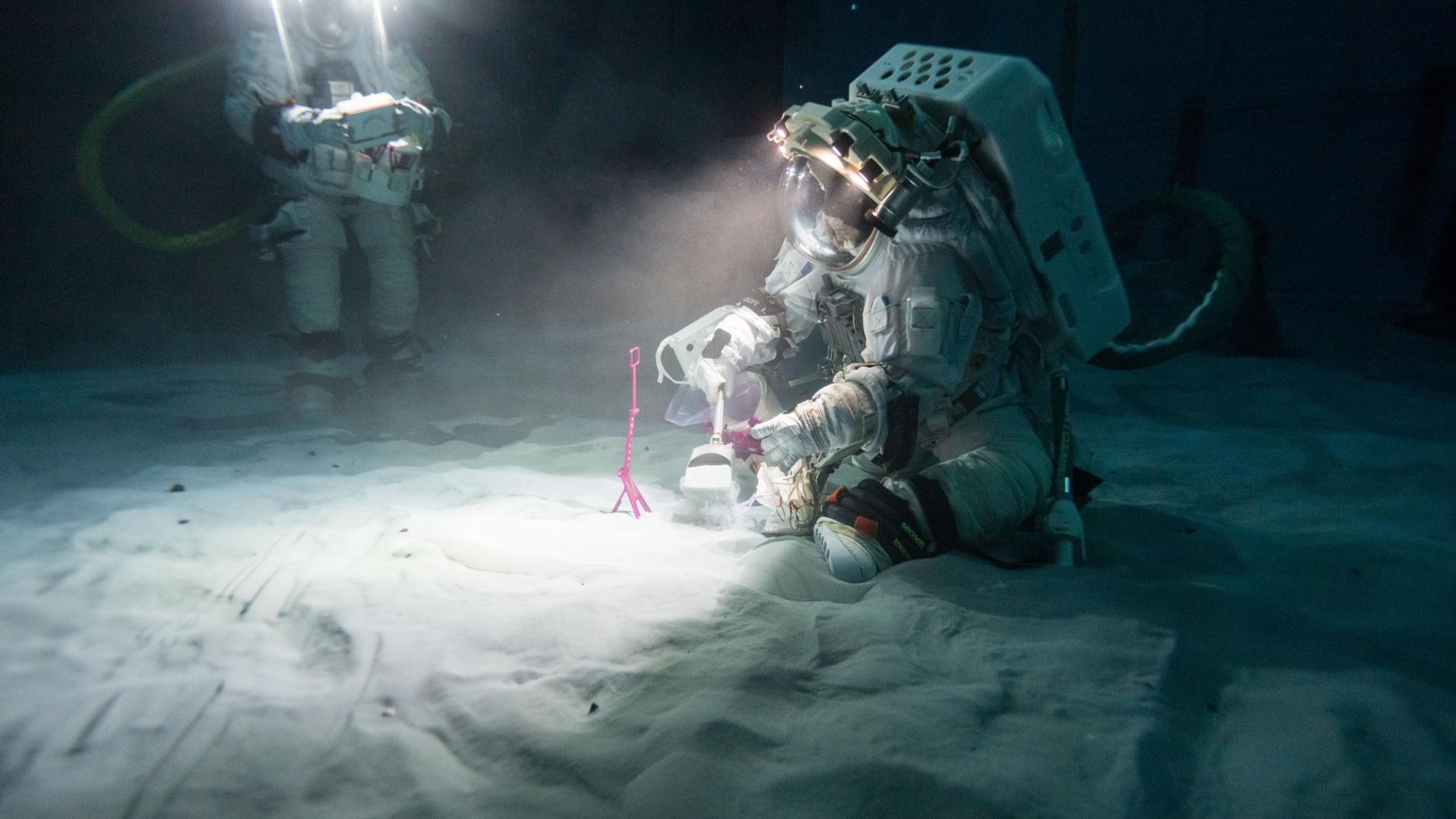
Exploration geologists and Artemis science officers Trevor Graff, left, and Angela Garcia carry out a lunar training development run at NASA's Neutral Buoyancy Laboratory (NBL) in Houston. (Image credit: NASA)
Sometimes to go to the moon, you first have to go underwater.
NASA is currently developing the training program for NASA's Artemis astronauts, some of whom could set foot on the moon during the agency's planned Artemis IV mission. As part of that development, two agency scientists recently donned Artemis moonsuits and took to NASA's underwater training facility.
What is it?
These photos show two NASA exploration geologists and Artemis science officers practicing using the same types of geology tools that astronauts might use when they explore the moon.
The scientists also "deployed a mock lunar payload under low-angle lighting conditions," according to a NASA statement accompanying the photo. NASA is currently aiming to place astronauts at the lunar south pole, where many areas remain in permanent shadow. As such, future lunar explorers may have to operate in near-total darkness and learn how to carry out their missions with very little light.
Exploration geologists and Artemis science officers Trevor Graff, left, and Angela Garcia carry out a lunar training development run at NASA's Neutral Buoyancy Laboratory (NBL) in Houston. (Image credit: NASA)
Why is it incredible?
The fact that NASA is preparing to send humans back to the moon is incredible in itself. Humanity hasn't set foot on our natural satellite since 1972. While NASA still has many technical hurdles to cross when it comes to developing and selecting a moon lander, the agency is pushing ahead with developing the training it will use to prepare its astronauts to explore the lunar surface.
For this particular part of Artemis training development, NASA placed two scientists in its Neutral Buoyancy Laboratory (NBL), a 40-foot-deep (12-meter) pool at NASA's Johnson Space Center in Houston. The particular test in these photos was "the first time that two geologists were suited up simultaneously for lunar geology training in the NBL," according to NASA's statement.
For these tests, a portion of the underwater laboratory was outfitted with soil and rocks that simulate the surface of the moon. The buoyancy of the pool can be manipulated in order to simulate different levels of gravity, helping astronauts train for spacewalks or for exploring other worlds like the moon.
In the latest example, the Energy Department will convert a shuttered Cold War-era uranium enrichment facility into a data center campus and gas plants.
President Trump and Energy Secretary Chris Wright during a White House event last week in which 200 companies vowed to prevent A.I. data centers from driving up power costs.
In the latest example, the Energy Department will convert a shuttered Cold War-era uranium enrichment facility into a data center campus and gas plants.
Queensland and the Northern Territory have rejected the federal government’s plans to mandate that AI datacentres use renewable power, rubbishing Anthony Albanese’s proposals to regulate the booming technology as “underdeveloped ideas that hand increased power to Canberra”.
The latest federal-state stoush on energy comes as S&P Global, the economic rating agency, warns that power use from datacentres could rise five-fold by 2035 to 10% of Australia’s total consumption, and that a mismatch between delivery timelines for datacentres and renewable projects could lead to energy bills skyrocketing.
At Branxton community hall in the New South Wales Hunter Valley last week, local resident Janet Murray was given five minutes to speak about plans for the state’s biggest coalmine extension.
Before her were dozens of people, also there to share their views about whether the 19-year extension proposed by Hunter Valley Operations (HVO) should be allowed to proceed.
A collaboration of researchers in North America has reported their findings from the first diagnostic X-ray imaging performed in space. X-ray images recorded during an orbital spaceflight exhibited similar overall quality to those taken preflight on Earth, demonstrating the feasibility of adding radiography as a diagnostic tool for crew health.
With humans venturing further into space and spending more time in this harsh environment, the risk of adverse medical events increases. Accurate and timely diagnosis and treatment is a must-have. Currently, the only reliable medical imaging modality available to astronauts in spaceflight is ultrasonography – which is operator dependent, requires substantial training and relies on limited acoustic windows.
X-ray imaging, on the other hand, benefits from low operator dependence, rapid acquisition and typically higher spatial resolution than ultrasound. Digital radiography could also offer superior diagnostic capabilities for many medical conditions of concern during spaceflight, including dental disease, musculoskeletal trauma, inhalational injury, collapsed lung and arthritis.
Traditional X-ray scanning systems are bulky, produce a lot of radiation and are sensitive to motion – making them less than ideal for sending into space. But a new generation of portable X-ray scanners shows potential to survive the spaceflight and be operated by crew members with minimal training.
“It’s been a dream for aerospace medicine to have more than one imaging modality for diagnosing illnesses and injuries in space,” says lead researcher Sheyna Gifford, an assistant professor of aerospace medicine at the Mayo Clinic in Rochester, MN, in a press statement.
Scanning in space
In a study led by co-author David Lerner, the researchers first demonstrated the feasibility of X-ray imaging in simulated microgravity in 2022. During a parabolic flight, they used a commercial off-the-shelf digital radiography system to successfully capture radiographs of a human subject and a phantom during lunar gravity (1/6g), Martian gravity (1/3g) and microgravity.
In this latest project, reported in in Radiology, Gifford and her team investigated the performance of a similar portable digital radiography system aboard the Dragon spacecraft, during the Fram2 spaceflight mission, a 3.5-day polar orbital flight launched on 31 March 2025 on a SpaceX Falcon 9 rocket. The imaging system comprised a commercial off-the-shelf, FDA-cleared, portable, digital X-ray generator (Impact Wireless; MinXray) along with an FDA-cleared flat-panel detector.
Chest radiographs Representative X-ray images acquired preflight by a crewmember (A), in-flight on day 3 after launch by a crewmember (B, C) and postflight by a non-crew operator using the same imaging protocol (D). (Courtesy: RSNA)
Prior to the mission, three crew members received 4 hr of training on the portable X-ray system and acquired preflight X-ray images of the hand, forearm, abdomen, pelvis, chest and a quality control phantom. They then recorded the same anatomic and phantom images whilst in space, and also imaged a smartwatch to investigate the potential for non-destructive testing.
During anatomic imaging, the devices were handheld by the crew members, while the phantom and smartwatch were secured to the detector for imaging. The crew reported that they found it easy to use the X-ray system and follow the imaging protocols.
Back on Earth
To assess the quality of the seven X-ray images acquired by the crew, three independent radiologists evaluated and compared the preflight and in-flight anatomic radiographs, finding no differences in overall image quality, contrast resolution or spatial resolution. For central-body radiographs (chest, abdomen and pelvis), image positioning was worse in-flight than preflight. Despite this, all X-rays achieved good or near-excellent diagnostic quality (rated on a 5-point Likert scale).
Phantom radiographs recorded in space exhibited good spatial and contrast resolution, imaging low-contrast targets down to the smallest 2-mm target and easily visualizing high-contrast meshes ranging from 20 to 60 lines per inch, with 80 lines per inch remaining visible. The smartwatch radiograph clearly showed the watch’s internal components at the submillimetre scale.
The research team found that the X-ray generator had sustained minor re-entry damage, but its internal components and X-ray output were not affected. Similarly, the detector passed visual inspection and quality control tests. The researchers also recorded a set of postflight X-rays (on non-crewmembers) following the same in-flight protocols. These showed no qualitative differences from the preflight or in-flight radiographs.
“By acquiring the first human and equipment X-rays in space, our study demonstrates the feasibility of in-orbit radiography and expanded diagnostic capabilities for crew health and hardware evaluation,” says Gifford. “Acquiring diagnostically useful X-rays in space is something that anyone can do. Three very talented nonmedical people with four hours of training in one of the harshest environments did it right and did it well.”
Gifford points out that a spaceflight-ready radiography system could also prove indispensable for mission-critical non-medical tasks. “For sustained human presence in space, X-rays are critical not just for crew members but also for other mission components like electronics and spacesuits. The only way to look inside these objects without taking them apart is to X-ray them,” she explains.
A compact optical technology that has already proved its worth in Earth-bound applications could be on its way to space after researchers at the University of California San Diego, US showed that it can map the Sun’s magnetic field just as well as traditional instruments. By making polarization gratings from specially engineered metasurfaces rather than a complex assembly of optics, the researchers say that future solar-observing missions could benefit from reduced complexity and cost as well as size.
“Our work makes use of recent advancements in nanoscale optical technologies to help improve the hardware for making astronomical observations of the Sun,” says study leader Noah Rubin of UC San Diego’s Jacobs School of Engineering. “We believe this is one of the first times that metasurface optics – which have been a subject of intense interest in both academic research and industry for about a decade – have been used to improve scientific instrumentation of any kind outside of a lab/academic proof-of-concept.”
Polarized light and solar magnetic fields
Although light emitted by the Sun is generally unpolarized – that is, the light waves do not vibrate along a particular axis – strong magnetic fields that develop near sunspots can polarize this light via the quantum mechanical Zeeman effect. These magnetic fields are closely associated with space weather events such as solar storms that can damage electronic infrastructure both on Earth and in orbit. Studying the Sun’s magnetic activity by monitoring areas of polarized light is thus an important step towards detecting or predicting such storms in time to take protective action.
Usually, measuring the polarization state of light means analysing different polarization directions using a device such as a waveplate that mechanically rotates between exposures. Rubin compares this process to taking several photographs through polarized sunglasses held at different angles, then combining them to obtain a fuller picture of what’s going on.
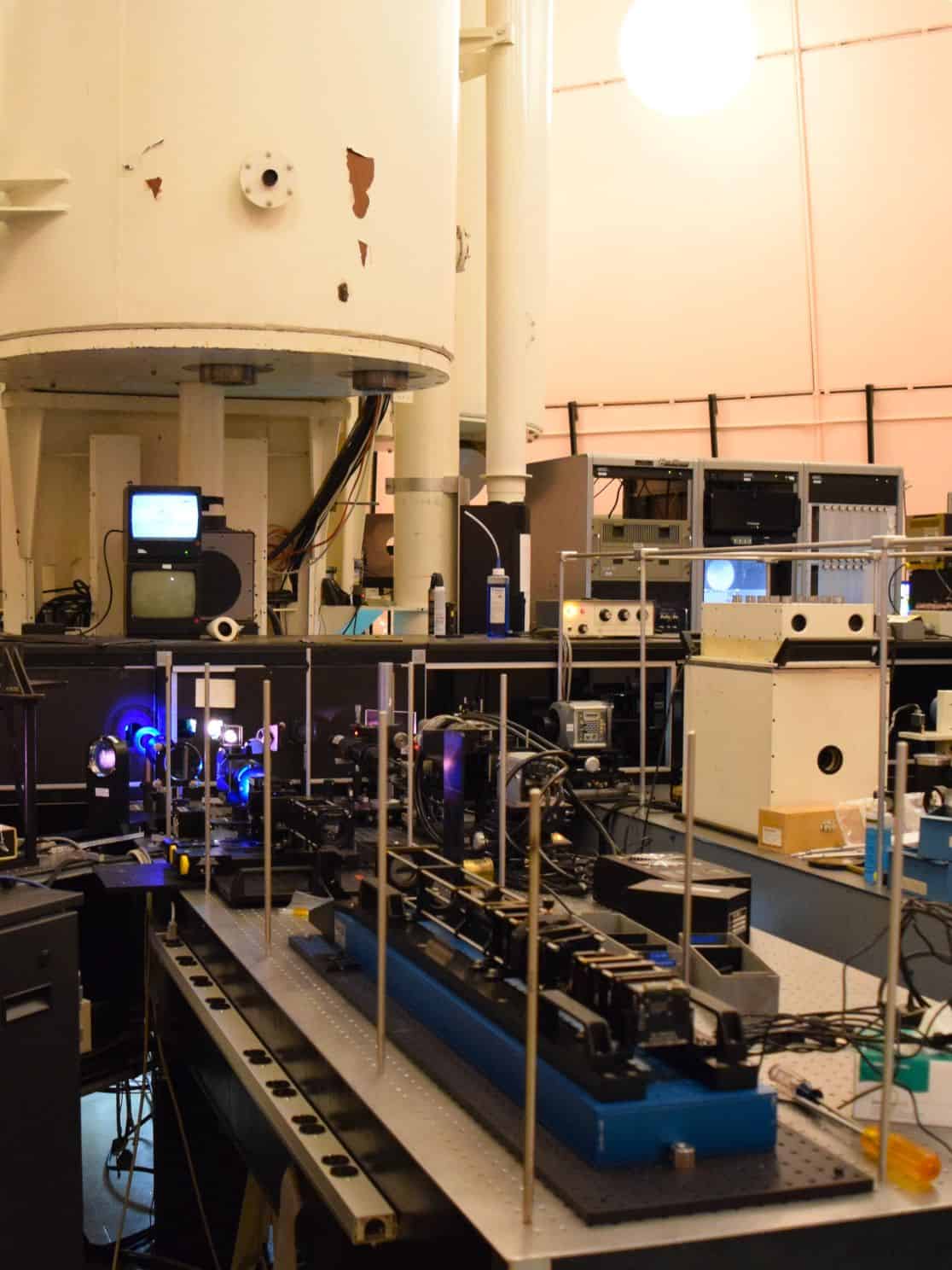
Test rig: Sunlight from the top of the Dunn Solar Telescope’s 136-foot-tall tower travels 228 feet underground and is reflected back up to this room at ground level, where it passes through an optical system (blue lights, background) before reaching the team’s custom-built telescope (foreground). (Courtesy: Noah Rubin)
While this technique works, and instruments that use it have already been sent into space, the image analysis process is very time-consuming. It also requires an external power source, and the need to mechanically rotate the waveplate introduces extra complexity and cost, says Rubin.
“In space-based applications, a satellite itself can be moving while this component reorients, causing a highly undesirable blurring effect,” he explains. “As a result, designers of these systems often invest considerable resources into mechanical remediation and engineering to correct the motion of the telescope on the satellite, and this frequently ends up being substantially more expensive than the telescope optics themselves.”
A metasurface solution
In the new study, which is detailed in Science Advances, Rubin and colleagues solved this problem by creating a polarization-sensitive metasurface that splits light into its different polarization components. A camera-like system containing this metasurface polarization grating can then form multiple images of a scene in parallel. Rubin explains that each image in this scene is analysed with respect to a different polarization state, meaning that the system can measure the polarization of light simultaneously and passively in a single camera frame.
Working with industrial partners at BAE Systems Space & Mission Systems in Colorado, US (formerly known as Ball Aerospace, which Rubin describes as “well-known for its involvement in the development of the James Webb Space Telescope, Hubble and countless other NASA missions”), the team designed a specialized telescope built around such a metasurface polarization grating. They also deployed their instrument on the Dunn Solar Telescope in New Mexico, US, and showed that they could quantitatively map the magnetic fields in sunspots by capturing simultaneous polarization images of these spots.
The researchers report that their results were comparable to those obtained by the state-of-the-art NASA Solar Dynamics Observatory mission in-orbit, highlighting what Rubin calls “the significant advantages that these metasurface components can offer when designed in conjunction with more traditional optical systems”. The UC San Diego team is now exploring ways of integrating its technology into future NASA solar-observing space missions.
A galaxy that formed around a billion years after the Big Bang is in its death throes thanks to a powerful galactic wind that is blasting its gas into space, say astronomers at Australia’s Swinburne University of Technology. The discovery, which is based on data from the James Webb Space Telescope (JWST) and the Atacama Large Millimeter/submillimeter Array (ALMA) in Chile, could help explain why some of the universe’s earliest massive galaxies ceased to form new stars.
One of the JWST’s most surprising discoveries is that when the universe was between one and two billion years old, it already contained large numbers of massive galaxies. Astronomers think these galaxies may have acquired most of their mass in intense bursts of star formation. But at some point, that process stopped: in technical terms, the galaxies became quiescent.
“These galaxies seemed to have formed all their stars very quickly and then they suddenly died, all within the first two billion years of the universe being formed,” says Rebecca Davies, who led the new research.
The CRISTAL-02 galaxy
One possible explanation for the onset of quiescence is that when galaxies collide with each other, the resulting winds “blow away” the hydrogen fuel required for new stars to form. To investigate this hypothesis, Davies and colleagues focused on a galaxy called CRISTAL-02, which was one of 20 galaxies in the recent ALMA-CRISTAL survey of early star-forming galaxies.
“When we looked at the data, it stood out because it was the only one that showed strong evidence for a galaxy wind,” Davies explains. “We saw this as an excellent opportunity to study how winds impacted the evolution of galaxies in the early universe.”
The light from CRISTAL-02 travelled for approximately 12.7 billion years to reach us, meaning that we see it as it was one billion years after the Big Bang. Because the universe has been expanding since then, the galaxy’s spectra appear highly red-shifted. This meant the Swinburne astronomers needed the JWST’s infrared-sensing capabilities to analyse a spectral feature known as the hydrogen-alpha (Hα) line that is normally red. They also used ALMA to analyse CRISTAL-02’s C II line, which comes from ionized carbon and has a (non-redshifted) wavelength of 158 mm. Both emission lines can yield important information about the properties of early galaxies.
Living fast and dying young
From the ALMA-CRISTAL survey’s measurements of Hα luminosity, astronomers knew that CRISTAL-02 forms stars at a rate of around 260 M☉ per year. This is about three times the average value for “main-sequence” star-forming galaxies at similar mass and redshifts.
The latest observations, however, suggest that it won’t maintain this pace for long. Davies and colleagues identified a huge plume of C II emissions that extends as far as 7 kiloparsecs (kpc) to the north-east of CRISTAL-02, making it almost as long as the galaxy itself. This is a telltale sign that gas is being driven out of the galaxy. The fact that the gas in this plume is blue-shifted by 100 km s-1 lends further support to this explanation.
If this rapid blowout continues, Davies says that CRISTAL-02 will cease to exist in less than 50 million years. But the team’s findings may have implications beyond the fate of this single galaxy. “Our results could help to explain how some of the earliest massive quiescent galaxies in the universe behave,” she tells Physics World. “When the JWST started observing distant galaxies in 2022, it found far more evolved galaxies in the early universe than models predicted. These galaxies seemed to have formed all their stars very quickly and then suddenly died, all within the first two billion years of the universe. The galaxy we discovered seems to be following this path.”
Learning about the early universe
Davies explains that because the early universe was much more compact than it is now, collisions between galaxies were common. During such collisions, gas funnels towards the galactic centres, triggering strong bursts of star formation but also producing strong winds that eventually drive the gas away. “If many early galaxies collide and experience rapid growth, then it may not be surprising at all that we see so many dead galaxies in the early universe,” she says.
The researchers stress that the present work, which is detailed in the Monthly Notices of the Royal Astronomical Society, is based on a case study of just one galaxy. They now need to observe other early, massive galaxies caught during periods of intense growth to determine whether they, too, experience powerful winds that could rapidly expel their gas and stop them from forming stars.
Black carbon particles released by rocket launches remain in the upper atmosphere for much longer than sooty particles produced by sources on the ground. This finding, which comes from a study led by researchers at University College London (UCL), UK, suggests that the soot created in deploying “megaconstellations” containing hundreds or thousands of satellites could have poorly understood and potentially serious consequences for the Earth’s climate.
“Rocket launches are a unique source of pollution, injecting harmful chemicals directly into the upper layers of the atmosphere and contaminating Earth’s last remaining relatively pristine environment,” says the study’s lead author, UCL atmospheric chemist Connor Barker.
The number of rockets being launched into space has increased dramatically since 2019, and the trend shows few signs of stopping. This year has already seen more launches than the whole of 2020, and space industry experts believe the eventual total could surpass 2025’s figure of 329. The increase has primarily been driven by the Falcon 9 rockets launched by the US firm SpaceX, though China also logged a record 92 launch attempts in 2025.
“An unregulated geoengineering experiment”
In the new work, Barker and colleagues analysed data from rocket launches and satellite re-entries from 2020 to 2022. Their results, which they detail in Earth’s Future, show that the soot particles lingering in the upper atmosphere are 540 times more effective at altering climate than ground-based soot emissions from sources such as cars and power plants.
“Space industry pollution is like an unregulated geoengineering experiment,” says Barker. Soot particles from burning kerosene in rocket fuel absorb sunlight, he explains, which prevents it from reaching the Earth’s surface. The result is a small cooling effect, which might sound like a good thing in the context of rising global temperatures. However, Barker stresses that this cooling is minimal compared to the global warming caused by other human-generated emissions, while the particles themselves could have “many other serious unintended consequences”.
Predictions likely to underestimate future impact
As well as quantifying recent space industry emissions, the researchers make predictions about future ones. According to their calculations, by 2029 the space industry will be releasing about 870 tonnes of soot into the atmosphere each year. By way of comparison, Baker notes that according to the latest UK government figures, the annual emissions of the country’s entire passenger car fleet amounted to just 728 tonnes.
The team based its predictions on projections of data from 2020-2022, which is considered the beginning of the megaconstellation satellite era. Because of this, Barker cautions that they are likely to be underestimates, making the problem even more urgent. “It is critical that we understand the environmental impacts of satellite megaconstellations now while their impact is small, before any unforeseen consequences are difficult to reverse or repair,” he tells Physics World.
While scientists have made great progress in the last few years, Baker says that are still large uncertainties in our emission estimates for the industry and our understanding of how they affect the atmosphere. “We hope that this work spurs further research to measure space industry emissions and highlights the need to regulate the geoengineering impacts of the space industry,” he says.
Team leader Eloise Marais, a professor of atmospheric chemistry and air quality at UCL, echoes this sentiment. “So far, there has been limited effort to effectively regulate this type of pollution,” she says.
The researchers are now working on an emissions tracker to visualize these emissions across the entire space age. “We are also using satellite imagery to remotely detect and quantify rocket launch emissions,” Barker reveals.

 Login